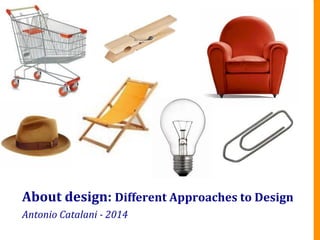
About	
  design:	
  Different	
  Approaches	
  to	
  Design	
  
Antonio	
  Catalani	
  -­‐	
  2014	
  
2
The	
  importance	
  of	
  	
  
design	
  is	
  improving	
  
Copyright Antonio Catalani
SOME CONSIDERATION
•  If you type “design” on Google you can found, it
happened to me, about 5,760,000 results
•  Design is an ambiguous word that needs to be
defined on the basis of the application area:
Industrial design, Fashion design, Graphic design,
Web design,………
•  All items, services or process can be designed,
including furniture, clothing, packaging, user
interface, corporate identities, business processes
•  We can't say that a design product is more beautiful,
more functional, more expensive
3
Copyright Antonio Catalani
DESIGN: AN OPERATIONAL DEFINITION
we can define an object of design the result of a process based on the
following steps:
•  the specification of an object or service
•  manifested by an entity (company, public institution, etc.),
•  intended to accomplish goals, (commercial, sales,
distribution),
•  in a particular environment, (the competitive arena, available
technologies),
•  using primitive components,
•  satisfying a set of requirements, (costs, production
facilities),
•  subject to constraints.
4
Copyright Antonio Catalani
5
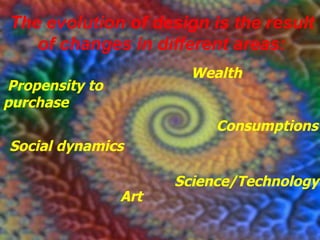
Propensity to
purchase
The evolution of design is the result
of changes in different areas:
Art
Science/Technology
Social dynamics
Wealth
Consumptions
DESIGN: THE CONTRIBUTION
•  Improves things that we use from the functional
and aesthetic point of view
•  Is instrumental in the creation of brand identity
•  Is an essential element in many differentiation
strategies
•  Develop consumption and replacement of the
objects
•  Educates the customers on the aesthetic
•  Supports the social differentiation between
people
6
Copyright Antonio Catalani
THE IMPORTANCE OF
THE PRODUCT DESIGN
The shape of an object influence the purchase:
• facing two objects equivalent in price and function we
buy the more attractive
The product design is relevant in competitive terms
• is noticed by the consumer
• helps in positioning and can reposition competitors
• transfers information to the consumer
• has a relationship with the brand identity
• affects the quality of daily life
• guarantees the durability of the product over time
7
Copyright Antonio Catalani
WHAT CAN DESIGNERS DO FOR YOU?
•  Identity – builds a formal language that can strengthen
or establish the company identity
•  Conceptualization – definition of one or more concepts
for a given product typology
•  Product form – study of a form
•  Re-styling – revamp the appearance of product lines
•  Problem Solving – provide a technical solution to a
well-defined technical problem
Copyright Antonio Catalani
8
BUT YOU CAN’T SAY “BRING ME NEW IDEAS FOR A NEW
KITCHEN…”
What do you really want?
• a project for new ways to cook
• a solution to furnish the kitchen space
according to the new size of houses
• a new technology to build a kitchen
• a new model that completes the range
• a new aesthetic project
• ….Copyright Antonio Catalani
9
COMMON PITFALLS IN MANAGING THE
DESIGN PROCESS
•  Generate photocopy ideas
•  Projects without a strategy
•  Involve designers late in new product
development
•  Allowing sales and production managers
excessive influence
•  Letting traditional market research dictate
design policies
Copyright Antonio Catalani
10
HOW DESIGNERS ARE WORKING?
11
Copyright Antonio Catalani
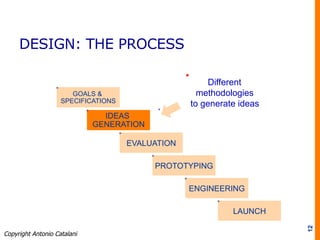
DESIGN: THE PROCESS
12
GOALS &
SPECIFICATIONS
IDEAS
GENERATION
EVALUATION
PROTOTYPING
ENGINEERING
LAUNCH
Different
methodologies
to generate ideas
Copyright Antonio Catalani
13
If you start from the
client needs how can
you be excellent?
If you start from
your skills how can
you find customers?
Copyright Antonio Catalani
DESIGN AS A PROCESS:
THE REASON-CENTRIC PERSPECTIVE
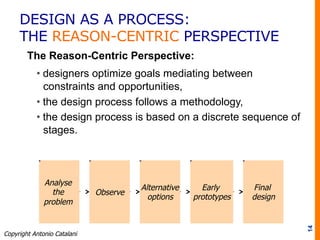
The Reason-Centric Perspective:
• designers optimize goals mediating between
constraints and opportunities,
• the design process follows a methodology,
• the design process is based on a discrete sequence of
stages.
14
Analyse
the
problem
Observe
Early
prototypes
Alternative
options
Final
design
Copyright Antonio Catalani
The approach
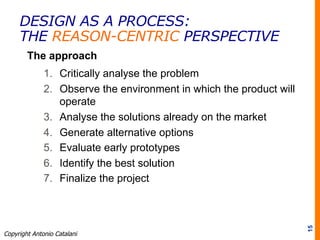
1.  Critically analyse the problem
2.  Observe the environment in which the product will
operate
3.  Analyse the solutions already on the market
4.  Generate alternative options
5.  Evaluate early prototypes
6.  Identify the best solution
7.  Finalize the project
15
Copyright Antonio Catalani
DESIGN AS A PROCESS:
THE REASON-CENTRIC PERSPECTIVE
THE TAKEAWAYS
•  Design requires a method
•  Designers (Design Consultancies) are
mediators between environment
(behaviours and choices) and company
•  Design has an alphabet-based on
technologies, materials and shapes
•  Evaluation on the basis of prototypes
Copyright Antonio Catalani
16
DESIGN AS A PROCESS:
THE ACTION-CENTRIC PERSPECTIVE
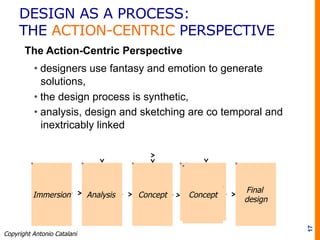
The Action-Centric Perspective
• designers use fantasy and emotion to generate
solutions,
• the design process is synthetic,
• analysis, design and sketching are co temporal and
inextricably linked
17
Iteraction
drawingImmersion Analysis ConceptConceptConcept
Final
design
Copyright Antonio Catalani
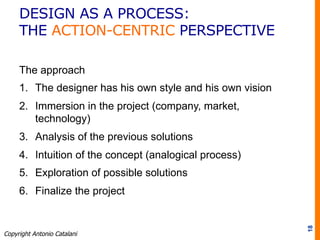
The approach
1.  The designer has his own style and his own vision
2.  Immersion in the project (company, market,
technology)
3.  Analysis of the previous solutions
4.  Intuition of the concept (analogical process)
5.  Exploration of possible solutions
6.  Finalize the project
18
Copyright Antonio Catalani
DESIGN AS A PROCESS:
THE ACTION-CENTRIC PERSPECTIVE
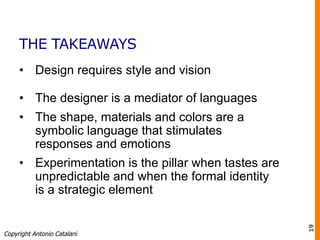
THE TAKEAWAYS
•  Design requires style and vision
•  The designer is a mediator of languages
•  The shape, materials and colors are a
symbolic language that stimulates
responses and emotions
•  Experimentation is the pillar when tastes are
unpredictable and when the formal identity
is a strategic element
Copyright Antonio Catalani
19
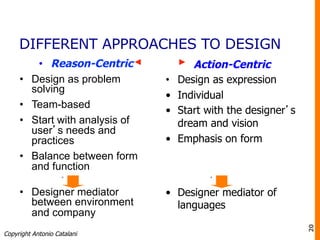
DIFFERENT APPROACHES TO DESIGN
•  Reason-Centric
•  Design as problem
solving
•  Team-based
•  Start with analysis of
user’s needs and
practices
•  Balance between form
and function
•  Designer mediator
between environment
and company
Action-Centric
•  Design as expression
•  Individual
•  Start with the designer’s
dream and vision
•  Emphasis on form
•  Designer mediator of
languages
Copyright Antonio Catalani
20
DESIGN
•  In terms of process is matter of approach
•  In terms of evaluation is matter of perception
•  Always is matter of gradient
Copyright Antonio Catalani
21
ALTERNATIVES ON THE DESIGN
•  art or craft
•  method or intuition
•  achieve the objectives or create an object?
•  utility or significance
•  shape or decoration?
•  poetic or language?
•  design comes the first poetic or technology?
22
PRODUCT IDENTITY BRAND IDENTITY
Copyright Antonio Catalani
DESIGN: NEW CHALLENGES
•  quality or quantity
•  products for a global market or local market
•  attention to the environment and energy
•  ……..
23
Copyright Antonio Catalani
Innovation
vs.
Evolution
24
Copyright Antonio Catalani

About design: Different Approaches to Design

  • 1.
    About  design:  Different  Approaches  to  Design   Antonio  Catalani  -­‐  2014  
  • 2.
    2 The  importance  of     design  is  improving   Copyright Antonio Catalani
  • 3.
    SOME CONSIDERATION •  Ifyou type “design” on Google you can found, it happened to me, about 5,760,000 results •  Design is an ambiguous word that needs to be defined on the basis of the application area: Industrial design, Fashion design, Graphic design, Web design,……… •  All items, services or process can be designed, including furniture, clothing, packaging, user interface, corporate identities, business processes •  We can't say that a design product is more beautiful, more functional, more expensive 3 Copyright Antonio Catalani
  • 4.
    DESIGN: AN OPERATIONALDEFINITION we can define an object of design the result of a process based on the following steps: •  the specification of an object or service •  manifested by an entity (company, public institution, etc.), •  intended to accomplish goals, (commercial, sales, distribution), •  in a particular environment, (the competitive arena, available technologies), •  using primitive components, •  satisfying a set of requirements, (costs, production facilities), •  subject to constraints. 4 Copyright Antonio Catalani
  • 5.
    5 Propensity to purchase The evolutionof design is the result of changes in different areas: Art Science/Technology Social dynamics Wealth Consumptions
  • 6.
    DESIGN: THE CONTRIBUTION • Improves things that we use from the functional and aesthetic point of view •  Is instrumental in the creation of brand identity •  Is an essential element in many differentiation strategies •  Develop consumption and replacement of the objects •  Educates the customers on the aesthetic •  Supports the social differentiation between people 6 Copyright Antonio Catalani
  • 7.
    THE IMPORTANCE OF THEPRODUCT DESIGN The shape of an object influence the purchase: • facing two objects equivalent in price and function we buy the more attractive The product design is relevant in competitive terms • is noticed by the consumer • helps in positioning and can reposition competitors • transfers information to the consumer • has a relationship with the brand identity • affects the quality of daily life • guarantees the durability of the product over time 7 Copyright Antonio Catalani
  • 8.
    WHAT CAN DESIGNERSDO FOR YOU? •  Identity – builds a formal language that can strengthen or establish the company identity •  Conceptualization – definition of one or more concepts for a given product typology •  Product form – study of a form •  Re-styling – revamp the appearance of product lines •  Problem Solving – provide a technical solution to a well-defined technical problem Copyright Antonio Catalani 8
  • 9.
    BUT YOU CAN’TSAY “BRING ME NEW IDEAS FOR A NEW KITCHEN…” What do you really want? • a project for new ways to cook • a solution to furnish the kitchen space according to the new size of houses • a new technology to build a kitchen • a new model that completes the range • a new aesthetic project • ….Copyright Antonio Catalani 9
  • 10.
    COMMON PITFALLS INMANAGING THE DESIGN PROCESS •  Generate photocopy ideas •  Projects without a strategy •  Involve designers late in new product development •  Allowing sales and production managers excessive influence •  Letting traditional market research dictate design policies Copyright Antonio Catalani 10
  • 11.
    HOW DESIGNERS AREWORKING? 11 Copyright Antonio Catalani
  • 12.
    DESIGN: THE PROCESS 12 GOALS& SPECIFICATIONS IDEAS GENERATION EVALUATION PROTOTYPING ENGINEERING LAUNCH Different methodologies to generate ideas Copyright Antonio Catalani
  • 13.
    13 If you startfrom the client needs how can you be excellent? If you start from your skills how can you find customers? Copyright Antonio Catalani
  • 14.
    DESIGN AS APROCESS: THE REASON-CENTRIC PERSPECTIVE The Reason-Centric Perspective: • designers optimize goals mediating between constraints and opportunities, • the design process follows a methodology, • the design process is based on a discrete sequence of stages. 14 Analyse the problem Observe Early prototypes Alternative options Final design Copyright Antonio Catalani
  • 15.
    The approach 1.  Criticallyanalyse the problem 2.  Observe the environment in which the product will operate 3.  Analyse the solutions already on the market 4.  Generate alternative options 5.  Evaluate early prototypes 6.  Identify the best solution 7.  Finalize the project 15 Copyright Antonio Catalani DESIGN AS A PROCESS: THE REASON-CENTRIC PERSPECTIVE
  • 16.
    THE TAKEAWAYS •  Designrequires a method •  Designers (Design Consultancies) are mediators between environment (behaviours and choices) and company •  Design has an alphabet-based on technologies, materials and shapes •  Evaluation on the basis of prototypes Copyright Antonio Catalani 16
  • 17.
    DESIGN AS APROCESS: THE ACTION-CENTRIC PERSPECTIVE The Action-Centric Perspective • designers use fantasy and emotion to generate solutions, • the design process is synthetic, • analysis, design and sketching are co temporal and inextricably linked 17 Iteraction drawingImmersion Analysis ConceptConceptConcept Final design Copyright Antonio Catalani
  • 18.
    The approach 1.  Thedesigner has his own style and his own vision 2.  Immersion in the project (company, market, technology) 3.  Analysis of the previous solutions 4.  Intuition of the concept (analogical process) 5.  Exploration of possible solutions 6.  Finalize the project 18 Copyright Antonio Catalani DESIGN AS A PROCESS: THE ACTION-CENTRIC PERSPECTIVE
  • 19.
    THE TAKEAWAYS •  Designrequires style and vision •  The designer is a mediator of languages •  The shape, materials and colors are a symbolic language that stimulates responses and emotions •  Experimentation is the pillar when tastes are unpredictable and when the formal identity is a strategic element Copyright Antonio Catalani 19
  • 20.
    DIFFERENT APPROACHES TODESIGN •  Reason-Centric •  Design as problem solving •  Team-based •  Start with analysis of user’s needs and practices •  Balance between form and function •  Designer mediator between environment and company Action-Centric •  Design as expression •  Individual •  Start with the designer’s dream and vision •  Emphasis on form •  Designer mediator of languages Copyright Antonio Catalani 20
  • 21.
    DESIGN •  In termsof process is matter of approach •  In terms of evaluation is matter of perception •  Always is matter of gradient Copyright Antonio Catalani 21
  • 22.
    ALTERNATIVES ON THEDESIGN •  art or craft •  method or intuition •  achieve the objectives or create an object? •  utility or significance •  shape or decoration? •  poetic or language? •  design comes the first poetic or technology? 22 PRODUCT IDENTITY BRAND IDENTITY Copyright Antonio Catalani
  • 23.
    DESIGN: NEW CHALLENGES • quality or quantity •  products for a global market or local market •  attention to the environment and energy •  …….. 23 Copyright Antonio Catalani
  • 24.