Industry
New and emerging technologies have changed
places of work to include automation and robotics.
Design teams can now work together remotely, with
increasing productivity and accuracy, saving money
and time.
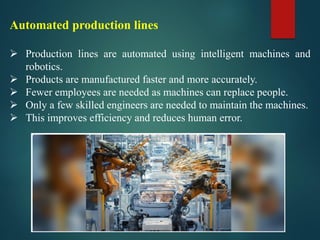
Automated production lines
➢ Production lines are automated using intelligent machines and
robotics.
➢ Products are manufactured faster and more accurately.
➢ Fewer employees are needed as machines can replace people.
➢ Only a few skilled engineers are needed to maintain the machines.
➢ This improves efficiency and reduces human error.
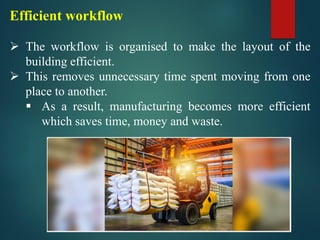
Efficient workflow
➢ The workflow is organised to make the layout of the
building efficient.
➢ This removes unnecessary time spent moving from one
place to another.
▪ As a result, manufacturing becomes more efficient
which saves time, money and waste.
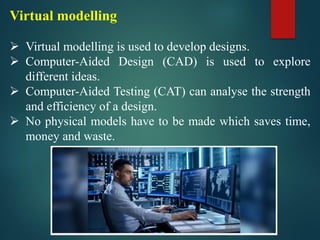
Virtual modelling
➢ Virtual modelling is used to develop designs.
➢ Computer-Aided Design (CAD) is used to explore
different ideas.
➢ Computer-Aided Testing (CAT) can analyse the strength
and efficiency of a design.
➢ No physical models have to be made which saves time,
money and waste.
Virtual workspaces
➢ Virtual workspace enables a design team to collaborate remotely.
➢ The internet and increased speed of data transfer have led to
shared online workspaces.
➢ Designs can be prototyped using Computer-Aided Manufacture
(CAM).
➢ There is no need to rent office space, and travel time and expenses
are reduced.
Enterprise
Enterprise involves converting an innovative idea
into a commercial product. The internet and social
media have allowed many more people to promote
ideas and find ways to finance them.
Crowdfunding
➢ Crowdfunding is typically an online platform where
designers pitch an idea and ask for investment.
➢ Lots of people make small contributions, choosing to
invest in interesting ideas.
➢ Designers can raise large amounts of money to finance
their project.
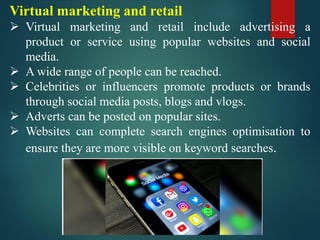
Virtual marketing and retail
➢ Virtual marketing and retail include advertising a
product or service using popular websites and social
media.
➢ A wide range of people can be reached.
➢ Celebrities or influencers promote products or brands
through social media posts, blogs and vlogs.
➢ Adverts can be posted on popular sites.
➢ Websites can complete search engines optimisation to
ensure they are more visible on keyword searches.
Co-operatives
➢ Groups of people with a common interest or goal
form a co-operative.
➢ Members can be part of the workforce and the
customers.
➢ Each member of the group has an equal share and
say in the business.
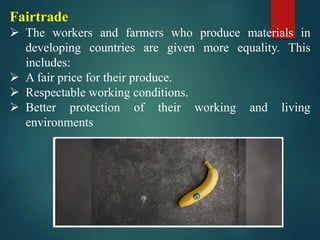
Fairtrade
➢ The workers and farmers who produce materials in
developing countries are given more equality. This
includes:
➢ A fair price for their produce.
➢ Respectable working conditions.
➢ Better protection of their working and living
environments
Sustainability
Sustainable design aims to minimise negative
impacts on the environment
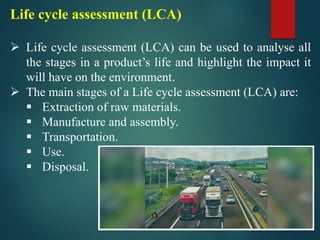
Life cycle assessment (LCA)
➢ Life cycle assessment (LCA) can be used to analyse all
the stages in a product’s life and highlight the impact it
will have on the environment.
➢ The main stages of a Life cycle assessment (LCA) are:
▪ Extraction of raw materials.
▪ Manufacture and assembly.
▪ Transportation.
▪ Use.
▪ Disposal.
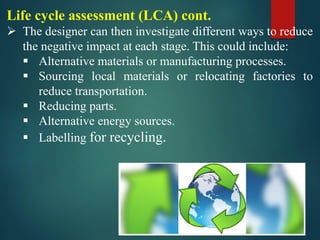
Life cycle assessment (LCA) cont.
➢ The designer can then investigate different ways to reduce
the negative impact at each stage. This could include:
▪ Alternative materials or manufacturing processes.
▪ Sourcing local materials or relocating factories to
reduce transportation.
▪ Reducing parts.
▪ Alternative energy sources.
▪ Labelling for recycling.
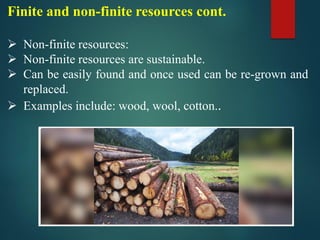
Finite and non-finite resources cont.
➢ Non-finite resources:
➢ Non-finite resources are sustainable.
➢ Can be easily found and once used can be re-grown and
replaced.
➢ Examples include: wood, wool, cotton..
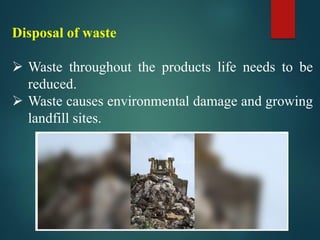
Disposal of waste
➢ Waste throughout the products life needs to be
reduced.
➢ Waste causes environmental damage and growing
landfill sites.
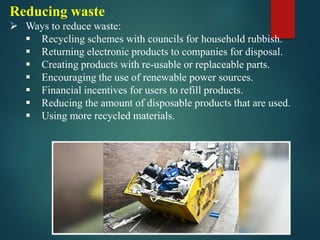
Reducing waste
➢ Ways to reduce waste:
▪ Recycling schemes with councils for household rubbish.
▪ Returning electronic products to companies for disposal.
▪ Creating products with re-usable or replaceable parts.
▪ Encouraging the use of renewable power sources.
▪ Financial incentives for users to refill products.
▪ Reducing the amount of disposable products that are used.
▪ Using more recycled materials.
People
The impact of new and emerging technologies affect
people in different ways:
Technology push
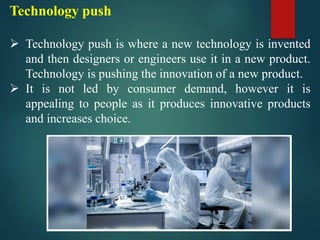
➢ Technology push is where a new technology is invented
and then designers or engineers use it in a new product.
Technology is pushing the innovation of a new product.
➢ It is not led by consumer demand, however it is
appealing to people as it produces innovative products
and increases choice.
Examples of technology push
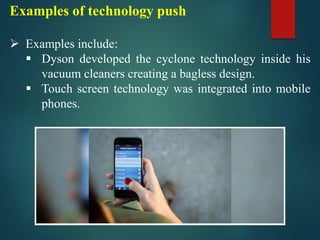
➢ Examples include:
▪ Dyson developed the cyclone technology inside his
vacuum cleaners creating a bagless design.
▪ Touch screen technology was integrated into mobile
phones.
Market pull
➢ Market pull is where consumers have a need or desire
for a new product and it is then developed and produced.
This could be a new product or an upgrade.
➢ This is led by consumer demand and helps to maintain
brand loyalty and create new customers.
Examples of market pull
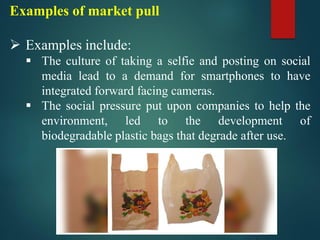
➢ Examples include:
▪ The culture of taking a selfie and posting on social
media lead to a demand for smartphones to have
integrated forward facing cameras.
▪ The social pressure put upon companies to help the
environment, led to the development of
biodegradable plastic bags that degrade after use.
Choice
People now have a lot more choice about the
products they buy.
They can shop all over the world and products are
posted to their door.
The market is competitive so prices are kept low.
Culture
Communities are made up of a wide range of
different people. These people can be influenced by
and have an influence on design.
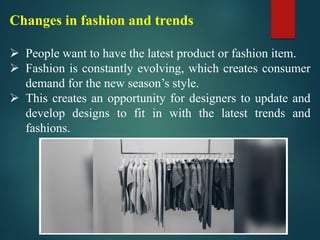
Changes in fashion and trends
➢ People want to have the latest product or fashion item.
➢ Fashion is constantly evolving, which creates consumer
demand for the new season’s style.
➢ This creates an opportunity for designers to update and
develop designs to fit in with the latest trends and
fashions.
Different faiths and beliefs
➢ Communities are made up of people with
different faiths and beliefs.
➢ Designers are responsible for ensuring that their
product doesn’t cause offence.
Example: Gucci
➢ Gucci’s balaclava knit top was withdrawn for
causing offence due to its oversized lips and
black colour, resembling a ‘black face’ which has
negative cultural significance to black
communities.
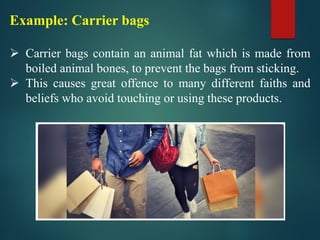
Example: Carrier bags
➢ Carrier bags contain an animal fat which is made from
boiled animal bones, to prevent the bags from sticking.
➢ This causes great offence to many different faiths and
beliefs who avoid touching or using these products.
Society
The design and manufacture of a product should try
not to have a negative impact on others and be as
accessible and inclusive as possible.
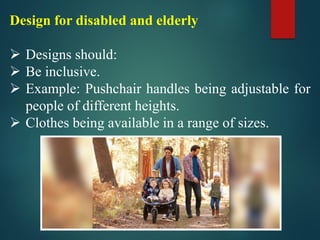
Design for disabled and elderly
➢ Designs should:
➢ Be inclusive.
➢ Example: Pushchair handles being adjustable for
people of different heights.
➢ Clothes being available in a range of sizes.
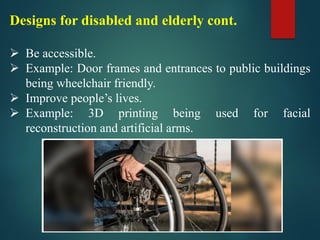
Designs for disabled and elderly cont.
➢ Be accessible.
➢ Example: Door frames and entrances to public buildings
being wheelchair friendly.
➢ Improve people’s lives.
➢ Example: 3D printing being used for facial
reconstruction and artificial arms.
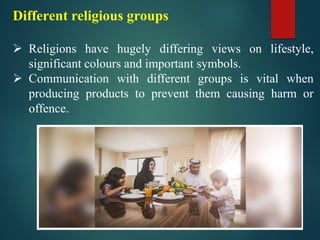
Different religious groups
➢ Religions have hugely differing views on lifestyle,
significant colours and important symbols.
➢ Communication with different groups is vital when
producing products to prevent them causing harm or
offence.
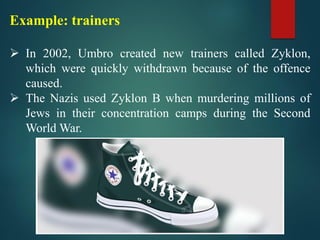
Example: trainers
➢ In 2002, Umbro created new trainers called Zyklon,
which were quickly withdrawn because of the offence
caused.
➢ The Nazis used Zyklon B when murdering millions of
Jews in their concentration camps during the Second
World War.
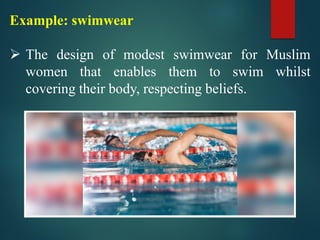
Example: swimwear
➢ The design of modest swimwear for Muslim
women that enables them to swim whilst
covering their body, respecting beliefs.
Environment
New products can have a positive and negative
impact on the environment.
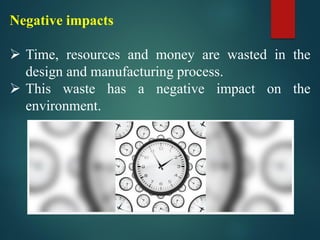
Negative impacts
➢ Time, resources and money are wasted in the
design and manufacturing process.
➢ This waste has a negative impact on the
environment.
Continuous improvement
➢ At every stage of the process people look for
ways to improve and small changes are made.
➢ This process reduces waste and reduces the
negative environmental impact.
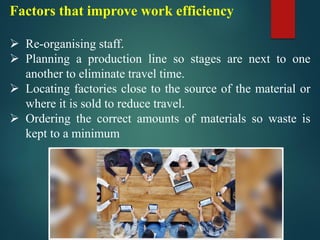
Factors that improve work efficiency
➢ Re-organising staff.
➢ Planning a production line so stages are next to one
another to eliminate travel time.
➢ Locating factories close to the source of the material or
where it is sold to reduce travel.
➢ Ordering the correct amounts of materials so waste is
kept to a minimum
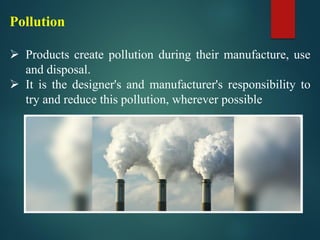
Pollution
➢ Products create pollution during their manufacture, use
and disposal.
➢ It is the designer's and manufacturer's responsibility to
try and reduce this pollution, wherever possible
Production Techniques & Systems
Computer Aided Design (CAD)
➢ Computers are now an integrated part of
production techniques and systems. As
technology and artificial intelligence develop we
will be increasingly reliant on them for all stages
of the design and manufacture process.
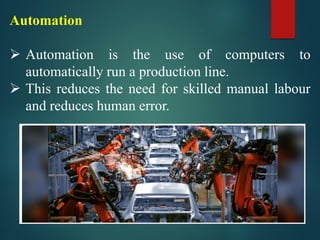
Automation
➢ Automation is the use of computers to
automatically run a production line.
➢ This reduces the need for skilled manual labour
and reduces human error.
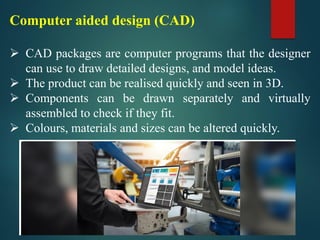
Computer aided design (CAD)
➢ CAD packages are computer programs that the designer
can use to draw detailed designs, and model ideas.
➢ The product can be realised quickly and seen in 3D.
➢ Components can be drawn separately and virtually
assembled to check if they fit.
➢ Colours, materials and sizes can be altered quickly.
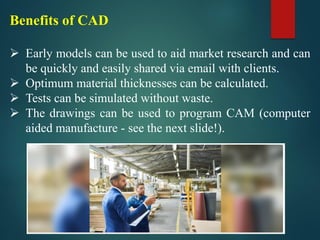
Benefits of CAD
➢ Early models can be used to aid market research and can
be quickly and easily shared via email with clients.
➢ Optimum material thicknesses can be calculated.
➢ Tests can be simulated without waste.
➢ The drawings can be used to program CAM (computer
aided manufacture - see the next slide!).
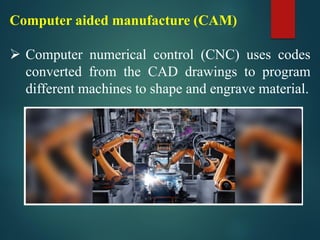
Computer aided manufacture (CAM)
➢ Computer numerical control (CNC) uses codes
converted from the CAD drawings to program
different machines to shape and engrave material.
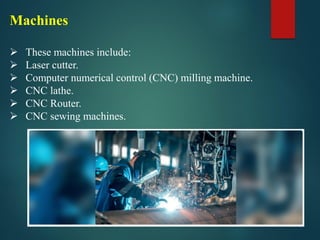
Machines
➢ These machines include:
➢ Laser cutter.
➢ Computer numerical control (CNC) milling machine.
➢ CNC lathe.
➢ CNC Router.
➢ CNC sewing machines.
Manufacturing Systems
➢ Computers are now an integrated part of
production techniques and systems. As
technology and artificial intelligence develops we
will be increasingly reliant on them for all stages
of the design and manufacture process
Flexible manufacturing systems (FMS)
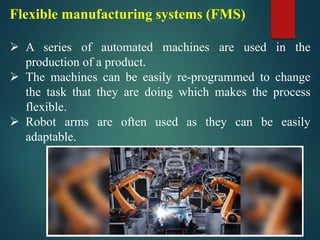
➢ A series of automated machines are used in the
production of a product.
➢ The machines can be easily re-programmed to change
the task that they are doing which makes the process
flexible.
➢ Robot arms are often used as they can be easily
adaptable.
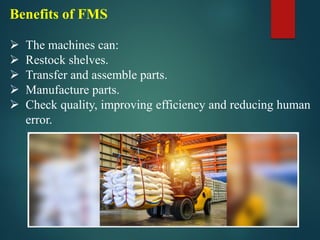
Benefits of FMS
➢ The machines can:
➢ Restock shelves.
➢ Transfer and assemble parts.
➢ Manufacture parts.
➢ Check quality, improving efficiency and reducing human
error.
Just in time (JIT)
➢ Just in time manufacturing systems work by having
close relationships with suppliers.
➢ The parts needed for manufacture arrive just as they are
needed directly from the supplier.
Advantages and disadvantages
➢ Advantages include:
▪ Less storage space needed.
▪ Minimal waste as you only order what you need.
▪ Production runs can change easily to another product.
➢ Disadvantages include:
▪ If there is a problem with the supplier, the process is delayed.
▪ An unexpected demand could lead to delays.
Lean manufacturing
➢ Lean manufacturing looks at the whole manufacturing
process and works to create the best product to meet
consumer demand.
➢ The main aim is to create the most efficient and effective
product while eliminating waste.
Lean manufacturing cont.
➢ It includes:
▪ Efficient working.
▪ Just in time manufacture.
▪ Continuous improvement.
▪ Quality assurance.
▪ Feedback from the consumer.
Evaluation of Emerging Technologies and Design
Decisions
Designers/manufactures are becoming more aware of the
ethical and environmental impact of their design decisions.
Consumers are also taking responsibility for the waste they
create and are demanding more environmentally friendly
products.
Planned obsolescence
➢ Products are manufactured to last a specific length of
time before needing to be replaced.
➢ Consumers will then need/want to buy a new version of
the product.
➢ Sales will be maintained.
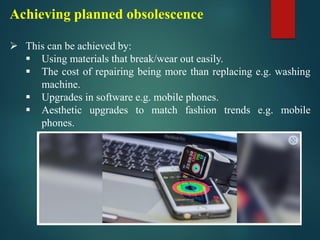
Achieving planned obsolescence
➢ This can be achieved by:
▪ Using materials that break/wear out easily.
▪ The cost of repairing being more than replacing e.g. washing
machine.
▪ Upgrades in software e.g. mobile phones.
▪ Aesthetic upgrades to match fashion trends e.g. mobile
phones.
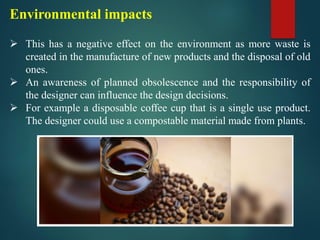
Environmental impacts
➢ This has a negative effect on the environment as more waste is
created in the manufacture of new products and the disposal of old
ones.
➢ An awareness of planned obsolescence and the responsibility of
the designer can influence the design decisions.
➢ For example a disposable coffee cup that is a single use product.
The designer could use a compostable material made from plants.
Design for maintenance
➢ Products are being designed with easily accessible, replaceable
parts.
➢ New software can be uploaded onto existing products to update
them.
➢ Companies usually arrange the replacement of parts to ensure
safety and reliability.
➢ These products are becoming more popular with people who are
increasingly more aware of reducing waste and the shared
responsibility for global warming.
The Environment and Ethics
Designers, manufacturers and consumers are becoming more
aware of the ethical and environmental impact of their
design decisions and purchases.
Consumers
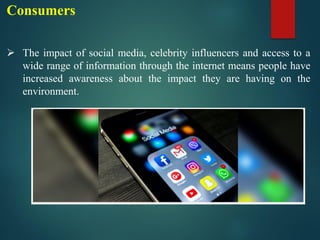
➢ The impact of social media, celebrity influencers and access to a
wide range of information through the internet means people have
increased awareness about the impact they are having on the
environment.
Consumer demand
➢ Consumers are realising their responsibility to help
reduce waste.
➢ This is leading to an increased demand for more
environmentally friendly products.
➢ There is also an increase in demand for “upcycled”
products and second-hand products.
End of life
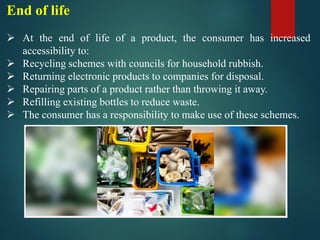
➢ At the end of life of a product, the consumer has increased
accessibility to:
➢ Recycling schemes with councils for household rubbish.
➢ Returning electronic products to companies for disposal.
➢ Repairing parts of a product rather than throwing it away.
➢ Refilling existing bottles to reduce waste.
➢ The consumer has a responsibility to make use of these schemes.
Designers and manufacturers
➢ The responsibility for designers and manufacturers to consider the
environmental impact of their products has become a key part of
the design process.
➢ Life cycle assessment (LCA) can be used to analyse all the stages
in a product’s life and highlight the impact it will have on the
environment.
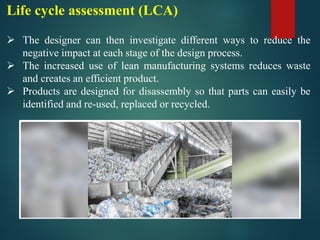
Life cycle assessment (LCA)
➢ The designer can then investigate different ways to reduce the
negative impact at each stage of the design process.
➢ The increased use of lean manufacturing systems reduces waste
and creates an efficient product.
➢ Products are designed for disassembly so that parts can easily be
identified and re-used, replaced or recycled.

Section1 New and emerging technologies.pdf

  • 1.
    Industry New and emergingtechnologies have changed places of work to include automation and robotics. Design teams can now work together remotely, with increasing productivity and accuracy, saving money and time.
  • 2.
    Automated production lines ➢Production lines are automated using intelligent machines and robotics. ➢ Products are manufactured faster and more accurately. ➢ Fewer employees are needed as machines can replace people. ➢ Only a few skilled engineers are needed to maintain the machines. ➢ This improves efficiency and reduces human error.
  • 3.
    Efficient workflow ➢ Theworkflow is organised to make the layout of the building efficient. ➢ This removes unnecessary time spent moving from one place to another. ▪ As a result, manufacturing becomes more efficient which saves time, money and waste.
  • 4.
    Virtual modelling ➢ Virtualmodelling is used to develop designs. ➢ Computer-Aided Design (CAD) is used to explore different ideas. ➢ Computer-Aided Testing (CAT) can analyse the strength and efficiency of a design. ➢ No physical models have to be made which saves time, money and waste.
  • 5.
    Virtual workspaces ➢ Virtualworkspace enables a design team to collaborate remotely. ➢ The internet and increased speed of data transfer have led to shared online workspaces. ➢ Designs can be prototyped using Computer-Aided Manufacture (CAM). ➢ There is no need to rent office space, and travel time and expenses are reduced.
  • 6.
    Enterprise Enterprise involves convertingan innovative idea into a commercial product. The internet and social media have allowed many more people to promote ideas and find ways to finance them.
  • 7.
    Crowdfunding ➢ Crowdfunding istypically an online platform where designers pitch an idea and ask for investment. ➢ Lots of people make small contributions, choosing to invest in interesting ideas. ➢ Designers can raise large amounts of money to finance their project.
  • 8.
    Virtual marketing andretail ➢ Virtual marketing and retail include advertising a product or service using popular websites and social media. ➢ A wide range of people can be reached. ➢ Celebrities or influencers promote products or brands through social media posts, blogs and vlogs. ➢ Adverts can be posted on popular sites. ➢ Websites can complete search engines optimisation to ensure they are more visible on keyword searches.
  • 9.
    Co-operatives ➢ Groups ofpeople with a common interest or goal form a co-operative. ➢ Members can be part of the workforce and the customers. ➢ Each member of the group has an equal share and say in the business.
  • 10.
    Fairtrade ➢ The workersand farmers who produce materials in developing countries are given more equality. This includes: ➢ A fair price for their produce. ➢ Respectable working conditions. ➢ Better protection of their working and living environments
  • 11.
    Sustainability Sustainable design aimsto minimise negative impacts on the environment
  • 12.
    Life cycle assessment(LCA) ➢ Life cycle assessment (LCA) can be used to analyse all the stages in a product’s life and highlight the impact it will have on the environment. ➢ The main stages of a Life cycle assessment (LCA) are: ▪ Extraction of raw materials. ▪ Manufacture and assembly. ▪ Transportation. ▪ Use. ▪ Disposal.
  • 13.
    Life cycle assessment(LCA) cont. ➢ The designer can then investigate different ways to reduce the negative impact at each stage. This could include: ▪ Alternative materials or manufacturing processes. ▪ Sourcing local materials or relocating factories to reduce transportation. ▪ Reducing parts. ▪ Alternative energy sources. ▪ Labelling for recycling.
  • 14.
    Finite and non-finiteresources cont. ➢ Non-finite resources: ➢ Non-finite resources are sustainable. ➢ Can be easily found and once used can be re-grown and replaced. ➢ Examples include: wood, wool, cotton..
  • 15.
    Disposal of waste ➢Waste throughout the products life needs to be reduced. ➢ Waste causes environmental damage and growing landfill sites.
  • 16.
    Reducing waste ➢ Waysto reduce waste: ▪ Recycling schemes with councils for household rubbish. ▪ Returning electronic products to companies for disposal. ▪ Creating products with re-usable or replaceable parts. ▪ Encouraging the use of renewable power sources. ▪ Financial incentives for users to refill products. ▪ Reducing the amount of disposable products that are used. ▪ Using more recycled materials.
  • 17.
    People The impact ofnew and emerging technologies affect people in different ways:
  • 18.
    Technology push ➢ Technologypush is where a new technology is invented and then designers or engineers use it in a new product. Technology is pushing the innovation of a new product. ➢ It is not led by consumer demand, however it is appealing to people as it produces innovative products and increases choice.
  • 19.
    Examples of technologypush ➢ Examples include: ▪ Dyson developed the cyclone technology inside his vacuum cleaners creating a bagless design. ▪ Touch screen technology was integrated into mobile phones.
  • 20.
    Market pull ➢ Marketpull is where consumers have a need or desire for a new product and it is then developed and produced. This could be a new product or an upgrade. ➢ This is led by consumer demand and helps to maintain brand loyalty and create new customers.
  • 21.
    Examples of marketpull ➢ Examples include: ▪ The culture of taking a selfie and posting on social media lead to a demand for smartphones to have integrated forward facing cameras. ▪ The social pressure put upon companies to help the environment, led to the development of biodegradable plastic bags that degrade after use.
  • 22.
    Choice People now havea lot more choice about the products they buy. They can shop all over the world and products are posted to their door. The market is competitive so prices are kept low.
  • 23.
    Culture Communities are madeup of a wide range of different people. These people can be influenced by and have an influence on design.
  • 24.
    Changes in fashionand trends ➢ People want to have the latest product or fashion item. ➢ Fashion is constantly evolving, which creates consumer demand for the new season’s style. ➢ This creates an opportunity for designers to update and develop designs to fit in with the latest trends and fashions.
  • 25.
    Different faiths andbeliefs ➢ Communities are made up of people with different faiths and beliefs. ➢ Designers are responsible for ensuring that their product doesn’t cause offence.
  • 26.
    Example: Gucci ➢ Gucci’sbalaclava knit top was withdrawn for causing offence due to its oversized lips and black colour, resembling a ‘black face’ which has negative cultural significance to black communities.
  • 27.
    Example: Carrier bags ➢Carrier bags contain an animal fat which is made from boiled animal bones, to prevent the bags from sticking. ➢ This causes great offence to many different faiths and beliefs who avoid touching or using these products.
  • 28.
    Society The design andmanufacture of a product should try not to have a negative impact on others and be as accessible and inclusive as possible.
  • 29.
    Design for disabledand elderly ➢ Designs should: ➢ Be inclusive. ➢ Example: Pushchair handles being adjustable for people of different heights. ➢ Clothes being available in a range of sizes.
  • 30.
    Designs for disabledand elderly cont. ➢ Be accessible. ➢ Example: Door frames and entrances to public buildings being wheelchair friendly. ➢ Improve people’s lives. ➢ Example: 3D printing being used for facial reconstruction and artificial arms.
  • 31.
    Different religious groups ➢Religions have hugely differing views on lifestyle, significant colours and important symbols. ➢ Communication with different groups is vital when producing products to prevent them causing harm or offence.
  • 32.
    Example: trainers ➢ In2002, Umbro created new trainers called Zyklon, which were quickly withdrawn because of the offence caused. ➢ The Nazis used Zyklon B when murdering millions of Jews in their concentration camps during the Second World War.
  • 33.
    Example: swimwear ➢ Thedesign of modest swimwear for Muslim women that enables them to swim whilst covering their body, respecting beliefs.
  • 34.
    Environment New products canhave a positive and negative impact on the environment.
  • 35.
    Negative impacts ➢ Time,resources and money are wasted in the design and manufacturing process. ➢ This waste has a negative impact on the environment.
  • 36.
    Continuous improvement ➢ Atevery stage of the process people look for ways to improve and small changes are made. ➢ This process reduces waste and reduces the negative environmental impact.
  • 37.
    Factors that improvework efficiency ➢ Re-organising staff. ➢ Planning a production line so stages are next to one another to eliminate travel time. ➢ Locating factories close to the source of the material or where it is sold to reduce travel. ➢ Ordering the correct amounts of materials so waste is kept to a minimum
  • 38.
    Pollution ➢ Products createpollution during their manufacture, use and disposal. ➢ It is the designer's and manufacturer's responsibility to try and reduce this pollution, wherever possible
  • 39.
  • 40.
    Computer Aided Design(CAD) ➢ Computers are now an integrated part of production techniques and systems. As technology and artificial intelligence develop we will be increasingly reliant on them for all stages of the design and manufacture process.
  • 41.
    Automation ➢ Automation isthe use of computers to automatically run a production line. ➢ This reduces the need for skilled manual labour and reduces human error.
  • 42.
    Computer aided design(CAD) ➢ CAD packages are computer programs that the designer can use to draw detailed designs, and model ideas. ➢ The product can be realised quickly and seen in 3D. ➢ Components can be drawn separately and virtually assembled to check if they fit. ➢ Colours, materials and sizes can be altered quickly.
  • 43.
    Benefits of CAD ➢Early models can be used to aid market research and can be quickly and easily shared via email with clients. ➢ Optimum material thicknesses can be calculated. ➢ Tests can be simulated without waste. ➢ The drawings can be used to program CAM (computer aided manufacture - see the next slide!).
  • 44.
    Computer aided manufacture(CAM) ➢ Computer numerical control (CNC) uses codes converted from the CAD drawings to program different machines to shape and engrave material.
  • 45.
    Machines ➢ These machinesinclude: ➢ Laser cutter. ➢ Computer numerical control (CNC) milling machine. ➢ CNC lathe. ➢ CNC Router. ➢ CNC sewing machines.
  • 46.
    Manufacturing Systems ➢ Computersare now an integrated part of production techniques and systems. As technology and artificial intelligence develops we will be increasingly reliant on them for all stages of the design and manufacture process
  • 47.
    Flexible manufacturing systems(FMS) ➢ A series of automated machines are used in the production of a product. ➢ The machines can be easily re-programmed to change the task that they are doing which makes the process flexible. ➢ Robot arms are often used as they can be easily adaptable.
  • 48.
    Benefits of FMS ➢The machines can: ➢ Restock shelves. ➢ Transfer and assemble parts. ➢ Manufacture parts. ➢ Check quality, improving efficiency and reducing human error.
  • 49.
    Just in time(JIT) ➢ Just in time manufacturing systems work by having close relationships with suppliers. ➢ The parts needed for manufacture arrive just as they are needed directly from the supplier.
  • 50.
    Advantages and disadvantages ➢Advantages include: ▪ Less storage space needed. ▪ Minimal waste as you only order what you need. ▪ Production runs can change easily to another product. ➢ Disadvantages include: ▪ If there is a problem with the supplier, the process is delayed. ▪ An unexpected demand could lead to delays.
  • 51.
    Lean manufacturing ➢ Leanmanufacturing looks at the whole manufacturing process and works to create the best product to meet consumer demand. ➢ The main aim is to create the most efficient and effective product while eliminating waste.
  • 52.
    Lean manufacturing cont. ➢It includes: ▪ Efficient working. ▪ Just in time manufacture. ▪ Continuous improvement. ▪ Quality assurance. ▪ Feedback from the consumer.
  • 53.
    Evaluation of EmergingTechnologies and Design Decisions Designers/manufactures are becoming more aware of the ethical and environmental impact of their design decisions. Consumers are also taking responsibility for the waste they create and are demanding more environmentally friendly products.
  • 54.
    Planned obsolescence ➢ Productsare manufactured to last a specific length of time before needing to be replaced. ➢ Consumers will then need/want to buy a new version of the product. ➢ Sales will be maintained.
  • 55.
    Achieving planned obsolescence ➢This can be achieved by: ▪ Using materials that break/wear out easily. ▪ The cost of repairing being more than replacing e.g. washing machine. ▪ Upgrades in software e.g. mobile phones. ▪ Aesthetic upgrades to match fashion trends e.g. mobile phones.
  • 56.
    Environmental impacts ➢ Thishas a negative effect on the environment as more waste is created in the manufacture of new products and the disposal of old ones. ➢ An awareness of planned obsolescence and the responsibility of the designer can influence the design decisions. ➢ For example a disposable coffee cup that is a single use product. The designer could use a compostable material made from plants.
  • 57.
    Design for maintenance ➢Products are being designed with easily accessible, replaceable parts. ➢ New software can be uploaded onto existing products to update them. ➢ Companies usually arrange the replacement of parts to ensure safety and reliability. ➢ These products are becoming more popular with people who are increasingly more aware of reducing waste and the shared responsibility for global warming.
  • 58.
    The Environment andEthics Designers, manufacturers and consumers are becoming more aware of the ethical and environmental impact of their design decisions and purchases.
  • 59.
    Consumers ➢ The impactof social media, celebrity influencers and access to a wide range of information through the internet means people have increased awareness about the impact they are having on the environment.
  • 60.
    Consumer demand ➢ Consumersare realising their responsibility to help reduce waste. ➢ This is leading to an increased demand for more environmentally friendly products. ➢ There is also an increase in demand for “upcycled” products and second-hand products.
  • 61.
    End of life ➢At the end of life of a product, the consumer has increased accessibility to: ➢ Recycling schemes with councils for household rubbish. ➢ Returning electronic products to companies for disposal. ➢ Repairing parts of a product rather than throwing it away. ➢ Refilling existing bottles to reduce waste. ➢ The consumer has a responsibility to make use of these schemes.
  • 62.
    Designers and manufacturers ➢The responsibility for designers and manufacturers to consider the environmental impact of their products has become a key part of the design process. ➢ Life cycle assessment (LCA) can be used to analyse all the stages in a product’s life and highlight the impact it will have on the environment.
  • 63.
    Life cycle assessment(LCA) ➢ The designer can then investigate different ways to reduce the negative impact at each stage of the design process. ➢ The increased use of lean manufacturing systems reduces waste and creates an efficient product. ➢ Products are designed for disassembly so that parts can easily be identified and re-used, replaced or recycled.