Design Fiction
Theresa Slater and Adam Owen
OCADU, DIGF 6004 Creative Techniques 2016
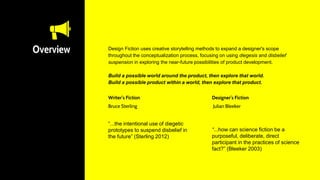
Overview Design Fiction uses creative storytelling methods to expand a designer's scope
throughout the conceptualization process, focusing on using diegesis and disbelief
suspension in exploring the near-future possibilities of product development.
Build a possible world around the product, then explore that world.
Build a possible product within a world, then explore that product.
Writer’s Fiction
Bruce Sterling
“...the intentional use of diegetic
prototypes to suspend disbelief in
the future” (Sterling 2012)
Designer’s Fiction
Julian Bleeker
“...how can science fiction be a
purposeful, deliberate, direct
participant in the practices of science
fact?” (Bleeker 2003)
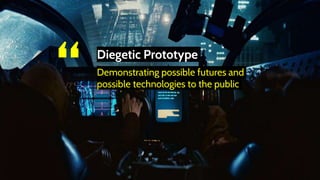
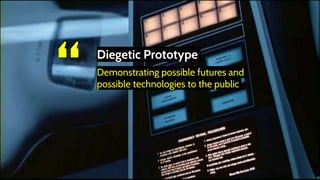
“ Diegetic Prototype
Demonstrating possible futures and
possible technologies to the public
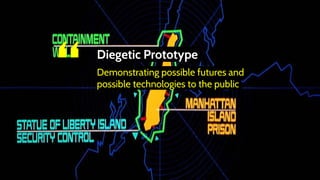
“ Diegetic Prototype
Demonstrating possible futures and
possible technologies to the public
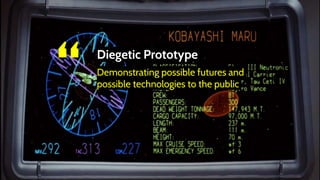
“ Diegetic Prototype
Demonstrating possible futures and
possible technologies to the public
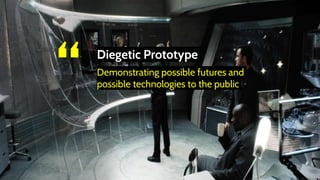
“ Diegetic Prototype
Demonstrating possible futures and
possible technologies to the public
“ Diegetic Prototype
Demonstrating possible futures and
possible technologies to the public
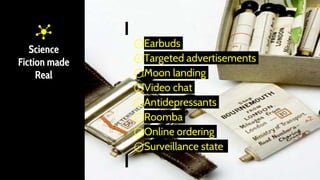
Science
Fiction made
Real
⊙Earbuds
⊙Targeted advertisements
⊙Moon landing
⊙Video chat
⊙Antidepressants
⊙Roomba
⊙Online ordering
⊙Surveillance state
1
Purpose
Recursive relationship
between science fiction and
fact
“
“... enhance our capacity to seek out and work
with possibility, enrich communication in the
exchange of speculative ideas, disrupt
conventional mindsets with provocative
visions of alternative futures, and affirm
individual agency.”
(Jonathan Resnick, 2011, p.3)
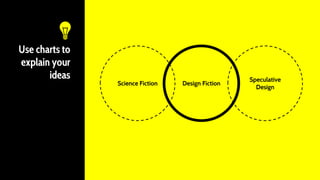
Use charts to
explain your
ideas
Design FictionScience Fiction
Speculative
Design
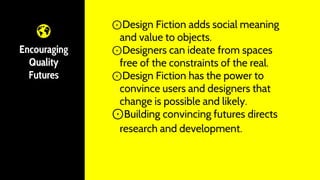
Encouraging
Quality
Futures
⊙Design Fiction adds social meaning
and value to objects.
⊙Designers can ideate from spaces
free of the constraints of the real.
⊙Design Fiction has the power to
convince users and designers that
change is possible and likely.
⊙Building convincing futures directs
research and development.
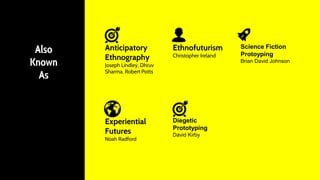
Experiential
Futures
Noah Radford
Also
Known
As
Anticipatory
Ethnography
Joseph Lindley, Dhruv
Sharma, Robert Potts
Ethnofuturism
Christopher Ireland
Science Fiction
Protoyping
Brian David Johnson
Diegetic
Prototyping
David Kirby
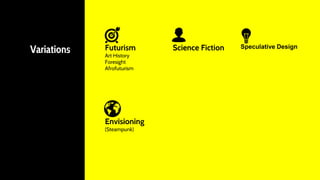
Envisioning
(Steampunk)
Variations Futurism
Art History
Foresight
Afrofuturism
Science Fiction Speculative Design
THE SLATER-OWEN
DESIGN FICTION TECHNIQUE
THE SLATER-OWEN
DESIGN FICTION TECHNIQUE
Imagine a future iteration of your product...
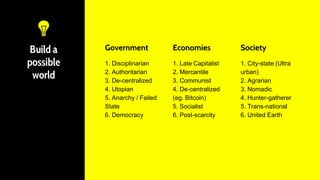
Build a
possible
world
Government
1. Disciplinarian
2. Authoritarian
3. De-centralized
4. Utopian
5. Anarchy / Failed
State
6. Democracy
Economies
1. Late Capitalist
2. Mercantile
3. Communist
4. De-centralized
(eg. Bitcoin)
5. Socialist
6. Post-scarcity
Society
1. City-state (Ultra
urban)
2. Agrarian
3. Nomadic
4. Hunter-gatherer
5. Trans-national
6. United Earth
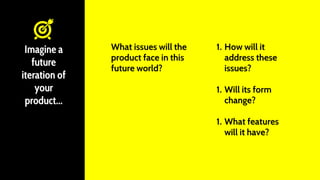
What issues will the
product face in this
future world?
Imagine a
future
iteration of
your
product...
1. How will it
address these
issues?
1. Will its form
change?
1. What features
will it have?
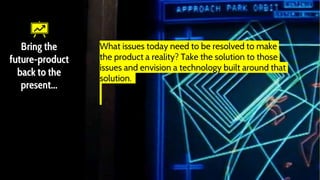
Bring the
future-product
back to the
present...
What issues today need to be resolved to make
the product a reality? Take the solution to those
issues and envision a technology built around that
solution.
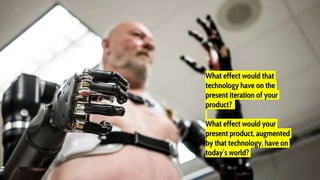
What effect would that
technology have on the
present iteration of your
product?
What effect would your
present product, augmented
by that technology, have on
today’s world?
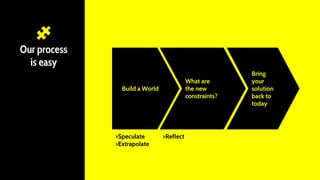
Our process
is easy
Build a World
What are
the new
constraints?
Bring
your
solution
back to
today
>Speculate >Reflect
>Extrapolate
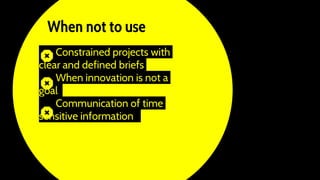
Constrained projects with
clear and defined briefs
When innovation is not a
goal
Communication of time
sensitive information
When not to use
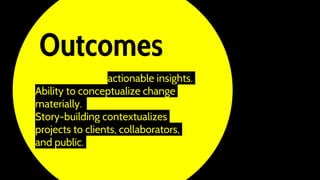
Foresight yields actionable insights.
Ability to conceptualize change
materially.
Story-building contextualizes
projects to clients, collaborators,
and public.
Outcomes
Design Fiction presentation

Design Fiction presentation