Design Futures through Design Fiction
Professor Paul Coulton

Chair of Speculative and Game Design, Lancaster University, UK
@ProfTriviality
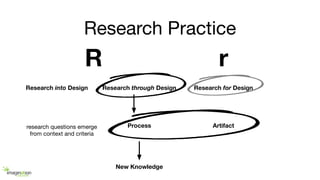
Research Practice
R r
Research into Design Research through Design Research for Design
Process Artifact
New Knowledge
research questions emerge
from context and criteria
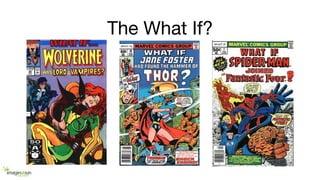
The What If?
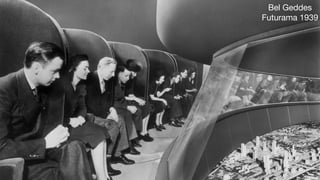
Bel Geddes

Futurama 1939
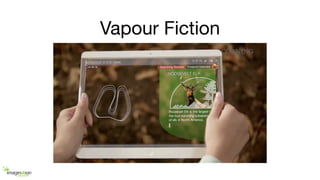
Vapour Fiction
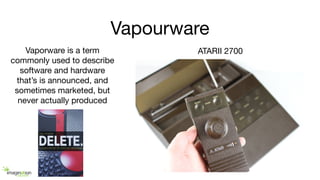
Vapourware
Vaporware is a term
commonly used to describe
software and hardware
that’s is announced, and
sometimes marketed, but
never actually produced
ATARII 2700
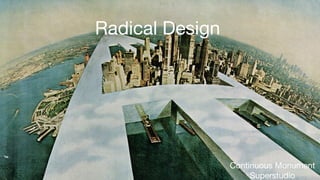
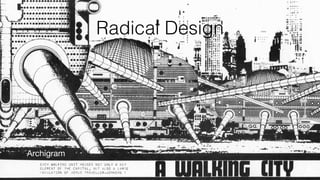
Radical Design
Continuous Monument

Superstudio
Radical Design
Archigram
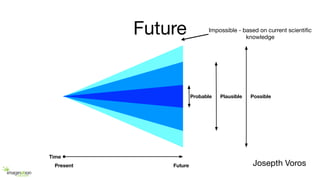
Future
Present Future
Time
Probable Plausible Possible
Josepth Voros
Impossible - based on current scientific
knowledge
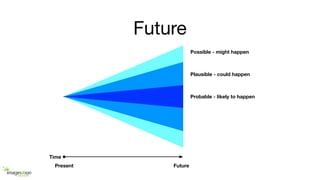
Possible
Present Future
Time
Probable - likely to happen
Plausible - could happen
Possible - might happen
Future
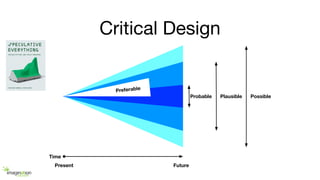
Critical Design
Present Future
Time
Probable Plausible Possible
Preferable
Preferable to who?
PREFERABLE SHOULD BE A QUESTION WE
ASK OURSELVES NOT SIMPLY THE AIM
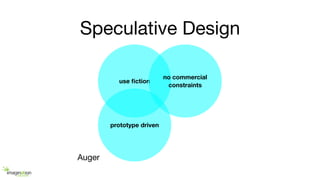
Speculative Design
Auger
use fiction
no commercial
constraints
prototype driven
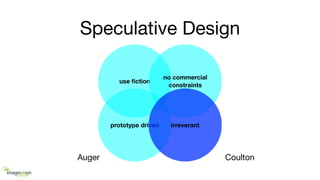
Speculative Design
use fiction
no commercial
constraints
prototype driven irreverant
Auger Coulton
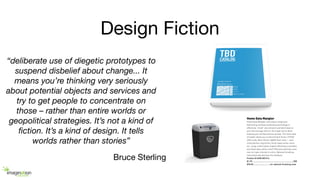
Design Fiction
“deliberate use of diegetic prototypes to
suspend disbelief about change... It
means you’re thinking very seriously
about potential objects and services and
try to get people to concentrate on
those – rather than entire worlds or
geopolitical strategies. It’s not a kind of
fiction. It’s a kind of design. It tells
worlds rather than stories”
Bruce Sterling
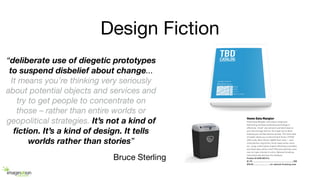
Design Fiction
“deliberate use of diegetic prototypes
to suspend disbelief about change...
It means you’re thinking very seriously
about potential objects and services and
try to get people to concentrate on
those – rather than entire worlds or
geopolitical strategies. It’s not a kind of
fiction. It’s a kind of design. It tells
worlds rather than stories”
Bruce Sterling
Diegesis
mimesis and diegesis describe ways of
presenting a story. In mimesis, the story is
acted out. In diegesis, the story is narrated.
Mimesis is show. Diegesis is tell.
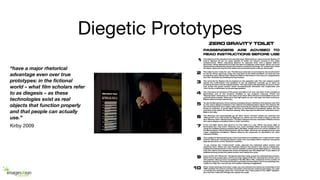
Diegetic Prototypes
“have a major rhetorical
advantage even over true
prototypes: in the fictional
world – what film scholars refer
to as diegesis – as these
technologies exist as real
objects that function properly
and that people can actually
use.”
Kirby 2009
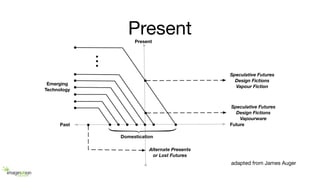
Present
adapted from James Auger
Present
Future
Domestication
Emerging
Technology
Speculative Futures
Design Fictions
Vapour Fiction
Past
Speculative Futures
Design Fictions
Vapourware
Alternate Presents
or Lost Futures
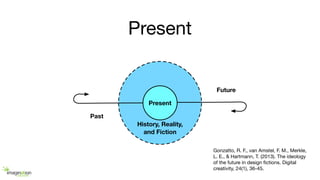
Present
Present
History, Reality,
and Fiction
Past
Future
Gonzatto, R. F., van Amstel, F. M., Merkle,
L. E., & Hartmann, T. (2013). The ideology
of the future in design fictions. Digital
creativity, 24(1), 36-45.
Past
“We look at the present through a rear-view mirror.
We march backwards into the future”
Marshall Mcluhan
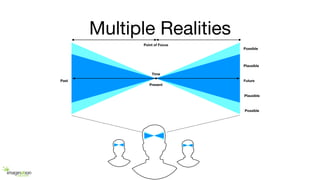
Multiple Realities
Present
Future
Time
Plausible
Possible
Past
Plausible
Possible
Point of Focus
Design Fiction
“So a design fiction is
(1) something that creates a fictional world, (2) has something
being prototyped within that fictional world, (3) does so in
order to create a discursive space.”
“Although this definition appears straightforward, complexity
arrives when we consider what something may be”
Lindley and Coulton
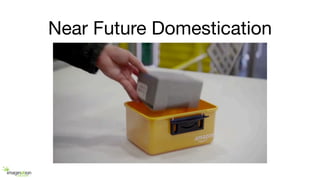
Near Future Domestication
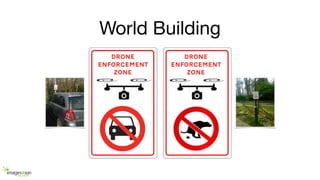
World Building
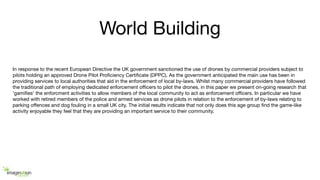
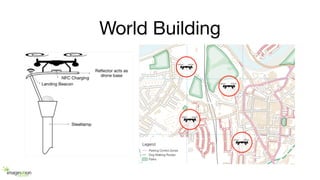
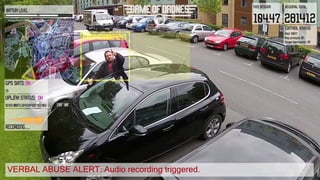
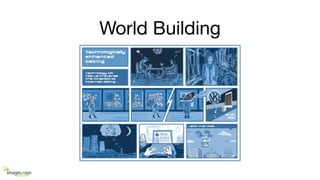
In response to the recent European Directive the UK government sanctioned the use of drones by commercial providers subject to
pilots holding an approved Drone Pilot Proficiency Certificate (DPPC). As the government anticipated the main use has been in
providing services to local authorities that aid in the enforcement of local by-laws. Whilst many commercial providers have followed
the traditional path of employing dedicated enforcement officers to pilot the drones, in this paper we present on-going research that
'gamifies' the enforcment activities to allow members of the local community to act as enforcement officers. In particular we have
worked with retired members of the police and armed services as drone pilots in relation to the enforcement of by-laws relating to
parking offences and dog fouling in a small UK city. The initial results indicate that not only does this age group find the game-like
activity enjoyable they feel that they are providing an important service to their community.
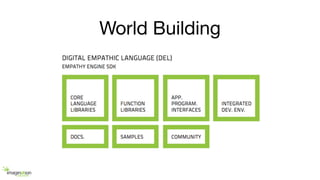
World Building
World Building
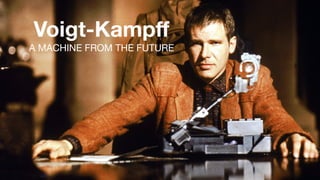
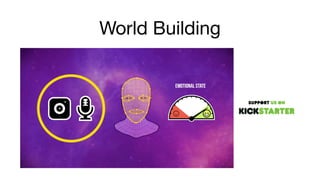
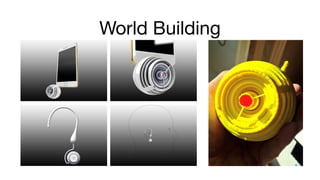
Voigt-Kampff
A MACHINE FROM THE FUTURE
World Building
World Building
World Building
World Building
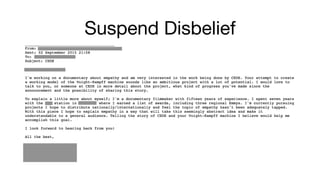
Suspend Disbelief
allowing players to consider alternate presents and plausible futures
Games as Speculative Design
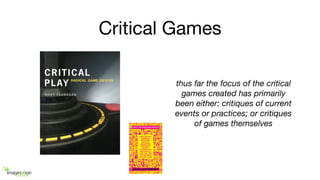
Critical Games
thus far the focus of the critical
games created has primarily
been either: critiques of current
events or practices; or critiques
of games themselves
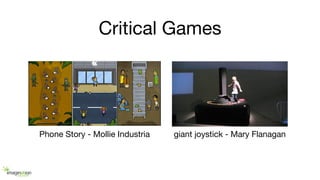
Critical Games
Phone Story - Mollie Industria giant joystick - Mary Flanagan
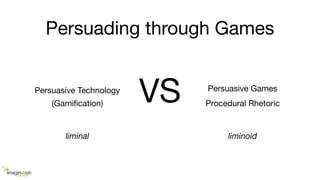
Persuading through Games
Persuasive Technology
Procedural Rhetoric(Gamification) VS Persuasive Games
liminal liminoid
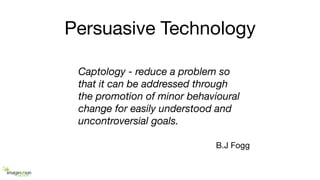
Persuasive Technology
B.J Fogg
Captology - reduce a problem so
that it can be addressed through
the promotion of minor behavioural
change for easily understood and
uncontroversial goals.
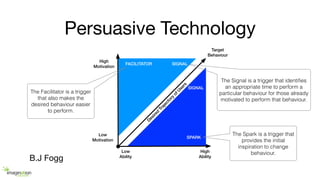
Persuasive Technology
High
Ability
Low
Ability
High
Motivation
Low
Motivation
Target
Behaviour
D
esired
Trajectory
ofU
sers
FACILITATOR
SPARK
SIGNAL
SIGNAL
The Facilitator is a trigger
that also makes the
desired behaviour easier
to perform.
The Signal is a trigger that identifies
an appropriate time to perform a
particular behaviour for those already
motivated to perform that behaviour.
The Spark is a trigger that
provides the initial
inspiration to change
behaviour.
B.J Fogg
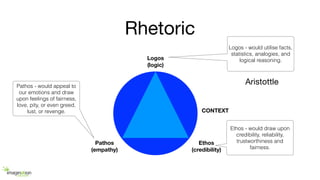
Rhetoric
Pathos
(empathy)
Ethos
(credibility)
Logos
(logic)
CONTEXT
Aristottle
Logos - would utilise facts,
statistics, analogies, and
logical reasoning.
Ethos - would draw upon
credibility, reliability,
trustworthiness and
fairness.
Pathos - would appeal to
our emotions and draw
upon feelings of fairness,
love, pity, or even greed,
lust, or revenge.
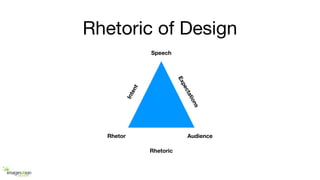
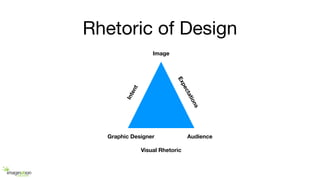
Rhetoric of Design
Rhetor Audience
Speech
Intent
Expectations
Rhetoric
Graphic Designer Audience
Image
Intent
Expectations
Visual Rhetoric
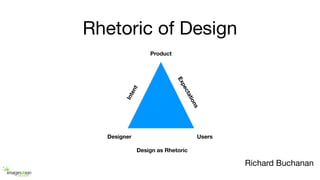
Rhetoric of Design
Designer Users
Product
Intent
Expectations
Design as Rhetoric
Rhetoric of Design
Richard Buchanan
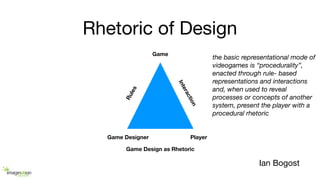
Game
Game Designer Player
Rules
Interaction
Game Design as Rhetoric
Rhetoric of Design
the basic representational mode of
videogames is “procedurality”,
enacted through rule- based
representations and interactions
and, when used to reveal
processes or concepts of another
system, present the player with a
procedural rhetoric
Ian Bogost
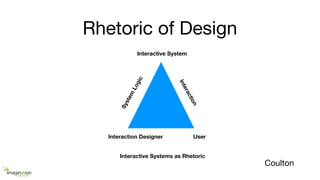
Interactive System
Interaction Designer User
System
Logic
Interaction
Interactive Systems as Rhetoric
Rhetoric of Design
Coulton
Developing In-Game Rhetoric
Mudlark
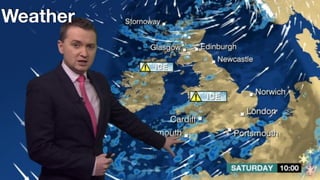
Climate Change
Weather
Flow
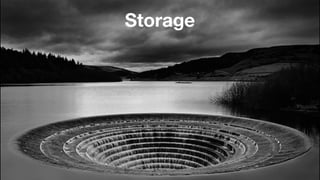
Storage
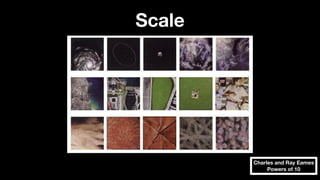
Scale
Charles and Ray Eames
Powers of 10
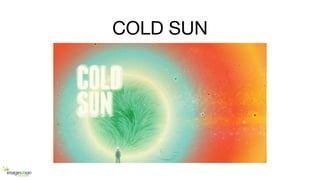
COLD SUN
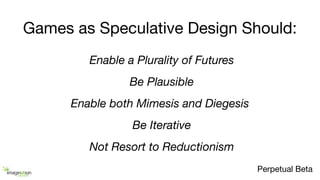
Games as Speculative Design Should:
Enable a Plurality of Futures
Be Plausible
Enable both Mimesis and Diegesis
Be Iterative
Not Resort to Reductionism
Perpetual Beta
Questions
Banksy

Design Futures through Design Fiction