By Alex Driver
What drives great
design?
Team Consulting
Insight Issue 13
14
Many desk-based tools are available to
help focus our activity and encourage
divergent thinking at the start of a
project:
•	 We can use tools such as ‘User
journey mapping’ or ‘PCA analysis1
’
to identify ‘pain points’ in the use
sequence.
•	 We can break a system into sub-
systems to help focus our attention
on specific user or mechanical
interactions, i.e. how might we deploy
a needle shield or how might we aid
removal from packaging?
•	 We can focus our brainstorms on
themes, e.g. size reduction, ease of
manufacture, robustness, reducing
cost of goods, etc.
These tools are a great way to help
identify, prioritise and solve practical
design challenges; however, they are
less well suited to more emotive issues.
How a product feels or, more accurately,
how a person feels about a product
needs a slightly different approach.
It should be a familiar scenario for most
designers you’ve waved goodbye to
the client after a successful briefing
and returned home with reams of
loose sketches and a head buzzing
with ideas. The next morning you find
yourself staring at a blank piece of paper
wondering how on earth you’re going
to give structure to the swirling mass
of possibilities that lie in front of you.
Moreover, you have to consider how
you’re going to demonstrate to the client
that the concepts appearing at the other
end answer the brief.
To tackle these challenges I like to use
a tool called ‘Design Drivers’. It’s useful
not only as a method to highlight areas
on which we want to focus, but also for
defining a vision of ‘where you want the
product to be’ rather than improving
incrementally on what you already have.
What are Design
Drivers?
“Design Drivers” are really just a list of
headings that describe what you want
the product to do or be; however, their
power comes in the (often provocative)
wording and careful selection of imagery
chosen to accompany them. They help us
to capture in a tangible way an example
of what a well-executed solution might
feel like, helping to define our aspirations
and providing a vision against which
we can quickly judge our design as it
inevitably evolves. So why is it important
to take this approach? Can’t we rely
on a well-written specification? Well
yes, your spec will clearly define your
requirements, and yes, you can solve
each requirement individually to prove
you’ve met the spec, but you might still
fall short of what was actually needed
from the overall product experience. ≥
15
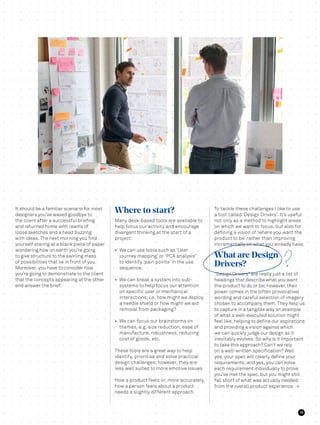
Take the following example, which
could be a driver for the design of a
wearable injector: a more functionalist
approach might have been to say
“small” or “compact”, but the use of the
word “invisible” in combination with
a stimulating image might encourage
participants in a brainstorming session
to push their thinking into areas
previously considered out-of-bounds.
How could the internal components
be reconfigured to create a slimmer
profile? What forms, materials and
colours are least conspicuous beneath
clothing? Could the device move or flex
with the body? The goal is to inspire
more divergent thinking in the hope of
landing on something truly innovative.
More than that, the image elicits an
emotional response, reminding you that
these are frequently worn on intimate
areas of the body and must be used
throughout the day, whether at work or
in bed. A picture tells a thousand words
as they say.
This image makes me think of materials
with inherently dirt-resistant qualities
and smooth forms that are easy to
clean. This might lead us to consider
construction methods that avoid
dirt-traps or the selection of materials
and surface finishes that won’t mark
easily, rather than just making it ‘easy
to clean’.
Team Consulting
Insight Issue 13
“You find yourself staring at a blank
piece of paper wondering how on
earth you’re going to give structure
to the swirling mass of possibilities
that lie in front of you.”
Invisible beneath
clothing
Never feels dirty
16
Design Drivers are primarily a powerful
tool for encouraging divergent thinking
during brainstorming sessions, but they
have several additional advantages:
•	 They provide a tangible example of the
ultimate aim at the start of a project;
their highly visual nature makes it
easier for the team (client – engineer
– designer) to discuss and agree the
nuances of what is required.
•	 The selection of imagery can often
help to establish the desired visual
look and feel of the product early in
the process.
•	 Walking through Design Drivers at
the start of a client presentation can
help to establish a context for the
concepts that are to follow.
•	 They provide a set of aspirational
goals for a project against which
designs can be ‘measured’ both
at the outset and throughout the
development process.
For example, during a recent project
to develop a piece of lab equipment,
Design Drivers helped the team to stay
on-track as manufacturing and time
constraints threatened to water down
the original design intent. The Drivers
were frequently referred to during the
project as they succinctly described
the key aspirations for the product at a
high level.
As the ‘design literacy’ of the average
consumer grows, we’ll look increasingly
at how a product makes us feel to
differentiate the myriad options
available, so tools such as Design Drivers
may see more use in our field of work.E N D S
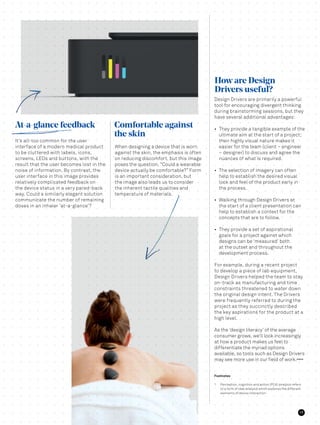
When designing a device that is worn
against the skin, the emphasis is often
on reducing discomfort, but this image
poses the question, “Could a wearable
device actually be comfortable?” Form
is an important consideration, but
the image also leads us to consider
the inherent tactile qualities and
temperature of materials.
It’s all-too common for the user
interface of a modern medical product
to be cluttered with labels, icons,
screens, LEDs and buttons, with the
result that the user becomes lost in the
noise of information. By contrast, the
user interface in this image provides
relatively complicated feedback on
the device status in a very pared-back
way. Could a similarly elegant solution
communicate the number of remaining
doses in an inhaler ‘at-a-glance’?
How are Design
Drivers useful?
Comfortable against
the skin
At-a-glance feedback
Footnotes
1	 Perception, cognition and action (PCA) analysis refers
to a form of task analysis which explores the different
elements of device interaction.
17

Design Drivers

  • 1.
    By Alex Driver Whatdrives great design? Team Consulting Insight Issue 13 14
  • 2.
    Many desk-based toolsare available to help focus our activity and encourage divergent thinking at the start of a project: • We can use tools such as ‘User journey mapping’ or ‘PCA analysis1 ’ to identify ‘pain points’ in the use sequence. • We can break a system into sub- systems to help focus our attention on specific user or mechanical interactions, i.e. how might we deploy a needle shield or how might we aid removal from packaging? • We can focus our brainstorms on themes, e.g. size reduction, ease of manufacture, robustness, reducing cost of goods, etc. These tools are a great way to help identify, prioritise and solve practical design challenges; however, they are less well suited to more emotive issues. How a product feels or, more accurately, how a person feels about a product needs a slightly different approach. It should be a familiar scenario for most designers you’ve waved goodbye to the client after a successful briefing and returned home with reams of loose sketches and a head buzzing with ideas. The next morning you find yourself staring at a blank piece of paper wondering how on earth you’re going to give structure to the swirling mass of possibilities that lie in front of you. Moreover, you have to consider how you’re going to demonstrate to the client that the concepts appearing at the other end answer the brief. To tackle these challenges I like to use a tool called ‘Design Drivers’. It’s useful not only as a method to highlight areas on which we want to focus, but also for defining a vision of ‘where you want the product to be’ rather than improving incrementally on what you already have. What are Design Drivers? “Design Drivers” are really just a list of headings that describe what you want the product to do or be; however, their power comes in the (often provocative) wording and careful selection of imagery chosen to accompany them. They help us to capture in a tangible way an example of what a well-executed solution might feel like, helping to define our aspirations and providing a vision against which we can quickly judge our design as it inevitably evolves. So why is it important to take this approach? Can’t we rely on a well-written specification? Well yes, your spec will clearly define your requirements, and yes, you can solve each requirement individually to prove you’ve met the spec, but you might still fall short of what was actually needed from the overall product experience. ≥ 15
  • 3.
    Take the followingexample, which could be a driver for the design of a wearable injector: a more functionalist approach might have been to say “small” or “compact”, but the use of the word “invisible” in combination with a stimulating image might encourage participants in a brainstorming session to push their thinking into areas previously considered out-of-bounds. How could the internal components be reconfigured to create a slimmer profile? What forms, materials and colours are least conspicuous beneath clothing? Could the device move or flex with the body? The goal is to inspire more divergent thinking in the hope of landing on something truly innovative. More than that, the image elicits an emotional response, reminding you that these are frequently worn on intimate areas of the body and must be used throughout the day, whether at work or in bed. A picture tells a thousand words as they say. This image makes me think of materials with inherently dirt-resistant qualities and smooth forms that are easy to clean. This might lead us to consider construction methods that avoid dirt-traps or the selection of materials and surface finishes that won’t mark easily, rather than just making it ‘easy to clean’. Team Consulting Insight Issue 13 “You find yourself staring at a blank piece of paper wondering how on earth you’re going to give structure to the swirling mass of possibilities that lie in front of you.” Invisible beneath clothing Never feels dirty 16
  • 4.
    Design Drivers areprimarily a powerful tool for encouraging divergent thinking during brainstorming sessions, but they have several additional advantages: • They provide a tangible example of the ultimate aim at the start of a project; their highly visual nature makes it easier for the team (client – engineer – designer) to discuss and agree the nuances of what is required. • The selection of imagery can often help to establish the desired visual look and feel of the product early in the process. • Walking through Design Drivers at the start of a client presentation can help to establish a context for the concepts that are to follow. • They provide a set of aspirational goals for a project against which designs can be ‘measured’ both at the outset and throughout the development process. For example, during a recent project to develop a piece of lab equipment, Design Drivers helped the team to stay on-track as manufacturing and time constraints threatened to water down the original design intent. The Drivers were frequently referred to during the project as they succinctly described the key aspirations for the product at a high level. As the ‘design literacy’ of the average consumer grows, we’ll look increasingly at how a product makes us feel to differentiate the myriad options available, so tools such as Design Drivers may see more use in our field of work.E N D S When designing a device that is worn against the skin, the emphasis is often on reducing discomfort, but this image poses the question, “Could a wearable device actually be comfortable?” Form is an important consideration, but the image also leads us to consider the inherent tactile qualities and temperature of materials. It’s all-too common for the user interface of a modern medical product to be cluttered with labels, icons, screens, LEDs and buttons, with the result that the user becomes lost in the noise of information. By contrast, the user interface in this image provides relatively complicated feedback on the device status in a very pared-back way. Could a similarly elegant solution communicate the number of remaining doses in an inhaler ‘at-a-glance’? How are Design Drivers useful? Comfortable against the skin At-a-glance feedback Footnotes 1 Perception, cognition and action (PCA) analysis refers to a form of task analysis which explores the different elements of device interaction. 17