DES 680 Digital Design Designing  Design What Design Has Become
The world's economy, and the designer's role within it, is radically changing.
Efficiency and aesthetics are no longer  enough.
Companies and societies will continue to prosper only if they push to higher grounds of Innovation.
Innovation: Ima ginative activity fashioned to produce outcomes that are both original and of practical value. *  An activity designers naturally engage in!
Designers are uniquely positioned to lead innovation, because they suggest that  something may be  and reach out to explore it. Designers are:  INTUITIVE
EXPERIMENTAL
EMPATHETIC
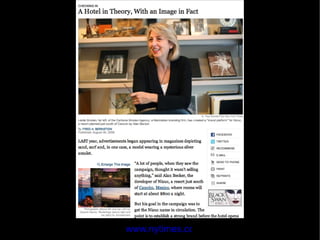
A tool of innovation associated with design is  Brand Platform. Brand Platform:  the ideas, words, colors, textures, sounds, animations, etc. from which later decisions about a product or service may evolve.
www.nytimes.com
Connotation and Denotation in Design Connotative:   Having  the p ower of implying or suggesting something in addition to what is explicit Denotative: Limited to the explicit meaning of a word or text; "a literal translation" Precisely and clearly expressed or readily observable; leaving nothing to implication
Connotation and Denotation in Design  from The Language of Advertising http://www.stanford.edu/class/linguist34/Unit_03/connotation.htm A simple sign has a signifier which denotes its signified; at the second level of connotation, this whole sign becomes a signifier for another signified.   Components of advertisements typically have connotations, which connect the advertisement to a larger cultural context. For example, think about the way that hair is portrayed in advertisements for hair products: either immaculately styled, or free-flowing and in motion. The styled image is used in advertisements that connote (a woman, typically) getting herself ready to socialize; the free-flowing image connotes freedom in life: freedom from worries about hair, freedom to travel, freedom of expression.
 
Motion Design   from  Designing for Motion by Matt Woolman “ The desktop computer has transformed the design profession profoundly over the past 25 years. Distinct stages of evolution are marked by points at which the once quaint profession of commercial art, or graphic design, has grown into something more complex, as the designer has expanded into new skill sets and areas of creative practice.” The eighties  -  print production processes, such as page layout, typesetting, and mechanical preparation, move from the domain of specialists working in these areas and onto the desktop of the designer’s workspace.  The early nineties -  an explosion of typeface design was the result of consumer access to technology.
Motion Design   from  Designing for Motion by Matt Woolman The mid-nineties -  the designer gained access to the tools for creating and producing Web sites and moving type.   The new wave -  motion graphics, or motion design. Behind this new wave lies yet another technological evolution. Design studios now have access to highly advanced yet affordable hardware and software literally on their desktops. Both 2-D and 3-D animation and video production are now possible “inhouse,” rather than in specialized—and expensive—shops.
Motion Design   from  Designing for Motion by Matt Woolman Motion-graphics design is not a single discipline. It is a convergence of animation, illustration, graphic design, narrative filmmaking, sculpture, and architecture, to name only a few. The word “graphic” is important: this includes formal content that has a graphic emphasis such as symbols, icons, and illustrated 2- and 3-D objects, often synthesized with live action.
Goal-Directed Design  (the Interactive Design process) Make people happy and your products & services will be a success. BUT why are so many digital products so difficult and unpleasant to use? Why aren't we all happy and successful? Imbuing creation with humanity. Pure technologically focused solutions tend to fail. Human oriented design activities: Understanding audience/users' desires, needs, motivations and contexts
Understanding business and technical opportunities, requirements, and constraints

Digital Design

  • 1.
    DES 680 DigitalDesign Designing Design What Design Has Become
  • 2.
    The world's economy,and the designer's role within it, is radically changing.
  • 3.
    Efficiency and aestheticsare no longer enough.
  • 4.
    Companies and societieswill continue to prosper only if they push to higher grounds of Innovation.
  • 5.
    Innovation: Ima ginativeactivity fashioned to produce outcomes that are both original and of practical value. * An activity designers naturally engage in!
  • 6.
    Designers are uniquelypositioned to lead innovation, because they suggest that something may be and reach out to explore it. Designers are: INTUITIVE
  • 7.
  • 8.
  • 9.
    A tool ofinnovation associated with design is Brand Platform. Brand Platform: the ideas, words, colors, textures, sounds, animations, etc. from which later decisions about a product or service may evolve.
  • 10.
  • 11.
    Connotation and Denotationin Design Connotative: Having the p ower of implying or suggesting something in addition to what is explicit Denotative: Limited to the explicit meaning of a word or text; "a literal translation" Precisely and clearly expressed or readily observable; leaving nothing to implication
  • 12.
    Connotation and Denotationin Design from The Language of Advertising http://www.stanford.edu/class/linguist34/Unit_03/connotation.htm A simple sign has a signifier which denotes its signified; at the second level of connotation, this whole sign becomes a signifier for another signified. Components of advertisements typically have connotations, which connect the advertisement to a larger cultural context. For example, think about the way that hair is portrayed in advertisements for hair products: either immaculately styled, or free-flowing and in motion. The styled image is used in advertisements that connote (a woman, typically) getting herself ready to socialize; the free-flowing image connotes freedom in life: freedom from worries about hair, freedom to travel, freedom of expression.
  • 13.
  • 14.
    Motion Design from Designing for Motion by Matt Woolman “ The desktop computer has transformed the design profession profoundly over the past 25 years. Distinct stages of evolution are marked by points at which the once quaint profession of commercial art, or graphic design, has grown into something more complex, as the designer has expanded into new skill sets and areas of creative practice.” The eighties - print production processes, such as page layout, typesetting, and mechanical preparation, move from the domain of specialists working in these areas and onto the desktop of the designer’s workspace. The early nineties - an explosion of typeface design was the result of consumer access to technology.
  • 15.
    Motion Design from Designing for Motion by Matt Woolman The mid-nineties - the designer gained access to the tools for creating and producing Web sites and moving type. The new wave - motion graphics, or motion design. Behind this new wave lies yet another technological evolution. Design studios now have access to highly advanced yet affordable hardware and software literally on their desktops. Both 2-D and 3-D animation and video production are now possible “inhouse,” rather than in specialized—and expensive—shops.
  • 16.
    Motion Design from Designing for Motion by Matt Woolman Motion-graphics design is not a single discipline. It is a convergence of animation, illustration, graphic design, narrative filmmaking, sculpture, and architecture, to name only a few. The word “graphic” is important: this includes formal content that has a graphic emphasis such as symbols, icons, and illustrated 2- and 3-D objects, often synthesized with live action.
  • 17.
    Goal-Directed Design (the Interactive Design process) Make people happy and your products & services will be a success. BUT why are so many digital products so difficult and unpleasant to use? Why aren't we all happy and successful? Imbuing creation with humanity. Pure technologically focused solutions tend to fail. Human oriented design activities: Understanding audience/users' desires, needs, motivations and contexts
  • 18.
    Understanding business andtechnical opportunities, requirements, and constraints