Copyright © 2009 Pearson Education, Inc. Publishing as Prentice Hall
Copyright © 2009 Pearson Education, Inc. Slide 4-1
E-commerce
Kenneth C. Laudon
Carol Guercio Traver
business. technology. society.
Fifth Edition
Copyright © 2009 Pearson Education, Inc. Publishing as Prentice Hall
Copyright © 2009 Pearson Education, Inc. Slide 4-2
Chapter 4
Building an E-commerce Web Site
Copyright © 2009 Pearson Education, Inc. Publishing as Prentice Hall
Right-Sizing a Web Site
Class Discussion
 What are the factors you should take into
account when sizing a Web site’s
infrastructure?
 Why is peak usage an important factor to
consider?
 What did eBay discover from its use of
OPERA?
 How can operators of smaller sites deal with
the right-sizing issue?
Slide 4-3
Copyright © 2009 Pearson Education, Inc. Publishing as Prentice Hall
Building an E-commerce Site:
A Systematic Approach
 Most important management challenges in
building a successful e-commerce site are:
 Developing a clear understanding of business
objectives
 Knowing how to choose the right technology to
achieve those objectives
Slide 4-4
Copyright © 2009 Pearson Education, Inc. Publishing as Prentice Hall
Pieces of the Site-Building Puzzle
 Main areas where you will need to make
decisions in building a site include:
 Human resources and organizational
capabilities—creating a team that has the skill set
to build and manage a successful site
 Hardware
 Software
 Telecommunications
 Site design
Slide 4-5
Copyright © 2009 Pearson Education, Inc. Publishing as Prentice Hall
The Systems Development Life Cycle
 Methodology for understanding business
objectives of a system and designing an
appropriate solution
 Five major steps in SDLC
1. Systems analysis/planning
2. Systems design
3. Building the system
4. Testing
5. Implementation
Slide 4-6
Copyright © 2009 Pearson Education, Inc. Publishing as Prentice Hall
Web Site Systems Development Life Cycle
Figure 4.2, Page 203
Slide 4-7
Copyright © 2009 Pearson Education, Inc. Publishing as Prentice Hall
System Analysis/Planning: Identifying
Business Objectives, System Functionality,
and Information Requirements
 Business objectives:
 List of capabilities you want your site to have
 System functionalities:
 List of information system capabilities needed to
achieve business objectives
 Information requirements:
 Information elements that system must produce in
order to achieve business objectives
Slide 4-8
Copyright © 2009 Pearson Education, Inc. Publishing as Prentice Hall
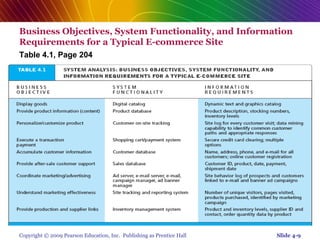
Business Objectives, System Functionality, and Information
Requirements for a Typical E-commerce Site
Table 4.1, Page 204
Slide 4-9
Copyright © 2009 Pearson Education, Inc. Publishing as Prentice Hall
Systems Design: Hardware and
Software Platforms
 System design specification:
 Description of main components of a system and
their relationship to one another
 Two components of system design:
 Logical design
 Data flow diagrams, processing functions,
databases
 Physical design
 Specifies actual physical, software components,
models, etc.
Slide 4-10
Copyright © 2009 Pearson Education, Inc. Publishing as Prentice Hall
Logical Design for a Simple Web Site
Figure 4.3 (a), Page 206
Slide 4-11
Copyright © 2009 Pearson Education, Inc. Publishing as Prentice Hall
Physical Design for a Simple Web Site
Figure 4.3 (b), Page 206
Slide 4-12
Copyright © 2009 Pearson Education, Inc. Publishing as Prentice Hall
Building the System: In-House versus
Outsourcing
 Outsourcing: Hiring vendors to provide services
involved in building site
 Build own vs. outsourcing:
 Build your own requires team with diverse skill set;
choice of software tools; both risks and possible
benefits
 Host own vs. outsourcing
 Hosting: Hosting company responsible for ensuring
site is accessible 24/7, for monthly fee
 Co-location: Firm purchases or leases Web server
(with control over its operation), but server is located
at vendor’s facility
Slide 4-13
Copyright © 2009 Pearson Education, Inc. Publishing as Prentice Hall
Choices in Building and Hosting
Figure 4.4, Page 207
Slide 4-14
Copyright © 2009 Pearson Education, Inc. Publishing as Prentice Hall
Insight on Business
Curly Hair and Tattoos: Getting
Started on the Cheap
Class Discussion
 How does a small, niche Web site become
profitable?
 What is the primary source of income for these
kinds of sites?
 What are Internet incubators and what is their
relationship to the ventures they support?
Slide 4-15
Copyright © 2009 Pearson Education, Inc. Publishing as Prentice Hall
Testing, Implementation, and
Maintenance
 Testing
 Unit testing
 System testing
 Acceptance testing
 Implementation and maintenance:
 Maintenance is ongoing
 Costs of maintenance parallel to development costs
 Benchmarking: Comparing site to competitors in
terms of response speed, quality of layout, and
design
Slide 4-16
Copyright © 2009 Pearson Education, Inc. Publishing as Prentice Hall
Factors in Web Site Optimization
Figure 4.7, Page 213
Slide 4-17
Copyright © 2009 Pearson Education, Inc. Publishing as Prentice Hall
Simple versus Multi-tiered Web Site
Architecture
 System architecture:
 Arrangement of software, machinery, and tasks in
an information system needed to achieve a
specific functionality
 Two-tier architecture
 Web server and database server
 Multi-tier architecture
 Web application servers
 Backend, legacy databases
Slide 4-18
Copyright © 2009 Pearson Education, Inc. Publishing as Prentice Hall
Two-Tier E-commerce Architecture
Figure 4.9(a), Page 216
Slide 4-19
Copyright © 2009 Pearson Education, Inc. Publishing as Prentice Hall
Multi-tier E-commerce Architecture
Figure 4.9(b), Page 216
Slide 4-20
Copyright © 2009 Pearson Education, Inc. Publishing as Prentice Hall
Web Server Software
 All e-commerce sites require basic Web server
software to answer HTTP requests from
customers
 Apache
 Leading Web server software (50% of market)
 Works only with UNIX, Linux OSs
 Microsoft’s Internet Information Server (IIS)
 Second major Web server software (35% of market)
 Windows-based
Slide 4-21
Copyright © 2009 Pearson Education, Inc. Publishing as Prentice Hall
Basic Functionality Provided by Web
Servers
Table 4.3, Page 218
Slide 4-22
Copyright © 2009 Pearson Education, Inc. Publishing as Prentice Hall
Site Management Tools
 Basic site management tools
 Included in all Web servers
 Verify that links on pages are still valid
 Identify orphan files
 Third-party software and services for advanced
site management
 Monitor customer purchases, marketing campaign
effectiveness, etc.
 e.g. WebTrends
Slide 4-23
Copyright © 2009 Pearson Education, Inc. Publishing as Prentice Hall
Dynamic Page Generation Tools
 Dynamic page generation:
 Contents of Web page stored as objects in database
and fetched when needed
 Common tools:
 CGI (Common Gateway Interface)
 ASP (Active Server Pages)
 JSP (Java Server Pages)
 Advantages
 Lowers menu costs
 Permits easy online market segmentation
 Enables cost-free price discrimination
 Enables Web content management system (WCMS)
Slide 4-24
Copyright © 2009 Pearson Education, Inc. Publishing as Prentice Hall
Application Servers
 Web application servers:
 Provide specific business functionality required for
a Web site
 Middleware
 Isolate business applications from Web servers
and databases
 Single-function applications increasingly being
replaced by integrated software tools that combine
all functionality needed for e-commerce site
Slide 4-25
Copyright © 2009 Pearson Education, Inc. Publishing as Prentice Hall
Application Servers and Their Functions
Table 4.4, Page 222
Slide 4-26
Copyright © 2009 Pearson Education, Inc. Publishing as Prentice Hall
E-commerce Merchant Server Software
 Provides the basic functionality for online sales
 Online catalog
 Shopping cart
 Credit card processing
 Merchant server software packages:
 Offer integrated environment
 E-commerce merchant services
 e.g. Yahoo’s Small Business Merchant Solutions
 Open source Web building tools:
 e.g. Apache Web server, MySQL, PHP, PERL
Slide 4-27
Copyright © 2009 Pearson Education, Inc. Publishing as Prentice Hall
Choosing the Hardware for an
E-commerce Site
 Hardware platform:
 Underlying computing equipment that system uses to
achieve e-commerce functionality
 Objective:
 Have enough platform capacity to meet peak demand
but not so much that you waste money
 Important to understand the different factors that
affect speed, capacity, and scalability of a site
Slide 4-28
Copyright © 2009 Pearson Education, Inc. Publishing as Prentice Hall
Right-Sizing Your Hardware
Platform: The Demand Side
 Demand that customers put on site the most
important factor affecting the speed of site
 Factors involved in overall demand:
 Number of simultaneous users in peak periods
 Nature of customer requests (user profile)
 Type of content (dynamic versus static Web pages)
 Required security
 Number of items in inventory
 Number of page requests
 Speed of legacy applications
Slide 4-29
Copyright © 2009 Pearson Education, Inc. Publishing as Prentice Hall
Factors in Right-sizing an E-commerce Platform
Table 4.7, Page 227
Slide 4-30
Copyright © 2009 Pearson Education, Inc. Publishing as Prentice Hall
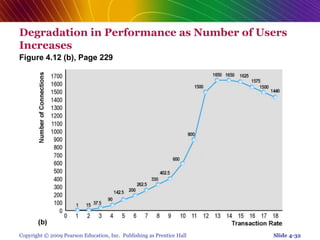
Degradation in Performance as Number of Users
Increases
Figure 4.12 (a), Page 229
Slide 4-31
Copyright © 2009 Pearson Education, Inc. Publishing as Prentice Hall Slide 4-32
Figure 4.12 (b), Page 229
Degradation in Performance as Number of Users
Increases
Copyright © 2009 Pearson Education, Inc. Publishing as Prentice Hall
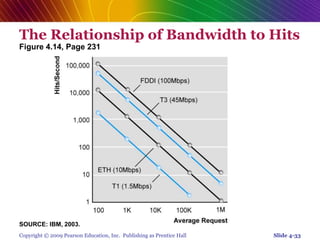
The Relationship of Bandwidth to Hits
Figure 4.14, Page 231
Slide 4-33
SOURCE: IBM, 2003.
Copyright © 2009 Pearson Education, Inc. Publishing as Prentice Hall
Right-Sizing Your Hardware
Platform: The Supply Side
 Scalability:
 Ability of site to increase in size as demand warrants
 Ways to scale hardware:
 Vertically
 Increase processing power of individual components
 Horizontally
 Employ multiple computers to share workload
 Improve processing architecture
Slide 4-34
Copyright © 2009 Pearson Education, Inc. Publishing as Prentice Hall
Vertical and Horizontal Scaling Techniques
Table 4.8, Page 231
Slide 4-35
Copyright © 2009 Pearson Education, Inc. Publishing as Prentice Hall
Vertically Scaling a System
Figure 4.15, Page 232
Slide 4-36
Copyright © 2009 Pearson Education, Inc. Publishing as Prentice Hall
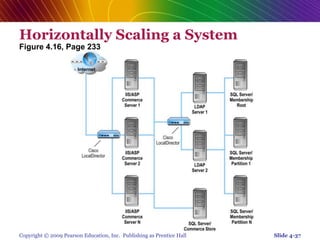
Horizontally Scaling a System
Figure 4.16, Page 233
Slide 4-37
Copyright © 2009 Pearson Education, Inc. Publishing as Prentice Hall
Improving the Processing Architecture of Your Site
Table 4.9, Page 234
Slide 4-38
Copyright © 2009 Pearson Education, Inc. Publishing as Prentice Hall
Web Site Design: Basic Business
Considerations
 Need design guidelines and software tools
that can cost-effectively achieve required
business functionality
 e.g. enabling customers to find what they need,
make purchase, leave
 75% users say they would not revisit a Web
site that they found annoying to use
Slide 4-39
Copyright © 2009 Pearson Education, Inc. Publishing as Prentice Hall
E-commerce
Web Site
Features that
Annoy
Customers
Figure 4.17, Page 235
Slide 4-40
SOURCE: Based on data from Hostway
Corporation’s survey, Consumers’ Pet
Peeves about Commercial Web Sites,
Hostway Corporation, 2007.
Copyright © 2009 Pearson Education, Inc. Publishing as Prentice Hall
The Eight Most Important Factors in
Successful E-commerce Site Design
Table 4.10, Page 236
Slide 4-41
Copyright © 2009 Pearson Education, Inc. Publishing as Prentice Hall
Tools for Web Site Optimization
 Optimization:
 How to attract a large audience to Web site
 Search engine rankings
 Keywords and page titles
 Identify market niches
 Offer expertise
 Link to and from other sites
 Buy ads
 Local e-commerce
Slide 4-42
Copyright © 2009 Pearson Education, Inc. Publishing as Prentice Hall
Tools for Interactivity and Active
Content
 Widgets:
 Small pre-built chunk of code that executes
automatically in an HTML Web page
 Mashups:
 Pull functionality/data from one program and include it
in another
 CGI (Common Gateway Interface):
 Standards for communication between browser and
program running on a server that allows for
interaction between the user and the server
Slide 4-43
Copyright © 2009 Pearson Education, Inc. Publishing as Prentice Hall
Tools for Interactivity and Active
Content (cont’d)
 ASP (Active Server Pages):
 Used to build dynamic pages with Microsoft’s IIS
 Java:
 Used to create interactivity and active content on
client computer
 JSP (Java Server Pages):
 Similar to CGI and ASP; allows developers to use
HTML, JSP scripts, and Java to dynamically generate
Web pages
Slide 4-44
Copyright © 2009 Pearson Education, Inc. Publishing as Prentice Hall
Tools for Interactivity and Active
Content (cont’d)
 JavaScript:
 Used to control objects on a Web page and
handle interactions with browser
 ActiveX:
 Invented by Microsoft to compete with Java
 VBScript:
 Invented by Microsoft to compete with JavaScript
 ColdFusion:
 Integrated server-side environment for developing
interactive Web applications
Slide 4-45
Copyright © 2009 Pearson Education, Inc. Publishing as Prentice Hall
Insight on Technology
Pumping Up the Customer
Experience Using AJAX and Flash
Class Discussion
 What is AJAX? How does it work?
 Compare AJAX to the traditional client/server
Web model.
 How does Google Maps use AJAX?
 What are some alternative ways to achieve the
same results as AJAX?
Slide 4-46
Copyright © 2009 Pearson Education, Inc. Publishing as Prentice Hall
Personalization Tools
 Personalization:
 Ability to treat people based on their personal
qualities and prior history with your site
 Customization:
 Ability to change the product to better fit the needs
of the customer
 Cookies:
 Primary method for achieving personalization and
customization
Slide 4-47
Copyright © 2009 Pearson Education, Inc. Publishing as Prentice Hall
The Information Policy Set
 Privacy policy
 Set of public statements declaring how site will
treat customers’ personal information that is
gathered by site
 Accessibility rules
 Set of design objectives that ensure disabled
users can affectively access site
Slide 4-48
Copyright © 2009 Pearson Education, Inc. Publishing as Prentice Hall
Insight on Society
Designing for Accessibility with Web 2.0
Class Discussion
 What is Section 508 of the Rehabilitation Act?
 Why are merchants reluctant to make their Web
sites accessible to disabled Americans?
 How can Web sites be made more accessible?
 Should all Web sites be required by law to
provide “equivalent alternatives” for visual and
sound content?
Slide 4-49
Copyright © 2009 Pearson Education, Inc. Publishing as Prentice Hall Slide 4-50
All rights reserved. No part of this publication may be reproduced, stored in a
retrieval system, or transmitted, in any form or by any means, electronic,
mechanical, photocopying, recording, or otherwise, without the prior written
permission of the publisher. Printed in the United States of America.
Copyright © 2009 Pearson Education, Inc.
Publishing as Prentice Hall

Building an E-commerce website.ppt

  • 1.
    Copyright © 2009Pearson Education, Inc. Publishing as Prentice Hall Copyright © 2009 Pearson Education, Inc. Slide 4-1 E-commerce Kenneth C. Laudon Carol Guercio Traver business. technology. society. Fifth Edition
  • 2.
    Copyright © 2009Pearson Education, Inc. Publishing as Prentice Hall Copyright © 2009 Pearson Education, Inc. Slide 4-2 Chapter 4 Building an E-commerce Web Site
  • 3.
    Copyright © 2009Pearson Education, Inc. Publishing as Prentice Hall Right-Sizing a Web Site Class Discussion  What are the factors you should take into account when sizing a Web site’s infrastructure?  Why is peak usage an important factor to consider?  What did eBay discover from its use of OPERA?  How can operators of smaller sites deal with the right-sizing issue? Slide 4-3
  • 4.
    Copyright © 2009Pearson Education, Inc. Publishing as Prentice Hall Building an E-commerce Site: A Systematic Approach  Most important management challenges in building a successful e-commerce site are:  Developing a clear understanding of business objectives  Knowing how to choose the right technology to achieve those objectives Slide 4-4
  • 5.
    Copyright © 2009Pearson Education, Inc. Publishing as Prentice Hall Pieces of the Site-Building Puzzle  Main areas where you will need to make decisions in building a site include:  Human resources and organizational capabilities—creating a team that has the skill set to build and manage a successful site  Hardware  Software  Telecommunications  Site design Slide 4-5
  • 6.
    Copyright © 2009Pearson Education, Inc. Publishing as Prentice Hall The Systems Development Life Cycle  Methodology for understanding business objectives of a system and designing an appropriate solution  Five major steps in SDLC 1. Systems analysis/planning 2. Systems design 3. Building the system 4. Testing 5. Implementation Slide 4-6
  • 7.
    Copyright © 2009Pearson Education, Inc. Publishing as Prentice Hall Web Site Systems Development Life Cycle Figure 4.2, Page 203 Slide 4-7
  • 8.
    Copyright © 2009Pearson Education, Inc. Publishing as Prentice Hall System Analysis/Planning: Identifying Business Objectives, System Functionality, and Information Requirements  Business objectives:  List of capabilities you want your site to have  System functionalities:  List of information system capabilities needed to achieve business objectives  Information requirements:  Information elements that system must produce in order to achieve business objectives Slide 4-8
  • 9.
    Copyright © 2009Pearson Education, Inc. Publishing as Prentice Hall Business Objectives, System Functionality, and Information Requirements for a Typical E-commerce Site Table 4.1, Page 204 Slide 4-9
  • 10.
    Copyright © 2009Pearson Education, Inc. Publishing as Prentice Hall Systems Design: Hardware and Software Platforms  System design specification:  Description of main components of a system and their relationship to one another  Two components of system design:  Logical design  Data flow diagrams, processing functions, databases  Physical design  Specifies actual physical, software components, models, etc. Slide 4-10
  • 11.
    Copyright © 2009Pearson Education, Inc. Publishing as Prentice Hall Logical Design for a Simple Web Site Figure 4.3 (a), Page 206 Slide 4-11
  • 12.
    Copyright © 2009Pearson Education, Inc. Publishing as Prentice Hall Physical Design for a Simple Web Site Figure 4.3 (b), Page 206 Slide 4-12
  • 13.
    Copyright © 2009Pearson Education, Inc. Publishing as Prentice Hall Building the System: In-House versus Outsourcing  Outsourcing: Hiring vendors to provide services involved in building site  Build own vs. outsourcing:  Build your own requires team with diverse skill set; choice of software tools; both risks and possible benefits  Host own vs. outsourcing  Hosting: Hosting company responsible for ensuring site is accessible 24/7, for monthly fee  Co-location: Firm purchases or leases Web server (with control over its operation), but server is located at vendor’s facility Slide 4-13
  • 14.
    Copyright © 2009Pearson Education, Inc. Publishing as Prentice Hall Choices in Building and Hosting Figure 4.4, Page 207 Slide 4-14
  • 15.
    Copyright © 2009Pearson Education, Inc. Publishing as Prentice Hall Insight on Business Curly Hair and Tattoos: Getting Started on the Cheap Class Discussion  How does a small, niche Web site become profitable?  What is the primary source of income for these kinds of sites?  What are Internet incubators and what is their relationship to the ventures they support? Slide 4-15
  • 16.
    Copyright © 2009Pearson Education, Inc. Publishing as Prentice Hall Testing, Implementation, and Maintenance  Testing  Unit testing  System testing  Acceptance testing  Implementation and maintenance:  Maintenance is ongoing  Costs of maintenance parallel to development costs  Benchmarking: Comparing site to competitors in terms of response speed, quality of layout, and design Slide 4-16
  • 17.
    Copyright © 2009Pearson Education, Inc. Publishing as Prentice Hall Factors in Web Site Optimization Figure 4.7, Page 213 Slide 4-17
  • 18.
    Copyright © 2009Pearson Education, Inc. Publishing as Prentice Hall Simple versus Multi-tiered Web Site Architecture  System architecture:  Arrangement of software, machinery, and tasks in an information system needed to achieve a specific functionality  Two-tier architecture  Web server and database server  Multi-tier architecture  Web application servers  Backend, legacy databases Slide 4-18
  • 19.
    Copyright © 2009Pearson Education, Inc. Publishing as Prentice Hall Two-Tier E-commerce Architecture Figure 4.9(a), Page 216 Slide 4-19
  • 20.
    Copyright © 2009Pearson Education, Inc. Publishing as Prentice Hall Multi-tier E-commerce Architecture Figure 4.9(b), Page 216 Slide 4-20
  • 21.
    Copyright © 2009Pearson Education, Inc. Publishing as Prentice Hall Web Server Software  All e-commerce sites require basic Web server software to answer HTTP requests from customers  Apache  Leading Web server software (50% of market)  Works only with UNIX, Linux OSs  Microsoft’s Internet Information Server (IIS)  Second major Web server software (35% of market)  Windows-based Slide 4-21
  • 22.
    Copyright © 2009Pearson Education, Inc. Publishing as Prentice Hall Basic Functionality Provided by Web Servers Table 4.3, Page 218 Slide 4-22
  • 23.
    Copyright © 2009Pearson Education, Inc. Publishing as Prentice Hall Site Management Tools  Basic site management tools  Included in all Web servers  Verify that links on pages are still valid  Identify orphan files  Third-party software and services for advanced site management  Monitor customer purchases, marketing campaign effectiveness, etc.  e.g. WebTrends Slide 4-23
  • 24.
    Copyright © 2009Pearson Education, Inc. Publishing as Prentice Hall Dynamic Page Generation Tools  Dynamic page generation:  Contents of Web page stored as objects in database and fetched when needed  Common tools:  CGI (Common Gateway Interface)  ASP (Active Server Pages)  JSP (Java Server Pages)  Advantages  Lowers menu costs  Permits easy online market segmentation  Enables cost-free price discrimination  Enables Web content management system (WCMS) Slide 4-24
  • 25.
    Copyright © 2009Pearson Education, Inc. Publishing as Prentice Hall Application Servers  Web application servers:  Provide specific business functionality required for a Web site  Middleware  Isolate business applications from Web servers and databases  Single-function applications increasingly being replaced by integrated software tools that combine all functionality needed for e-commerce site Slide 4-25
  • 26.
    Copyright © 2009Pearson Education, Inc. Publishing as Prentice Hall Application Servers and Their Functions Table 4.4, Page 222 Slide 4-26
  • 27.
    Copyright © 2009Pearson Education, Inc. Publishing as Prentice Hall E-commerce Merchant Server Software  Provides the basic functionality for online sales  Online catalog  Shopping cart  Credit card processing  Merchant server software packages:  Offer integrated environment  E-commerce merchant services  e.g. Yahoo’s Small Business Merchant Solutions  Open source Web building tools:  e.g. Apache Web server, MySQL, PHP, PERL Slide 4-27
  • 28.
    Copyright © 2009Pearson Education, Inc. Publishing as Prentice Hall Choosing the Hardware for an E-commerce Site  Hardware platform:  Underlying computing equipment that system uses to achieve e-commerce functionality  Objective:  Have enough platform capacity to meet peak demand but not so much that you waste money  Important to understand the different factors that affect speed, capacity, and scalability of a site Slide 4-28
  • 29.
    Copyright © 2009Pearson Education, Inc. Publishing as Prentice Hall Right-Sizing Your Hardware Platform: The Demand Side  Demand that customers put on site the most important factor affecting the speed of site  Factors involved in overall demand:  Number of simultaneous users in peak periods  Nature of customer requests (user profile)  Type of content (dynamic versus static Web pages)  Required security  Number of items in inventory  Number of page requests  Speed of legacy applications Slide 4-29
  • 30.
    Copyright © 2009Pearson Education, Inc. Publishing as Prentice Hall Factors in Right-sizing an E-commerce Platform Table 4.7, Page 227 Slide 4-30
  • 31.
    Copyright © 2009Pearson Education, Inc. Publishing as Prentice Hall Degradation in Performance as Number of Users Increases Figure 4.12 (a), Page 229 Slide 4-31
  • 32.
    Copyright © 2009Pearson Education, Inc. Publishing as Prentice Hall Slide 4-32 Figure 4.12 (b), Page 229 Degradation in Performance as Number of Users Increases
  • 33.
    Copyright © 2009Pearson Education, Inc. Publishing as Prentice Hall The Relationship of Bandwidth to Hits Figure 4.14, Page 231 Slide 4-33 SOURCE: IBM, 2003.
  • 34.
    Copyright © 2009Pearson Education, Inc. Publishing as Prentice Hall Right-Sizing Your Hardware Platform: The Supply Side  Scalability:  Ability of site to increase in size as demand warrants  Ways to scale hardware:  Vertically  Increase processing power of individual components  Horizontally  Employ multiple computers to share workload  Improve processing architecture Slide 4-34
  • 35.
    Copyright © 2009Pearson Education, Inc. Publishing as Prentice Hall Vertical and Horizontal Scaling Techniques Table 4.8, Page 231 Slide 4-35
  • 36.
    Copyright © 2009Pearson Education, Inc. Publishing as Prentice Hall Vertically Scaling a System Figure 4.15, Page 232 Slide 4-36
  • 37.
    Copyright © 2009Pearson Education, Inc. Publishing as Prentice Hall Horizontally Scaling a System Figure 4.16, Page 233 Slide 4-37
  • 38.
    Copyright © 2009Pearson Education, Inc. Publishing as Prentice Hall Improving the Processing Architecture of Your Site Table 4.9, Page 234 Slide 4-38
  • 39.
    Copyright © 2009Pearson Education, Inc. Publishing as Prentice Hall Web Site Design: Basic Business Considerations  Need design guidelines and software tools that can cost-effectively achieve required business functionality  e.g. enabling customers to find what they need, make purchase, leave  75% users say they would not revisit a Web site that they found annoying to use Slide 4-39
  • 40.
    Copyright © 2009Pearson Education, Inc. Publishing as Prentice Hall E-commerce Web Site Features that Annoy Customers Figure 4.17, Page 235 Slide 4-40 SOURCE: Based on data from Hostway Corporation’s survey, Consumers’ Pet Peeves about Commercial Web Sites, Hostway Corporation, 2007.
  • 41.
    Copyright © 2009Pearson Education, Inc. Publishing as Prentice Hall The Eight Most Important Factors in Successful E-commerce Site Design Table 4.10, Page 236 Slide 4-41
  • 42.
    Copyright © 2009Pearson Education, Inc. Publishing as Prentice Hall Tools for Web Site Optimization  Optimization:  How to attract a large audience to Web site  Search engine rankings  Keywords and page titles  Identify market niches  Offer expertise  Link to and from other sites  Buy ads  Local e-commerce Slide 4-42
  • 43.
    Copyright © 2009Pearson Education, Inc. Publishing as Prentice Hall Tools for Interactivity and Active Content  Widgets:  Small pre-built chunk of code that executes automatically in an HTML Web page  Mashups:  Pull functionality/data from one program and include it in another  CGI (Common Gateway Interface):  Standards for communication between browser and program running on a server that allows for interaction between the user and the server Slide 4-43
  • 44.
    Copyright © 2009Pearson Education, Inc. Publishing as Prentice Hall Tools for Interactivity and Active Content (cont’d)  ASP (Active Server Pages):  Used to build dynamic pages with Microsoft’s IIS  Java:  Used to create interactivity and active content on client computer  JSP (Java Server Pages):  Similar to CGI and ASP; allows developers to use HTML, JSP scripts, and Java to dynamically generate Web pages Slide 4-44
  • 45.
    Copyright © 2009Pearson Education, Inc. Publishing as Prentice Hall Tools for Interactivity and Active Content (cont’d)  JavaScript:  Used to control objects on a Web page and handle interactions with browser  ActiveX:  Invented by Microsoft to compete with Java  VBScript:  Invented by Microsoft to compete with JavaScript  ColdFusion:  Integrated server-side environment for developing interactive Web applications Slide 4-45
  • 46.
    Copyright © 2009Pearson Education, Inc. Publishing as Prentice Hall Insight on Technology Pumping Up the Customer Experience Using AJAX and Flash Class Discussion  What is AJAX? How does it work?  Compare AJAX to the traditional client/server Web model.  How does Google Maps use AJAX?  What are some alternative ways to achieve the same results as AJAX? Slide 4-46
  • 47.
    Copyright © 2009Pearson Education, Inc. Publishing as Prentice Hall Personalization Tools  Personalization:  Ability to treat people based on their personal qualities and prior history with your site  Customization:  Ability to change the product to better fit the needs of the customer  Cookies:  Primary method for achieving personalization and customization Slide 4-47
  • 48.
    Copyright © 2009Pearson Education, Inc. Publishing as Prentice Hall The Information Policy Set  Privacy policy  Set of public statements declaring how site will treat customers’ personal information that is gathered by site  Accessibility rules  Set of design objectives that ensure disabled users can affectively access site Slide 4-48
  • 49.
    Copyright © 2009Pearson Education, Inc. Publishing as Prentice Hall Insight on Society Designing for Accessibility with Web 2.0 Class Discussion  What is Section 508 of the Rehabilitation Act?  Why are merchants reluctant to make their Web sites accessible to disabled Americans?  How can Web sites be made more accessible?  Should all Web sites be required by law to provide “equivalent alternatives” for visual and sound content? Slide 4-49
  • 50.
    Copyright © 2009Pearson Education, Inc. Publishing as Prentice Hall Slide 4-50 All rights reserved. No part of this publication may be reproduced, stored in a retrieval system, or transmitted, in any form or by any means, electronic, mechanical, photocopying, recording, or otherwise, without the prior written permission of the publisher. Printed in the United States of America. Copyright © 2009 Pearson Education, Inc. Publishing as Prentice Hall