Transfer and promotion
A PRIME CORPORATE SUCCESS DETERMINANT
The Glindex (Index and Glossary)
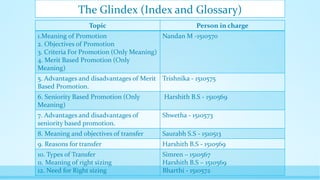
Topic Person in charge
1.Meaning of Promotion
2. Objectives of Promotion
3. Criteria For Promotion (Only Meaning)
4. Merit Based Promotion (Only
Meaning)
Nandan M -1510570
5. Advantages and disadvantages of Merit
Based Promotion.
Trishnika - 1510575
6. Seniority Based Promotion (Only
Meaning)
Harshith B.S - 1510569
7. Advantages and disadvantages of
seniority based promotion.
Shwetha - 1510573
8. Meaning and objectives of transfer Saurabh S.S - 1510513
9. Reasons for transfer Harshith B.S - 1510569
10. Types of Transfer
11. Meaning of right sizing
12. Need for Right sizing
Simren – 1510567
Harshith B.S – 1510569
Bharthi - 1510572
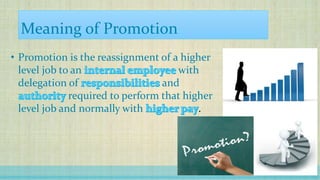
Meaning of Promotion
• Promotion is the reassignment of a higher
level job to an with
delegation of and
required to perform that higher
level job and normally with .
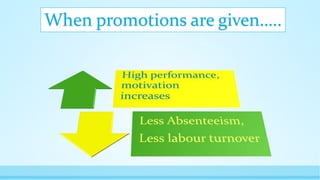
When promotions are given…..
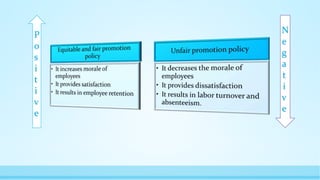
P
o
s
i
t
i
v
e
N
e
g
a
t
i
v
e
Purposes or objectives of promotion
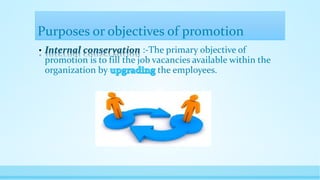
• Internal conservation :-The primary objective of
promotion is to fill the job vacancies available within the
organization by the employees.
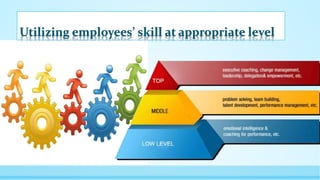
Utilizing employees’ skill at appropriate level
Purposes or objectives of promotion
• Reduces labour turnover :-To promote employee’s self-
development and make them await their turn of promotions. It
reduces
Purposes or objectives of promotion
• To promote interest :-To promote interest in
and in team
development areas.
• To boost morale :- Organizations seek to encourage
efficiency and loyalty among the employees through
motivation.
Purposes or objectives of promotion
• To Improve constructive competition
• To reward loyal and committed employees
• To impress upon others that opportunities are available
to them too in the organization, if they perform well.
Please note down…… Objectives of Promotion
• Internal conservation
• Utilizing employees’ skill at appropriate level
• Reduces labour turnover
• To promote interest
• To boost morale
• To Improve constructive competition
• To reward loyal and committed employees
• To impress upon others that opportunities are available
to them too in the organization, if they perform well.
Basis or Criteria of Promotion
• Promotion is one of the highly tasks of HR Managers
especially when it involves selecting from a pool of candidates.
• This is because employees who do not get promotion may blame
the system if it is .
• Therefore an organization should be careful with its promotion
policy and criteria.
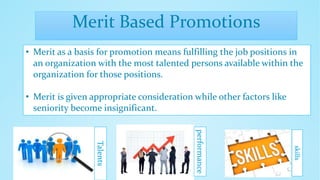
Merit Based Promotions
• Merit as a basis for promotion means fulfilling the job positions in
an organization with the most talented persons available within the
organization for those positions.
• Merit is given appropriate consideration while other factors like
seniority become insignificant.
Talents
performance
skills
Merit Based Promotions
Advantages
• It improves both employee and organizational
• It acts as an and for the competent and diligent employees
of the organizations.
• Promotions on the basis of merit necessitates continuous
by the employees throughout their career to remain competitive in the
lab our market.
• It increases of the employees and keeps the organization dynamic to meet
the challenges from the external environment.
Merit Based Promotions
Disadvantages
• Organizations may find it difficult to the employees and their
unions about the fairness of the promotion system when merit is the sole
criterion in promotion.
• This method can cause intense and destructive among the
employees, leading to a mutual block of performance.
• It may favor the with fresh and relevant knowledge,
thereby putting the aged employees in a disadvantageous position.
• It can cause undue for the employees if they are promoted.
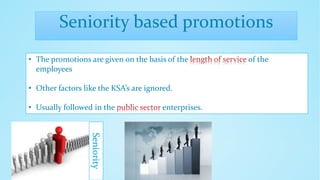
Seniority based promotions
• The promotions are given on the basis of the of the
employees
• Other factors like the KSA’s are ignored.
• Usually followed in the enterprises.
Seniority
Seniority based promotions
Advantages
• This method is suitable for organizations and avoids
conflicts.
• It may improve the and of the employees.
• There arise no bitter feelings in any employee at the end of the
promotion process.
• It is simple and straight forward.
Seniority based promotions
Disadvantages
• It offers for the efficiency, creativity and commitment of the
sincere and hardworking employees.
• It kills the of employees.
• There will be to change.
• It may lead to
Seniority-Cum-Merit
• Both the and are taken into consideration.
• The primary objective is to include the virtues of both
merit and seniority.
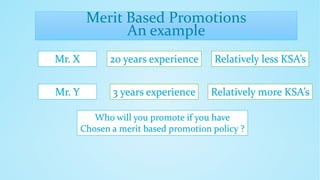
Merit Based Promotions
An example
Mr. X 20 years experience Relatively less KSA’s
Mr. Y 3 years experience Relatively more KSA’s
Who will you promote if you have
Chosen a merit based promotion policy ?
Transfer
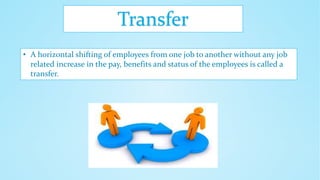
• A horizontal shifting of employees from one job to another without any job
related increase in the pay, benefits and status of the employees is called a
transfer.
Reasons for Transfer
• Over a period of time, the productivity of an employee may decline because
of the monotony of his or her job. To break this monotony, the employee is
transferred.
Reasons for Transfer
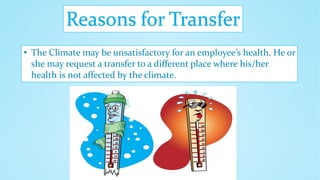
• The Climate may be unsatisfactory for an employee’s health. He or
she may request a transfer to a different place where his/her
health is not affected by the climate.
Reasons for transfer
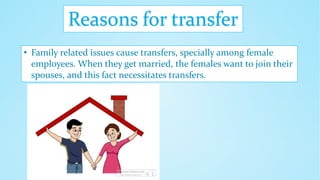
• Family related issues cause transfers, specially among female
employees. When they get married, the females want to join their
spouses, and this fact necessitates transfers.
Objectives or Purposes of Transfer
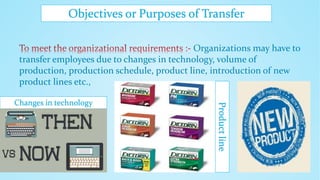
Organizations may have to
transfer employees due to changes in technology, volume of
production, production schedule, product line, introduction of new
product lines etc.,
Changes in technology
Productline
Objectives or Purposes of Transfer
• To satisfy the employee needs :- to reduce the
boredom of the employees etc., transfer may be
given.
Objectives or Purposes of Transfer
• Correction of faulty initial placement of an
employee.
Objectives or Purposes of Transfer
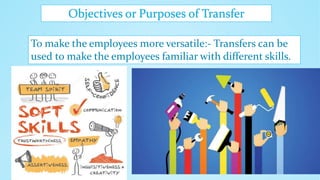
To make the employees more versatile:- Transfers can be
used to make the employees familiar with different skills.
Objectives or Purposes of Transfer
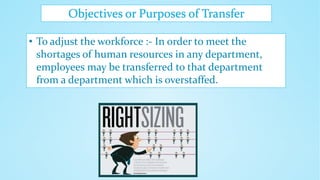
• To adjust the workforce :- In order to meet the
shortages of human resources in any department,
employees may be transferred to that department
from a department which is overstaffed.
Objectives or Purposes of Transfer
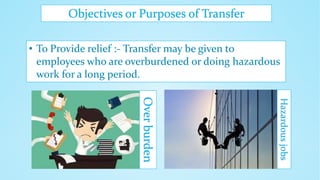
• To Provide relief :- Transfer may be given to
employees who are overburdened or doing hazardous
work for a long period.
Overburden
Hazardousjobs
Objectives or Purposes of Transfer
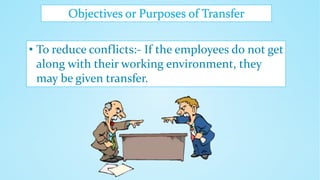
• To reduce conflicts:- If the employees do not get
along with their working environment, they
may be given transfer.
Objectives or Purposes of Transfer
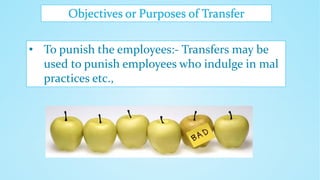
• To punish the employees:- Transfers may be
used to punish employees who indulge in mal
practices etc.,
Please Note Down… Objectives of transfer
• To meet the organizational requirements
• To satisfy the employee needs
• To utilize employees better
• To make the employees more versatile
• To adjust the workforce
• To Provide relief
• To reduce conflicts
• To punish the employees
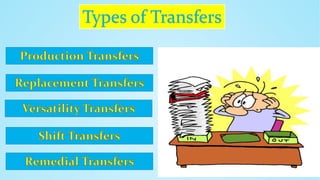
Types of Transfers
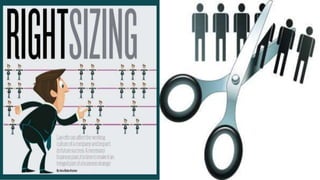
• Right-sizing of workforce refers to employing and maintaining exact number of employees with the required
skills, knowledge and abilities to perform the existing number of jobs in an organization.
Meaning
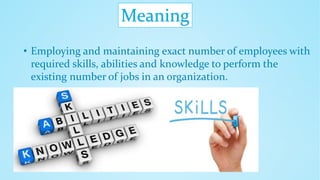
• Employing and maintaining exact number of employees with
required skills, abilities and knowledge to perform the
existing number of jobs in an organization.
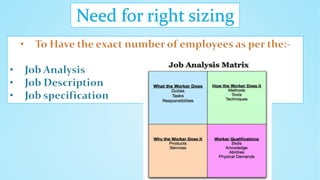
Need for right sizing
References
• Human Resource management – P Subbarao
• Human Resource management – VSP Rao
• Human Resource management – Gary Dessler
• Human Resource management 7e – K Aswathappa
• Slide Share Articles
• Online research articles
Transfer and promotion

Transfer and promotion

  • 1.
    Transfer and promotion APRIME CORPORATE SUCCESS DETERMINANT
  • 2.
    The Glindex (Indexand Glossary) Topic Person in charge 1.Meaning of Promotion 2. Objectives of Promotion 3. Criteria For Promotion (Only Meaning) 4. Merit Based Promotion (Only Meaning) Nandan M -1510570 5. Advantages and disadvantages of Merit Based Promotion. Trishnika - 1510575 6. Seniority Based Promotion (Only Meaning) Harshith B.S - 1510569 7. Advantages and disadvantages of seniority based promotion. Shwetha - 1510573 8. Meaning and objectives of transfer Saurabh S.S - 1510513 9. Reasons for transfer Harshith B.S - 1510569 10. Types of Transfer 11. Meaning of right sizing 12. Need for Right sizing Simren – 1510567 Harshith B.S – 1510569 Bharthi - 1510572
  • 4.
    Meaning of Promotion •Promotion is the reassignment of a higher level job to an with delegation of and required to perform that higher level job and normally with .
  • 5.
  • 6.
  • 7.
    Purposes or objectivesof promotion • Internal conservation :-The primary objective of promotion is to fill the job vacancies available within the organization by the employees.
  • 8.
    Utilizing employees’ skillat appropriate level
  • 9.
    Purposes or objectivesof promotion • Reduces labour turnover :-To promote employee’s self- development and make them await their turn of promotions. It reduces
  • 10.
    Purposes or objectivesof promotion • To promote interest :-To promote interest in and in team development areas.
  • 14.
    • To boostmorale :- Organizations seek to encourage efficiency and loyalty among the employees through motivation. Purposes or objectives of promotion
  • 15.
    Purposes or objectivesof promotion • To Improve constructive competition
  • 16.
    • To rewardloyal and committed employees
  • 17.
    • To impressupon others that opportunities are available to them too in the organization, if they perform well.
  • 18.
    Please note down……Objectives of Promotion • Internal conservation • Utilizing employees’ skill at appropriate level • Reduces labour turnover • To promote interest • To boost morale • To Improve constructive competition • To reward loyal and committed employees • To impress upon others that opportunities are available to them too in the organization, if they perform well.
  • 20.
    Basis or Criteriaof Promotion • Promotion is one of the highly tasks of HR Managers especially when it involves selecting from a pool of candidates. • This is because employees who do not get promotion may blame the system if it is . • Therefore an organization should be careful with its promotion policy and criteria.
  • 22.
    Merit Based Promotions •Merit as a basis for promotion means fulfilling the job positions in an organization with the most talented persons available within the organization for those positions. • Merit is given appropriate consideration while other factors like seniority become insignificant. Talents performance skills
  • 24.
    Merit Based Promotions Advantages •It improves both employee and organizational • It acts as an and for the competent and diligent employees of the organizations. • Promotions on the basis of merit necessitates continuous by the employees throughout their career to remain competitive in the lab our market. • It increases of the employees and keeps the organization dynamic to meet the challenges from the external environment.
  • 25.
    Merit Based Promotions Disadvantages •Organizations may find it difficult to the employees and their unions about the fairness of the promotion system when merit is the sole criterion in promotion. • This method can cause intense and destructive among the employees, leading to a mutual block of performance. • It may favor the with fresh and relevant knowledge, thereby putting the aged employees in a disadvantageous position. • It can cause undue for the employees if they are promoted.
  • 26.
    Seniority based promotions •The promotions are given on the basis of the of the employees • Other factors like the KSA’s are ignored. • Usually followed in the enterprises. Seniority
  • 27.
    Seniority based promotions Advantages •This method is suitable for organizations and avoids conflicts. • It may improve the and of the employees. • There arise no bitter feelings in any employee at the end of the promotion process. • It is simple and straight forward.
  • 28.
    Seniority based promotions Disadvantages •It offers for the efficiency, creativity and commitment of the sincere and hardworking employees. • It kills the of employees. • There will be to change. • It may lead to
  • 29.
    Seniority-Cum-Merit • Both theand are taken into consideration. • The primary objective is to include the virtues of both merit and seniority.
  • 30.
    Merit Based Promotions Anexample Mr. X 20 years experience Relatively less KSA’s Mr. Y 3 years experience Relatively more KSA’s Who will you promote if you have Chosen a merit based promotion policy ?
  • 32.
    Transfer • A horizontalshifting of employees from one job to another without any job related increase in the pay, benefits and status of the employees is called a transfer.
  • 33.
    Reasons for Transfer •Over a period of time, the productivity of an employee may decline because of the monotony of his or her job. To break this monotony, the employee is transferred.
  • 34.
    Reasons for Transfer •The Climate may be unsatisfactory for an employee’s health. He or she may request a transfer to a different place where his/her health is not affected by the climate.
  • 36.
    Reasons for transfer •Family related issues cause transfers, specially among female employees. When they get married, the females want to join their spouses, and this fact necessitates transfers.
  • 37.
    Objectives or Purposesof Transfer Organizations may have to transfer employees due to changes in technology, volume of production, production schedule, product line, introduction of new product lines etc., Changes in technology Productline
  • 38.
    Objectives or Purposesof Transfer • To satisfy the employee needs :- to reduce the boredom of the employees etc., transfer may be given.
  • 39.
    Objectives or Purposesof Transfer • Correction of faulty initial placement of an employee.
  • 40.
    Objectives or Purposesof Transfer To make the employees more versatile:- Transfers can be used to make the employees familiar with different skills.

  • 41.

    Objectives or Purposesof Transfer • To adjust the workforce :- In order to meet the shortages of human resources in any department, employees may be transferred to that department from a department which is overstaffed.
  • 42.
    Objectives or Purposesof Transfer • To Provide relief :- Transfer may be given to employees who are overburdened or doing hazardous work for a long period. Overburden Hazardousjobs
  • 43.
    Objectives or Purposesof Transfer • To reduce conflicts:- If the employees do not get along with their working environment, they may be given transfer.
  • 44.
    Objectives or Purposesof Transfer • To punish the employees:- Transfers may be used to punish employees who indulge in mal practices etc.,
  • 45.
    Please Note Down…Objectives of transfer • To meet the organizational requirements • To satisfy the employee needs • To utilize employees better • To make the employees more versatile • To adjust the workforce • To Provide relief • To reduce conflicts • To punish the employees
  • 46.
  • 47.
    • Right-sizing ofworkforce refers to employing and maintaining exact number of employees with the required skills, knowledge and abilities to perform the existing number of jobs in an organization.
  • 48.
    Meaning • Employing andmaintaining exact number of employees with required skills, abilities and knowledge to perform the existing number of jobs in an organization.
  • 49.
  • 54.
    References • Human Resourcemanagement – P Subbarao • Human Resource management – VSP Rao • Human Resource management – Gary Dessler • Human Resource management 7e – K Aswathappa • Slide Share Articles • Online research articles