Design  and Implementation of Relational Database Design Tool Guided By: Prof. Aruna Tiwari Computer Engineering Department Prepared By: Harish Shakya ME-Computer Engineering
Introduction It is a relational database design tool Define the all relational database concepts All concepts is part of successful relational database design without this database system can be inaccurate, slow and inefficient. Main basic concepts of Database are as follows
Introduction  ……cont. Normal Forms (1NF,2NF,3NF & BCNF) Canonical Cover Of  functional dependencies (minimal set of  Fd’s) Decomposition (Lossy &Lossless) Dependency Preservation Closer of Attributes
Introduction  …cont. This is a purely educational tool, means  he works like as teacher not same but with the help of this tool teacher teaches all concept of database normalization easily. That tool find the Normalization step by step with the help of decomposition and check all conditions. The Relational databases stores all its data inside tables, nothing more .
Objective Enhancing the teaching and learning Learning the Database normalization concepts easily. Provide alternative approach and its effectiveness in teaching database normalization. Positive impacts on student’s perceptions
Problem Statement Database Normalization concepts is theoretically easy but practically we find the normalization is tuff , So I have decided to focus my M.E project on the creation and use of educational tool. Number of tools are available but not fulfill our requirements  means that are not purely database normalization educational tool e.g.
Problem Statement  Existing Tool Datanamic tool Smart draw tool Toad data modeler DB designer Case studio DB tool
Who Used Student trying to learn database normalization concepts Practically Faculty used in Class room Unknown person who don’t know what is normalization.
How to Used It is simple software tool  this is input the relations and FD’s in given boxes and click the submit button  then load all information into the tool. They provide the  other different options View Schema Modify Schema Decompose a Relations
Proposed Methodology In  theoretically we find the key use of Dependency diagram but at the time of implementation we can’t use this so we use algorithms based concepts means find the key with the help of canonical cover of fds algorithms .
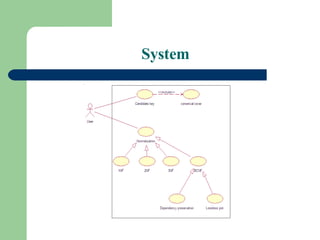
System
Provide in Facility Software provide the facility to find the key with the help of algorithms. Software will also provide the users to check the internal properties  of decomposition.
About Implementation …… We follow two Reference papers, Some drawbacks into that Papers we remove all weakness. Then after we can call the complete web based database design educational tool.
References A WEB-BASED TOOL TO ENHANCE TEACHING/LEARNING  DATABASE NORMALIZATION,   Hsiang-Jui Kung,2006  Southern Association for Information Systems Conference A database design tool  for the relational model of data ,IEEE transition 1984
Thank You

Design and Implementation of Relational Database Design Tool

  • 1.
    Design andImplementation of Relational Database Design Tool Guided By: Prof. Aruna Tiwari Computer Engineering Department Prepared By: Harish Shakya ME-Computer Engineering
  • 2.
    Introduction It isa relational database design tool Define the all relational database concepts All concepts is part of successful relational database design without this database system can be inaccurate, slow and inefficient. Main basic concepts of Database are as follows
  • 3.
    Introduction ……cont.Normal Forms (1NF,2NF,3NF & BCNF) Canonical Cover Of functional dependencies (minimal set of Fd’s) Decomposition (Lossy &Lossless) Dependency Preservation Closer of Attributes
  • 4.
    Introduction …cont.This is a purely educational tool, means he works like as teacher not same but with the help of this tool teacher teaches all concept of database normalization easily. That tool find the Normalization step by step with the help of decomposition and check all conditions. The Relational databases stores all its data inside tables, nothing more .
  • 5.
    Objective Enhancing theteaching and learning Learning the Database normalization concepts easily. Provide alternative approach and its effectiveness in teaching database normalization. Positive impacts on student’s perceptions
  • 6.
    Problem Statement DatabaseNormalization concepts is theoretically easy but practically we find the normalization is tuff , So I have decided to focus my M.E project on the creation and use of educational tool. Number of tools are available but not fulfill our requirements means that are not purely database normalization educational tool e.g.
  • 7.
    Problem Statement Existing Tool Datanamic tool Smart draw tool Toad data modeler DB designer Case studio DB tool
  • 8.
    Who Used Studenttrying to learn database normalization concepts Practically Faculty used in Class room Unknown person who don’t know what is normalization.
  • 9.
    How to UsedIt is simple software tool this is input the relations and FD’s in given boxes and click the submit button then load all information into the tool. They provide the other different options View Schema Modify Schema Decompose a Relations
  • 10.
    Proposed Methodology In theoretically we find the key use of Dependency diagram but at the time of implementation we can’t use this so we use algorithms based concepts means find the key with the help of canonical cover of fds algorithms .
  • 11.
  • 12.
    Provide in FacilitySoftware provide the facility to find the key with the help of algorithms. Software will also provide the users to check the internal properties of decomposition.
  • 13.
    About Implementation ……We follow two Reference papers, Some drawbacks into that Papers we remove all weakness. Then after we can call the complete web based database design educational tool.
  • 14.
    References A WEB-BASEDTOOL TO ENHANCE TEACHING/LEARNING DATABASE NORMALIZATION, Hsiang-Jui Kung,2006 Southern Association for Information Systems Conference A database design tool for the relational model of data ,IEEE transition 1984
  • 15.