August 2025: TOP 10 Read
Articles in Database
Management Systems
Research Articles
International Journal of Database
Management Systems (IJDMS)
*** WJCI Indexed***
ISSN : 0975-5705 (Online); 0975-5985 (Print)
https://airccse.org/journal/ijdms/index.html
Citations, h-index, i10-index
Citations 3689 h-index 29 i10-index 81
MAPPING COMMON ERRORS IN ENTITY RELATIONSHIP
DIAGRAM DESIGN OF NOVICE DESIGNERS
Rami Rashkovits1
and Ilana Lavy2
1
Department of Management Information Systems, Peres Academic Center, Israel
2
Department of Information Systems, Yezreel Valley College, Israel
ABSTRACT
Data modeling in the context of database design is a challenging task for any database designer, even
more so for novice designers. A proper database schema is a key factor for the success of any
information systems, hence conceptual data modeling that yields the database schema is an essential
process of the system development. However, novice designers encounter difficulties in
understanding and implementing such models. This study aims to identify the difficulties in
understanding and implementing data models and explore the origins of these difficulties. This
research examines the data model produced by students and maps the errors done by the students. The
errors were classified using the SOLO taxonomy. The study also sheds light on the underlying reasons
for the errors done during the design of the data model based on interviews conducted with a
representative group of the study participants. We also suggest ways to improve novice designer's
performances more effectively, so they can draw more accurate models and make use of advanced
design constituents such as entity hierarchies, ternary relationships, aggregated entities, and alike. The
research findings might enrich the data body research on data model design from
the students' perspectives.
KEYWORDS
Database, Conceptual Data Modelling, Novice Designers
For More Details : https://aircconline.com/ijdms/V13N1/13121ijdms01.pdf
Volume Link : https://airccse.org/journal/ijdms/current2021.html
REFERENCES
[1] Moody, D. L. & Shanks, G. G. (1998). "What Makes a Good Data Model? A Framework for
Evaluating and Improving the Quality of Entity Relationship Models," Australian Computer Journal,
vol. 30, pp. 97-110
[2] Codd, E. F. (1970). A relational model of data for large shared data banks. Communications of the
ACM, 13(6), 377-387.
[3] Codd, E. F. (1979). Extending the database relational model to capture more meaning. ACM
Transactions on Database Systems (TODS), 4(4), 397-434.
[4] Frederiks, P. J., & Van der Weide, T. P. (2006). Information modeling: The process and the
required competencies of its participants. Data & Knowledge Engineering, 58(1), 4-20.
[5] Chen, P. P. S. (1976). The entity-relationship model—toward a unified view of data. ACM
Transactions on Database Systems (TODS), 1(1), 9-36.
[6] Teorey, T.J., Yang, D., and Fry, J.F. (1986). A logical design methodology for relational databases
using the extended entity-relationship model. Computing Surveys, Vol. 18, No. 2, pp. 197-222.
[7] Ram, S. (1995). "Deriving Functional Dependencies from the Entity Relationship Model,"
Communications of the ACM. Vol. 38, No. 9, pp. 95-107.
[8] Batra, D. and Antony, S (1994). Novice errors in database design. European Journal of
Information Systems, Vol. 3, No. 1, pp. 57-69.
[9] Antony, S. R., & Batra, D. (2002). CODASYS: a consulting tool for novice database designers.
ACM Sigmis Database, 33(3), 54-68.
[10] Batra, D. (2007). Cognitive complexity in data modeling: Causes and recommendations.
Requirements Engineering 12(4), 231–244.
[11] Anderson, L. W., Krathwohl, D. R., & Bloom, B. S. (2001). A taxonomy for learning, teaching,
and assessing: A revision of Bloom's taxonomy of educational objectives. Allyn & Bacon.
[12] Biggs, J. B., & Collis, K. F. (1982). Evaluation the quality of learning: the SOLO taxonomy
(structure of the observed learning outcome). Academic Press.
[13] Bloom, B. S. (1956). Taxonomy of educational objectives. Vol. 1: Cognitive domain. New York:
McKay, 20, 24.
[14] Rashkovits, R. & Lavy, I. (2020). Students difficulties in identifying the use of ternary
relationships in data modeling. The International Journal of Information and Communication
Technology Education (IJICTE), Vol. 16, Issue 2, 47-58.
[15] Balaban, M., & Shoval, P. (1999, November). Resolving the ―weak status‖ of weak entity types
in entity-relationship schemas. In International Conference on Conceptual Modeling (pp. 369-383).
Springer Berlin Heidelberg.
[16] Or-Bach, R., & Lavy, I. (2004). Cognitive activities of abstraction in object-orientation: An
empirical study. The SIGCSE Bulletin, 36(2), 82-85.
[17] Liberman, N., Beeri, C., Ben-David Kolikant, Y., 2011). Difficulties in Learning Inheritance
andPolymorphism. ACM Transactions on Computing Education, 11, (1), Article 4, 1-23.
[18] Chick, H. (1998). Cognition in the formal modes: Research mathematics and the SOLO
taxonomy. Mathematics Education Research Journal, 10(2), 4-26.
[19] Huang, I. L. (2012). An empirical analysis of students' difficulties on learning conceptual data
modeling. Journal of Management Information and Decision Sciences, 15(2), 73.
[20] Leung, F., & Bolloju, N. (2005). Analyzing the quality of domain models developed by novice
systems analysts. In System Sciences, 2005. HICSS'05. Proceedings of the 38th Annual Hawaii
International Conference on (pp. 188b-188b). IEEE.
[21] Kesh, S. (1995). Evaluating the quality of entity relationship models. Information and Software
Technology, 37(12), 681-689.
[22] Topi, H., Valacich, J. S., Wright, R. T., Kaiser, K., Nunamaker Jr, J. F., Sipior, J. C., & de
Vreede, G. J. (2010). IS (2010): Curriculum guidelines for undergraduate degree programs in
information systems. Communications of the Association for Information Systems, 26(1), 18.
[23] Lindland, O. I., Sindre G., and Solvberg A., (1994). "Understanding quality in conceptual
modeling," IEEE Software, vol. 11, pp. 42-49.
[24] Taylor, S.J. & Bogdan, R. (1998). Introduction to Qualitative Research Methods. New York:
John Wiley & Sons.
[25] Neuendorf, K. A.(2002). The Content Analysis Guidebook. Thousand Oaks, CA: Sage
Publications.
[26] Batra, D., & Davis, J. G. (1992). Conceptual data modelling in database design: similarities and
differences between expert and novice designers. International journal of man-machine studies, 37(1),
83-101
ALGORITHM FOR RELATIONAL DATABASE NORMALIZATION UP TO 3NF
Moussa Demba
Department of Computer Science & Information, Aljouf University
Sakaka, Kingdom of Saudi Arabia
ABSTRACT
When an attempt is made to modify tables that have not been sufficiently normalized undesirable side effects
may follow. This can be further specified as an update, insertion or deletion anomaly depending on whether the
action that causes the error is a row update, insertion or deletion respectively. If a relation R has more than one
key, each key is referred to as a candidate key of R. Most of the practical recent works on database
normalization use a restricted definition of normal forms where only the primary key (an arbitrary chosen key) is
taken into account and ignoring the rest of candidate keys.
In this paper, we propose an algorithmic approach for database normalization up to third normal form by taking
into account all candidate keys, including the primary key. The effectiveness of the proposed approach is
evaluated on many real world examples.
KEYWORDS
Relational database, Normalization, Normal forms, functional dependency, redundancy
For More Details : http://airccse.org/journal/ijdms/papers/5313ijdms03.pdf
Volume Link : https://airccse.org/journal/ijdms/current2013.html
REFERENCES
[1] Thomas, C., Carolyn, B. (2005) Database Systems, A Practical Approach to Design,
Implementation, and Management, Pearson Fourth edition .
[2] Bahmani A., Naghibzadeh, M. and Bahmani, B. (2008) "Automatic database normalization andprimary
key generation", Niagara Falls Canada IEEE.
[3] Beynon-Davies, P. (2004) Database systems, Palgrave Macmillan, Third edition, ISBN 1–4039—1601–2.
[4] Dongare,Y. V., Dhabe,P. S. and Deshmukh, S. V. (2011) RDBNorma: "A semi-automated tool forrelational
database schema normalization up to third normal form", International Journal of Database Management
Systems, Vol.3, No.1.
[5] Vangipuram, R., Velputa, R., Sravya, V. (2011) "A Web Based Relational database design Tool toPerform
Normalization", International Journal of Wisdom Based Computing, Vol.1(3).
[6] Codd, E.F. (1972) "Further normalization of the data base relational model", In Database Systems,Courant
Inst. Comptr. Sci. Symp. 6, R. Rustin, Ed., Prentice-Hall, Englewood Cliffs, pp. 33—64.
[7] Elmasri, R., Navathe, S.B. (2003) Fundamentals of Database Systems, Addison Wesley, fourthEdition.
[8] Date, C.J. (2004) Introduction to Database Systems (8th ed.). Boston: Addison-Wesley. ISBN 978-0- 321-
19784-9.
[9] Ullman, J.D. (1982) Principe of Database Systems. Computer Science Press, Rockville, Md.
[10] Maier, D. (1983) The Theory of relational Databases. Computer Science Press, Rockville, Md.
[11] Bernstein, P.A. (1976) "Synthesizing third normal form relations from functional dependencies", ACM
Transactions on database Systems, vol.1, No.4, pp.277—298.
[12] Diederich, J., Milton, J. (1988) "New Methods and Fast Algorithms for Database Normalization", ACM
Transactions on database Systems, Vol.13, No.3, pp. 339—365
HIGH CAPACITY DATA HIDING USING LSB STEGANOGRAPHY AND
ENCRYPTION
Shamim Ahmed Laskar1
and Kattamanchi Hemachandran2
Department of Computer ScienceAssam University, Silchar, Assam, India
ABSTRACT
The network provides a method of communication to distribute information to the masses. With the growth of data
communication over computer network, the security of information has become a major issue. Steganography and
cryptography are two different data hiding techniques. Steganography hides messages inside some other digital
media. Cryptography, on the other hand obscures the content of the message. We propose a high capacity data
embedding approach by the combination of Steganography and cryptography. In the process a message is first
encrypted using transposition cipher method and then the encrypted message is embedded inside an image using
LSB insertion method. The combination of these two methods will enhance the security of the data embedded. This
combinational methodology will satisfy the requirements such as capacity, security and robustness for secure data
transmission over an open channel. A comparative analysis is made to demonstrate the effectiveness of the
proposed method by computing Mean square error (MSE) and Peak Signal to Noise Ratio (PSNR). We analyzed
the data hiding technique using the image performance parameters like Entropy, Mean and Standard Deviation.
The stego images are tested by transmitting them and the embedded data are successfully extracted by the receiver.
The main objective in this paper is to provide resistance against visual and statistical attacks as well as high
capacity.
KEYWORDS
Steganography, Cryptography, plain text, encryption, decryption, transposition cipher, Least Significant Bit,
Human Visual System, Mean square error and Peak Signal to Noise Ratio.
For More Details : https://airccse.org/journal/ijdms/papers/4612ijdms05.pdf
Volume Link : https://airccse.org/journal/ijdms/current2012.html
REFERENCES
[1] Anderson , R. J. and Petitcolas, F. A.P. (1998) “On The Limits of Steganography”, IEEE Journal of
Selected Areas in Communications, Vol.16 No.4, pp.474-481, ISSN 0733-8716.
[2] Petitcolas, F.A.P., Anderson, R. J. and Kuhn, M.G. (1999) “Information Hiding -A Survey”,
Proceedings of the IEEE, Special issue on Protection of Multimedia Content, vol. 87, no. 7, pp.1062-
1078. International Journal of Database Management Systems ( IJDMS ) Vol.4, No.6, December 2012
67
[3] Johnson, N.F. and Jajodia, S. (1998) “Exploring Steganography: Seeing the Unseen”, IEEE,
Computer, vol. 31, no. 2, pp. 26-34.
[4] Raphael, A. J. and Sundaram, V. “Cryptography and Steganography – A Survey”, Int. J. Comp.
Tech. Appl., Vol 2 (3), pp. 626-630 , ISSN:2229-6093.
[5] Gutte, R. S. and Chincholkar, Y. D. (2012) “Comparison of Steganography at One LSB and Two
LSB Positions”, International Journal of Computer Applications, Vol.49,no.11, pp.1-7.
[6] Laskar, S.A. and Hemachandran, K. (2012), “An Analysis of Steganography and Steganalysis
Techniques”, Assam University Journal of Sscience and Technology, Vol.9, No.II, pp.83-103, ISSN:
0975-2773.
[7] Younes, M.A.B. and Jantan, A. (2008), "Image Encryption Using Block-Based Transformation
Algorithm," International Journal of Computer Science, Vol. 35, Issue.1, pp.15-23.
[8] Walia, E., Jain, P. and Navdeep. (2010), “ An Analysis of LSB & DCT based Steganography”,
Global Journal of Computer Science and Technology, Vol. 10 Issue 1 , pp 4-8.
[9] Khare, P., Singh, J. and Tiwari, M. (2011), “Digital Image Steganography”, Journal of Engineering
Research and Studies, Vol. II, Issue III, pp. 101-104, ISSN:0976-7916.
[10] Sokouti, M., Sokouti, B. and Pashazadeh, S. (2009), “An approach in improving transposition
cipher system”, Indian Journal of Science and Technology, Vol.2 No. 8, pp. 9-15, ISSN: 0974- 6846.
[11] Kharrazi, M., Sencar, H. T. and Memon, N. (2006), “Performance study of common image
steganography and steganalysis techniques”, Journal of Electronic Imaging, SPIE Proceedings Vol.
5681.15(4), 041104 pp.1-16.
[12] R., Chandramouli, and Nasir Memon.(2001), "Analysis of LSB based image steganography
techniques." In Image Processing, 2001. Proceedings. 2001 International Conference on, IEEE, vol. 3,
pp. 1019-1022.
[13] Giddy, J.P. and Safavi- Naini, R. (1994), “ Automated Cryptanalysis of Transposition Ciphers”,
The Computer Journal, Vol.37, No.5, pp. 429-436.
[14] Johnson, N. F. and Katzenbeisser, S. (2000), "A survey of steganographic techniques", In
Information Hiding, Artech House, Norwood, MA, pp. 43-78.
[15] Chandramouli, R. and Menon, N. (2001), “Analysis of LSB based image steganography
techniques”, IEEE Proceedings on Image Processing, Vol.3, pp.1019-1022.
[16] Carvajal-Gamez , B.E., Gallegos-Funes, F. J. and Lopez-Bonilla, J. L. (2009), “ Scaling Factor for
RGB Images to Steganography Applications”, Journal of Vectorial Relativity, Vol. 4, no. 3, pp.55-65.
[17] Ulutas, G., Ulutas, M. and Nabiyev,V. (2011), “Distortion free geometry based secret image
sharing”, Elsevier Inc, Procedia Computer Science 3, pp.721–726.
[18] Tiwari, N. and Shandilya, M. (2010), “Evaluation of Various LSB based Methods of Image
Steganography on GIF File Format”, International Journal of Computer Applications (0975 – 8887) Vol.
6, no.2, pp.1-4.
[19] Rabah, K. (2004), “Steganography – The Art of Hiding Data”, Information Technology Journal,
Vol.3, no.3, pp. 245-269.
[20] Deshpande, N., Kamalapur, S. and Daisy, J. (2006), “Implementation of LSB steganography and Its
Evaluation for Various Bits”, 1st International Conference on Digital Information Management, pp.173-
178.
[21] Karen, Bailey, and Kevin Curran.(2006) "An evaluation of image based steganography methods"
Multimedia Tools and Applications, Springer Vol.30, no. 1, pp. 55-88.
[22] Celik, M. U., Sharma, G., Tekalp, A.M. and Saber, E. (2005), “Lossless Generalized-LSB Data
Embedding”, IEEE Transaction on Image Processing, Vol. 14, No. 2, pp. 253-266.
[23] Huang, Y. S., Huang, Y. P., Huang, K.N. and Young, M. S. (2005), “The Assessment System of
Human Visual Spectral Sensitivity Curve by Frequency Modulated Light”, Proceedings of the 2005
IEEE Engineering in Medicine and Biology 27th Annual Conference, pp. 263-265. International Journal
of Database Management Systems ( IJDMS ) Vol.4, No.6, December 2012 68
[24] Chan, Chi-Kwong, and L. M. Cheng. (2004), "Hiding data in images by simple LSB substitution."
Pattern Recognition Vol. 37, no. 3, pp. 469-474.
[25] Brisbane, G., Safavi-Naini, R. and Ogunbona, P. 2005. “High-capacity steganography using a
shared colour palette”, IEEE Proceedings on Vision, Image and Signal Processing, Vol.152, No.6,
pp.787- 792.
[26] Curran, K. and Bailey, K. (2003), “An Evaluation of Image Based Steganography Methods”,
International Journal of Digital Evidence Fall 2003, Volume 2, Issue 2, www.ijde.org.
[27] Dickman, S.D. (2007), “An Overview of Steganography”, JMU-INFOSEC-TR-2007-002, http://
citeseerx.ist.psu.edu/viewdoc/summary? doi=10.1.1.137.5129. [28] Dunbar, B. (2002). “A detailed look
at Steganographic Techniques and their use in an Open-Systems Environment”, SANS Institute 2002,
pp.1-9, http://www.sans.org.
[29] Lee, Y-K. ; Bell, G., Huang, S-Y., Wang, R-Z. and Shyu, S-J. (2009), “An Advanced
LeastSignificant-Bit Embedding Scheme for Steganographic Encoding”,PSIVT 2009, LNCS 5414,
Springer, pp. 349–360.
[30] Smith, C. (2001), “Basic Cryptanalysis Techniques”, SANS Institute 2001, GSEC Version 1.2f,
http://www.sans.org.
[31] Kaur, R., Singh, B. and Singh, I. (2012), “A Comparative Study of Combination of Different Bit
Positions In Image Steganography”, International Journal of Modern Engineering Research, Vol.2,
Issue.5, pp-3835-3840.
[32] Kruus, P., Caroline, S., Michael, H. and Mathew, M. (2002), “A Survey of Steganographic
Techniques for Image Files”, Advanced Security Research Journal, Network Associates Laboratories,
pp.41-51.
[33] Kharrazi, M., Sencar, H. T. and Memon, N. (2004), “Image Steganography: Concepts and
Practice”, WSPC/Lecture Notes Series: 9in x 6in, pp.1-31.
[34] B, Li., J, He. and J, Huang. (2011), “A Survey on Image Steganography and Steganalysis”, Journal
of Information Hiding and Multimedia Signal Processing, Vol. 2, No. 2, pp. 142-172.
[35] Friedman, W.F. (1967), "Cryptology", Encyclopedia Britannica, Vol. 6, pp. 844-851, 1967.
[36] Kahate, A. (2008), “Cryptography and Network Security”, 2nd Edition, Tata McGraw-Hill.
[37] Gonzalez, R. C. and Woods, R. E. (2002), “Digital Image Processing”, 2nd edition, Prentice Hall,
Inc
AUTHORS
Shamim Ahmed Laskar received his B.Sc. and M.Sc. degrees in Computer Science in 2006 and
2008 respectively from Assam University, Silchar, where he is currently doing his Ph.D. His
research interest includes Image Processing, Steganography, Information Retrieval and Data
Security
Prof. Kattamanchi Hemachandran obtained his M.Sc. Degree from Sri Venkateswara University,
Tirupati and M.Tech and Ph.D Degrees from Indian School of Mines, Dhanbad. Presently, he is
serving as Head, Department of Computer Science, Assam University, Silchar. He is associated
with this department since 1998. He is supervising many research scholars. His areas of research
interest are Image Processing, Software Engineering and Dist ributed Computing.
DESIGNINGA FRAMEWORKTO STANDARDIZE
DATAWAREHOUSE DEVELOPMENTPROCESS
FOREFFECTIVE DATA WAREHOUSING
PRACTICES
Deepak Asrani1
and Renu Jain2
1
Department of Computer Science Engineering, Teerthanker Mahaveer University
Moradabad, U. P., India
2
Department of Computer Science Engineering, University Institute of Engineering &
Technology, Kanpur, U.P., India
ABSTRACT
Data warehousing solutions work as information base for large organizations to support theirdecision
making tasks. With the proven need of such solutions in current times, it is crucial to effectively
design, implement and utilize these solutions. Data warehouse (DW) implementation has been a
challenge for the organizations and the success rate of its implementation has been very low. To
address these problems, we have proposed a framework for developing effective data warehousing
solutions. The framework is primarily based on procedural aspect of data warehouse development
and aims to standardize its process. We first identified its components and then worked on them in
depth to come up with the framework for effective implementation of data warehousing projects. To
verify effectiveness of the designed framework, we worked on National Rural Health Mission
(NRHM) project of Indian government and designed data warehousing solution using the proposed
framework.
KEYWORDS
Data warehousing, Framework Design, Dimensional modelling, Decision making, Materialized View
For More Details : https://aircconline.com/ijdms/V8N4/8416ijdms02.pdf
Volume Link : https://airccse.org/journal/ijdms/current2016.html
REFERENCES
[1] Lee, S.hyun. & Kim Mi Na, (2008) “This is my paper”, ABC Transactions on ECE,
Vol. 10, No. 5, pp120-122.[
[2] Chan. G. K. Y., Li. Q., and Fenf. L., “Design and Selection of Materialized Views in a
Data Warehousing Environment: A Case Study”, DOLAP’ 99, Kanas City MO USA,
ACM 1999 1- 58113-220-4/99/11
[3] Colleen Cunningham and Il-Yeol Song, “A Taxonomy of Customer Relationship
Management Analyses for Data Warehousing”, Twenty-Sixth International Conference
on Conceptual Modelling ER 2007 Tutorials
[4] Connor, D. (2003). Report: Data Warehouse Failures Commonplace. Network World,
20(3), 24.
[5] Ewen. E. F., Medskar. C. E., and Dusterhoft. L. E., “Data Warehousing in an Integrated
Health System;Building the Business Case” DOLAP ‘98 Washington DC USA, ACM
1999 l-581 13-120- 8/98/l 1
[6] Finnegan, P., Murphy, C., and O'Riordan, J. (1999). "Challenging the Hierarchical
Perspective on Information Systems: Implications from External Information Analysis,"
Journal of Information Technology, Forthcoming.
[7] P. Giorgini et al. “Goal-Oriented Requirement Analysis for Data Warehouse Design”,
in “Eighth ACM International Workshop on Data Warehousing and OLAP”, ISBN: 1-
59593-162-7, ACM Press, NY, 2005...
[8] Hao Fan, Alexandra Poulovassilis “Using AutoMed Metadata in Data Warehousing
Environments” DOLAP’03, November 7, 2003, New Orleans, Louisiana, USA.
[9] Hwang, M.I. & Xu, H., (2005, fall). “A Survey of Data Warehouse Success Issues”,
Business Intelligence Journal, 10(4), 7-13.
[10] Inmon W. H. “Building the Data Warehouse, 3rd Edition, Willey, 2002.
[11] James F. Kimpel “Critical Success Factors for Data warehousing: A Classical Answer
to A Modern Question” Issues in Information Systems, Volume 14, Issue 1, pp. 376-
384, 2013.
[12] Jindal. R. & Taneja. S., “Comparative Study of Data warehouse Approaches: A
Survey”,
International Journal of Database Management Systems (IJDMS) Vol. 4, No. 1, February
2012
[13] M.E. Jones and I-Y. Song. “Dimensional Modelling:Identifying, Classifying, and
Applying Patterns ", in “Eighth ACM International Workshop on Data Warehousing
and OLAP”, ISBN: 1-59593-162-7, ACM Press, NY, 2005..
[14] Kim. H., Lee. T., Lee. S., and Chun. J., “Automated Data Warehousing for Rule-
based CRM Systems”, (ADC 2003), Fourteenth Australian Database Conference,
Adelaide Australia.
[15] Kimball R., Reeves. L., Ross. M., and Thronthwaire. W. “The Data Warehouse Life
Cycle Kit” Willey. New York, 1998.
[16] Kimball R., & Ross. M., “The Data Warehousing Tool Kit” Willey, New York, 2005.”
[17] L. Bellatrach et al. “A Personalization Framework for OLAP Queries”, in “Eighth ACM
International Workshop on Data Warehousing and OLAP”, ISBN: 1-59593-162-7,
ACM Press, NY, 2005...
[18] J-N. Mazón et al. “Applying MDA to the Development of Data Warehouses”, in
“Eighth ACM International Workshop on Data Warehousing and OLAP”, ISBN: 1-
59593-162-7, ACM Press, NY, 2005..
[19] MET/S Methodology Documentation Book Release 2.3, Cork: Data Warehouse Network.
[20] Ordonez. C., Song. Y., & Alvarado. C. G., “Relational versus Non-Relational Database
Systems for Data Warehousing”, DOLAP'10, October 30, 2010, Toronto, Ontario,
Canada.ACM 978-1-4503- 0383-5/10/10.
[21] J. M. Pérez et al. “A Relevance-Extended Multidimensional Model for a Data
Warehouse Contextualized with Documents”, in “Eighth ACM International Workshop
on Data Warehousing and OLAP”, ISBN: 1-59593-162-7, ACM Press, NY, 2005..
[22] K. Q. Pu “Modelling, Querying and Reasoning about OLAP Databases: a Functional
Approach”, in “Eighth ACM International Workshop on Data Warehousing and
OLAP”, ISBN: 1-59593-162-7, ACM Press, NY, 2005...
[23] Sammon, D. & Finnegon, P., “The Ten Commandments of Data warehousing”, “The
DATA BASE for Advances in Information Systems - Fall 2000 (Vol. 31, No. 4)”
[24] Sen, A., Ramamurthy, K. (Ram), & Sinha, A.P. (2012) “A Model of Data Warehouse
Process Maturity”, IEEE Transactions on Software Engineering”, 38(2), 336-353.
doi:http://dx.doi.org/10.1109/TSE.2011.2
[25] Sen. A, and Sinha. A.P. “A Comparison of Data warehousing Methodologies”, “
Communications of the ACM, March 2005, Vol. 48, No. 3”
[26] Trujillo. J. & Song. Y., “A Report on the Eighth ACM International Workshop on Data
Warehousing and OLAP (DOLAP’ 05), SIGMOD Records, Vol. 36, No. 4, December
2006.
[27] Business Intelligence: A managerial approach. (2011) (2nd ed.) Boston: Prentice Hall.
[28] http://nrhm.gov.in
[29] http://nrhm-mcts.nic.in
AUTHORS
Deepak Asrani is a Ph. D scholar of Teerthanker Mahaveer University,
Moradabad, U.P., India. He is a B.E. (Electronics and Telecommunication),
and M.S (Software Systems) from BITS, Pilani, Rajasthan, India. He has
Software industry and academic experience of 24 years in various
organizations and academic institutions.
Dr. Renu Jain is Director of University Institute of Engineering &
Technology, Kanpur, U.P, India. She has worked as Head in the Department
of Computer Science Engineering in the same institutions. She is an eminent
personality in academics and holds Ph. D in Computer Science from BITS,
Pilani, Rajasthan, India. She has rich academic experience of more than 30
years and has published around 50 research papers in various reputed national
and international journals.
A STUDY ON CHALLENGES AND OPPORTUNITIES IN
MASTER DATA MANAGEMENT
Tapan kumar Das1
and Manas Ranjan Mishra2
1
SITE, VIT University, Vellore, TN, India
2
IBM India Pvt .Ltd, Bangalore, India
ABSTRACT
This paper aims to provide a data definition of one master data for cross application consistency. The
concepts related to Master data management in broader spectrum has been discussed. The current
challenges companies are facing while implementing the MDM solutions are outlined. We have taken a
case study to highlight why Master Data Management is imperative for the enterprises in optimizing
their business Also we have identified some of the long term benefits for the enterprises on
implementing MDM..
KEYWORDS
Data quality, Information system, Unstructured, Transactional data
For More Details : https://airccse.org/journal/ijdms/papers/3211ijdms09.pdf
Volume Link : https://airccse.org/journal/ijdms/current2011.html
REFERENCES
[1] Berson, A. and Dubov, L. (2007), Master Data Management and Customer Data Integration for
aGlobal Enterprise, McGraw-Hill, New York, NY.
[2] Boyd, M. (2006), “Product information management – forcing the second wave of data
quality”,available at: ww.thecopywritingpro.com/pages/samples_assets/2nd-waveDQ.pdf(accessed 27
April 2010).
[3] Breuer, T. (2009), “Data quality is everyone’s business – designing quality into your datawarehouse
– part 1”, Journal of Direct, Data and Digital Marketing Practice, Vol. 11,pp. 20-9.
[4] Butler,David., Stackowiak,Bob., ”Master Data Management”, Oracle Corporation.available at
www.oracle.com.
[5] Dayton, M. (2007), “Strategic MDM: the foundation of enterprise performance management”,Cutter
IT Journal, Vol. 20 No. 9, pp. 13-17.
[6] Dreibelbis,Allen , Hechler,Eberhard, Milman ,Ivan(2009), “Enterprise Master Data
Management”,Pearson Education.
[7] Dumas, M., Aalst, W. and Ter Hofstede, A. (2005), Process-aware Information Systems:
BridgingPeople and Software Through Process Technology, Wiley, Hoboken, NJ.Managing onemaster
data161
[8] Gartner MDM Summit,(2011),UK International Journal of Database Management Systems ( IJDMS
), Vol.3, No.2, May 2011 139
[9] Knolmayer, G. and Ro¨thlin, M. (2006), “Quality of material master data and its effect on
theusefulness of distributed ERP systems”, Lecture Notes in Computer Science, Vol. 4231,pp. 362-71.
[10] Lee, Y.W., Pipino, L.L., Funk, J.D. and Wang, R.Y. (2006),” Journey to Data Quality”, MIT Press,
Cambridge, MA.
[11] Loshin, D. (2009), Master Data Management, Morgan Kaufmann, Burlington,MA.
[12] Malcolm, Chisholm(Dec 2010),”The Governance Challenge for Master Data Management”, Data
Governance Conference, Orlando, Florida
[13] “MDM Fundamentals and Best practices”,www.elearningcurve.com
[14] Moss, L. (2007), “Critical success factors for master data management”, Cutter IT Journal, Vol.
20No. 9, pp. 7-12.
[15] Rachuri, S., Subrahmanian, E., Bouras, A., Fenves, S., Foufou, S. and Sriram, R.
(2008),“Information sharing and exchange in the context of product lifecycle management: role
ofstandards”, Computer-Aided Design, Vol. 40 No. 7, pp. 789-800.
[16] Rittman,Mark.”Introduction to Master Data Management”.www.rittmanmead.com
[17] Russon,Philip. (2006), Master Data Management – TDWI Best practice Report a vailable at
www.tdwi.org.
[18] Schumachar, Scott (Oct 2010),”MDM: Realizing the same benefits through different
implementations”, www.initiatesystems.com
[19] Toronto MDM Summit.(2008),”MDM Challenges and solutions from the real world” available at
www.adastracorp.com
[20] White, A., Newman, D., Logan, D. and Radcliffe, J. (2006), “Mastering master datamanagement”,
available at: http://kona.kontera.com/IMAGE_DIR/pdf/MDM_gar060125_MasteringMDMB.pdf
(accessed 12 April 2010).
[21] Wolter,Roger.,Haselden,Kirk.(2006),A White paper on MDM, Microsoft Corporation.
[22] Yang, X., Moore, P.R., Wong, C.-B., Pu, J.-S. and Chong, S.K. (2007), “Product lifecycle
information acquisition and management for consumer products”, Industrial Management & Data
Systems, Vol. 107 No. 7, pp. 936-56.
TOP NEWSQL DATABASES AND FEATURES CLASSIFICATION
Ahmed Almassabi1
, Omar Bawazeer and Salahadin Adam2
1
Department of Computer Science, Najran University, Najran, Saudi Arabia
2
Department of Information and Computer Science, King Fahad University of Petroleum
and Mineral, Dhahran, Saudi Arabia
ABSTRACT
Versatility of NewSQL databases is to achieve low latency constrains as well as to reduce cost
commodity nodes. Out work emphasize on how big data is addressed through top NewSQL databases
considering their features. This NewSQL databases paper conveys some of the top NewSQL
databases [54] features collection considering high demand and usage. First part, around 11 NewSQL
databases have been investigated for eliciting, comparing and examining their features so that they
might assist to observe high hierarchy of NewSQL databases and to reveal their similarities and their
differences. Our taxonomy involves four types categories in terms of how NewSQL databases handle,
and process big data considering technologies are offered or supported. Advantages and disadvantages
are conveyed in this survey for each of NewSQL databases. At second part, we register our findings
based on several categories and aspects: first, by our first taxonomy which sees features
characteristics are either functional or non-functional. A second taxonomy moved into another aspect
regarding data integrity and data manipulation; we found data features classified based on supervised,
semi-supervised, or unsupervised. Third taxonomy was about how diverse each single NewSQL
database can deal with different types of databases. Surprisingly, Not only do NewSQL databases
process regular (raw) data, but also they are stringent enough to afford diverse type of data such as
historical and vertical distributed system, real-time, streaming, and timestamp databases. Thereby we
release NewSQL databases are significant enough to survive and associate with other technologies to
support other database types such as NoSQL, traditional, distributed system, and semirelationship to
be as our fourth taxonomy-based. We strive to visualize our results for the former categories and the
latter using chart graph. Eventually, NewSQL databases motivate us to analyze its big data throughput
and we could classify them into good data or bad data. We conclude this paper with couple
suggestions in how to manage big data using Predictable Analytics and other techniques.
KEYWORDS
NewSQL, NoSQL, RDBMs. FF, Non-FF, and Big data.
For More Details : https://aircconline.com/ijdms/V10N2/10218ijdms02.pdf
Volume Link : https://airccse.org/journal/ijdms/current2018.html
REFERENCES
[1] Ismail, M., Gebremeskel, E., Kakantousis, T., Berthou, G., Dowling, J. (2017, June). Hopsworks:
Improving User Experience and Development on Hadoop with Scalable, Strongly Consistent
Metadata. In Distributed Comput-ing Systems (ICDCS), 2017 IEEE 37th International Conference
on(pp. 2525-2528). IEEE.
[2] Sangtani, M., D'souza, S. M., Harsh, M., Chander, S., Vijaya, P. IN-TERNATIONAL JOURNAL
OF ENGINEERING SCIENCES RESEARCH TECHNOLOGY IMPLEMENTATION
CHALLENGESINVOLVED IN BIG DATA ANALYTICS.
[3] Kobielus, J. (2012). Hadoop: Nucleus of the next-generation big data ware-house. IBM Data
Management Magazine.
[4] Lightstone, S., Ohanian, R., Haide, M., Cho, J., Springgay, M., Steinbach, T. (2017, April).
Making
Big Data Simple with dashDB Local. In Data Engi-neering (ICDE), 2017 IEEE 33rd International
Conference on (pp. 1195-1205). IEEE.
[5] Santos, M. Y., Costa, C., Galv~ao, J., Andrade, C., Martinho, B. A., Lima, F. V., Costa, E. (2017,
July). Evaluating SQL-on-hadoop for big data warehous-ing on not-so-good hardware. In Proceedings
of the 21st International Database Engineering Applications Symposium (pp. 242-252). ACM.
[6] Ismail, M., Gebremeskel, E., Kakantousis, T., Berthou, G., Dowling, J. (2017, June). Hopsworks:
Improving User Experience and Development on Hadoop with Scalable, Strongly Consistent
Metadata. In Distributed Com-puting Systems (ICDCS), 2017 IEEE 37th International Conference on
(pp. 2525-2528). IEEE.
[7] Thusoo, A., Shao, Z., Anthony, S., Borthakur, D., Jain, N., Sen Sarma, J., Liu, H. (2010, June).
Data
warehousing and analytics infrastructure at face-book. In Proceedings of the 2010 ACM SIGMOD
International Conference on Management of data (pp. 1013-1020). ACM.
[8] Barkhordari, M., Niamanesh, M. (2017). Atrak: a MapReduce-based data warehouse for big data.
The Journal of Supercomputing, 1-15.
[9] Tankard, C. (2012). Big data security. Network security, 2012(7), 5-8.
[10] Corbett, J. C., Dean, J., Epstein, M., Fikes, A., Frost, C., Furman, J. J., Hsieh, W. (2013).
Spanner:
Google's globally distributed database. ACM Transactions on Computer Systems (TOCS), 31(3), 8.
[11] Song, L., Smola, A., Gretton, A., Borgwardt, K. M., Bedo, J. (2007, June). Supervised feature
selection via dependence estimation. In Proceedings of the 24th international conference on Machine
learning (pp. 823-830). ACM.
[12] Huang, S. H. (2015). Supervised feature selection: A tutorial. Arti cial Intelligence Research,4(2),
[13] Erturk, E., Jyoti, K. (2015). Perspectives on a Big Data Application: What Database Engineersand IT
Students Need to Know. Engineering, Technology Applied Science Research, 5(5), pp-850.
[14] Davenport, T. H., Barth, P., Bean, R. (2012). How big data is di erent. MIT Sloan Management
Review, 54(1), 43.
[15] [Book] Iafrate, F. (2015). From big data to smart data (Vol. 1). John Wiley Sons.
[16] Russom, P. (2013). Managing big data. TDWI Best Practices Report, TDWI Research, 1-40
.
[17] Cox, M., Ellsworth, D. (1997, August). Managing big data for scienti c visualization. In ACM
Siggraph (Vol. 97, pp. 21-38).
EXPERIMENTAL EVALUATION OF NOSQL
DATABASES
Veronika Abramova1
, Jorge Bernardino1,2
and Pedro Furtado2
1
Polytechnic Institute of Coimbra - ISEC / CISUC, Coimbra,
Portugal
2
University of Coimbra – DEI / CISUC, Coimbra, Portugal
Relational databases are a technology used universally that enables storage, management and retrieval of
varied data schemas. However, execution of requests can become a lengthy and inefficient process for
some large databases. Moreover, storing large amounts of data requires servers with larger capacities and
scalability capabilities. Relational databases have limitations to deal with scalability for large volumes of
data. On the other hand, non-relational database technologies, also known as NoSQL, were developed to
better meet the needs of key-value storage of large amounts of records. But there is a large amount of
NoSQL candidates, and most have not been compared thoroughly yet. The purpose of this paper is to
compare different NoSQL databases, to evaluate their performance according to the typical use for storing
and retrieving data. We tested 10 NoSQL databases with Yahoo! Cloud Serving Benchmark using a mix
of operations to better understand the capability of non-relational databases for handling different requests,
and to understand how performance is affected by each database type and their internal mechanisms
KEYWORDS
NoSQL databases, SQL databases, performance evaluation, database models, YCSB
For More Details : https://airccse.org/journal/ijdms/papers/6314ijdms01.pdf
Volume Link : https://airccse.org/journal/ijdms/current2014.html
REFERENCES
[1] Fayech, I. and Ounalli, H.: Towards a Flexible Database Interrogation. International Journal
of Database Management Systems ( IJDMS ) Vol.4, No.3, June 2012 .
[2] http://nosql-database.org/. International Journal of Database Management Systems ( IJDMS )
Vol.6, No.3, June 2014 15
[3] Vimala, S., Khanna Nehemiah, H., Bhuvaneswaran, R. S., and Saranya, G.: Design
Methodology for Relational Databases: Issues Related to Ternary Relationships in Entity-
relationship Model and Higher Normal Forms.
[4] Stonebraker, M.: SQL databases vs. NoSQL databases. Communications of the ACM, Vol.
53 No. 4, Pages 10-11.
[5] Gajendran, S.: A Survey on NoSQL Databases, 2012, http://ping.sg/story/A-Survey-on-
NoSQLDatabases---Department-of-Computer-Science.
[6] Cooper, B., Silberstein, A., Tam, E., Ramakrishnan, R., and Sears, R.: Benchmarking cloud
serving systems with YCSB. In Proceedings of the 1st ACM Symposium on Cloud Computing
(SoCC '10). ACM, New York, NY, USA, 143-154.
[7] Strozzi, C.: NoSQL – A relational database management system, 2013, http://www.strozzi.it.
[8] Chang, F., Jeffrey, D., Ghemawat, S., Hsieh, W., Wallach, D., Burrows, M., Chandra, T.,
Fikes, A. and Gruber, R.: Bigtable: A Distributed Storage System for Structured Data. ACM
Transactions on Computer Systems, 26(2), Article 4.
[9] Decandia, G., Hastorun, D., Jampani, M., Kakulapati, G., Lakshman, A., Pilchin, A.,
Sivasubramanian, S., Vosshall, P., and Vogels, W.: Dynamo: amazon's highly available key-
value store. In Proceedings of twenty-first ACM SIGOPS Symposium on Operating Systems
principles (SOSP '07). ACM, New York, NY, USA, 205-220.
[10] Notes from the NoSQL Meetup, 2013,
http://developer.yahoo.com/blogs/ydn/posts/2009/06/nosql_meetup.
[11] Hecht, R. and JABLINSKI, S.: NoSQL Evaluation A Use Case Oriented Survey.
Proceedings International Conference on Cloud and Service Computing, pp. 12-14.
[12] Han, J.: Survey on NOSQL Databases. Proceedings 6th International Conference on
Pervasive Computing and Applications, pp. 363-366.
[13] Leavitt, N.: Will NoSQL Databases Live up to Their Promise?. Computer Magazine, Vol.
43 No. 2, pp. 12-14.
[14] Floratou, A., Teletia, N., Dewitt, D., Patel, J. and Zhang, D.: Can the elephants handle the
NoSQL onslaught?. Proc. VLDB Endow. 5,1712-1723.
[15] Tudorica, B.G. and Bucur, C.: A comparison between several NoSQL databases with
comments and notes. Roedunet International Conference (RoEduNet), pp.1-5.
[16] Pritchett, D.: BASE: An Acid Alternative. ACM Queue 6(3), 48-55.
[17] Cook, J. D.: ACID versus BASE for database transactions, 2009,
http://www.johndcook.com/blog/2009/07/06/brewer-cap-theorem-base.
[18] Browne, J.: Brewer's CAP Theorem,
2009, http://www.julianbrowne.com/article/viewer/brewers-captheorem.
[19] Indrawan-Santiago, M.: Database Research: Are We at a Crossroad? Reflection on
NoSQL. NetworkBased Information Systems (NBiS), 15th International Conference on
Network-Based Information Systems, pp.45-51.
[20] Zhang, H. and Tompa, F.W.: Querying XML documents by dynamic shredding.
InProceedings of the 2004 ACM symposium on Document engineering (DocEng '04). ACM,
New York, NY, USA, 21-30.
[21] Crockford, D.: JavaScript: The Good Parts. Sebastopol, CA: O'Reilly Media.
[22] Lamb, C.: Oracle NoSQL Database in 5 minutes, 2013,
https://blogs.oracle.com/charlesLamb/entry/oracle_nosql_database_in_5.
[23] Armstrong, T., Ponnekanti, V., Dhruba, B., and Callaghan, M.: LinkBench: a database
benchmark based on the Facebook social graph. In Proceedings of the 2013 ACM SIGMOD
International Conference on Management of Data (SIGMOD '13). ACM, New York, NY,
USA, 1185-1196.
[24] Dayarathna, M. and Suzumura, T.: XGDBench: A benchmarking platform for graph
stores in exascale clouds. Cloud Computing Technology and Science (CloudCom), IEEE 4th
International Conference on, Taipei, 363 – 370.
AUTHORS
Veronika Abramova is currently a researcher at CISUC – Centre for Informatics and
Systems of the University of Coimbra. Previously she has received a bachelor degree at
Instituto Superior Engenharia de Coimbra (ISEC). She is currently working in an industrial
project, with an electricity sector company, focused on transferring part of the company’s
data to the non- relational storage. She has evaluated and studied different NoSQL
databases, focusing on their performance comparison and characteristics. Her main research
fields are business intelligence, big data, database knowledge management, NoSQL and SQL
databases performance evaluation.
Jorge Bernardino received the PhD degree in computer science from the University of Coimbra
in 2002. He is a Coordinator Professor at ISEC (Instituto Superior de Engenharia de Coimbra) of the Polytechnic
of Coimbra, Portugal. His main research fields are big data, data warehousing, business intelligence, open source
tools, and software engineering, subjects in which he has authored or co-authored dozens of papers in refereed
conferences and journals.
Jorge Bernardino received the PhD degree in computer science from the University of
Coimbra in 2002. He is a Coordinator Professor at ISEC (Instituto Superior de Engenharia
de Coimbra) of the Polytechnic of Coimbra, Portugal. His main research fields are big data,
data warehousing, business intelligence, open source tools, and software engineering,
subjects in which he has authored or co-authored dozens of papers in refereed conferences
and journals. Jorge Bernardino has served on program committees of many conferences and
acted as referee for many international conferences and journals. He was President of ISEC
from 2005– 2010. Actually, he is serving as General Chair of IDEAS conference and visiting
professor at Carnegie Mellon University (CMU).
Pedro Furtado is Professor at University of Coimbra, Portugal, where he teaches courses in
both Computer and Biomedical Engineering. His main research interests are data scalability
and bigdata, data mining, service-oriented systems and real time systems. Lately, his
research has focused both on scalable and real time warehousing, and also on middleware for
wireless sensors in industrial and healthcare applications. He has more than 100 papers
published in international conferences and journals, books published and several research
collaboratio ns with both industry and academia. Besides a PhD in Computer Engineering
from University Coimbra (UC) in 2000, Pedro Furtado also holds an MBA from
Universidade Catolica Portuguesa (UCP)
A THEORETICAL EXPLORATION OF DATA
MANAGEMENT AND INTEGRATION IN ORGANISATION
SECTORS
Chisom E. Offia and Malcolm Crowe
ABSTRACT
1
SITE, VIT University, Vellore, TN, India
2
IBM India Pvt .Ltd, Bangalore, India
Big data development is a disturbing issue that will affect enterprise across various sectors. The increase
of data volume, high speed of data generation and increasing rate of different data from heterogeneous
sources have led to difficulties in data management. This paper first reviews different aspects of big
data management, including data integration and traditional data warehouse, and their associated
challenges.The problems include increase of redundant data, data accessibility, time consumption in
data modelling and data movement from heterogeneous sources into a central database, especially in
the big data environment. We then propose a logical data management approach using RESTview
technology to integrate and analyse data, without fully adopting traditional ETL processes. Data that
for governance, corporate, security or other restriction reasons cannot be copied or moved, can easily
be accessed, integrated and analysed, without creating a central repository. Data can be kept in its
original form and location, eliminating the movement of data, significantly speeding up the process and
allowing for live data interrogation. It may not be the practical solution for every situation but, it is a
feasible solution that is comparably cost effective.
KEYWORDS
Big Data; Data Integration; Data warehouse; RESTView
For More Details : https://aircconline.com/ijdms/V11N1/11119ijdms03.pdf
Volume Link : https://airccse.org/journal/ijdms/current2019.html
REFERENCES
[1] Bansal, S. and Kagemann, S. (2015). Integrating Big Data: A Semantic Extract-Transform-
Load Framework. Computer, 48(3), pp.42-50.
[2] Saxena, S. and Kumar Sharma, S. (2016). Integrating Big Data in “e-Oman”: opportunities
and challenges. info, 18(5), pp.79-97.
[3] Khan, M., Wu, X., Xu, X. and Dou, W. (2017). Big data challenges and opportunities in
the hype of Industry 4.0. 2017 IEEE International Conference on Communications (ICC).
[4] Karafiloski, E. and Mishev, A. (2017). Blockchain solutions for big data challenges: A
literature review. IEEE EUROCON 2017 -17th International Conference on Smart
Technologies.
[5] Crowe, M., Begg, C., Laiho, M. and Lau, F. (2016). Data validation for Big Live
data.[online] Available at:
https://www.researchgate.net/publication/315686427_Data_Validation_for_Big_Live_Data
[6] Chauhan, S., Agarwal, N. and Kar, A. (2016). Addressing big data challenges in smart cities:
a systematic literature review. info, 18(4), pp.73-90.
[7] Al Nuaimi, E., Al Neyadi, H., Mohamed, N. and Al-Jaroodi, J. (2015). Applications of big
data to smart cities. Journal of Internet Services and Applications, 6(1).
[8] Rabiul, I., Islam, R., Musfiqur, R. and Abiduzzaman, R. (2016). Big Data Characteristics,
Value Chain and Challenges.
[9] Almeida, F. and Calistru, C. (2013). The main challenges and issues of big data
management. International Journal of Research Studies in Computing, 2(1).
[10] Manyika, J., Chui, M., Brown, B., Bughin, J., Dobbs, R., Roxburgh, C., & Byers, A.
(2011). Big data: the next frontier for innovation, competition, and productivity. McKinsey
Global Institute Reports, 5, 15-36.
[11] Sivarajah, U., Kamal, M., Irani, Z. and Weerakkody, V. (2017). Critical analysis of Big
Data challenges and analytical methods. Journal of Business Research, 70, pp.263-286.
[12] De Oliveira Veras, A., de Sá, P., da Costa Pinheiro, K., Barh, D., Azevedo, V., Jucá Ramos,
R. and da Costa da Silva, A. (2018). Computational Techniques in Data Integration and Big Data
Handling in Omics. Omics Technologies and Bio-Engineering, pp.209-222.
[13] Mishra, S., Dhote, V., S. Prajapati, G. and Shukla, J. (2015). Challenges in Big Data
Application: A Review. International Journal of Computer Applications, 121(19), pp.42-46.
[14] TOLE, A. (2013). Big Data Challenges. Database Systems Journal, vol. IV, p.no. 3.
[15] Trifu, M. and Ivan, M. (2014). Big Data: present and future. Database Systems Journal,
5(1), pp.32- 41.
[16] Mehmood, R., Meriton, R., Graham, G., Hennelly, P. and Kumar, M. (2017). Exploring
the influence of big data on city transport operations: a Markovian approach. International
Journal of Operations & Production Management, 37(1), pp.75-104.
[17] CEBR (2012). Data equity: unlocking the value of big data. Centre for Economics and
Business Research White Paper, 4, 7-26.
[18] McNulty, E. and Freeman, H. (2014). Understanding Big Data: The Seven V's -
Dataconomy. [online] Dataconomy. Available at: http://dataconomy.com/2014/05/seven-vs-
big-data/.
[19] Chaudhuri S. What next?: a half-dozen data management research goals for big data and
the cloud. In Proceedings of the 31st symposium on Principles of Database Systems. ACM;
2012. pp. 1–4.
[20] Lenzerini, M. (2002). Data integration. Proceedings of the twenty-first ACM SIGMOD-
SIGACTSIGART symposium on Principles of database systems - PODS '02.
[21] Merelli, I., Pérez-Sánchez, H., Gesing, S. and D’Agostino, D. (2014). Managing,
Analysing, and Integrating Big Data in Medical Bioinformatics: Open Problems and Future
Perspectives. BioMed Research International.
[22] George, G., Osinga, E., Lavie, D. and Scott, B. (2016). Big Data and Data Science
Methods for Management Research. Academy of Management Journal, 59(5), pp.1493-1507.
[23] Wang, L. and Alexander, C. (2015). Big Data in Distributed Analytics, Cybersecurity,
Cyber Warfare and Digital Forensics. Science and Education Publishing, Vol. 1, pp.pp 22-27.
[24] Khan, N., Alsaqer, M., Shah, H., Badsha, G., Abbasi, A. and Salehian, S. (2018). The 10
Vs, Issues and Challenges of Big Data. Proceedings of the 2018 International Conference on
Big Data and Education - ICBDE '18.
[25] Smith, J., Bernstein, P., Dayal, U., Goodman, N., Landers, T., Lin, K. and Wong, E. (1981).
Multibase. Proceedings of the May 4-7, 1981, national computer conference on - AFIPS '81.
[26] Ruggles, S., Hacker, J. and Sobek, M. (1995). General Design of the Integrated Public
Use Microdata Series. Historical Methods: A Journal of Quantitative and Interdisciplinary
History, 28(1), pp.33-39.
[27] Ray, S., Bandyopadhyay, S. and Pal, S. (2009). Combining Multisource Information
Through Functional-Annotation-Based Weighting: Gene Function Prediction in Yeast. IEEE
Transactions on Biomedical Engineering, 56(2), pp.229-236.
[28] Mireku Kwakye, M. (2011). A Practical Approach to Merging Multidimensional Data
Models. [online] Dx.doi.org. Available at: http://dx.doi.org/10.20381/ruor-5072.
[29] Dong, X. and Srivastava, D. (2015). Big Data Integration. Synthesis Lectures on Data
Management, 7(1), pp.1-198.
[30] Kadadi, A., Agrawal, R., Nyamful, C. and Atiq, R. (2014). Challenges of data integration
and interoperability in big data. 2014 IEEE International Conference on Big Data (Big Data).
[31] Ziegler, P. and Dittrich, K. (2008). Data Integration — Problems, Approaches, and
Perspectives.
[32] Halevy, A., Rajaraman, A. and Ordille, J. (2006). Data integration: the teenage years.
VLDB '06 Proceedings of the 32nd international conference on Very large data bases, pp.9 -
16.
[33] Knoblock, C.A. and Szekely, P., 2013, November. Semantics for big data integration and
analysis. In 2013 AAAI Fall Symposium Series.
AUTHORS
Offia Chisom Ernesther studied her bachelor’s degree on BSc computer Engineering
and graduated with Second class Upper Division in 2015 at Ghana Telecom University
College, Accra Ghana. She furthered her Education in Teesside University;
Middlesbrough, England United Kingdom on MSc Computer Security and Networks
and graduated with Merit. She started her PhD degree in the year 2017 at the University
of the West of Scotland, Paisley Scotland with the research focus on achieving logical
data warehouse in the process of data analytics (Data Integration).
Malcolm Crowe was born in Dublin 13 January 1948. His first and only employment
was at Paisley College in 1972, now the University of the West of Scotland, where he
is an Emeritus Professor. He received his D.Phil from Oxford University in 1978 with
a thesis entitled “The Connective k-theory of the Infinite Symmetric Group”.
Computing rather than Mathematics is his real passion. During the 1980s and 1990s he
worked on several ESPRIT projects and co-authored several books on CSCW,
Information Systems, and Interdisciplinary Research.Since 2006 he has been
developing new ideas for how to improve the implementation of relational DBMS,
where he regards the maintenance of the transaction log as the only guarantee of accountability and
transactional behaviour. He developed a strongly typed optimistic RDBMS called Pyrrho
(www.pyrrhodb.com) to try out several technical additions to relational technology including role-based
namespaces and semantic and distributed databases. In 2016 Malcolm began to focus on “Big Live Data”
(Virtual Data Warehousing), and his collaborators on this concept include Fritz Laux who presented a
paper on this concept at DBKDA 2017.
COMPARATIVE STUDY OF DATA WAREHOUSE DESIGN
APPROACHES: A SURVEY
Rajni Jindal1
and Shweta Taneja2
1
Associate Professor, Dept. of Computer Engineering, Delhi Technological University Formerly Delhi
College of Engineering (DCE), Bawana Road, Delhi-42.
2
Research Scholar, Dept. of Computer Engineering, Delhi Technological University Formerly Delhi
College of Engineering (DCE), Bawana Road, Delhi-42.
ABSTRACT
The process of developing a data warehouse starts with identifying and gathering requirements,
designing the dimensional model followed by testing and maintenance. The design phase is the most
important activity in the successful building of a data warehouse. In this paper, we surveyed and
evaluated the literature related to the various data warehouse design approaches on the basis of design
criteria and propose a generalized object oriented conceptual design framework based on UML that
meets all types of user needs.
KEYWORDS
Data warehouse design, Multidimensional modelling, Unified Modelling Language
For More Details : https://airccse.org/journal/ijdms/papers/4112ijdms04.pdf
Volume Link : https://airccse.org/journal/ijdms/current2012.html
REFERENCES
[1] Inmon, W.H., Hackathorn, and R.D (1994) Using the data warehouse. Wiley-QED
Publishing, Somerset, NJ, USA.
[2] June 1999,UML Modelling Language Specification. Version 1.3, Available at
http://www.rational.com/uml/resources/documention / (March 2009).
[3] Booch G., Rumbaugh J., and Jacobson I.(1999 ) The Unified Modelling Language User
Guide, Addison- Wesley Longman, p.482.
[4] Vassiliadis P. and Sellis, T.,(1999) “A Survey of Logical Models for OLAP Databases”.
SIGMOD Record 28(4),pp 64–69.
[5] S. Rizzi, A. Abelló, J. Lechtenbörger, J. Trujillo(2006) “Research in data warehouse
modelling and design: dead or alive?” DOLAP, ACM, , pp. 3–10.
[6] A. Abelló, J. Samos, and F. Saltor (2001) “A Framework for the Classification and
Description of Multidimensional Data Models” In Proceedings of the 12th International
Conference on Database and Expert Systems Applications (DEXA’01).
[7] M. Blaschka, C. Sapia, G. Höfling, and B. Dinter,(1998) “ Finding your way through
ultidimensional data models” In Proceedings of the 9th International Conference on Database
and Expert Systems Applications DEXA’98, volume 1460 of Lecture Notes in Computer
science, pp 198–203, Vienna, Austria, August 1998. Springer-Verlag.
[8] Stefano Rizzi, Matteo Golfarelli. (1998) “A Methodological Framework for Data
Warehouse Design”. DOLAP 98 Washington DC USA.Copyright ACM 1999 l-581 13-120-
8/98/l 1...$5.00.
[9] Juan Trujilio,E.Medina and S.Lujan Mora (2002) ,”A Web Oriented Approach to manage
Multidimensional Models through XML Schemas and XSLT ‘’ EDBT 2002 Workshops,
LNCS 2490, pp. 29–44, 2002. Springer-Verlag Berlin Heidelberg.
[10] S.Lujan Mora and I.Song (2002),“Multidimensional Modeling with UML Package
Diagrams “ In Proc. of the 21st Int. Conf. on Conceptual Modeling.Lecture Notes in Computer
Science pp 199- 213,Finland,October 7-11,2002, . Springer-Verlag
[11] Stefano Rizzi, Matteo Golfarelli,D.Maio (1998) ”The Dimensional Fact Model:A
Conceptual Model for Data Warehouses.” International Journal of Cooperative Information
Systems(IJC IS),7(2- 3):215-247.’’
[12] Lujan Mora and Juan Trujilio (2003) “A Comprehensive Method for Data Warehouse
Design.”in Proceedings of 5th International Workshop on Design and Management of Data
Warehose(DMDW’03), pp 1.1-1.14.
[13] Juan Trujillo and Sergio LujánMora (2004) ” Physical Modeling of Data Warehouses
using UML” DOLAP’04, Washington, DC, USA.Copyright 2004 ACM
1581139772/04/0011 ...$5.00.
[14] Sergio Luján-Mora1, Panos Vassiliadis and Juan Trujillo. (2004) ” Data Mapping
Diagrams for Data Warehouse Design with UML”in Proceedings of 23 rd International
Conference on Conceptual Modeling (ER 04),volume 3288 of LNCS,China,Springer
[15] Lujan Mora and Juan Trujilio (2006) .”Physical Modeling of Data warehouses by using
UML Component and Deployment Diagrams:Design and implementation issues.” Journal of
Database Management 17(1)
[16] Rizzi,Trujilio,Abello. (2006) ” Research in Data Warehouse Modeling and Design:Dead
or Alive?”. DOLAP’06, Arlington, Virginia, USA.Copyright 2006 ACM 1-59593-530-
4/06/0011 ...$5.00.
[17] Deepti Mishra, Ali Yazici, Beri, Pinar Başaran. (2008) ” A Casestudy of Data Models in
Data Warehousing.” 978-1-4244-2624-9/08/$25.00 ©2008 IEEE.
[18] Kamal Alaskar1 and Akhtar Shaikh. (2009)” Object Oriented Data Modeling for Data
Warehousing(An Extension of UML approach to study Hajj pilgrim’s private tour as a Case
Study). International Arab Journal of e-Technology, Vol. 1, No. 2.
[19] Hui Ma,Yiping Yang and Fan Zhang (2009) ”The Anti-standardized Design Research of
Data Warehouse”. IEEE.
[20] Fernandez Medina et al. (2010)” Model Driven Development of Secure XML Data
Warehouses: A Case Study” EDBT 2010, Lausanne, Switzerland. Copyright 2010 ACM 978-
1-60558-945-9/10/0003 $10.00.
[21] Francois Pinet et. al. (2010) ”The use of UML to design agricultural data warehouses.”
AgEng 2010,International Conference on Agricultural Engineering.France
[22] Jesús Pardillo and Jose-Norberto Mazón. (2011) ” Using Ontologies for the Design of
Data Warehouses.” International Journal of Database Management Systems ( IJDMS ), Vol.3,
No.2.
[23] Payal Pahwa and Shweta Taneja. (2011) ”Design of a Multidimensional model using
Object Oriented Features in UML.” IARS International journal.
[24] L. Cabibbo and R.Torlone(1998) “A Logical Approach to Multidimensional Databases”
in Proceedings of 6th International Conference on Extending Database Technology EDBT
98 ,Volume 1337 of LNCS,pp 183-197, Spain,Springer.
[25] J. Trujillo, M. Palomar, J. Gómez, I.-Y. Song(2001),” Designing data warehouses with
OO conceptual models”, IEEE Comput. 34 (12) (2001) 66– 75.
[26] N.Tryfona,F.Busborg and J.G.Chriastiansen(1998) ,”StarER:A Conceptual Model for
Data Warehouse Design”,in Proceedings of the ACM 2 nd International Workshop on Data
Warehousing and OLAP , DOLAP 99,pp 3-8 .
[27] Luj´n-Mora S., Trujillo J., and Song, I.(2002), “Multidimensional modeling with UML
package diagrams warehouses, ” in Proceedings of 21 st International Conference on
Conceptual Modeling, ER 02 ,Volume 2503 of LNCS,pp 199-213,Finland ,Springer. [28] Golfarelli,
M., & Rizzi, S. (2001).” WanD: A CASE Tool for Data Warehouse Design”. In Demo Proceedings
17th International Conference on Data Engineering (ICDE 2001), Heidelberg, Germany, 7-9.
[29] Luj´n-Mora S., Trujillo J., and Song, I., “A UML profile for multidimensional modeling
in data warehouses,” Data Knowl. Eng. 59(3) 725–769
[30] Anjana Gosain,Suman Mann, (2010)”Object Oriented Multidimensional Model for a Data
Warehouse with Operators”, International Journal of Database Theory and Application Vol. 3,
No. 4.
[31] Rodolfo Villarroel, Emilio Soler, Eduardo Fernández-Medina, Juan Trujillo4,and Mario
Piattini (2006),” Using UML Packages for Designing Secure Data Warehouses”, ICCSA 2006,
LNCS 3982, pp. 1024 – 1034 .© Springer-Verlag Berlin Heidelberg.
[32] Payal Pahwa, Shweta Taneja and Garima Thakur(2011)” Uclean: A Requirement based
Object Oriented ETL Framework”, International Journal of Computer Science & Engineering
Survey (IJCSES) Vol.2, No.4, November 2011
[33] Sarkar, A., Choudhury, S., Chaki, N. & Bhattacharya, S, (2009) “Conceptual Level Design
of Object Oriented Data Warehouse: Graph Semantic Based Model”, INFOCOMP Journal of
Computer Science, pp. 60-70.
[34] Ponniah, P, (2001) Data Warehousing Fundamentals: A Comprehensive Guide for IT
Professionals, pp 402.
[35] Elmasri, R. & Navathe, S.B, (2000) Fundamentals of Database Systems, Addison Weasely
PubCo. ISBN 0201542633.
[36] Nazri, Mior Nasir Mior,Noah, Shahrul Azman Mohd,Hamid, Zarinah (2008),” Automatic
data warehouse conceptual design “,International Symposium on Information
Technology,Malaysia.
[37] Karen C. Davis Sandipto Banerjee (2007),” Teaching and Assessing a Data Warehouse
Design Course”, 24th British National Conference on Databases (BNCOD'07) 0-7695-2912-
7/07 $20.00 © 2007 IEEE.
[38] Mayank Sharma, Navin Rajpal and B.V.R.Reddy (2010),” Physical Data Warehouse
Design using Neural Network” . International Journal of Computer Applications 1(3):86–94,
February 2010. Published By Foundation of Computer Science.
[39] Abraham Silberschatz, Henry F. Korth, and Sudarshan (2002). Database System Concepts
pp 445- 489. 4th Edition, McGraw Hill.
[40] Marotta, A., Ruggia, R.(2002),” Data warehouse design: a schema-transformation
approach”, Computer Science Society, 2002. SCCC 2002. Proceedings. 22nd International
Conference of the Chilean.
AUTHORS
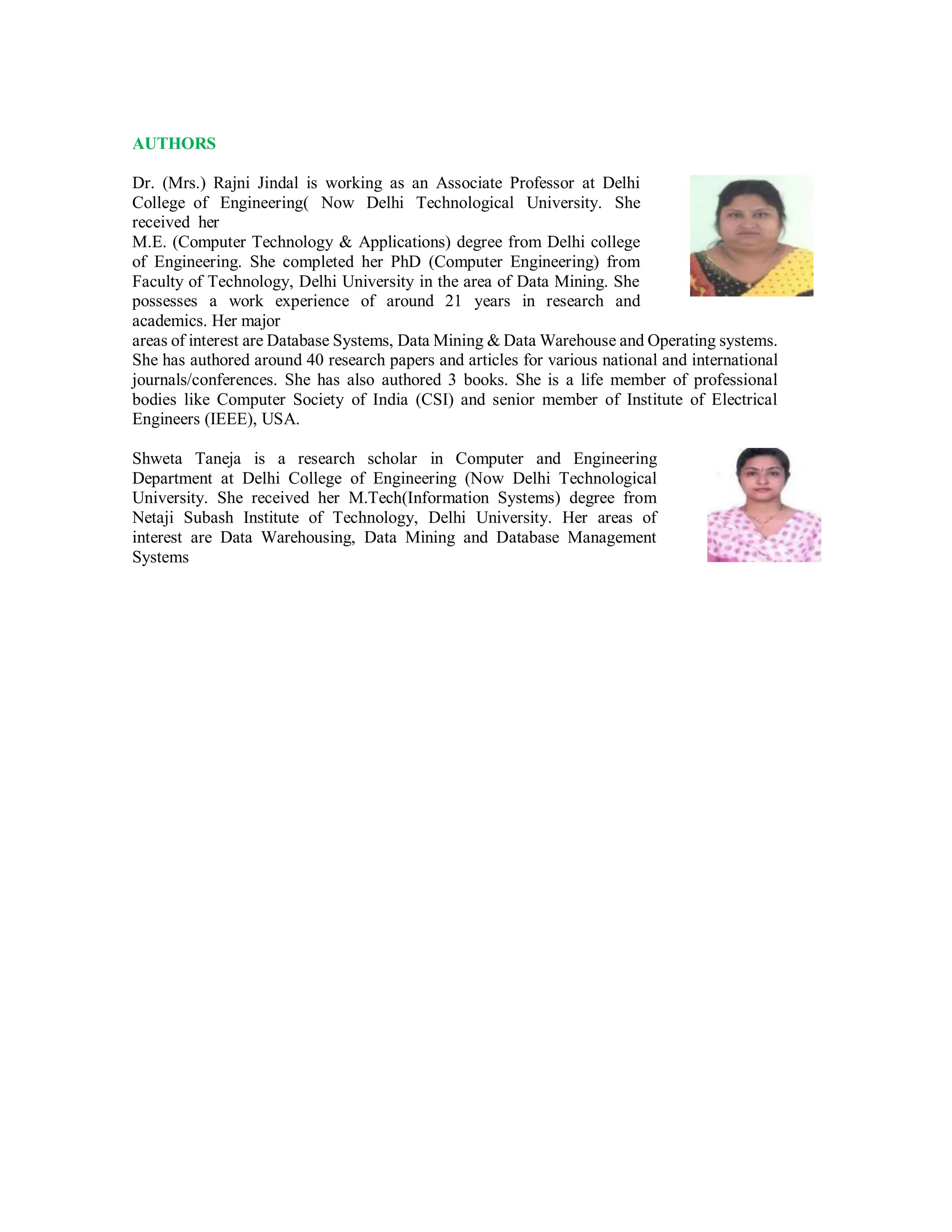
Dr. (Mrs.) Rajni Jindal is working as an Associate Professor at Delhi
College of Engineering( Now Delhi Technological University. She
received her
M.E. (Computer Technology & Applications) degree from Delhi college
of Engineering. She completed her PhD (Computer Engineering) from
Faculty of Technology, Delhi University in the area of Data Mining. She
possesses a work experience of around 21 years in research and
academics. Her major
areas of interest are Database Systems, Data Mining & Data Warehouse and Operating systems.
She has authored around 40 research papers and articles for various national and international
journals/conferences. She has also authored 3 books. She is a life member of professional
bodies like Computer Society of India (CSI) and senior member of Institute of Electrical
Engineers (IEEE), USA.
Shweta Taneja is a research scholar in Computer and Engineering
Department at Delhi College of Engineering (Now Delhi Technological
University. She received her M.Tech(Information Systems) degree from
Netaji Subash Institute of Technology, Delhi University. Her areas of
interest are Data Warehousing, Data Mining and Database Management
Systems
A TYPICAL CASE OF RECOMMENDING THE USE OF A
HIERARCHICAL DATA FORMAT
Elisa Margareth Sibarani1
, Paul Wagenaars2
, Guido Bakema3
1
Del Polytechnic of Informatics, Toba Samosir, North Sumatra, Indonesia
2
KEMA, Arnhem, the Netherlands
3
HAN University of Applied Sciences, Arnhem and Nijmegen, The Netherlands
ABSTRACT
Storing large amounts of data in an efficient way from the point of view of very fast retrieval is an
important requirement for many industries like KEMA, a company offering consulting, testing
and certification in the energy business. Because their relational database could not cope fast
enough with the large amounts of data involved, an alternative way for data storage was
proposed, called Hierarchical Data Format 5 (HDF5). HDF5 is a data model, a library, and file
format for storing and managing data. Four hierarchical designs for storing and retrieving the
large amounts of data involved were investigated. A benchmark was carried out in order to know
which hierarchical structure would perform best. Eventually, a benchmark between HDF5 and
MS SQL Server was carried out. It could be shown that HDF5 performs four (4) times better for
inserting and even 200 times better for retrieving data than the MS. SQL Server.
KEYWORDS
Hierarchical Data Format (HDF), Relational Database, Hierarchical Design, Benchmarking
For More Details : https://airccse.org/journal/ijdms/papers/4612ijdms03.pdf
Volume Link : https://airccse.org/journal/ijdms/current2012.html
REFERENCES
[1] Fred Steennis, Ad Kerstens, Theo van Rijn, Jan Mosterd, Leon Bokma, Piet Soepboer, Alfred Arts,
Nico van Donk and Branko Carli, "On-line Partial Discharge Monitoring for MV Cables with SCG –
Practical Experiences in the Period 2007 to 2010", 8th Int. Conf. on Insulated Power Cables (Jicable),
Versailles, France, 19-23 June 2011.
[2] Sibarani, Elisa Margareth, Simanjuntak, Humasak T.A. & Lumbantoruan, Rosni, (2010) “A Solution
to Partial Discharges Online (PD-OL) System in KEMA”, Thesis Report in Hogeschool Van Arnhem
en Nijmegen (HAN) University of Applied Sciences, Arnhem, The Netherlands.
[3] Why HDF? www.hdfgroup.org. [Online] September 23, 2009. [Cited: July 4, 2010.]
http://www.hdfgroup.org/why_hdf/.
[4] Oskam, Jaco (2010) PD-Online Architectural Design Document.
[5] Treinish, Lloyd A. Scientific data models for large-scale applications. www.research.ibm.com.
[Online] [Cited: September 9, 2010.] http://www.research.ibm.com/people/l/lloydt/dm/DM.htm.
[6] DBMS. www.scribd.com. [Online] [Cited: June 4, 2010.]
http://www.scribd.com/doc/6947984/DBMS.
[7] Products. www.hdfgroup.org. [Online] September 23, 2009. [Cited: July 4, 2010.]
http://www.hdfgroup.org/products/.
[8] The HDF Levels of Interaction. www.hdfgroup.org. [Online] September 23, 2009. [Cited: July 5,
2010.] http://www.hdfgroup.org/products/hdf4/whatishdf.html.
[9] Scientific Data Management in the Coming Decade. Gray, Jim, et al. Redmond : s.n., 2005.
[10] Chapter 1 The HDF5 Data Model and File Structure. www.hdfgroup.org. [Online] March 12, 2010.
[Cited: July 8, 2010.] http://www.hdfgroup.org/HDF5/doc/UG/UG_frame03DataModel.html.
[11] Introduction to HDF5. www.hdfgroup.org. [Online] February 6, 2006. [Cited: July 6, 2010.]
http://www.hdfgroup.org/HDF5/doc/H5.intro.html.
[12] Group, Hierarchical Data Format (HDF). HDF5 Tutorial. University of Illinois at Urbana-Champaign
(UIUC) : National Center for Supercomputing Applications (NCSA), October 1999.
[13] SQL Server Replication. msdn.microsoft.com. [Online] [Cited: August 2, 2010.]
http://msdn.microsoft.com/en-us/library/ms151198.aspx.
[14] Steed, Chad A., Braud, James E and Koehler, Kim A. VGRID: A Generic, Dynamic HDF5 Storage
Model for Georeferenced, Grid Data. aser.ornl.gov. [Online]
http://aser.ornl.gov/steed/personal/publications/papers/2002_Steed-etal_VGRID_OCEANS.pdf.
[15] Improving Access to Multi-dimensional Self-describing Scientific Datasets. Nam, Beomseok and
Sussman, Alan. p. 10.
[16] Comparison of relational database management systems. en.wikipedia.org. [Online] [Cited: August 5,
2010.] http://en.wikipedia.org/wiki/Comparison_of_relational_database_management_systems.
[17] Mainzer, John. RFC: Metadata Journaling to Improve Crash Survivability. www.hdfgroup.org.
[Online] August 22, 2008. [Cited: August 1, 2010.]
http://www.hdfgroup.org/pubs/rfcs/Metadata_Journaling_RFC.pdf.
[18] SQL Server 2008 R2 Pricing. www.microsoft.com. [Online] [Cited:August 9, 2010.]
http://www.microsoft.com/sqlserver/2008/en/us/pricing.aspx.
[19] SQL Server 2008 Troubleshooting and Support. technet.microsoft.com. [Online] [Cited: August 9,
2010.] http://technet.microsoft.com/en-us/sqlserver/bb895929.aspx.
[20] Helpdesk and Mailing Lists. www.hdfgroup.org. [Online] [Cited: August 8, 2010.]
http://www.hdfgroup.org/services/support.html.
[21] HDFView. www.hdfgroup.org. [Online] [Cited: July 1, 2010.] http://www.hdfgroup.org/hdf-java-
html/hdfview/.
[22] PyTables Getting the most *out* of our data. www.pytables.org. [Online] [Cited: July 8, 2010.]
http://www.pytables.org/moin.
[23] Järvinen, Jani. The Basics of Manipulating File Access Control Lists with C#. www.developer.com.
[Online] [Cited: August 3, 2010.] http://www.developer.com/net/article.php/10916_3701811_1/The-
Basics-of-Manipulating-File-Access-Control-Lists-with-C.htm.
[24] Microsoft, MSDN. Partitioning. MSDN Library. [Online] http://msdn.microsoft.com/en-
us/library/ms178148.aspx.
AUTHORS
Elisa Margareth SIBARANI got a Master of Information Systems Development in
HAN University of Applied Sciences in The Netherlands. At the moment she is head
of and lecturer at the Informatics Engineering Study Program at Del Polytechnic
Institute of Informatics in Indonesia. Her research interests are mainly about
information systems development, software engineering, database performance and
business intelligence.
Paul WAGENAARS received the MSc. degree in electrical engineering from the
Eindhoven University of Technology in The Netherlands in 2004. In 2010, he received
a PhD. degree from the same university for his research on online partial discharge
monitoring of medium-voltage cable systems. Since then he joined KEMA as specialist
on power cable technology.
Guido BAKEMA is a graduated theoretical mathematician from Leiden University and
a informatician from Nijmegen University, both in The Netherlands. Early 2011 he
retired as a professor in information systems development at HAN University of
Applied Sciences in The Netherlands. In 2010 he supervised the first author during her
final project and master thesis writing at the end of her master study on Information
Systems Development in The Netherlands.

August 2025 Top read articles in International Journal of Database Management Systems ( IJDMS ).pdf

  • 1.
    August 2025: TOP10 Read Articles in Database Management Systems Research Articles International Journal of Database Management Systems (IJDMS) *** WJCI Indexed*** ISSN : 0975-5705 (Online); 0975-5985 (Print) https://airccse.org/journal/ijdms/index.html Citations, h-index, i10-index Citations 3689 h-index 29 i10-index 81
  • 2.
    MAPPING COMMON ERRORSIN ENTITY RELATIONSHIP DIAGRAM DESIGN OF NOVICE DESIGNERS Rami Rashkovits1 and Ilana Lavy2 1 Department of Management Information Systems, Peres Academic Center, Israel 2 Department of Information Systems, Yezreel Valley College, Israel ABSTRACT Data modeling in the context of database design is a challenging task for any database designer, even more so for novice designers. A proper database schema is a key factor for the success of any information systems, hence conceptual data modeling that yields the database schema is an essential process of the system development. However, novice designers encounter difficulties in understanding and implementing such models. This study aims to identify the difficulties in understanding and implementing data models and explore the origins of these difficulties. This research examines the data model produced by students and maps the errors done by the students. The errors were classified using the SOLO taxonomy. The study also sheds light on the underlying reasons for the errors done during the design of the data model based on interviews conducted with a representative group of the study participants. We also suggest ways to improve novice designer's performances more effectively, so they can draw more accurate models and make use of advanced design constituents such as entity hierarchies, ternary relationships, aggregated entities, and alike. The research findings might enrich the data body research on data model design from the students' perspectives. KEYWORDS Database, Conceptual Data Modelling, Novice Designers For More Details : https://aircconline.com/ijdms/V13N1/13121ijdms01.pdf Volume Link : https://airccse.org/journal/ijdms/current2021.html
  • 3.
    REFERENCES [1] Moody, D.L. & Shanks, G. G. (1998). "What Makes a Good Data Model? A Framework for Evaluating and Improving the Quality of Entity Relationship Models," Australian Computer Journal, vol. 30, pp. 97-110 [2] Codd, E. F. (1970). A relational model of data for large shared data banks. Communications of the ACM, 13(6), 377-387. [3] Codd, E. F. (1979). Extending the database relational model to capture more meaning. ACM Transactions on Database Systems (TODS), 4(4), 397-434. [4] Frederiks, P. J., & Van der Weide, T. P. (2006). Information modeling: The process and the required competencies of its participants. Data & Knowledge Engineering, 58(1), 4-20. [5] Chen, P. P. S. (1976). The entity-relationship model—toward a unified view of data. ACM Transactions on Database Systems (TODS), 1(1), 9-36. [6] Teorey, T.J., Yang, D., and Fry, J.F. (1986). A logical design methodology for relational databases using the extended entity-relationship model. Computing Surveys, Vol. 18, No. 2, pp. 197-222. [7] Ram, S. (1995). "Deriving Functional Dependencies from the Entity Relationship Model," Communications of the ACM. Vol. 38, No. 9, pp. 95-107. [8] Batra, D. and Antony, S (1994). Novice errors in database design. European Journal of Information Systems, Vol. 3, No. 1, pp. 57-69. [9] Antony, S. R., & Batra, D. (2002). CODASYS: a consulting tool for novice database designers. ACM Sigmis Database, 33(3), 54-68. [10] Batra, D. (2007). Cognitive complexity in data modeling: Causes and recommendations. Requirements Engineering 12(4), 231–244. [11] Anderson, L. W., Krathwohl, D. R., & Bloom, B. S. (2001). A taxonomy for learning, teaching, and assessing: A revision of Bloom's taxonomy of educational objectives. Allyn & Bacon. [12] Biggs, J. B., & Collis, K. F. (1982). Evaluation the quality of learning: the SOLO taxonomy (structure of the observed learning outcome). Academic Press. [13] Bloom, B. S. (1956). Taxonomy of educational objectives. Vol. 1: Cognitive domain. New York: McKay, 20, 24. [14] Rashkovits, R. & Lavy, I. (2020). Students difficulties in identifying the use of ternary relationships in data modeling. The International Journal of Information and Communication Technology Education (IJICTE), Vol. 16, Issue 2, 47-58. [15] Balaban, M., & Shoval, P. (1999, November). Resolving the ―weak status‖ of weak entity types in entity-relationship schemas. In International Conference on Conceptual Modeling (pp. 369-383). Springer Berlin Heidelberg. [16] Or-Bach, R., & Lavy, I. (2004). Cognitive activities of abstraction in object-orientation: An empirical study. The SIGCSE Bulletin, 36(2), 82-85. [17] Liberman, N., Beeri, C., Ben-David Kolikant, Y., 2011). Difficulties in Learning Inheritance andPolymorphism. ACM Transactions on Computing Education, 11, (1), Article 4, 1-23.
  • 4.
    [18] Chick, H.(1998). Cognition in the formal modes: Research mathematics and the SOLO taxonomy. Mathematics Education Research Journal, 10(2), 4-26. [19] Huang, I. L. (2012). An empirical analysis of students' difficulties on learning conceptual data modeling. Journal of Management Information and Decision Sciences, 15(2), 73. [20] Leung, F., & Bolloju, N. (2005). Analyzing the quality of domain models developed by novice systems analysts. In System Sciences, 2005. HICSS'05. Proceedings of the 38th Annual Hawaii International Conference on (pp. 188b-188b). IEEE. [21] Kesh, S. (1995). Evaluating the quality of entity relationship models. Information and Software Technology, 37(12), 681-689. [22] Topi, H., Valacich, J. S., Wright, R. T., Kaiser, K., Nunamaker Jr, J. F., Sipior, J. C., & de Vreede, G. J. (2010). IS (2010): Curriculum guidelines for undergraduate degree programs in information systems. Communications of the Association for Information Systems, 26(1), 18. [23] Lindland, O. I., Sindre G., and Solvberg A., (1994). "Understanding quality in conceptual modeling," IEEE Software, vol. 11, pp. 42-49. [24] Taylor, S.J. & Bogdan, R. (1998). Introduction to Qualitative Research Methods. New York: John Wiley & Sons. [25] Neuendorf, K. A.(2002). The Content Analysis Guidebook. Thousand Oaks, CA: Sage Publications. [26] Batra, D., & Davis, J. G. (1992). Conceptual data modelling in database design: similarities and differences between expert and novice designers. International journal of man-machine studies, 37(1), 83-101
  • 5.
    ALGORITHM FOR RELATIONALDATABASE NORMALIZATION UP TO 3NF Moussa Demba Department of Computer Science & Information, Aljouf University Sakaka, Kingdom of Saudi Arabia ABSTRACT When an attempt is made to modify tables that have not been sufficiently normalized undesirable side effects may follow. This can be further specified as an update, insertion or deletion anomaly depending on whether the action that causes the error is a row update, insertion or deletion respectively. If a relation R has more than one key, each key is referred to as a candidate key of R. Most of the practical recent works on database normalization use a restricted definition of normal forms where only the primary key (an arbitrary chosen key) is taken into account and ignoring the rest of candidate keys. In this paper, we propose an algorithmic approach for database normalization up to third normal form by taking into account all candidate keys, including the primary key. The effectiveness of the proposed approach is evaluated on many real world examples. KEYWORDS Relational database, Normalization, Normal forms, functional dependency, redundancy For More Details : http://airccse.org/journal/ijdms/papers/5313ijdms03.pdf Volume Link : https://airccse.org/journal/ijdms/current2013.html
  • 6.
    REFERENCES [1] Thomas, C.,Carolyn, B. (2005) Database Systems, A Practical Approach to Design, Implementation, and Management, Pearson Fourth edition . [2] Bahmani A., Naghibzadeh, M. and Bahmani, B. (2008) "Automatic database normalization andprimary key generation", Niagara Falls Canada IEEE. [3] Beynon-Davies, P. (2004) Database systems, Palgrave Macmillan, Third edition, ISBN 1–4039—1601–2. [4] Dongare,Y. V., Dhabe,P. S. and Deshmukh, S. V. (2011) RDBNorma: "A semi-automated tool forrelational database schema normalization up to third normal form", International Journal of Database Management Systems, Vol.3, No.1. [5] Vangipuram, R., Velputa, R., Sravya, V. (2011) "A Web Based Relational database design Tool toPerform Normalization", International Journal of Wisdom Based Computing, Vol.1(3). [6] Codd, E.F. (1972) "Further normalization of the data base relational model", In Database Systems,Courant Inst. Comptr. Sci. Symp. 6, R. Rustin, Ed., Prentice-Hall, Englewood Cliffs, pp. 33—64. [7] Elmasri, R., Navathe, S.B. (2003) Fundamentals of Database Systems, Addison Wesley, fourthEdition. [8] Date, C.J. (2004) Introduction to Database Systems (8th ed.). Boston: Addison-Wesley. ISBN 978-0- 321- 19784-9. [9] Ullman, J.D. (1982) Principe of Database Systems. Computer Science Press, Rockville, Md. [10] Maier, D. (1983) The Theory of relational Databases. Computer Science Press, Rockville, Md. [11] Bernstein, P.A. (1976) "Synthesizing third normal form relations from functional dependencies", ACM Transactions on database Systems, vol.1, No.4, pp.277—298. [12] Diederich, J., Milton, J. (1988) "New Methods and Fast Algorithms for Database Normalization", ACM Transactions on database Systems, Vol.13, No.3, pp. 339—365
  • 7.
    HIGH CAPACITY DATAHIDING USING LSB STEGANOGRAPHY AND ENCRYPTION Shamim Ahmed Laskar1 and Kattamanchi Hemachandran2 Department of Computer ScienceAssam University, Silchar, Assam, India ABSTRACT The network provides a method of communication to distribute information to the masses. With the growth of data communication over computer network, the security of information has become a major issue. Steganography and cryptography are two different data hiding techniques. Steganography hides messages inside some other digital media. Cryptography, on the other hand obscures the content of the message. We propose a high capacity data embedding approach by the combination of Steganography and cryptography. In the process a message is first encrypted using transposition cipher method and then the encrypted message is embedded inside an image using LSB insertion method. The combination of these two methods will enhance the security of the data embedded. This combinational methodology will satisfy the requirements such as capacity, security and robustness for secure data transmission over an open channel. A comparative analysis is made to demonstrate the effectiveness of the proposed method by computing Mean square error (MSE) and Peak Signal to Noise Ratio (PSNR). We analyzed the data hiding technique using the image performance parameters like Entropy, Mean and Standard Deviation. The stego images are tested by transmitting them and the embedded data are successfully extracted by the receiver. The main objective in this paper is to provide resistance against visual and statistical attacks as well as high capacity. KEYWORDS Steganography, Cryptography, plain text, encryption, decryption, transposition cipher, Least Significant Bit, Human Visual System, Mean square error and Peak Signal to Noise Ratio. For More Details : https://airccse.org/journal/ijdms/papers/4612ijdms05.pdf Volume Link : https://airccse.org/journal/ijdms/current2012.html
  • 8.
    REFERENCES [1] Anderson ,R. J. and Petitcolas, F. A.P. (1998) “On The Limits of Steganography”, IEEE Journal of Selected Areas in Communications, Vol.16 No.4, pp.474-481, ISSN 0733-8716. [2] Petitcolas, F.A.P., Anderson, R. J. and Kuhn, M.G. (1999) “Information Hiding -A Survey”, Proceedings of the IEEE, Special issue on Protection of Multimedia Content, vol. 87, no. 7, pp.1062- 1078. International Journal of Database Management Systems ( IJDMS ) Vol.4, No.6, December 2012 67 [3] Johnson, N.F. and Jajodia, S. (1998) “Exploring Steganography: Seeing the Unseen”, IEEE, Computer, vol. 31, no. 2, pp. 26-34. [4] Raphael, A. J. and Sundaram, V. “Cryptography and Steganography – A Survey”, Int. J. Comp. Tech. Appl., Vol 2 (3), pp. 626-630 , ISSN:2229-6093. [5] Gutte, R. S. and Chincholkar, Y. D. (2012) “Comparison of Steganography at One LSB and Two LSB Positions”, International Journal of Computer Applications, Vol.49,no.11, pp.1-7. [6] Laskar, S.A. and Hemachandran, K. (2012), “An Analysis of Steganography and Steganalysis Techniques”, Assam University Journal of Sscience and Technology, Vol.9, No.II, pp.83-103, ISSN: 0975-2773. [7] Younes, M.A.B. and Jantan, A. (2008), "Image Encryption Using Block-Based Transformation Algorithm," International Journal of Computer Science, Vol. 35, Issue.1, pp.15-23. [8] Walia, E., Jain, P. and Navdeep. (2010), “ An Analysis of LSB & DCT based Steganography”, Global Journal of Computer Science and Technology, Vol. 10 Issue 1 , pp 4-8. [9] Khare, P., Singh, J. and Tiwari, M. (2011), “Digital Image Steganography”, Journal of Engineering Research and Studies, Vol. II, Issue III, pp. 101-104, ISSN:0976-7916. [10] Sokouti, M., Sokouti, B. and Pashazadeh, S. (2009), “An approach in improving transposition cipher system”, Indian Journal of Science and Technology, Vol.2 No. 8, pp. 9-15, ISSN: 0974- 6846. [11] Kharrazi, M., Sencar, H. T. and Memon, N. (2006), “Performance study of common image steganography and steganalysis techniques”, Journal of Electronic Imaging, SPIE Proceedings Vol. 5681.15(4), 041104 pp.1-16. [12] R., Chandramouli, and Nasir Memon.(2001), "Analysis of LSB based image steganography techniques." In Image Processing, 2001. Proceedings. 2001 International Conference on, IEEE, vol. 3, pp. 1019-1022. [13] Giddy, J.P. and Safavi- Naini, R. (1994), “ Automated Cryptanalysis of Transposition Ciphers”, The Computer Journal, Vol.37, No.5, pp. 429-436. [14] Johnson, N. F. and Katzenbeisser, S. (2000), "A survey of steganographic techniques", In Information Hiding, Artech House, Norwood, MA, pp. 43-78. [15] Chandramouli, R. and Menon, N. (2001), “Analysis of LSB based image steganography techniques”, IEEE Proceedings on Image Processing, Vol.3, pp.1019-1022. [16] Carvajal-Gamez , B.E., Gallegos-Funes, F. J. and Lopez-Bonilla, J. L. (2009), “ Scaling Factor for RGB Images to Steganography Applications”, Journal of Vectorial Relativity, Vol. 4, no. 3, pp.55-65. [17] Ulutas, G., Ulutas, M. and Nabiyev,V. (2011), “Distortion free geometry based secret image sharing”, Elsevier Inc, Procedia Computer Science 3, pp.721–726.
  • 9.
    [18] Tiwari, N.and Shandilya, M. (2010), “Evaluation of Various LSB based Methods of Image Steganography on GIF File Format”, International Journal of Computer Applications (0975 – 8887) Vol. 6, no.2, pp.1-4. [19] Rabah, K. (2004), “Steganography – The Art of Hiding Data”, Information Technology Journal, Vol.3, no.3, pp. 245-269. [20] Deshpande, N., Kamalapur, S. and Daisy, J. (2006), “Implementation of LSB steganography and Its Evaluation for Various Bits”, 1st International Conference on Digital Information Management, pp.173- 178. [21] Karen, Bailey, and Kevin Curran.(2006) "An evaluation of image based steganography methods" Multimedia Tools and Applications, Springer Vol.30, no. 1, pp. 55-88. [22] Celik, M. U., Sharma, G., Tekalp, A.M. and Saber, E. (2005), “Lossless Generalized-LSB Data Embedding”, IEEE Transaction on Image Processing, Vol. 14, No. 2, pp. 253-266. [23] Huang, Y. S., Huang, Y. P., Huang, K.N. and Young, M. S. (2005), “The Assessment System of Human Visual Spectral Sensitivity Curve by Frequency Modulated Light”, Proceedings of the 2005 IEEE Engineering in Medicine and Biology 27th Annual Conference, pp. 263-265. International Journal of Database Management Systems ( IJDMS ) Vol.4, No.6, December 2012 68 [24] Chan, Chi-Kwong, and L. M. Cheng. (2004), "Hiding data in images by simple LSB substitution." Pattern Recognition Vol. 37, no. 3, pp. 469-474. [25] Brisbane, G., Safavi-Naini, R. and Ogunbona, P. 2005. “High-capacity steganography using a shared colour palette”, IEEE Proceedings on Vision, Image and Signal Processing, Vol.152, No.6, pp.787- 792. [26] Curran, K. and Bailey, K. (2003), “An Evaluation of Image Based Steganography Methods”, International Journal of Digital Evidence Fall 2003, Volume 2, Issue 2, www.ijde.org. [27] Dickman, S.D. (2007), “An Overview of Steganography”, JMU-INFOSEC-TR-2007-002, http:// citeseerx.ist.psu.edu/viewdoc/summary? doi=10.1.1.137.5129. [28] Dunbar, B. (2002). “A detailed look at Steganographic Techniques and their use in an Open-Systems Environment”, SANS Institute 2002, pp.1-9, http://www.sans.org. [29] Lee, Y-K. ; Bell, G., Huang, S-Y., Wang, R-Z. and Shyu, S-J. (2009), “An Advanced LeastSignificant-Bit Embedding Scheme for Steganographic Encoding”,PSIVT 2009, LNCS 5414, Springer, pp. 349–360. [30] Smith, C. (2001), “Basic Cryptanalysis Techniques”, SANS Institute 2001, GSEC Version 1.2f, http://www.sans.org. [31] Kaur, R., Singh, B. and Singh, I. (2012), “A Comparative Study of Combination of Different Bit Positions In Image Steganography”, International Journal of Modern Engineering Research, Vol.2, Issue.5, pp-3835-3840. [32] Kruus, P., Caroline, S., Michael, H. and Mathew, M. (2002), “A Survey of Steganographic Techniques for Image Files”, Advanced Security Research Journal, Network Associates Laboratories, pp.41-51. [33] Kharrazi, M., Sencar, H. T. and Memon, N. (2004), “Image Steganography: Concepts and Practice”, WSPC/Lecture Notes Series: 9in x 6in, pp.1-31. [34] B, Li., J, He. and J, Huang. (2011), “A Survey on Image Steganography and Steganalysis”, Journal of Information Hiding and Multimedia Signal Processing, Vol. 2, No. 2, pp. 142-172. [35] Friedman, W.F. (1967), "Cryptology", Encyclopedia Britannica, Vol. 6, pp. 844-851, 1967.
  • 10.
    [36] Kahate, A.(2008), “Cryptography and Network Security”, 2nd Edition, Tata McGraw-Hill. [37] Gonzalez, R. C. and Woods, R. E. (2002), “Digital Image Processing”, 2nd edition, Prentice Hall, Inc AUTHORS Shamim Ahmed Laskar received his B.Sc. and M.Sc. degrees in Computer Science in 2006 and 2008 respectively from Assam University, Silchar, where he is currently doing his Ph.D. His research interest includes Image Processing, Steganography, Information Retrieval and Data Security Prof. Kattamanchi Hemachandran obtained his M.Sc. Degree from Sri Venkateswara University, Tirupati and M.Tech and Ph.D Degrees from Indian School of Mines, Dhanbad. Presently, he is serving as Head, Department of Computer Science, Assam University, Silchar. He is associated with this department since 1998. He is supervising many research scholars. His areas of research interest are Image Processing, Software Engineering and Dist ributed Computing.
  • 11.
    DESIGNINGA FRAMEWORKTO STANDARDIZE DATAWAREHOUSEDEVELOPMENTPROCESS FOREFFECTIVE DATA WAREHOUSING PRACTICES Deepak Asrani1 and Renu Jain2 1 Department of Computer Science Engineering, Teerthanker Mahaveer University Moradabad, U. P., India 2 Department of Computer Science Engineering, University Institute of Engineering & Technology, Kanpur, U.P., India ABSTRACT Data warehousing solutions work as information base for large organizations to support theirdecision making tasks. With the proven need of such solutions in current times, it is crucial to effectively design, implement and utilize these solutions. Data warehouse (DW) implementation has been a challenge for the organizations and the success rate of its implementation has been very low. To address these problems, we have proposed a framework for developing effective data warehousing solutions. The framework is primarily based on procedural aspect of data warehouse development and aims to standardize its process. We first identified its components and then worked on them in depth to come up with the framework for effective implementation of data warehousing projects. To verify effectiveness of the designed framework, we worked on National Rural Health Mission (NRHM) project of Indian government and designed data warehousing solution using the proposed framework. KEYWORDS Data warehousing, Framework Design, Dimensional modelling, Decision making, Materialized View For More Details : https://aircconline.com/ijdms/V8N4/8416ijdms02.pdf Volume Link : https://airccse.org/journal/ijdms/current2016.html
  • 12.
    REFERENCES [1] Lee, S.hyun.& Kim Mi Na, (2008) “This is my paper”, ABC Transactions on ECE, Vol. 10, No. 5, pp120-122.[ [2] Chan. G. K. Y., Li. Q., and Fenf. L., “Design and Selection of Materialized Views in a Data Warehousing Environment: A Case Study”, DOLAP’ 99, Kanas City MO USA, ACM 1999 1- 58113-220-4/99/11 [3] Colleen Cunningham and Il-Yeol Song, “A Taxonomy of Customer Relationship Management Analyses for Data Warehousing”, Twenty-Sixth International Conference on Conceptual Modelling ER 2007 Tutorials [4] Connor, D. (2003). Report: Data Warehouse Failures Commonplace. Network World, 20(3), 24. [5] Ewen. E. F., Medskar. C. E., and Dusterhoft. L. E., “Data Warehousing in an Integrated Health System;Building the Business Case” DOLAP ‘98 Washington DC USA, ACM 1999 l-581 13-120- 8/98/l 1 [6] Finnegan, P., Murphy, C., and O'Riordan, J. (1999). "Challenging the Hierarchical Perspective on Information Systems: Implications from External Information Analysis," Journal of Information Technology, Forthcoming. [7] P. Giorgini et al. “Goal-Oriented Requirement Analysis for Data Warehouse Design”, in “Eighth ACM International Workshop on Data Warehousing and OLAP”, ISBN: 1- 59593-162-7, ACM Press, NY, 2005... [8] Hao Fan, Alexandra Poulovassilis “Using AutoMed Metadata in Data Warehousing Environments” DOLAP’03, November 7, 2003, New Orleans, Louisiana, USA. [9] Hwang, M.I. & Xu, H., (2005, fall). “A Survey of Data Warehouse Success Issues”, Business Intelligence Journal, 10(4), 7-13. [10] Inmon W. H. “Building the Data Warehouse, 3rd Edition, Willey, 2002. [11] James F. Kimpel “Critical Success Factors for Data warehousing: A Classical Answer to A Modern Question” Issues in Information Systems, Volume 14, Issue 1, pp. 376- 384, 2013. [12] Jindal. R. & Taneja. S., “Comparative Study of Data warehouse Approaches: A Survey”, International Journal of Database Management Systems (IJDMS) Vol. 4, No. 1, February 2012 [13] M.E. Jones and I-Y. Song. “Dimensional Modelling:Identifying, Classifying, and Applying Patterns ", in “Eighth ACM International Workshop on Data Warehousing and OLAP”, ISBN: 1-59593-162-7, ACM Press, NY, 2005.. [14] Kim. H., Lee. T., Lee. S., and Chun. J., “Automated Data Warehousing for Rule- based CRM Systems”, (ADC 2003), Fourteenth Australian Database Conference, Adelaide Australia. [15] Kimball R., Reeves. L., Ross. M., and Thronthwaire. W. “The Data Warehouse Life Cycle Kit” Willey. New York, 1998. [16] Kimball R., & Ross. M., “The Data Warehousing Tool Kit” Willey, New York, 2005.” [17] L. Bellatrach et al. “A Personalization Framework for OLAP Queries”, in “Eighth ACM International Workshop on Data Warehousing and OLAP”, ISBN: 1-59593-162-7, ACM Press, NY, 2005... [18] J-N. Mazón et al. “Applying MDA to the Development of Data Warehouses”, in “Eighth ACM International Workshop on Data Warehousing and OLAP”, ISBN: 1- 59593-162-7, ACM Press, NY, 2005.. [19] MET/S Methodology Documentation Book Release 2.3, Cork: Data Warehouse Network. [20] Ordonez. C., Song. Y., & Alvarado. C. G., “Relational versus Non-Relational Database Systems for Data Warehousing”, DOLAP'10, October 30, 2010, Toronto, Ontario, Canada.ACM 978-1-4503- 0383-5/10/10.
  • 13.
    [21] J. M.Pérez et al. “A Relevance-Extended Multidimensional Model for a Data Warehouse Contextualized with Documents”, in “Eighth ACM International Workshop on Data Warehousing and OLAP”, ISBN: 1-59593-162-7, ACM Press, NY, 2005.. [22] K. Q. Pu “Modelling, Querying and Reasoning about OLAP Databases: a Functional Approach”, in “Eighth ACM International Workshop on Data Warehousing and OLAP”, ISBN: 1-59593-162-7, ACM Press, NY, 2005... [23] Sammon, D. & Finnegon, P., “The Ten Commandments of Data warehousing”, “The DATA BASE for Advances in Information Systems - Fall 2000 (Vol. 31, No. 4)” [24] Sen, A., Ramamurthy, K. (Ram), & Sinha, A.P. (2012) “A Model of Data Warehouse Process Maturity”, IEEE Transactions on Software Engineering”, 38(2), 336-353. doi:http://dx.doi.org/10.1109/TSE.2011.2 [25] Sen. A, and Sinha. A.P. “A Comparison of Data warehousing Methodologies”, “ Communications of the ACM, March 2005, Vol. 48, No. 3” [26] Trujillo. J. & Song. Y., “A Report on the Eighth ACM International Workshop on Data Warehousing and OLAP (DOLAP’ 05), SIGMOD Records, Vol. 36, No. 4, December 2006. [27] Business Intelligence: A managerial approach. (2011) (2nd ed.) Boston: Prentice Hall. [28] http://nrhm.gov.in [29] http://nrhm-mcts.nic.in AUTHORS Deepak Asrani is a Ph. D scholar of Teerthanker Mahaveer University, Moradabad, U.P., India. He is a B.E. (Electronics and Telecommunication), and M.S (Software Systems) from BITS, Pilani, Rajasthan, India. He has Software industry and academic experience of 24 years in various organizations and academic institutions. Dr. Renu Jain is Director of University Institute of Engineering & Technology, Kanpur, U.P, India. She has worked as Head in the Department of Computer Science Engineering in the same institutions. She is an eminent personality in academics and holds Ph. D in Computer Science from BITS, Pilani, Rajasthan, India. She has rich academic experience of more than 30 years and has published around 50 research papers in various reputed national and international journals.
  • 14.
    A STUDY ONCHALLENGES AND OPPORTUNITIES IN MASTER DATA MANAGEMENT Tapan kumar Das1 and Manas Ranjan Mishra2 1 SITE, VIT University, Vellore, TN, India 2 IBM India Pvt .Ltd, Bangalore, India ABSTRACT This paper aims to provide a data definition of one master data for cross application consistency. The concepts related to Master data management in broader spectrum has been discussed. The current challenges companies are facing while implementing the MDM solutions are outlined. We have taken a case study to highlight why Master Data Management is imperative for the enterprises in optimizing their business Also we have identified some of the long term benefits for the enterprises on implementing MDM.. KEYWORDS Data quality, Information system, Unstructured, Transactional data For More Details : https://airccse.org/journal/ijdms/papers/3211ijdms09.pdf Volume Link : https://airccse.org/journal/ijdms/current2011.html
  • 15.
    REFERENCES [1] Berson, A.and Dubov, L. (2007), Master Data Management and Customer Data Integration for aGlobal Enterprise, McGraw-Hill, New York, NY. [2] Boyd, M. (2006), “Product information management – forcing the second wave of data quality”,available at: ww.thecopywritingpro.com/pages/samples_assets/2nd-waveDQ.pdf(accessed 27 April 2010). [3] Breuer, T. (2009), “Data quality is everyone’s business – designing quality into your datawarehouse – part 1”, Journal of Direct, Data and Digital Marketing Practice, Vol. 11,pp. 20-9. [4] Butler,David., Stackowiak,Bob., ”Master Data Management”, Oracle Corporation.available at www.oracle.com. [5] Dayton, M. (2007), “Strategic MDM: the foundation of enterprise performance management”,Cutter IT Journal, Vol. 20 No. 9, pp. 13-17. [6] Dreibelbis,Allen , Hechler,Eberhard, Milman ,Ivan(2009), “Enterprise Master Data Management”,Pearson Education. [7] Dumas, M., Aalst, W. and Ter Hofstede, A. (2005), Process-aware Information Systems: BridgingPeople and Software Through Process Technology, Wiley, Hoboken, NJ.Managing onemaster data161 [8] Gartner MDM Summit,(2011),UK International Journal of Database Management Systems ( IJDMS ), Vol.3, No.2, May 2011 139 [9] Knolmayer, G. and Ro¨thlin, M. (2006), “Quality of material master data and its effect on theusefulness of distributed ERP systems”, Lecture Notes in Computer Science, Vol. 4231,pp. 362-71. [10] Lee, Y.W., Pipino, L.L., Funk, J.D. and Wang, R.Y. (2006),” Journey to Data Quality”, MIT Press, Cambridge, MA. [11] Loshin, D. (2009), Master Data Management, Morgan Kaufmann, Burlington,MA. [12] Malcolm, Chisholm(Dec 2010),”The Governance Challenge for Master Data Management”, Data Governance Conference, Orlando, Florida [13] “MDM Fundamentals and Best practices”,www.elearningcurve.com [14] Moss, L. (2007), “Critical success factors for master data management”, Cutter IT Journal, Vol. 20No. 9, pp. 7-12. [15] Rachuri, S., Subrahmanian, E., Bouras, A., Fenves, S., Foufou, S. and Sriram, R. (2008),“Information sharing and exchange in the context of product lifecycle management: role ofstandards”, Computer-Aided Design, Vol. 40 No. 7, pp. 789-800. [16] Rittman,Mark.”Introduction to Master Data Management”.www.rittmanmead.com [17] Russon,Philip. (2006), Master Data Management – TDWI Best practice Report a vailable at www.tdwi.org. [18] Schumachar, Scott (Oct 2010),”MDM: Realizing the same benefits through different implementations”, www.initiatesystems.com [19] Toronto MDM Summit.(2008),”MDM Challenges and solutions from the real world” available at www.adastracorp.com [20] White, A., Newman, D., Logan, D. and Radcliffe, J. (2006), “Mastering master datamanagement”, available at: http://kona.kontera.com/IMAGE_DIR/pdf/MDM_gar060125_MasteringMDMB.pdf (accessed 12 April 2010). [21] Wolter,Roger.,Haselden,Kirk.(2006),A White paper on MDM, Microsoft Corporation. [22] Yang, X., Moore, P.R., Wong, C.-B., Pu, J.-S. and Chong, S.K. (2007), “Product lifecycle information acquisition and management for consumer products”, Industrial Management & Data Systems, Vol. 107 No. 7, pp. 936-56.
  • 16.
    TOP NEWSQL DATABASESAND FEATURES CLASSIFICATION Ahmed Almassabi1 , Omar Bawazeer and Salahadin Adam2 1 Department of Computer Science, Najran University, Najran, Saudi Arabia 2 Department of Information and Computer Science, King Fahad University of Petroleum and Mineral, Dhahran, Saudi Arabia ABSTRACT Versatility of NewSQL databases is to achieve low latency constrains as well as to reduce cost commodity nodes. Out work emphasize on how big data is addressed through top NewSQL databases considering their features. This NewSQL databases paper conveys some of the top NewSQL databases [54] features collection considering high demand and usage. First part, around 11 NewSQL databases have been investigated for eliciting, comparing and examining their features so that they might assist to observe high hierarchy of NewSQL databases and to reveal their similarities and their differences. Our taxonomy involves four types categories in terms of how NewSQL databases handle, and process big data considering technologies are offered or supported. Advantages and disadvantages are conveyed in this survey for each of NewSQL databases. At second part, we register our findings based on several categories and aspects: first, by our first taxonomy which sees features characteristics are either functional or non-functional. A second taxonomy moved into another aspect regarding data integrity and data manipulation; we found data features classified based on supervised, semi-supervised, or unsupervised. Third taxonomy was about how diverse each single NewSQL database can deal with different types of databases. Surprisingly, Not only do NewSQL databases process regular (raw) data, but also they are stringent enough to afford diverse type of data such as historical and vertical distributed system, real-time, streaming, and timestamp databases. Thereby we release NewSQL databases are significant enough to survive and associate with other technologies to support other database types such as NoSQL, traditional, distributed system, and semirelationship to be as our fourth taxonomy-based. We strive to visualize our results for the former categories and the latter using chart graph. Eventually, NewSQL databases motivate us to analyze its big data throughput and we could classify them into good data or bad data. We conclude this paper with couple suggestions in how to manage big data using Predictable Analytics and other techniques. KEYWORDS NewSQL, NoSQL, RDBMs. FF, Non-FF, and Big data. For More Details : https://aircconline.com/ijdms/V10N2/10218ijdms02.pdf Volume Link : https://airccse.org/journal/ijdms/current2018.html
  • 17.
    REFERENCES [1] Ismail, M.,Gebremeskel, E., Kakantousis, T., Berthou, G., Dowling, J. (2017, June). Hopsworks: Improving User Experience and Development on Hadoop with Scalable, Strongly Consistent Metadata. In Distributed Comput-ing Systems (ICDCS), 2017 IEEE 37th International Conference on(pp. 2525-2528). IEEE. [2] Sangtani, M., D'souza, S. M., Harsh, M., Chander, S., Vijaya, P. IN-TERNATIONAL JOURNAL OF ENGINEERING SCIENCES RESEARCH TECHNOLOGY IMPLEMENTATION CHALLENGESINVOLVED IN BIG DATA ANALYTICS. [3] Kobielus, J. (2012). Hadoop: Nucleus of the next-generation big data ware-house. IBM Data Management Magazine. [4] Lightstone, S., Ohanian, R., Haide, M., Cho, J., Springgay, M., Steinbach, T. (2017, April). Making Big Data Simple with dashDB Local. In Data Engi-neering (ICDE), 2017 IEEE 33rd International Conference on (pp. 1195-1205). IEEE. [5] Santos, M. Y., Costa, C., Galv~ao, J., Andrade, C., Martinho, B. A., Lima, F. V., Costa, E. (2017, July). Evaluating SQL-on-hadoop for big data warehous-ing on not-so-good hardware. In Proceedings of the 21st International Database Engineering Applications Symposium (pp. 242-252). ACM. [6] Ismail, M., Gebremeskel, E., Kakantousis, T., Berthou, G., Dowling, J. (2017, June). Hopsworks: Improving User Experience and Development on Hadoop with Scalable, Strongly Consistent Metadata. In Distributed Com-puting Systems (ICDCS), 2017 IEEE 37th International Conference on (pp. 2525-2528). IEEE. [7] Thusoo, A., Shao, Z., Anthony, S., Borthakur, D., Jain, N., Sen Sarma, J., Liu, H. (2010, June). Data warehousing and analytics infrastructure at face-book. In Proceedings of the 2010 ACM SIGMOD International Conference on Management of data (pp. 1013-1020). ACM. [8] Barkhordari, M., Niamanesh, M. (2017). Atrak: a MapReduce-based data warehouse for big data. The Journal of Supercomputing, 1-15. [9] Tankard, C. (2012). Big data security. Network security, 2012(7), 5-8. [10] Corbett, J. C., Dean, J., Epstein, M., Fikes, A., Frost, C., Furman, J. J., Hsieh, W. (2013). Spanner: Google's globally distributed database. ACM Transactions on Computer Systems (TOCS), 31(3), 8. [11] Song, L., Smola, A., Gretton, A., Borgwardt, K. M., Bedo, J. (2007, June). Supervised feature selection via dependence estimation. In Proceedings of the 24th international conference on Machine learning (pp. 823-830). ACM.
  • 18.
    [12] Huang, S.H. (2015). Supervised feature selection: A tutorial. Arti cial Intelligence Research,4(2), [13] Erturk, E., Jyoti, K. (2015). Perspectives on a Big Data Application: What Database Engineersand IT Students Need to Know. Engineering, Technology Applied Science Research, 5(5), pp-850. [14] Davenport, T. H., Barth, P., Bean, R. (2012). How big data is di erent. MIT Sloan Management Review, 54(1), 43. [15] [Book] Iafrate, F. (2015). From big data to smart data (Vol. 1). John Wiley Sons. [16] Russom, P. (2013). Managing big data. TDWI Best Practices Report, TDWI Research, 1-40 . [17] Cox, M., Ellsworth, D. (1997, August). Managing big data for scienti c visualization. In ACM Siggraph (Vol. 97, pp. 21-38).
  • 19.
    EXPERIMENTAL EVALUATION OFNOSQL DATABASES Veronika Abramova1 , Jorge Bernardino1,2 and Pedro Furtado2 1 Polytechnic Institute of Coimbra - ISEC / CISUC, Coimbra, Portugal 2 University of Coimbra – DEI / CISUC, Coimbra, Portugal Relational databases are a technology used universally that enables storage, management and retrieval of varied data schemas. However, execution of requests can become a lengthy and inefficient process for some large databases. Moreover, storing large amounts of data requires servers with larger capacities and scalability capabilities. Relational databases have limitations to deal with scalability for large volumes of data. On the other hand, non-relational database technologies, also known as NoSQL, were developed to better meet the needs of key-value storage of large amounts of records. But there is a large amount of NoSQL candidates, and most have not been compared thoroughly yet. The purpose of this paper is to compare different NoSQL databases, to evaluate their performance according to the typical use for storing and retrieving data. We tested 10 NoSQL databases with Yahoo! Cloud Serving Benchmark using a mix of operations to better understand the capability of non-relational databases for handling different requests, and to understand how performance is affected by each database type and their internal mechanisms KEYWORDS NoSQL databases, SQL databases, performance evaluation, database models, YCSB For More Details : https://airccse.org/journal/ijdms/papers/6314ijdms01.pdf Volume Link : https://airccse.org/journal/ijdms/current2014.html
  • 20.
    REFERENCES [1] Fayech, I.and Ounalli, H.: Towards a Flexible Database Interrogation. International Journal of Database Management Systems ( IJDMS ) Vol.4, No.3, June 2012 . [2] http://nosql-database.org/. International Journal of Database Management Systems ( IJDMS ) Vol.6, No.3, June 2014 15 [3] Vimala, S., Khanna Nehemiah, H., Bhuvaneswaran, R. S., and Saranya, G.: Design Methodology for Relational Databases: Issues Related to Ternary Relationships in Entity- relationship Model and Higher Normal Forms. [4] Stonebraker, M.: SQL databases vs. NoSQL databases. Communications of the ACM, Vol. 53 No. 4, Pages 10-11. [5] Gajendran, S.: A Survey on NoSQL Databases, 2012, http://ping.sg/story/A-Survey-on- NoSQLDatabases---Department-of-Computer-Science. [6] Cooper, B., Silberstein, A., Tam, E., Ramakrishnan, R., and Sears, R.: Benchmarking cloud serving systems with YCSB. In Proceedings of the 1st ACM Symposium on Cloud Computing (SoCC '10). ACM, New York, NY, USA, 143-154. [7] Strozzi, C.: NoSQL – A relational database management system, 2013, http://www.strozzi.it. [8] Chang, F., Jeffrey, D., Ghemawat, S., Hsieh, W., Wallach, D., Burrows, M., Chandra, T., Fikes, A. and Gruber, R.: Bigtable: A Distributed Storage System for Structured Data. ACM Transactions on Computer Systems, 26(2), Article 4. [9] Decandia, G., Hastorun, D., Jampani, M., Kakulapati, G., Lakshman, A., Pilchin, A., Sivasubramanian, S., Vosshall, P., and Vogels, W.: Dynamo: amazon's highly available key- value store. In Proceedings of twenty-first ACM SIGOPS Symposium on Operating Systems principles (SOSP '07). ACM, New York, NY, USA, 205-220. [10] Notes from the NoSQL Meetup, 2013, http://developer.yahoo.com/blogs/ydn/posts/2009/06/nosql_meetup. [11] Hecht, R. and JABLINSKI, S.: NoSQL Evaluation A Use Case Oriented Survey. Proceedings International Conference on Cloud and Service Computing, pp. 12-14. [12] Han, J.: Survey on NOSQL Databases. Proceedings 6th International Conference on Pervasive Computing and Applications, pp. 363-366. [13] Leavitt, N.: Will NoSQL Databases Live up to Their Promise?. Computer Magazine, Vol. 43 No. 2, pp. 12-14. [14] Floratou, A., Teletia, N., Dewitt, D., Patel, J. and Zhang, D.: Can the elephants handle the NoSQL onslaught?. Proc. VLDB Endow. 5,1712-1723. [15] Tudorica, B.G. and Bucur, C.: A comparison between several NoSQL databases with comments and notes. Roedunet International Conference (RoEduNet), pp.1-5. [16] Pritchett, D.: BASE: An Acid Alternative. ACM Queue 6(3), 48-55. [17] Cook, J. D.: ACID versus BASE for database transactions, 2009, http://www.johndcook.com/blog/2009/07/06/brewer-cap-theorem-base.
  • 21.
    [18] Browne, J.:Brewer's CAP Theorem, 2009, http://www.julianbrowne.com/article/viewer/brewers-captheorem. [19] Indrawan-Santiago, M.: Database Research: Are We at a Crossroad? Reflection on NoSQL. NetworkBased Information Systems (NBiS), 15th International Conference on Network-Based Information Systems, pp.45-51. [20] Zhang, H. and Tompa, F.W.: Querying XML documents by dynamic shredding. InProceedings of the 2004 ACM symposium on Document engineering (DocEng '04). ACM, New York, NY, USA, 21-30. [21] Crockford, D.: JavaScript: The Good Parts. Sebastopol, CA: O'Reilly Media. [22] Lamb, C.: Oracle NoSQL Database in 5 minutes, 2013, https://blogs.oracle.com/charlesLamb/entry/oracle_nosql_database_in_5. [23] Armstrong, T., Ponnekanti, V., Dhruba, B., and Callaghan, M.: LinkBench: a database benchmark based on the Facebook social graph. In Proceedings of the 2013 ACM SIGMOD International Conference on Management of Data (SIGMOD '13). ACM, New York, NY, USA, 1185-1196. [24] Dayarathna, M. and Suzumura, T.: XGDBench: A benchmarking platform for graph stores in exascale clouds. Cloud Computing Technology and Science (CloudCom), IEEE 4th International Conference on, Taipei, 363 – 370.
  • 22.
    AUTHORS Veronika Abramova iscurrently a researcher at CISUC – Centre for Informatics and Systems of the University of Coimbra. Previously she has received a bachelor degree at Instituto Superior Engenharia de Coimbra (ISEC). She is currently working in an industrial project, with an electricity sector company, focused on transferring part of the company’s data to the non- relational storage. She has evaluated and studied different NoSQL databases, focusing on their performance comparison and characteristics. Her main research fields are business intelligence, big data, database knowledge management, NoSQL and SQL databases performance evaluation. Jorge Bernardino received the PhD degree in computer science from the University of Coimbra in 2002. He is a Coordinator Professor at ISEC (Instituto Superior de Engenharia de Coimbra) of the Polytechnic of Coimbra, Portugal. His main research fields are big data, data warehousing, business intelligence, open source tools, and software engineering, subjects in which he has authored or co-authored dozens of papers in refereed conferences and journals. Jorge Bernardino received the PhD degree in computer science from the University of Coimbra in 2002. He is a Coordinator Professor at ISEC (Instituto Superior de Engenharia de Coimbra) of the Polytechnic of Coimbra, Portugal. His main research fields are big data, data warehousing, business intelligence, open source tools, and software engineering, subjects in which he has authored or co-authored dozens of papers in refereed conferences and journals. Jorge Bernardino has served on program committees of many conferences and acted as referee for many international conferences and journals. He was President of ISEC from 2005– 2010. Actually, he is serving as General Chair of IDEAS conference and visiting professor at Carnegie Mellon University (CMU). Pedro Furtado is Professor at University of Coimbra, Portugal, where he teaches courses in both Computer and Biomedical Engineering. His main research interests are data scalability and bigdata, data mining, service-oriented systems and real time systems. Lately, his research has focused both on scalable and real time warehousing, and also on middleware for wireless sensors in industrial and healthcare applications. He has more than 100 papers published in international conferences and journals, books published and several research collaboratio ns with both industry and academia. Besides a PhD in Computer Engineering from University Coimbra (UC) in 2000, Pedro Furtado also holds an MBA from Universidade Catolica Portuguesa (UCP)
  • 23.
    A THEORETICAL EXPLORATIONOF DATA MANAGEMENT AND INTEGRATION IN ORGANISATION SECTORS Chisom E. Offia and Malcolm Crowe ABSTRACT 1 SITE, VIT University, Vellore, TN, India 2 IBM India Pvt .Ltd, Bangalore, India Big data development is a disturbing issue that will affect enterprise across various sectors. The increase of data volume, high speed of data generation and increasing rate of different data from heterogeneous sources have led to difficulties in data management. This paper first reviews different aspects of big data management, including data integration and traditional data warehouse, and their associated challenges.The problems include increase of redundant data, data accessibility, time consumption in data modelling and data movement from heterogeneous sources into a central database, especially in the big data environment. We then propose a logical data management approach using RESTview technology to integrate and analyse data, without fully adopting traditional ETL processes. Data that for governance, corporate, security or other restriction reasons cannot be copied or moved, can easily be accessed, integrated and analysed, without creating a central repository. Data can be kept in its original form and location, eliminating the movement of data, significantly speeding up the process and allowing for live data interrogation. It may not be the practical solution for every situation but, it is a feasible solution that is comparably cost effective. KEYWORDS Big Data; Data Integration; Data warehouse; RESTView For More Details : https://aircconline.com/ijdms/V11N1/11119ijdms03.pdf Volume Link : https://airccse.org/journal/ijdms/current2019.html
  • 24.
    REFERENCES [1] Bansal, S.and Kagemann, S. (2015). Integrating Big Data: A Semantic Extract-Transform- Load Framework. Computer, 48(3), pp.42-50. [2] Saxena, S. and Kumar Sharma, S. (2016). Integrating Big Data in “e-Oman”: opportunities and challenges. info, 18(5), pp.79-97. [3] Khan, M., Wu, X., Xu, X. and Dou, W. (2017). Big data challenges and opportunities in the hype of Industry 4.0. 2017 IEEE International Conference on Communications (ICC). [4] Karafiloski, E. and Mishev, A. (2017). Blockchain solutions for big data challenges: A literature review. IEEE EUROCON 2017 -17th International Conference on Smart Technologies. [5] Crowe, M., Begg, C., Laiho, M. and Lau, F. (2016). Data validation for Big Live data.[online] Available at: https://www.researchgate.net/publication/315686427_Data_Validation_for_Big_Live_Data [6] Chauhan, S., Agarwal, N. and Kar, A. (2016). Addressing big data challenges in smart cities: a systematic literature review. info, 18(4), pp.73-90. [7] Al Nuaimi, E., Al Neyadi, H., Mohamed, N. and Al-Jaroodi, J. (2015). Applications of big data to smart cities. Journal of Internet Services and Applications, 6(1). [8] Rabiul, I., Islam, R., Musfiqur, R. and Abiduzzaman, R. (2016). Big Data Characteristics, Value Chain and Challenges. [9] Almeida, F. and Calistru, C. (2013). The main challenges and issues of big data management. International Journal of Research Studies in Computing, 2(1). [10] Manyika, J., Chui, M., Brown, B., Bughin, J., Dobbs, R., Roxburgh, C., & Byers, A. (2011). Big data: the next frontier for innovation, competition, and productivity. McKinsey Global Institute Reports, 5, 15-36. [11] Sivarajah, U., Kamal, M., Irani, Z. and Weerakkody, V. (2017). Critical analysis of Big Data challenges and analytical methods. Journal of Business Research, 70, pp.263-286. [12] De Oliveira Veras, A., de Sá, P., da Costa Pinheiro, K., Barh, D., Azevedo, V., Jucá Ramos, R. and da Costa da Silva, A. (2018). Computational Techniques in Data Integration and Big Data Handling in Omics. Omics Technologies and Bio-Engineering, pp.209-222. [13] Mishra, S., Dhote, V., S. Prajapati, G. and Shukla, J. (2015). Challenges in Big Data Application: A Review. International Journal of Computer Applications, 121(19), pp.42-46. [14] TOLE, A. (2013). Big Data Challenges. Database Systems Journal, vol. IV, p.no. 3. [15] Trifu, M. and Ivan, M. (2014). Big Data: present and future. Database Systems Journal, 5(1), pp.32- 41.
  • 25.
    [16] Mehmood, R.,Meriton, R., Graham, G., Hennelly, P. and Kumar, M. (2017). Exploring the influence of big data on city transport operations: a Markovian approach. International Journal of Operations & Production Management, 37(1), pp.75-104. [17] CEBR (2012). Data equity: unlocking the value of big data. Centre for Economics and Business Research White Paper, 4, 7-26. [18] McNulty, E. and Freeman, H. (2014). Understanding Big Data: The Seven V's - Dataconomy. [online] Dataconomy. Available at: http://dataconomy.com/2014/05/seven-vs- big-data/. [19] Chaudhuri S. What next?: a half-dozen data management research goals for big data and the cloud. In Proceedings of the 31st symposium on Principles of Database Systems. ACM; 2012. pp. 1–4. [20] Lenzerini, M. (2002). Data integration. Proceedings of the twenty-first ACM SIGMOD- SIGACTSIGART symposium on Principles of database systems - PODS '02. [21] Merelli, I., Pérez-Sánchez, H., Gesing, S. and D’Agostino, D. (2014). Managing, Analysing, and Integrating Big Data in Medical Bioinformatics: Open Problems and Future Perspectives. BioMed Research International. [22] George, G., Osinga, E., Lavie, D. and Scott, B. (2016). Big Data and Data Science Methods for Management Research. Academy of Management Journal, 59(5), pp.1493-1507. [23] Wang, L. and Alexander, C. (2015). Big Data in Distributed Analytics, Cybersecurity, Cyber Warfare and Digital Forensics. Science and Education Publishing, Vol. 1, pp.pp 22-27. [24] Khan, N., Alsaqer, M., Shah, H., Badsha, G., Abbasi, A. and Salehian, S. (2018). The 10 Vs, Issues and Challenges of Big Data. Proceedings of the 2018 International Conference on Big Data and Education - ICBDE '18. [25] Smith, J., Bernstein, P., Dayal, U., Goodman, N., Landers, T., Lin, K. and Wong, E. (1981). Multibase. Proceedings of the May 4-7, 1981, national computer conference on - AFIPS '81. [26] Ruggles, S., Hacker, J. and Sobek, M. (1995). General Design of the Integrated Public Use Microdata Series. Historical Methods: A Journal of Quantitative and Interdisciplinary History, 28(1), pp.33-39. [27] Ray, S., Bandyopadhyay, S. and Pal, S. (2009). Combining Multisource Information Through Functional-Annotation-Based Weighting: Gene Function Prediction in Yeast. IEEE Transactions on Biomedical Engineering, 56(2), pp.229-236. [28] Mireku Kwakye, M. (2011). A Practical Approach to Merging Multidimensional Data Models. [online] Dx.doi.org. Available at: http://dx.doi.org/10.20381/ruor-5072. [29] Dong, X. and Srivastava, D. (2015). Big Data Integration. Synthesis Lectures on Data Management, 7(1), pp.1-198.
  • 26.
    [30] Kadadi, A.,Agrawal, R., Nyamful, C. and Atiq, R. (2014). Challenges of data integration and interoperability in big data. 2014 IEEE International Conference on Big Data (Big Data). [31] Ziegler, P. and Dittrich, K. (2008). Data Integration — Problems, Approaches, and Perspectives. [32] Halevy, A., Rajaraman, A. and Ordille, J. (2006). Data integration: the teenage years. VLDB '06 Proceedings of the 32nd international conference on Very large data bases, pp.9 - 16. [33] Knoblock, C.A. and Szekely, P., 2013, November. Semantics for big data integration and analysis. In 2013 AAAI Fall Symposium Series. AUTHORS Offia Chisom Ernesther studied her bachelor’s degree on BSc computer Engineering and graduated with Second class Upper Division in 2015 at Ghana Telecom University College, Accra Ghana. She furthered her Education in Teesside University; Middlesbrough, England United Kingdom on MSc Computer Security and Networks and graduated with Merit. She started her PhD degree in the year 2017 at the University of the West of Scotland, Paisley Scotland with the research focus on achieving logical data warehouse in the process of data analytics (Data Integration). Malcolm Crowe was born in Dublin 13 January 1948. His first and only employment was at Paisley College in 1972, now the University of the West of Scotland, where he is an Emeritus Professor. He received his D.Phil from Oxford University in 1978 with a thesis entitled “The Connective k-theory of the Infinite Symmetric Group”. Computing rather than Mathematics is his real passion. During the 1980s and 1990s he worked on several ESPRIT projects and co-authored several books on CSCW, Information Systems, and Interdisciplinary Research.Since 2006 he has been developing new ideas for how to improve the implementation of relational DBMS, where he regards the maintenance of the transaction log as the only guarantee of accountability and transactional behaviour. He developed a strongly typed optimistic RDBMS called Pyrrho (www.pyrrhodb.com) to try out several technical additions to relational technology including role-based namespaces and semantic and distributed databases. In 2016 Malcolm began to focus on “Big Live Data” (Virtual Data Warehousing), and his collaborators on this concept include Fritz Laux who presented a paper on this concept at DBKDA 2017.
  • 27.
    COMPARATIVE STUDY OFDATA WAREHOUSE DESIGN APPROACHES: A SURVEY Rajni Jindal1 and Shweta Taneja2 1 Associate Professor, Dept. of Computer Engineering, Delhi Technological University Formerly Delhi College of Engineering (DCE), Bawana Road, Delhi-42. 2 Research Scholar, Dept. of Computer Engineering, Delhi Technological University Formerly Delhi College of Engineering (DCE), Bawana Road, Delhi-42. ABSTRACT The process of developing a data warehouse starts with identifying and gathering requirements, designing the dimensional model followed by testing and maintenance. The design phase is the most important activity in the successful building of a data warehouse. In this paper, we surveyed and evaluated the literature related to the various data warehouse design approaches on the basis of design criteria and propose a generalized object oriented conceptual design framework based on UML that meets all types of user needs. KEYWORDS Data warehouse design, Multidimensional modelling, Unified Modelling Language For More Details : https://airccse.org/journal/ijdms/papers/4112ijdms04.pdf Volume Link : https://airccse.org/journal/ijdms/current2012.html
  • 28.
    REFERENCES [1] Inmon, W.H.,Hackathorn, and R.D (1994) Using the data warehouse. Wiley-QED Publishing, Somerset, NJ, USA. [2] June 1999,UML Modelling Language Specification. Version 1.3, Available at http://www.rational.com/uml/resources/documention / (March 2009). [3] Booch G., Rumbaugh J., and Jacobson I.(1999 ) The Unified Modelling Language User Guide, Addison- Wesley Longman, p.482. [4] Vassiliadis P. and Sellis, T.,(1999) “A Survey of Logical Models for OLAP Databases”. SIGMOD Record 28(4),pp 64–69. [5] S. Rizzi, A. Abelló, J. Lechtenbörger, J. Trujillo(2006) “Research in data warehouse modelling and design: dead or alive?” DOLAP, ACM, , pp. 3–10. [6] A. Abelló, J. Samos, and F. Saltor (2001) “A Framework for the Classification and Description of Multidimensional Data Models” In Proceedings of the 12th International Conference on Database and Expert Systems Applications (DEXA’01). [7] M. Blaschka, C. Sapia, G. Höfling, and B. Dinter,(1998) “ Finding your way through ultidimensional data models” In Proceedings of the 9th International Conference on Database and Expert Systems Applications DEXA’98, volume 1460 of Lecture Notes in Computer science, pp 198–203, Vienna, Austria, August 1998. Springer-Verlag. [8] Stefano Rizzi, Matteo Golfarelli. (1998) “A Methodological Framework for Data Warehouse Design”. DOLAP 98 Washington DC USA.Copyright ACM 1999 l-581 13-120- 8/98/l 1...$5.00. [9] Juan Trujilio,E.Medina and S.Lujan Mora (2002) ,”A Web Oriented Approach to manage Multidimensional Models through XML Schemas and XSLT ‘’ EDBT 2002 Workshops, LNCS 2490, pp. 29–44, 2002. Springer-Verlag Berlin Heidelberg. [10] S.Lujan Mora and I.Song (2002),“Multidimensional Modeling with UML Package Diagrams “ In Proc. of the 21st Int. Conf. on Conceptual Modeling.Lecture Notes in Computer Science pp 199- 213,Finland,October 7-11,2002, . Springer-Verlag [11] Stefano Rizzi, Matteo Golfarelli,D.Maio (1998) ”The Dimensional Fact Model:A Conceptual Model for Data Warehouses.” International Journal of Cooperative Information Systems(IJC IS),7(2- 3):215-247.’’ [12] Lujan Mora and Juan Trujilio (2003) “A Comprehensive Method for Data Warehouse Design.”in Proceedings of 5th International Workshop on Design and Management of Data Warehose(DMDW’03), pp 1.1-1.14. [13] Juan Trujillo and Sergio LujánMora (2004) ” Physical Modeling of Data Warehouses using UML” DOLAP’04, Washington, DC, USA.Copyright 2004 ACM 1581139772/04/0011 ...$5.00.
  • 29.
    [14] Sergio Luján-Mora1,Panos Vassiliadis and Juan Trujillo. (2004) ” Data Mapping Diagrams for Data Warehouse Design with UML”in Proceedings of 23 rd International Conference on Conceptual Modeling (ER 04),volume 3288 of LNCS,China,Springer [15] Lujan Mora and Juan Trujilio (2006) .”Physical Modeling of Data warehouses by using UML Component and Deployment Diagrams:Design and implementation issues.” Journal of Database Management 17(1) [16] Rizzi,Trujilio,Abello. (2006) ” Research in Data Warehouse Modeling and Design:Dead or Alive?”. DOLAP’06, Arlington, Virginia, USA.Copyright 2006 ACM 1-59593-530- 4/06/0011 ...$5.00. [17] Deepti Mishra, Ali Yazici, Beri, Pinar Başaran. (2008) ” A Casestudy of Data Models in Data Warehousing.” 978-1-4244-2624-9/08/$25.00 ©2008 IEEE. [18] Kamal Alaskar1 and Akhtar Shaikh. (2009)” Object Oriented Data Modeling for Data Warehousing(An Extension of UML approach to study Hajj pilgrim’s private tour as a Case Study). International Arab Journal of e-Technology, Vol. 1, No. 2. [19] Hui Ma,Yiping Yang and Fan Zhang (2009) ”The Anti-standardized Design Research of Data Warehouse”. IEEE. [20] Fernandez Medina et al. (2010)” Model Driven Development of Secure XML Data Warehouses: A Case Study” EDBT 2010, Lausanne, Switzerland. Copyright 2010 ACM 978- 1-60558-945-9/10/0003 $10.00. [21] Francois Pinet et. al. (2010) ”The use of UML to design agricultural data warehouses.” AgEng 2010,International Conference on Agricultural Engineering.France [22] Jesús Pardillo and Jose-Norberto Mazón. (2011) ” Using Ontologies for the Design of Data Warehouses.” International Journal of Database Management Systems ( IJDMS ), Vol.3, No.2. [23] Payal Pahwa and Shweta Taneja. (2011) ”Design of a Multidimensional model using Object Oriented Features in UML.” IARS International journal. [24] L. Cabibbo and R.Torlone(1998) “A Logical Approach to Multidimensional Databases” in Proceedings of 6th International Conference on Extending Database Technology EDBT 98 ,Volume 1337 of LNCS,pp 183-197, Spain,Springer. [25] J. Trujillo, M. Palomar, J. Gómez, I.-Y. Song(2001),” Designing data warehouses with OO conceptual models”, IEEE Comput. 34 (12) (2001) 66– 75. [26] N.Tryfona,F.Busborg and J.G.Chriastiansen(1998) ,”StarER:A Conceptual Model for Data Warehouse Design”,in Proceedings of the ACM 2 nd International Workshop on Data Warehousing and OLAP , DOLAP 99,pp 3-8 . [27] Luj´n-Mora S., Trujillo J., and Song, I.(2002), “Multidimensional modeling with UML package diagrams warehouses, ” in Proceedings of 21 st International Conference on
  • 30.
    Conceptual Modeling, ER02 ,Volume 2503 of LNCS,pp 199-213,Finland ,Springer. [28] Golfarelli, M., & Rizzi, S. (2001).” WanD: A CASE Tool for Data Warehouse Design”. In Demo Proceedings 17th International Conference on Data Engineering (ICDE 2001), Heidelberg, Germany, 7-9. [29] Luj´n-Mora S., Trujillo J., and Song, I., “A UML profile for multidimensional modeling in data warehouses,” Data Knowl. Eng. 59(3) 725–769 [30] Anjana Gosain,Suman Mann, (2010)”Object Oriented Multidimensional Model for a Data Warehouse with Operators”, International Journal of Database Theory and Application Vol. 3, No. 4. [31] Rodolfo Villarroel, Emilio Soler, Eduardo Fernández-Medina, Juan Trujillo4,and Mario Piattini (2006),” Using UML Packages for Designing Secure Data Warehouses”, ICCSA 2006, LNCS 3982, pp. 1024 – 1034 .© Springer-Verlag Berlin Heidelberg. [32] Payal Pahwa, Shweta Taneja and Garima Thakur(2011)” Uclean: A Requirement based Object Oriented ETL Framework”, International Journal of Computer Science & Engineering Survey (IJCSES) Vol.2, No.4, November 2011 [33] Sarkar, A., Choudhury, S., Chaki, N. & Bhattacharya, S, (2009) “Conceptual Level Design of Object Oriented Data Warehouse: Graph Semantic Based Model”, INFOCOMP Journal of Computer Science, pp. 60-70. [34] Ponniah, P, (2001) Data Warehousing Fundamentals: A Comprehensive Guide for IT Professionals, pp 402. [35] Elmasri, R. & Navathe, S.B, (2000) Fundamentals of Database Systems, Addison Weasely PubCo. ISBN 0201542633. [36] Nazri, Mior Nasir Mior,Noah, Shahrul Azman Mohd,Hamid, Zarinah (2008),” Automatic data warehouse conceptual design “,International Symposium on Information Technology,Malaysia. [37] Karen C. Davis Sandipto Banerjee (2007),” Teaching and Assessing a Data Warehouse Design Course”, 24th British National Conference on Databases (BNCOD'07) 0-7695-2912- 7/07 $20.00 © 2007 IEEE. [38] Mayank Sharma, Navin Rajpal and B.V.R.Reddy (2010),” Physical Data Warehouse Design using Neural Network” . International Journal of Computer Applications 1(3):86–94, February 2010. Published By Foundation of Computer Science. [39] Abraham Silberschatz, Henry F. Korth, and Sudarshan (2002). Database System Concepts pp 445- 489. 4th Edition, McGraw Hill. [40] Marotta, A., Ruggia, R.(2002),” Data warehouse design: a schema-transformation approach”, Computer Science Society, 2002. SCCC 2002. Proceedings. 22nd International Conference of the Chilean.
  • 31.
    AUTHORS Dr. (Mrs.) RajniJindal is working as an Associate Professor at Delhi College of Engineering( Now Delhi Technological University. She received her M.E. (Computer Technology & Applications) degree from Delhi college of Engineering. She completed her PhD (Computer Engineering) from Faculty of Technology, Delhi University in the area of Data Mining. She possesses a work experience of around 21 years in research and academics. Her major areas of interest are Database Systems, Data Mining & Data Warehouse and Operating systems. She has authored around 40 research papers and articles for various national and international journals/conferences. She has also authored 3 books. She is a life member of professional bodies like Computer Society of India (CSI) and senior member of Institute of Electrical Engineers (IEEE), USA. Shweta Taneja is a research scholar in Computer and Engineering Department at Delhi College of Engineering (Now Delhi Technological University. She received her M.Tech(Information Systems) degree from Netaji Subash Institute of Technology, Delhi University. Her areas of interest are Data Warehousing, Data Mining and Database Management Systems
  • 32.
    A TYPICAL CASEOF RECOMMENDING THE USE OF A HIERARCHICAL DATA FORMAT Elisa Margareth Sibarani1 , Paul Wagenaars2 , Guido Bakema3 1 Del Polytechnic of Informatics, Toba Samosir, North Sumatra, Indonesia 2 KEMA, Arnhem, the Netherlands 3 HAN University of Applied Sciences, Arnhem and Nijmegen, The Netherlands ABSTRACT Storing large amounts of data in an efficient way from the point of view of very fast retrieval is an important requirement for many industries like KEMA, a company offering consulting, testing and certification in the energy business. Because their relational database could not cope fast enough with the large amounts of data involved, an alternative way for data storage was proposed, called Hierarchical Data Format 5 (HDF5). HDF5 is a data model, a library, and file format for storing and managing data. Four hierarchical designs for storing and retrieving the large amounts of data involved were investigated. A benchmark was carried out in order to know which hierarchical structure would perform best. Eventually, a benchmark between HDF5 and MS SQL Server was carried out. It could be shown that HDF5 performs four (4) times better for inserting and even 200 times better for retrieving data than the MS. SQL Server. KEYWORDS Hierarchical Data Format (HDF), Relational Database, Hierarchical Design, Benchmarking For More Details : https://airccse.org/journal/ijdms/papers/4612ijdms03.pdf Volume Link : https://airccse.org/journal/ijdms/current2012.html
  • 33.
    REFERENCES [1] Fred Steennis,Ad Kerstens, Theo van Rijn, Jan Mosterd, Leon Bokma, Piet Soepboer, Alfred Arts, Nico van Donk and Branko Carli, "On-line Partial Discharge Monitoring for MV Cables with SCG – Practical Experiences in the Period 2007 to 2010", 8th Int. Conf. on Insulated Power Cables (Jicable), Versailles, France, 19-23 June 2011. [2] Sibarani, Elisa Margareth, Simanjuntak, Humasak T.A. & Lumbantoruan, Rosni, (2010) “A Solution to Partial Discharges Online (PD-OL) System in KEMA”, Thesis Report in Hogeschool Van Arnhem en Nijmegen (HAN) University of Applied Sciences, Arnhem, The Netherlands. [3] Why HDF? www.hdfgroup.org. [Online] September 23, 2009. [Cited: July 4, 2010.] http://www.hdfgroup.org/why_hdf/. [4] Oskam, Jaco (2010) PD-Online Architectural Design Document. [5] Treinish, Lloyd A. Scientific data models for large-scale applications. www.research.ibm.com. [Online] [Cited: September 9, 2010.] http://www.research.ibm.com/people/l/lloydt/dm/DM.htm. [6] DBMS. www.scribd.com. [Online] [Cited: June 4, 2010.] http://www.scribd.com/doc/6947984/DBMS. [7] Products. www.hdfgroup.org. [Online] September 23, 2009. [Cited: July 4, 2010.] http://www.hdfgroup.org/products/. [8] The HDF Levels of Interaction. www.hdfgroup.org. [Online] September 23, 2009. [Cited: July 5, 2010.] http://www.hdfgroup.org/products/hdf4/whatishdf.html. [9] Scientific Data Management in the Coming Decade. Gray, Jim, et al. Redmond : s.n., 2005. [10] Chapter 1 The HDF5 Data Model and File Structure. www.hdfgroup.org. [Online] March 12, 2010. [Cited: July 8, 2010.] http://www.hdfgroup.org/HDF5/doc/UG/UG_frame03DataModel.html. [11] Introduction to HDF5. www.hdfgroup.org. [Online] February 6, 2006. [Cited: July 6, 2010.] http://www.hdfgroup.org/HDF5/doc/H5.intro.html. [12] Group, Hierarchical Data Format (HDF). HDF5 Tutorial. University of Illinois at Urbana-Champaign (UIUC) : National Center for Supercomputing Applications (NCSA), October 1999. [13] SQL Server Replication. msdn.microsoft.com. [Online] [Cited: August 2, 2010.] http://msdn.microsoft.com/en-us/library/ms151198.aspx. [14] Steed, Chad A., Braud, James E and Koehler, Kim A. VGRID: A Generic, Dynamic HDF5 Storage Model for Georeferenced, Grid Data. aser.ornl.gov. [Online] http://aser.ornl.gov/steed/personal/publications/papers/2002_Steed-etal_VGRID_OCEANS.pdf. [15] Improving Access to Multi-dimensional Self-describing Scientific Datasets. Nam, Beomseok and Sussman, Alan. p. 10. [16] Comparison of relational database management systems. en.wikipedia.org. [Online] [Cited: August 5, 2010.] http://en.wikipedia.org/wiki/Comparison_of_relational_database_management_systems. [17] Mainzer, John. RFC: Metadata Journaling to Improve Crash Survivability. www.hdfgroup.org. [Online] August 22, 2008. [Cited: August 1, 2010.] http://www.hdfgroup.org/pubs/rfcs/Metadata_Journaling_RFC.pdf. [18] SQL Server 2008 R2 Pricing. www.microsoft.com. [Online] [Cited:August 9, 2010.] http://www.microsoft.com/sqlserver/2008/en/us/pricing.aspx. [19] SQL Server 2008 Troubleshooting and Support. technet.microsoft.com. [Online] [Cited: August 9, 2010.] http://technet.microsoft.com/en-us/sqlserver/bb895929.aspx. [20] Helpdesk and Mailing Lists. www.hdfgroup.org. [Online] [Cited: August 8, 2010.] http://www.hdfgroup.org/services/support.html. [21] HDFView. www.hdfgroup.org. [Online] [Cited: July 1, 2010.] http://www.hdfgroup.org/hdf-java- html/hdfview/. [22] PyTables Getting the most *out* of our data. www.pytables.org. [Online] [Cited: July 8, 2010.] http://www.pytables.org/moin. [23] Järvinen, Jani. The Basics of Manipulating File Access Control Lists with C#. www.developer.com. [Online] [Cited: August 3, 2010.] http://www.developer.com/net/article.php/10916_3701811_1/The- Basics-of-Manipulating-File-Access-Control-Lists-with-C.htm.
  • 34.
    [24] Microsoft, MSDN.Partitioning. MSDN Library. [Online] http://msdn.microsoft.com/en- us/library/ms178148.aspx. AUTHORS Elisa Margareth SIBARANI got a Master of Information Systems Development in HAN University of Applied Sciences in The Netherlands. At the moment she is head of and lecturer at the Informatics Engineering Study Program at Del Polytechnic Institute of Informatics in Indonesia. Her research interests are mainly about information systems development, software engineering, database performance and business intelligence. Paul WAGENAARS received the MSc. degree in electrical engineering from the Eindhoven University of Technology in The Netherlands in 2004. In 2010, he received a PhD. degree from the same university for his research on online partial discharge monitoring of medium-voltage cable systems. Since then he joined KEMA as specialist on power cable technology. Guido BAKEMA is a graduated theoretical mathematician from Leiden University and a informatician from Nijmegen University, both in The Netherlands. Early 2011 he retired as a professor in information systems development at HAN University of Applied Sciences in The Netherlands. In 2010 he supervised the first author during her final project and master thesis writing at the end of her master study on Information Systems Development in The Netherlands.