PROJECT OBJECTIVE
 A beam is a structural element that is capable of
withstanding load primarily by resisting against bending
 A beam can be made of wood, concrete, steel depending
upon need
 The bending force induced into the material of the beam
as a result of the external loads, own weight, span and
external reactions to these loads
 Internally, beams experience compressive,
tensile and shear stresses as a result of the loads
applied to them
 To retain beam within safe operating environment, it must
be designed with high rigidity and damping capacity
 Cantilever beam has one end fixed and one end loaded
PROJECT OBJECTIVE
 We compared the cantilever beam stress and natural
frequency for different material having same I, C and T
cross- sectional beam
 Cantilever beam having steel, stainless steel, &cast iron
undergoes static and modal analysis
 The cantilever beam is designed and analyzed in
ANSYS
PROJECT OBJECTIVE
 Solid modeling of I,C,&T beam cross-section with help
of Creo(formerly Pro–Engineer) CAD software
 Save the file in igs format
 Import solid model into ANSYS
 Assigning material properties
 Do analysis for static structural model for I,C,&T cross
section for cantilever beam for steel,stainless steel
&cast iron.
 Do modal analysis for I,C,&T cross section for
cantilever beam for steel,stainless steel &cast iron.
PROJECT OBJECTIVE
 Identifying minimum stress, strain & deformation
reducing material for structural analysis
 Identifying minimum stress, strain & deformation
reducing material for modal analysis
 Conclusion based on results comparison
 Project document preparation
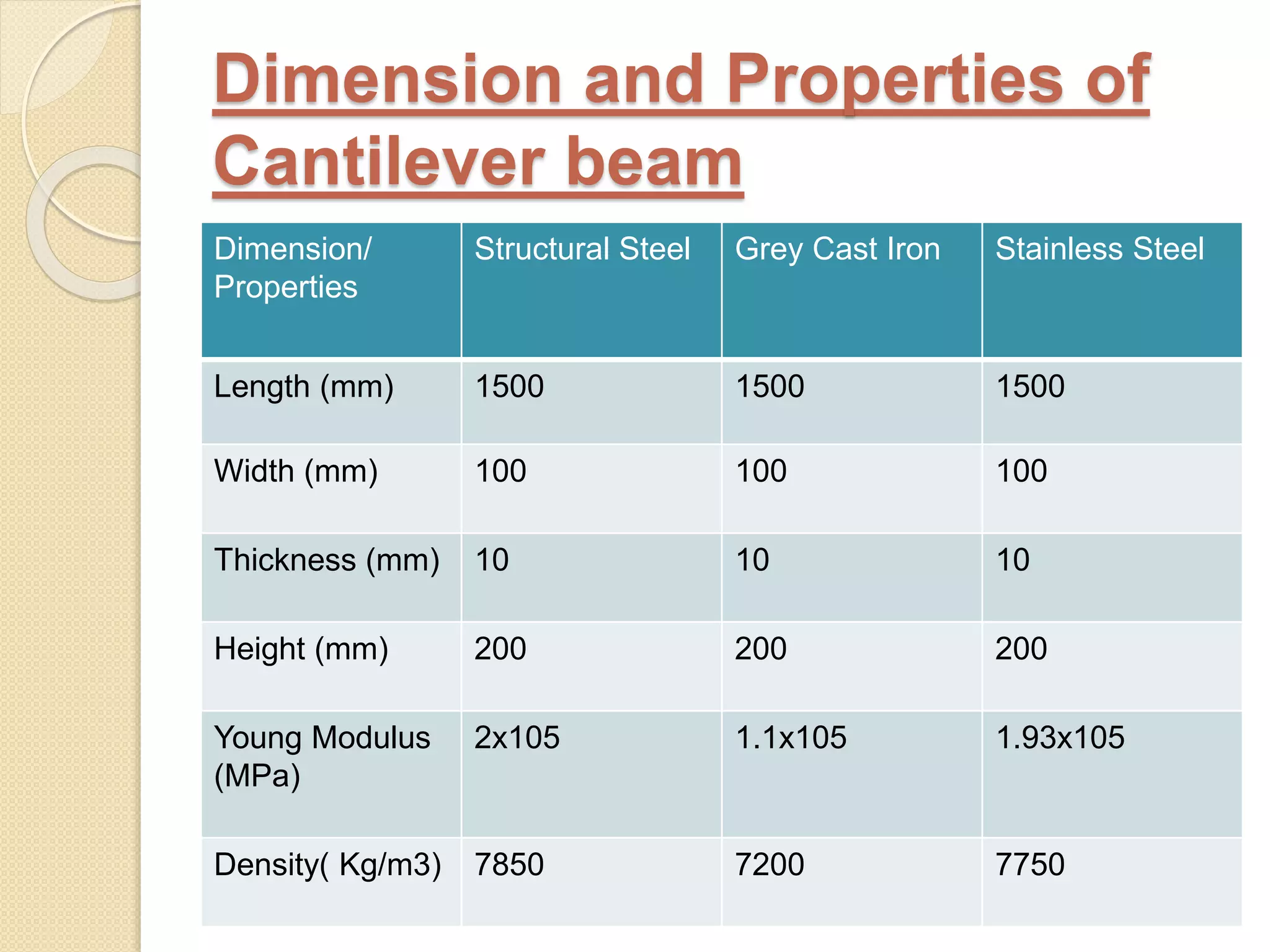
Dimension and Properties of
Cantilever beam
Dimension/
Properties
Structural Steel Grey Cast Iron Stainless Steel
Length (mm) 1500 1500 1500
Width (mm) 100 100 100
Thickness (mm) 10 10 10
Height (mm) 200 200 200
Young Modulus
(MPa)
2x10⁵ 1.1x10⁵ 1.93x10⁵
Density( Kg/m3) 7850 7200 7750
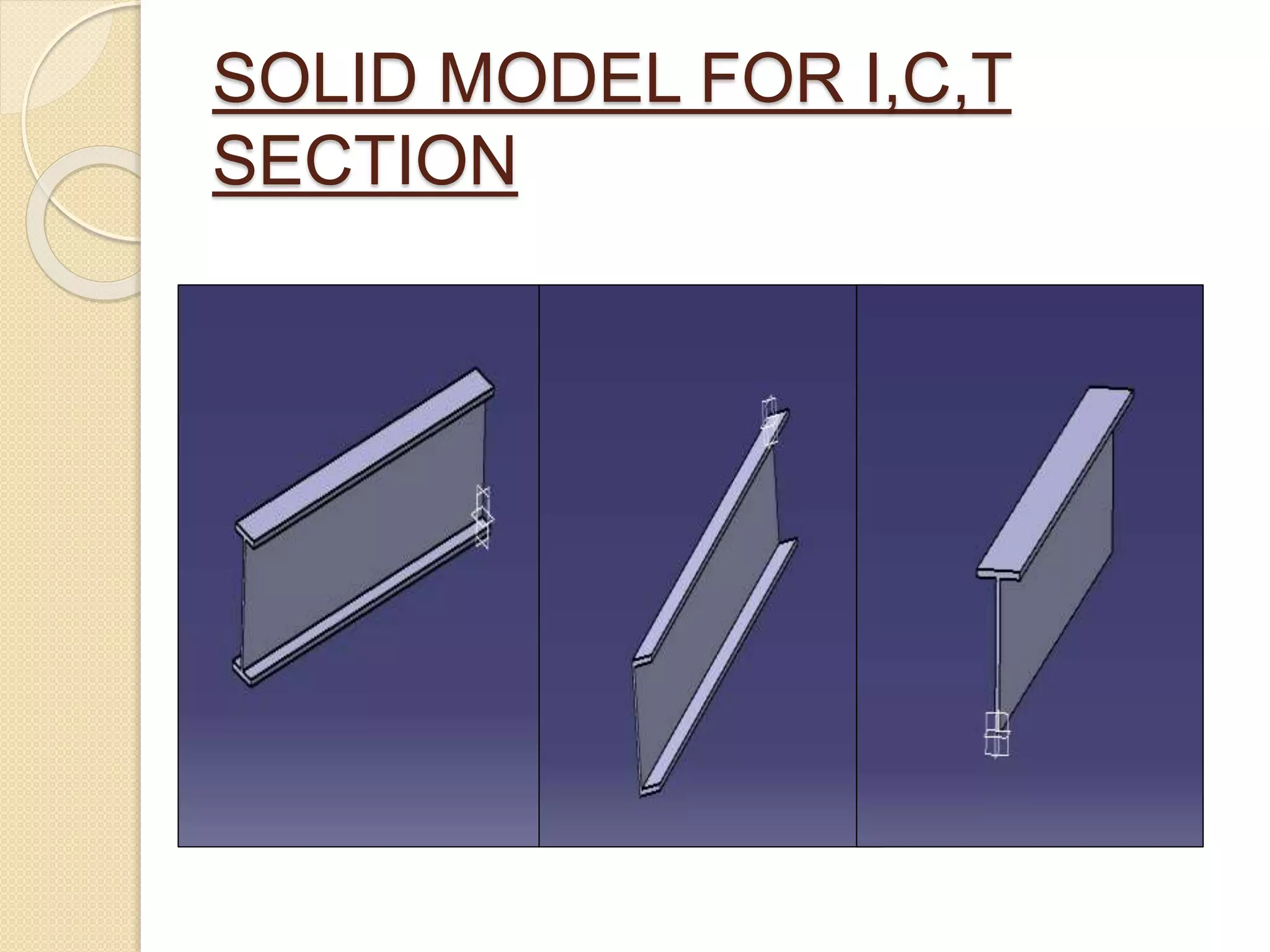
SOLID MODEL FOR I,C,T
SECTION
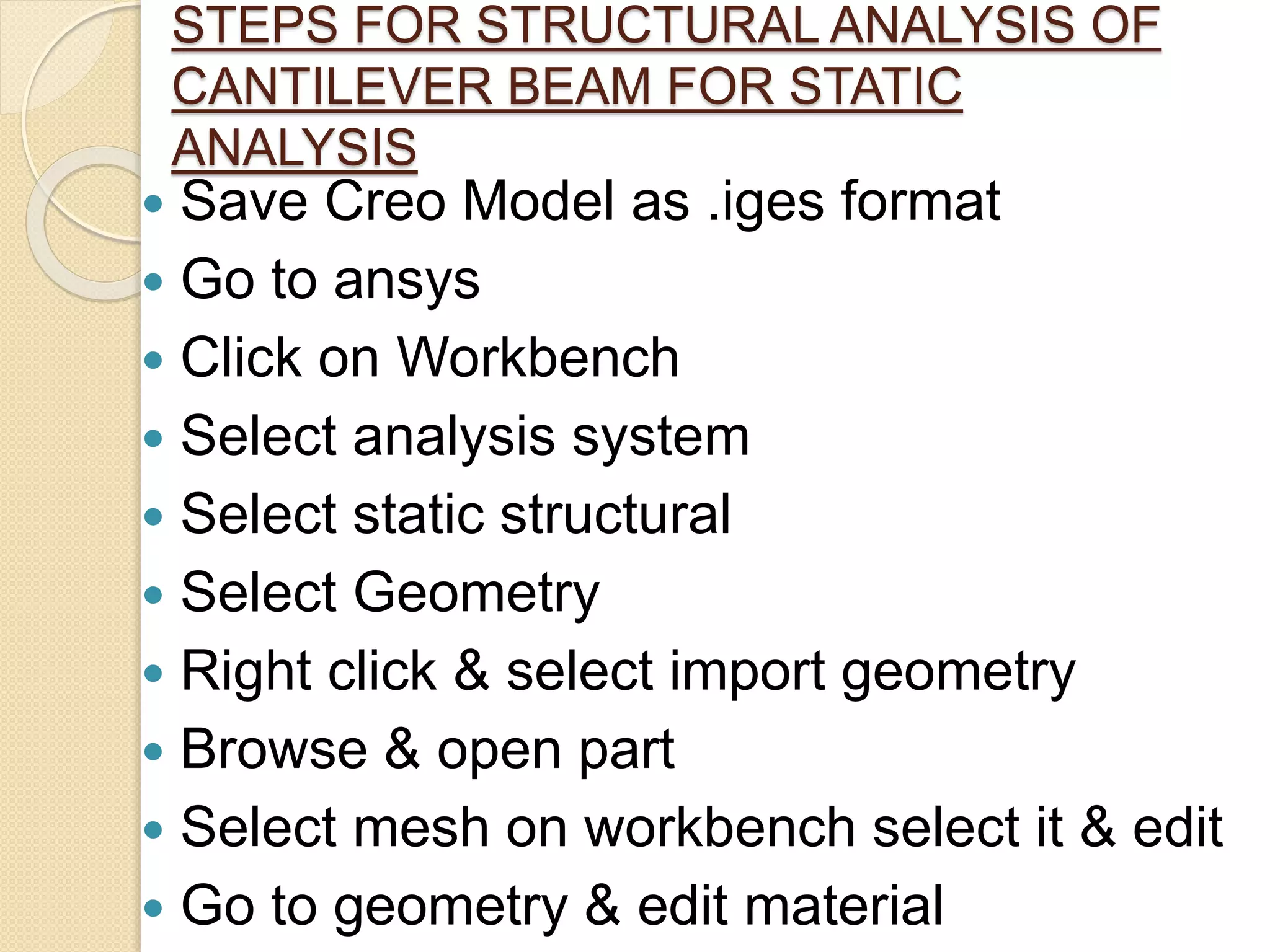
STEPS FOR STRUCTURAL ANALYSIS OF
CANTILEVER BEAM FOR STATIC
ANALYSIS
 Save Creo Model as .iges format
 Go to ansys
 Click on Workbench
 Select analysis system
 Select static structural
 Select Geometry
 Right click & select import geometry
 Browse & open part
 Select mesh on workbench select it & edit
 Go to geometry & edit material
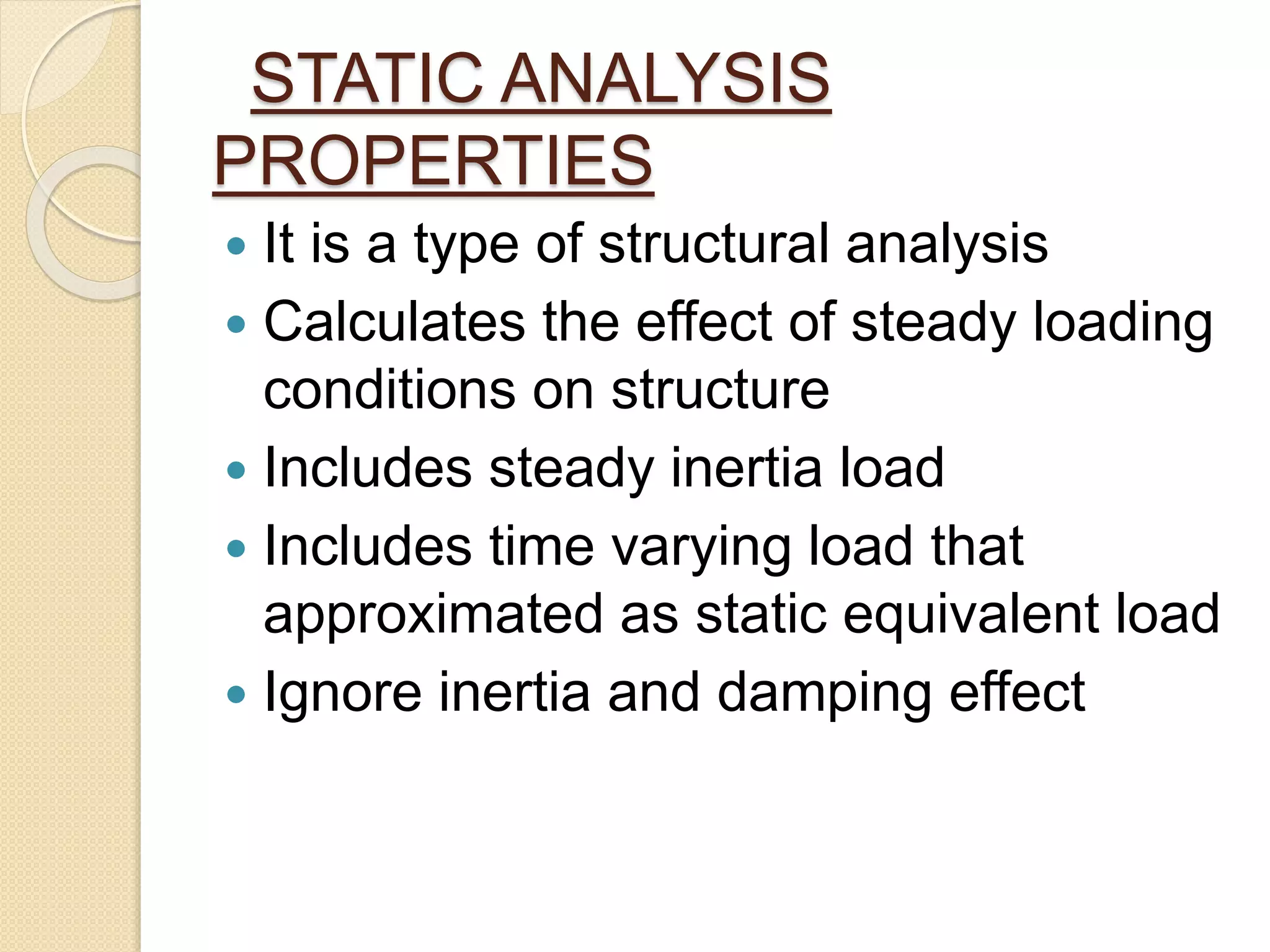
STATIC ANALYSIS
PROPERTIES
 It is a type of structural analysis
 Calculates the effect of steady loading
conditions on structure
 Includes steady inertia load
 Includes time varying load that
approximated as static equivalent load
 Ignore inertia and damping effect
STATIC ANALYSIS OF CANTILEVER
BEAM
CONDITION – I SECTION
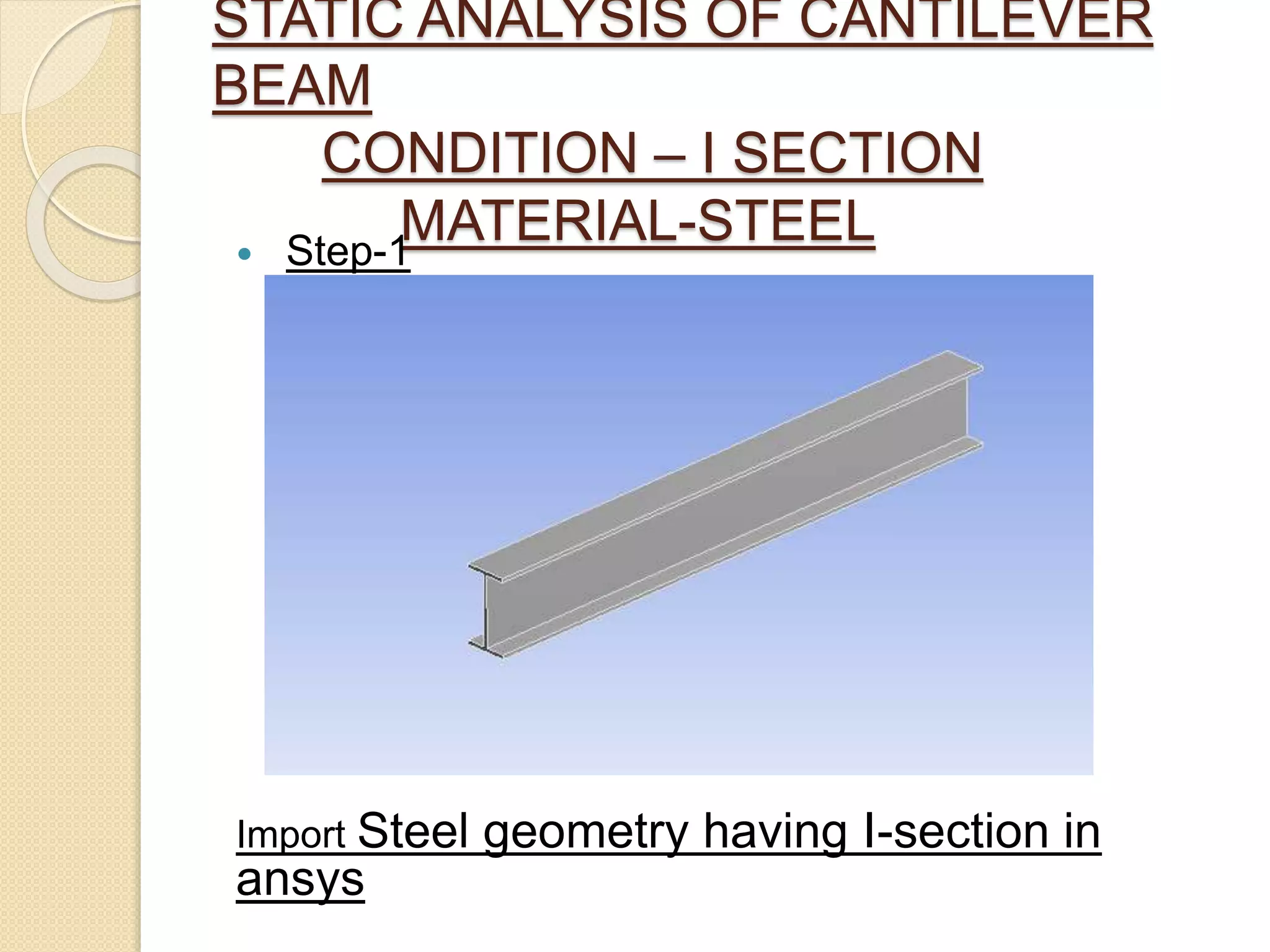
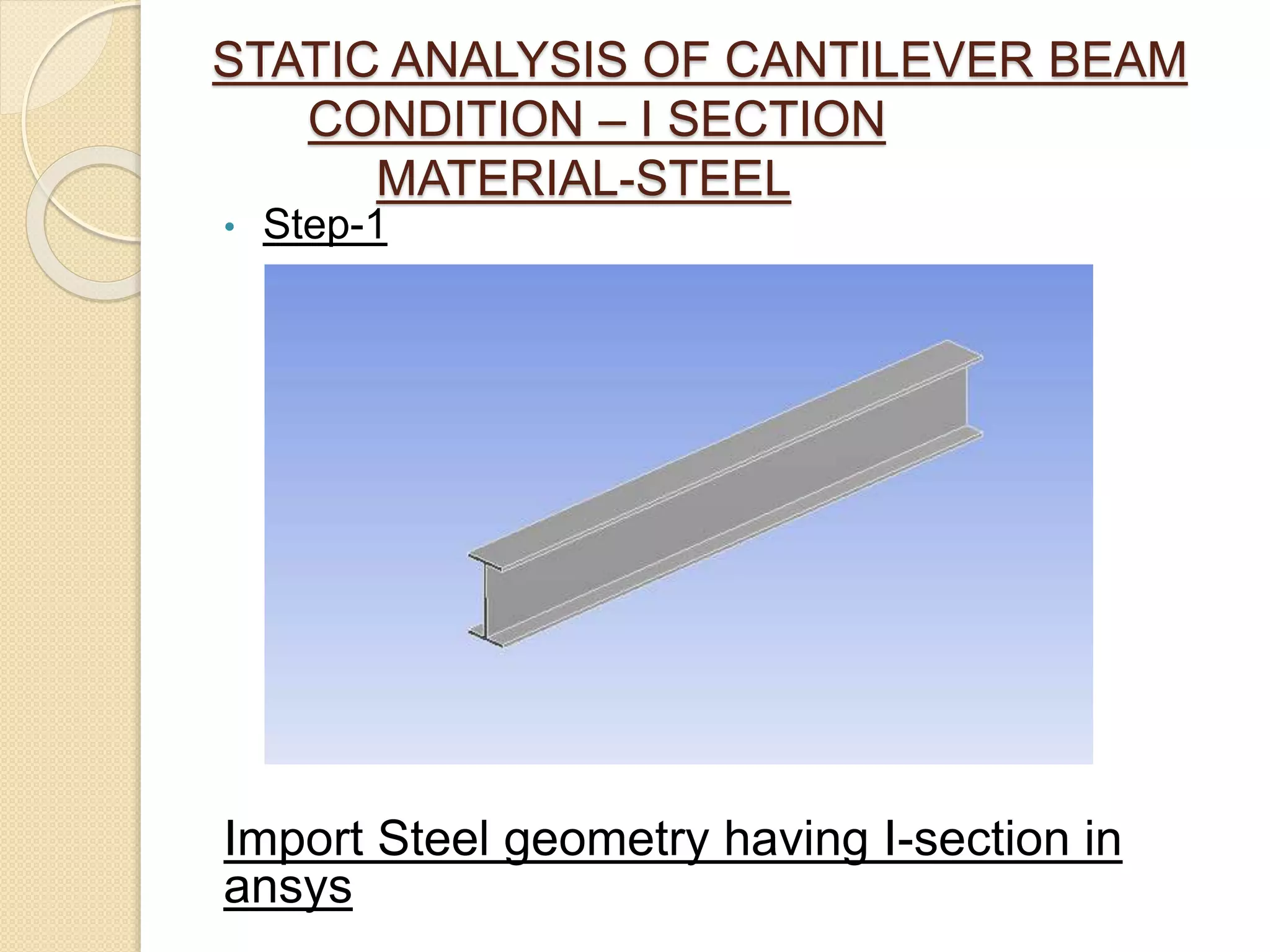
MATERIAL-STEEL Step-1
Import Steel geometry having I-section in
ansys
Step-2:-
 Go to geometry
 Select geometries
 Edit material
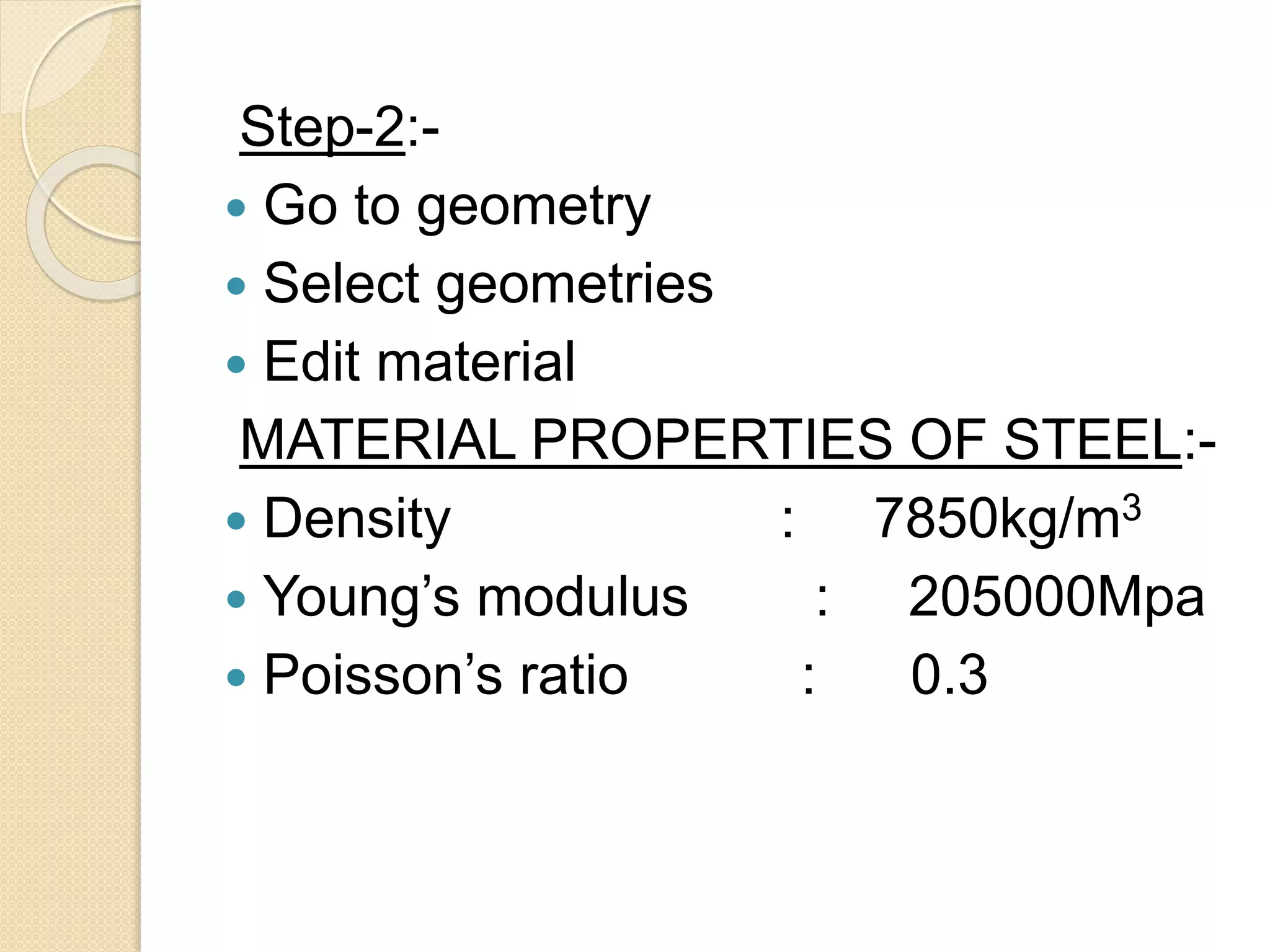
MATERIAL PROPERTIES OF STEEL:-
 Density : 7850kg/m3
 Young’s modulus : 205000Mpa
 Poisson’s ratio : 0.3
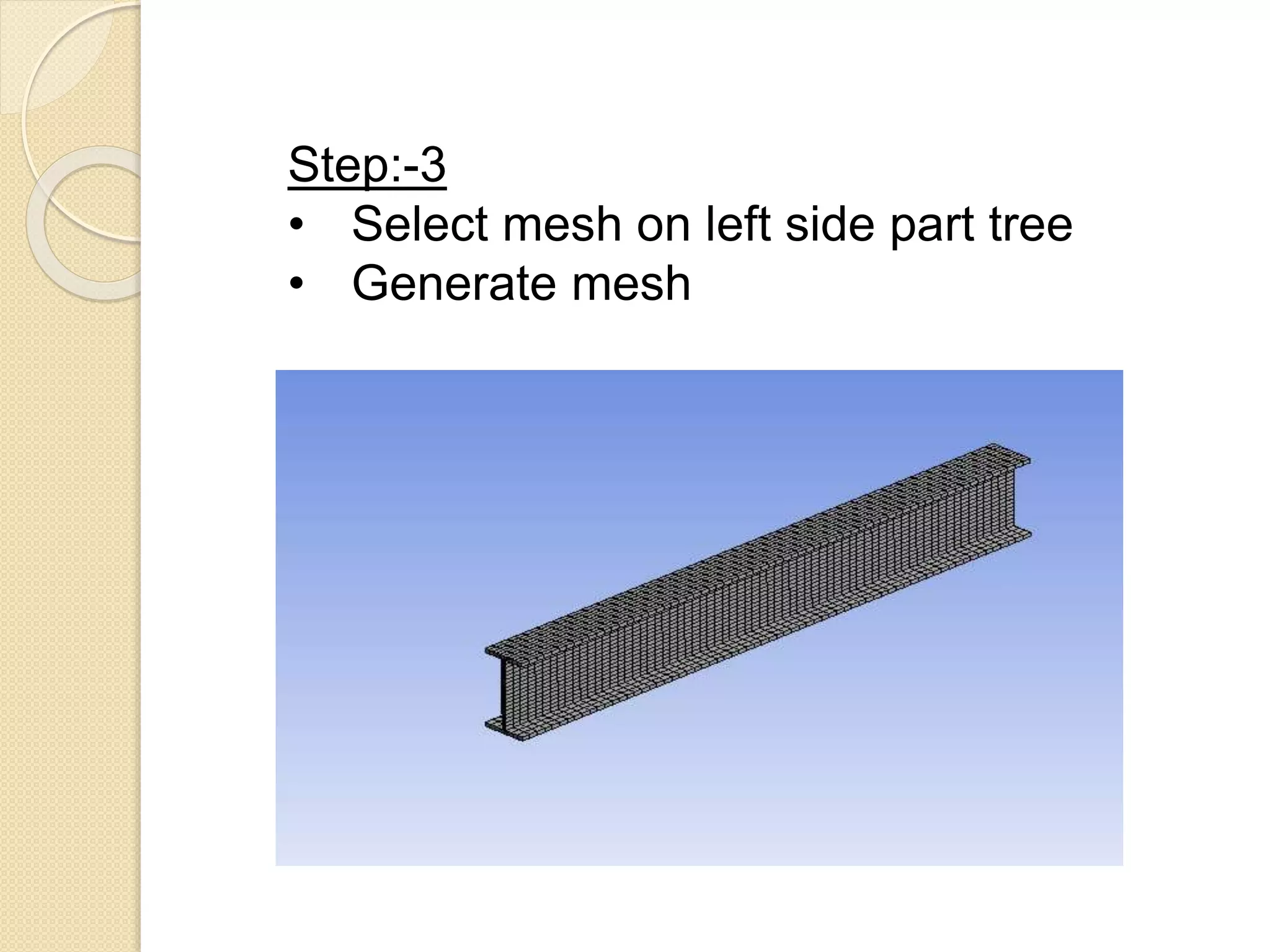
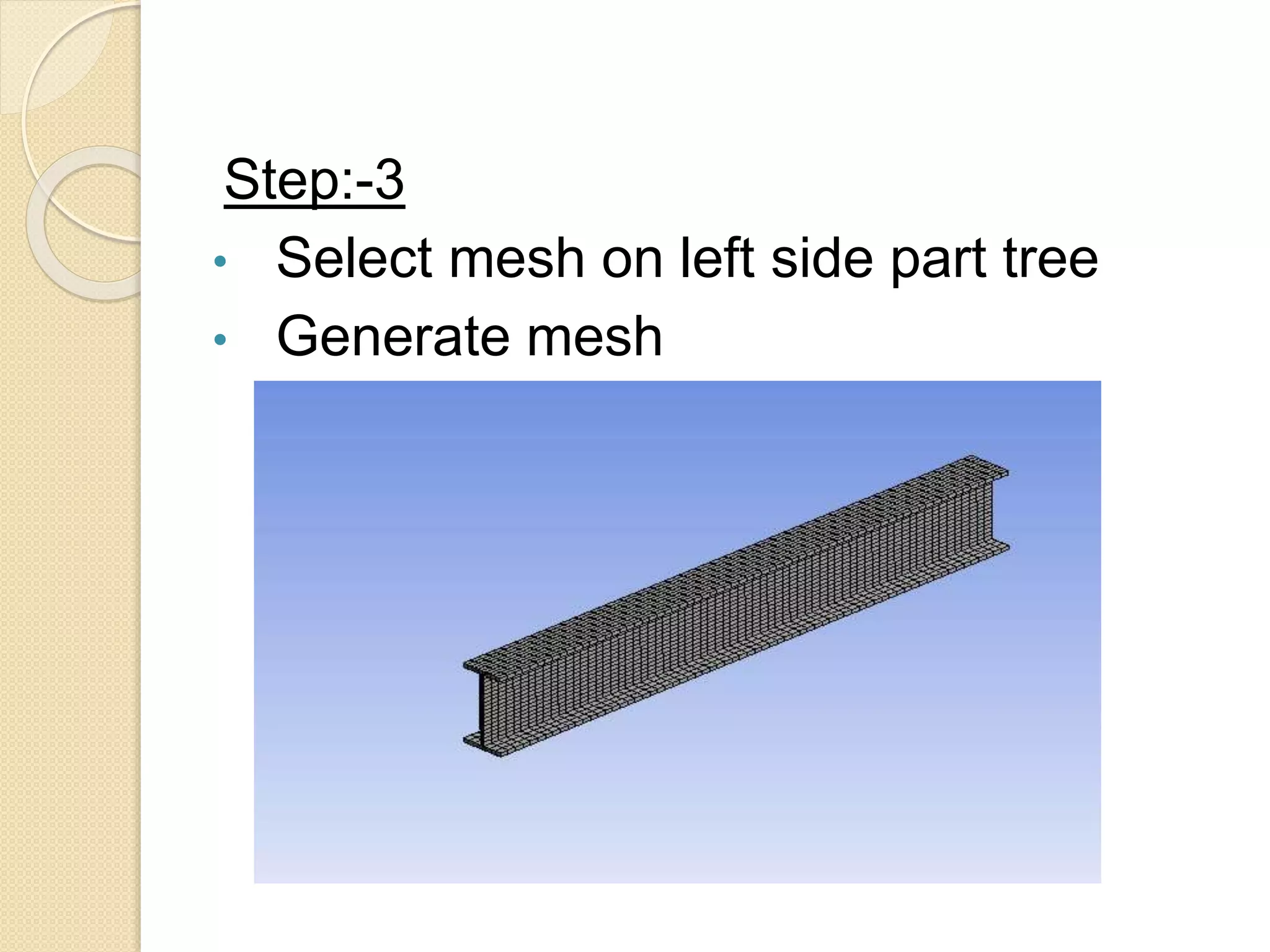
Step:-3
• Select mesh on left side part tree
• Generate mesh
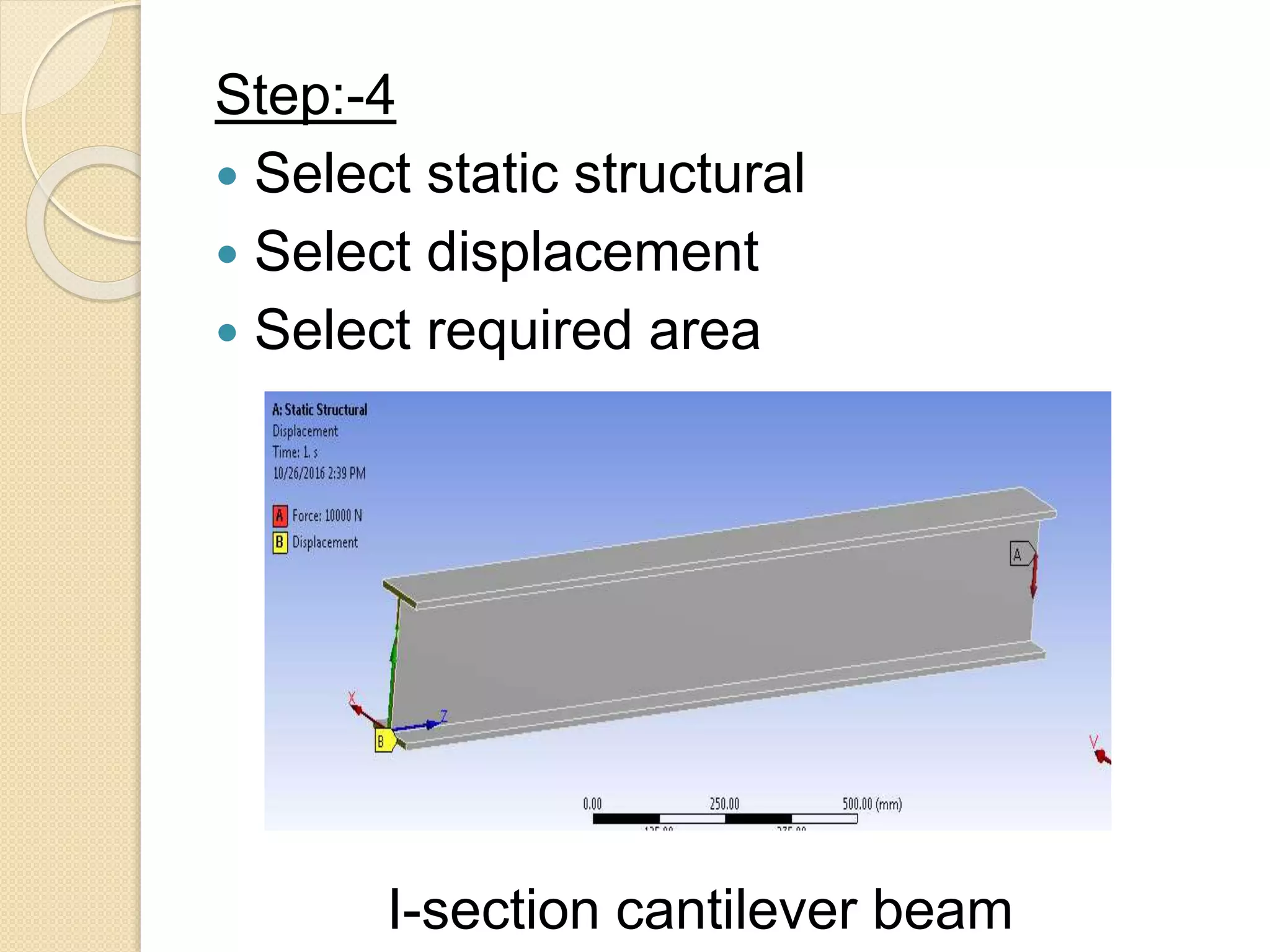
Step:-4
 Select static structural
 Select displacement
 Select required area
I-section cantilever beam
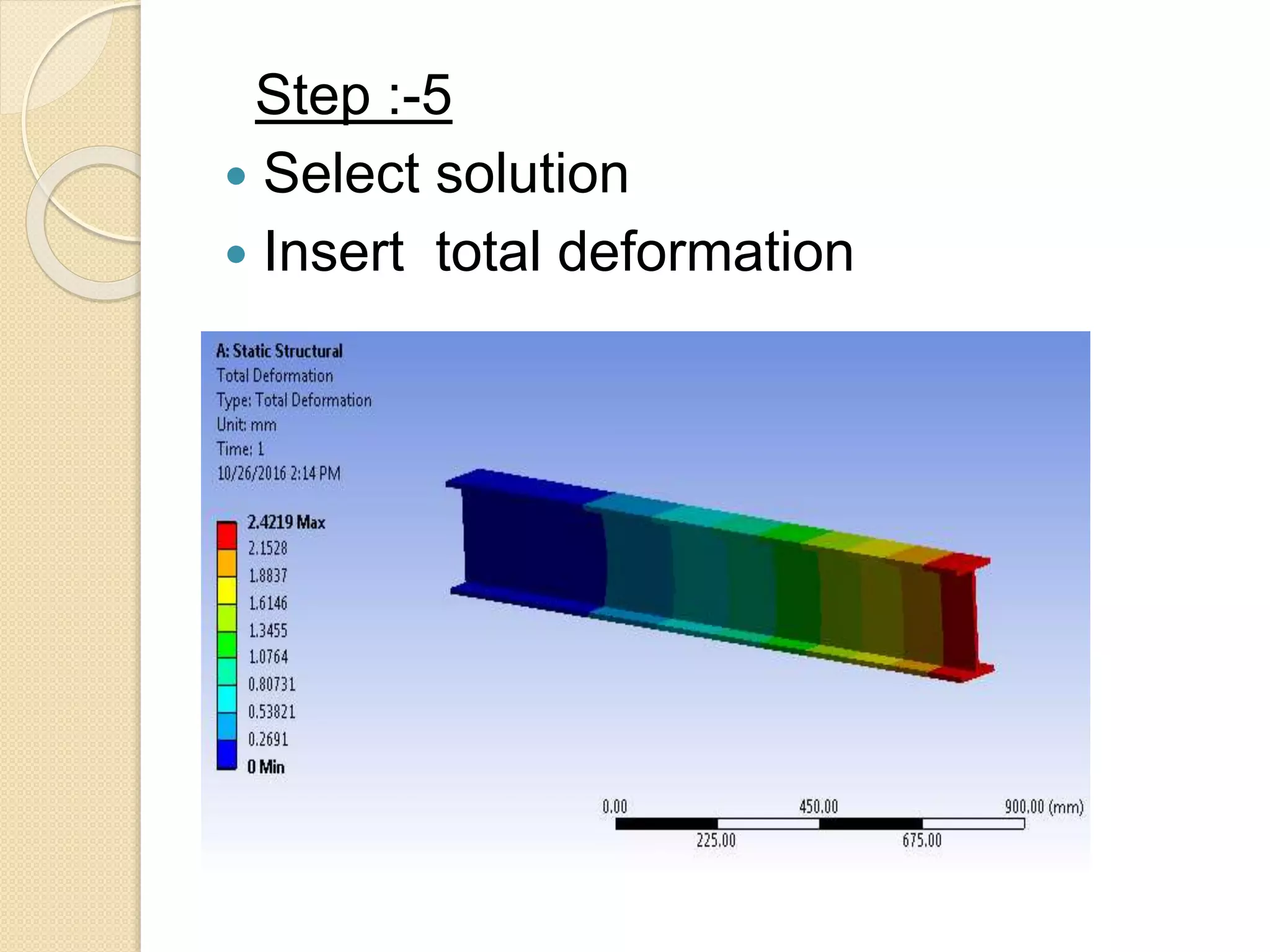
Step :-5
 Select solution
 Insert total deformation
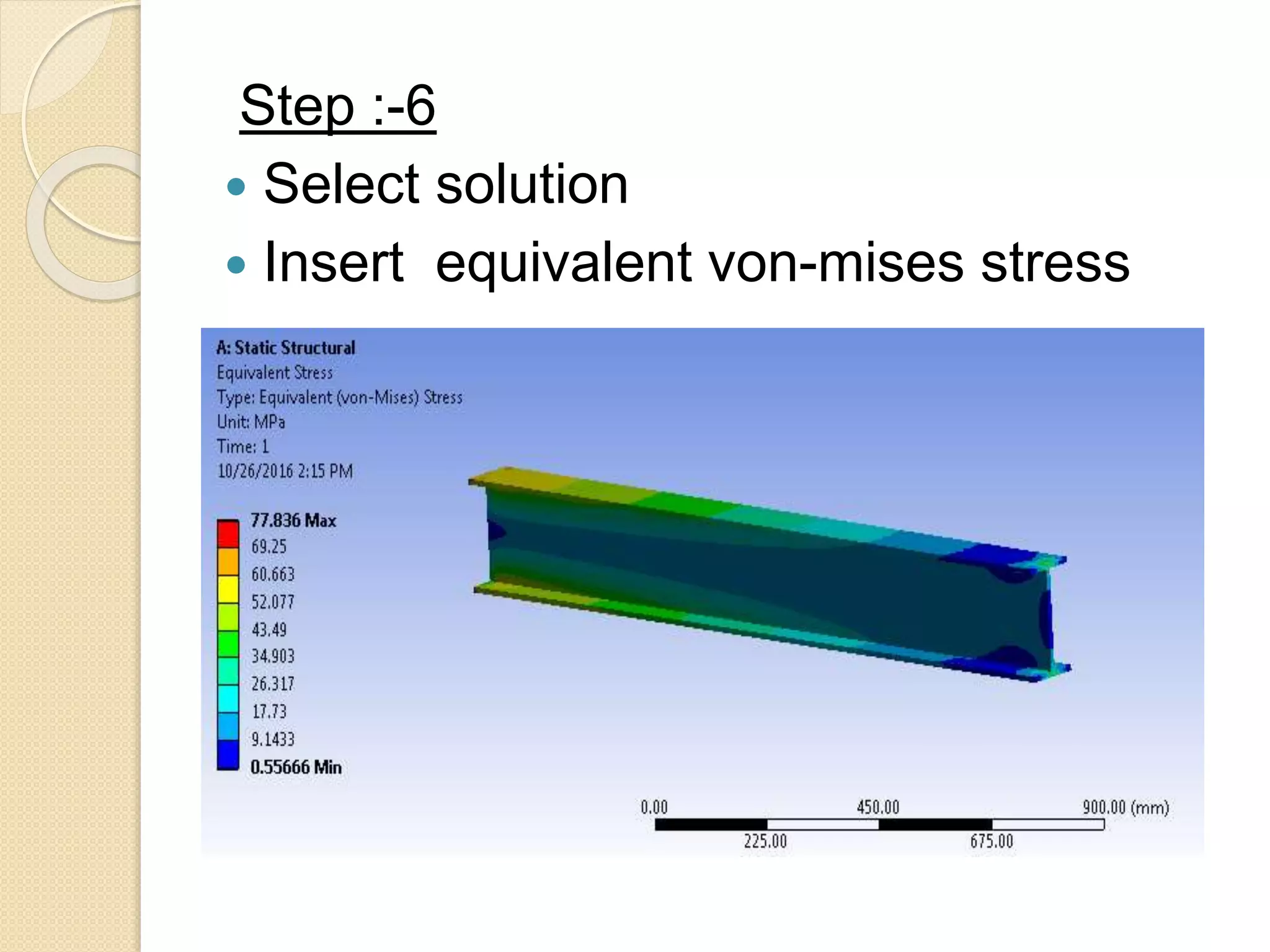
Step :-6
 Select solution
 Insert equivalent von-mises stress
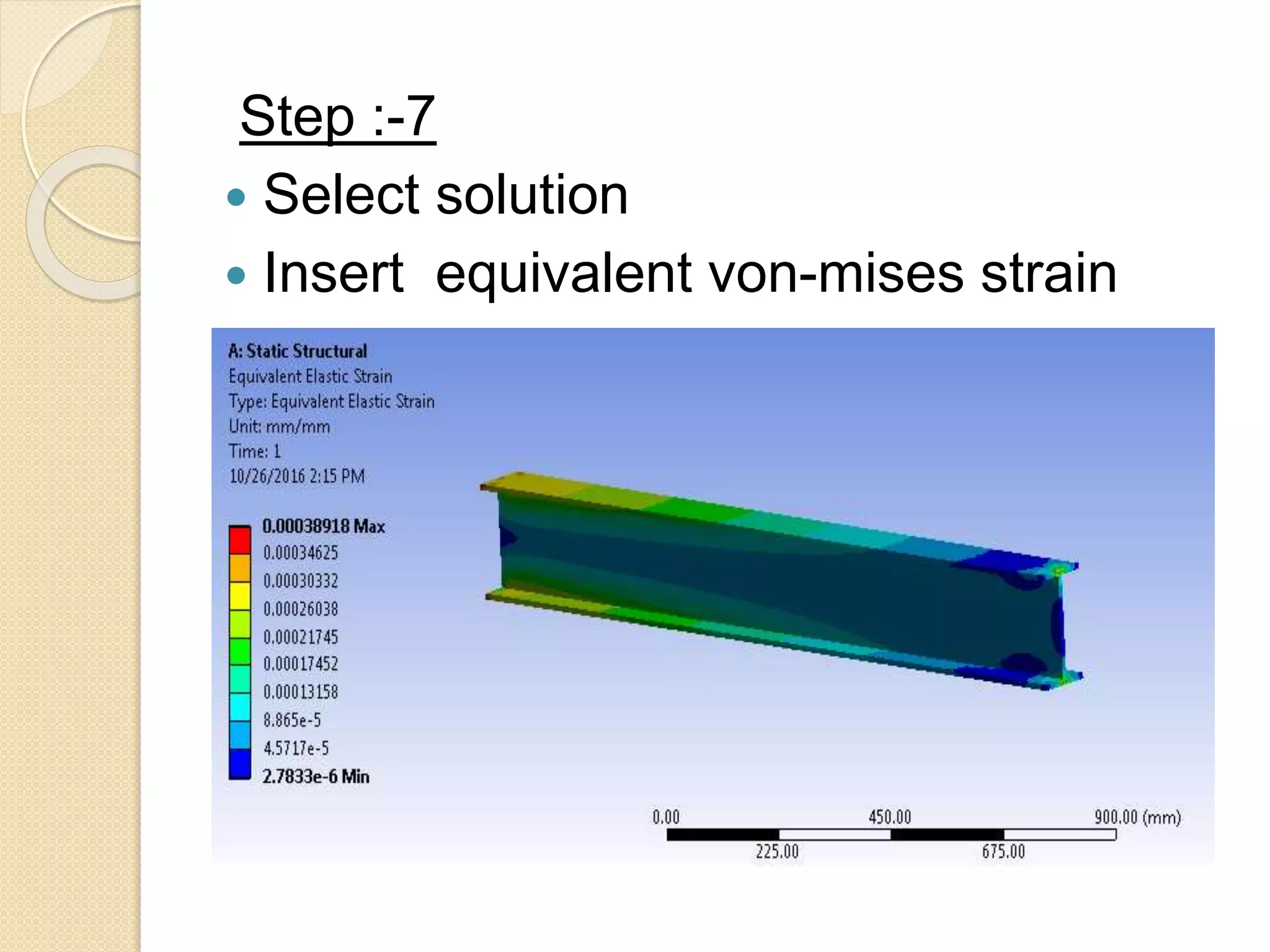
Step :-7
 Select solution
 Insert equivalent von-mises strain
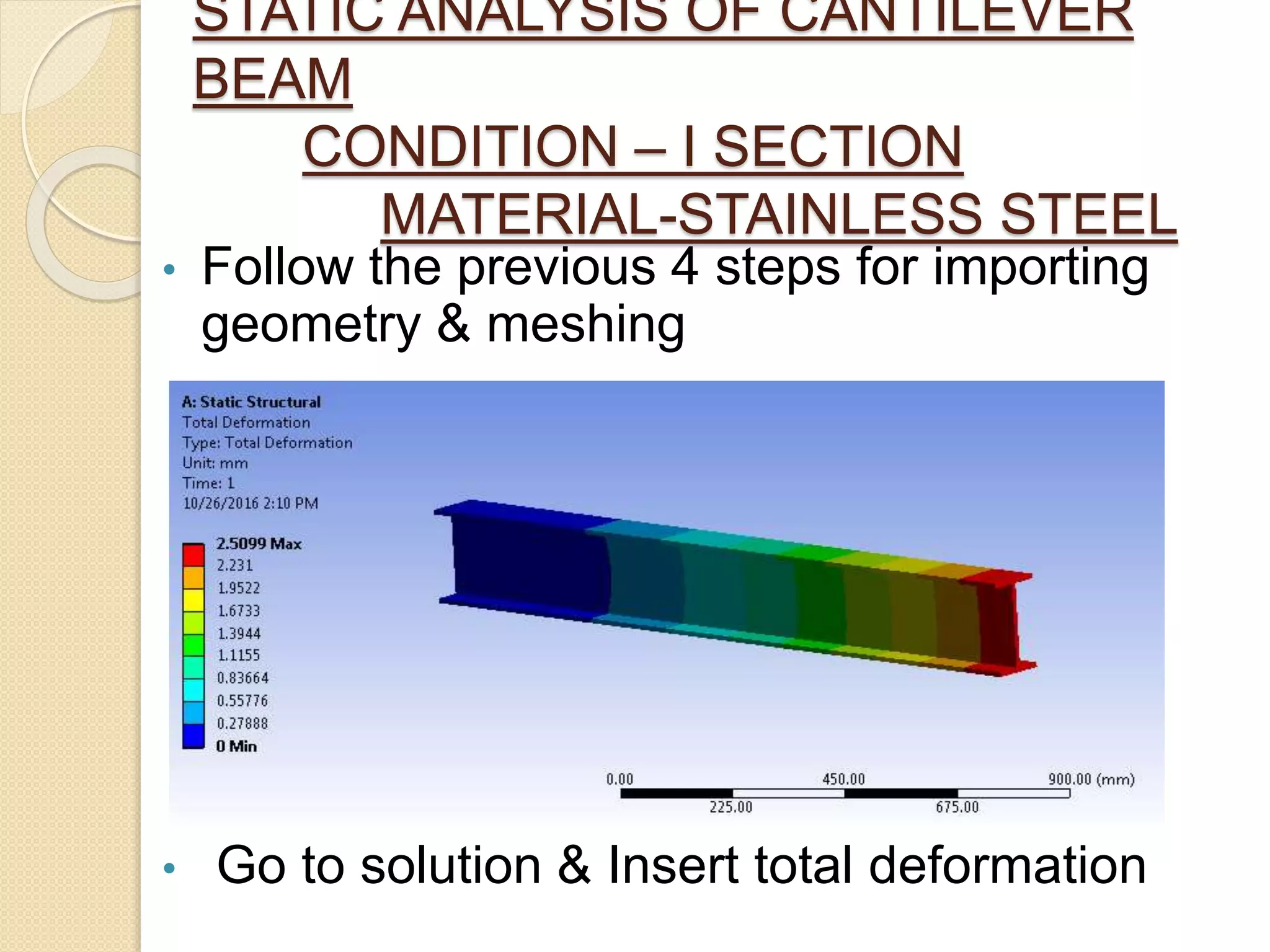
STATIC ANALYSIS OF CANTILEVER
BEAM
CONDITION – I SECTION
MATERIAL-STAINLESS STEEL
• Follow the previous 4 steps for importing
geometry & meshing
• Go to solution & Insert total deformation
In Step-2:-
 Go to geometry
 Select geometries
 Edit material
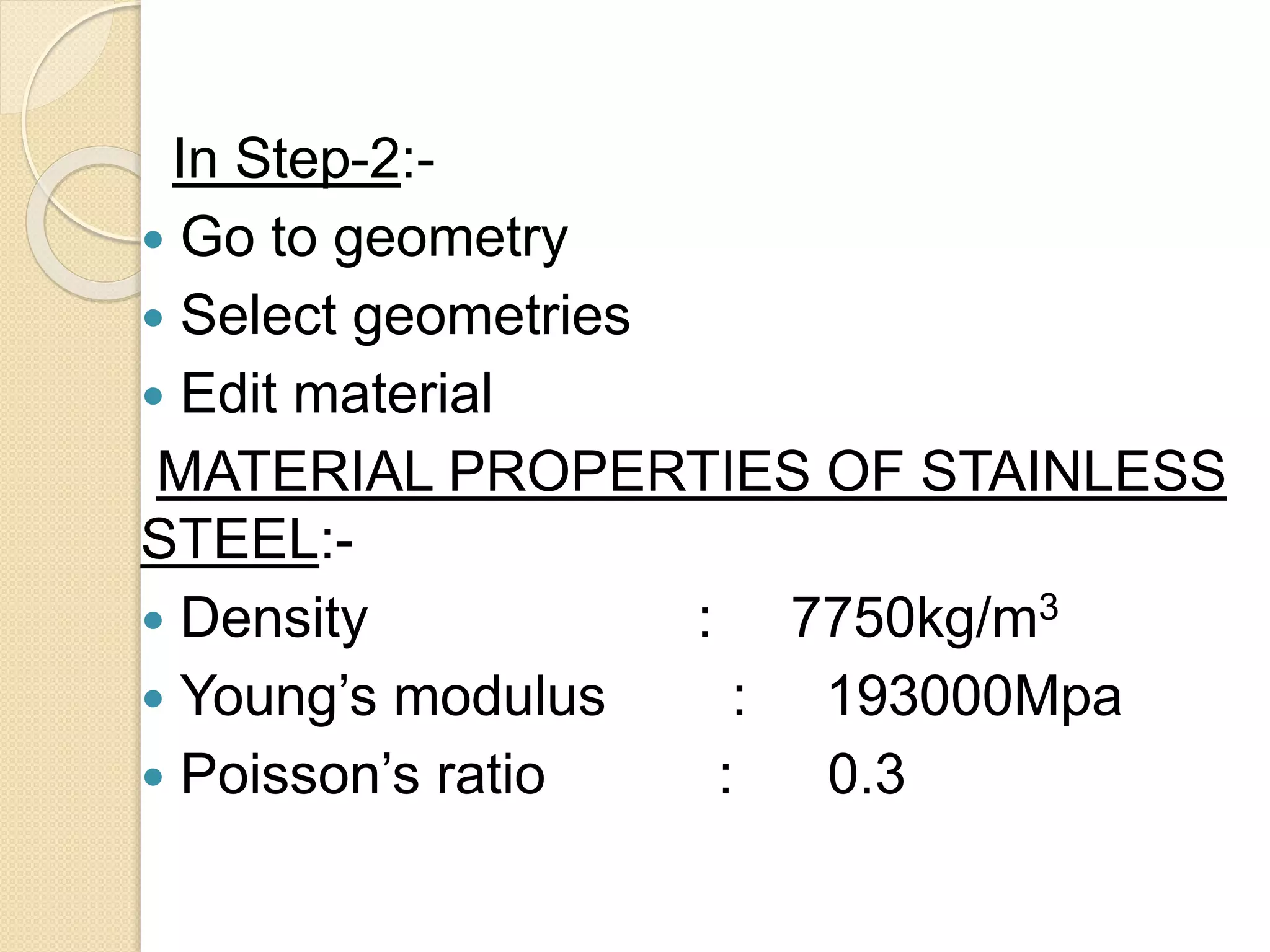
MATERIAL PROPERTIES OF STAINLESS
STEEL:-
 Density : 7750kg/m3
 Young’s modulus : 193000Mpa
 Poisson’s ratio : 0.3
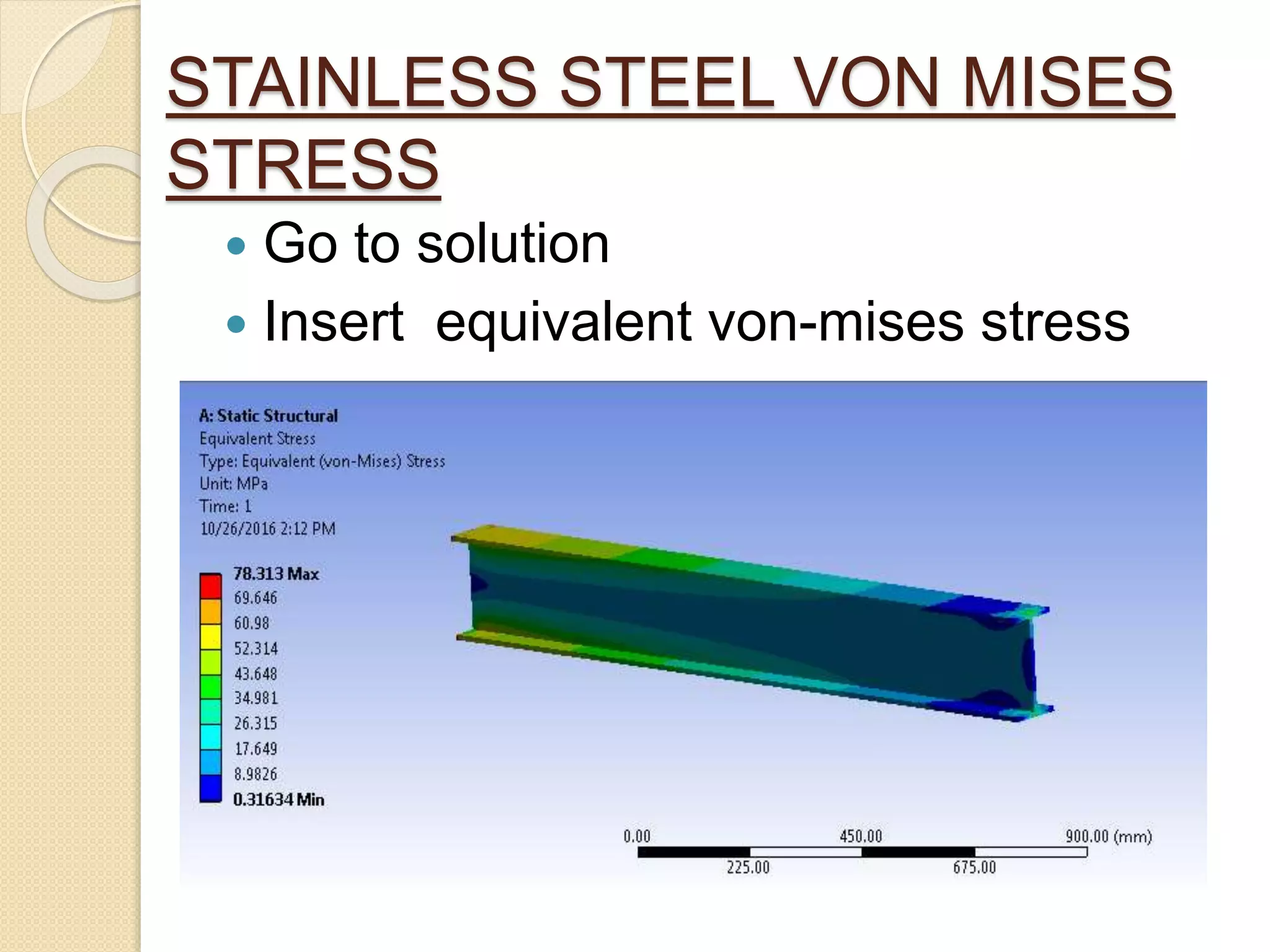
STAINLESS STEEL VON MISES
STRESS
 Go to solution
 Insert equivalent von-mises stress
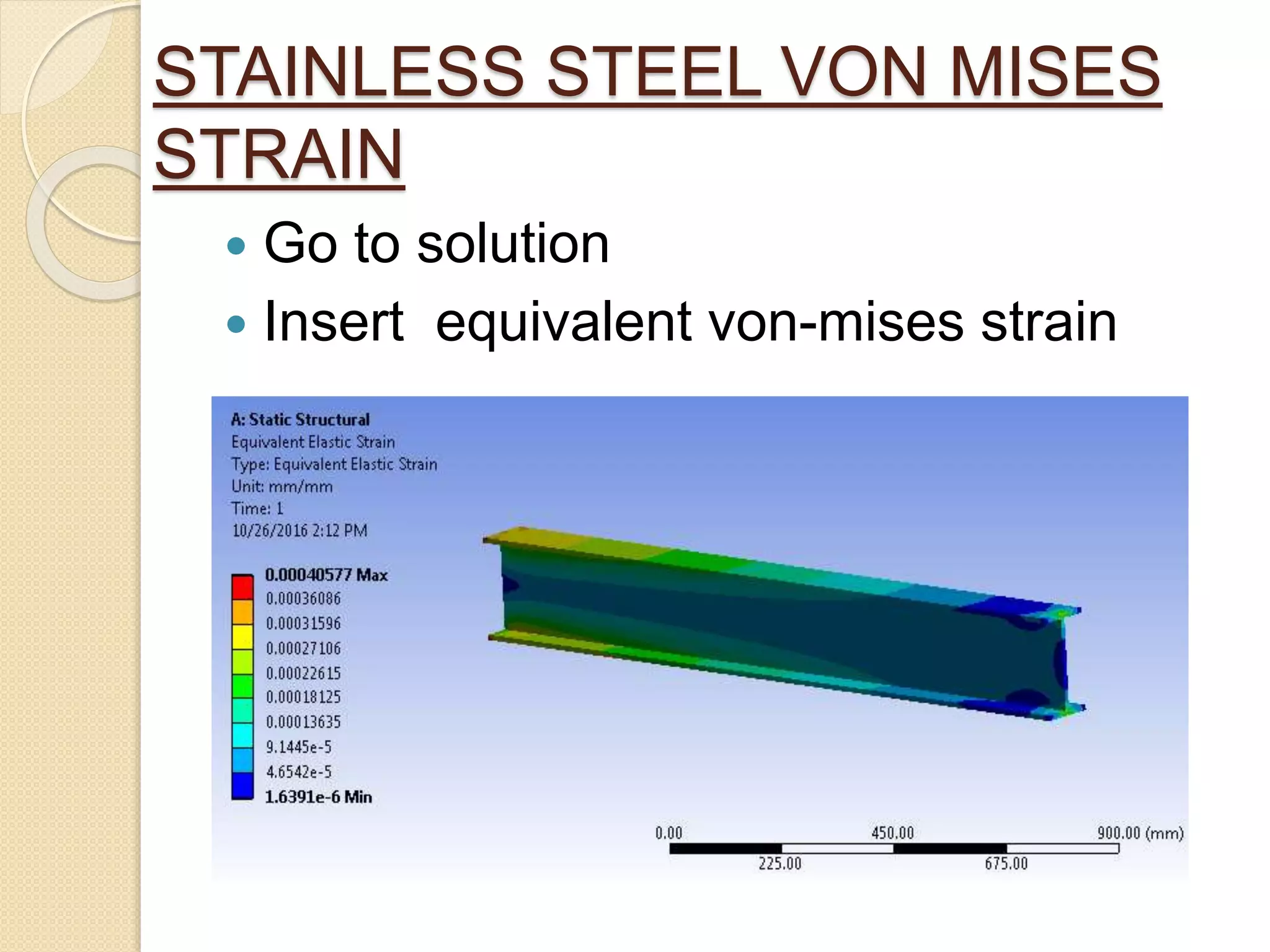
STAINLESS STEEL VON MISES
STRAIN
 Go to solution
 Insert equivalent von-mises strain
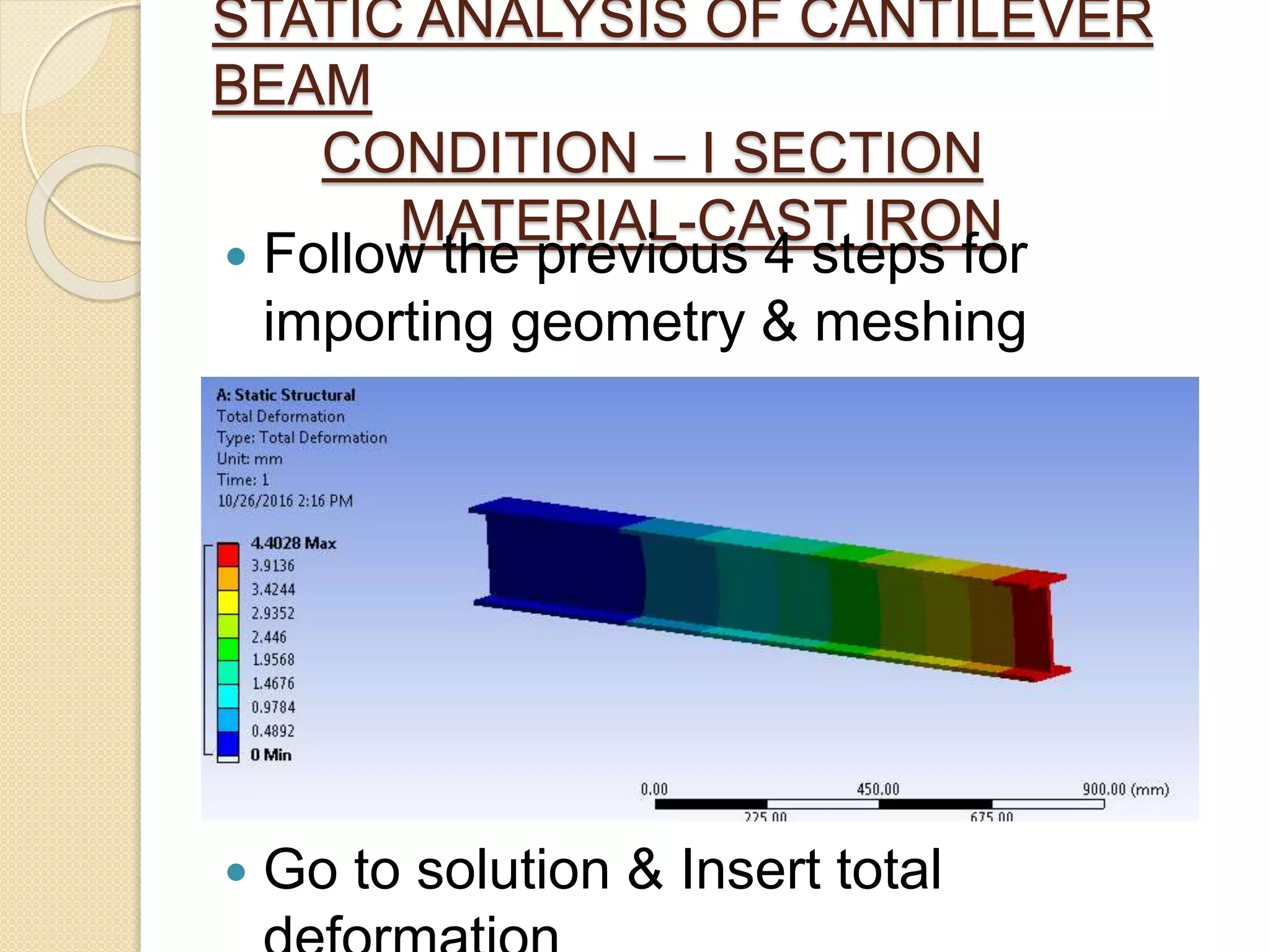
STATIC ANALYSIS OF CANTILEVER
BEAM
CONDITION – I SECTION
MATERIAL-CAST IRON
 Follow the previous 4 steps for
importing geometry & meshing
 Go to solution & Insert total
In Step-2:-
 Go to geometry
 Select geometries
 Edit material
MATERIAL PROPERTIES OF CAST
IRON:-
 Density : 7200kg/m3
 Young’s modulus : 110000Mpa
 Poisson’s ratio : 0.24
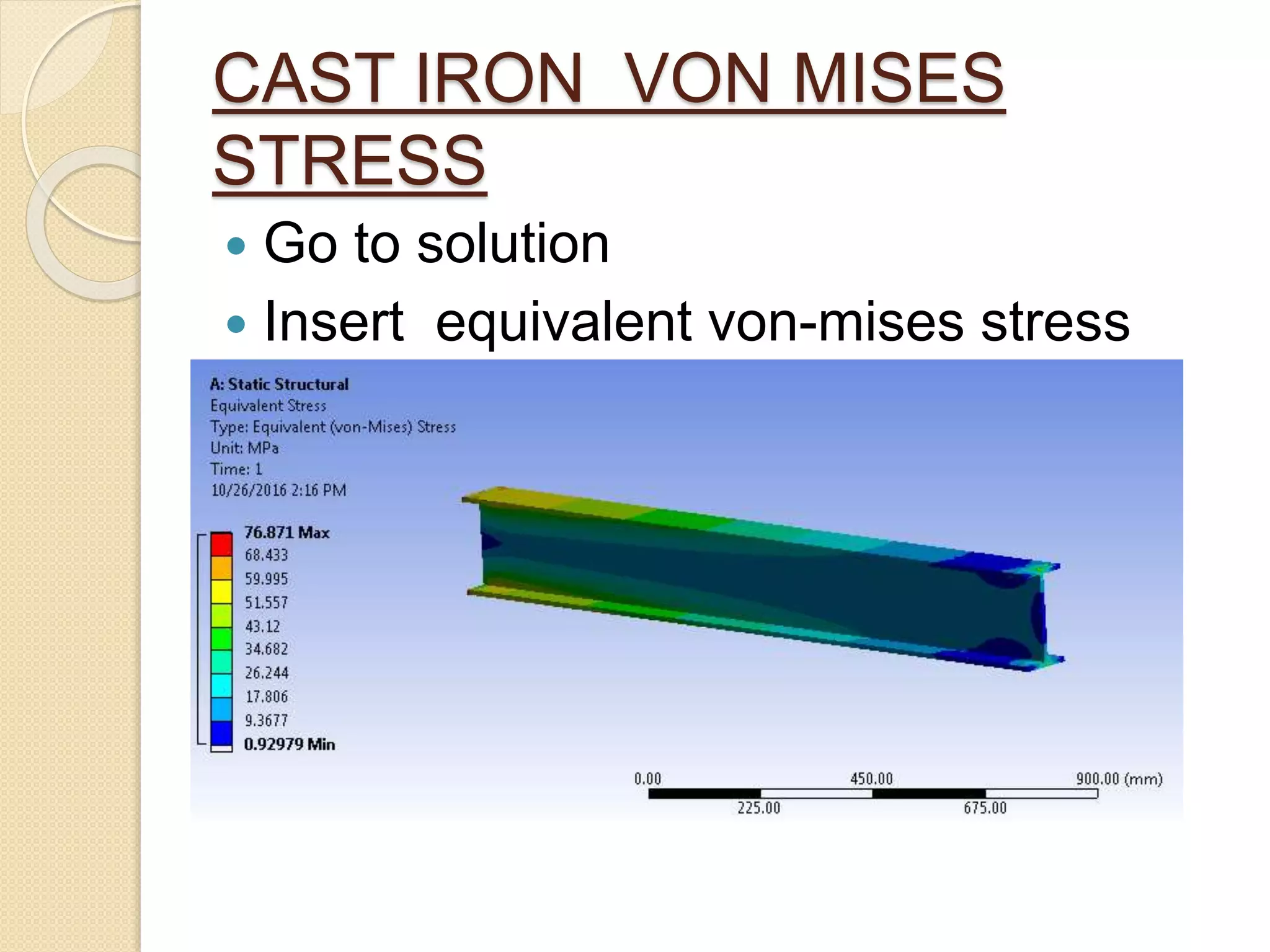
CAST IRON VON MISES
STRESS
 Go to solution
 Insert equivalent von-mises stress
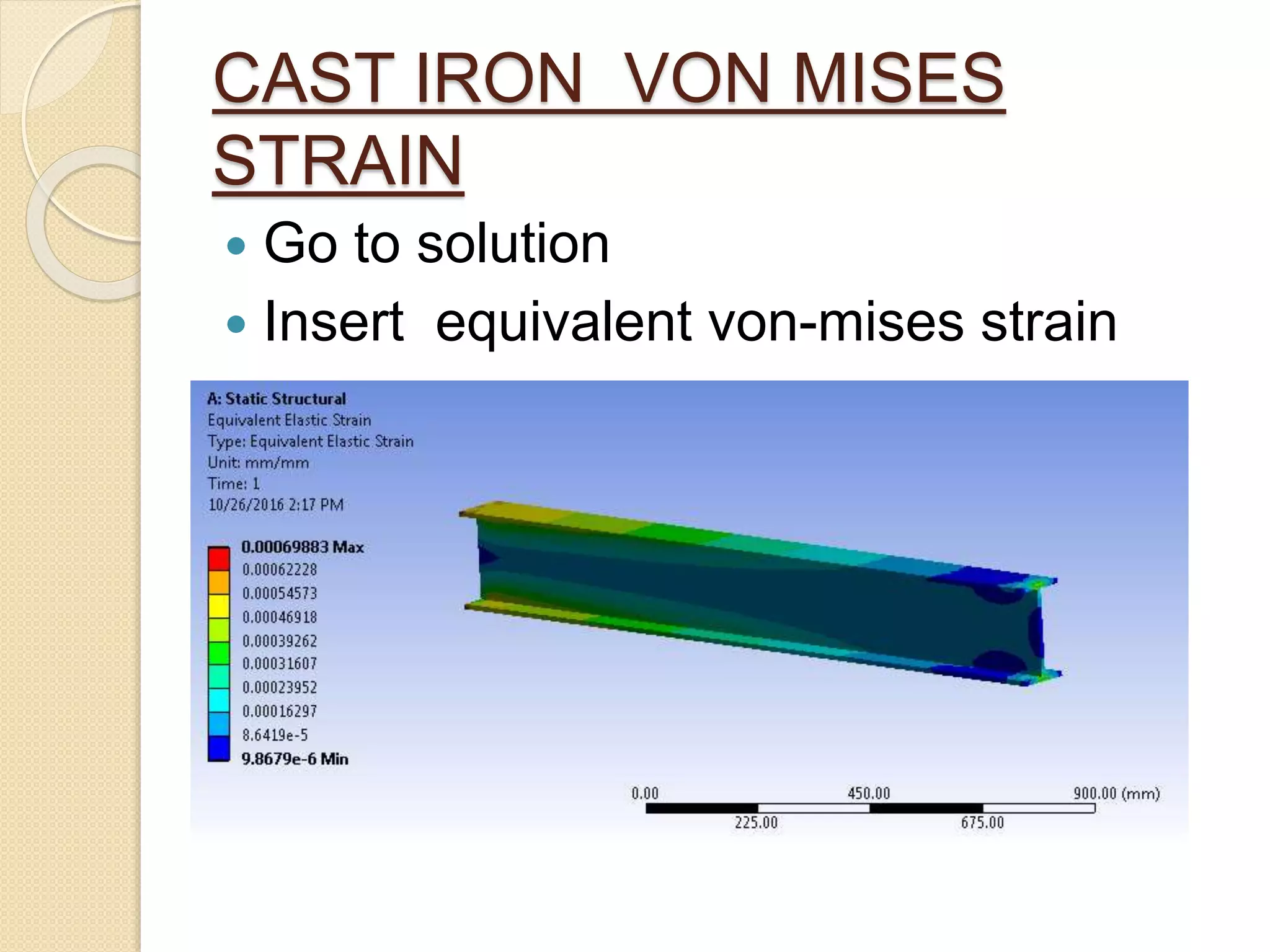
CAST IRON VON MISES
STRAIN
 Go to solution
 Insert equivalent von-mises strain
STATIC ANALYSIS OF CANTILEVER
BEAM
CONDITION – C SECTION & T SECTION
• Follow the same steps for C section & T
section of beam
• Change the properties by changing the
Materials
• Use steel, stainless steel, cast iron
materials for the sections
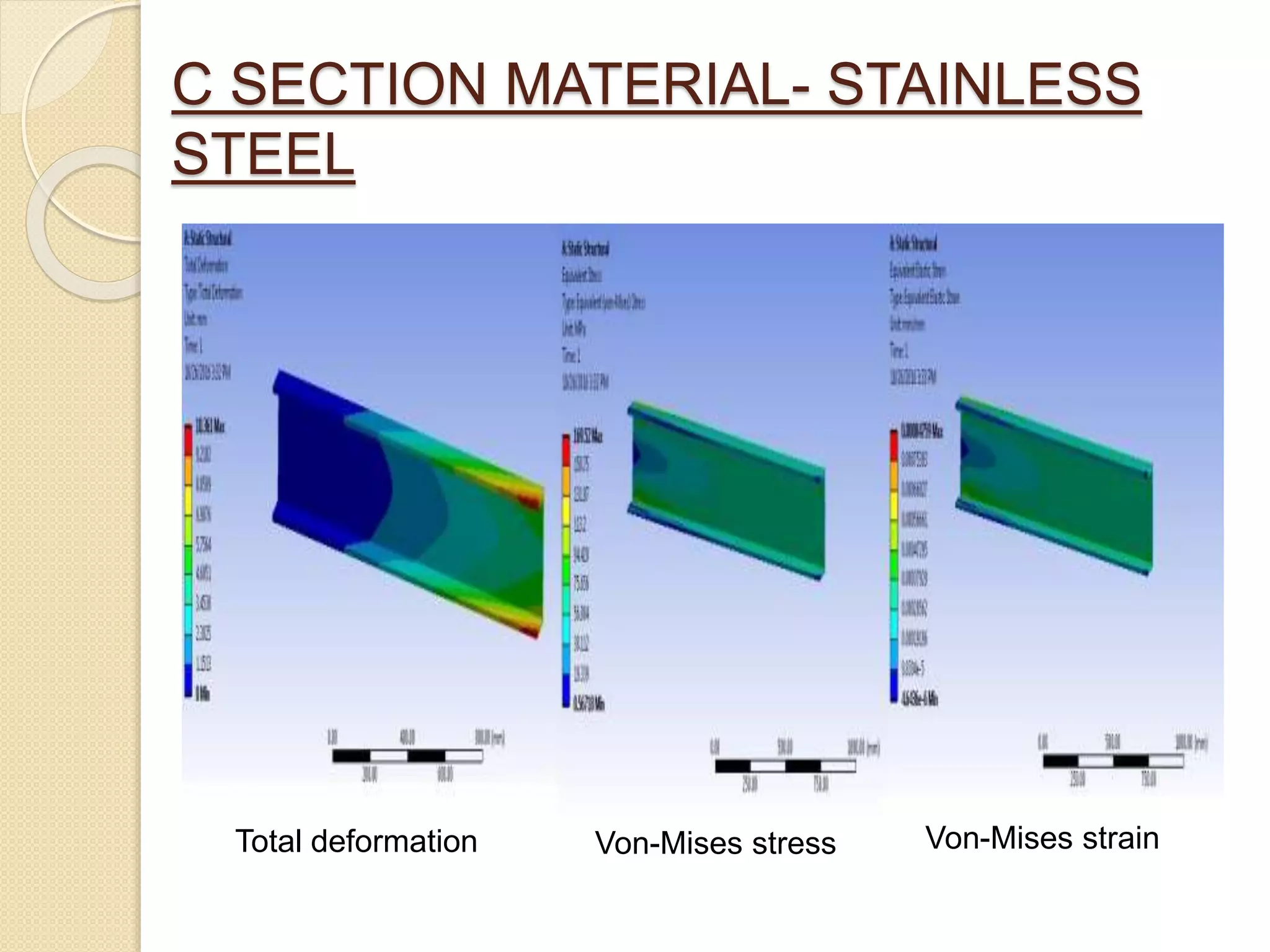
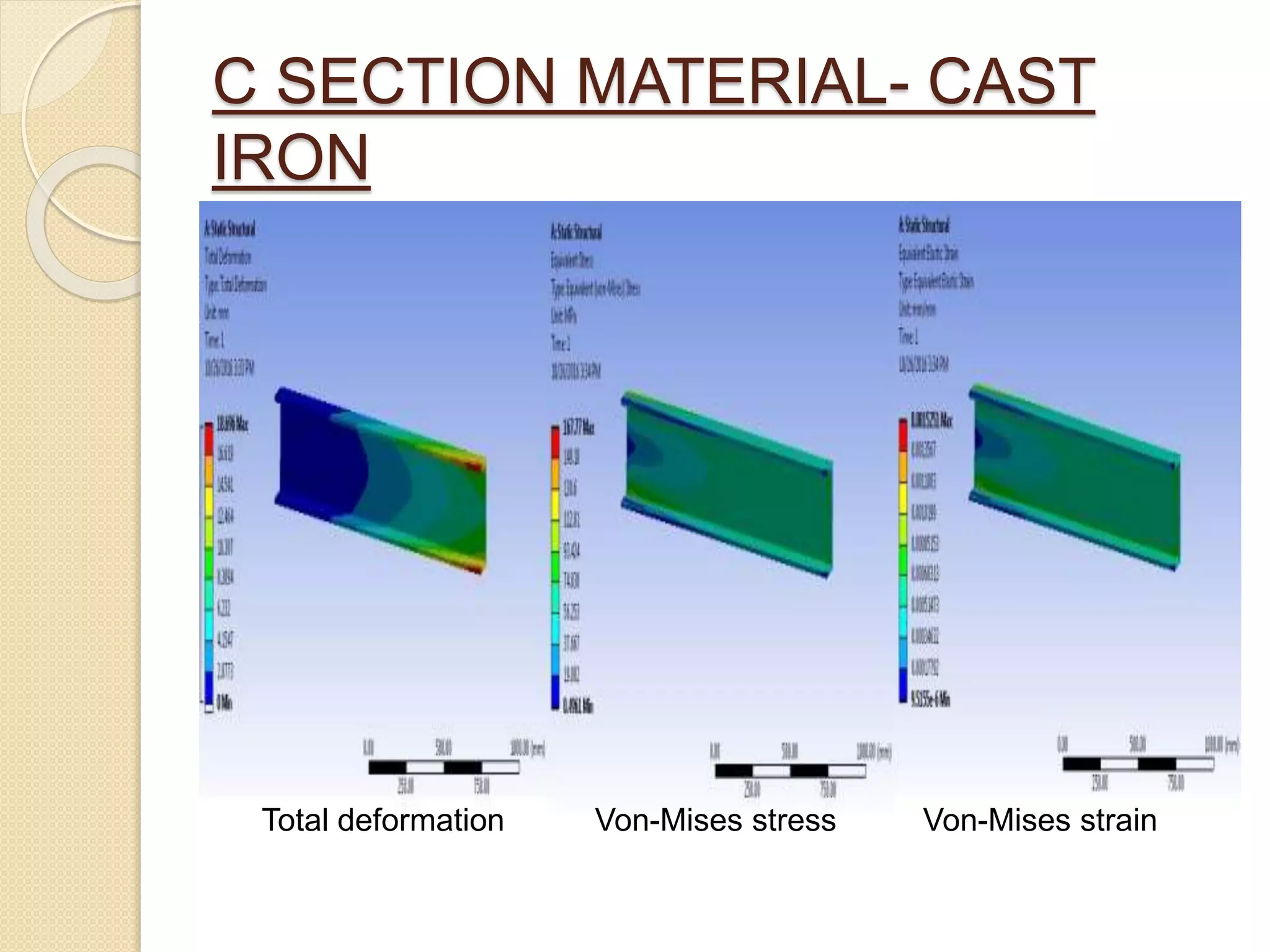
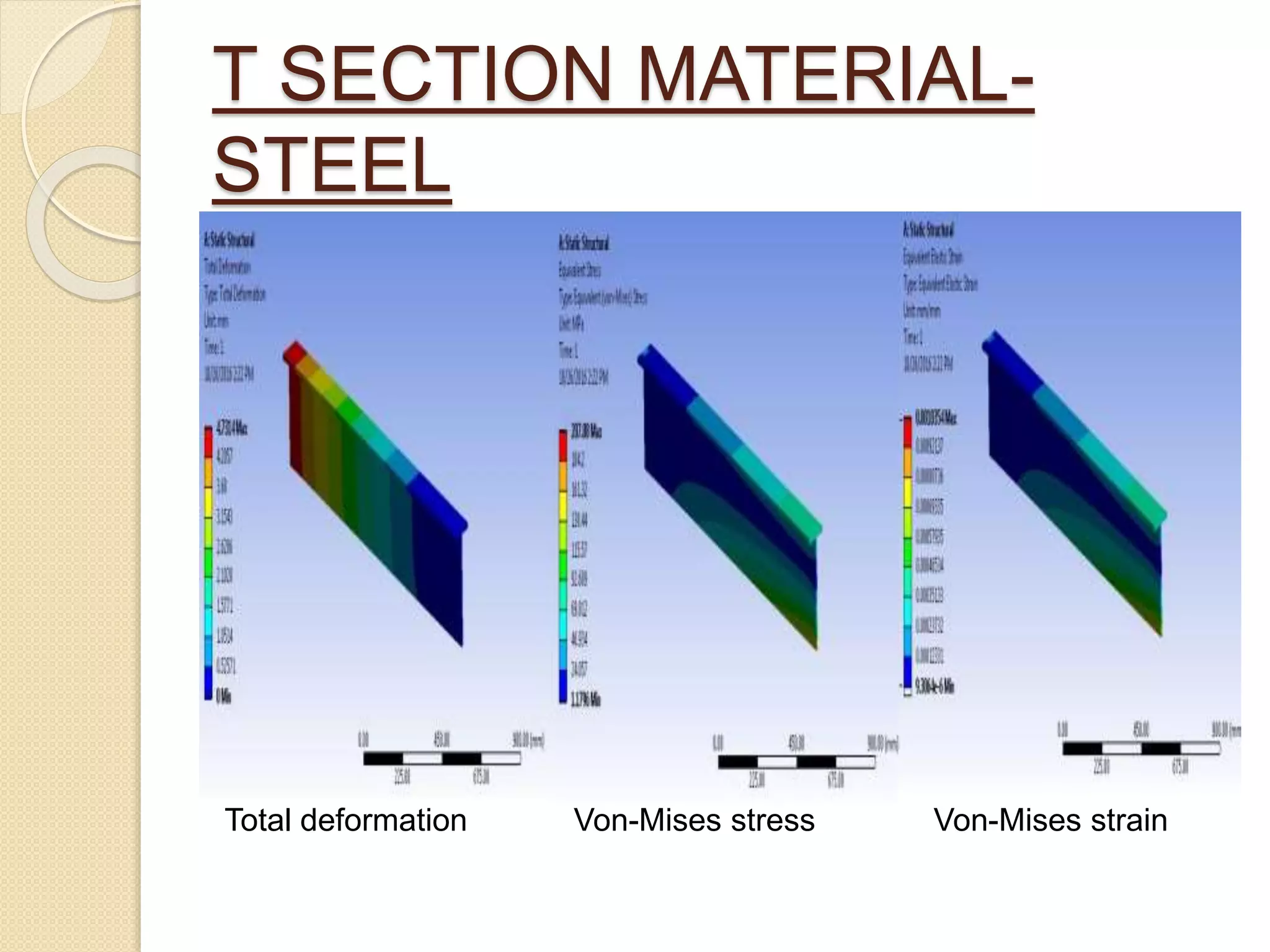
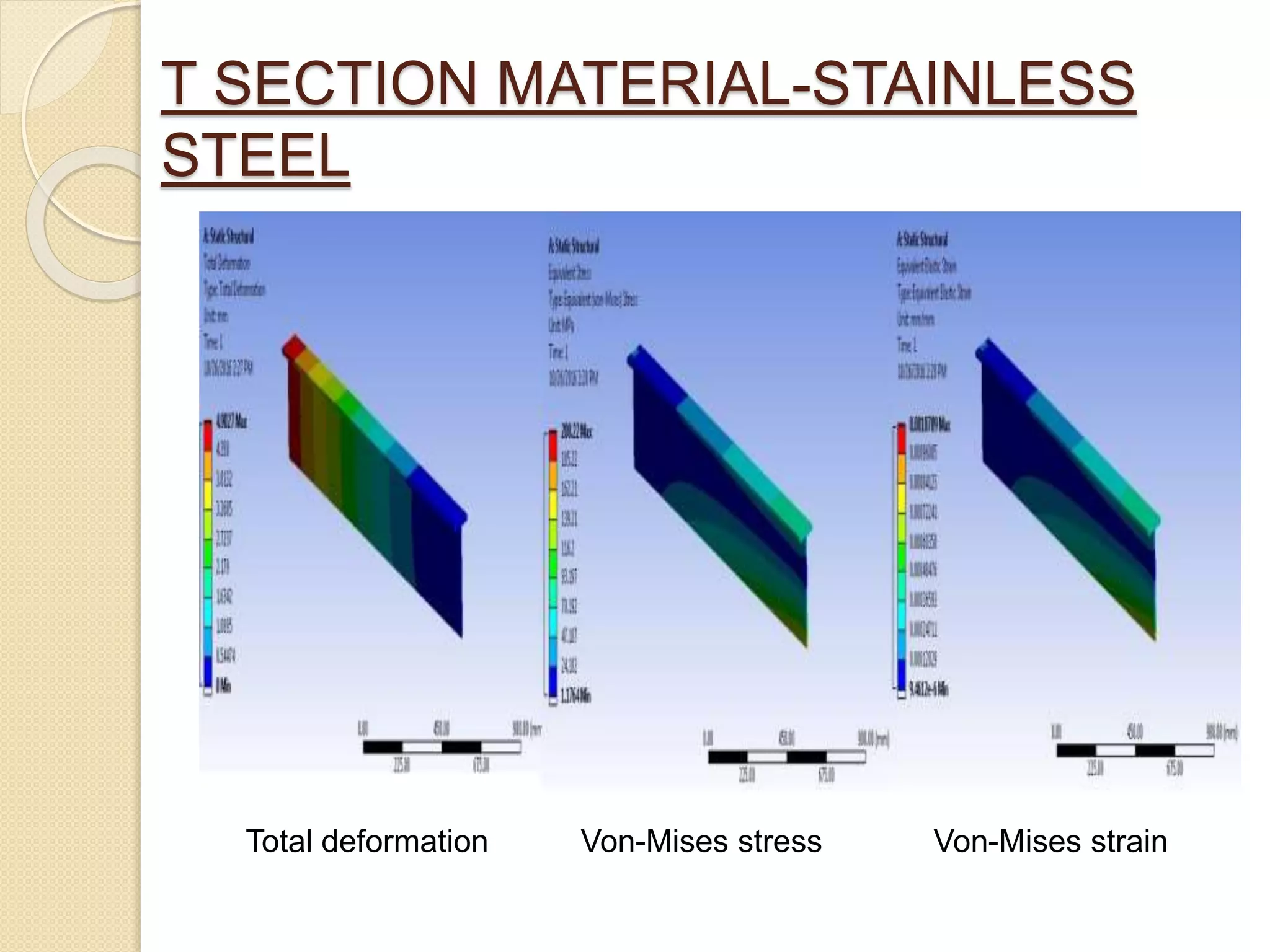
• Do solution for deformation, von mises
stress & von mises strain
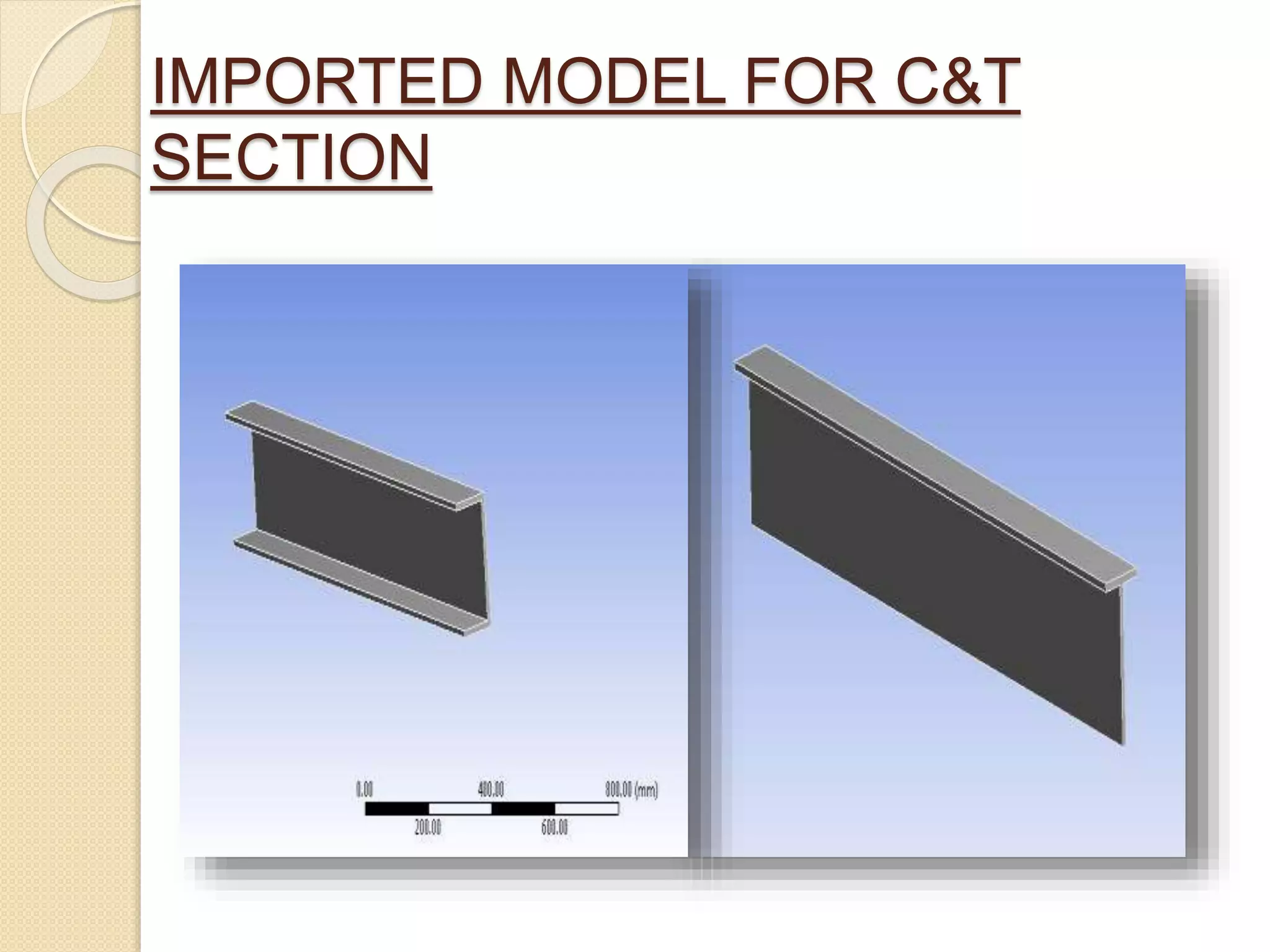
IMPORTED MODEL FOR C&T
SECTION
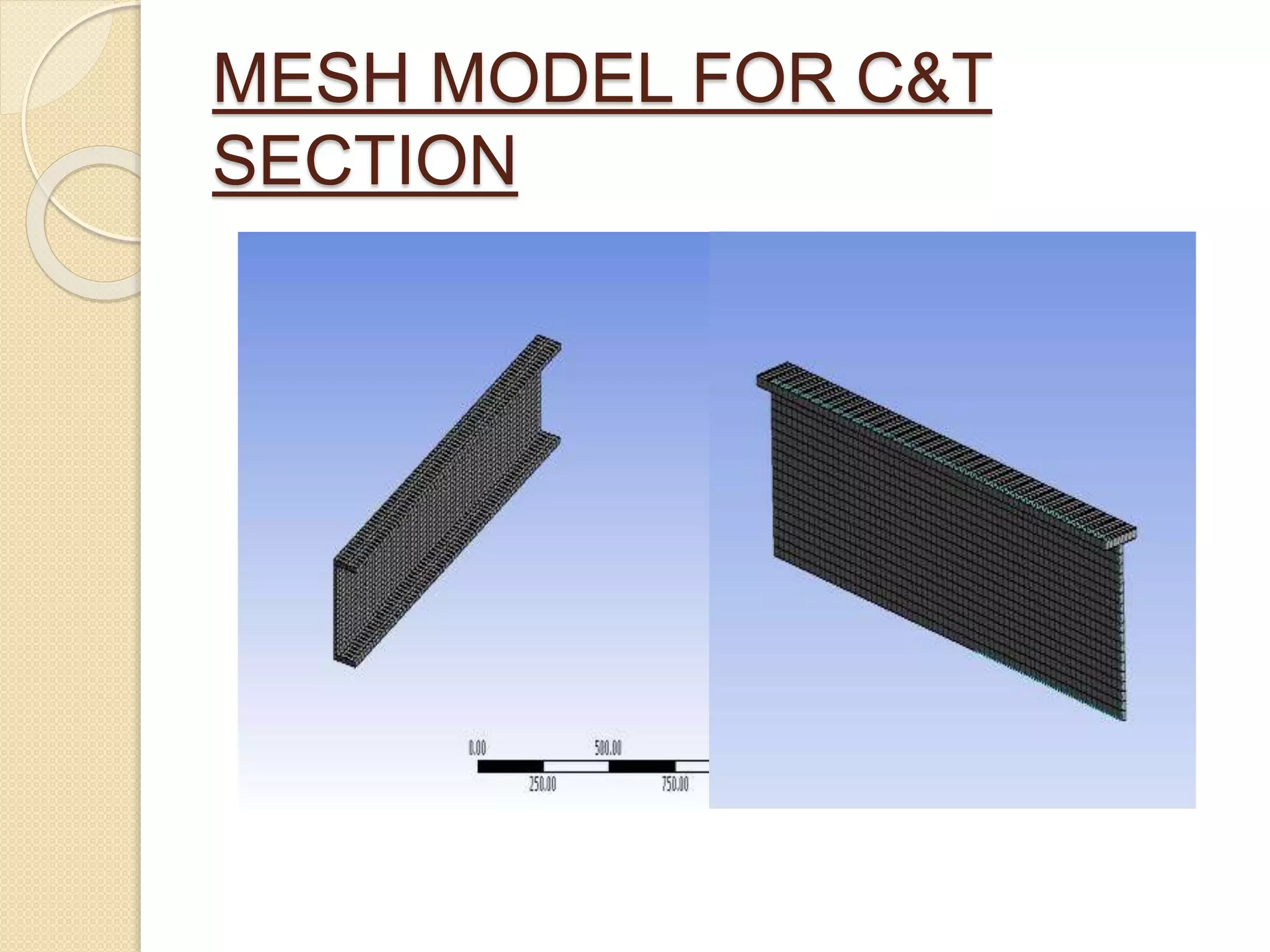
MESH MODEL FOR C&T
SECTION
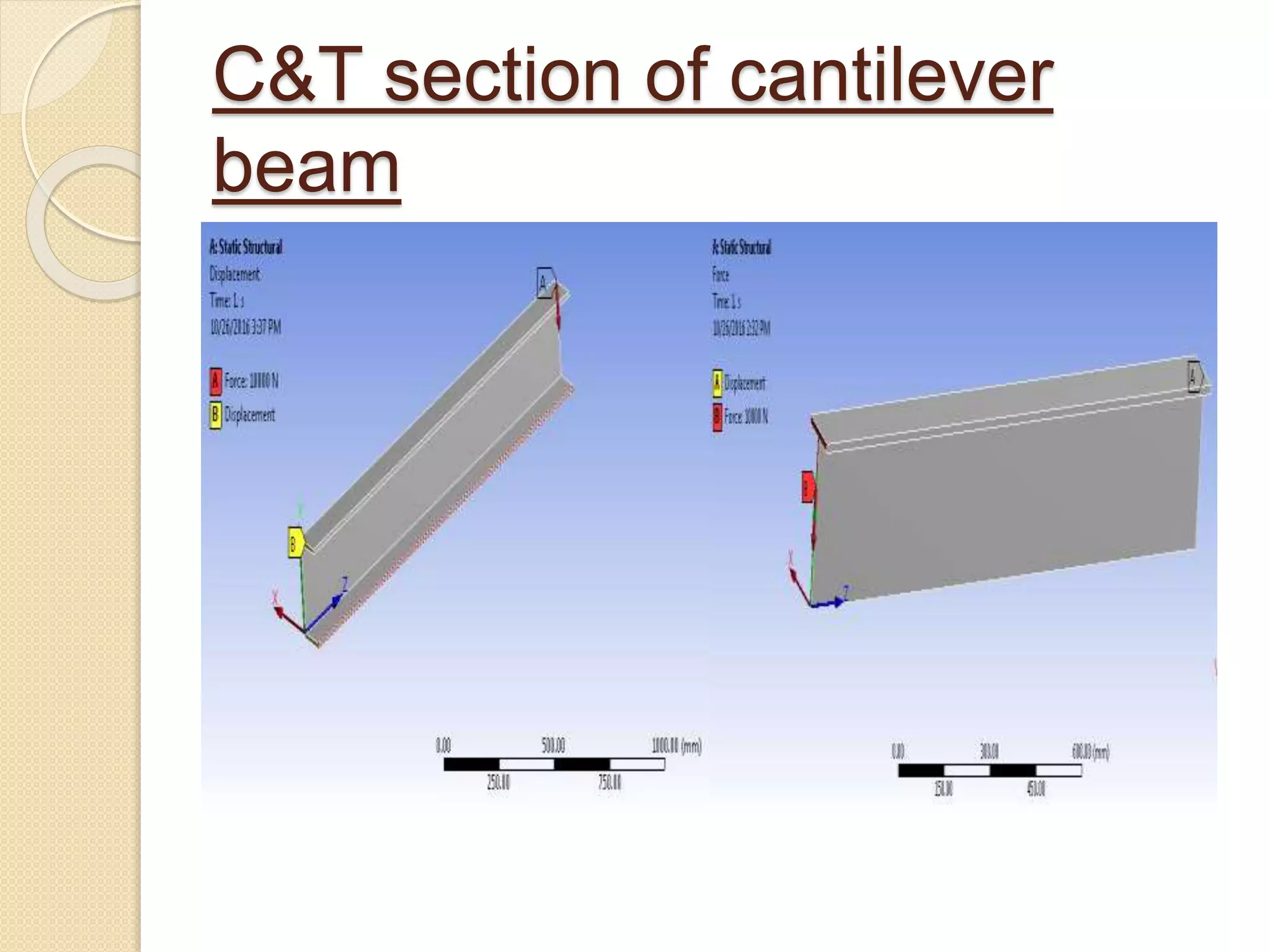
C&T section of cantilever
beam
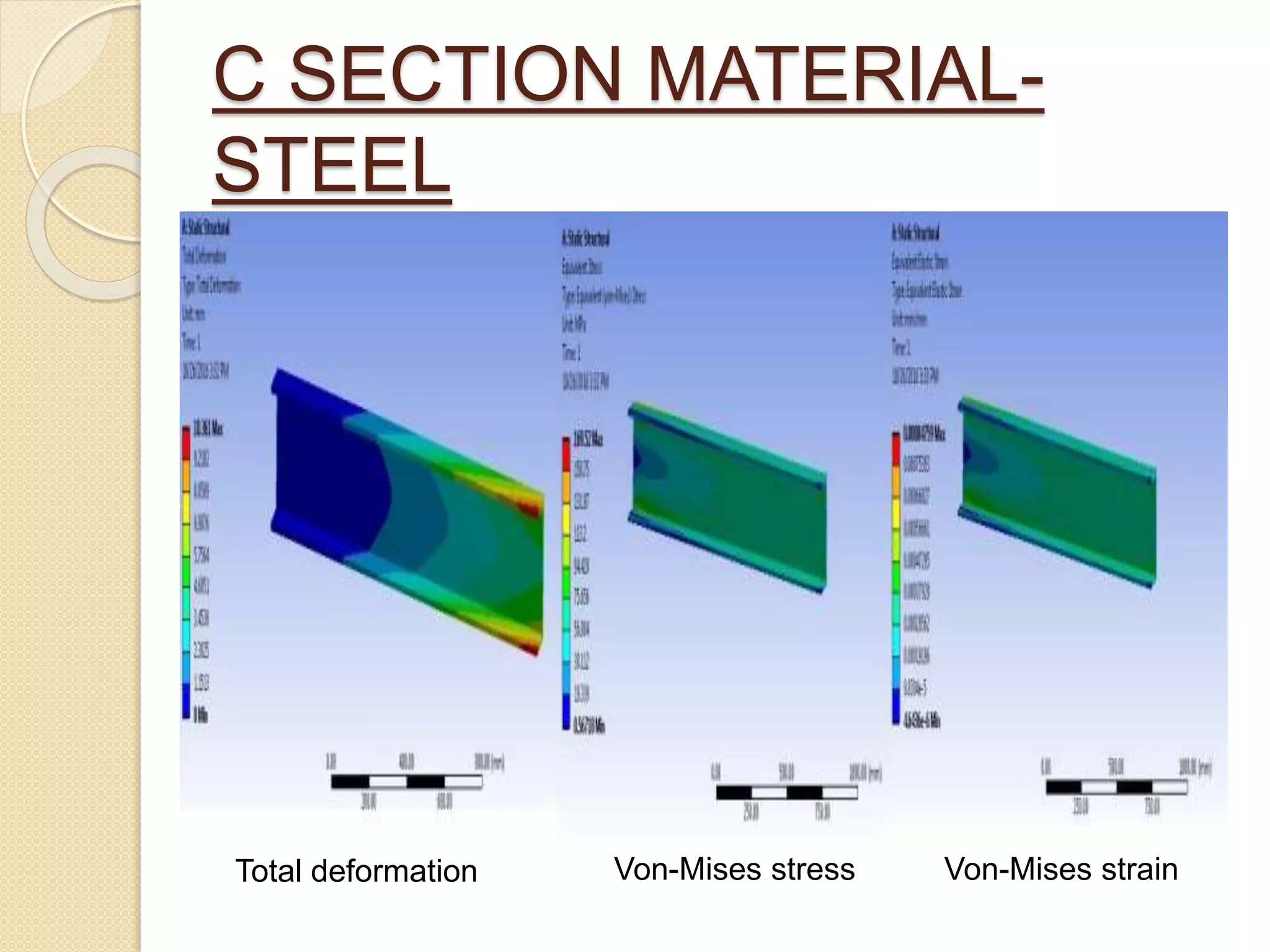
C SECTION MATERIAL-
STEEL
Total deformation Von-Mises stress Von-Mises strain
C SECTION MATERIAL- STAINLESS
STEEL
Total deformation Von-Mises stress Von-Mises strain
C SECTION MATERIAL- CAST
IRON
Total deformation Von-Mises stress Von-Mises strain
T SECTION MATERIAL-
STEEL
Total deformation Von-Mises stress Von-Mises strain
T SECTION MATERIAL-STAINLESS
STEEL
Total deformation Von-Mises stress Von-Mises strain
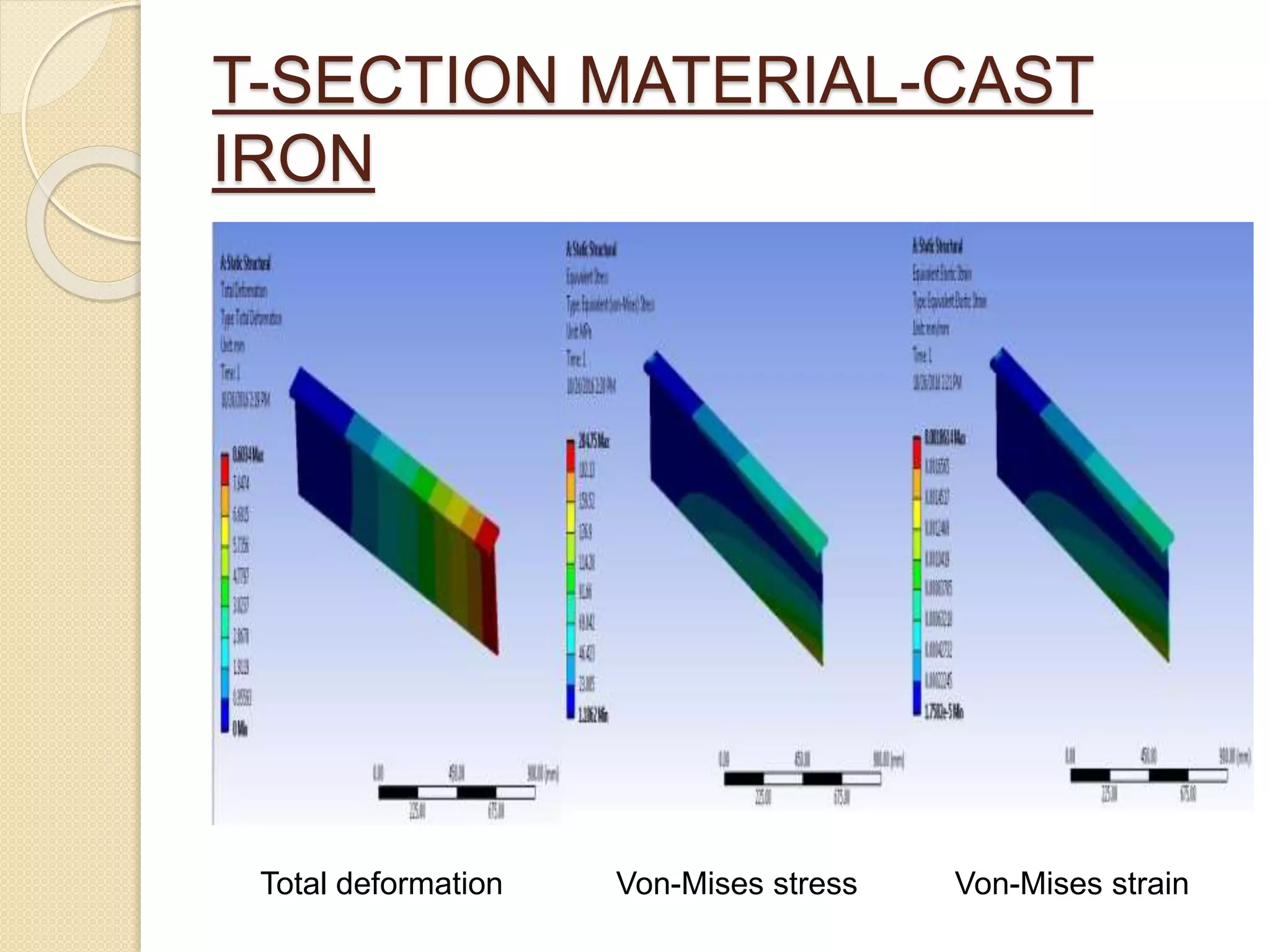
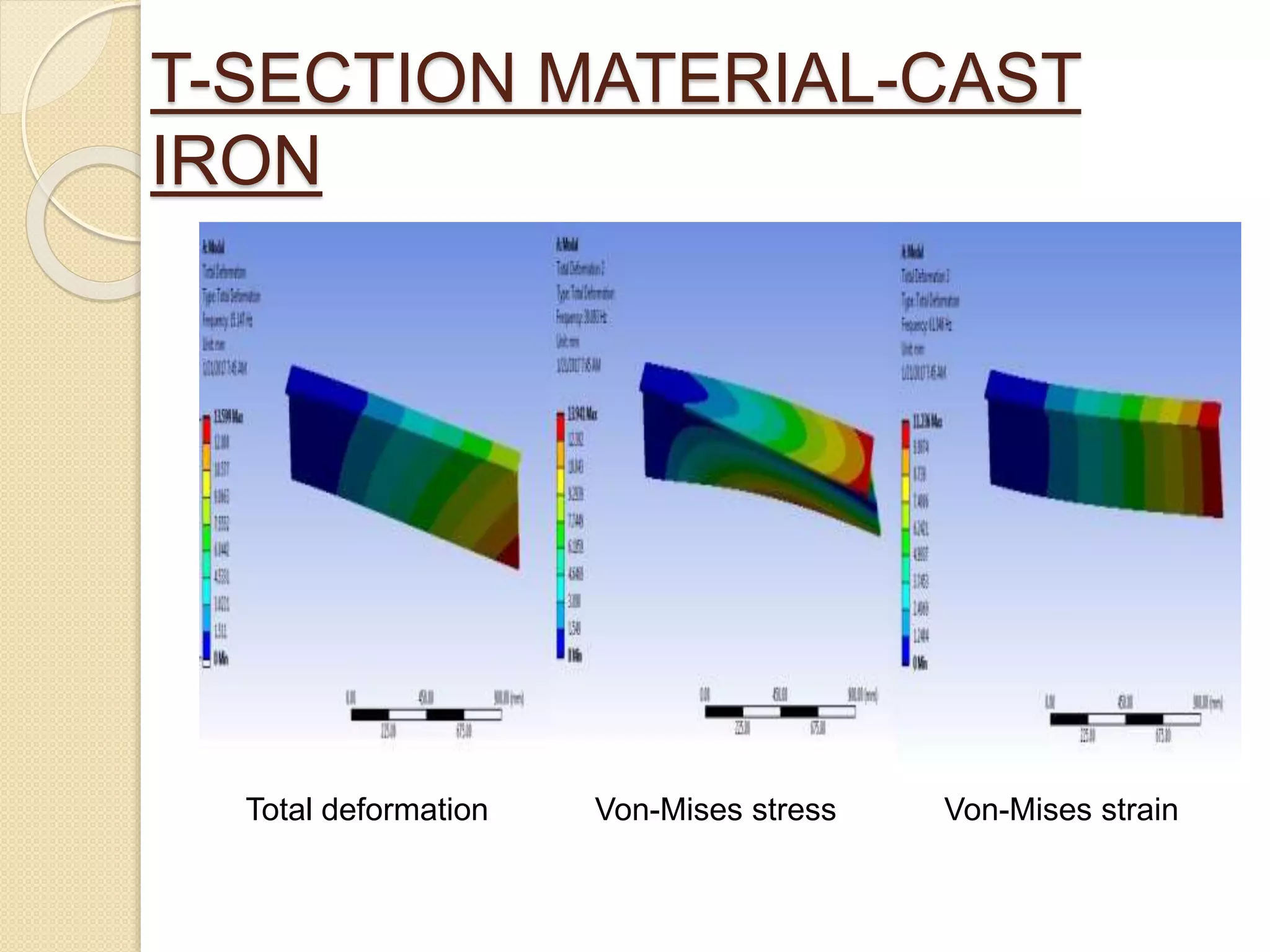
T-SECTION MATERIAL-CAST
IRON
Total deformation Von-Mises stress Von-Mises strain
STEPS FOR STRUCTURAL ANALYSIS OF
CANTILEVER BEAM FOR MODAL
ANALYSIS Save Creo Model as .iges format
 Go to ansys
 Click on Workbench
 Select analysis system
 Select modal
 Select Geometry
 Right click & select import geometry
 Browse & open part
 Select modal do right click & edit
 Another window will be open
MODAL ANALYSIS
PROPERTIES
 Type of Structural analysis
 Use for determining structure dynamic
characteristics
 Determine the natural frequencies and
mode shapes of a structure
 Consider frequencies at which
vibration occurs
 Consider the modal shapes of
vibrating system
STATIC ANALYSIS OF CANTILEVER BEAM
CONDITION – I SECTION
MATERIAL-STEEL
• Step-1
Import Steel geometry having I-section in
ansys
Step-2:-
 Go to geometry
 Select geometries
 Edit material
MATERIAL PROPERTIES OF STEEL:-
 Density : 7850kg/m3
 Young’s modulus : 205000Mpa
 Poisson’s ratio : 0.3
Step:-3
• Select mesh on left side part tree
• Generate mesh
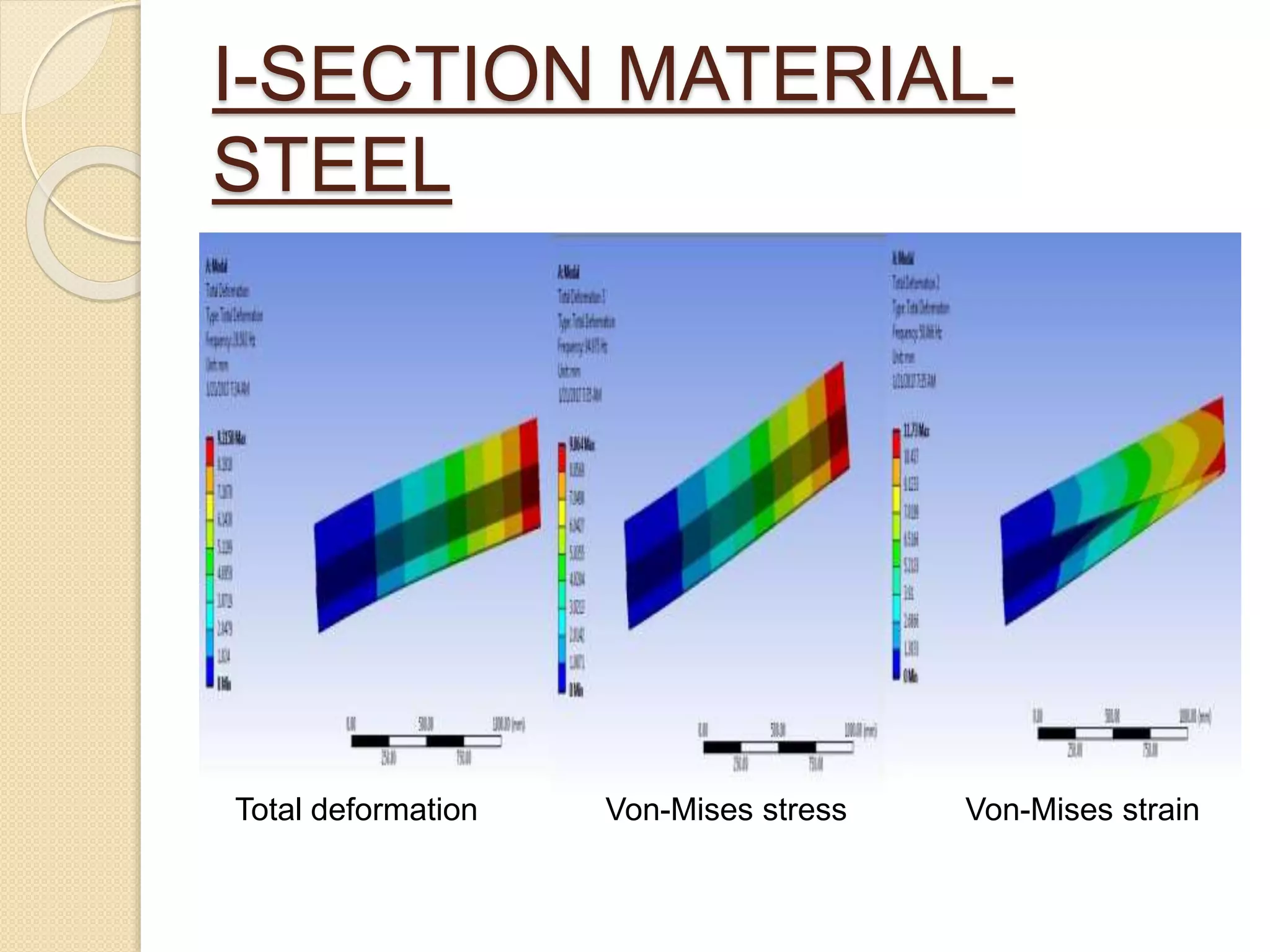
I-SECTION MATERIAL-
STEEL
Total deformation Von-Mises stress Von-Mises strain
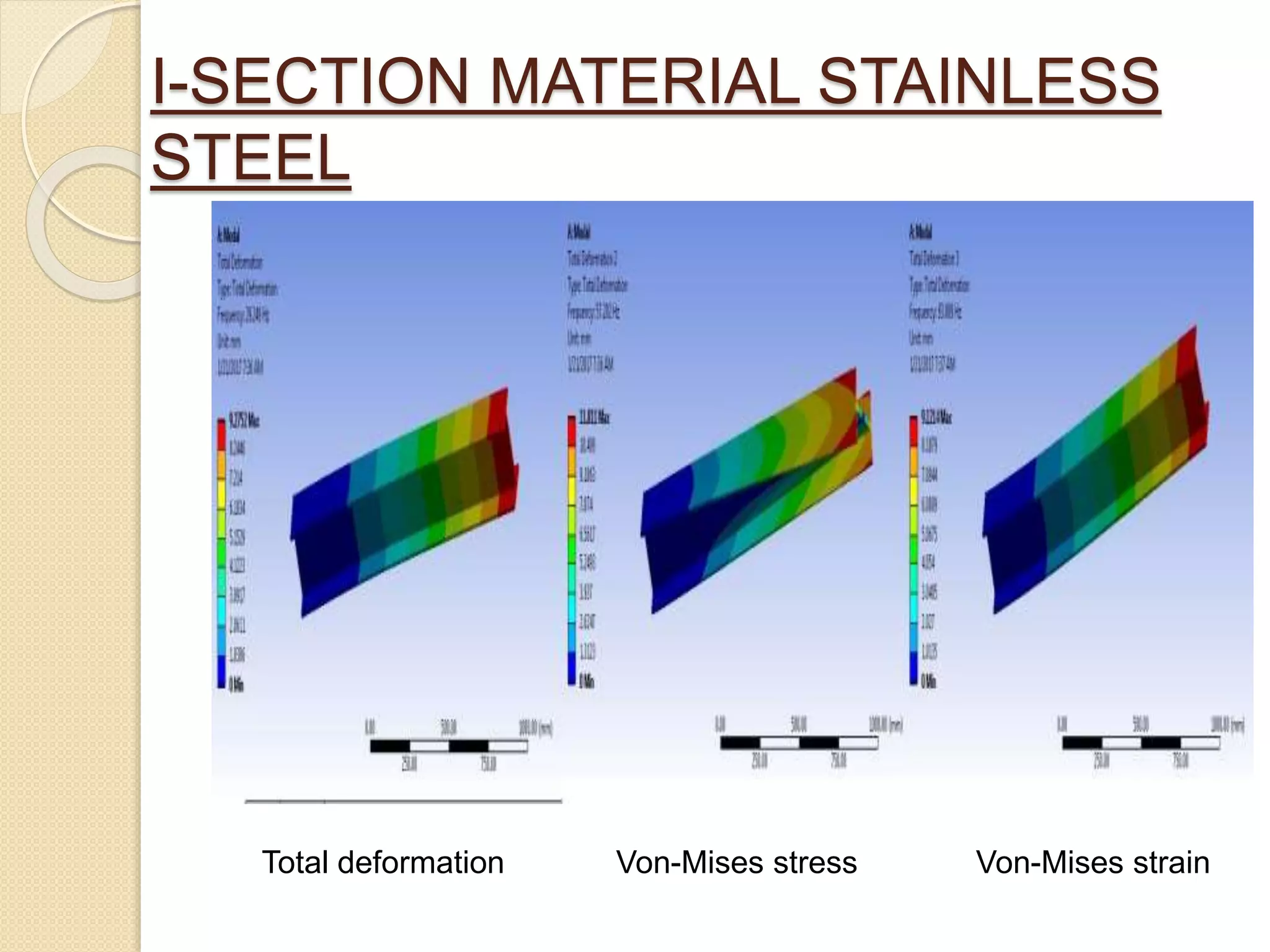
I-SECTION MATERIAL STAINLESS
STEEL
Total deformation Von-Mises stress Von-Mises strain
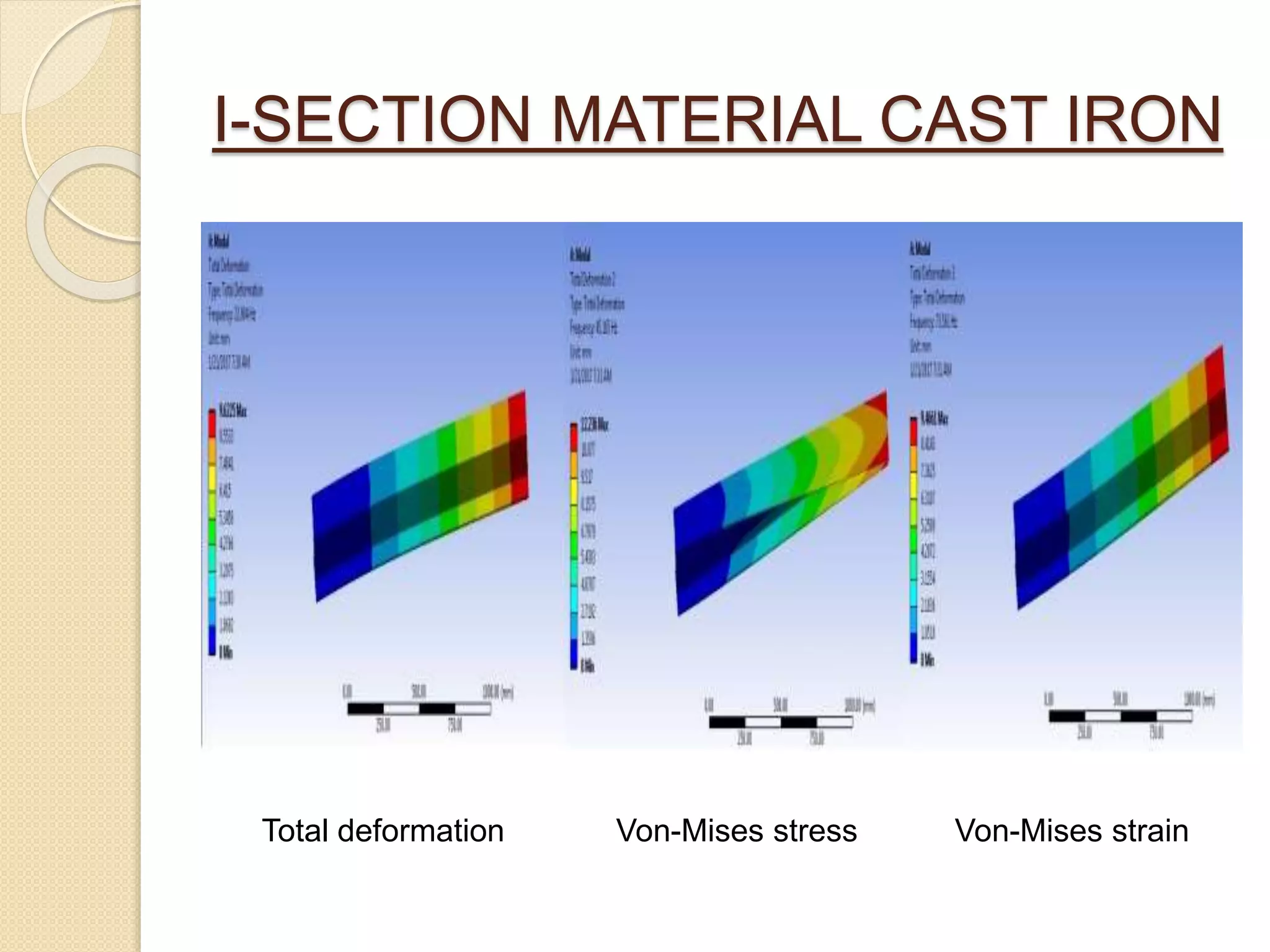
I-SECTION MATERIAL CAST IRON
Total deformation Von-Mises stress Von-Mises strain
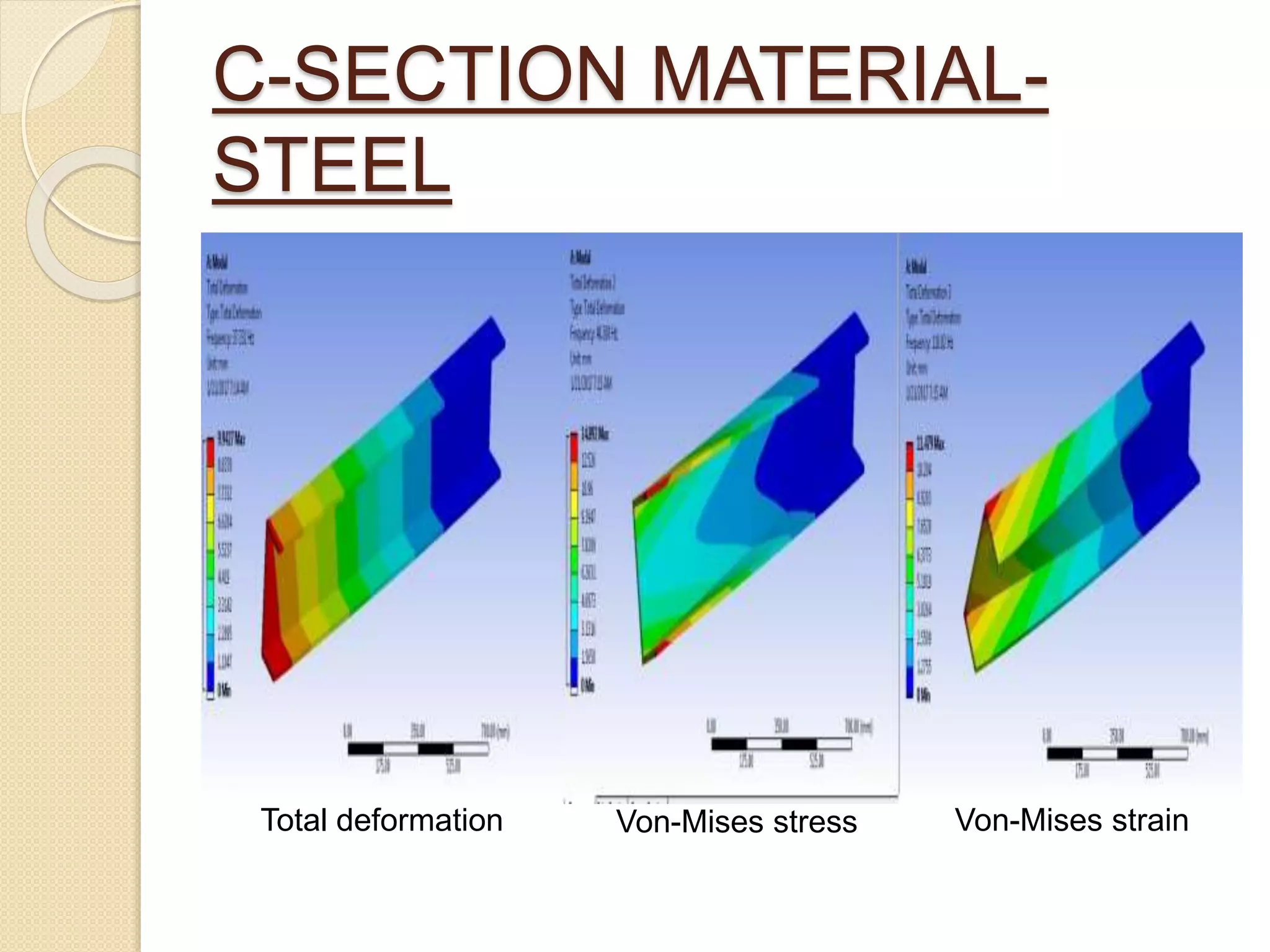
C-SECTION MATERIAL-
STEEL
Total deformation Von-Mises stress Von-Mises strain
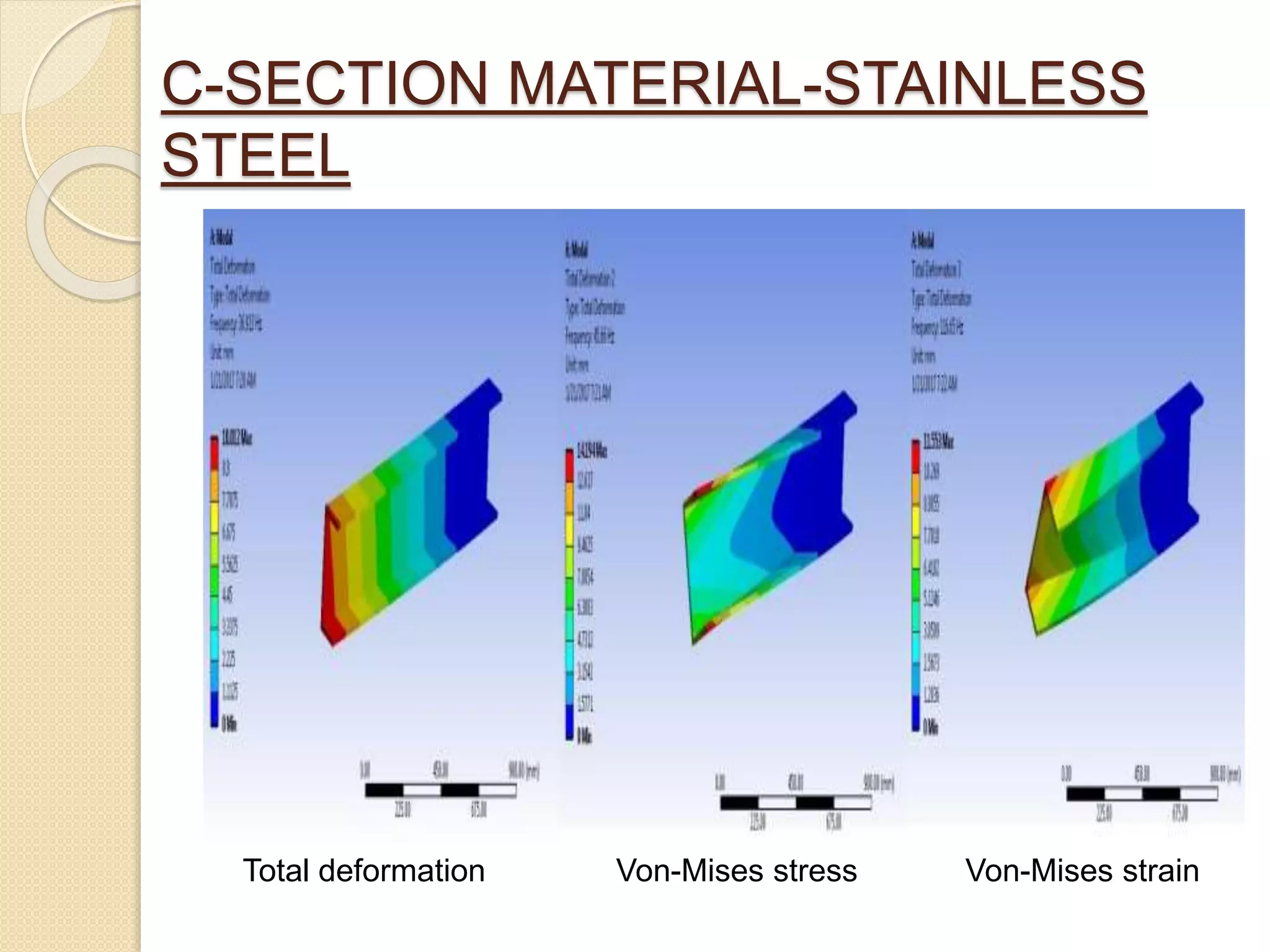
C-SECTION MATERIAL-STAINLESS
STEEL
Total deformation Von-Mises stress Von-Mises strain
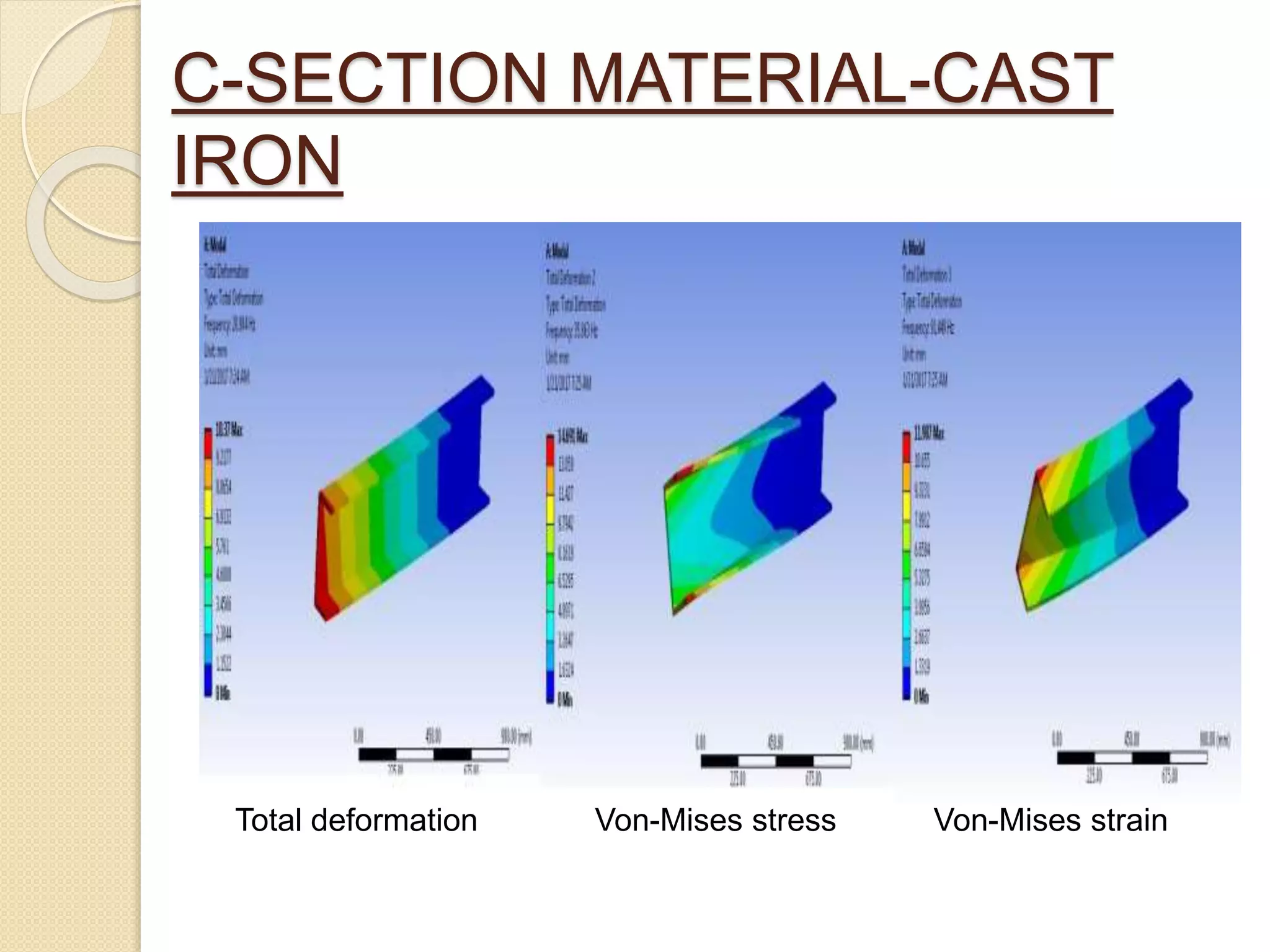
C-SECTION MATERIAL-CAST
IRON
Total deformation Von-Mises stress Von-Mises strain
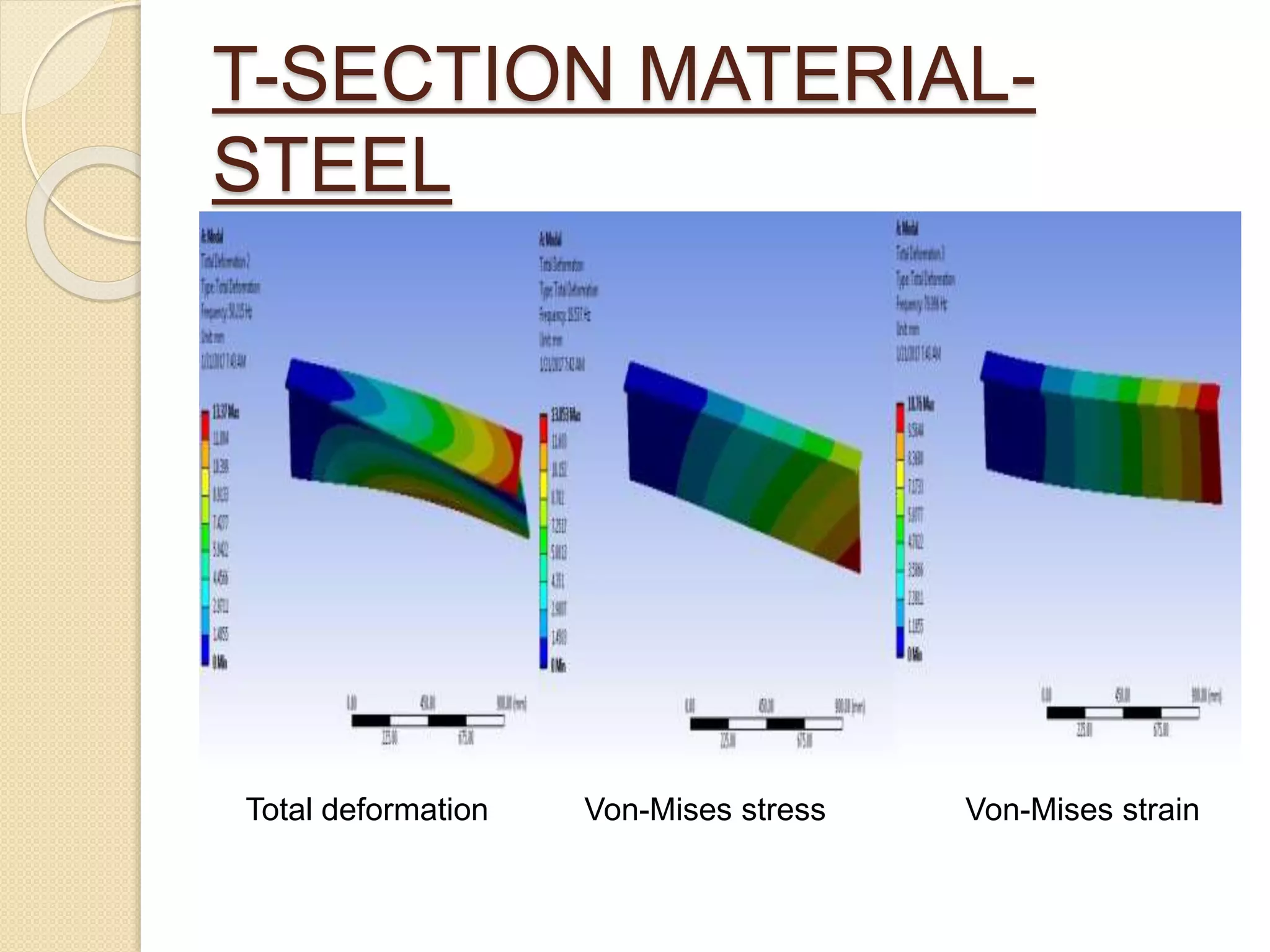
T-SECTION MATERIAL-
STEEL
Total deformation Von-Mises stress Von-Mises strain
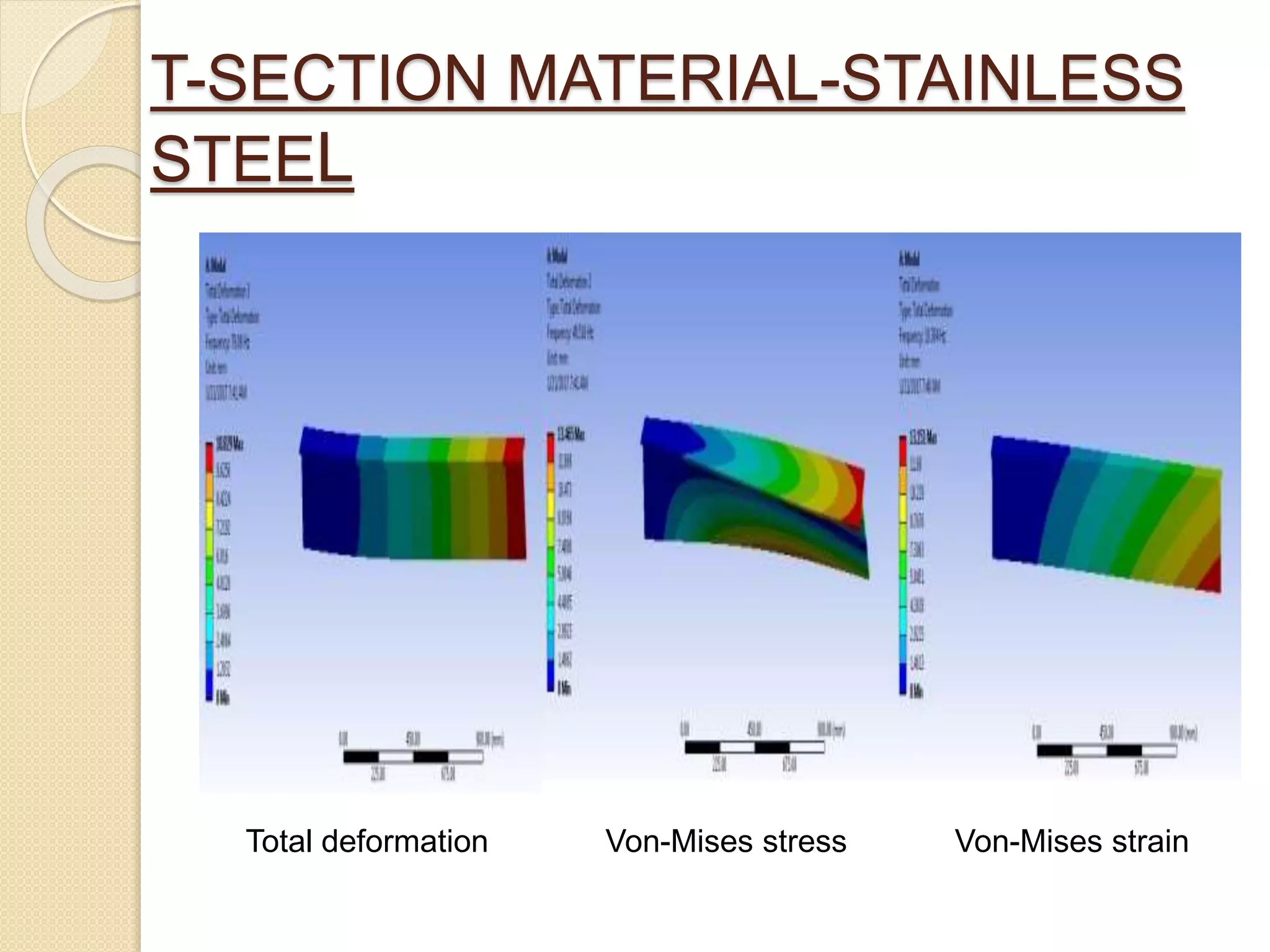
T-SECTION MATERIAL-STAINLESS
STEEL
Total deformation Von-Mises stress Von-Mises strain
T-SECTION MATERIAL-CAST
IRON
Total deformation Von-Mises stress Von-Mises strain
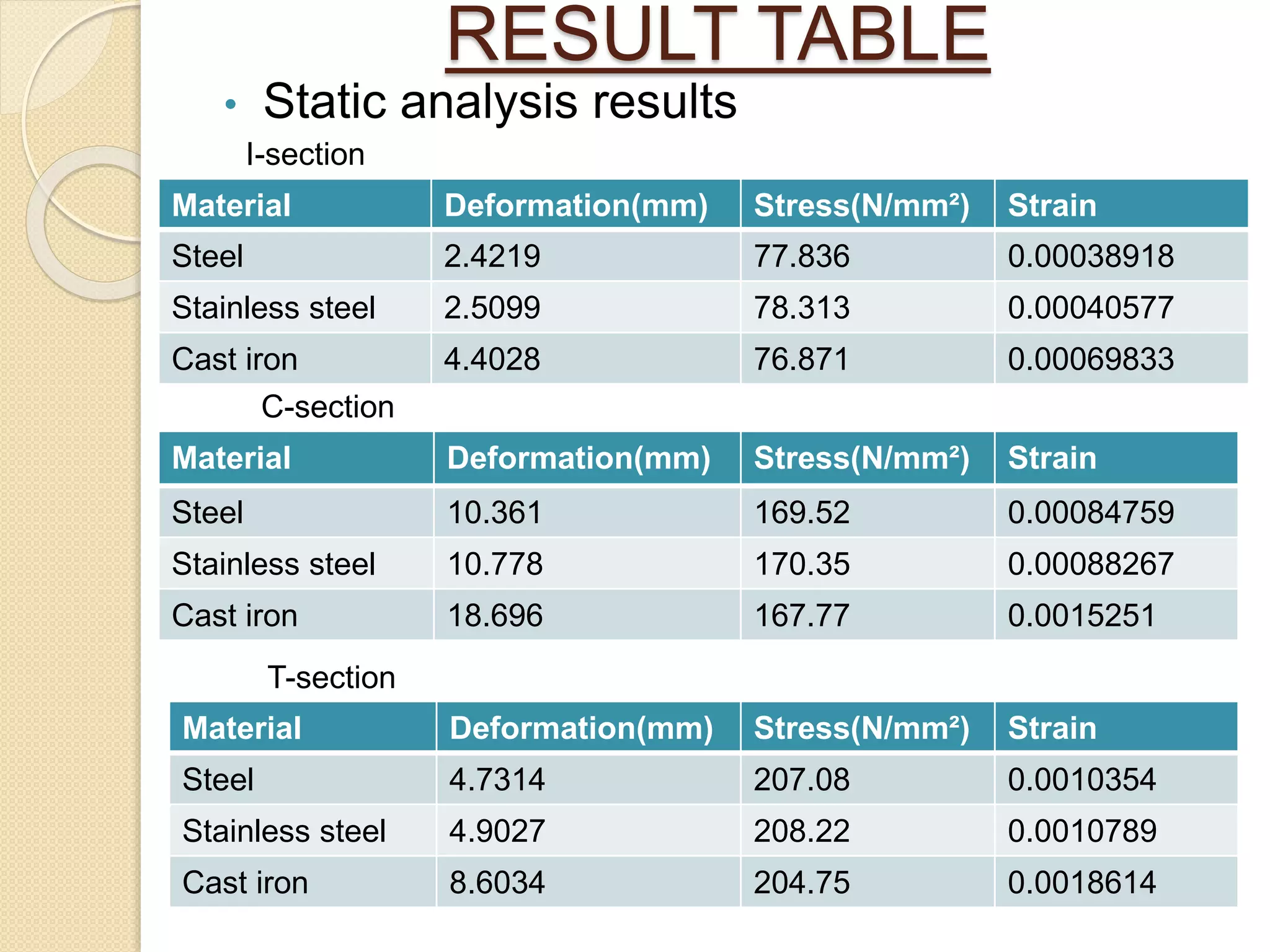
RESULT TABLE
• Static analysis results
Material Deformation(mm) Stress(N/mm²) Strain
Steel 2.4219 77.836 0.00038918
Stainless steel 2.5099 78.313 0.00040577
Cast iron 4.4028 76.871 0.00069833
C-section
Material Deformation(mm) Stress(N/mm²) Strain
Steel 10.361 169.52 0.00084759
Stainless steel 10.778 170.35 0.00088267
Cast iron 18.696 167.77 0.0015251
I-section
T-section
Material Deformation(mm) Stress(N/mm²) Strain
Steel 4.7314 207.08 0.0010354
Stainless steel 4.9027 208.22 0.0010789
Cast iron 8.6034 204.75 0.0018614
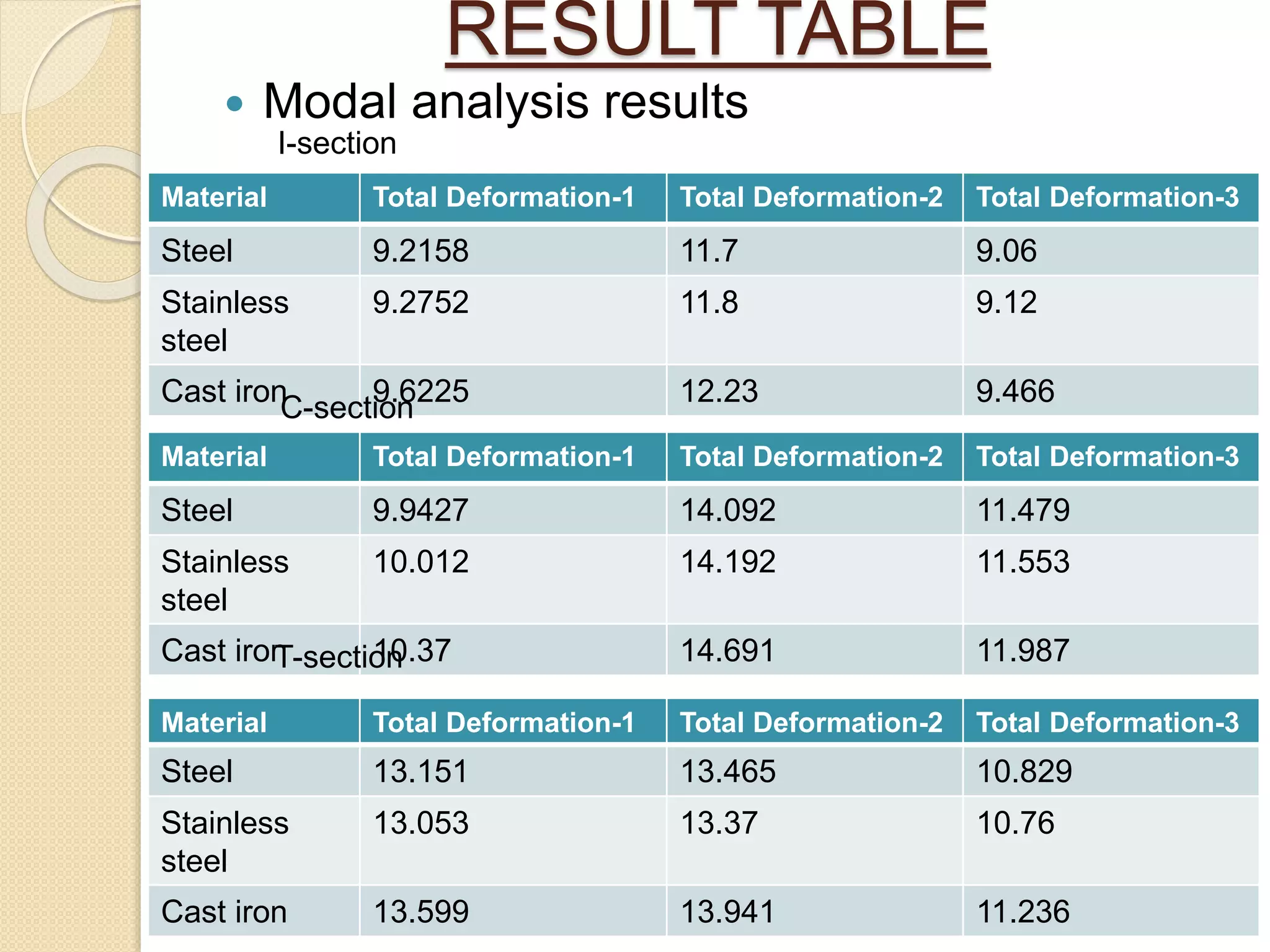
RESULT TABLE
 Modal analysis results
I-section
Material Total Deformation-1 Total Deformation-2 Total Deformation-3
Steel 9.2158 11.7 9.06
Stainless
steel
9.2752 11.8 9.12
Cast iron 9.6225 12.23 9.466
C-section
Material Total Deformation-1 Total Deformation-2 Total Deformation-3
Steel 9.9427 14.092 11.479
Stainless
steel
10.012 14.192 11.553
Cast iron 10.37 14.691 11.987T-section
Material Total Deformation-1 Total Deformation-2 Total Deformation-3
Steel 13.151 13.465 10.829
Stainless
steel
13.053 13.37 10.76
Cast iron 13.599 13.941 11.236
CONCLUSION
 In this work we compared the stress and natural
frequency for different material having same I, C and T
cross- sectional beam.
 The cantilever beam is designed and analyzed in
ANSYS. The cantilever beam which is fixed at one end
is vibrated to obtain the natural frequency, mode shapes
and deflection with different sections and materials.
 By observing the static analysis the deformation and
stress values are less for I-section cantilever beam at
cast iron material than steel and stainless steel.
 By observing the modal analysis results the deformation
and frequency values are less for I-section cantilever
beam more for T-section.
 So it can be conclude the cast iron material is better
material for cantilever beam in this type I-section model.
THANK YOU

design and analysis of cantilever beam ppt

  • 1.
    PROJECT OBJECTIVE  Abeam is a structural element that is capable of withstanding load primarily by resisting against bending  A beam can be made of wood, concrete, steel depending upon need  The bending force induced into the material of the beam as a result of the external loads, own weight, span and external reactions to these loads  Internally, beams experience compressive, tensile and shear stresses as a result of the loads applied to them  To retain beam within safe operating environment, it must be designed with high rigidity and damping capacity  Cantilever beam has one end fixed and one end loaded
  • 2.
    PROJECT OBJECTIVE  Wecompared the cantilever beam stress and natural frequency for different material having same I, C and T cross- sectional beam  Cantilever beam having steel, stainless steel, &cast iron undergoes static and modal analysis  The cantilever beam is designed and analyzed in ANSYS
  • 3.
    PROJECT OBJECTIVE  Solidmodeling of I,C,&T beam cross-section with help of Creo(formerly Pro–Engineer) CAD software  Save the file in igs format  Import solid model into ANSYS  Assigning material properties  Do analysis for static structural model for I,C,&T cross section for cantilever beam for steel,stainless steel &cast iron.  Do modal analysis for I,C,&T cross section for cantilever beam for steel,stainless steel &cast iron.
  • 4.
    PROJECT OBJECTIVE  Identifyingminimum stress, strain & deformation reducing material for structural analysis  Identifying minimum stress, strain & deformation reducing material for modal analysis  Conclusion based on results comparison  Project document preparation
  • 5.
    Dimension and Propertiesof Cantilever beam Dimension/ Properties Structural Steel Grey Cast Iron Stainless Steel Length (mm) 1500 1500 1500 Width (mm) 100 100 100 Thickness (mm) 10 10 10 Height (mm) 200 200 200 Young Modulus (MPa) 2x10⁵ 1.1x10⁵ 1.93x10⁵ Density( Kg/m3) 7850 7200 7750
  • 6.
    SOLID MODEL FORI,C,T SECTION
  • 7.
    STEPS FOR STRUCTURALANALYSIS OF CANTILEVER BEAM FOR STATIC ANALYSIS  Save Creo Model as .iges format  Go to ansys  Click on Workbench  Select analysis system  Select static structural  Select Geometry  Right click & select import geometry  Browse & open part  Select mesh on workbench select it & edit  Go to geometry & edit material
  • 8.
    STATIC ANALYSIS PROPERTIES  Itis a type of structural analysis  Calculates the effect of steady loading conditions on structure  Includes steady inertia load  Includes time varying load that approximated as static equivalent load  Ignore inertia and damping effect
  • 9.
    STATIC ANALYSIS OFCANTILEVER BEAM CONDITION – I SECTION MATERIAL-STEEL Step-1 Import Steel geometry having I-section in ansys
  • 10.
    Step-2:-  Go togeometry  Select geometries  Edit material MATERIAL PROPERTIES OF STEEL:-  Density : 7850kg/m3  Young’s modulus : 205000Mpa  Poisson’s ratio : 0.3
  • 11.
    Step:-3 • Select meshon left side part tree • Generate mesh
  • 12.
    Step:-4  Select staticstructural  Select displacement  Select required area I-section cantilever beam
  • 13.
    Step :-5  Selectsolution  Insert total deformation
  • 14.
    Step :-6  Selectsolution  Insert equivalent von-mises stress
  • 15.
    Step :-7  Selectsolution  Insert equivalent von-mises strain
  • 16.
    STATIC ANALYSIS OFCANTILEVER BEAM CONDITION – I SECTION MATERIAL-STAINLESS STEEL • Follow the previous 4 steps for importing geometry & meshing • Go to solution & Insert total deformation
  • 17.
    In Step-2:-  Goto geometry  Select geometries  Edit material MATERIAL PROPERTIES OF STAINLESS STEEL:-  Density : 7750kg/m3  Young’s modulus : 193000Mpa  Poisson’s ratio : 0.3
  • 18.
    STAINLESS STEEL VONMISES STRESS  Go to solution  Insert equivalent von-mises stress
  • 19.
    STAINLESS STEEL VONMISES STRAIN  Go to solution  Insert equivalent von-mises strain
  • 20.
    STATIC ANALYSIS OFCANTILEVER BEAM CONDITION – I SECTION MATERIAL-CAST IRON  Follow the previous 4 steps for importing geometry & meshing  Go to solution & Insert total
  • 21.
    In Step-2:-  Goto geometry  Select geometries  Edit material MATERIAL PROPERTIES OF CAST IRON:-  Density : 7200kg/m3  Young’s modulus : 110000Mpa  Poisson’s ratio : 0.24
  • 22.
    CAST IRON VONMISES STRESS  Go to solution  Insert equivalent von-mises stress
  • 23.
    CAST IRON VONMISES STRAIN  Go to solution  Insert equivalent von-mises strain
  • 24.
    STATIC ANALYSIS OFCANTILEVER BEAM CONDITION – C SECTION & T SECTION • Follow the same steps for C section & T section of beam • Change the properties by changing the Materials • Use steel, stainless steel, cast iron materials for the sections • Do solution for deformation, von mises stress & von mises strain
  • 25.
    IMPORTED MODEL FORC&T SECTION
  • 26.
    MESH MODEL FORC&T SECTION
  • 27.
    C&T section ofcantilever beam
  • 28.
    C SECTION MATERIAL- STEEL Totaldeformation Von-Mises stress Von-Mises strain
  • 29.
    C SECTION MATERIAL-STAINLESS STEEL Total deformation Von-Mises stress Von-Mises strain
  • 30.
    C SECTION MATERIAL-CAST IRON Total deformation Von-Mises stress Von-Mises strain
  • 31.
    T SECTION MATERIAL- STEEL Totaldeformation Von-Mises stress Von-Mises strain
  • 32.
    T SECTION MATERIAL-STAINLESS STEEL Totaldeformation Von-Mises stress Von-Mises strain
  • 33.
    T-SECTION MATERIAL-CAST IRON Total deformationVon-Mises stress Von-Mises strain
  • 34.
    STEPS FOR STRUCTURALANALYSIS OF CANTILEVER BEAM FOR MODAL ANALYSIS Save Creo Model as .iges format  Go to ansys  Click on Workbench  Select analysis system  Select modal  Select Geometry  Right click & select import geometry  Browse & open part  Select modal do right click & edit  Another window will be open
  • 35.
    MODAL ANALYSIS PROPERTIES  Typeof Structural analysis  Use for determining structure dynamic characteristics  Determine the natural frequencies and mode shapes of a structure  Consider frequencies at which vibration occurs  Consider the modal shapes of vibrating system
  • 36.
    STATIC ANALYSIS OFCANTILEVER BEAM CONDITION – I SECTION MATERIAL-STEEL • Step-1 Import Steel geometry having I-section in ansys
  • 37.
    Step-2:-  Go togeometry  Select geometries  Edit material MATERIAL PROPERTIES OF STEEL:-  Density : 7850kg/m3  Young’s modulus : 205000Mpa  Poisson’s ratio : 0.3
  • 38.
    Step:-3 • Select meshon left side part tree • Generate mesh
  • 39.
    I-SECTION MATERIAL- STEEL Total deformationVon-Mises stress Von-Mises strain
  • 40.
    I-SECTION MATERIAL STAINLESS STEEL Totaldeformation Von-Mises stress Von-Mises strain
  • 41.
    I-SECTION MATERIAL CASTIRON Total deformation Von-Mises stress Von-Mises strain
  • 42.
    C-SECTION MATERIAL- STEEL Total deformationVon-Mises stress Von-Mises strain
  • 43.
  • 44.
    C-SECTION MATERIAL-CAST IRON Total deformationVon-Mises stress Von-Mises strain
  • 45.
    T-SECTION MATERIAL- STEEL Total deformationVon-Mises stress Von-Mises strain
  • 46.
  • 47.
    T-SECTION MATERIAL-CAST IRON Total deformationVon-Mises stress Von-Mises strain
  • 48.
    RESULT TABLE • Staticanalysis results Material Deformation(mm) Stress(N/mm²) Strain Steel 2.4219 77.836 0.00038918 Stainless steel 2.5099 78.313 0.00040577 Cast iron 4.4028 76.871 0.00069833 C-section Material Deformation(mm) Stress(N/mm²) Strain Steel 10.361 169.52 0.00084759 Stainless steel 10.778 170.35 0.00088267 Cast iron 18.696 167.77 0.0015251 I-section T-section Material Deformation(mm) Stress(N/mm²) Strain Steel 4.7314 207.08 0.0010354 Stainless steel 4.9027 208.22 0.0010789 Cast iron 8.6034 204.75 0.0018614
  • 49.
    RESULT TABLE  Modalanalysis results I-section Material Total Deformation-1 Total Deformation-2 Total Deformation-3 Steel 9.2158 11.7 9.06 Stainless steel 9.2752 11.8 9.12 Cast iron 9.6225 12.23 9.466 C-section Material Total Deformation-1 Total Deformation-2 Total Deformation-3 Steel 9.9427 14.092 11.479 Stainless steel 10.012 14.192 11.553 Cast iron 10.37 14.691 11.987T-section Material Total Deformation-1 Total Deformation-2 Total Deformation-3 Steel 13.151 13.465 10.829 Stainless steel 13.053 13.37 10.76 Cast iron 13.599 13.941 11.236
  • 50.
    CONCLUSION  In thiswork we compared the stress and natural frequency for different material having same I, C and T cross- sectional beam.  The cantilever beam is designed and analyzed in ANSYS. The cantilever beam which is fixed at one end is vibrated to obtain the natural frequency, mode shapes and deflection with different sections and materials.  By observing the static analysis the deformation and stress values are less for I-section cantilever beam at cast iron material than steel and stainless steel.  By observing the modal analysis results the deformation and frequency values are less for I-section cantilever beam more for T-section.  So it can be conclude the cast iron material is better material for cantilever beam in this type I-section model.
  • 51.