International Research Journal of Engineering and Technology (IRJET) e-ISSN: 2395-0056
Volume: 09 Issue: 04 | Apr 2022 www.irjet.net p-ISSN: 2395-0072
© 2022, IRJET | Impact Factor value: 7.529 | ISO 9001:2008 Certified Journal | Page 3329
Comparative Analysis of Natural Frequency of Transverse Vibration of
a Cantilever Beam by Analytical and Experimental Methods
Prof. S. V. Tawade1, Dr. R. J. Patil2, Prof. A. S. Kale3
1Asst. Professor, Dept. of Mechanical Engineering, Navsahyadri Engineering College, Pune, India
2Principal, Navsahyadri Engineering College, Pune, India
3Asst. Professor, Dept. of Electrical Engineering, Navsahyadri Engineering College, Pune, India
---------------------------------------------------------------------***---------------------------------------------------------------------
Abstract - Vibration analysis of any mechanical systems
is very important since excess vibrations leads to failure of
the mechanical systems. There are many methods and
instruments available in the engineering field for measuring
the mechanical vibrations in mechanical systems. In this
present work transverse vibrations of a cantilever beam are
analyzed analytically and experimentally. In our present
work FFT analyzer is used to measure the natural frequency
of vibration of a cantilever beam. Initially the natural
frequency of the cantilever beam is calculated analytically
and then natural frequency was found out by experimentally
by using FFT and the results were compared. Both
analytical and experimental results were found to be almost
the same. The present work shows a standard procedure for
the determination of natural frequency of vibration of a
cantilever beam by analytical and experimental methods by
using FFT analyzer.
Key Words: Cantilever beam, Natural frequency, FFT
1. INTRODUCTION
A straight, horizontal cantilever beam is deformed into
curve when it is subjected to a vertical load. After the
removal of Load, the beam regains its original shape as it
was prior before subjected to load, but due to inertia the
beam stays in motion. Which results in vibration of beam
at characteristic frequency [6]. In this paper a cantilever
beam with rectangular cross section for transverse
vibration is investigated. Device used are Accelerometer
and Fast Fourier Transform Analyzer. Most extensively
studied among structural elements are beam as it finds
many engineering applications. Structure like Long span
bridges, robot arm and tall buildings are modeled with
beam like element, beams as well as the presence of cracks
affects the dynamic response of the structure significantly.
It can result into failure of structure in a very extreme
way. To predict the failure, vibration monitoring can be
used to detect changes in the dynamic responses and/or
dynamic characteristics of the structure [7]. One of the
most important tasks in designing of mechanical system is
Vibration Analysis. Design engineer has to take into
consideration information like dynamic behaviour of
structure of machine tool, effect of vibration absorber on
rotating machineries. This information helps to design
system to control the excessive amplitude of the vibration
[2]. Before the advent of computers, seeking the analytical
solution was one of the most popular ways to solve an
engineering problem. In comparison with numerical
methods, the analytical solutions have the advantage of
elegance and are time-saving. However, for most practical
engineering problems no analytical solutions can be found,
unless they are significantly simplified. Because of this
drawback of the analytical method, it has gradually been
replaced by numerical methods after the invention of
computer, particularly in recent years. One of the greatest
shortcomings of the numerical approach is that it is time-
consuming, but because of its powerful ability for solving
the practical problems this drawback seems allowable [1].
An intelligent FFT analyser is capable of adapting its
operating parameters on the basis of the signal spectrum
set up and characters. The realised instrument is equipped
with auto configuration capability. The experimental tests
carried out on a large number of signals highlight the
instrument capability of correctly detecting a good
frequency resolution for any signal spectrum type [3]. In
this paper a straight horizontal cantilever beam is
subjected to free vibration due to which it will vibrate at
its natural frequency. The aim is to study the vibration of
thin film cantilever beam. The frequency equations are
solved to show the output frequencies and the mode
shapes related to each frequency [4]
2. THE CANTILEVER BEAM
Figure No. -1: The beam under free vibration
A Cantilever beam is a beam whose one end is fixed and
another end is free. When a beam is subjected to load it
withstands the load by resisting against bending. Bending
moment is the reaction of the beam, when a beam is
subjected to bending force due to its own weight, external
load, etc. When a straight horizontal cantilever beam is
International Research Journal of Engineering and Technology (IRJET) e-ISSN: 2395-0056
Volume: 09 Issue: 04 | Apr 2022 www.irjet.net p-ISSN: 2395-0072
© 2022, IRJET | Impact Factor value: 7.529 | ISO 9001:2008 Certified Journal | Page 3330
exposed to vertical load, it will bend downwards and after
removal of load will regain its original shape but will
vibrate at natural frequency due to inertia. Most
fundamental structure of any structure from decades is
cantilever beam. The cantilever beam is much greater in
length as compared to width and depth. In addition,
cantilever beams may be straight or curved, with
rectangular or circular cross sections. Figure 1 shows a
cantilever beam with a rectangular cross section. The
design and shape of cantilever beam is application specific,
its weight, size, shape all parameters changes based on
application. For example, one of the most common
applications of a cantilever beam can be the “fixed wing” in
meters is designed as a beam for some preliminary
analysis to help lift the plane and make it fly. In Micro
Electrical Mechanical Systems (MEMS), micro cantilever
beams are used in radio frequency filters and resonator
[4].
3. NATURAL FREQUENCY FROM ANALYTICAL
CALCULATION
Beam’s Specifications: L = 0.3 m, b = 0.019 m, t = 0.002 m
M. I. of cantilever beam (I) = (1/12)xbt3
= (1/12)x0.019 x (0.002)3 = 1.267 x 10⁻¹¹ m4
Area of cross section of cantilever beam (A)
= b x t = 0.019 x 0.002 = 3.8 x 10⁻⁵ m2
E = 210GPa (210x109 N/m2) ---For steel.
ρ = 7800 kg/m3 ----For steel.
For 1st mode
√ √
= 117.03rad/sec, & = 18.62Hz
For 2nd mode
√ √
=733.5rad/sec, & = 116.74 Hz
For 3rd mode
√ √
=2054.03rad/sec, & =326.9Hz
4. THE FFT ANALYZER
In FFT spectrum analyzer, the input signal is digitized and
that to at high sampling rate which is similar to
oscilloscope. The digital time record obtained as a result is
then transformed using a algorithm known as Fast Fourier
transform algorithm, into a Frequency Spectrum. The
signal analyzer measures the magnitude of an input signal
and compares with the maximum frequency range values
of instruments. The vibration amplitude is recorded on the
fact that its development versus the frequency at that the
signals were appeared. The original time domain signal is
converted into Frequency domain view. Single Channel
FFT and Multichannel type is specially used for
determining Single vibration parameter from one or more
sources.
4.1. Benefits of FFT analyzer:
4.1.1. Quick capture of waveform:
It is generally observed that the waveform is identified
digitally. The waveform can be identified in a remarkably
very short span of time and then the afterwards it is
analyzed. This short capture time has much benefit. It will
provide the capture of short-lived waveforms.
4.1.2. Able to capture non-repetitive events:
The short capture time indicate the truth that the FFT
analyzer will record non-repetitive waveforms giving
them a capability, which will not be possible with other
kinds of spectrum analyzers.
4.1.3. Able to analyze signal phase:
As part of the signal capture method, information is gained
which might be processed to reveal the phase of signals.
4.1.4. Waveforms can be stored using FFT technology:
It will be quite possible to record the waveform and
analyze it later and this will be required.
4.2. Disadvantages of the FFT analyzer:
4.2.1. Frequency limitations:
The important limitation of the frequency and bandwidth
of FFT spectrum analyzers is that the analogue to digital
converter, ADC that is used to convert the analogue signal
into a digital format. Whereas technology is raising this
component is still places a serious limitation on the higher
frequency limits or the bandwidth if a down-conversion
stage is employed.
4.2.2. Cost:
The high level of performance needed by the ADC implies
that, this item could be a terribly very high-cost item.
Additionally, to all the other processing and display
circuitry required, this leads to the prices rising for this
stuff.
5. EQUIPMENT USED FOR EXPERIMENTATION
Apparatus used to conduct the experimentation are, The
Impact Hammer, Accelerometer, Multi-channel Vibration
Analyzer (DEWESoft-DEWE-43), a laptop installed with
software for modal analysis. The cantilever beam is held in
a fixture, power supply is given to the laptop and the
vibration analyzer, connecting cables which in turn
connected to the impact hammer and the accelerometer.
Fasteners and spanner are used to assemble rigidly the
International Research Journal of Engineering and Technology (IRJET) e-ISSN: 2395-0056
Volume: 09 Issue: 04 | Apr 2022 www.irjet.net p-ISSN: 2395-0072
© 2022, IRJET | Impact Factor value: 7.529 | ISO 9001:2008 Certified Journal | Page 3331
specimen in the fixture, adhesive wax is used to fix the
accelerometer.
5.1. Impact Hammer:
It is just like an ordinary hammer but its head is fitted with
a load cell and contains electronic circuitry and an output
cable that will be connected to vibration analyzer. On
hitting the impact hammer on any structure an impulsive
force is applied to the structure which is a cantilever beam
in our present work. An equal and opposite force is
detected by the load cell fitted within the head of the
hammer. This generates an electrical signal that is given
to vibration analyzer that analyzes the signal, compares
with the signal received from accelerometer connected to
the structure, and this information is used to develop FRF
(Frequency Response Function) and finally the natural
frequencies of the structure are found out.
5.2. Accelerometer:
An accelerometer is a device (a transducer) which when
attached to a vibrating structure gives out the electric
signals which are proportional to the acceleration. This
signal is given to a vibration analyzer that processes and
analyzes the signal. Just in case of our experiment, the
signal coming from accelerometer fitted to the cantilever
is analyzed with respect to the one received from the
impact hammer in order to search out the natural
frequencies of the cantilever.
5.3. Vibration Analyzer:
Vibration Analyzer is an electronic instrument which
performs and examines the signals received from
transducers used in vibration measurement such as
impact hammer, accelerometer, digital tachometer and
many more instruments. It has various channels that is it
can receive number of electric signals at same time. The
vibration analyzer has terribly refined electronic circuits
and works along with with a computer. Fast Fourier
Transform (FFT) is an algorithm often used for analysis of
the electric signals which gives frequency components and
their corresponding amplitudes present in the signals.
5.4. A Computer or a Laptop loaded with software for
modal analysis:
Additionally, to the software used together with the
vibration analyzer, the software are available now-a-days
devoted exclusively to the modal analysis. Such kind of
software will help in inputting data to the computer
related to geometry of the structure, location of placing of
the accelerometer on the structure as well as points of
hitting of the impact hammer and their directions and so
on. Also, there are facilities to choose different type of
analysis required, ranges of various parameters of
interest. The software employed was found supporting for
the signals received. The signals were received from the
impact hammer and accelerometer. The software analyzed
signals FFTs, finding FRF, getting Mode Indicator Function
and carrying out curve fitting over a selected range of
frequencies. As a result model damping factor, natural
frequencies and mode shapes were found out for the
chosen range of frequencies.
5.5. Fixture and Test-Specimen:
The test specimen is held by using a fixture. One end of the
test specimen with rectangular cross section is held in
fixture and the other end is kept fee so that the test
specimen is considered as a cantilever beam. The cross-
sectional dimensions of the cantilever beam used are
19mm x 2 mm and length 300 mm. The fixture holds the
cantilever bar firmly at one end and the fixture is
assembled to a table. A small accelerometer is attached at
the middle of the cantilever beam using an adhesive like
loctite.
6. NATURAL FREQUENCY FROM
EXPERIMENTATION
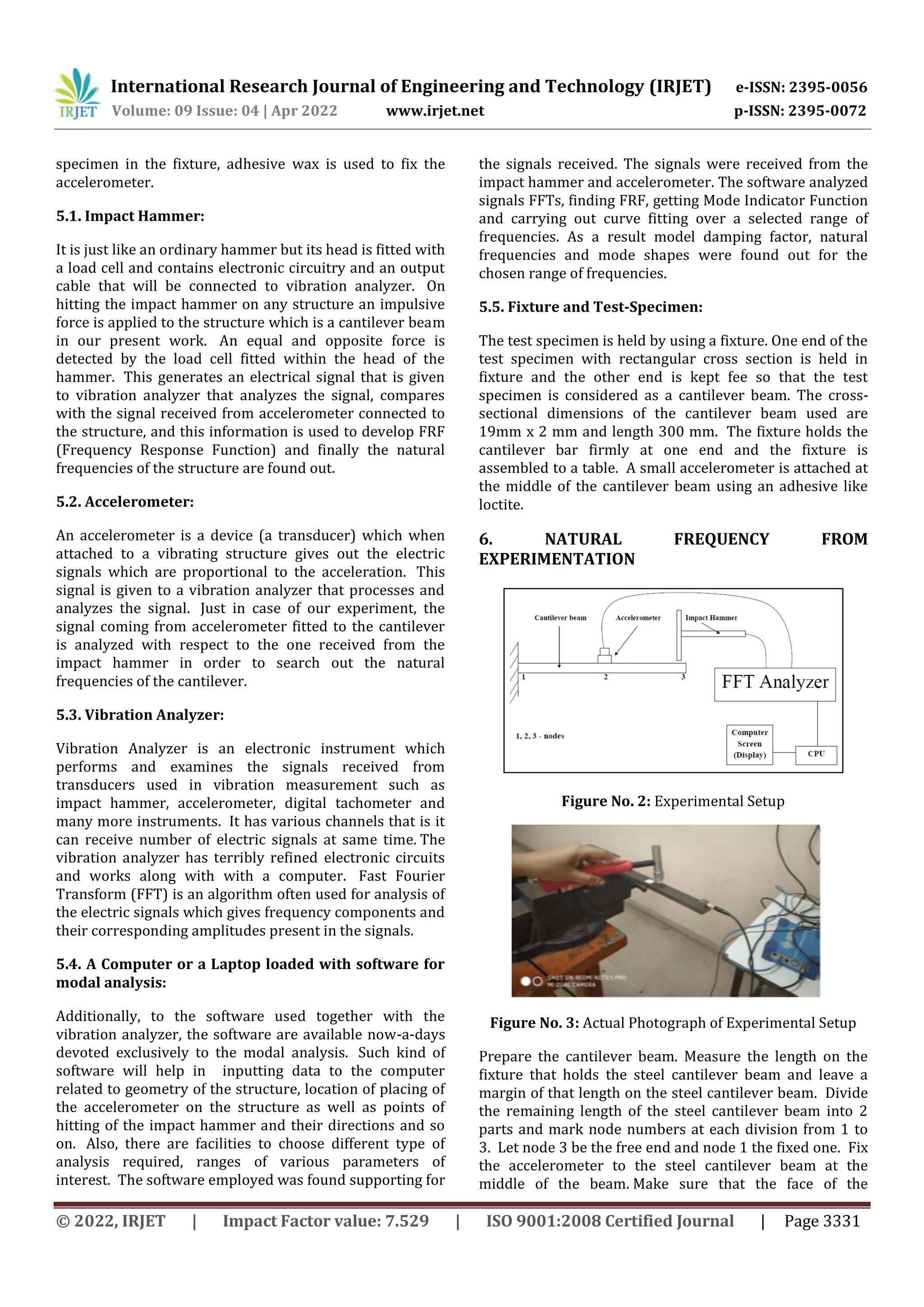
Figure No. 2: Experimental Setup
Figure No. 3: Actual Photograph of Experimental Setup
Prepare the cantilever beam. Measure the length on the
fixture that holds the steel cantilever beam and leave a
margin of that length on the steel cantilever beam. Divide
the remaining length of the steel cantilever beam into 2
parts and mark node numbers at each division from 1 to
3. Let node 3 be the free end and node 1 the fixed one. Fix
the accelerometer to the steel cantilever beam at the
middle of the beam. Make sure that the face of the
International Research Journal of Engineering and Technology (IRJET) e-ISSN: 2395-0056
Volume: 09 Issue: 04 | Apr 2022 www.irjet.net p-ISSN: 2395-0072
© 2022, IRJET | Impact Factor value: 7.529 | ISO 9001:2008 Certified Journal | Page 3332
cantilever beam with markings and node numbers is kept
upper side. Rigidly fix the beam into the slot of the fixture
in order that a cantilever is made. Connect all the wires
and cables properly. Connections of the vibration analyzer,
laptop, accelerometer and the impact hammer are made
properly. Switch on the power supply. Open the software
of vibration analysis and experimental modal analysis
installed on the computer/laptop. The necessary inputs to
be given and do the necessary settings in the
software. Make sure that there is proper supply and
between the devices connected. Now impacts are done by
the impact hammer over the test specimen that is a
cantilever beam on which the nodes marked. Impacts are
given on nodes 2 and 3, the node 1 is fixed. The
Accelerometer is placed at node 2. The signals from the
impact hammer and the accelerometer are received by the
vibration analyzer for the every impact made one by one
and are compared and analyzed by the software used. The
Frequency Response Function (FRF) generated by the
software has been used to find the natural frequencies of
the cantilever beam. Observed the curve and read the
frequencies that correspond to peaks of the FRF.
7. OBSERVATION GRAPHS FROM FFT ANALYZER
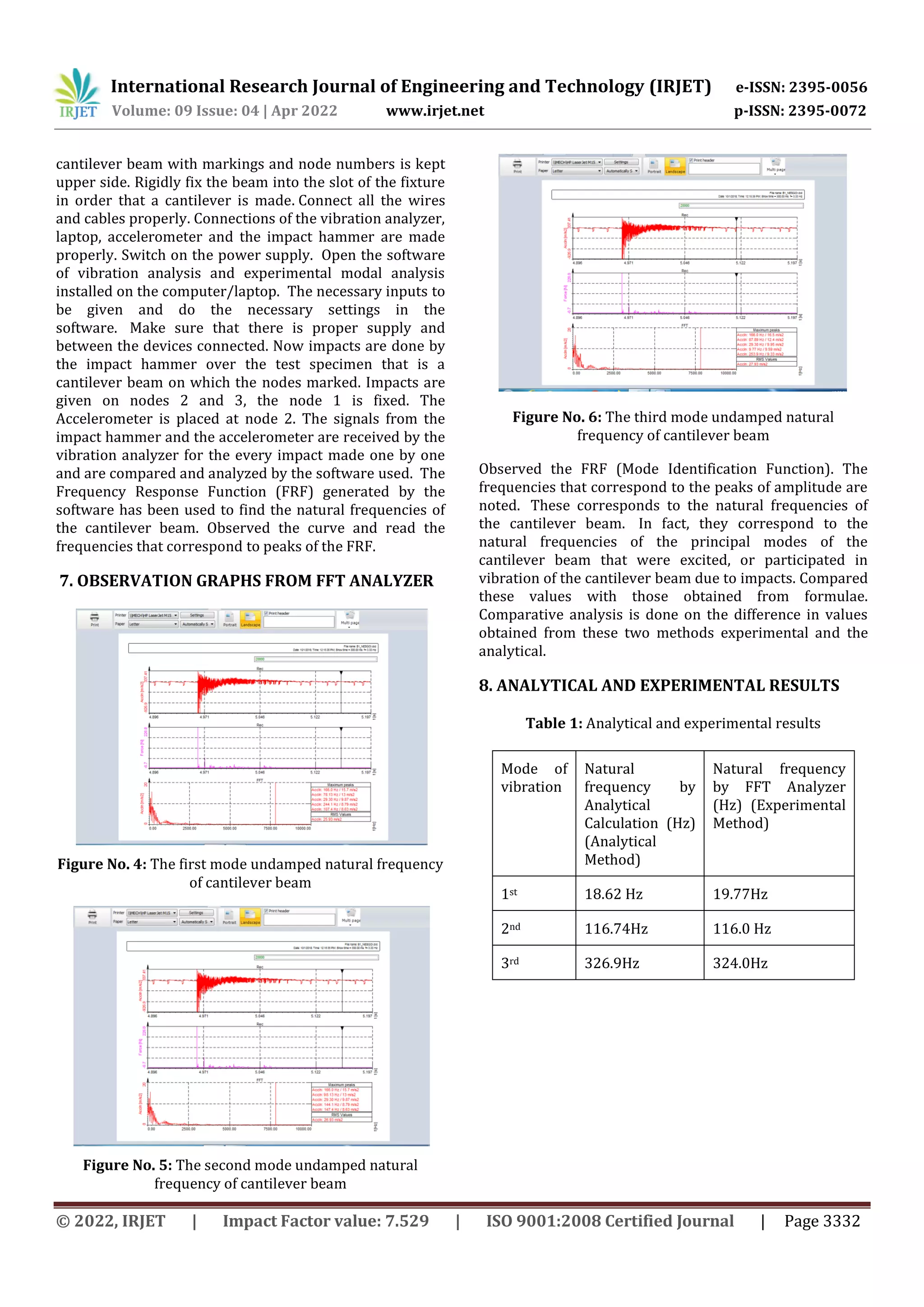
Figure No. 4: The first mode undamped natural frequency
of cantilever beam
Figure No. 5: The second mode undamped natural
frequency of cantilever beam
Figure No. 6: The third mode undamped natural
frequency of cantilever beam
Observed the FRF (Mode Identification Function). The
frequencies that correspond to the peaks of amplitude are
noted. These corresponds to the natural frequencies of
the cantilever beam. In fact, they correspond to the
natural frequencies of the principal modes of the
cantilever beam that were excited, or participated in
vibration of the cantilever beam due to impacts. Compared
these values with those obtained from formulae.
Comparative analysis is done on the difference in values
obtained from these two methods experimental and the
analytical.
8. ANALYTICAL AND EXPERIMENTAL RESULTS
Table 1: Analytical and experimental results
Mode of
vibration
Natural
frequency by
Analytical
Calculation (Hz)
(Analytical
Method)
Natural frequency
by FFT Analyzer
(Hz) (Experimental
Method)
1st 18.62 Hz 19.77Hz
2nd 116.74Hz 116.0 Hz
3rd 326.9Hz 324.0Hz
International Research Journal of Engineering and Technology (IRJET) e-ISSN: 2395-0056
Volume: 09 Issue: 04 | Apr 2022 www.irjet.net p-ISSN: 2395-0072
© 2022, IRJET | Impact Factor value: 7.529 | ISO 9001:2008 Certified Journal | Page 3333
Figure No. 7: Analytical and experimental results
9. CONCLUSIONS
Vibration analysis is one of the most important processes
in the field of mechanical engineering. Vibration study of a
cantilever beam is very important. This study will helps to
determine the durability concerns. The observations from
this work can be is used to decrease the discomforts and
the excessive stresses in different applications where
beams are important components. Beams will have
different dynamic loads in different applications. When a
cantilever beam is subjected to a dynamic load, the beam
will vibrate at its natural frequencies. The natural
frequency of vibration of cantilever beam is analyzed by
both analytical and experimental methods and both the
results were compared. From result table it can be
concluded that Natural frequency obtained by FFT
Analyzer i.e., by experimental method is matching with
natural frequency by analytical calculation. The
dimensions of the cantilever beam are length L = 0.3 m,
breadth b = 0.019 m and thickness t = 0.002 m. Natural
frequency obtained by analytical calculation for 1st mode,
2nd mode and 3rd mode of vibrations are 18.62 Hz,
116.74Hz and 326.9Hz respectively. The natural frequency
obtained by experimental method by using FFT for 1st
mode, 2nd mode and 3rd mode of vibrations are 19.77Hz,
116.0 Hz and 324.0Hz.
REFERENCES
[1]. J.-S. WV, T.-L. LIN, “Free Vibration Analysis of a
Uniform Cantilever Beam with Point Masses by An
Analytical-And-Numerical Combined Method”, Journal
of Sound and Vibration (1990) 136(2), 201-213,1990
Academic Press Limited
[2]. J.P. Chopade, R.B. Barjibhe”Free Vibration Analysis of
Fixed Free Beam with Theoretical and Numerical
Approach Method”, International Journal of
Innovations in Engineering and Technology
(IJIET),Vol. 2 Issue 1 February 2013,ISSN: 2319 –
1058
[3]. Giovanni Betta,, Massimo D’Apuzzo, “An Intelligent
FFT-Analyzer”, IEEE Transactions on Instrumentation
and Measurement, VOL. 47, NO. 5, October 1998
[4]. Mohammad Zannon, “Free Vibration of Thin Film
Cantilever Beam”, International Journal of Engineering
and Technical Research (IJETR), ISSN: 2321-0869,
Volume-2, Issue-11, November 2014
[5]. Simarnjit Singh, Amandeep Singh, “Free Vibration
Analysis on Cantilever Beam- A Review”, International
Research Journal of Engineering and Technology
(IRJET) e-ISSN: 2395 -0056, p-ISSN: 2395-0072,
Volume: 04 Issue: 02 | Feb -2017
[6]. Mohammad Vaziri, Ali Vaziri, Prof. S.S. Kadam
“Vibration analysis of cantilever beam by using FFT
Analyzer”, International Journal of Advanced
Engineering Technology, E-ISSN 0976-3945,
IJAET/Vol. IV/ Issue II/April-June, 2013/112-115
[7]. GAWALI A.L. and SANJAY C. KUMAWAT, “Vibration
Analysis of Beams”, World Research Journal of Civil
Engineering, ISSN: 2277-5986 & E-ISSN: 2277-5994,
Volume 1, Issue 1, 2011, pp-15-29
[8]. Pooja Ghumai, Dr. L G Navale, “Cantilever Beam Crack
Detection using FEA and FFT Analyser”, International
Research Journal of Engineering and Technology
(IRJET), e-ISSN: 2395-0056, p-ISSN: 2395-0072,
Volume: 05 Issue: 10 | Oct 2018
[9]. Mihir H. Patel, Ankit J. Desai, “Development of FFT
Analyzer for measuring Vibration”, The International
journal of analytical and experimental modal analysis,
ISSN NO:0886-9367, Volume XII, Issue IV, April/2020
[10]. Suraj R. Karanjikar, Prof. D.S. Supekar, “Vibrational
Analysis of Four Stroke Diesel Engine using FFT
Analyzer”, International Journal of Engineering
Research & Technology (IJERT), ISSN: 2278-0181, Vol.
4 Issue 06, June-2015
0
100
200
300
400
1st MOV 3rd MOV
Analytical
Method
Experimental
Method

Comparative Analysis of Natural Frequency of Transverse Vibration of a Cantilever Beam by Analytical and Experimental Methods

  • 1.
    International Research Journalof Engineering and Technology (IRJET) e-ISSN: 2395-0056 Volume: 09 Issue: 04 | Apr 2022 www.irjet.net p-ISSN: 2395-0072 © 2022, IRJET | Impact Factor value: 7.529 | ISO 9001:2008 Certified Journal | Page 3329 Comparative Analysis of Natural Frequency of Transverse Vibration of a Cantilever Beam by Analytical and Experimental Methods Prof. S. V. Tawade1, Dr. R. J. Patil2, Prof. A. S. Kale3 1Asst. Professor, Dept. of Mechanical Engineering, Navsahyadri Engineering College, Pune, India 2Principal, Navsahyadri Engineering College, Pune, India 3Asst. Professor, Dept. of Electrical Engineering, Navsahyadri Engineering College, Pune, India ---------------------------------------------------------------------***--------------------------------------------------------------------- Abstract - Vibration analysis of any mechanical systems is very important since excess vibrations leads to failure of the mechanical systems. There are many methods and instruments available in the engineering field for measuring the mechanical vibrations in mechanical systems. In this present work transverse vibrations of a cantilever beam are analyzed analytically and experimentally. In our present work FFT analyzer is used to measure the natural frequency of vibration of a cantilever beam. Initially the natural frequency of the cantilever beam is calculated analytically and then natural frequency was found out by experimentally by using FFT and the results were compared. Both analytical and experimental results were found to be almost the same. The present work shows a standard procedure for the determination of natural frequency of vibration of a cantilever beam by analytical and experimental methods by using FFT analyzer. Key Words: Cantilever beam, Natural frequency, FFT 1. INTRODUCTION A straight, horizontal cantilever beam is deformed into curve when it is subjected to a vertical load. After the removal of Load, the beam regains its original shape as it was prior before subjected to load, but due to inertia the beam stays in motion. Which results in vibration of beam at characteristic frequency [6]. In this paper a cantilever beam with rectangular cross section for transverse vibration is investigated. Device used are Accelerometer and Fast Fourier Transform Analyzer. Most extensively studied among structural elements are beam as it finds many engineering applications. Structure like Long span bridges, robot arm and tall buildings are modeled with beam like element, beams as well as the presence of cracks affects the dynamic response of the structure significantly. It can result into failure of structure in a very extreme way. To predict the failure, vibration monitoring can be used to detect changes in the dynamic responses and/or dynamic characteristics of the structure [7]. One of the most important tasks in designing of mechanical system is Vibration Analysis. Design engineer has to take into consideration information like dynamic behaviour of structure of machine tool, effect of vibration absorber on rotating machineries. This information helps to design system to control the excessive amplitude of the vibration [2]. Before the advent of computers, seeking the analytical solution was one of the most popular ways to solve an engineering problem. In comparison with numerical methods, the analytical solutions have the advantage of elegance and are time-saving. However, for most practical engineering problems no analytical solutions can be found, unless they are significantly simplified. Because of this drawback of the analytical method, it has gradually been replaced by numerical methods after the invention of computer, particularly in recent years. One of the greatest shortcomings of the numerical approach is that it is time- consuming, but because of its powerful ability for solving the practical problems this drawback seems allowable [1]. An intelligent FFT analyser is capable of adapting its operating parameters on the basis of the signal spectrum set up and characters. The realised instrument is equipped with auto configuration capability. The experimental tests carried out on a large number of signals highlight the instrument capability of correctly detecting a good frequency resolution for any signal spectrum type [3]. In this paper a straight horizontal cantilever beam is subjected to free vibration due to which it will vibrate at its natural frequency. The aim is to study the vibration of thin film cantilever beam. The frequency equations are solved to show the output frequencies and the mode shapes related to each frequency [4] 2. THE CANTILEVER BEAM Figure No. -1: The beam under free vibration A Cantilever beam is a beam whose one end is fixed and another end is free. When a beam is subjected to load it withstands the load by resisting against bending. Bending moment is the reaction of the beam, when a beam is subjected to bending force due to its own weight, external load, etc. When a straight horizontal cantilever beam is
  • 2.
    International Research Journalof Engineering and Technology (IRJET) e-ISSN: 2395-0056 Volume: 09 Issue: 04 | Apr 2022 www.irjet.net p-ISSN: 2395-0072 © 2022, IRJET | Impact Factor value: 7.529 | ISO 9001:2008 Certified Journal | Page 3330 exposed to vertical load, it will bend downwards and after removal of load will regain its original shape but will vibrate at natural frequency due to inertia. Most fundamental structure of any structure from decades is cantilever beam. The cantilever beam is much greater in length as compared to width and depth. In addition, cantilever beams may be straight or curved, with rectangular or circular cross sections. Figure 1 shows a cantilever beam with a rectangular cross section. The design and shape of cantilever beam is application specific, its weight, size, shape all parameters changes based on application. For example, one of the most common applications of a cantilever beam can be the “fixed wing” in meters is designed as a beam for some preliminary analysis to help lift the plane and make it fly. In Micro Electrical Mechanical Systems (MEMS), micro cantilever beams are used in radio frequency filters and resonator [4]. 3. NATURAL FREQUENCY FROM ANALYTICAL CALCULATION Beam’s Specifications: L = 0.3 m, b = 0.019 m, t = 0.002 m M. I. of cantilever beam (I) = (1/12)xbt3 = (1/12)x0.019 x (0.002)3 = 1.267 x 10⁻¹¹ m4 Area of cross section of cantilever beam (A) = b x t = 0.019 x 0.002 = 3.8 x 10⁻⁵ m2 E = 210GPa (210x109 N/m2) ---For steel. ρ = 7800 kg/m3 ----For steel. For 1st mode √ √ = 117.03rad/sec, & = 18.62Hz For 2nd mode √ √ =733.5rad/sec, & = 116.74 Hz For 3rd mode √ √ =2054.03rad/sec, & =326.9Hz 4. THE FFT ANALYZER In FFT spectrum analyzer, the input signal is digitized and that to at high sampling rate which is similar to oscilloscope. The digital time record obtained as a result is then transformed using a algorithm known as Fast Fourier transform algorithm, into a Frequency Spectrum. The signal analyzer measures the magnitude of an input signal and compares with the maximum frequency range values of instruments. The vibration amplitude is recorded on the fact that its development versus the frequency at that the signals were appeared. The original time domain signal is converted into Frequency domain view. Single Channel FFT and Multichannel type is specially used for determining Single vibration parameter from one or more sources. 4.1. Benefits of FFT analyzer: 4.1.1. Quick capture of waveform: It is generally observed that the waveform is identified digitally. The waveform can be identified in a remarkably very short span of time and then the afterwards it is analyzed. This short capture time has much benefit. It will provide the capture of short-lived waveforms. 4.1.2. Able to capture non-repetitive events: The short capture time indicate the truth that the FFT analyzer will record non-repetitive waveforms giving them a capability, which will not be possible with other kinds of spectrum analyzers. 4.1.3. Able to analyze signal phase: As part of the signal capture method, information is gained which might be processed to reveal the phase of signals. 4.1.4. Waveforms can be stored using FFT technology: It will be quite possible to record the waveform and analyze it later and this will be required. 4.2. Disadvantages of the FFT analyzer: 4.2.1. Frequency limitations: The important limitation of the frequency and bandwidth of FFT spectrum analyzers is that the analogue to digital converter, ADC that is used to convert the analogue signal into a digital format. Whereas technology is raising this component is still places a serious limitation on the higher frequency limits or the bandwidth if a down-conversion stage is employed. 4.2.2. Cost: The high level of performance needed by the ADC implies that, this item could be a terribly very high-cost item. Additionally, to all the other processing and display circuitry required, this leads to the prices rising for this stuff. 5. EQUIPMENT USED FOR EXPERIMENTATION Apparatus used to conduct the experimentation are, The Impact Hammer, Accelerometer, Multi-channel Vibration Analyzer (DEWESoft-DEWE-43), a laptop installed with software for modal analysis. The cantilever beam is held in a fixture, power supply is given to the laptop and the vibration analyzer, connecting cables which in turn connected to the impact hammer and the accelerometer. Fasteners and spanner are used to assemble rigidly the
  • 3.
    International Research Journalof Engineering and Technology (IRJET) e-ISSN: 2395-0056 Volume: 09 Issue: 04 | Apr 2022 www.irjet.net p-ISSN: 2395-0072 © 2022, IRJET | Impact Factor value: 7.529 | ISO 9001:2008 Certified Journal | Page 3331 specimen in the fixture, adhesive wax is used to fix the accelerometer. 5.1. Impact Hammer: It is just like an ordinary hammer but its head is fitted with a load cell and contains electronic circuitry and an output cable that will be connected to vibration analyzer. On hitting the impact hammer on any structure an impulsive force is applied to the structure which is a cantilever beam in our present work. An equal and opposite force is detected by the load cell fitted within the head of the hammer. This generates an electrical signal that is given to vibration analyzer that analyzes the signal, compares with the signal received from accelerometer connected to the structure, and this information is used to develop FRF (Frequency Response Function) and finally the natural frequencies of the structure are found out. 5.2. Accelerometer: An accelerometer is a device (a transducer) which when attached to a vibrating structure gives out the electric signals which are proportional to the acceleration. This signal is given to a vibration analyzer that processes and analyzes the signal. Just in case of our experiment, the signal coming from accelerometer fitted to the cantilever is analyzed with respect to the one received from the impact hammer in order to search out the natural frequencies of the cantilever. 5.3. Vibration Analyzer: Vibration Analyzer is an electronic instrument which performs and examines the signals received from transducers used in vibration measurement such as impact hammer, accelerometer, digital tachometer and many more instruments. It has various channels that is it can receive number of electric signals at same time. The vibration analyzer has terribly refined electronic circuits and works along with with a computer. Fast Fourier Transform (FFT) is an algorithm often used for analysis of the electric signals which gives frequency components and their corresponding amplitudes present in the signals. 5.4. A Computer or a Laptop loaded with software for modal analysis: Additionally, to the software used together with the vibration analyzer, the software are available now-a-days devoted exclusively to the modal analysis. Such kind of software will help in inputting data to the computer related to geometry of the structure, location of placing of the accelerometer on the structure as well as points of hitting of the impact hammer and their directions and so on. Also, there are facilities to choose different type of analysis required, ranges of various parameters of interest. The software employed was found supporting for the signals received. The signals were received from the impact hammer and accelerometer. The software analyzed signals FFTs, finding FRF, getting Mode Indicator Function and carrying out curve fitting over a selected range of frequencies. As a result model damping factor, natural frequencies and mode shapes were found out for the chosen range of frequencies. 5.5. Fixture and Test-Specimen: The test specimen is held by using a fixture. One end of the test specimen with rectangular cross section is held in fixture and the other end is kept fee so that the test specimen is considered as a cantilever beam. The cross- sectional dimensions of the cantilever beam used are 19mm x 2 mm and length 300 mm. The fixture holds the cantilever bar firmly at one end and the fixture is assembled to a table. A small accelerometer is attached at the middle of the cantilever beam using an adhesive like loctite. 6. NATURAL FREQUENCY FROM EXPERIMENTATION Figure No. 2: Experimental Setup Figure No. 3: Actual Photograph of Experimental Setup Prepare the cantilever beam. Measure the length on the fixture that holds the steel cantilever beam and leave a margin of that length on the steel cantilever beam. Divide the remaining length of the steel cantilever beam into 2 parts and mark node numbers at each division from 1 to 3. Let node 3 be the free end and node 1 the fixed one. Fix the accelerometer to the steel cantilever beam at the middle of the beam. Make sure that the face of the
  • 4.
    International Research Journalof Engineering and Technology (IRJET) e-ISSN: 2395-0056 Volume: 09 Issue: 04 | Apr 2022 www.irjet.net p-ISSN: 2395-0072 © 2022, IRJET | Impact Factor value: 7.529 | ISO 9001:2008 Certified Journal | Page 3332 cantilever beam with markings and node numbers is kept upper side. Rigidly fix the beam into the slot of the fixture in order that a cantilever is made. Connect all the wires and cables properly. Connections of the vibration analyzer, laptop, accelerometer and the impact hammer are made properly. Switch on the power supply. Open the software of vibration analysis and experimental modal analysis installed on the computer/laptop. The necessary inputs to be given and do the necessary settings in the software. Make sure that there is proper supply and between the devices connected. Now impacts are done by the impact hammer over the test specimen that is a cantilever beam on which the nodes marked. Impacts are given on nodes 2 and 3, the node 1 is fixed. The Accelerometer is placed at node 2. The signals from the impact hammer and the accelerometer are received by the vibration analyzer for the every impact made one by one and are compared and analyzed by the software used. The Frequency Response Function (FRF) generated by the software has been used to find the natural frequencies of the cantilever beam. Observed the curve and read the frequencies that correspond to peaks of the FRF. 7. OBSERVATION GRAPHS FROM FFT ANALYZER Figure No. 4: The first mode undamped natural frequency of cantilever beam Figure No. 5: The second mode undamped natural frequency of cantilever beam Figure No. 6: The third mode undamped natural frequency of cantilever beam Observed the FRF (Mode Identification Function). The frequencies that correspond to the peaks of amplitude are noted. These corresponds to the natural frequencies of the cantilever beam. In fact, they correspond to the natural frequencies of the principal modes of the cantilever beam that were excited, or participated in vibration of the cantilever beam due to impacts. Compared these values with those obtained from formulae. Comparative analysis is done on the difference in values obtained from these two methods experimental and the analytical. 8. ANALYTICAL AND EXPERIMENTAL RESULTS Table 1: Analytical and experimental results Mode of vibration Natural frequency by Analytical Calculation (Hz) (Analytical Method) Natural frequency by FFT Analyzer (Hz) (Experimental Method) 1st 18.62 Hz 19.77Hz 2nd 116.74Hz 116.0 Hz 3rd 326.9Hz 324.0Hz
  • 5.
    International Research Journalof Engineering and Technology (IRJET) e-ISSN: 2395-0056 Volume: 09 Issue: 04 | Apr 2022 www.irjet.net p-ISSN: 2395-0072 © 2022, IRJET | Impact Factor value: 7.529 | ISO 9001:2008 Certified Journal | Page 3333 Figure No. 7: Analytical and experimental results 9. CONCLUSIONS Vibration analysis is one of the most important processes in the field of mechanical engineering. Vibration study of a cantilever beam is very important. This study will helps to determine the durability concerns. The observations from this work can be is used to decrease the discomforts and the excessive stresses in different applications where beams are important components. Beams will have different dynamic loads in different applications. When a cantilever beam is subjected to a dynamic load, the beam will vibrate at its natural frequencies. The natural frequency of vibration of cantilever beam is analyzed by both analytical and experimental methods and both the results were compared. From result table it can be concluded that Natural frequency obtained by FFT Analyzer i.e., by experimental method is matching with natural frequency by analytical calculation. The dimensions of the cantilever beam are length L = 0.3 m, breadth b = 0.019 m and thickness t = 0.002 m. Natural frequency obtained by analytical calculation for 1st mode, 2nd mode and 3rd mode of vibrations are 18.62 Hz, 116.74Hz and 326.9Hz respectively. The natural frequency obtained by experimental method by using FFT for 1st mode, 2nd mode and 3rd mode of vibrations are 19.77Hz, 116.0 Hz and 324.0Hz. REFERENCES [1]. J.-S. WV, T.-L. LIN, “Free Vibration Analysis of a Uniform Cantilever Beam with Point Masses by An Analytical-And-Numerical Combined Method”, Journal of Sound and Vibration (1990) 136(2), 201-213,1990 Academic Press Limited [2]. J.P. Chopade, R.B. Barjibhe”Free Vibration Analysis of Fixed Free Beam with Theoretical and Numerical Approach Method”, International Journal of Innovations in Engineering and Technology (IJIET),Vol. 2 Issue 1 February 2013,ISSN: 2319 – 1058 [3]. Giovanni Betta,, Massimo D’Apuzzo, “An Intelligent FFT-Analyzer”, IEEE Transactions on Instrumentation and Measurement, VOL. 47, NO. 5, October 1998 [4]. Mohammad Zannon, “Free Vibration of Thin Film Cantilever Beam”, International Journal of Engineering and Technical Research (IJETR), ISSN: 2321-0869, Volume-2, Issue-11, November 2014 [5]. Simarnjit Singh, Amandeep Singh, “Free Vibration Analysis on Cantilever Beam- A Review”, International Research Journal of Engineering and Technology (IRJET) e-ISSN: 2395 -0056, p-ISSN: 2395-0072, Volume: 04 Issue: 02 | Feb -2017 [6]. Mohammad Vaziri, Ali Vaziri, Prof. S.S. Kadam “Vibration analysis of cantilever beam by using FFT Analyzer”, International Journal of Advanced Engineering Technology, E-ISSN 0976-3945, IJAET/Vol. IV/ Issue II/April-June, 2013/112-115 [7]. GAWALI A.L. and SANJAY C. KUMAWAT, “Vibration Analysis of Beams”, World Research Journal of Civil Engineering, ISSN: 2277-5986 & E-ISSN: 2277-5994, Volume 1, Issue 1, 2011, pp-15-29 [8]. Pooja Ghumai, Dr. L G Navale, “Cantilever Beam Crack Detection using FEA and FFT Analyser”, International Research Journal of Engineering and Technology (IRJET), e-ISSN: 2395-0056, p-ISSN: 2395-0072, Volume: 05 Issue: 10 | Oct 2018 [9]. Mihir H. Patel, Ankit J. Desai, “Development of FFT Analyzer for measuring Vibration”, The International journal of analytical and experimental modal analysis, ISSN NO:0886-9367, Volume XII, Issue IV, April/2020 [10]. Suraj R. Karanjikar, Prof. D.S. Supekar, “Vibrational Analysis of Four Stroke Diesel Engine using FFT Analyzer”, International Journal of Engineering Research & Technology (IJERT), ISSN: 2278-0181, Vol. 4 Issue 06, June-2015 0 100 200 300 400 1st MOV 3rd MOV Analytical Method Experimental Method