Describing Differences
So Far… We have seen  variation  in individuals of the  same  species  ( Homo sapiens  – humans) Tonge rolling Hair colour Height Today we will look at variations between  different   species
L3 - Know that there are different ways of describing organisms.  L3  -Know that living things can be classified into groups. L4 - How to classify some organisms into groups. Objectives
By the end of this lesson you  Must be able recognise the features of some organisms Should be able to put some organisms into groups Need to write down and know the keywords Must answer a written question about insects
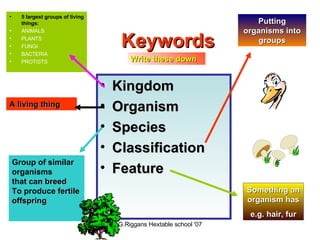
Keywords Kingdom  Organism Species Classification Feature 5 largest groups of living things: ANIMALS PLANTS FUNGI BACTERIA PROTISTS A living thing Group of similar organisms  that can  breed To produce  fertile   offspring Putting organisms into groups Something an organism has e.g. hair, fur Write these down
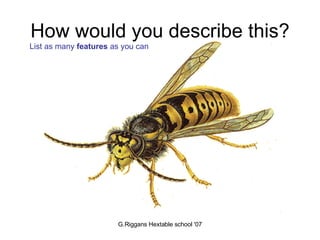
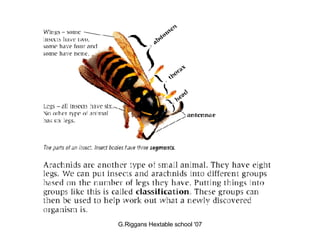
How would you describe this? List as many  features  as you can
 
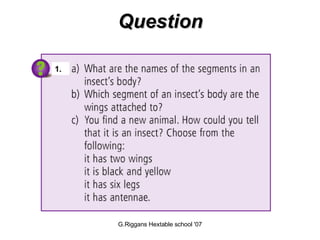
Question 1.
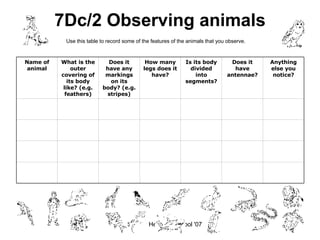
7Dc/2 Observing animals Use this table to record some of the features of the animals that you observe. Anything else you notice? Does it have antennae? Is its body divided into segments? How many legs does it have? Does it have any markings on its body? (e.g. stripes) What is the outer covering of its body like? (e.g. feathers) Name of animal
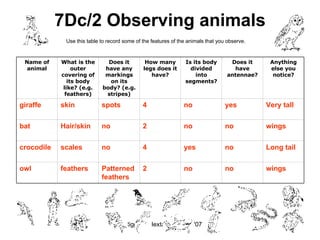
7Dc/2 Observing animals Use this table to record some of the features of the animals that you observe. wings no no 2 Patterned feathers feathers owl Long tail no yes 4 no scales crocodile wings no no 2 no Hair/skin bat Very tall yes no 4 spots skin giraffe Anything else you notice? Does it have antennae? Is its body divided into segments? How many legs does it have? Does it have any markings on its body? (e.g. stripes) What is the outer covering of its body like? (e.g. feathers) Name of animal
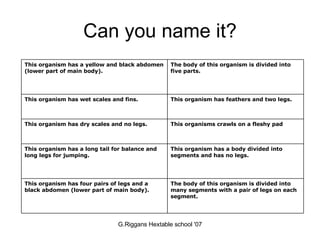
Can you name it? The body of this organism is divided into many segments with a pair of legs on each segment. This organism has four pairs of legs and a black abdomen (lower part of main body). This organism has a body divided into segments and has no legs. This organism has a long tail for balance and long legs for jumping. This organisms crawls on a fleshy pad This organism has dry scales and no legs. This organism has feathers and two legs. This organism has wet scales and fins. The body of this organism is divided into five parts. This organism has a yellow and black abdomen (lower part of main body).
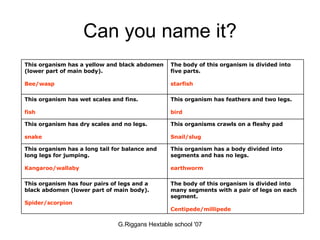
Can you name it? The body of this organism is divided into many segments with a pair of legs on each segment. Centipede/millipede This organism has four pairs of legs and a black abdomen (lower part of main body). Spider/scorpion This organism has a body divided into segments and has no legs. earthworm This organism has a long tail for balance and long legs for jumping. Kangaroo/wallaby This organisms crawls on a fleshy pad Snail/slug This organism has dry scales and no legs. snake This organism has feathers and two legs. bird This organism has wet scales and fins. fish The body of this organism is divided into five parts. starfish This organism has a yellow and black abdomen (lower part of main body). Bee/wasp
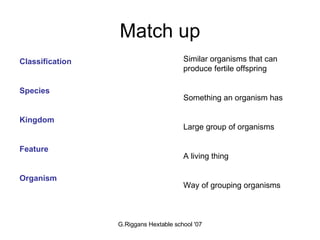
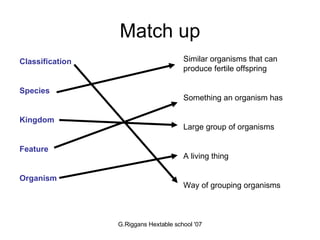
Match up Classification Species Kingdom Feature Organism Similar organisms that can produce fertile offspring Something an organism has Large group of organisms A living thing Way of grouping organisms
Homework /Extension Choose 2 organisms we have  not  looked at today Describe them in detail Draw a picture of them
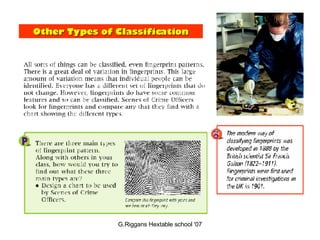
Other Types of Classification
Classification Summary Organisms are  classified , or put into groups The smallest group is a  SPECIES Examples of  species are wasps and crocodiles The biggest group is a  KINGDOM Two kingdoms are the animal and plant kingdoms We look for common  features  in order to group organisms
Next Lesson… We will look at the FIVE Kingdoms in more detail: Animals Plants Fungi Bacteria Protists We will look at the 2 main groups of animals: Vertebrates & invertebrates

Describing Differences

  • 1.
  • 2.
    So Far… Wehave seen variation in individuals of the same species ( Homo sapiens – humans) Tonge rolling Hair colour Height Today we will look at variations between different species
  • 3.
    L3 - Knowthat there are different ways of describing organisms. L3 -Know that living things can be classified into groups. L4 - How to classify some organisms into groups. Objectives
  • 4.
    By the endof this lesson you Must be able recognise the features of some organisms Should be able to put some organisms into groups Need to write down and know the keywords Must answer a written question about insects
  • 5.
    Keywords Kingdom Organism Species Classification Feature 5 largest groups of living things: ANIMALS PLANTS FUNGI BACTERIA PROTISTS A living thing Group of similar organisms that can breed To produce fertile offspring Putting organisms into groups Something an organism has e.g. hair, fur Write these down
  • 6.
    How would youdescribe this? List as many features as you can
  • 7.
  • 8.
  • 9.
    7Dc/2 Observing animalsUse this table to record some of the features of the animals that you observe. Anything else you notice? Does it have antennae? Is its body divided into segments? How many legs does it have? Does it have any markings on its body? (e.g. stripes) What is the outer covering of its body like? (e.g. feathers) Name of animal
  • 10.
    7Dc/2 Observing animalsUse this table to record some of the features of the animals that you observe. wings no no 2 Patterned feathers feathers owl Long tail no yes 4 no scales crocodile wings no no 2 no Hair/skin bat Very tall yes no 4 spots skin giraffe Anything else you notice? Does it have antennae? Is its body divided into segments? How many legs does it have? Does it have any markings on its body? (e.g. stripes) What is the outer covering of its body like? (e.g. feathers) Name of animal
  • 11.
    Can you nameit? The body of this organism is divided into many segments with a pair of legs on each segment. This organism has four pairs of legs and a black abdomen (lower part of main body). This organism has a body divided into segments and has no legs. This organism has a long tail for balance and long legs for jumping. This organisms crawls on a fleshy pad This organism has dry scales and no legs. This organism has feathers and two legs. This organism has wet scales and fins. The body of this organism is divided into five parts. This organism has a yellow and black abdomen (lower part of main body).
  • 12.
    Can you nameit? The body of this organism is divided into many segments with a pair of legs on each segment. Centipede/millipede This organism has four pairs of legs and a black abdomen (lower part of main body). Spider/scorpion This organism has a body divided into segments and has no legs. earthworm This organism has a long tail for balance and long legs for jumping. Kangaroo/wallaby This organisms crawls on a fleshy pad Snail/slug This organism has dry scales and no legs. snake This organism has feathers and two legs. bird This organism has wet scales and fins. fish The body of this organism is divided into five parts. starfish This organism has a yellow and black abdomen (lower part of main body). Bee/wasp
  • 13.
    Match up ClassificationSpecies Kingdom Feature Organism Similar organisms that can produce fertile offspring Something an organism has Large group of organisms A living thing Way of grouping organisms
  • 14.
    Match up ClassificationSpecies Kingdom Feature Organism Similar organisms that can produce fertile offspring Something an organism has Large group of organisms A living thing Way of grouping organisms
  • 15.
    Homework /Extension Choose2 organisms we have not looked at today Describe them in detail Draw a picture of them
  • 16.
    Other Types ofClassification
  • 17.
    Classification Summary Organismsare classified , or put into groups The smallest group is a SPECIES Examples of species are wasps and crocodiles The biggest group is a KINGDOM Two kingdoms are the animal and plant kingdoms We look for common features in order to group organisms
  • 18.
    Next Lesson… Wewill look at the FIVE Kingdoms in more detail: Animals Plants Fungi Bacteria Protists We will look at the 2 main groups of animals: Vertebrates & invertebrates