
THANK YOU
MONETARY POLICY OF RBI
BY : VINISHA CHANDIL
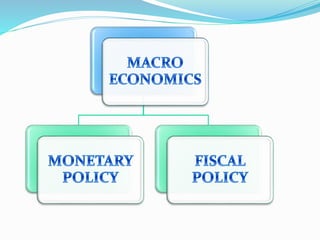
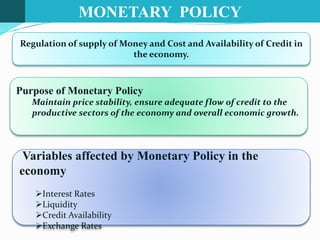
MONETARY POLICY
Regulation of supply of Money and Cost and Availability of Credit in
the economy.
Variables affected by Monetary Policy in the
economy
Interest Rates
Liquidity
Credit Availability
Exchange Rates
Purpose of Monetary Policy
Maintain price stability, ensure adequate flow of credit to the
productive sectors of the economy and overall economic growth.
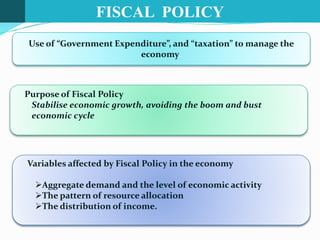
FISCAL POLICY
Use of “Government Expenditure”, and “taxation” to manage the
economy.
Variables affected by Fiscal Policy in the economy
Aggregate demand and the level of economic activity
The pattern of resource allocation
The distribution of income.
Purpose of Fiscal Policy
Stabilise economic growth, avoiding the boom and bust
economic cycle
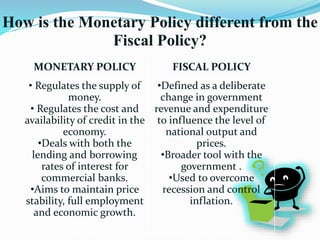
How is the Monetary Policy different from the
Fiscal Policy?
MONETARY POLICY FISCAL POLICY
• Regulates the supply of
money.
• Regulates the cost and
availability of credit in the
economy.
•Deals with both the
lending and borrowing
rates of interest for
commercial banks.
•Aims to maintain price
stability, full employment
and economic growth.
•Defined as a deliberate
change in government
revenue and expenditure
to influence the level of
national output and
prices.
•Broader tool with the
government .
•Used to overcome
recession and control
inflation.
6Monetary Policy
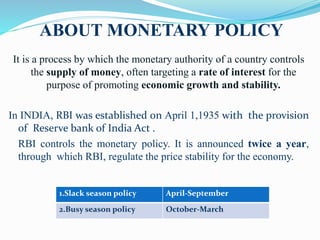
ABOUT MONETARY POLICY
It is a process by which the monetary authority of a country controls
the supply of money, often targeting a rate of interest for the
purpose of promoting economic growth and stability.
In INDIA, RBI was established on April 1,1935 with the provision
of Reserve bank of India Act .
RBI controls the monetary policy. It is announced twice a year,
through which RBI, regulate the price stability for the economy.
1.Slack season policy April-September
2.Busy season policy October-March
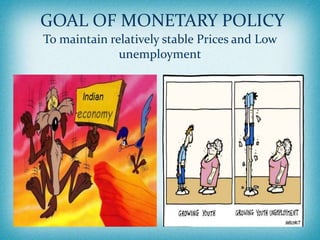
GOAL OF MONETARY POLICY
To maintain relatively stable Prices and Low
unemployment
OBJECTIVES
 Rapid Economic Growth
 Price Stability
 Exchange Rate Stability
 Balance of Payments (BOP) Equilibrium
 Full Employment
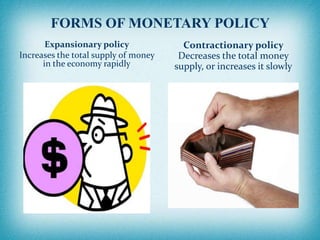
FORMS OF MONETARY POLICY
Expansionary policy
Increases the total supply of money
in the economy rapidly
Contractionary policy
Decreases the total money
supply, or increases it slowly
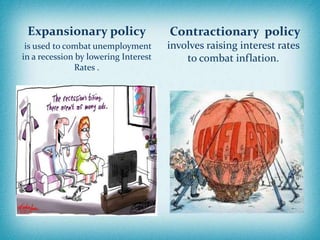
Expansionary policy
is used to combat unemployment
in a recession by lowering Interest
Rates .
Contractionary policy
involves raising interest rates
to combat inflation.
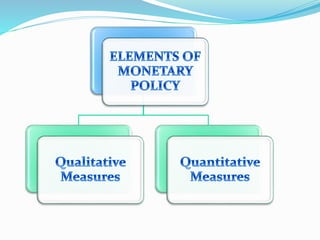
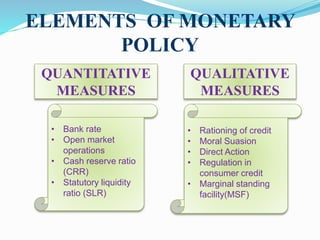
ELEMENTS OF MONETARY
POLICY
QUANTITATIVE
MEASURES
QUALITATIVE
MEASURES
• Bank rate
• Open market
operations
• Cash reserve ratio
(CRR)
• Statutory liquidity
ratio (SLR)
• Rationing of credit
• Moral Suasion
• Direct Action
• Regulation in
consumer credit
• Marginal standing
facility(MSF)
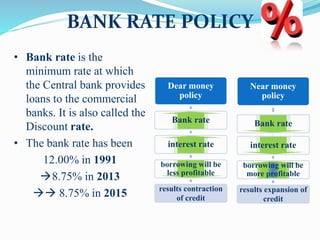
BANK RATE POLICY
• Bank rate is the
minimum rate at which
the Central bank provides
loans to the commercial
banks. It is also called the
Discount rate.
• The bank rate has been
12.00% in 1991
8.75% in 2013
 8.75% in 2015
Dear money
policy
Bank rate
interest rate
borrowing will be
less profitable
results contraction
of credit
Near money
policy
Bank rate
interest rate
borrowing will be
more profitable
results expansion of
credit
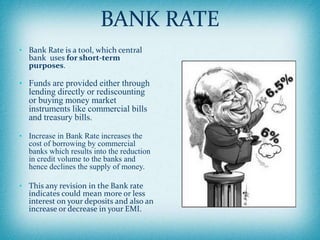
BANK RATE
• Bank Rate is a tool, which central
bank uses for short-term
purposes.
• Funds are provided either through
lending directly or rediscounting
or buying money market
instruments like commercial bills
and treasury bills.
• Increase in Bank Rate increases the
cost of borrowing by commercial
banks which results into the reduction
in credit volume to the banks and
hence declines the supply of money.
• This any revision in the Bank rate
indicates could mean more or less
interest on your deposits and also an
increase or decrease in your EMI.
OPEN MARKET OPERATIONS
 An open market operation is an instruments of monetary
policy which involves buying or selling of
government securities from or to the public and banks.
 This mechanism influences the reserve position of the
banks, yield on government securities and cost of bank
credit.
• The RBI sells government securities to contract the flow of
credit and buys government securities to increase credit
flow.
Open market operation makes bank rate policy effective and
maintains stability in government securities market.
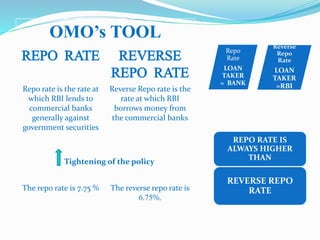
OMO’s TOOL
REPO RATE REVERSE
REPO RATE
Repo rate is the rate at
which RBI lends to
commercial banks
generally against
government securities
Reverse Repo rate is the
rate at which RBI
borrows money from
the commercial banks
Tightening of the policy
The repo rate is 7.75 % The reverse repo rate is
6.75%.
Reverse
Repo
Rate
LOAN
TAKER
=RBI
Repo
Rate
LOAN
TAKER
= BANK
REPO RATE IS
ALWAYS HIGHER
THAN
REVERSE REPO
RATE
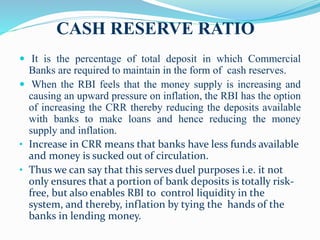
CASH RESERVE RATIO
 It is the percentage of total deposit in which Commercial
Banks are required to maintain in the form of cash reserves.
 When the RBI feels that the money supply is increasing and
causing an upward pressure on inflation, the RBI has the option
of increasing the CRR thereby reducing the deposits available
with banks to make loans and hence reducing the money
supply and inflation.
• Increase in CRR means that banks have less funds available
and money is sucked out of circulation.
• Thus we can say that this serves duel purposes i.e. it not
only ensures that a portion of bank deposits is totally risk-
free, but also enables RBI to control liquidity in the
system, and thereby, inflation by tying the hands of the
banks in lending money.
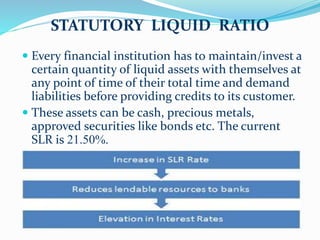
STATUTORY LIQUID RATIO
 Every financial institution has to maintain/invest a
certain quantity of liquid assets with themselves at
any point of time of their total time and demand
liabilities before providing credits to its customer.
 These assets can be cash, precious metals,
approved securities like bonds etc. The current
SLR is 21.50%.
CREDIT RATIONING
 It refers to the situation where lenders limit the supply of additional
credit to borrowers who demand funds, even if the latter are willing
to pay higher interest rates.
 Minimum of “Capital : Total Assets” (ratio between capital and total
asset) can also be prescribed by Reserve Bank of India.
Generally two measures are adopted:
 Imposition of upper limits on the credit available to well
developed industries and large scale firms.
 Charging a higher or progressive interest rate on bank loans
beyond a certain limit.
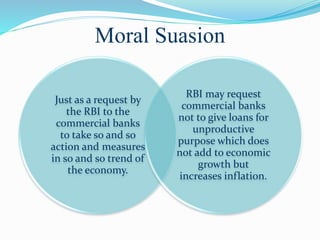
Moral Suasion
Just as a request by
the RBI to the
commercial banks
to take so and so
action and measures
in so and so trend of
the economy.
RBI may request
commercial banks
not to give loans for
unproductive
purpose which does
not add to economic
growth but
increases inflation.
21Monetary Policy
DIRECT CONTROL
 This method is adopted when a commercial bank does not
co-operate the central bank in achieving its desirable
objectives.
 It is used as a last resort in case other methods prove
ineffective.
 In this method the monetary authorities with clear directive to
carry out their lending activity in a specified manner.
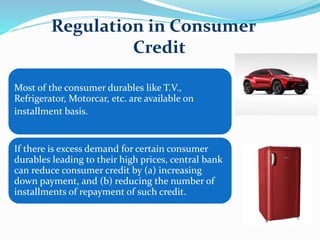
Most of the consumer durables like T.V.,
Refrigerator, Motorcar, etc. are available on
installment basis.
If there is excess demand for certain consumer
durables leading to their high prices, central bank
can reduce consumer credit by (a) increasing
down payment, and (b) reducing the number of
installments of repayment of such credit.
Regulation in Consumer
Credit
CHANGE IN LENDING MARGINS
MARGINAL REQUIREMENTS
It is the gap between the value of the mortgaged property and the
amount advanced. RBI increases lending margins to decrease
bank credit.
 Marginal Requirement of loan = current value of security
offered for loan-value of loans granted.
 The marginal requirement is increased for those business
activities, the flow of whose credit is to be restricted in the
economy.
 E.g.- A person mortgages his property worth Rs. 1,00,000
against loan.
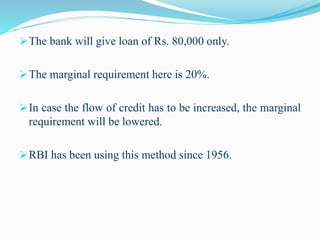
The bank will give loan of Rs. 80,000 only.
The marginal requirement here is 20%.
In case the flow of credit has to be increased, the marginal
requirement will be lowered.
RBI has been using this method since 1956.
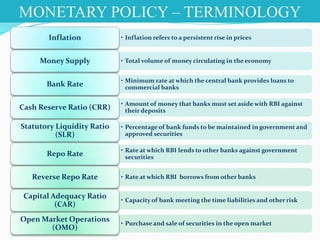
• Inflation refers to a persistent rise in pricesInflation
• Total volume of money circulating in the economyMoney Supply
• Minimum rate at which the central bank provides loans to
commercial banksBank Rate
• Amount of money that banks must set aside with RBI against
their depositsCash Reserve Ratio (CRR)
• Percentage of bank funds to be maintained in government and
approved securities
Statutory Liquidity Ratio
(SLR)
• Rate at which RBI lends to other banks against government
securitiesRepo Rate
• Rate at which RBI borrows from other banksReverse Repo Rate
• Capacity of bank meeting the time liabilities and other risk
Capital Adequacy Ratio
(CAR)
• Purchase and sale of securities in the open market
Open Market Operations
(OMO)
MONETARY POLICY – TERMINOLOGY
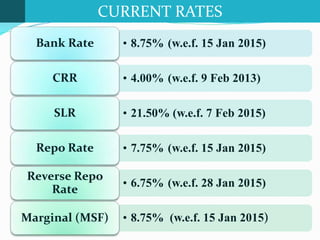
• 8.75% (w.e.f. 15 Jan 2015)Bank Rate
• 4.00% (w.e.f. 9 Feb 2013)CRR
• 21.50% (w.e.f. 7 Feb 2015)SLR
• 7.75% (w.e.f. 15 Jan 2015)Repo Rate
• 6.75% (w.e.f. 28 Jan 2015)
Reverse Repo
Rate
• 8.75% (w.e.f. 15 Jan 2015)Marginal (MSF)
CURRENT RATES
THANK YOU

Rbi monetary policy vinisha

  • 1.
    THANK YOU MONETARY POLICYOF RBI BY : VINISHA CHANDIL
  • 3.
    MONETARY POLICY Regulation ofsupply of Money and Cost and Availability of Credit in the economy. Variables affected by Monetary Policy in the economy Interest Rates Liquidity Credit Availability Exchange Rates Purpose of Monetary Policy Maintain price stability, ensure adequate flow of credit to the productive sectors of the economy and overall economic growth.
  • 4.
    FISCAL POLICY Use of“Government Expenditure”, and “taxation” to manage the economy. Variables affected by Fiscal Policy in the economy Aggregate demand and the level of economic activity The pattern of resource allocation The distribution of income. Purpose of Fiscal Policy Stabilise economic growth, avoiding the boom and bust economic cycle
  • 5.
    How is theMonetary Policy different from the Fiscal Policy? MONETARY POLICY FISCAL POLICY • Regulates the supply of money. • Regulates the cost and availability of credit in the economy. •Deals with both the lending and borrowing rates of interest for commercial banks. •Aims to maintain price stability, full employment and economic growth. •Defined as a deliberate change in government revenue and expenditure to influence the level of national output and prices. •Broader tool with the government . •Used to overcome recession and control inflation.
  • 6.
  • 7.
    ABOUT MONETARY POLICY Itis a process by which the monetary authority of a country controls the supply of money, often targeting a rate of interest for the purpose of promoting economic growth and stability. In INDIA, RBI was established on April 1,1935 with the provision of Reserve bank of India Act . RBI controls the monetary policy. It is announced twice a year, through which RBI, regulate the price stability for the economy. 1.Slack season policy April-September 2.Busy season policy October-March
  • 8.
    GOAL OF MONETARYPOLICY To maintain relatively stable Prices and Low unemployment
  • 9.
    OBJECTIVES  Rapid EconomicGrowth  Price Stability  Exchange Rate Stability  Balance of Payments (BOP) Equilibrium  Full Employment
  • 10.
    FORMS OF MONETARYPOLICY Expansionary policy Increases the total supply of money in the economy rapidly Contractionary policy Decreases the total money supply, or increases it slowly
  • 11.
    Expansionary policy is usedto combat unemployment in a recession by lowering Interest Rates . Contractionary policy involves raising interest rates to combat inflation.
  • 13.
    ELEMENTS OF MONETARY POLICY QUANTITATIVE MEASURES QUALITATIVE MEASURES •Bank rate • Open market operations • Cash reserve ratio (CRR) • Statutory liquidity ratio (SLR) • Rationing of credit • Moral Suasion • Direct Action • Regulation in consumer credit • Marginal standing facility(MSF)
  • 14.
    BANK RATE POLICY •Bank rate is the minimum rate at which the Central bank provides loans to the commercial banks. It is also called the Discount rate. • The bank rate has been 12.00% in 1991 8.75% in 2013  8.75% in 2015 Dear money policy Bank rate interest rate borrowing will be less profitable results contraction of credit Near money policy Bank rate interest rate borrowing will be more profitable results expansion of credit
  • 15.
    BANK RATE • BankRate is a tool, which central bank uses for short-term purposes. • Funds are provided either through lending directly or rediscounting or buying money market instruments like commercial bills and treasury bills. • Increase in Bank Rate increases the cost of borrowing by commercial banks which results into the reduction in credit volume to the banks and hence declines the supply of money. • This any revision in the Bank rate indicates could mean more or less interest on your deposits and also an increase or decrease in your EMI.
  • 16.
    OPEN MARKET OPERATIONS An open market operation is an instruments of monetary policy which involves buying or selling of government securities from or to the public and banks.  This mechanism influences the reserve position of the banks, yield on government securities and cost of bank credit. • The RBI sells government securities to contract the flow of credit and buys government securities to increase credit flow. Open market operation makes bank rate policy effective and maintains stability in government securities market.
  • 17.
    OMO’s TOOL REPO RATEREVERSE REPO RATE Repo rate is the rate at which RBI lends to commercial banks generally against government securities Reverse Repo rate is the rate at which RBI borrows money from the commercial banks Tightening of the policy The repo rate is 7.75 % The reverse repo rate is 6.75%. Reverse Repo Rate LOAN TAKER =RBI Repo Rate LOAN TAKER = BANK REPO RATE IS ALWAYS HIGHER THAN REVERSE REPO RATE
  • 18.
    CASH RESERVE RATIO It is the percentage of total deposit in which Commercial Banks are required to maintain in the form of cash reserves.  When the RBI feels that the money supply is increasing and causing an upward pressure on inflation, the RBI has the option of increasing the CRR thereby reducing the deposits available with banks to make loans and hence reducing the money supply and inflation. • Increase in CRR means that banks have less funds available and money is sucked out of circulation. • Thus we can say that this serves duel purposes i.e. it not only ensures that a portion of bank deposits is totally risk- free, but also enables RBI to control liquidity in the system, and thereby, inflation by tying the hands of the banks in lending money.
  • 19.
    STATUTORY LIQUID RATIO Every financial institution has to maintain/invest a certain quantity of liquid assets with themselves at any point of time of their total time and demand liabilities before providing credits to its customer.  These assets can be cash, precious metals, approved securities like bonds etc. The current SLR is 21.50%.
  • 20.
    CREDIT RATIONING  Itrefers to the situation where lenders limit the supply of additional credit to borrowers who demand funds, even if the latter are willing to pay higher interest rates.  Minimum of “Capital : Total Assets” (ratio between capital and total asset) can also be prescribed by Reserve Bank of India. Generally two measures are adopted:  Imposition of upper limits on the credit available to well developed industries and large scale firms.  Charging a higher or progressive interest rate on bank loans beyond a certain limit.
  • 21.
    Moral Suasion Just asa request by the RBI to the commercial banks to take so and so action and measures in so and so trend of the economy. RBI may request commercial banks not to give loans for unproductive purpose which does not add to economic growth but increases inflation. 21Monetary Policy
  • 22.
    DIRECT CONTROL  Thismethod is adopted when a commercial bank does not co-operate the central bank in achieving its desirable objectives.  It is used as a last resort in case other methods prove ineffective.  In this method the monetary authorities with clear directive to carry out their lending activity in a specified manner.
  • 23.
    Most of theconsumer durables like T.V., Refrigerator, Motorcar, etc. are available on installment basis. If there is excess demand for certain consumer durables leading to their high prices, central bank can reduce consumer credit by (a) increasing down payment, and (b) reducing the number of installments of repayment of such credit. Regulation in Consumer Credit
  • 24.
    CHANGE IN LENDINGMARGINS MARGINAL REQUIREMENTS It is the gap between the value of the mortgaged property and the amount advanced. RBI increases lending margins to decrease bank credit.  Marginal Requirement of loan = current value of security offered for loan-value of loans granted.  The marginal requirement is increased for those business activities, the flow of whose credit is to be restricted in the economy.  E.g.- A person mortgages his property worth Rs. 1,00,000 against loan.
  • 25.
    The bank willgive loan of Rs. 80,000 only. The marginal requirement here is 20%. In case the flow of credit has to be increased, the marginal requirement will be lowered. RBI has been using this method since 1956.
  • 26.
    • Inflation refersto a persistent rise in pricesInflation • Total volume of money circulating in the economyMoney Supply • Minimum rate at which the central bank provides loans to commercial banksBank Rate • Amount of money that banks must set aside with RBI against their depositsCash Reserve Ratio (CRR) • Percentage of bank funds to be maintained in government and approved securities Statutory Liquidity Ratio (SLR) • Rate at which RBI lends to other banks against government securitiesRepo Rate • Rate at which RBI borrows from other banksReverse Repo Rate • Capacity of bank meeting the time liabilities and other risk Capital Adequacy Ratio (CAR) • Purchase and sale of securities in the open market Open Market Operations (OMO) MONETARY POLICY – TERMINOLOGY
  • 27.
    • 8.75% (w.e.f.15 Jan 2015)Bank Rate • 4.00% (w.e.f. 9 Feb 2013)CRR • 21.50% (w.e.f. 7 Feb 2015)SLR • 7.75% (w.e.f. 15 Jan 2015)Repo Rate • 6.75% (w.e.f. 28 Jan 2015) Reverse Repo Rate • 8.75% (w.e.f. 15 Jan 2015)Marginal (MSF) CURRENT RATES
  • 28.

Editor's Notes

  • #27 Bank Rate minimum rate at which the central bank provides loans to commercial banks Also called the discount rate. An increase in bank rate results in commercial banks increasing their lending rates. Changes in bank rate alter the cost of credit Current Bank rate 6% Cash Reserve Ratio Certain amount of banks deposits in cash with RBI. This % is cash reserve ratio The current CRR requirement is 5 per cent. Statutory Liquidity Ratio Banks to maintain 24 per cent of their demand and time liabilities in government securities and certain approved securities called SLR securities Buying/Selling of securities laid to Harshad Mehta scam(1992) Repo secured short-term (usually 15 days) loan by one bank to another against government securities. The borrower sells the securities to the lending bank for cash, with the stipulation that at the end of the borrowing term, it will buy back the securities at a slightly higher price, the difference in price representing the interest. Current Repo Rate is 5% Reverse Repo same repurchase agreement(as Repo) from the buyer's viewpoint seller executing the transaction would describe it as a 'repo', while the buyer would describe it a 'reverse repo‘ Current Reverse Repo rate is 3.5% CAR (Capital adequacy Ratio ): ratio of a bank's capital to its risk National regulators track a bank's CAR to ensure banks can bear reasonable amount of loss and are complying with statutory Capital requirements capacity of bank meeting the time liabilities and other risk Risk could be credit risk, operational risk, etc Bank's capital is the "cushion" for potential losses, which protect the bank's depositors or other lenders Banking regulators in most countries define and monitor CAR to protect depositors, thereby maintaining confidence in the banking system CAR is similar to leverage Open Market Operations important instrument of credit control RBI purchases/sells securities in open market operations. During inflation, RBI sells securities to remove excess money in the market. During Deflation ,RBI purchases securities Money Supply (M3) total volume of money circulating in the economy currency with the public and demand deposits (current account + savings account) with the public. four concepts of measuring money supply: M1= currency with the public + demand deposits with the public + other deposits with the public. All coins and notes in circulation, and personal current accounts. M2= M1+ personal deposit accounts + government deposits + deposits in currencies other than rupee. M3= fixed deposits + savings deposits with post office + saving banks + M1 Most Popular and known as Broad money concept Inflation Inflation refers to a persistent rise in prices Too much money and too few goods Scarcity of goods and many buyers, push the prices up Deflation is Converse of inflation persistent falling of prices. RBI can take two steps to reduce Inflation Reduce supply of money Increase interest rates
  • #28 Bank Rate minimum rate at which the central bank provides loans to commercial banks Also called the discount rate. An increase in bank rate results in commercial banks increasing their lending rates. Changes in bank rate alter the cost of credit Current Bank rate 6% Cash Reserve Ratio Certain amount of banks deposits in cash with RBI. This % is cash reserve ratio The current CRR requirement is 5 per cent. Statutory Liquidity Ratio Banks to maintain 24 per cent of their demand and time liabilities in government securities and certain approved securities called SLR securities Buying/Selling of securities laid to Harshad Mehta scam(1992) Repo secured short-term (usually 15 days) loan by one bank to another against government securities. The borrower sells the securities to the lending bank for cash, with the stipulation that at the end of the borrowing term, it will buy back the securities at a slightly higher price, the difference in price representing the interest. Current Repo Rate is 5% Reverse Repo same repurchase agreement(as Repo) from the buyer's viewpoint seller executing the transaction would describe it as a 'repo', while the buyer would describe it a 'reverse repo‘ Current Reverse Repo rate is 3.5% CAR (Capital adequacy Ratio ): ratio of a bank's capital to its risk National regulators track a bank's CAR to ensure banks can bear reasonable amount of loss and are complying with statutory Capital requirements capacity of bank meeting the time liabilities and other risk Risk could be credit risk, operational risk, etc Bank's capital is the "cushion" for potential losses, which protect the bank's depositors or other lenders Banking regulators in most countries define and monitor CAR to protect depositors, thereby maintaining confidence in the banking system CAR is similar to leverage Open Market Operations important instrument of credit control RBI purchases/sells securities in open market operations. During inflation, RBI sells securities to remove excess money in the market. During Deflation ,RBI purchases securities Money Supply (M3) total volume of money circulating in the economy currency with the public and demand deposits (current account + savings account) with the public. four concepts of measuring money supply: M1= currency with the public + demand deposits with the public + other deposits with the public. All coins and notes in circulation, and personal current accounts. M2= M1+ personal deposit accounts + government deposits + deposits in currencies other than rupee. M3= fixed deposits + savings deposits with post office + saving banks + M1 Most Popular and known as Broad money concept Inflation Inflation refers to a persistent rise in prices Too much money and too few goods Scarcity of goods and many buyers, push the prices up Deflation is Converse of inflation persistent falling of prices. RBI can take two steps to reduce Inflation Reduce supply of money Increase interest rates