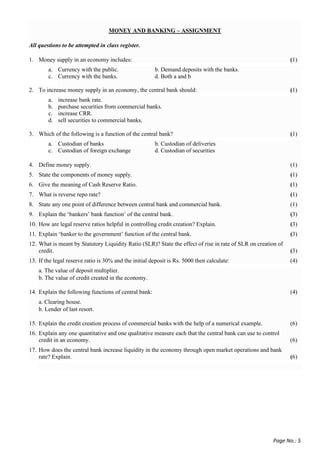
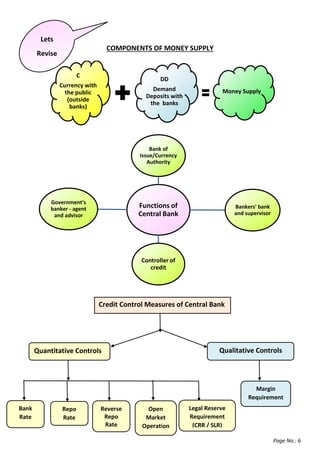
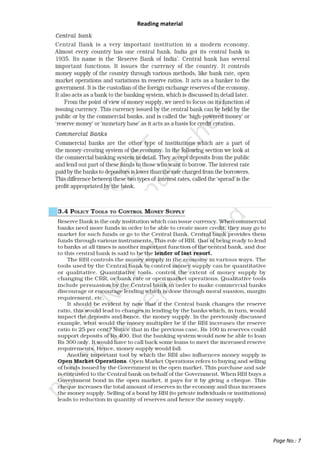
This document defines key concepts related to money, money supply, and banking in India. It discusses that money supply refers to the total stock of money held by the public at a given time, and includes currency and demand deposits. The central bank of India, called the Reserve Bank of India (RBI), acts as the banker, lender of last resort, and regulator of other commercial banks. It controls money supply through various instruments like bank rate, cash reserve ratio, and open market operations. Commercial banks accept deposits and provide loans, creating money through demand deposits, while the RBI issues currency and oversees the banking system.

![Page No.: 4
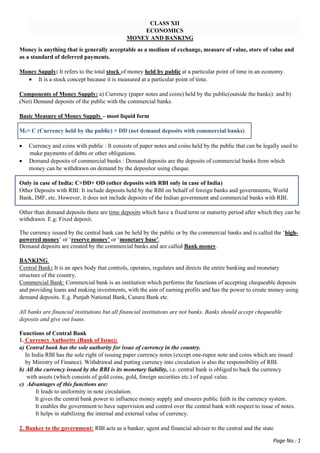
Money Multiplier / Credit creation by commercial banks
Credit creation refers to the process of creation of credit by the commercial banks with the help of an initial
deposit and given LRR.
Assumptions: a) The amount of initial deposit (assumed to be `1000)
b) The LRR or legal reserve ratio (assumed to be 20%)
Legal Reserve Ratio is the fraction of deposits that the banks have to keep compulsorily in the form of cash with the
central bank or designated liquid assets like govt securities with themselves. These may be in the form of CRR or
SLR.
Principle: a) All transactions are routed through the banks.
b) All banking system is treated as a single ‘Bank’
Working:
1) Suppose the initial deposits in the banks are Rs.1000. Since LRR is 20%, it means that the banks can lend out the
remaining 80% to the borrowers i.e. Rs 800. It does so by opening an account in the name of the borrower.
2) If the borrowers withdraw the entire amount and make payments using Rs.800. Since all transactions are routed
through the banks, the money comes back to the banks in the form of deposits by the receivers of this money. This
increases the deposits by Rs.800. Thus, the total credit created now increases to 1000 + 800 = Rs.1800.
3)The bank then uses the Rs.800 to lend after keeping reserves worth 20% i.e. Rs.160 and lends the remaining Rs.640
as fresh loans to borrowers which again comes back as deposits in the accounts of the receivers of this money. Hence
total credit created now equals Rs. 1000 + 800 + 640 = Rs.2440.
This continues and in each round, the deposit creation is 80% of the previous round. These increases become smaller
and smaller and continue till all of the initial deposit equals the total cash reserves.
Total value of deposits created = (1/LRR) initial deposit = (1/20% ) 1000 = 5 x 1000 = Rs. 5000.
Thus, the initial deposit get multiplied 5 times and hence the money multiplier is 1/LRR = 5.
Deposit Loans Reserves
1000 800 200
800 640 160
640 512 128
------ ----- ------
5000 4000 1000
Questions
Q1. How do banks create money? Or Explain the concept of credit creation by banks.
Q2. ‘The introduction of Jan Dhan Yojana has led to the addition of `1000 crores to the banking system.’ If it is believed that on
an average LRR is 25%, what will be the extent of money creation?
Q3. What is the value of credit created if LRR is 10% and the initial deposit is `100 crores? Explain with a numerical example.
Q4. Use a numerical example to show that the multiplier is inversely related to LRR. (Take two values of LRR and calculate the
value of final deposits created.)
Q5. Is there a limit to money or credit creation by banks? [Yes, CRR and SLR]
Note : Lower is the LRR, higher the money multiplier and more the money creation.
If the LRR = 0.1, the money multiplier is 10 (1/LRR=1/0.1) If the LRR is 0.4, the money multiplier is 2.5 (1/LRR=1/0.4)
Note on Demonetisation
Demonetisation was a new initiative taken by the Government of India in November 2016 to tackle the problem of corruption,
black money, terrorism and circulation of fake currency in the economy. Old currency notes of Rs 500 and Rs 1000 were no
longer legal tender. New currency notes in the denomination of Rs 500 and Rs 2000 were launched. The public were advised to
deposit old currency notes in their bank account till 31 December 2016 without any declaration and upto 31March 2017 with the
RBI with declaration.
Legal tender is money declared legal by a government or backed by law of the land. (can be legally used to make payments)](https://image.slidesharecdn.com/moneyandbankingnotesandvideolink-210916080932/85/Money-and-banking-notes-4-320.jpg)