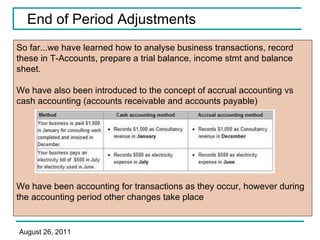
So far...we have learned how to analyse business transactions, record these in T-Accounts, prepare a trial balance, income stmt and balance sheet. We have also been introduced to the concept of accrual accounting vs cash accounting (accounts receivable and accounts payable) We have been accounting for transactions as they occur, however during the accounting period other changes take place End of Period Adjustments
Changes that take place during the accounting period  that have yet to be entered into the accounting system include: Pre-paid insurance is being used up Supplies are being used up  Equipment is wearing out Employees are earning wages that have not yet been paid As these events have not yet been recorded, adjusting entries must be made prior to the preparation of the financial statements. The  matching  principle in accounting requires that revenues earned during an accounting period are  matched  with expenses incurred in the production of that revenue. End of Period Adjustments cont..
The income stmt reports earnings for a specific time period (1qtr, 1yr etc) The balance sheet reports the assets, liabilities and owners equity on a specific date (as at 31 Dec 20xx) Therefore to follow the  matching principle,  accounts in the trial balance must be adjusted before financial statements are prepared. The matching principle
Assets are resources or items of value owned by the business which will generate  future income . Examples of assets include cash at bank, accounts receivable, buildings.. Assets are classified on a time basis (liquidity): Current Assets – those that will be consumed or converted into cash within the accounting period - normally 1 year Non Current Assets (also known as Fixed Assets) - those that will be held onto for a long period of time  Definition of an Asset
Current vs Non Current Assets               Balance Sheet         Current Assets: Within the financial year:     Cash - Expected to produce revenue     Accounts receivable - Can be used to meet short term / day to day obligations     Prepaid Insurance - Generally can be liquidated (converted to cash within 1 yr)     Inventories         Non Current Assets: (Fixed Assets)     Office Furniture - Tend to remain in the business for a longer period of time     Motor Vehicles - Indirectly generate income     Buildings - Can not be liquidated instantly for cash     Land - Suject to depreciation         Total Assets = Current + Non Current Assets              
Prepaid expenses A pre-paid expense occurs when a business pays for an item in advance and not all of the cost has been used at balance day. Example: - Prepaid Insurance A company pays an annual insurance bill up front - $1,200 The entries are: DR – Asset – Pre-paid Insurance $1,200 CR – Asset – Cash $1,200 Why is the asset debited? Does the insurance policy provide future benefit? The company prepares monthly accounts, how should we adjust prepaid insurance to accurately report the income stmt and balance sheet?
Prepaid expenses cont. Example: - Prepaid Insurance - Adjustment Since the premium covered 12 months, the cost of the expired coverage is $100 per month ($1,200 / 12 mths) The monthly adjusting entry is: DR – Expense – Insurance Expense $100 CR – Asset – Pre-paid Insurance $100 After 3 months, what will be the balance of prepaid insurance? & Insurance expense?
Prepaid expenses cont. Other examples of pre-paid expenses include: Rent paid in advance Supplies / Inventory / Stock remaining unused at the end of the period. Wages paid in advance Cash Prepaid Insurance Insurance Expense   (1,200) 1200 (100) 100     (100) 100     (100) 100   1200 (300)         balance (1,200) balance 900 300 balance
Non-current assets such as vehicles, equipment etc cannot be included as expenses in an income statement because they are not used up in one reporting period.  A delivery van for example will be useful to a company for a number of years, during which time it helps the company earn revenues by delivering goods. Under accrual accounting, revenue for a reporting period must be  Matched  with the relevant expenses for that period. Depreciation  is the process of allocating (or writing off) the cost of a non-current asset over its  useful life . What is Depreciation?
An assets  useful life  is the period of time that asset is expected to help produce revenues. Depreciation  is the recognition of a decline in value of an asset due to wear and tear. Depreciation  is an expense account.  When  depreciation  is recognized as an adjusting entry at the end of the accounting period, an expense is charged – a debit entry is made to depreciation expense. Where does the credit entry go? Adjusting Entries - Depreciation
Under the ‘historical cost’ principle, assets are recorded at their actual cost. (regardless of whether the firm got a good buy or over paid for them.) When we made an adjustment for pre-paid insurance, the asset accounts were credited to show that they had been consumed. However assets that are expected to provide future benefits for more than 1 yr require a different approach. The business must maintain a record of the actual cost of an asset.  The credit side of the adjusting entry therefore goes to an asset – contra account called  ‘Accumulated Depreciation’ Accumulated Depreciation
The depreciation adjusting entry is: DR Depreciation Expense (P/L) CR Accumulated Depreciation (B/S – contra asset account) Accumulated depreciation is also known as Provision for depreciation Accumulated Depreciation cont.. Balance Sheet   Income Statement           Assets:   Expenses:   Delivery Equipment 3,600 Depreciation Expense 100 less: Accumulated depreciation (100)     Net Book Value 3,500    
Balance Sheet with accumulated depreciation
Straight-line method  - the most common method of depreciating assets in financial statements  - the depreciation for each full year is the same amount. Example: On July 1, 2009 a company purchases equipment having a cost of $10,500. The company estimates that the equipment will have a useful life of 5 years. At the end of its useful life, the company expects to sell the equipment for $500. The company wants the depreciation to be reported evenly over the 5–year life. Calculating Depreciation Straight Line Depreciation: Original cost – Salvage Value = Depreciable Cost Depreciable Cost Estimated Useful Life = Depreciation Exp
If a company's accounting year ends on December 31, but the purchase of the asset was 1 July, what will the depreciation schedule look like? What is the cash outlay? How will the company report the depreciation expense on the company's income statement?  Why is depreciation expense regarded as a non-cash expense? Depreciation Example cont.
Depreciation Estimates Salvage Value  – can also be  referred to as disposal value, scrap  value, or residual value. This is the amount the company estimates it will receive on disposal of an asset at the end of its useful life. Often the salvage value can be zero. 2.  Useful life  - an estimate of how long the asset will be used (as opposed to how long the asset will last).  For example, a graphic artist might purchase a computer in 2009 and expects to replace it in 2011 with a more advanced computer.  Hence the graphic artist's computer will have an estimated  useful life of 2  yrs.  An accountant purchasing a similar computer in 2009 expects to use it until 2013. The accountant will use an estimated useful life of 4 yrs when computing depreciation.
Your turn Depreciation drill – Accounting Coach (do not do Q 12, Q 15 or Q 20) VCE – depn exercises 18.7 & 18.8 Richmond Rugs Exercise Chapter 5 – Book questions

Depreciation

  • 1.
    So far...we havelearned how to analyse business transactions, record these in T-Accounts, prepare a trial balance, income stmt and balance sheet. We have also been introduced to the concept of accrual accounting vs cash accounting (accounts receivable and accounts payable) We have been accounting for transactions as they occur, however during the accounting period other changes take place End of Period Adjustments
  • 2.
    Changes that takeplace during the accounting period that have yet to be entered into the accounting system include: Pre-paid insurance is being used up Supplies are being used up Equipment is wearing out Employees are earning wages that have not yet been paid As these events have not yet been recorded, adjusting entries must be made prior to the preparation of the financial statements. The matching principle in accounting requires that revenues earned during an accounting period are matched with expenses incurred in the production of that revenue. End of Period Adjustments cont..
  • 3.
    The income stmtreports earnings for a specific time period (1qtr, 1yr etc) The balance sheet reports the assets, liabilities and owners equity on a specific date (as at 31 Dec 20xx) Therefore to follow the matching principle, accounts in the trial balance must be adjusted before financial statements are prepared. The matching principle
  • 4.
    Assets are resourcesor items of value owned by the business which will generate future income . Examples of assets include cash at bank, accounts receivable, buildings.. Assets are classified on a time basis (liquidity): Current Assets – those that will be consumed or converted into cash within the accounting period - normally 1 year Non Current Assets (also known as Fixed Assets) - those that will be held onto for a long period of time Definition of an Asset
  • 5.
    Current vs NonCurrent Assets               Balance Sheet         Current Assets: Within the financial year:     Cash - Expected to produce revenue     Accounts receivable - Can be used to meet short term / day to day obligations     Prepaid Insurance - Generally can be liquidated (converted to cash within 1 yr)     Inventories         Non Current Assets: (Fixed Assets)     Office Furniture - Tend to remain in the business for a longer period of time     Motor Vehicles - Indirectly generate income     Buildings - Can not be liquidated instantly for cash     Land - Suject to depreciation         Total Assets = Current + Non Current Assets              
  • 6.
    Prepaid expenses Apre-paid expense occurs when a business pays for an item in advance and not all of the cost has been used at balance day. Example: - Prepaid Insurance A company pays an annual insurance bill up front - $1,200 The entries are: DR – Asset – Pre-paid Insurance $1,200 CR – Asset – Cash $1,200 Why is the asset debited? Does the insurance policy provide future benefit? The company prepares monthly accounts, how should we adjust prepaid insurance to accurately report the income stmt and balance sheet?
  • 7.
    Prepaid expenses cont.Example: - Prepaid Insurance - Adjustment Since the premium covered 12 months, the cost of the expired coverage is $100 per month ($1,200 / 12 mths) The monthly adjusting entry is: DR – Expense – Insurance Expense $100 CR – Asset – Pre-paid Insurance $100 After 3 months, what will be the balance of prepaid insurance? & Insurance expense?
  • 8.
    Prepaid expenses cont.Other examples of pre-paid expenses include: Rent paid in advance Supplies / Inventory / Stock remaining unused at the end of the period. Wages paid in advance Cash Prepaid Insurance Insurance Expense   (1,200) 1200 (100) 100     (100) 100     (100) 100   1200 (300)         balance (1,200) balance 900 300 balance
  • 9.
    Non-current assets suchas vehicles, equipment etc cannot be included as expenses in an income statement because they are not used up in one reporting period. A delivery van for example will be useful to a company for a number of years, during which time it helps the company earn revenues by delivering goods. Under accrual accounting, revenue for a reporting period must be Matched with the relevant expenses for that period. Depreciation is the process of allocating (or writing off) the cost of a non-current asset over its useful life . What is Depreciation?
  • 10.
    An assets useful life is the period of time that asset is expected to help produce revenues. Depreciation is the recognition of a decline in value of an asset due to wear and tear. Depreciation is an expense account. When depreciation is recognized as an adjusting entry at the end of the accounting period, an expense is charged – a debit entry is made to depreciation expense. Where does the credit entry go? Adjusting Entries - Depreciation
  • 11.
    Under the ‘historicalcost’ principle, assets are recorded at their actual cost. (regardless of whether the firm got a good buy or over paid for them.) When we made an adjustment for pre-paid insurance, the asset accounts were credited to show that they had been consumed. However assets that are expected to provide future benefits for more than 1 yr require a different approach. The business must maintain a record of the actual cost of an asset. The credit side of the adjusting entry therefore goes to an asset – contra account called ‘Accumulated Depreciation’ Accumulated Depreciation
  • 12.
    The depreciation adjustingentry is: DR Depreciation Expense (P/L) CR Accumulated Depreciation (B/S – contra asset account) Accumulated depreciation is also known as Provision for depreciation Accumulated Depreciation cont.. Balance Sheet   Income Statement           Assets:   Expenses:   Delivery Equipment 3,600 Depreciation Expense 100 less: Accumulated depreciation (100)     Net Book Value 3,500    
  • 13.
    Balance Sheet withaccumulated depreciation
  • 14.
    Straight-line method - the most common method of depreciating assets in financial statements - the depreciation for each full year is the same amount. Example: On July 1, 2009 a company purchases equipment having a cost of $10,500. The company estimates that the equipment will have a useful life of 5 years. At the end of its useful life, the company expects to sell the equipment for $500. The company wants the depreciation to be reported evenly over the 5–year life. Calculating Depreciation Straight Line Depreciation: Original cost – Salvage Value = Depreciable Cost Depreciable Cost Estimated Useful Life = Depreciation Exp
  • 15.
    If a company'saccounting year ends on December 31, but the purchase of the asset was 1 July, what will the depreciation schedule look like? What is the cash outlay? How will the company report the depreciation expense on the company's income statement? Why is depreciation expense regarded as a non-cash expense? Depreciation Example cont.
  • 16.
    Depreciation Estimates SalvageValue – can also be referred to as disposal value, scrap value, or residual value. This is the amount the company estimates it will receive on disposal of an asset at the end of its useful life. Often the salvage value can be zero. 2. Useful life - an estimate of how long the asset will be used (as opposed to how long the asset will last). For example, a graphic artist might purchase a computer in 2009 and expects to replace it in 2011 with a more advanced computer. Hence the graphic artist's computer will have an estimated useful life of 2 yrs. An accountant purchasing a similar computer in 2009 expects to use it until 2013. The accountant will use an estimated useful life of 4 yrs when computing depreciation.
  • 17.
    Your turn Depreciationdrill – Accounting Coach (do not do Q 12, Q 15 or Q 20) VCE – depn exercises 18.7 & 18.8 Richmond Rugs Exercise Chapter 5 – Book questions