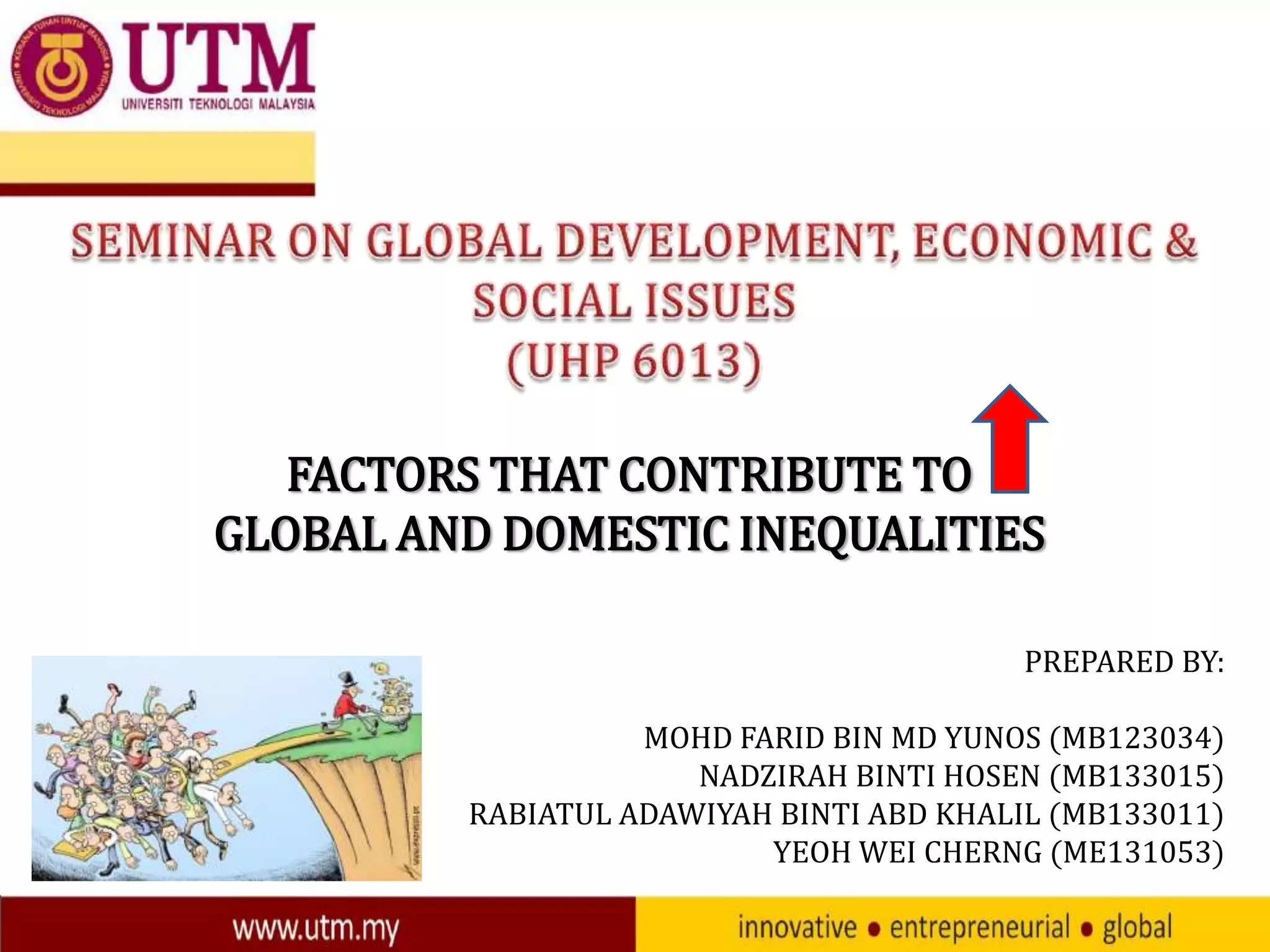

FACTORS THAT CONTRIBUTE TO
GLOBAL AND DOMESTIC INEQUALITIES
PREPARED BY:
MOHD FARID BIN MD YUNOS (MB123034)
NADZIRAH BINTI HOSEN (MB133015)
RABIATUL ADAWIYAH BINTI ABD KHALIL (MB133011)
YEOH WEI CHERNG (ME131053)
•
•
•
•

Introduction
Dependency theory
Dependency theory and global inequality
Factors that contribute to domestic and global
inequalities.
• Case Studies
• Conclusion
 The emergence of global inequality as a theme implies a horizon that is
global and adopts human equality as a norm. Equality as a general
sensibility arose with liberalism and socialism. (Franklin, 1997)
 As a theme global inequality goes back by and large to the midtwentieth century. As a global sensibility it is part of the postwar era
shaped by the United Nations and the adoption of the Universal
Declaration of Human Rights. UN agencies such as the UNDP, UNRISD,
UNICEF and UNESCO have done much to monitor world-scale
inequality. (Nederveen, 2002)
 Global inequality evokes what has been termed the ‘second great
transformation’, the transformation from national market capitalism to
global capitalism.
 Inequality is generally used to refer to income. However, income
inequality is not a comprehensive way to look at inequality. In fact,
there are other aspects such as financial and land assets, or health and
education, which should be taken into account. It may be argued that
investigating income inequality is nonetheless quite effective because
it is strictly correlated with other inequalities in areas such as land and
education. (World Bank, 2000)

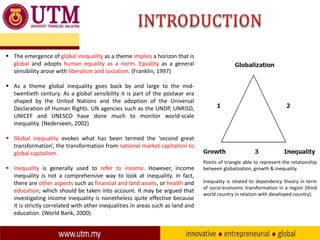
Points of triangle able to represent the relationship
between globalization, growth & inequality.
Inequality is related to dependency theory in term
of socio-economic transformation in a region (third
world country in relation with developed country).
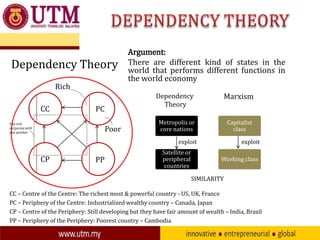
Dependency Theory
Rich
CC

Dependency
Theory

PC

The rich
corporate with
one another

Argument:
There are different kind of states in the
world that performs different functions in
the world economy

Poor

Marxism

Metropolis or
core nations

Capitalist
class

exploit

CP

PP

Satellite or
peripheral
countries

exploit
Working class

SIMILARITY
CC – Centre of the Centre: The richest most & powerful country - US, UK, France
PC – Periphery of the Centre: Industrialized wealthy country – Canada, Japan
CP – Centre of the Periphery: Still developing but they have fair amount of wealth – India, Brazil
PP – Periphery of the Periphery: Poorest country – Cambodia
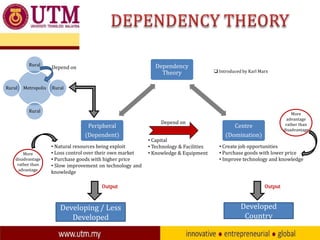
Rural

Rural

Metropolis

Dependency
Theory

Depend on

 Introduced by Karl Marx

Rural

Rural

Peripheral
(Dependent)
More
disadvantage
rather than
advantage

• Natural resources being exploit
• Loss control over their own market
• Purchase goods with higher price
• Slow improvement on technology and
knowledge
Output

Developing / Less
Developed

Depend on
• Capital
• Technology & Facilities
• Knowledge & Equipment

More
advantage
rather than
disadvantage

Centre
(Domination)

• Create job opportunities
• Purchase goods with lower price
• Improve technology and knowledge

Output

Developed
Country
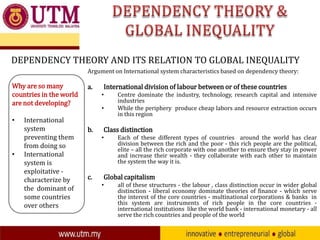
DEPENDENCY THEORY AND ITS RELATION TO GLOBAL INEQUALITY
Argument on International system characteristics based on dependency theory:

Why are so many
countries in the world
are not developing?
•

•

International
system
preventing them
from doing so
International
system is
exploitative characterize by
the dominant of
some countries
over others

a.

International division of labour between or of these countries
•
•

b.

Class distinction
•

c.

Centre dominate the industry, technology, research capital and intensive
industries
While the periphery produce cheap labors and resource extraction occurs
in this region

Each of these different types of countries around the world has clear
division between the rich and the poor - this rich people are the political,
elite – all the rich corporate with one another to ensure they stay in power
and increase their wealth - they collaborate with each other to maintain
the system the way it is.

Global capitalism
•

all of these structures - the labour , class distinction occur in wider global
distinction - liberal economy dominate theories of finance - which serve
the interest of the core countries - multinational corporations & banks in
this system are instruments of rich people in the core countries international institutions like the world bank - international monetary - all
serve the rich countries and people of the world
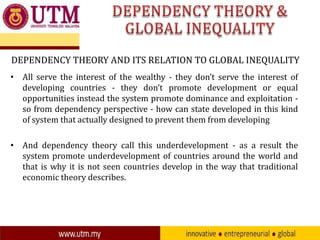
DEPENDENCY THEORY AND ITS RELATION TO GLOBAL INEQUALITY
• All serve the interest of the wealthy - they don’t serve the interest of
developing countries - they don’t promote development or equal
opportunities instead the system promote dominance and exploitation so from dependency perspective - how can state developed in this kind
of system that actually designed to prevent them from developing
• And dependency theory call this underdevelopment - as a result the
system promote underdevelopment of countries around the world and
that is why it is not seen countries develop in the way that traditional
economic theory describes.
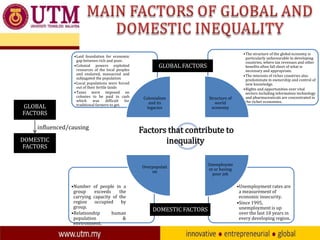
GLOBAL
FACTORS

•Laid foundation for economic
gap between rich and poor.
•Colonial powers exploited
resources of the local peoples
and enslaved, massacred and
subjugated the population
•Local populations were forced
out of their fertile lands
•Taxes were imposed on
colonies to be paid in cash
which was difficult for
traditional farmers to get.

influenced/causing
DOMESTIC
FACTORS

GLOBAL FACTORS

Colonialism
and its
legacies

Factors that contribute to
inequality
Overpopulati
on

•Number of people in a
group
exceeds
the
carrying capacity of the
region
occupied
by
group.
•Relationship
human
population
&
environment.

Structure of
world
economy

•The structure of the global economy is
particularly unfavourable to developing
countries, where tax revenues and other
benefits often fall short of what is
necessary and appropriate.
•The interests of richer countries also
predominate in ownership and control of
new knowledge.
•Rights and opportunities over vital
sectors including information technology
and pharmaceuticals are concentrated in
the richer economies.

Unemployme
nt or having
poor job

DOMESTIC FACTORS

•Unemployment rates are
a measurement of
economic insecurity.
•Since 1995,
unemployment is up
over the last 10 years in
every developing region.
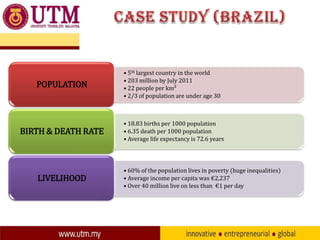
POPULATION

• 5th largest country in the world
• 203 million by July 2011
• 22 people per km²
• 2/3 of population are under age 30

BIRTH & DEATH RATE

• 18.83 births per 1000 population
• 6.35 death per 1000 population
• Average life expectancy is 72.6 years

LIVELIHOOD

• 60% of the population lives in poverty (huge inequalities)
• Average income per capita was €2,237
• Over 40 million live on less than €1 per day
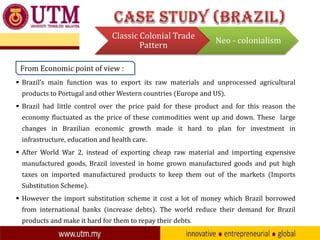
Classic Colonial Trade
Pattern

Neo - colonialism

From Economic point of view :
 Brazil’s main function was to export its raw materials and unprocessed agricultural
products to Portugal and other Western countries (Europe and US).
 Brazil had little control over the price paid for these product and for this reason the
economy fluctuated as the price of these commodities went up and down. These large
changes in Brazilian economic growth made it hard to plan for investment in

infrastructure, education and health care.
 After World War 2, instead of exporting cheap raw material and importing expensive
manufactured goods, Brazil invested in home grown manufactured goods and put high
taxes on imported manufactured products to keep them out of the markets (Imports
Substitution Scheme).
 However the import substitution scheme it cost a lot of money which Brazil borrowed
from international banks (increase debts). The world reduce their demand for Brazil
products and make it hard for them to repay their debts.
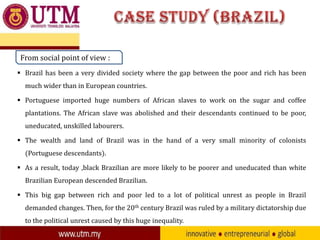
From social point of view :
 Brazil has been a very divided society where the gap between the poor and rich has been

much wider than in European countries.
 Portuguese imported huge numbers of African slaves to work on the sugar and coffee
plantations. The African slave was abolished and their descendants continued to be poor,
uneducated, unskilled labourers.

 The wealth and land of Brazil was in the hand of a very small minority of colonists
(Portuguese descendants).
 As a result, today ,black Brazilian are more likely to be poorer and uneducated than white
Brazilian European descended Brazilian.

 This big gap between rich and poor led to a lot of political unrest as people in Brazil
demanded changes. Then, for the 20th century Brazil was ruled by a military dictatorship due
to the political unrest caused by this huge inequality.
 Thus, based on above statement and case study, the critiques of
dependency theory can be leveled within a nation (Domestic) as well as
internationally (Global).
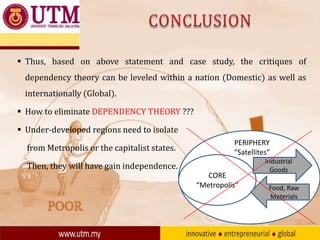
 How to eliminate DEPENDENCY THEORY ???
 Under-developed regions need to isolate
from Metropolis or the capitalist states.

PERIPHERY
“Satellites”

Then, they will have gain independence.
CORE
“Metropolis”

Industrial
Goods

Food, Raw
Materials
 Ahmad Shukri Mohd Nain dan Rosman Md. Yusoff (2003), Konsep, Teori, Dimensi & Isu Pembangunan,
Universiti Teknologi Malaysia Skudai, Johor
 Yves Keller, Inequality and Economic Growth in Brazil, Bachelor’s Thesis, Department of Economics in
University of Zurich
 Franklin, J (ed) (1997) Equality (London: Institute for Public Policy Research).
 Nederveen Pieterse, J (2002b), Globalization, kitsch and conflict: Technologies Of Work, War And Politic,
Review of International Political Economy, 9 (1), pp 1–36.
 World Bank (2000) A Better World for All (Washington, DC: World Bank).
Global Inequality-Theory and Factors

Global Inequality-Theory and Factors

  • 1.
    FACTORS THAT CONTRIBUTETO GLOBAL AND DOMESTIC INEQUALITIES PREPARED BY: MOHD FARID BIN MD YUNOS (MB123034) NADZIRAH BINTI HOSEN (MB133015) RABIATUL ADAWIYAH BINTI ABD KHALIL (MB133011) YEOH WEI CHERNG (ME131053)
  • 2.
    • • • • Introduction Dependency theory Dependency theoryand global inequality Factors that contribute to domestic and global inequalities. • Case Studies • Conclusion
  • 3.
     The emergenceof global inequality as a theme implies a horizon that is global and adopts human equality as a norm. Equality as a general sensibility arose with liberalism and socialism. (Franklin, 1997)  As a theme global inequality goes back by and large to the midtwentieth century. As a global sensibility it is part of the postwar era shaped by the United Nations and the adoption of the Universal Declaration of Human Rights. UN agencies such as the UNDP, UNRISD, UNICEF and UNESCO have done much to monitor world-scale inequality. (Nederveen, 2002)  Global inequality evokes what has been termed the ‘second great transformation’, the transformation from national market capitalism to global capitalism.  Inequality is generally used to refer to income. However, income inequality is not a comprehensive way to look at inequality. In fact, there are other aspects such as financial and land assets, or health and education, which should be taken into account. It may be argued that investigating income inequality is nonetheless quite effective because it is strictly correlated with other inequalities in areas such as land and education. (World Bank, 2000) Points of triangle able to represent the relationship between globalization, growth & inequality. Inequality is related to dependency theory in term of socio-economic transformation in a region (third world country in relation with developed country).
  • 4.
    Dependency Theory Rich CC Dependency Theory PC The rich corporatewith one another Argument: There are different kind of states in the world that performs different functions in the world economy Poor Marxism Metropolis or core nations Capitalist class exploit CP PP Satellite or peripheral countries exploit Working class SIMILARITY CC – Centre of the Centre: The richest most & powerful country - US, UK, France PC – Periphery of the Centre: Industrialized wealthy country – Canada, Japan CP – Centre of the Periphery: Still developing but they have fair amount of wealth – India, Brazil PP – Periphery of the Periphery: Poorest country – Cambodia
  • 5.
    Rural Rural Metropolis Dependency Theory Depend on  Introducedby Karl Marx Rural Rural Peripheral (Dependent) More disadvantage rather than advantage • Natural resources being exploit • Loss control over their own market • Purchase goods with higher price • Slow improvement on technology and knowledge Output Developing / Less Developed Depend on • Capital • Technology & Facilities • Knowledge & Equipment More advantage rather than disadvantage Centre (Domination) • Create job opportunities • Purchase goods with lower price • Improve technology and knowledge Output Developed Country
  • 6.
    DEPENDENCY THEORY ANDITS RELATION TO GLOBAL INEQUALITY Argument on International system characteristics based on dependency theory: Why are so many countries in the world are not developing? • • International system preventing them from doing so International system is exploitative characterize by the dominant of some countries over others a. International division of labour between or of these countries • • b. Class distinction • c. Centre dominate the industry, technology, research capital and intensive industries While the periphery produce cheap labors and resource extraction occurs in this region Each of these different types of countries around the world has clear division between the rich and the poor - this rich people are the political, elite – all the rich corporate with one another to ensure they stay in power and increase their wealth - they collaborate with each other to maintain the system the way it is. Global capitalism • all of these structures - the labour , class distinction occur in wider global distinction - liberal economy dominate theories of finance - which serve the interest of the core countries - multinational corporations & banks in this system are instruments of rich people in the core countries international institutions like the world bank - international monetary - all serve the rich countries and people of the world
  • 7.
    DEPENDENCY THEORY ANDITS RELATION TO GLOBAL INEQUALITY • All serve the interest of the wealthy - they don’t serve the interest of developing countries - they don’t promote development or equal opportunities instead the system promote dominance and exploitation so from dependency perspective - how can state developed in this kind of system that actually designed to prevent them from developing • And dependency theory call this underdevelopment - as a result the system promote underdevelopment of countries around the world and that is why it is not seen countries develop in the way that traditional economic theory describes.
  • 8.
    GLOBAL FACTORS •Laid foundation foreconomic gap between rich and poor. •Colonial powers exploited resources of the local peoples and enslaved, massacred and subjugated the population •Local populations were forced out of their fertile lands •Taxes were imposed on colonies to be paid in cash which was difficult for traditional farmers to get. influenced/causing DOMESTIC FACTORS GLOBAL FACTORS Colonialism and its legacies Factors that contribute to inequality Overpopulati on •Number of people in a group exceeds the carrying capacity of the region occupied by group. •Relationship human population & environment. Structure of world economy •The structure of the global economy is particularly unfavourable to developing countries, where tax revenues and other benefits often fall short of what is necessary and appropriate. •The interests of richer countries also predominate in ownership and control of new knowledge. •Rights and opportunities over vital sectors including information technology and pharmaceuticals are concentrated in the richer economies. Unemployme nt or having poor job DOMESTIC FACTORS •Unemployment rates are a measurement of economic insecurity. •Since 1995, unemployment is up over the last 10 years in every developing region.
  • 9.
    POPULATION • 5th largestcountry in the world • 203 million by July 2011 • 22 people per km² • 2/3 of population are under age 30 BIRTH & DEATH RATE • 18.83 births per 1000 population • 6.35 death per 1000 population • Average life expectancy is 72.6 years LIVELIHOOD • 60% of the population lives in poverty (huge inequalities) • Average income per capita was €2,237 • Over 40 million live on less than €1 per day
  • 10.
    Classic Colonial Trade Pattern Neo- colonialism From Economic point of view :  Brazil’s main function was to export its raw materials and unprocessed agricultural products to Portugal and other Western countries (Europe and US).  Brazil had little control over the price paid for these product and for this reason the economy fluctuated as the price of these commodities went up and down. These large changes in Brazilian economic growth made it hard to plan for investment in infrastructure, education and health care.  After World War 2, instead of exporting cheap raw material and importing expensive manufactured goods, Brazil invested in home grown manufactured goods and put high taxes on imported manufactured products to keep them out of the markets (Imports Substitution Scheme).  However the import substitution scheme it cost a lot of money which Brazil borrowed from international banks (increase debts). The world reduce their demand for Brazil products and make it hard for them to repay their debts.
  • 11.
    From social pointof view :  Brazil has been a very divided society where the gap between the poor and rich has been much wider than in European countries.  Portuguese imported huge numbers of African slaves to work on the sugar and coffee plantations. The African slave was abolished and their descendants continued to be poor, uneducated, unskilled labourers.  The wealth and land of Brazil was in the hand of a very small minority of colonists (Portuguese descendants).  As a result, today ,black Brazilian are more likely to be poorer and uneducated than white Brazilian European descended Brazilian.  This big gap between rich and poor led to a lot of political unrest as people in Brazil demanded changes. Then, for the 20th century Brazil was ruled by a military dictatorship due to the political unrest caused by this huge inequality.
  • 12.
     Thus, basedon above statement and case study, the critiques of dependency theory can be leveled within a nation (Domestic) as well as internationally (Global).  How to eliminate DEPENDENCY THEORY ???  Under-developed regions need to isolate from Metropolis or the capitalist states. PERIPHERY “Satellites” Then, they will have gain independence. CORE “Metropolis” Industrial Goods Food, Raw Materials
  • 13.
     Ahmad ShukriMohd Nain dan Rosman Md. Yusoff (2003), Konsep, Teori, Dimensi & Isu Pembangunan, Universiti Teknologi Malaysia Skudai, Johor  Yves Keller, Inequality and Economic Growth in Brazil, Bachelor’s Thesis, Department of Economics in University of Zurich  Franklin, J (ed) (1997) Equality (London: Institute for Public Policy Research).  Nederveen Pieterse, J (2002b), Globalization, kitsch and conflict: Technologies Of Work, War And Politic, Review of International Political Economy, 9 (1), pp 1–36.  World Bank (2000) A Better World for All (Washington, DC: World Bank).

Editor's Notes

  • #5 f
  • #6 f
  • #7 f
  • #8 f
  • #10 Brazil is a country with reasonable levels of economic development, but serious shortcomings in the social sphere. The Human Development Report, published in 2002 by the United Nations development program, puts Brazil in the 73rd place in the overall ranking of social development. With 7.6 thousand dollar per capita, it ranked 59th on income, but lagged behind in indicators such as infant mortality and literacy. Brazil is also supposed to have one of the worse income distribution in the world (United Nation Development Programme (UNDP) 2002).
  • #11 Brazil was used as a cheap source of raw material, especially agricultural raw material such as sugar cane, tobacco, coffee and timber. Brazil had little control over the price paid for these product and for this reason the economy fluctuated as the price of these commodities went up and down. Most of the export went to Portugal and other Western Countries (Europe and US). Here the raw materials were processed, which created jobs in these countries and added value to the products, which benefitted the developed countries. Brazil did not benefit from this type of trade as its export cheaply and then had to buy expensive manufactured goods from rich developed countries. This kind of trade are known as Classic Colonial Trade Pattern and after independence, economist called it as Neo-colonialism. By the 1970s these high debts become major problem for Brazil as a world recession reduced demand for Brazil’s products and it was unable to repay these debts.
  • #12  Colonialism also affected the population of Brazil. Even when slavery was abolished the descendants of these people continued to be poor and uneducated laborers. As a result, today ,black Brazilian are more likely to be poorer and uneducated than white Brazilian European descended Brazilian. This big gap between rich and poor led to a lot of political unrest as people in Brazil demanded changes. Then, for the 20th century Brazil was ruled by a military dictatorship due to the political unrest caused by this huge inequality.