1
WELCOME
2
Course Name : International Development
Instructor : Anik Datta
Lecturer
Department of International
Relations
Bangladesh Military Academy
TODAY’S TOPIC
 DEPENDENCY THEORY
3
OBJECTIVES
• To learn about the Dependency theory
• To figure out about the origins of Dependency theory
• Learn about the characteristics of Dependency theory
• Learn about the importance of Dependency theory in
current world.
4
DEPENDENCY THEORY
Dependency theory is a sociological theory which holds
that economic events in history have encouraged developing
countries to depend upon the support of more advanced
nations. Dependency theory explains that underdeveloped
nations enrich advanced countries with resources at their own
expense.
5
DEPENDENCY THEORY
Dependency Theory emerged as a prominent critique of
mainstream development theories in the mid-20th century. It
offered an alternative perspective on the global economic
system, highlighting the structural inequalities perpetuated
by the relationship between core and peripheral nations.
6
First proposed in the late 1950s by the Argentine economist
and statesman Raúl Prebisch, dependency theory gained
prominence in the 1960s and '70s.
7
ORIGINS
8
Dependency Theory originated in the 1950s and 1960s as a
response to the limitations of modernization theory and its
failure to explain persistent underdevelopment in many
countries.
Scholars from Latin America, notably Raul Prebisch,
Fernando Cardoso, and Andre Gunder Frank, played
pivotal roles in developing Dependency Theory. These
intellectuals observed that despite efforts at modernization,
many countries remained locked in a cycle of poverty and
underdevelopment.
9
CHARACTERISTICS
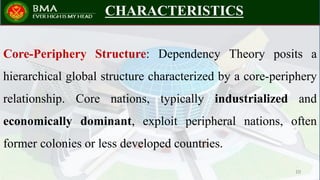
Core-Periphery Structure: Dependency Theory posits a
hierarchical global structure characterized by a core-periphery
relationship. Core nations, typically industrialized and
economically dominant, exploit peripheral nations, often
former colonies or less developed countries.
10
11
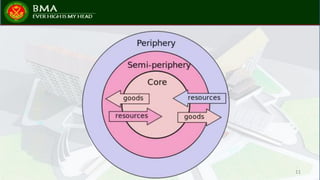
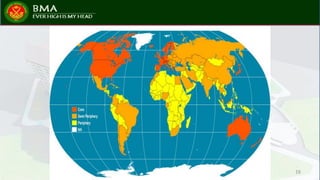
CORE
• Dominant Capitalist Countries
• Exploit Peripheral Countries for labor and raw
materials
• US, Canada, Most of Western Europe, Japan,
Australia and New Zealand.
• Population: Average , Wealthiest, Best
Educated 12
SEMI PERIPHERY
• They share both characteristics of core and periphery
countries.
• Newly industrialized countries.
• They contribute to the manufacturing and exportation of a
variety of goods.
• Above average land mass.
• E.g. Argentina, China, India, Brazil, Mexico, Indonesia and
Iran
13
PERIPHERY
• Countries who are less developed than the semi periphery
and core countries.
• Dependent on core for capital
• Underdeveloped industry
• E.g. Bangladesh, China, Congo
14
Unequal Exchange: Dependency theorists emphasize the
unequal exchange of resources between core and peripheral
nations. This exchange, they argue, is skewed in favor of the
core, resulting in a net transfer of wealth from the periphery to
the core.
15
16
External Dependency: Peripheral nations become dependent
on the core for capital, technology, and market access. This
dependency perpetuates underdevelopment by limiting the
peripheral countries' ability to develop independently.
17
Historical Context: Dependency Theory underscores the
historical roots of global inequality, particularly colonialism
and imperialism. The exploitation and extraction of resources
during colonial rule laid the groundwork for the unequal
relations between core and peripheral nations.
18
Structural Transformation: Dependency theorists advocate
for structural transformation within peripheral nations to
break free from dependency. This involves reducing reliance
on exports of raw materials, promoting domestic industries,
and challenging the dominance of multinational corporations.
19
KEY IDEAS
• Rejects the modernization theory- problems are imposed on
the Third world not in them.
• Capitalism is based on exploitation and that is not ok.
• The reason these places are poor and under-developed are
because of the structure of exploitation, Capitalism and
world trade.
• Rich countries benefits from under-developed ones, by
means of cheap labor and raw materials 20
CRITIQUE
Simplistic Dichotomy: Critics argue that Dependency Theory
oversimplifies the global economic system by reducing it to a
binary division between core and periphery. In reality, the
global economy is more complex, with diverse economic
relationships between nations.
21
Neglect of Internal Factors: Dependency Theory tends to
overlook internal factors such as governance, institutions, and
cultural dynamics that influence development outcomes within
nations. Focusing solely on external forces may neglect the
importance of domestic policies in promoting development.
22
Limited Policy Prescriptions: While Dependency Theory
identifies structural inequalities, it offers limited guidance
on practical policy interventions to address these issues.
Critics contend that its focus on external constraints obscures
the potential for autonomous development strategies within
peripheral nations.
23
24
Neglect of Agency: Dependency Theory sometimes neglects
the agency of peripheral nations in shaping their development
trajectories. While acknowledging external constraints, it
may underestimate the potential for domestic actors to pursue
alternative paths to development.
• Relevance of Dependency Theory in the
Present World
25
Globalization and Inequality: In an era of globalization,
Dependency Theory provides insights into the persisting
inequalities between nations. The concentration of wealth and
power in core nations continues to marginalize peripheral
economies, exacerbating global inequality.
26
Neocolonialism and Exploitation: Dependency theorists
argue that neocolonial structures perpetuate exploitation and
dependency in the global South. The dominance of
multinational corporations and international financial
institutions reflects enduring power imbalances rooted in
colonial history.
27
Alternative Development Paradigms: Dependency Theory
has inspired alternative development paradigms that prioritize
self-reliance, equitable trade relations, and grassroots
empowerment. These ideas resonate with movements
advocating for economic justice, decolonization, and
sustainable development.
28
Environmental Degradation: Dependency Theory's
emphasis on extractive industries and environmental
degradation remains pertinent in the context of climate
change. Peripheral nations often bear the brunt of
environmental destruction caused by global economic
activities driven by core nations.
29
CONCLUSION
In conclusion, Dependency Theory serves as a critical lens
through which to analyze the dynamics of global inequality
and underdevelopment. By recognizing the historical
legacies and structural constraints that shape the global
economic order, policymakers and scholars can work towards
more equitable and sustainable development pathways for all
nations. 30
SUMMARY
Dependency Theory offers valuable insights into the structural
inequalities embedded within the global economic system. While subject
to critique, its emphasis on historical context, unequal exchange, and
structural transformation continues to inform debates on development
and global justice. As we navigate the complexities of the modern world,
understanding Dependency Theory enriches our perspective on the
challenges of achieving inclusive and sustainable development.
31
QUESTIONS
1. Define the theory Dependency?
2. Why is it called the Dependency theory?
3. Is it relevant in current world? Give justification of your
answer.
32
HOME TASK
• Make notes on the differences between
Modernization theory and Dependency theory?
33
34
THANK YOU

DEPENDENCY theory International Relations.pptx

  • 1.
  • 2.
    2 Course Name :International Development Instructor : Anik Datta Lecturer Department of International Relations Bangladesh Military Academy
  • 3.
  • 4.
    OBJECTIVES • To learnabout the Dependency theory • To figure out about the origins of Dependency theory • Learn about the characteristics of Dependency theory • Learn about the importance of Dependency theory in current world. 4
  • 5.
    DEPENDENCY THEORY Dependency theoryis a sociological theory which holds that economic events in history have encouraged developing countries to depend upon the support of more advanced nations. Dependency theory explains that underdeveloped nations enrich advanced countries with resources at their own expense. 5
  • 6.
    DEPENDENCY THEORY Dependency Theoryemerged as a prominent critique of mainstream development theories in the mid-20th century. It offered an alternative perspective on the global economic system, highlighting the structural inequalities perpetuated by the relationship between core and peripheral nations. 6
  • 7.
    First proposed inthe late 1950s by the Argentine economist and statesman Raúl Prebisch, dependency theory gained prominence in the 1960s and '70s. 7
  • 8.
    ORIGINS 8 Dependency Theory originatedin the 1950s and 1960s as a response to the limitations of modernization theory and its failure to explain persistent underdevelopment in many countries.
  • 9.
    Scholars from LatinAmerica, notably Raul Prebisch, Fernando Cardoso, and Andre Gunder Frank, played pivotal roles in developing Dependency Theory. These intellectuals observed that despite efforts at modernization, many countries remained locked in a cycle of poverty and underdevelopment. 9
  • 10.
    CHARACTERISTICS Core-Periphery Structure: DependencyTheory posits a hierarchical global structure characterized by a core-periphery relationship. Core nations, typically industrialized and economically dominant, exploit peripheral nations, often former colonies or less developed countries. 10
  • 11.
  • 12.
    CORE • Dominant CapitalistCountries • Exploit Peripheral Countries for labor and raw materials • US, Canada, Most of Western Europe, Japan, Australia and New Zealand. • Population: Average , Wealthiest, Best Educated 12
  • 13.
    SEMI PERIPHERY • Theyshare both characteristics of core and periphery countries. • Newly industrialized countries. • They contribute to the manufacturing and exportation of a variety of goods. • Above average land mass. • E.g. Argentina, China, India, Brazil, Mexico, Indonesia and Iran 13
  • 14.
    PERIPHERY • Countries whoare less developed than the semi periphery and core countries. • Dependent on core for capital • Underdeveloped industry • E.g. Bangladesh, China, Congo 14
  • 15.
    Unequal Exchange: Dependencytheorists emphasize the unequal exchange of resources between core and peripheral nations. This exchange, they argue, is skewed in favor of the core, resulting in a net transfer of wealth from the periphery to the core. 15
  • 16.
  • 17.
    External Dependency: Peripheralnations become dependent on the core for capital, technology, and market access. This dependency perpetuates underdevelopment by limiting the peripheral countries' ability to develop independently. 17
  • 18.
    Historical Context: DependencyTheory underscores the historical roots of global inequality, particularly colonialism and imperialism. The exploitation and extraction of resources during colonial rule laid the groundwork for the unequal relations between core and peripheral nations. 18
  • 19.
    Structural Transformation: Dependencytheorists advocate for structural transformation within peripheral nations to break free from dependency. This involves reducing reliance on exports of raw materials, promoting domestic industries, and challenging the dominance of multinational corporations. 19
  • 20.
    KEY IDEAS • Rejectsthe modernization theory- problems are imposed on the Third world not in them. • Capitalism is based on exploitation and that is not ok. • The reason these places are poor and under-developed are because of the structure of exploitation, Capitalism and world trade. • Rich countries benefits from under-developed ones, by means of cheap labor and raw materials 20
  • 21.
    CRITIQUE Simplistic Dichotomy: Criticsargue that Dependency Theory oversimplifies the global economic system by reducing it to a binary division between core and periphery. In reality, the global economy is more complex, with diverse economic relationships between nations. 21
  • 22.
    Neglect of InternalFactors: Dependency Theory tends to overlook internal factors such as governance, institutions, and cultural dynamics that influence development outcomes within nations. Focusing solely on external forces may neglect the importance of domestic policies in promoting development. 22
  • 23.
    Limited Policy Prescriptions:While Dependency Theory identifies structural inequalities, it offers limited guidance on practical policy interventions to address these issues. Critics contend that its focus on external constraints obscures the potential for autonomous development strategies within peripheral nations. 23
  • 24.
    24 Neglect of Agency:Dependency Theory sometimes neglects the agency of peripheral nations in shaping their development trajectories. While acknowledging external constraints, it may underestimate the potential for domestic actors to pursue alternative paths to development.
  • 25.
    • Relevance ofDependency Theory in the Present World 25
  • 26.
    Globalization and Inequality:In an era of globalization, Dependency Theory provides insights into the persisting inequalities between nations. The concentration of wealth and power in core nations continues to marginalize peripheral economies, exacerbating global inequality. 26
  • 27.
    Neocolonialism and Exploitation:Dependency theorists argue that neocolonial structures perpetuate exploitation and dependency in the global South. The dominance of multinational corporations and international financial institutions reflects enduring power imbalances rooted in colonial history. 27
  • 28.
    Alternative Development Paradigms:Dependency Theory has inspired alternative development paradigms that prioritize self-reliance, equitable trade relations, and grassroots empowerment. These ideas resonate with movements advocating for economic justice, decolonization, and sustainable development. 28
  • 29.
    Environmental Degradation: DependencyTheory's emphasis on extractive industries and environmental degradation remains pertinent in the context of climate change. Peripheral nations often bear the brunt of environmental destruction caused by global economic activities driven by core nations. 29
  • 30.
    CONCLUSION In conclusion, DependencyTheory serves as a critical lens through which to analyze the dynamics of global inequality and underdevelopment. By recognizing the historical legacies and structural constraints that shape the global economic order, policymakers and scholars can work towards more equitable and sustainable development pathways for all nations. 30
  • 31.
    SUMMARY Dependency Theory offersvaluable insights into the structural inequalities embedded within the global economic system. While subject to critique, its emphasis on historical context, unequal exchange, and structural transformation continues to inform debates on development and global justice. As we navigate the complexities of the modern world, understanding Dependency Theory enriches our perspective on the challenges of achieving inclusive and sustainable development. 31
  • 32.
    QUESTIONS 1. Define thetheory Dependency? 2. Why is it called the Dependency theory? 3. Is it relevant in current world? Give justification of your answer. 32
  • 33.
    HOME TASK • Makenotes on the differences between Modernization theory and Dependency theory? 33
  • 34.