See discussions, stats, and author profiles for this publication at: https://www.researchgate.net/publication/348008769
Orthodontic management of impacted central incisor
Presentation · December 2019
CITATIONS
0
READS
120
1 author:
Abu-Hussein Muhamad
645 PUBLICATIONS 3,162 CITATIONS
SEE PROFILE
All content following this page was uploaded by Abu-Hussein Muhamad on 30 December 2020.
The user has requested enhancement of the downloaded file.
Orthodontic management of
impacted central incisor
Dr.Abu-Hussein Muhamad
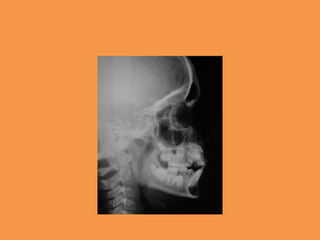
DDS,MScD,MSc,Ped.Cert,FICD
Abstract
Multiple treatment options are available for patients who
have impacted incisor. This presentation shows a cases in
which orthodontic as well as surgical considerations in
10-year-old female child were presented in the
management of impacted central incisor. The
orthodontictreatment plan included three steps – creation
of space, exposure of crown, and forced eruption. A unique
and innovative technique or orthodontic traction (0.017 ×
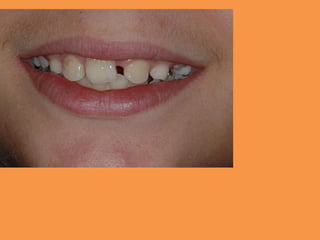
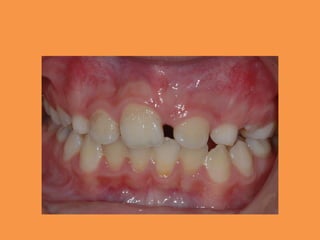
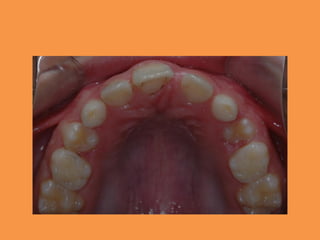
0.025 TMA wire with palatal extension) was employed to
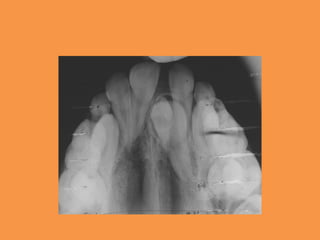
move the maxillary incisor into arch, with minimum injury
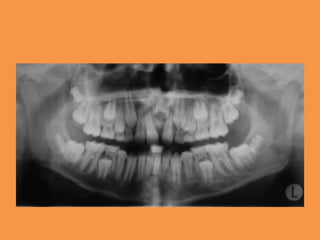
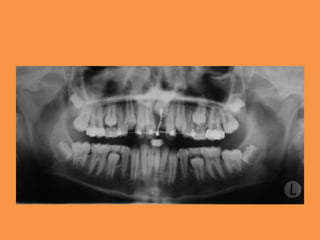
to neighboring soft tissue. After the successful
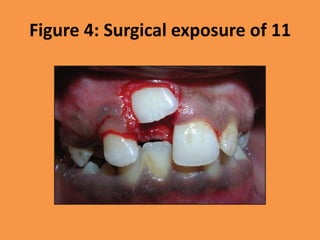
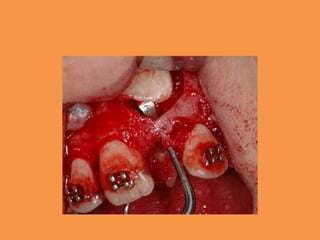
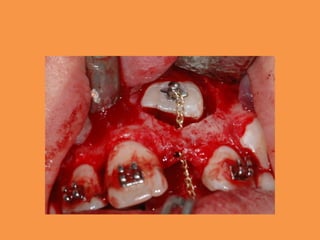
management of impacted teeth, it is very important to
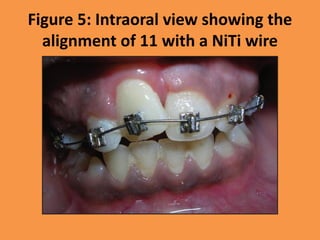
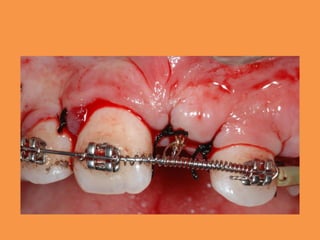
periodically reviewthe periodontal condition and stability.
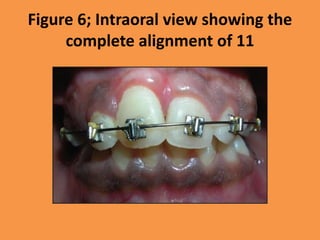
Clinical relevance
• Unerupted central incisors are a clinical
complication that occurs commonly in
orthodontic practice. The clinician should be
aware of the aetiology and possible treatment
options.
Objectives statement
• The reader should be aware of the aetiology
and treatment of unerupted central incisors
Development of the maxillary central
incisor
• The maxillary central incisor commences its
development in the 30th week in utero.
Calcification begins 3 to 4 months post partum
and the crown is usually complete by the age
of 5 years. It is often the second maxillary
permanent tooth to erupt, following the first
permanent molars, roughly between the ages
of 7 to 8 years. This is followed by eruption of
the mandibular lateral and maxillary lateral
incisors.
Eruption path
• The follicle of the permanent central incisor
forms palatal to the root apex of the deciduous
predecessor and the eruptive path has a labial
vector. As the mesio-distal width of the
permanent tooth is greater than its predecessor,
permanent maxillary central incisors by necessity
erupt labially and therefore into a wider dental
arch. This eruptive process results in resorption
of the deciduous incisor root, under the influence
of follicular cells .
Raising suspicions
• The absence of a maxillary permanent central
incisor in a patient aged over 9 years is
unusual. Eruptive delay of greater than 6
months compared to the contralateral tooth,
or disturbance in eruption sequence (eruption
of lateral incisors before central incisors)
should raise suspicions, and certainly warrants
further investigation. There may be several
possible reasons for this central incisor not to
erupt including, but not limited to:
Systemic Causes:
• • Cleft lip and palate
• • Cleidocranial dysplasia
• • Generalised delay in development
• • Gingival fibromatosis
Local Causes
• 1. Obstruction of the eruptive path of the central incisor
• 1.1 Supernumerary teeth
• The most common cause for delayed eruption of a maxillary
permanent central incisor is the presence of a supernumerary tooth
in the eruptive path, usually a tuberculate type 2, 8. These often lie
palatal to the incisor (Figure 1) and develop as a fragmentation
from the dental lamina 9 due to loss of function of the Sprouty
genes (Spry2 & Srpy4) 10. Unlike the tuberculate supernumerary,
midline supernumeraries such as the mesiodens do not prevent the
eruption of the central incisor, but can lead to a deflection from its
normal path of eruption and the creation of a midline diastema
(Figure 2). Occasionally a supplemental incisor can also lead to a
deflection of the path of eruption of the central incisor as illustrated
in Figure 3.
1.2 Persistence of the primary tooth
• Physiological resorption of primary teeth usually occurs as a
coupled process between programmed resorption and repair under
the influence of the overlying developing follicle. Failure of this
process will result in retention of the primary tooth root and
obstruction of the pre-emergent eruption of the permanent tooth
germ. This can lead to a deviation of the crown with consequential
dilaceration, a palatal eruption or just delayed eruption of the
permanent central incisor. Failure of resorption is often of unknown
cause, but it may potentially be due to traumatic insult.
Alternatively, if a deciduous central incisor has itself been
traumatised and become non vital, it may lead to the formation of a
periapical granuloma or periapical cyst that may prevent resorption
of the deciduous root and normal eruption of the permanent
successor (Figure 4)
Treatment in the case of obstruction
• The vast majority of teeth will erupt following the removal
of the obstruction, i.e. the supernumerary tooth or
retained primary tooth Adequate space provision is an
important factor for the successful eruption of the
permanent central incisor following removal of the
obstruction . Although the probability is high, there is no
guarantee the permanent central incisor will erupt under
its own volition. Traction may be required and placement of
an attachment at the same time as obstruction removal
may be prudent and reduce the need for a second
anaesthetic . Care needs to be taken if an attachment is to
be bonded to the unerupted tooth in order to ensure the
tooth erupts through attached mucosa and consequently a
good keratinised gingival margin is created
Early loss of the primary incisor
• Early loss of the primary incisor due to caries
or trauma may result in healing, with the
gingiva overlying the permanent tooth
becoming thickened and fibrous. This will
provide additional resistance to normal
eruption of the permanent tooth.
Treatment in the case of early loss of
the primary incisor
• In most instances the permanent central incisor will erupt if
sufficient space is created (Figures 6a and 6b). However,
occasionally an apically repositioned flap is required to
encourage the tooth to erupt, and traction must in these
circumstances be applied to the tooth. Very occasionally,
excision of overlying fibrous tissue is all that is required to
allow normal eruption of the permanent tooth 16. In the
case of both the apically repositioned flap and fibrous
excision, care must be taken to ensure the unerupted tooth
erupts through keratinised mucosa in order to end up with
a normal attached gingiva. Once again space may need to
be created to facilitate the eruption of the permanent
incisor.
Dilaceration of the Permanent Central
Incisor
• Dilaceration can occur as a result of traumatic
intrusive injury to the deciduous tooth or it can
be developmental in origin. Crown root
angulation occurs in 3% of all permanent
dentitions 17. The position and severity of the
dilaceration depends on the timing and degree of
the intrusion injury in relation to root
development of the permanent central incisor.
Roughly 20-30% of all dilacerations occur as a
result of a traumatic injury to the primary tooth
18, with around 70% being developmental in
origin .
Treatment in the case of dilaceration
• Alignment of the dilacerated central incisor is
often possible, but is dependent on the severity
and position of the crown root angulation. This
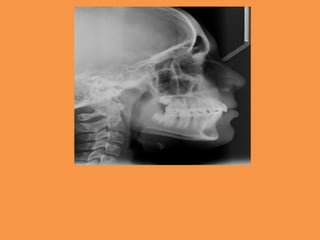
can be assessed with a lateral cephalogram or
with Cone Beam Computed Tomography (CBCT)
(Figure 7). Should alignment be planned, the root
apex of the dilacerated tooth will be translated a
significant distance and is at high risk of external
root resorption . Following alignment, the root
apex may perforate the labial or palatal plate of
the maxilla and care should be taken not to fully
upright the crown in such cases.
Ankylosis of the permanent central
incisor
• This can occur as a consequence of either an intrusive
injury to the primary or permanent incisor, or as a poor
outcome following repositioning of a subluxated incisor
or replantation of an avulsed central incisor . The
effect on the final outcome will depend at what stage
of development the tooth became ankylosed. The
younger the patient when the ankylosis occurs the
worse the outcome. This is because the face, and in
particular the dentoalveolar tissues, will continue to
grow vertically. The ankylosed tooth will not move
during subsequent growth and instead will appear to
submerge (Figure 8).
Treatment of the ankylosed central
incisor
• The ankylosed tooth will not respond to
orthodontic forces and will require either
removal with space closure; removal and
replacement with either a prostheses or an
autotransplanted tooth ; or surgical repositioning
with a dentoalveolar osteotomy . Decoronation
of the tooth can aid bone preservation in the
anterior maxilla, with gradual resorption of the
root left in situ . This may be a treatment choice
should a future implant retained prosthesis be
considered.
Ectopic position of the permanent
central incisor
• Although rare, it is possible for the upper
central incisor to be ectopically positioned.
The incisor may be positioned horizontally and
high, under the anterior nasal spine. Ectopia
of the tooth germ may be a result of trauma
to the primary predecessor or due to
abnormal positional development of the
follicle
Treatment of the ectopic permanent
central incisor
• If there is an indication to align the tooth then the same principles
should be observed as for the treatment of the dilacerated or any
other unerupted permanent incisor. The tooth will require exposure
and placement of a chain to allow traction to be placed onto the
tooth. It is important that the tooth erupts through attached
keratinised gingiva for normal gingival margin development . If the
tooth is low then it may be possible to expose using an apically
repositioned flap. If the tooth is high, then a closed eruption
technique is advisable, with placement of the attachment onto the
palatal surface of the central incisor in order to avoid fenestration
through the labial mucosa and the creation of a poor gingival
margin. The vector of force should also be in a palatal and occlusal
direction to prevent early penetration of the mucosa and
unfavourable gingival contour.
Absence of the permanent central
incisor
• Developmental absence of the maxillary permanent central incisor
is rare and a recent systematic review and meta-analysis calculated
the incidence to be <1.2%. Should the permanent central incisor be
absent, it is more likely to be due to traumatic injury. These are the
most common teeth to be traumatised with avulsion accounting
for over 8% of dental trauma in a paediatric emergency department
. The most recent Child Dental Health Survey (2013) reported an
increased incidence of missing central incisors as a result of trauma,
compared to2003, for both 12 and 15 year olds (2.1/1000 and
1.1/1000 respectively, compared to 0.5/1000 and 0.1/1000 in 2003)
. In the absence of an upper central incisor the orthodontic
consultation should involve questioning to determine whether
there has been any history of previous trauma to either the primary
or permanent dentitions
Treatment of the absent permanent
central incisor
• When a central incisor is missing a decision has to be made
whether to open/ retain the space or to close it. This
decision will depend on a number of factors including the
amount of space already available and patient attitudes
towards prosthetic teeth or complex treatment procedures.
If the space is to be maintained or reopened, the
permanent central incisor can be replaced with either a
prosthetic tooth (a denture, acid etch retained bridge or
implant supported crown) or an autotransplanted premolar
tooth. If the space is to be closed, the lateral incisor will
then need to be camouflaged to mimic the missing central
incisor. Autotransplantation and space closure with the
lateral incisor will be discussed further.
Autotansplantation
• Premolar transplantations have gained popularity in recent years as
they provide a natural, physiological replacement in the anterior
maxilla and can be placed in a growing individual. This is an
especially attractive prospect when teeth will require extraction
from other quadrants as part of comprehensive orthodontic
treatment. Unlike conventional implant retained restorations, the
autotransplanted tooth (often lower second premolars) develops a
physiological and functional periodontal ligament, provided a
careful surgical technique is used, and it will respond to subsequent
orthodontic forces . Autotransplantation in adolescent patients
means patients do not need to wear a removable prosthesis for a
prolonged period of time. There are reports of success rates and
aesthetic satisfaction equal to and greater than those with
implants. Figure 9 shows the replacement of the upper left central
incisor with an autotransplanted premolar prior to reshaping with
composite filling material
Space closure
• Space closure may provide the most appropriate treatment for
some patients. Camouflage of teeth in the anterior maxilla is most
often used when upper lateral incisors are missing and where the
canines are of a small size, incisiform in shape and of a good colour
to mimic the missing lateral incisor. In the case of missing central
incisors, space closure and camouflage to enlarge the lateral incisor,
along with reshaping of the canine and premolar can sometimes
result in highly aesthetic outcomes, with a reduced restorative
burden for the patient . However, often this is not the case (Figure
10). Not only can the mesiodistal width be a challenge to
camouflage in such cases, but so also can the crown length, which
can lead to uneven gingival heights between the adjacent central
and lateral incisor.
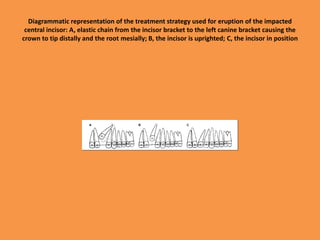
Diagrammatic representation of the treatment strategy used for eruption of the impacted
central incisor: A, elastic chain from the incisor bracket to the left canine bracket causing the
crown to tip distally and the root mesially; B, the incisor is uprighted; C, the incisor in position
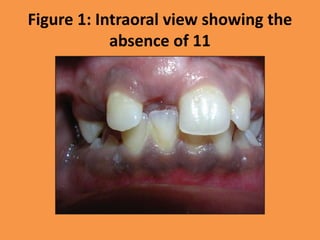
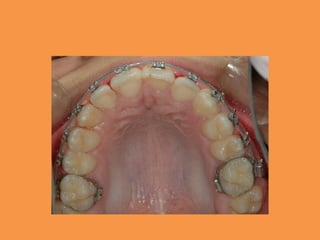
Figure 1: Intraoral view showing the
absence of 11
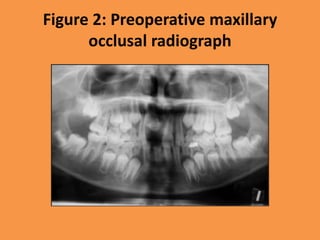
Figure 2: Preoperative maxillary
occlusal radiograph
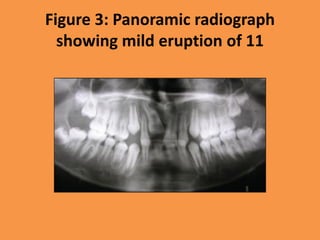
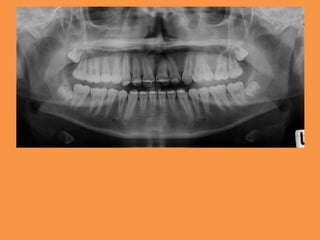
Figure 3: Panoramic radiograph
showing mild eruption of 11
Figure 4: Surgical exposure of 11
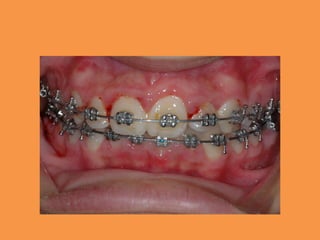
Figure 5: Intraoral view showing the
alignment of 11 with a NiTi wire
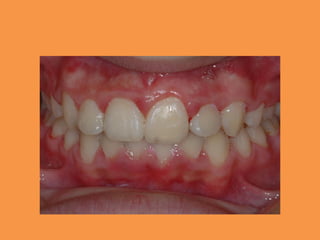
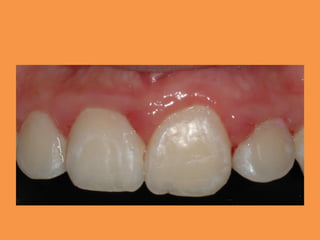
Figure 6; Intraoral view showing the
complete alignment of 11
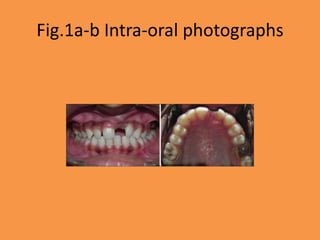
Fig.1a-b Intra-oral photographs
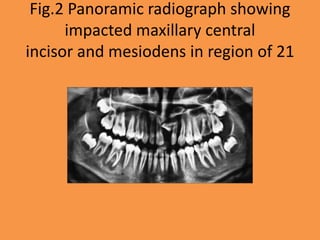
Fig.2 Panoramic radiograph showing
impacted maxillary central
incisor and mesiodens in region of 21
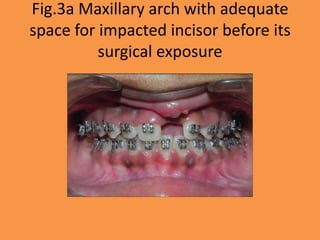
Fig.3a Maxillary arch with adequate
space for impacted incisor before its
surgical exposure
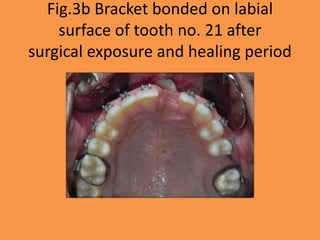
Fig.3b Bracket bonded on labial
surface of tooth no. 21 after
surgical exposure and healing period
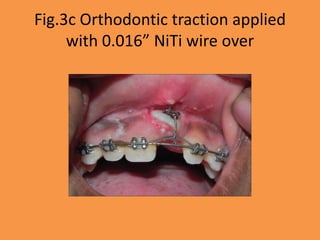
Fig.3c Orthodontic traction applied
with 0.016” NiTi wire over
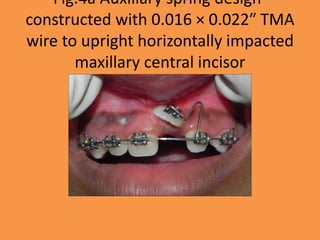
Fig.4a Auxiliary spring design-
constructed with 0.016 × 0.022″ TMA
wire to upright horizontally impacted
maxillary central incisor
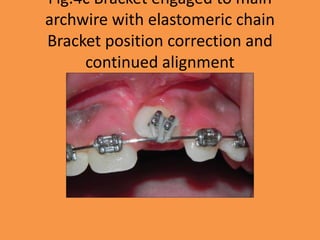
Fig.4c Bracket engaged to main
archwire with elastomeric chain
Bracket position correction and
continued alignment
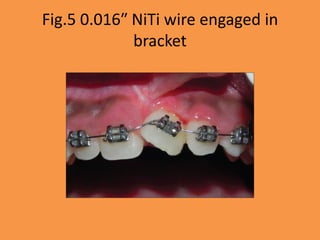
Fig.5 0.016″ NiTi wire engaged in
bracket
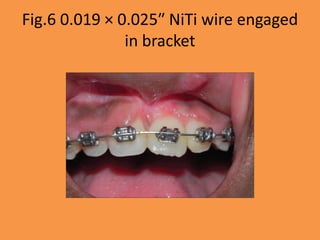
Fig.6 0.019 × 0.025″ NiTi wire engaged
in bracket
Local Causes:
• • Obstruction of the eruptive path of the central incisor: o Most often due to a
supernumerary tooth/odontome 2
• o Persistence of the primary tooth
• • Early loss of the primary tooth causing: o Thickened gingival tissues
• o Space loss
• • Dilaceration of the permanent central incisor o Traumatic (22%) or
developmental (71%)
• • Ankylosis of the permanent central incisor
• • Ectopic position of the central incisor
• • Absence of the permanent central incisor o Due to previous trauma 4. Up to 2%
of 12 year olds have a missing central incisor as a result of trauma
Systemic Causes
• Cleft lip and palate and cleidocranial dysplasia
are both associated with delayed eruption and
an increased incidence of supernumerary
teeth, especially in the region of the cleft .
Gingival fibromatosis is a condition
characterised by progressive enlargement of
the keratinised gingiva, providing greater
resistance and difficulty for teeth to erupt
normally .
Treatment objectives
• 1. Create the space for impacted central
incisor
• 2. Orthodontic traction of impacted tooth
• 3. Establish an acceptable functional
occlusion.
Treatment options
• The following are three possible treatment
options.
1. Creation of space for impacted tooth, surgical
crown exposure and removal of odontoma,
and orthodontic traction of the impacted
central incisor
Treatment options
• 2. Extraction of the impacted central incisor
and temporary restoration with removable
prosthetic denture, followed by a permanent
restoration with bridge or an implant when
growth ceases
• 3. Extraction of the impacted central incisor
and closure of the space, converting the
lateral incisor into the centralincisor with
subsequent prosthetic restoration.
Treatment plan
• 1. Expansion of the maxillary dental arch to
create the space for impacted right central
incisor
• 2. Surgical exposure of impacted central
incisor and removal of odontoma
• 3. Traction of maxillary right central incisor,
with special attention to the gingival recession
Conclusions
The successful management of impacted central
incisor is aclinical challenge. There is also a
risk of periodontal problem after alignment.
Hence, the periodontal care is very critical.To
minimize relapse, a fiberotomy or a bonded
fixed retainer may need to be considered for
retention.
References
• Muhamad Abu-Hussein, Nezar Watted, Abdulgani
Azzaldeen, Mohammad Yehia, Obaida Awadi,
Yosef Abu-Hussein. Prevalence of Malocclusion
and Impacted Canine in Arab Israelian Population
(Arab48). International Journal of Public Health
Research. Vol. 3, No. 5, 2015, 180-191.
• Nezar Watted, Muhamad Abu-Hussein.
Prevalence of Impacted Canines in Arab
Population in Israel. International Journal of
Public Health Research. Vol. 2, No. 6, 2014, pp.
71-77.
References
• Ali Watted Abdulgani Azzaldeen , Watted Nezar , Abu -Hussein Muhamad; Management of an
Unerupted Permanent Maxillary Incisor; Clinical Case. International Journal Dental and Medical
Sciences Research, Volume 2, Issue 2 (Feb- 2018), PP 11-17
• Abu-Hussein Muhamad; ORTHODONTIC TREATMENT OF AN IMPACTED MAXILLARY CENTRAL
INCISOR COMBINED WITH SURGICAL EXPOSURE. International Journal of Dental and Health
Sciences2015, Volume 02, Issue 05,216-221
• Muhamad Abu-Hussein ,Nezar Watted ,Dana Feştila ,Péter Borbély; Surgical-Orthodontic
Treatment of Impacted Canines. Journal of Dental and Medical Sciences2015,Volume 14, Issue 10
Ver. V ,97-104
• Nezar Watted, Muhamad Abu-Hussein, Obaida Awadi, Borbély Péter ; Titanium Button With Chain
by Watted For Orthodontic Traction of Impacted Maxillary Canines ,Journal of Dental and Medical
Science .Volume 14, Issue 2 Ver. VII (Feb. 2015), 116-127
• Nezar Watted, Emad Hussein, Obaida Awadi, and Muhamad Abu-Hussein. Transmigration of
Impacted Canines: A Report of Two Cases and a Review of the Literature. RRJDS | Volume 2 | Issue 4
| October - December, 2014 ,23-32
• Abu-Hussein Muhamad. Cleft Lip and Palate: Clinical Update. IOSR Journal of Dental and Medical
Sciences (IOSR-JDMS). 2019; 18(6):60-65.
• Abu-Hussein M, Watted N, Abdulgani M, Abdulgani Az (2016) Tooth Autotransplantation; Clinical
Concepts. Journal of Dental and Medical Sciences 15: 105-113
• Abu-Hussein Muhamad, Watted Nezar, Abdulgani Azzaldeen. The Curve of Dental Arch in Normal
Occlusion. Open Science Journal of Clinical Medicine. 2015; 3(2):47-54
View publication stats

Orthodonticmanagementofimpactedcentralincisor.pdf

  • 1.
    See discussions, stats,and author profiles for this publication at: https://www.researchgate.net/publication/348008769 Orthodontic management of impacted central incisor Presentation · December 2019 CITATIONS 0 READS 120 1 author: Abu-Hussein Muhamad 645 PUBLICATIONS 3,162 CITATIONS SEE PROFILE All content following this page was uploaded by Abu-Hussein Muhamad on 30 December 2020. The user has requested enhancement of the downloaded file.
  • 2.
    Orthodontic management of impactedcentral incisor Dr.Abu-Hussein Muhamad DDS,MScD,MSc,Ped.Cert,FICD
  • 3.
    Abstract Multiple treatment optionsare available for patients who have impacted incisor. This presentation shows a cases in which orthodontic as well as surgical considerations in 10-year-old female child were presented in the management of impacted central incisor. The orthodontictreatment plan included three steps – creation of space, exposure of crown, and forced eruption. A unique and innovative technique or orthodontic traction (0.017 × 0.025 TMA wire with palatal extension) was employed to move the maxillary incisor into arch, with minimum injury to neighboring soft tissue. After the successful management of impacted teeth, it is very important to periodically reviewthe periodontal condition and stability.
  • 4.
    Clinical relevance • Uneruptedcentral incisors are a clinical complication that occurs commonly in orthodontic practice. The clinician should be aware of the aetiology and possible treatment options.
  • 5.
    Objectives statement • Thereader should be aware of the aetiology and treatment of unerupted central incisors
  • 6.
    Development of themaxillary central incisor • The maxillary central incisor commences its development in the 30th week in utero. Calcification begins 3 to 4 months post partum and the crown is usually complete by the age of 5 years. It is often the second maxillary permanent tooth to erupt, following the first permanent molars, roughly between the ages of 7 to 8 years. This is followed by eruption of the mandibular lateral and maxillary lateral incisors.
  • 7.
    Eruption path • Thefollicle of the permanent central incisor forms palatal to the root apex of the deciduous predecessor and the eruptive path has a labial vector. As the mesio-distal width of the permanent tooth is greater than its predecessor, permanent maxillary central incisors by necessity erupt labially and therefore into a wider dental arch. This eruptive process results in resorption of the deciduous incisor root, under the influence of follicular cells .
  • 8.
    Raising suspicions • Theabsence of a maxillary permanent central incisor in a patient aged over 9 years is unusual. Eruptive delay of greater than 6 months compared to the contralateral tooth, or disturbance in eruption sequence (eruption of lateral incisors before central incisors) should raise suspicions, and certainly warrants further investigation. There may be several possible reasons for this central incisor not to erupt including, but not limited to:
  • 9.
    Systemic Causes: • •Cleft lip and palate • • Cleidocranial dysplasia • • Generalised delay in development • • Gingival fibromatosis
  • 10.
    Local Causes • 1.Obstruction of the eruptive path of the central incisor • 1.1 Supernumerary teeth • The most common cause for delayed eruption of a maxillary permanent central incisor is the presence of a supernumerary tooth in the eruptive path, usually a tuberculate type 2, 8. These often lie palatal to the incisor (Figure 1) and develop as a fragmentation from the dental lamina 9 due to loss of function of the Sprouty genes (Spry2 & Srpy4) 10. Unlike the tuberculate supernumerary, midline supernumeraries such as the mesiodens do not prevent the eruption of the central incisor, but can lead to a deflection from its normal path of eruption and the creation of a midline diastema (Figure 2). Occasionally a supplemental incisor can also lead to a deflection of the path of eruption of the central incisor as illustrated in Figure 3.
  • 11.
    1.2 Persistence ofthe primary tooth • Physiological resorption of primary teeth usually occurs as a coupled process between programmed resorption and repair under the influence of the overlying developing follicle. Failure of this process will result in retention of the primary tooth root and obstruction of the pre-emergent eruption of the permanent tooth germ. This can lead to a deviation of the crown with consequential dilaceration, a palatal eruption or just delayed eruption of the permanent central incisor. Failure of resorption is often of unknown cause, but it may potentially be due to traumatic insult. Alternatively, if a deciduous central incisor has itself been traumatised and become non vital, it may lead to the formation of a periapical granuloma or periapical cyst that may prevent resorption of the deciduous root and normal eruption of the permanent successor (Figure 4)
  • 12.
    Treatment in thecase of obstruction • The vast majority of teeth will erupt following the removal of the obstruction, i.e. the supernumerary tooth or retained primary tooth Adequate space provision is an important factor for the successful eruption of the permanent central incisor following removal of the obstruction . Although the probability is high, there is no guarantee the permanent central incisor will erupt under its own volition. Traction may be required and placement of an attachment at the same time as obstruction removal may be prudent and reduce the need for a second anaesthetic . Care needs to be taken if an attachment is to be bonded to the unerupted tooth in order to ensure the tooth erupts through attached mucosa and consequently a good keratinised gingival margin is created
  • 13.
    Early loss ofthe primary incisor • Early loss of the primary incisor due to caries or trauma may result in healing, with the gingiva overlying the permanent tooth becoming thickened and fibrous. This will provide additional resistance to normal eruption of the permanent tooth.
  • 14.
    Treatment in thecase of early loss of the primary incisor • In most instances the permanent central incisor will erupt if sufficient space is created (Figures 6a and 6b). However, occasionally an apically repositioned flap is required to encourage the tooth to erupt, and traction must in these circumstances be applied to the tooth. Very occasionally, excision of overlying fibrous tissue is all that is required to allow normal eruption of the permanent tooth 16. In the case of both the apically repositioned flap and fibrous excision, care must be taken to ensure the unerupted tooth erupts through keratinised mucosa in order to end up with a normal attached gingiva. Once again space may need to be created to facilitate the eruption of the permanent incisor.
  • 15.
    Dilaceration of thePermanent Central Incisor • Dilaceration can occur as a result of traumatic intrusive injury to the deciduous tooth or it can be developmental in origin. Crown root angulation occurs in 3% of all permanent dentitions 17. The position and severity of the dilaceration depends on the timing and degree of the intrusion injury in relation to root development of the permanent central incisor. Roughly 20-30% of all dilacerations occur as a result of a traumatic injury to the primary tooth 18, with around 70% being developmental in origin .
  • 16.
    Treatment in thecase of dilaceration • Alignment of the dilacerated central incisor is often possible, but is dependent on the severity and position of the crown root angulation. This can be assessed with a lateral cephalogram or with Cone Beam Computed Tomography (CBCT) (Figure 7). Should alignment be planned, the root apex of the dilacerated tooth will be translated a significant distance and is at high risk of external root resorption . Following alignment, the root apex may perforate the labial or palatal plate of the maxilla and care should be taken not to fully upright the crown in such cases.
  • 17.
    Ankylosis of thepermanent central incisor • This can occur as a consequence of either an intrusive injury to the primary or permanent incisor, or as a poor outcome following repositioning of a subluxated incisor or replantation of an avulsed central incisor . The effect on the final outcome will depend at what stage of development the tooth became ankylosed. The younger the patient when the ankylosis occurs the worse the outcome. This is because the face, and in particular the dentoalveolar tissues, will continue to grow vertically. The ankylosed tooth will not move during subsequent growth and instead will appear to submerge (Figure 8).
  • 18.
    Treatment of theankylosed central incisor • The ankylosed tooth will not respond to orthodontic forces and will require either removal with space closure; removal and replacement with either a prostheses or an autotransplanted tooth ; or surgical repositioning with a dentoalveolar osteotomy . Decoronation of the tooth can aid bone preservation in the anterior maxilla, with gradual resorption of the root left in situ . This may be a treatment choice should a future implant retained prosthesis be considered.
  • 19.
    Ectopic position ofthe permanent central incisor • Although rare, it is possible for the upper central incisor to be ectopically positioned. The incisor may be positioned horizontally and high, under the anterior nasal spine. Ectopia of the tooth germ may be a result of trauma to the primary predecessor or due to abnormal positional development of the follicle
  • 20.
    Treatment of theectopic permanent central incisor • If there is an indication to align the tooth then the same principles should be observed as for the treatment of the dilacerated or any other unerupted permanent incisor. The tooth will require exposure and placement of a chain to allow traction to be placed onto the tooth. It is important that the tooth erupts through attached keratinised gingiva for normal gingival margin development . If the tooth is low then it may be possible to expose using an apically repositioned flap. If the tooth is high, then a closed eruption technique is advisable, with placement of the attachment onto the palatal surface of the central incisor in order to avoid fenestration through the labial mucosa and the creation of a poor gingival margin. The vector of force should also be in a palatal and occlusal direction to prevent early penetration of the mucosa and unfavourable gingival contour.
  • 21.
    Absence of thepermanent central incisor • Developmental absence of the maxillary permanent central incisor is rare and a recent systematic review and meta-analysis calculated the incidence to be <1.2%. Should the permanent central incisor be absent, it is more likely to be due to traumatic injury. These are the most common teeth to be traumatised with avulsion accounting for over 8% of dental trauma in a paediatric emergency department . The most recent Child Dental Health Survey (2013) reported an increased incidence of missing central incisors as a result of trauma, compared to2003, for both 12 and 15 year olds (2.1/1000 and 1.1/1000 respectively, compared to 0.5/1000 and 0.1/1000 in 2003) . In the absence of an upper central incisor the orthodontic consultation should involve questioning to determine whether there has been any history of previous trauma to either the primary or permanent dentitions
  • 22.
    Treatment of theabsent permanent central incisor • When a central incisor is missing a decision has to be made whether to open/ retain the space or to close it. This decision will depend on a number of factors including the amount of space already available and patient attitudes towards prosthetic teeth or complex treatment procedures. If the space is to be maintained or reopened, the permanent central incisor can be replaced with either a prosthetic tooth (a denture, acid etch retained bridge or implant supported crown) or an autotransplanted premolar tooth. If the space is to be closed, the lateral incisor will then need to be camouflaged to mimic the missing central incisor. Autotransplantation and space closure with the lateral incisor will be discussed further.
  • 23.
    Autotansplantation • Premolar transplantationshave gained popularity in recent years as they provide a natural, physiological replacement in the anterior maxilla and can be placed in a growing individual. This is an especially attractive prospect when teeth will require extraction from other quadrants as part of comprehensive orthodontic treatment. Unlike conventional implant retained restorations, the autotransplanted tooth (often lower second premolars) develops a physiological and functional periodontal ligament, provided a careful surgical technique is used, and it will respond to subsequent orthodontic forces . Autotransplantation in adolescent patients means patients do not need to wear a removable prosthesis for a prolonged period of time. There are reports of success rates and aesthetic satisfaction equal to and greater than those with implants. Figure 9 shows the replacement of the upper left central incisor with an autotransplanted premolar prior to reshaping with composite filling material
  • 24.
    Space closure • Spaceclosure may provide the most appropriate treatment for some patients. Camouflage of teeth in the anterior maxilla is most often used when upper lateral incisors are missing and where the canines are of a small size, incisiform in shape and of a good colour to mimic the missing lateral incisor. In the case of missing central incisors, space closure and camouflage to enlarge the lateral incisor, along with reshaping of the canine and premolar can sometimes result in highly aesthetic outcomes, with a reduced restorative burden for the patient . However, often this is not the case (Figure 10). Not only can the mesiodistal width be a challenge to camouflage in such cases, but so also can the crown length, which can lead to uneven gingival heights between the adjacent central and lateral incisor.
  • 25.
    Diagrammatic representation ofthe treatment strategy used for eruption of the impacted central incisor: A, elastic chain from the incisor bracket to the left canine bracket causing the crown to tip distally and the root mesially; B, the incisor is uprighted; C, the incisor in position
  • 26.
    Figure 1: Intraoralview showing the absence of 11
  • 27.
    Figure 2: Preoperativemaxillary occlusal radiograph
  • 28.
    Figure 3: Panoramicradiograph showing mild eruption of 11
  • 29.
    Figure 4: Surgicalexposure of 11
  • 30.
    Figure 5: Intraoralview showing the alignment of 11 with a NiTi wire
  • 31.
    Figure 6; Intraoralview showing the complete alignment of 11
  • 32.
  • 33.
    Fig.2 Panoramic radiographshowing impacted maxillary central incisor and mesiodens in region of 21
  • 34.
    Fig.3a Maxillary archwith adequate space for impacted incisor before its surgical exposure
  • 35.
    Fig.3b Bracket bondedon labial surface of tooth no. 21 after surgical exposure and healing period
  • 36.
    Fig.3c Orthodontic tractionapplied with 0.016” NiTi wire over
  • 37.
    Fig.4a Auxiliary springdesign- constructed with 0.016 × 0.022″ TMA wire to upright horizontally impacted maxillary central incisor
  • 38.
    Fig.4c Bracket engagedto main archwire with elastomeric chain Bracket position correction and continued alignment
  • 39.
    Fig.5 0.016″ NiTiwire engaged in bracket
  • 40.
    Fig.6 0.019 ×0.025″ NiTi wire engaged in bracket
  • 41.
    Local Causes: • •Obstruction of the eruptive path of the central incisor: o Most often due to a supernumerary tooth/odontome 2 • o Persistence of the primary tooth • • Early loss of the primary tooth causing: o Thickened gingival tissues • o Space loss • • Dilaceration of the permanent central incisor o Traumatic (22%) or developmental (71%) • • Ankylosis of the permanent central incisor • • Ectopic position of the central incisor • • Absence of the permanent central incisor o Due to previous trauma 4. Up to 2% of 12 year olds have a missing central incisor as a result of trauma
  • 42.
    Systemic Causes • Cleftlip and palate and cleidocranial dysplasia are both associated with delayed eruption and an increased incidence of supernumerary teeth, especially in the region of the cleft . Gingival fibromatosis is a condition characterised by progressive enlargement of the keratinised gingiva, providing greater resistance and difficulty for teeth to erupt normally .
  • 43.
    Treatment objectives • 1.Create the space for impacted central incisor • 2. Orthodontic traction of impacted tooth • 3. Establish an acceptable functional occlusion.
  • 44.
    Treatment options • Thefollowing are three possible treatment options. 1. Creation of space for impacted tooth, surgical crown exposure and removal of odontoma, and orthodontic traction of the impacted central incisor
  • 45.
    Treatment options • 2.Extraction of the impacted central incisor and temporary restoration with removable prosthetic denture, followed by a permanent restoration with bridge or an implant when growth ceases • 3. Extraction of the impacted central incisor and closure of the space, converting the lateral incisor into the centralincisor with subsequent prosthetic restoration.
  • 46.
    Treatment plan • 1.Expansion of the maxillary dental arch to create the space for impacted right central incisor • 2. Surgical exposure of impacted central incisor and removal of odontoma • 3. Traction of maxillary right central incisor, with special attention to the gingival recession
  • 63.
    Conclusions The successful managementof impacted central incisor is aclinical challenge. There is also a risk of periodontal problem after alignment. Hence, the periodontal care is very critical.To minimize relapse, a fiberotomy or a bonded fixed retainer may need to be considered for retention.
  • 64.
    References • Muhamad Abu-Hussein,Nezar Watted, Abdulgani Azzaldeen, Mohammad Yehia, Obaida Awadi, Yosef Abu-Hussein. Prevalence of Malocclusion and Impacted Canine in Arab Israelian Population (Arab48). International Journal of Public Health Research. Vol. 3, No. 5, 2015, 180-191. • Nezar Watted, Muhamad Abu-Hussein. Prevalence of Impacted Canines in Arab Population in Israel. International Journal of Public Health Research. Vol. 2, No. 6, 2014, pp. 71-77.
  • 65.
    References • Ali WattedAbdulgani Azzaldeen , Watted Nezar , Abu -Hussein Muhamad; Management of an Unerupted Permanent Maxillary Incisor; Clinical Case. International Journal Dental and Medical Sciences Research, Volume 2, Issue 2 (Feb- 2018), PP 11-17 • Abu-Hussein Muhamad; ORTHODONTIC TREATMENT OF AN IMPACTED MAXILLARY CENTRAL INCISOR COMBINED WITH SURGICAL EXPOSURE. International Journal of Dental and Health Sciences2015, Volume 02, Issue 05,216-221 • Muhamad Abu-Hussein ,Nezar Watted ,Dana Feştila ,Péter Borbély; Surgical-Orthodontic Treatment of Impacted Canines. Journal of Dental and Medical Sciences2015,Volume 14, Issue 10 Ver. V ,97-104 • Nezar Watted, Muhamad Abu-Hussein, Obaida Awadi, Borbély Péter ; Titanium Button With Chain by Watted For Orthodontic Traction of Impacted Maxillary Canines ,Journal of Dental and Medical Science .Volume 14, Issue 2 Ver. VII (Feb. 2015), 116-127 • Nezar Watted, Emad Hussein, Obaida Awadi, and Muhamad Abu-Hussein. Transmigration of Impacted Canines: A Report of Two Cases and a Review of the Literature. RRJDS | Volume 2 | Issue 4 | October - December, 2014 ,23-32 • Abu-Hussein Muhamad. Cleft Lip and Palate: Clinical Update. IOSR Journal of Dental and Medical Sciences (IOSR-JDMS). 2019; 18(6):60-65. • Abu-Hussein M, Watted N, Abdulgani M, Abdulgani Az (2016) Tooth Autotransplantation; Clinical Concepts. Journal of Dental and Medical Sciences 15: 105-113 • Abu-Hussein Muhamad, Watted Nezar, Abdulgani Azzaldeen. The Curve of Dental Arch in Normal Occlusion. Open Science Journal of Clinical Medicine. 2015; 3(2):47-54 View publication stats