Cementation of FPD
INTRODUCTION
Cementation- The process of attaching any
part by means of a cemnet GPT
Dental cements are materials of
comparitively low strength
The word luting is defined as the use of a
moldable substance to seal joints and
cement two substances together.
The cement is selected according
to the functional & biological
demands of the particular clinical
situation .
•Various cements are used for
luting for example zinc
phosphate, zinc silicophosphate,
zinc polycarboxylate, glass
ionomer, and zinc oxide eugenol
and resin cements.
IDEAL REQUIREMENTS .
- Low viscosity and film
thickness
-Long working time with rapid
set at mouth temperature
-Good resistance to aqueous or
acid attack
-High compressive and tensile
strength
- Adhesion to tooth
structure and restoration
- Cariostatic
- Biologically compatible
with pulp
- Translucency
- Radio opacity
- Resistance to plastic
deformation
BASED ON THE PURPOSE :
•Interim cementation : Zn O E
Cement .
•Definitive cementation : Zn
Po4 cement , GIC ,Zn poly
carboxylate cements ,Resin
cements .
Based on application :
1)Zinc phosphate : Retention of restoration .
2)Zinc silicophophate :
Retention of restoration .
3) Zn OE : Temporary & permenant
restorations.
4)Zinc polyacrylate : Retention of restoration
5) Glass ionomer : Retention of restoration .
6)Resins : Retention of conventional crowns &
bridges .
CHARACTERESTICS OF
ABUTMENT TOOTH INTERFACE
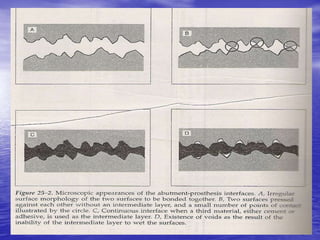
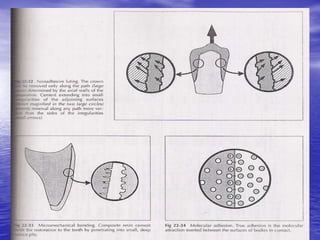
When two relatively flat surfaces are in
contact , a space exists between them at
microscopic level . This area is rough –
has peaks & valleys
So only point contact .
Open space provides space for saliva &
bacterial invasion .
Cement serves as filling to this space &
retains the prosthesis .
MECHANISM OF RETENTION
•MECHANICAL .
•CHEMICAL .
•COMBINATION .
BONDING MECHANISM
Non adhesive luting:
Originally luting cements
served to fill the gap b/w
the tooth & restoration
.Zn Po4 cements holds the
restoration by engaging
the irregularities
Micromechanical Bonding
Resin cements when used on
pitted surfaces provide
micromechanical bonding
.Deep irregularities are
produced by etching of the
tooth surface & restoration
inner surface.
Molecular adhesion
Involves physical forces &
chemical bonds between the
molecules of different
substances .Due to the low
cohesive strength ,GIC &
Carboxylate cements have
some adhesive properties
Dislodgement of Prosthesis
A fixed prosthesis can get debonded due
to :
a) Biologic reasons .
b) Physical reasons .
c) Combination .
Two basic modes of failure associated
with cements are
a) Cohesive fracture .
b) Seperation along the interfaces
Several factors influence the
retention of a prosthesis :
a) Film thickness .
b) Strength of the cement .
c) Type of bonding .
d) Dimensional changes that
occur during the setting of the
cement
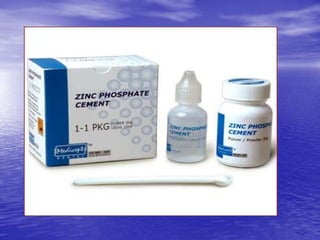
ZINC PHOSPHATE CEMENT
Zinc phosphate cement is the
oldest of the cementation agents.
It serves as a standard by which
newer systems can be compared.
It is a traditional crown and
bridge cement used for the alloy
restorations. It is supplied as a
powder and liquid
According to ADA sp. No. 8
Type I – fine grained for
luting
Type II – medium grained
for luting and filling
APPLICATIONS
Zinc phosphate cement is used
most commonly for luting
permanent metal restorations
and as abase.
Other applications include
cementation of orthodontic
bands and the use of cement
as a provisional restoration
Advantages
Adequate strength to maintain
the restoration
•Relatively good manufacturer
properties
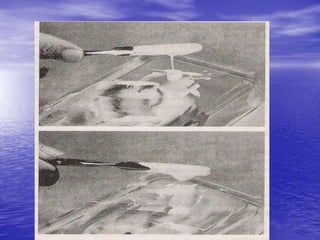
•Mixed easily and that they set
sharply to a relatively strong
mass from a fluid consistency.
Disadvantages
•Irritating effect on the pulp
•Lack of anticariogenic
properties
•Lack of adhesion to the tooth
•Vulnerability to acid attack
•Brittleness
•Solubility in acid fluids
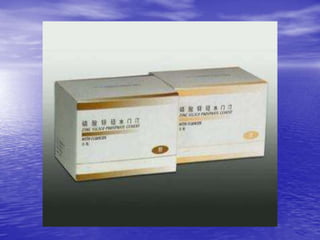
ZINC SILICOPHOSPHATE CEMENT
•They are also called as Zinc
silicate, Silicate zinc cement.
•Zinc silicophosphate cement is
a hybrid resulting from the
combination of zinc phosphate
cement and silicate powders
•Types of Zinc silicophosphate
cements
•According to ADA no –28 (1969)
there are three types
•Type I – as a cementing media
•Type II – temporary posterior
filling material
•Type III – dual purpose cementing
media and temporary posterior
filling material.
PROPERTIES
1)Superior strength to Zn PO4 cement
2)Translucent so esthetically superior
3)Fluoride release so anticariogenic
4)Less soluble than Zn PO4 cement .
5)Retention by mechanical interlocking
6)Flow not good so increased film
thickness
•Advantages
• Zinc silicophosphate cements have a
better strength and toughness than zinc
phosphate cements
• Shows considerable fluoride release
hence anticariogenic
• Translucent
• Under clinical conditions lower solubility
and better bonding
• Best suited to cement of ortho bars and
restoration on non-vital teeth.
•Disadvantages
•Less satisfactory mixing
•Higher film thickness
•Greater pulpal irritation
USES :
1)As luting agents .
2)Intermediate restorations .
3)As die material
The use of Zinc silicophosphate
cement is declining, as practitioners
have choice of other more
esthetically pleasing materials such
as resin and glass ionomer cements.
ZINC POLYCARBOXYLATE
CEMENT
(Polyacrylate Cements )
•In the quest for an adhesive cement
that can bond strongly to the tooth
structure, Zinc polycarboxylate
cement was the first cement system
that developed an adhesive bond to
tooth structure in 1960.
PROPERTIES
1)Viscosity : initially high .
2)Film thickness :more viscous
3)WT - 2.5 mnts
4)S T – 6-9 mnts .
5)Compressive strength – 55 Mpa
6)Tensile strength – higher than
phosphate
7)Mod of elasticity – less than half
Solubility – Low but as ph decreases 4.5
or less solubility increases .
Bond strength – 3.4 -13 Mpa
Dimensional stability –
Linear contraction :1% wet 1day .
6% dry 14 days
Acidity – Initially more .
Removal of cement – it is less brittle so
difficult to remove .
Surface penetration & Retention :
Does not bond to metal in
chemically contaminated
situation .
A clean tooth surface
necessary.Apply 10% polyacrylic
acid for 10 -15 sec followed by
rinsing with water
Applications
Zinc polyacrylate cements are
used primarily for luting
permanent alloy restorations
and as bases.
Advantages
•Biocompatibility with the pulp
is excellent.
• Postoperative sensitivity is
negligible when used as a
luting agent
•Adhesion to tooth and alloy
•Easy manipulation.
Disadvantages
•Need for accurate
proportioning required for
optimal properties
•Greater viscoelasticity
•Shorter working time
•Low compressive strength
•More critical manipulation
ZINC OXIDE EUGENOL CEMENT
• This material has been used to a wide
range applications in dentistry .
• ZOE cement is one of the least irritating of
all the dental materials and provides an
excellent seal against leakage.
Types
• According to ADA specification 30
• Type I ZOE cement –temporary
cementation
• Type II ZOE cements –permanent
cementation of restorations or appliances
fabricated outside of the mouth
• Type III ZOE cements –temporary
restoration and thermal insulating bases
• Type IV ZOE cements – cavity liner
• Unmodified ZOE cements are used as a
luting material for provisional restorations
in crown and bridge prosthodontics.
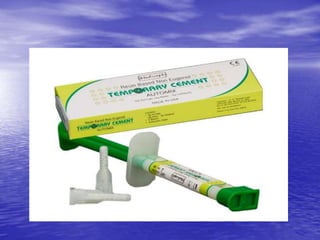
Non-eugenol cements
Due to certain disadv of Zn OE , like
- stinging or burning sensation
- incomplete reaction leads to
leaching out of free euginol
- disagreeable taste of euginol
- surgical pack can cause gastric
irritation
led to non – euginol cements
GLASS IONOMER CEMENT
Glass ionomer is the generic
name of a group of materials
that use silicate glass powder
and an aqueous solution of
polyacrylic acid . It is also
referred to as polyalkeonate
cement. The cement produces a
truly adhesive bond to tooth
structure.
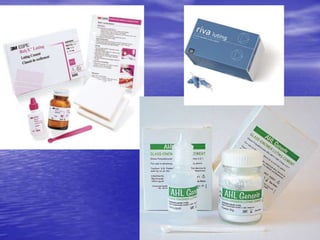
Types of Glass ionomer cement
Type I
• Luting applications
• Powder liquid ratio is generally 1.5 : 1
• Grain size 15 µm or less
• High early resistance to water
contamination
• Radiopaque for easy detection of
excess
• Limited extension of working time
thru chilling glass slab.
PROPERTIES
1)Film thickness : 25 mu m or less
2)Working time : 3-5 mnts
3)Setting time : 5-9 mnts
4)Strength : 24 hr compressive
strength is 90 -230 Mpa
Tensile strength similar
to Zn po4 cement
5) Bond strength : Tensile bond
strength is b/w 1 & 3 Mpa
6) Solubility : is high in water for the
first 24 hrs
7) Biological properties : good
adhesion to tooth structure , less
irritating ,less post operative
sensitivity ,anticariogenic & high
thermal diffusivity at high L/P ratio
•Fluoride release
•Reaction on the pulp
•Applications :
Used as permenant
cement ,as a base ,fiiling
material , pit & fissure
sealant ,endodontic sealer .
RESIN BASED CEMENTS
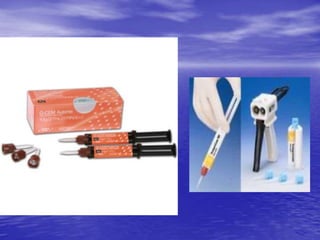
Resin luting cements are used since
1950s .Early formullightly filled MMA
.
ISO 4049 describes three classes of
composites for polymer based filling,
restoration and luting materials
•Class 1 – self cured materials
•Class 2 – light cured materials
•Class 3 – dual cured materials ations
PROPERTIES
1)Insoluble in oral fluids .
2)Film thicknesss -25 mu m or less
3)Good bond strength with dentin
4)No anticariogenic potential
5)Low filler content & low viscosity
6)Stronger than conventional
cements
7) High tensile strength –
micromechanical bonding to
etched ceramic veneers &
pitted partial denture retainers
.
8) Highly irritating to the pulp ,
so pulp protection is a must
when using resin cements .
MANIPULATION
Chemically activated resin cements
are supplied as two components (
Mixing 20 -30 secs )
Light cured as single component
system . ( Exposure to light
should be less than 40 secs )
Dual cure system is two component
system .
DISADVANTAGES
• Excessive cement film thickness
• Marginal leakage because of setting
shrinkage
• Severe pulpal reactions when applied to
cut vital dentin
• Dentin bonding agents have been
reported to reduce pulpal response,
presumably by sealing the dentinal tubules
and reducing micro leakage. Adhesive
resin was found to produce better
marginal seal than zinc phosphate cement.
Try In procedure
• Proximal contact
• Marginal integrity
• Stability
• Occlusion
• Aesthetic considerations- Cracks, stained
crack lines, exposed tooth
CEMENTATION PROCEDURE
ISOLATION
SALIVA CONTROL
FINAL CEMENTATION
POST CEMENTATION
Post cementation instructions
• Pt is asked to perform all oral functions
• Pt should be aware of the initial
discomfort
• Sudden impact forces should be avoided
• Oral hygiene instructions
• Regular recall visits
• Pt is advised to report if pain is present
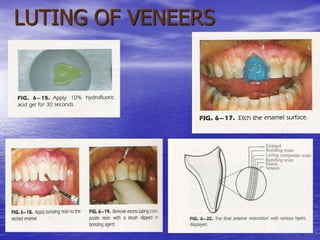
LUTING OF VENEERS
•CONCLUSION
Luting agents possess varied,
complex chemistries that affect their
physical properties, longevity and
suitability in clinical situations. It
appears a single adhesive will not
suffice in modern day practice.
Prosthdontics must be aware of the
virtues and shortcomings of each
cement type and select them
appropriately.
Referneces
• Kenneth J,. Anusavice- PhilipsScience of Dental
materials- 10th edition
• Robert G Craig- Restorative dental Materials-
11th Edition
• William J. o brien- Dental matereials and their
selection- 3rd edition
• Herbet T Shillingburg- Fundamentals of Fixed
Prosthodontics- 3rd edition
• Notes on Dental Materials, E. C Combe- 6th
edition
• Contemporary Fixed Prosthodontics IIIrd Edition by
Rosenthal, Land & Fujimoto.

Cementation procedures in fpd

  • 1.
  • 2.
    INTRODUCTION Cementation- The processof attaching any part by means of a cemnet GPT Dental cements are materials of comparitively low strength The word luting is defined as the use of a moldable substance to seal joints and cement two substances together.
  • 3.
    The cement isselected according to the functional & biological demands of the particular clinical situation . •Various cements are used for luting for example zinc phosphate, zinc silicophosphate, zinc polycarboxylate, glass ionomer, and zinc oxide eugenol and resin cements.
  • 4.
    IDEAL REQUIREMENTS . -Low viscosity and film thickness -Long working time with rapid set at mouth temperature -Good resistance to aqueous or acid attack -High compressive and tensile strength
  • 5.
    - Adhesion totooth structure and restoration - Cariostatic - Biologically compatible with pulp - Translucency - Radio opacity - Resistance to plastic deformation
  • 6.
    BASED ON THEPURPOSE : •Interim cementation : Zn O E Cement . •Definitive cementation : Zn Po4 cement , GIC ,Zn poly carboxylate cements ,Resin cements .
  • 7.
    Based on application: 1)Zinc phosphate : Retention of restoration . 2)Zinc silicophophate : Retention of restoration . 3) Zn OE : Temporary & permenant restorations. 4)Zinc polyacrylate : Retention of restoration 5) Glass ionomer : Retention of restoration . 6)Resins : Retention of conventional crowns & bridges .

  • 8.
    CHARACTERESTICS OF ABUTMENT TOOTHINTERFACE When two relatively flat surfaces are in contact , a space exists between them at microscopic level . This area is rough – has peaks & valleys So only point contact . Open space provides space for saliva & bacterial invasion . Cement serves as filling to this space & retains the prosthesis .
  • 10.
    MECHANISM OF RETENTION •MECHANICAL. •CHEMICAL . •COMBINATION .
  • 11.
    BONDING MECHANISM Non adhesiveluting: Originally luting cements served to fill the gap b/w the tooth & restoration .Zn Po4 cements holds the restoration by engaging the irregularities
  • 12.
    Micromechanical Bonding Resin cementswhen used on pitted surfaces provide micromechanical bonding .Deep irregularities are produced by etching of the tooth surface & restoration inner surface.
  • 13.
    Molecular adhesion Involves physicalforces & chemical bonds between the molecules of different substances .Due to the low cohesive strength ,GIC & Carboxylate cements have some adhesive properties
  • 15.
    Dislodgement of Prosthesis Afixed prosthesis can get debonded due to : a) Biologic reasons . b) Physical reasons . c) Combination . Two basic modes of failure associated with cements are a) Cohesive fracture . b) Seperation along the interfaces
  • 16.
    Several factors influencethe retention of a prosthesis : a) Film thickness . b) Strength of the cement . c) Type of bonding . d) Dimensional changes that occur during the setting of the cement
  • 17.
    ZINC PHOSPHATE CEMENT Zincphosphate cement is the oldest of the cementation agents. It serves as a standard by which newer systems can be compared. It is a traditional crown and bridge cement used for the alloy restorations. It is supplied as a powder and liquid
  • 19.
    According to ADAsp. No. 8 Type I – fine grained for luting Type II – medium grained for luting and filling
  • 21.
    APPLICATIONS Zinc phosphate cementis used most commonly for luting permanent metal restorations and as abase. Other applications include cementation of orthodontic bands and the use of cement as a provisional restoration
  • 22.
    Advantages Adequate strength tomaintain the restoration •Relatively good manufacturer properties •Mixed easily and that they set sharply to a relatively strong mass from a fluid consistency.
  • 23.
    Disadvantages •Irritating effect onthe pulp •Lack of anticariogenic properties •Lack of adhesion to the tooth •Vulnerability to acid attack •Brittleness •Solubility in acid fluids
  • 24.
    ZINC SILICOPHOSPHATE CEMENT •Theyare also called as Zinc silicate, Silicate zinc cement. •Zinc silicophosphate cement is a hybrid resulting from the combination of zinc phosphate cement and silicate powders
  • 26.
    •Types of Zincsilicophosphate cements •According to ADA no –28 (1969) there are three types •Type I – as a cementing media •Type II – temporary posterior filling material •Type III – dual purpose cementing media and temporary posterior filling material.
  • 27.
    PROPERTIES 1)Superior strength toZn PO4 cement 2)Translucent so esthetically superior 3)Fluoride release so anticariogenic 4)Less soluble than Zn PO4 cement . 5)Retention by mechanical interlocking 6)Flow not good so increased film thickness
  • 28.
    •Advantages • Zinc silicophosphatecements have a better strength and toughness than zinc phosphate cements • Shows considerable fluoride release hence anticariogenic • Translucent • Under clinical conditions lower solubility and better bonding • Best suited to cement of ortho bars and restoration on non-vital teeth.
  • 29.
    •Disadvantages •Less satisfactory mixing •Higherfilm thickness •Greater pulpal irritation
  • 30.
    USES : 1)As lutingagents . 2)Intermediate restorations . 3)As die material The use of Zinc silicophosphate cement is declining, as practitioners have choice of other more esthetically pleasing materials such as resin and glass ionomer cements.
  • 31.
    ZINC POLYCARBOXYLATE CEMENT (Polyacrylate Cements) •In the quest for an adhesive cement that can bond strongly to the tooth structure, Zinc polycarboxylate cement was the first cement system that developed an adhesive bond to tooth structure in 1960.
  • 32.
    PROPERTIES 1)Viscosity : initiallyhigh . 2)Film thickness :more viscous 3)WT - 2.5 mnts 4)S T – 6-9 mnts . 5)Compressive strength – 55 Mpa 6)Tensile strength – higher than phosphate 7)Mod of elasticity – less than half
  • 33.
    Solubility – Lowbut as ph decreases 4.5 or less solubility increases . Bond strength – 3.4 -13 Mpa Dimensional stability – Linear contraction :1% wet 1day . 6% dry 14 days Acidity – Initially more . Removal of cement – it is less brittle so difficult to remove .
  • 34.
    Surface penetration &Retention : Does not bond to metal in chemically contaminated situation . A clean tooth surface necessary.Apply 10% polyacrylic acid for 10 -15 sec followed by rinsing with water
  • 35.
    Applications Zinc polyacrylate cementsare used primarily for luting permanent alloy restorations and as bases.
  • 36.
    Advantages •Biocompatibility with thepulp is excellent. • Postoperative sensitivity is negligible when used as a luting agent •Adhesion to tooth and alloy •Easy manipulation.
  • 37.
    Disadvantages •Need for accurate proportioningrequired for optimal properties •Greater viscoelasticity •Shorter working time •Low compressive strength •More critical manipulation
  • 38.
    ZINC OXIDE EUGENOLCEMENT • This material has been used to a wide range applications in dentistry . • ZOE cement is one of the least irritating of all the dental materials and provides an excellent seal against leakage.
  • 39.
    Types • According toADA specification 30 • Type I ZOE cement –temporary cementation • Type II ZOE cements –permanent cementation of restorations or appliances fabricated outside of the mouth • Type III ZOE cements –temporary restoration and thermal insulating bases • Type IV ZOE cements – cavity liner
  • 40.
    • Unmodified ZOEcements are used as a luting material for provisional restorations in crown and bridge prosthodontics.
  • 41.
    Non-eugenol cements Due tocertain disadv of Zn OE , like - stinging or burning sensation - incomplete reaction leads to leaching out of free euginol - disagreeable taste of euginol - surgical pack can cause gastric irritation led to non – euginol cements
  • 43.
    GLASS IONOMER CEMENT Glassionomer is the generic name of a group of materials that use silicate glass powder and an aqueous solution of polyacrylic acid . It is also referred to as polyalkeonate cement. The cement produces a truly adhesive bond to tooth structure.
  • 45.
    Types of Glassionomer cement Type I • Luting applications • Powder liquid ratio is generally 1.5 : 1 • Grain size 15 µm or less • High early resistance to water contamination • Radiopaque for easy detection of excess • Limited extension of working time thru chilling glass slab.
  • 46.
    PROPERTIES 1)Film thickness :25 mu m or less 2)Working time : 3-5 mnts 3)Setting time : 5-9 mnts 4)Strength : 24 hr compressive strength is 90 -230 Mpa Tensile strength similar to Zn po4 cement
  • 47.
    5) Bond strength: Tensile bond strength is b/w 1 & 3 Mpa 6) Solubility : is high in water for the first 24 hrs 7) Biological properties : good adhesion to tooth structure , less irritating ,less post operative sensitivity ,anticariogenic & high thermal diffusivity at high L/P ratio
  • 48.
    •Fluoride release •Reaction onthe pulp •Applications : Used as permenant cement ,as a base ,fiiling material , pit & fissure sealant ,endodontic sealer .
  • 49.
    RESIN BASED CEMENTS Resinluting cements are used since 1950s .Early formullightly filled MMA . ISO 4049 describes three classes of composites for polymer based filling, restoration and luting materials •Class 1 – self cured materials •Class 2 – light cured materials •Class 3 – dual cured materials ations
  • 51.
    PROPERTIES 1)Insoluble in oralfluids . 2)Film thicknesss -25 mu m or less 3)Good bond strength with dentin 4)No anticariogenic potential 5)Low filler content & low viscosity 6)Stronger than conventional cements
  • 52.
    7) High tensilestrength – micromechanical bonding to etched ceramic veneers & pitted partial denture retainers . 8) Highly irritating to the pulp , so pulp protection is a must when using resin cements .
  • 53.
    MANIPULATION Chemically activated resincements are supplied as two components ( Mixing 20 -30 secs ) Light cured as single component system . ( Exposure to light should be less than 40 secs ) Dual cure system is two component system .
  • 54.
    DISADVANTAGES • Excessive cementfilm thickness • Marginal leakage because of setting shrinkage • Severe pulpal reactions when applied to cut vital dentin • Dentin bonding agents have been reported to reduce pulpal response, presumably by sealing the dentinal tubules and reducing micro leakage. Adhesive resin was found to produce better marginal seal than zinc phosphate cement.
  • 55.
    Try In procedure •Proximal contact • Marginal integrity • Stability • Occlusion • Aesthetic considerations- Cracks, stained crack lines, exposed tooth
  • 56.
  • 57.
    Post cementation instructions •Pt is asked to perform all oral functions • Pt should be aware of the initial discomfort • Sudden impact forces should be avoided • Oral hygiene instructions • Regular recall visits • Pt is advised to report if pain is present
  • 58.
  • 59.
    •CONCLUSION Luting agents possessvaried, complex chemistries that affect their physical properties, longevity and suitability in clinical situations. It appears a single adhesive will not suffice in modern day practice. Prosthdontics must be aware of the virtues and shortcomings of each cement type and select them appropriately.
  • 60.
    Referneces • Kenneth J,.Anusavice- PhilipsScience of Dental materials- 10th edition • Robert G Craig- Restorative dental Materials- 11th Edition • William J. o brien- Dental matereials and their selection- 3rd edition • Herbet T Shillingburg- Fundamentals of Fixed Prosthodontics- 3rd edition • Notes on Dental Materials, E. C Combe- 6th edition • Contemporary Fixed Prosthodontics IIIrd Edition by Rosenthal, Land & Fujimoto.