CONTENTS
 Fluorosis
 Difference between dental fluorosis and non fluoride
enamel opacities
 Different index
 Dean’s Fluorosis Index
 Thylstrup and Fejerskov
 Other index at a glance
Fluorosis Index- Department of Public Health Dentistry 2
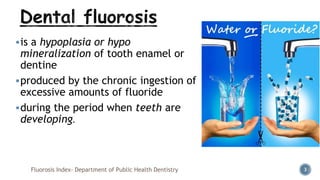
is a hypoplasia or hypo
mineralization of tooth enamel or
dentine
produced by the chronic ingestion of
excessive amounts of fluoride
during the period when teeth are
developing.
Fluorosis Index- Department of Public Health Dentistry 3
Fluorosis Index- Department of Public Health Dentistry 4
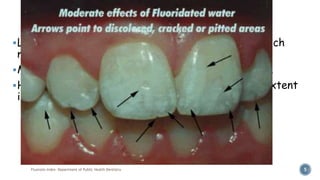
Lustreless, opaque white patches on the enamel which
may become mottled, striated and pitted.
Mottled areas may become stained yellow or brown.
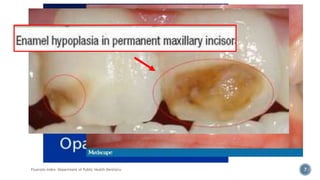
Hypoplastic areas may also be present to such an extent
in severe cases that normal tooth form is lost.
Fluorosis Index- Department of Public Health Dentistry 5
Fluorosis Index- Department of Public Health Dentistry 6
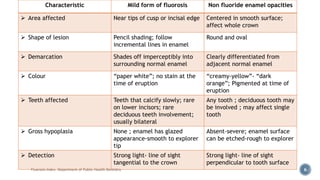
Characteristic Mild form of fluorosis Non fluoride enamel opacities
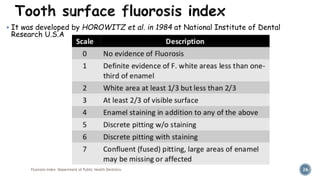
 Area affected Near tips of cusp or incisal edge Centered in smooth surface;
affect whole crown
 Shape of lesion Pencil shading; follow
incremental lines in enamel
Round and oval
 Demarcation Shades off imperceptibly into
surrounding normal enamel
Clearly differentiated from
adjacent normal enamel
 Colour “paper white”; no stain at the
time of eruption
“creamy-yellow”- “dark
orange”; Pigmented at time of
eruption
 Teeth affected Teeth that calcify slowly; rare
on lower incisors; rare
deciduous teeth involvement;
usually bilateral
Any tooth ; deciduous tooth may
be involved ; may affect single
tooth
 Gross hypoplasia None ; enamel has glazed
appearance-smooth to explorer
tip
Absent-severe; enamel surface
can be etched-rough to explorer
 Detection Strong light- line of sight
tangential to the crown
Strong light- line of sight
perpendicular to tooth surface
Fluorosis Index- Department of Public Health Dentistry 7
Fluorosis Index- Department of Public Health Dentistry 8
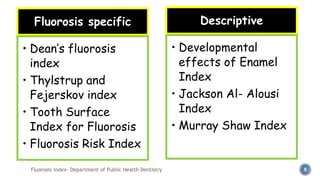
Fluorosis specific
• Dean’s fluorosis
index
• Thylstrup and
Fejerskov index
• Tooth Surface
Index for Fluorosis
• Fluorosis Risk Index
Descriptive
• Developmental
effects of Enamel
Index
• Jackson Al- Alousi
Index
• Murray Shaw Index
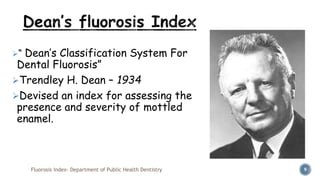
“ Dean’s Classification System For
Dental Fluorosis”
Trendley H. Dean – 1934
Devised an index for assessing the
presence and severity of mottled
enamel.
Fluorosis Index- Department of Public Health Dentistry 9
Fluorosis Index- Department of Public Health Dentistry 10
The fluorosis index set
criteria for categorization of
dental fluorosis on a 7 point
scale.
Although no numbers were
used it was considered to be
on an ordinal scale.
Under his classification all
those showing hypoplasia
other than mottling of enamel
were placed in normal
category.
Children who had not lived in
the community continuously or
ha obtained domestic water
from other than public supply
are eliminated.
Salient
Features
Fluorosis Index- Department of Public Health Dentistry 11
Mouth mirror and probes
were utilized for
examination.
Examinations are made in
good natural light with
the subject sitting facing
the window
If there is doubt, lower
score is recorded.
Fluorosis Index- Department of Public Health Dentistry 12
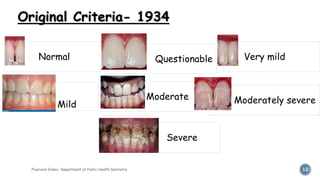
Original Criteria- 1934
Normal Questionable Very mild
Mild
Moderate Moderately severe
Severe
Dean’s fluorosis index- Modified
Criteria (1942)
Combined “moderately severe” and “severe”
6 point ordinal scale
Extensively used today
Recommended by WHO in its basic survey manual(W.H.O,
1997)
The scoring system 0-4
Fluorosis Index- Department of Public Health Dentistry 13
Fluorosis Index- Department of Public Health Dentistry 14
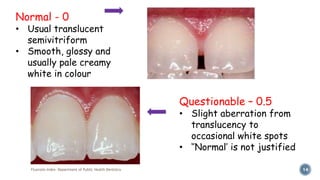
Normal - 0
• Usual translucent
semivitriform
• Smooth, glossy and
usually pale creamy
white in colour
Questionable – 0.5
• Slight aberration from
translucency to
occasional white spots
• ‘’Normal’ is not justified
Fluorosis Index- Department of Public Health Dentistry 15
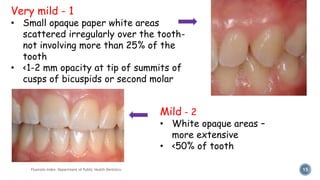
Very mild - 1
• Small opaque paper white areas
scattered irregularly over the tooth-
not involving more than 25% of the
tooth
• <1-2 mm opacity at tip of summits of
cusps of bicuspids or second molar
Mild - 2
• White opaque areas –
more extensive
• <50% of tooth
Fluorosis Index- Department of Public Health Dentistry 16
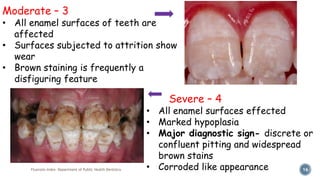
Moderate – 3
• All enamel surfaces of teeth are
affected
• Surfaces subjected to attrition show
wear
• Brown staining is frequently a
disfiguring feature
Severe – 4
• All enamel surfaces effected
• Marked hypoplasia
• Major diagnostic sign- discrete or
confluent pitting and widespread
brown stains
• Corroded like appearance
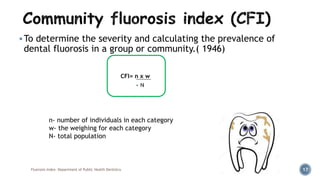
To determine the severity and calculating the prevalence of
dental fluorosis in a group or community.( 1946)
Fluorosis Index- Department of Public Health Dentistry 17
CFI= n x w
n- number of individuals in each category
w- the weighing for each category
N- total population
Fluorosis Index- Department of Public Health Dentistry 18
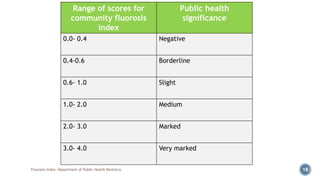
Range of scores for
community fluorosis
index
Public health
significance
0.0- 0.4 Negative
0.4-0.6 Borderline
0.6- 1.0 Slight
1.0- 2.0 Medium
2.0- 3.0 Marked
3.0- 4.0 Very marked
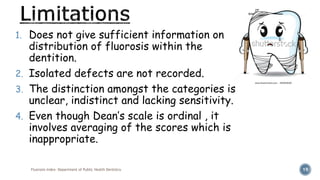
1. Does not give sufficient information on
distribution of fluorosis within the
dentition.
2. Isolated defects are not recorded.
3. The distinction amongst the categories is
unclear, indistinct and lacking sensitivity.
4. Even though Dean’s scale is ordinal , it
involves averaging of the scores which is
inappropriate.
Fluorosis Index- Department of Public Health Dentistry 19
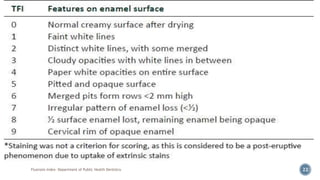
Thylstrup and Fejerskov Index for Fluorosis
1978
TFI given By Thylstrup A. and Fejerskov O.
Purpose-to refine modify and extend the Dean’s Index.
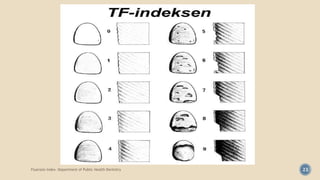
10 point classification system designed to characterize the
macroscopic appearance of teeth in relation to the
underlying histological condition of enamel.
In 1988 TFI was modified by Fejerskov - 0nly one surface
examined.
Fluorosis Index- Department of Public Health Dentistry 20
Fluorosis Index- Department of Public Health Dentistry 21
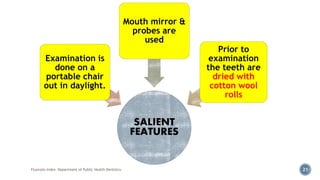
SALIENT
FEATURES
Examination is
done on a
portable chair
out in daylight.
Mouth mirror &
probes are
used
Prior to
examination
the teeth are
dried with
cotton wool
rolls
Fluorosis Index- Department of Public Health Dentistry 22
Fluorosis Index- Department of Public Health Dentistry 23
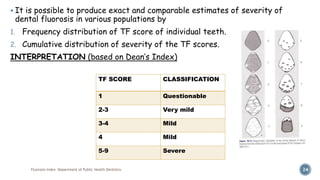
 It is possible to produce exact and comparable estimates of severity of
dental fluorosis in various populations by
1. Frequency distribution of TF score of individual teeth.
2. Cumulative distribution of severity of the TF scores.
INTERPRETATION (based on Dean’s Index)
Fluorosis Index- Department of Public Health Dentistry 24
TF SCORE CLASSIFICATION
1 Questionable
2-3 Very mild
3-4 Mild
4 Mild
5-9 Severe
 It attempts to validate the visual appearance against the histological defect.
 Most sensitive of all fluorosis measuring indices.
 Studies have concluded that the T-F index is the most indicated for work
where detailed information about the problem is required.
[Cleaton-Jones and Hargreaves (1990) ; Granath et al. (1985)]
 Clarkson (1989) reported that in TF index drying of teeth creates an
unnatural situation due to which changes in score 1 and 2 are very minor.
The aesthetic significance of these changes are questionable.
Fluorosis Index- Department of Public Health Dentistry 25
Disadvanta
ges
 It was developed by HOROWITZ et al. in 1984 at National Institute of Dental
Research U.S.A
Fluorosis Index- Department of Public Health Dentistry 26
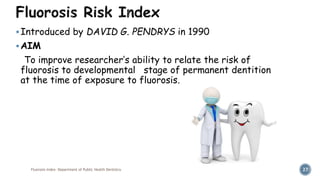
Introduced by DAVID G. PENDRYS in 1990
AIM
To improve researcher’s ability to relate the risk of
fluorosis to developmental stage of permanent dentition
at the time of exposure to fluorosis.
Fluorosis Index- Department of Public Health Dentistry 27
Fluorosis Index- Department of Public Health Dentistry 28
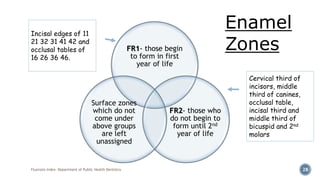
FR1- those begin
to form in first
year of life
FR2- those who
do not begin to
form until 2nd
year of life
Surface zones
which do not
come under
above groups
are left
unassigned
Incisal edges of 11
21 32 31 41 42 and
occlusal tables of
16 26 36 46.
Cervical third of
incisors, middle
third of canines,
occlusal table,
incisal third and
middle third of
bicuspid and 2nd
molars
Enamel
Zones
Fluorosis Index- Department of Public Health Dentistry 29
 Essentials of public health dentistry- Soben Peter 5 th edition
 PubMed
 Antonio Carlos PEREIRA ;Ben-Hur Wey MOREIRA; Analysis of Three Dental
Fluorosis Indexes Used in Epidemiologic Trials, Braz Dent J (1999) 10(1): 1-60
 Pendrys DG, Katz RV, Morse DE. Risk factors for enamel fluorosis in a fluoridated
population. Am J Epidemiol 1994;140:461-71
 R.G Rosier, Epidemiologic Indices for Measuring the Clinical Manifestations of
Dental Fluorosis: Overview and Critique; ADR June 1994 vol. 8 no. 1 39-55
Fluorosis Index- Department of Public Health Dentistry 30
Thank you and God
bless
Fluorosis Index- Department of Public Health Dentistry 31

Fluorosis index

  • 2.
    CONTENTS  Fluorosis  Differencebetween dental fluorosis and non fluoride enamel opacities  Different index  Dean’s Fluorosis Index  Thylstrup and Fejerskov  Other index at a glance Fluorosis Index- Department of Public Health Dentistry 2
  • 3.
    is a hypoplasiaor hypo mineralization of tooth enamel or dentine produced by the chronic ingestion of excessive amounts of fluoride during the period when teeth are developing. Fluorosis Index- Department of Public Health Dentistry 3
  • 4.
    Fluorosis Index- Departmentof Public Health Dentistry 4
  • 5.
    Lustreless, opaque whitepatches on the enamel which may become mottled, striated and pitted. Mottled areas may become stained yellow or brown. Hypoplastic areas may also be present to such an extent in severe cases that normal tooth form is lost. Fluorosis Index- Department of Public Health Dentistry 5
  • 6.
    Fluorosis Index- Departmentof Public Health Dentistry 6 Characteristic Mild form of fluorosis Non fluoride enamel opacities  Area affected Near tips of cusp or incisal edge Centered in smooth surface; affect whole crown  Shape of lesion Pencil shading; follow incremental lines in enamel Round and oval  Demarcation Shades off imperceptibly into surrounding normal enamel Clearly differentiated from adjacent normal enamel  Colour “paper white”; no stain at the time of eruption “creamy-yellow”- “dark orange”; Pigmented at time of eruption  Teeth affected Teeth that calcify slowly; rare on lower incisors; rare deciduous teeth involvement; usually bilateral Any tooth ; deciduous tooth may be involved ; may affect single tooth  Gross hypoplasia None ; enamel has glazed appearance-smooth to explorer tip Absent-severe; enamel surface can be etched-rough to explorer  Detection Strong light- line of sight tangential to the crown Strong light- line of sight perpendicular to tooth surface
  • 7.
    Fluorosis Index- Departmentof Public Health Dentistry 7
  • 8.
    Fluorosis Index- Departmentof Public Health Dentistry 8 Fluorosis specific • Dean’s fluorosis index • Thylstrup and Fejerskov index • Tooth Surface Index for Fluorosis • Fluorosis Risk Index Descriptive • Developmental effects of Enamel Index • Jackson Al- Alousi Index • Murray Shaw Index
  • 9.
    “ Dean’s ClassificationSystem For Dental Fluorosis” Trendley H. Dean – 1934 Devised an index for assessing the presence and severity of mottled enamel. Fluorosis Index- Department of Public Health Dentistry 9
  • 10.
    Fluorosis Index- Departmentof Public Health Dentistry 10 The fluorosis index set criteria for categorization of dental fluorosis on a 7 point scale. Although no numbers were used it was considered to be on an ordinal scale. Under his classification all those showing hypoplasia other than mottling of enamel were placed in normal category. Children who had not lived in the community continuously or ha obtained domestic water from other than public supply are eliminated. Salient Features
  • 11.
    Fluorosis Index- Departmentof Public Health Dentistry 11 Mouth mirror and probes were utilized for examination. Examinations are made in good natural light with the subject sitting facing the window If there is doubt, lower score is recorded.
  • 12.
    Fluorosis Index- Departmentof Public Health Dentistry 12 Original Criteria- 1934 Normal Questionable Very mild Mild Moderate Moderately severe Severe
  • 13.
    Dean’s fluorosis index-Modified Criteria (1942) Combined “moderately severe” and “severe” 6 point ordinal scale Extensively used today Recommended by WHO in its basic survey manual(W.H.O, 1997) The scoring system 0-4 Fluorosis Index- Department of Public Health Dentistry 13
  • 14.
    Fluorosis Index- Departmentof Public Health Dentistry 14 Normal - 0 • Usual translucent semivitriform • Smooth, glossy and usually pale creamy white in colour Questionable – 0.5 • Slight aberration from translucency to occasional white spots • ‘’Normal’ is not justified
  • 15.
    Fluorosis Index- Departmentof Public Health Dentistry 15 Very mild - 1 • Small opaque paper white areas scattered irregularly over the tooth- not involving more than 25% of the tooth • <1-2 mm opacity at tip of summits of cusps of bicuspids or second molar Mild - 2 • White opaque areas – more extensive • <50% of tooth
  • 16.
    Fluorosis Index- Departmentof Public Health Dentistry 16 Moderate – 3 • All enamel surfaces of teeth are affected • Surfaces subjected to attrition show wear • Brown staining is frequently a disfiguring feature Severe – 4 • All enamel surfaces effected • Marked hypoplasia • Major diagnostic sign- discrete or confluent pitting and widespread brown stains • Corroded like appearance
  • 17.
    To determine theseverity and calculating the prevalence of dental fluorosis in a group or community.( 1946) Fluorosis Index- Department of Public Health Dentistry 17 CFI= n x w n- number of individuals in each category w- the weighing for each category N- total population
  • 18.
    Fluorosis Index- Departmentof Public Health Dentistry 18 Range of scores for community fluorosis index Public health significance 0.0- 0.4 Negative 0.4-0.6 Borderline 0.6- 1.0 Slight 1.0- 2.0 Medium 2.0- 3.0 Marked 3.0- 4.0 Very marked
  • 19.
    1. Does notgive sufficient information on distribution of fluorosis within the dentition. 2. Isolated defects are not recorded. 3. The distinction amongst the categories is unclear, indistinct and lacking sensitivity. 4. Even though Dean’s scale is ordinal , it involves averaging of the scores which is inappropriate. Fluorosis Index- Department of Public Health Dentistry 19
  • 20.
    Thylstrup and FejerskovIndex for Fluorosis 1978 TFI given By Thylstrup A. and Fejerskov O. Purpose-to refine modify and extend the Dean’s Index. 10 point classification system designed to characterize the macroscopic appearance of teeth in relation to the underlying histological condition of enamel. In 1988 TFI was modified by Fejerskov - 0nly one surface examined. Fluorosis Index- Department of Public Health Dentistry 20
  • 21.
    Fluorosis Index- Departmentof Public Health Dentistry 21 SALIENT FEATURES Examination is done on a portable chair out in daylight. Mouth mirror & probes are used Prior to examination the teeth are dried with cotton wool rolls
  • 22.
    Fluorosis Index- Departmentof Public Health Dentistry 22
  • 23.
    Fluorosis Index- Departmentof Public Health Dentistry 23
  • 24.
     It ispossible to produce exact and comparable estimates of severity of dental fluorosis in various populations by 1. Frequency distribution of TF score of individual teeth. 2. Cumulative distribution of severity of the TF scores. INTERPRETATION (based on Dean’s Index) Fluorosis Index- Department of Public Health Dentistry 24 TF SCORE CLASSIFICATION 1 Questionable 2-3 Very mild 3-4 Mild 4 Mild 5-9 Severe
  • 25.
     It attemptsto validate the visual appearance against the histological defect.  Most sensitive of all fluorosis measuring indices.  Studies have concluded that the T-F index is the most indicated for work where detailed information about the problem is required. [Cleaton-Jones and Hargreaves (1990) ; Granath et al. (1985)]  Clarkson (1989) reported that in TF index drying of teeth creates an unnatural situation due to which changes in score 1 and 2 are very minor. The aesthetic significance of these changes are questionable. Fluorosis Index- Department of Public Health Dentistry 25 Disadvanta ges
  • 26.
     It wasdeveloped by HOROWITZ et al. in 1984 at National Institute of Dental Research U.S.A Fluorosis Index- Department of Public Health Dentistry 26
  • 27.
    Introduced by DAVIDG. PENDRYS in 1990 AIM To improve researcher’s ability to relate the risk of fluorosis to developmental stage of permanent dentition at the time of exposure to fluorosis. Fluorosis Index- Department of Public Health Dentistry 27
  • 28.
    Fluorosis Index- Departmentof Public Health Dentistry 28 FR1- those begin to form in first year of life FR2- those who do not begin to form until 2nd year of life Surface zones which do not come under above groups are left unassigned Incisal edges of 11 21 32 31 41 42 and occlusal tables of 16 26 36 46. Cervical third of incisors, middle third of canines, occlusal table, incisal third and middle third of bicuspid and 2nd molars Enamel Zones
  • 29.
    Fluorosis Index- Departmentof Public Health Dentistry 29
  • 30.
     Essentials ofpublic health dentistry- Soben Peter 5 th edition  PubMed  Antonio Carlos PEREIRA ;Ben-Hur Wey MOREIRA; Analysis of Three Dental Fluorosis Indexes Used in Epidemiologic Trials, Braz Dent J (1999) 10(1): 1-60  Pendrys DG, Katz RV, Morse DE. Risk factors for enamel fluorosis in a fluoridated population. Am J Epidemiol 1994;140:461-71  R.G Rosier, Epidemiologic Indices for Measuring the Clinical Manifestations of Dental Fluorosis: Overview and Critique; ADR June 1994 vol. 8 no. 1 39-55 Fluorosis Index- Department of Public Health Dentistry 30
  • 31.
    Thank you andGod bless Fluorosis Index- Department of Public Health Dentistry 31

Editor's Notes