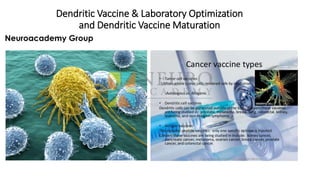
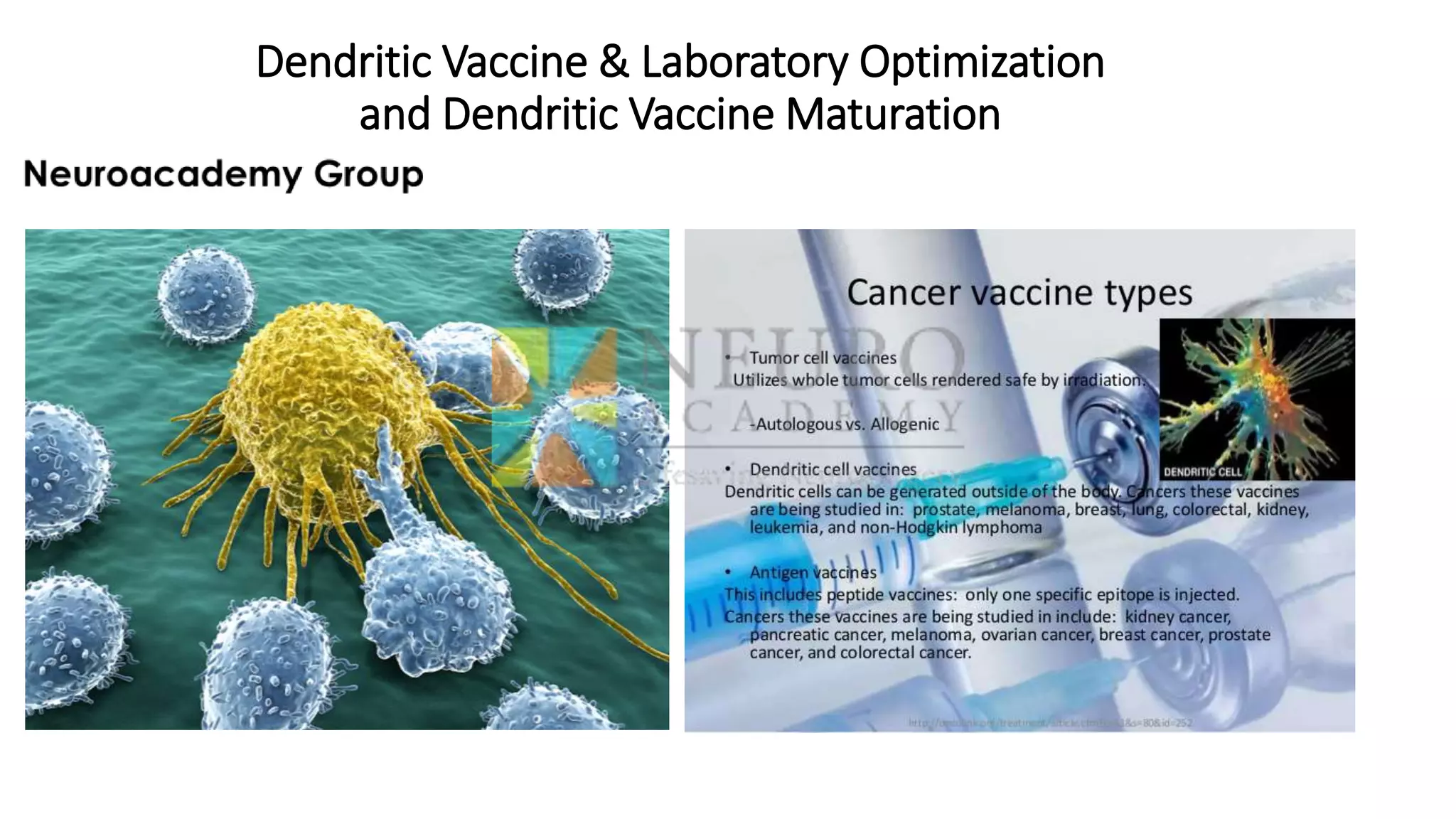


Dendritic Vaccine & Laboratory Optimization
and Dendritic Vaccine Maturation
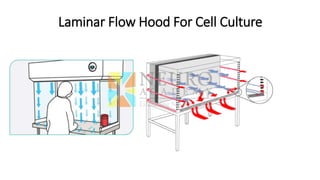
Laminar Flow Hood For Cell Culture
Laminar Flow Hood & Sterile Pipettes
Laminar Flow Hood/Cabinet & Consumables
Cell Culture: Importance for Sterility & Cell Culture
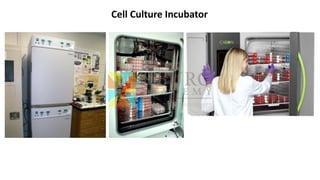
Incubator
Cell Culture Incubator
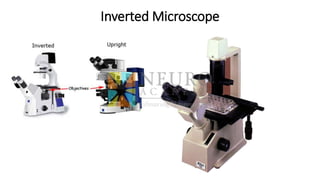
Inverted Microscope
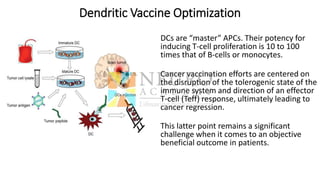
Dendritic Vaccine Optimization
DCs are “master” APCs. Their potency for
inducing T-cell proliferation is 10 to 100
times that of B-cells or monocytes.
Cancer vaccination efforts are centered on
the disruption of the tolerogenic state of the
immune system and direction of an effector
T-cell (Teff) response, ultimately leading to
cancer regression.
This latter point remains a significant
challenge when it comes to an objective
beneficial outcome in patients.
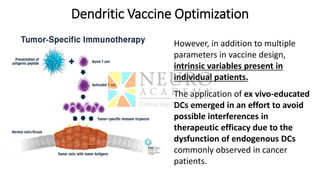
Dendritic Vaccine Optimization
However, in addition to multiple
parameters in vaccine design,
intrinsic variables present in
individual patients.
The application of ex vivo-educated
DCs emerged in an effort to avoid
possible interferences in
therapeutic efficacy due to the
dysfunction of endogenous DCs
commonly observed in cancer
patients.
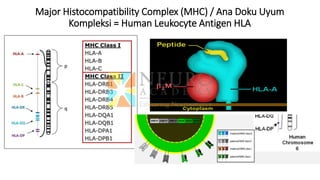
Major Histocompatibility Complex (MHC) / Ana Doku Uyum
Kompleksi = Human Leukocyte Antigen HLA
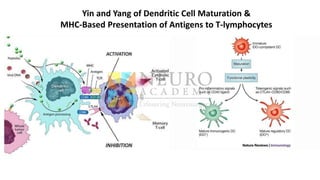
Yin and Yang of Dendritic Cell Maturation &
MHC-Based Presentation of Antigens to T-lymphocytes
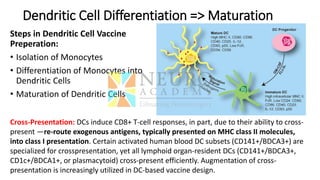
Dendritic Cell Differentiation => Maturation
Steps in Dendritic Cell Vaccine
Preperation:
• Isolation of Monocytes
• Differentiation of Monocytes into
Dendritic Cells
• Maturation of Dendritic Cells
Cross-Presentation: DCs induce CD8+ T-cell responses, in part, due to their ability to cross-
present —re-route exogenous antigens, typically presented on MHC class II molecules,
into class I presentation. Certain activated human blood DC subsets (CD141+/BDCA3+) are
specialized for crosspresentation, yet all lymphoid organ-resident DCs (CD141+/BDCA3+,
CD1c+/BDCA1+, or plasmacytoid) cross-present efficiently. Augmentation of cross-
presentation is increasingly utilized in DC-based vaccine design.
Dendritic Vaccine Optimization
Ex vivo DCs are mainly generated through in vitro
differentiation of peripheral blood mononuclear cells
(PBMCs) in the presence of granulocyte–macrophage
colony-stimulating factor (GM-CSF) and interleukin
IL-4 or IL-13.
Langerhans cell-type DCs — derived from CD34+
progenitors or IL-15-monocytes— are more efficient
at priming antigen-specific CTLs than GM-CSF/IL-4-
DCs.
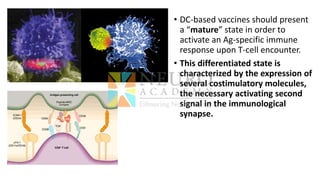
• DC-based vaccines should present
a “mature” state in order to
activate an Ag-specific immune
response upon T-cell encounter.
• This differentiated state is
characterized by the expression of
several costimulatory molecules,
the necessary activating second
signal in the immunological
synapse.
Dendritic Cell Maturation
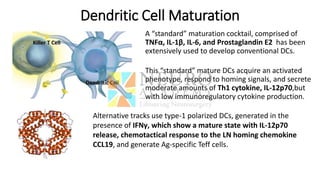
A “standard” maturation cocktail, comprised of
TNFα, IL-1β, IL-6, and Prostaglandin E2 has been
extensively used to develop conventional DCs.
This “standard” mature DCs acquire an activated
phenotype, respond to homing signals, and secrete
moderate amounts of Th1 cytokine, IL-12p70,but
with low immunoregulatory cytokine production.
Alternative tracks use type-1 polarized DCs, generated in the
presence of IFNγ, which show a mature state with IL-12p70
release, chemotactical response to the LN homing chemokine
CCL19, and generate Ag-specific Teff cells.
Dendritic Vaccine Optimization
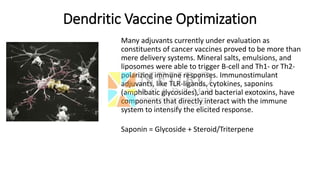
Many adjuvants currently under evaluation as
constituents of cancer vaccines proved to be more than
mere delivery systems. Mineral salts, emulsions, and
liposomes were able to trigger B-cell and Th1- or Th2-
polarizing immune responses. Immunostimulant
adjuvants, like TLR-ligands, cytokines, saponins
(amphibatic glycosides), and bacterial exotoxins, have
components that directly interact with the immune
system to intensify the elicited response.
Saponin = Glycoside + Steroid/Triterpene
Dendritic Cell Maturation
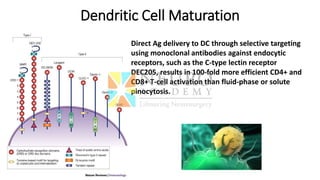
Direct Ag delivery to DC through selective targeting
using monoclonal antibodies against endocytic
receptors, such as the C-type lectin receptor
DEC205, results in 100-fold more efficient CD4+ and
CD8+ T-cell activation than fluid-phase or solute
pinocytosis.
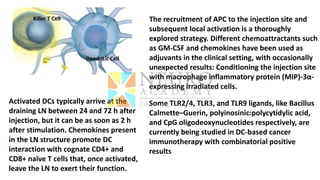
The recruitment of APC to the injection site and
subsequent local activation is a thoroughly
explored strategy. Different chemoattractants such
as GM-CSF and chemokines have been used as
adjuvants in the clinical setting, with occasionally
unexpected results: Conditioning the injection site
with macrophage inflammatory protein (MIP)-3α-
expressing irradiated cells.
Some TLR2/4, TLR3, and TLR9 ligands, like Bacillus
Calmette–Guerin, polyinosinic:polycytidylic acid,
and CpG oligodeoxynucleotides respectively, are
currently being studied in DC-based cancer
immunotherapy with combinatorial positive
results
Activated DCs typically arrive at the
draining LN between 24 and 72 h after
injection, but it can be as soon as 2 h
after stimulation. Chemokines present
in the LN structure promote DC
interaction with cognate CD4+ and
CD8+ naïve T cells that, once activated,
leave the LN to exert their function.
Dendritic Vaccine Optimization
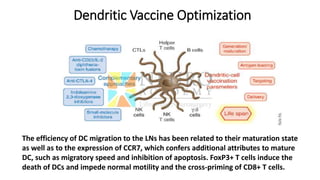
The efficiency of DC migration to the LNs has been related to their maturation state
as well as to the expression of CCR7, which confers additional attributes to mature
DC, such as migratory speed and inhibition of apoptosis. FoxP3+ T cells induce the
death of DCs and impede normal motility and the cross-priming of CD8+ T cells.
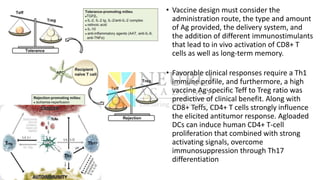
• Vaccine design must consider the
administration route, the type and amount
of Ag provided, the delivery system, and
the addition of different immunostimulants
that lead to in vivo activation of CD8+ T
cells as well as long-term memory.
• Favorable clinical responses require a Th1
immune profile, and furthermore, a high
vaccine Ag-specific Teff to Treg ratio was
predictive of clinical benefit. Along with
CD8+ Teffs, CD4+ T cells strongly influence
the elicited antitumor response. Agloaded
DCs can induce human CD4+ T-cell
proliferation that combined with strong
activating signals, overcome
immunosuppression through Th17
differentiation
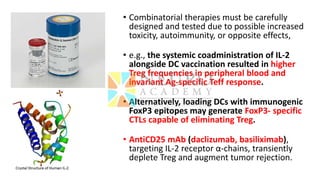
• Combinatorial therapies must be carefully
designed and tested due to possible increased
toxicity, autoimmunity, or opposite effects,
• e.g., the systemic coadministration of IL-2
alongside DC vaccination resulted in higher
Treg frequencies in peripheral blood and
invariant Ag-specific Teff response.
• Alternatively, loading DCs with immunogenic
FoxP3 epitopes may generate FoxP3- specific
CTLs capable of eliminating Treg.
• AntiCD25 mAb (daclizumab, basiliximab),
targeting IL-2 receptor α-chains, transiently
deplete Treg and augment tumor rejection.
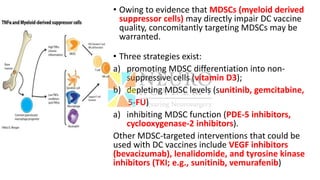
• Owing to evidence that MDSCs (myeloid derived
suppressor cells) may directly impair DC vaccine
quality, concomitantly targeting MDSCs may be
warranted.
• Three strategies exist:
a) promoting MDSC differentiation into non-
suppressive cells (vitamin D3);
b) depleting MDSC levels (sunitinib, gemcitabine,
5-FU)
a) inhibiting MDSC function (PDE-5 inhibitors,
cyclooxygenase-2 inhibitors).
Other MDSC-targeted interventions that could be
used with DC vaccines include VEGF inhibitors
(bevacizumab), lenalidomide, and tyrosine kinase
inhibitors (TKI; e.g., sunitinib, vemurafenib)
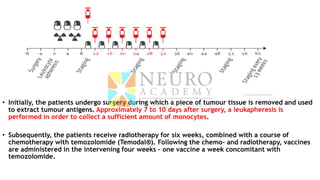
• Initially, the patients undergo surgery during which a piece of tumour tissue is removed and used
to extract tumour antigens. Approximately 7 to 10 days after surgery, a leukapheresis is
performed in order to collect a sufficient amount of monocytes.
• Subsequently, the patients receive radiotherapy for six weeks, combined with a course of
chemotherapy with temozolomide (Temodal®). Following the chemo- and radiotherapy, vaccines
are administered in the intervening four weeks – one vaccine a week concomitant with
temozolomide.
http://www.macrophage.de/
On April 28, 1999, the European Macrophage Society (EMS) was founded in Regensburg. At the end of
year 2000, the members of the EMS decided to rename the society as European Macrophage and
Dendritic Cell Society (EMDS) in order to better emphasize the two main streams of research within
the Society. -- EMDS Meeting 2016 in Amsterdam – 2016, Sept 21-23

Dendritic Vaccine Laboratory Optimization and Dendritic Cell Maturation

  • 1.
    Dendritic Vaccine &Laboratory Optimization and Dendritic Vaccine Maturation
  • 2.
    Laminar Flow HoodFor Cell Culture
  • 3.
    Laminar Flow Hood& Sterile Pipettes
  • 4.
  • 5.
    Cell Culture: Importancefor Sterility & Cell Culture Incubator
  • 6.
  • 7.
  • 8.
    Dendritic Vaccine Optimization DCsare “master” APCs. Their potency for inducing T-cell proliferation is 10 to 100 times that of B-cells or monocytes. Cancer vaccination efforts are centered on the disruption of the tolerogenic state of the immune system and direction of an effector T-cell (Teff) response, ultimately leading to cancer regression. This latter point remains a significant challenge when it comes to an objective beneficial outcome in patients.
  • 9.
    Dendritic Vaccine Optimization However,in addition to multiple parameters in vaccine design, intrinsic variables present in individual patients. The application of ex vivo-educated DCs emerged in an effort to avoid possible interferences in therapeutic efficacy due to the dysfunction of endogenous DCs commonly observed in cancer patients.
  • 10.
    Major Histocompatibility Complex(MHC) / Ana Doku Uyum Kompleksi = Human Leukocyte Antigen HLA
  • 11.
    Yin and Yangof Dendritic Cell Maturation & MHC-Based Presentation of Antigens to T-lymphocytes
  • 12.
    Dendritic Cell Differentiation=> Maturation Steps in Dendritic Cell Vaccine Preperation: • Isolation of Monocytes • Differentiation of Monocytes into Dendritic Cells • Maturation of Dendritic Cells Cross-Presentation: DCs induce CD8+ T-cell responses, in part, due to their ability to cross- present —re-route exogenous antigens, typically presented on MHC class II molecules, into class I presentation. Certain activated human blood DC subsets (CD141+/BDCA3+) are specialized for crosspresentation, yet all lymphoid organ-resident DCs (CD141+/BDCA3+, CD1c+/BDCA1+, or plasmacytoid) cross-present efficiently. Augmentation of cross- presentation is increasingly utilized in DC-based vaccine design.
  • 13.
    Dendritic Vaccine Optimization Exvivo DCs are mainly generated through in vitro differentiation of peripheral blood mononuclear cells (PBMCs) in the presence of granulocyte–macrophage colony-stimulating factor (GM-CSF) and interleukin IL-4 or IL-13. Langerhans cell-type DCs — derived from CD34+ progenitors or IL-15-monocytes— are more efficient at priming antigen-specific CTLs than GM-CSF/IL-4- DCs.
  • 14.
    • DC-based vaccinesshould present a “mature” state in order to activate an Ag-specific immune response upon T-cell encounter. • This differentiated state is characterized by the expression of several costimulatory molecules, the necessary activating second signal in the immunological synapse.
  • 15.
    Dendritic Cell Maturation A“standard” maturation cocktail, comprised of TNFα, IL-1β, IL-6, and Prostaglandin E2 has been extensively used to develop conventional DCs. This “standard” mature DCs acquire an activated phenotype, respond to homing signals, and secrete moderate amounts of Th1 cytokine, IL-12p70,but with low immunoregulatory cytokine production. Alternative tracks use type-1 polarized DCs, generated in the presence of IFNγ, which show a mature state with IL-12p70 release, chemotactical response to the LN homing chemokine CCL19, and generate Ag-specific Teff cells.
  • 16.
    Dendritic Vaccine Optimization Manyadjuvants currently under evaluation as constituents of cancer vaccines proved to be more than mere delivery systems. Mineral salts, emulsions, and liposomes were able to trigger B-cell and Th1- or Th2- polarizing immune responses. Immunostimulant adjuvants, like TLR-ligands, cytokines, saponins (amphibatic glycosides), and bacterial exotoxins, have components that directly interact with the immune system to intensify the elicited response. Saponin = Glycoside + Steroid/Triterpene
  • 17.
    Dendritic Cell Maturation DirectAg delivery to DC through selective targeting using monoclonal antibodies against endocytic receptors, such as the C-type lectin receptor DEC205, results in 100-fold more efficient CD4+ and CD8+ T-cell activation than fluid-phase or solute pinocytosis.
  • 18.
    The recruitment ofAPC to the injection site and subsequent local activation is a thoroughly explored strategy. Different chemoattractants such as GM-CSF and chemokines have been used as adjuvants in the clinical setting, with occasionally unexpected results: Conditioning the injection site with macrophage inflammatory protein (MIP)-3α- expressing irradiated cells. Some TLR2/4, TLR3, and TLR9 ligands, like Bacillus Calmette–Guerin, polyinosinic:polycytidylic acid, and CpG oligodeoxynucleotides respectively, are currently being studied in DC-based cancer immunotherapy with combinatorial positive results Activated DCs typically arrive at the draining LN between 24 and 72 h after injection, but it can be as soon as 2 h after stimulation. Chemokines present in the LN structure promote DC interaction with cognate CD4+ and CD8+ naïve T cells that, once activated, leave the LN to exert their function.
  • 19.
    Dendritic Vaccine Optimization Theefficiency of DC migration to the LNs has been related to their maturation state as well as to the expression of CCR7, which confers additional attributes to mature DC, such as migratory speed and inhibition of apoptosis. FoxP3+ T cells induce the death of DCs and impede normal motility and the cross-priming of CD8+ T cells.
  • 20.
    • Vaccine designmust consider the administration route, the type and amount of Ag provided, the delivery system, and the addition of different immunostimulants that lead to in vivo activation of CD8+ T cells as well as long-term memory. • Favorable clinical responses require a Th1 immune profile, and furthermore, a high vaccine Ag-specific Teff to Treg ratio was predictive of clinical benefit. Along with CD8+ Teffs, CD4+ T cells strongly influence the elicited antitumor response. Agloaded DCs can induce human CD4+ T-cell proliferation that combined with strong activating signals, overcome immunosuppression through Th17 differentiation
  • 21.
    • Combinatorial therapiesmust be carefully designed and tested due to possible increased toxicity, autoimmunity, or opposite effects, • e.g., the systemic coadministration of IL-2 alongside DC vaccination resulted in higher Treg frequencies in peripheral blood and invariant Ag-specific Teff response. • Alternatively, loading DCs with immunogenic FoxP3 epitopes may generate FoxP3- specific CTLs capable of eliminating Treg. • AntiCD25 mAb (daclizumab, basiliximab), targeting IL-2 receptor α-chains, transiently deplete Treg and augment tumor rejection.
  • 22.
    • Owing toevidence that MDSCs (myeloid derived suppressor cells) may directly impair DC vaccine quality, concomitantly targeting MDSCs may be warranted. • Three strategies exist: a) promoting MDSC differentiation into non- suppressive cells (vitamin D3); b) depleting MDSC levels (sunitinib, gemcitabine, 5-FU) a) inhibiting MDSC function (PDE-5 inhibitors, cyclooxygenase-2 inhibitors). Other MDSC-targeted interventions that could be used with DC vaccines include VEGF inhibitors (bevacizumab), lenalidomide, and tyrosine kinase inhibitors (TKI; e.g., sunitinib, vemurafenib)
  • 23.
    • Initially, thepatients undergo surgery during which a piece of tumour tissue is removed and used to extract tumour antigens. Approximately 7 to 10 days after surgery, a leukapheresis is performed in order to collect a sufficient amount of monocytes. • Subsequently, the patients receive radiotherapy for six weeks, combined with a course of chemotherapy with temozolomide (Temodal®). Following the chemo- and radiotherapy, vaccines are administered in the intervening four weeks – one vaccine a week concomitant with temozolomide.
  • 24.
    http://www.macrophage.de/ On April 28,1999, the European Macrophage Society (EMS) was founded in Regensburg. At the end of year 2000, the members of the EMS decided to rename the society as European Macrophage and Dendritic Cell Society (EMDS) in order to better emphasize the two main streams of research within the Society. -- EMDS Meeting 2016 in Amsterdam – 2016, Sept 21-23