HEALTH FOR ALL
DR. MAHESWARI JAIKUMAR.maheswarijaikumar2103@gmail.com
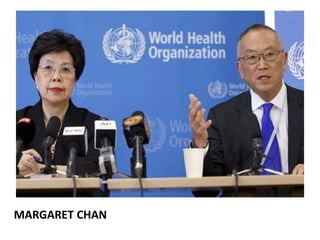
MARGARET CHAN
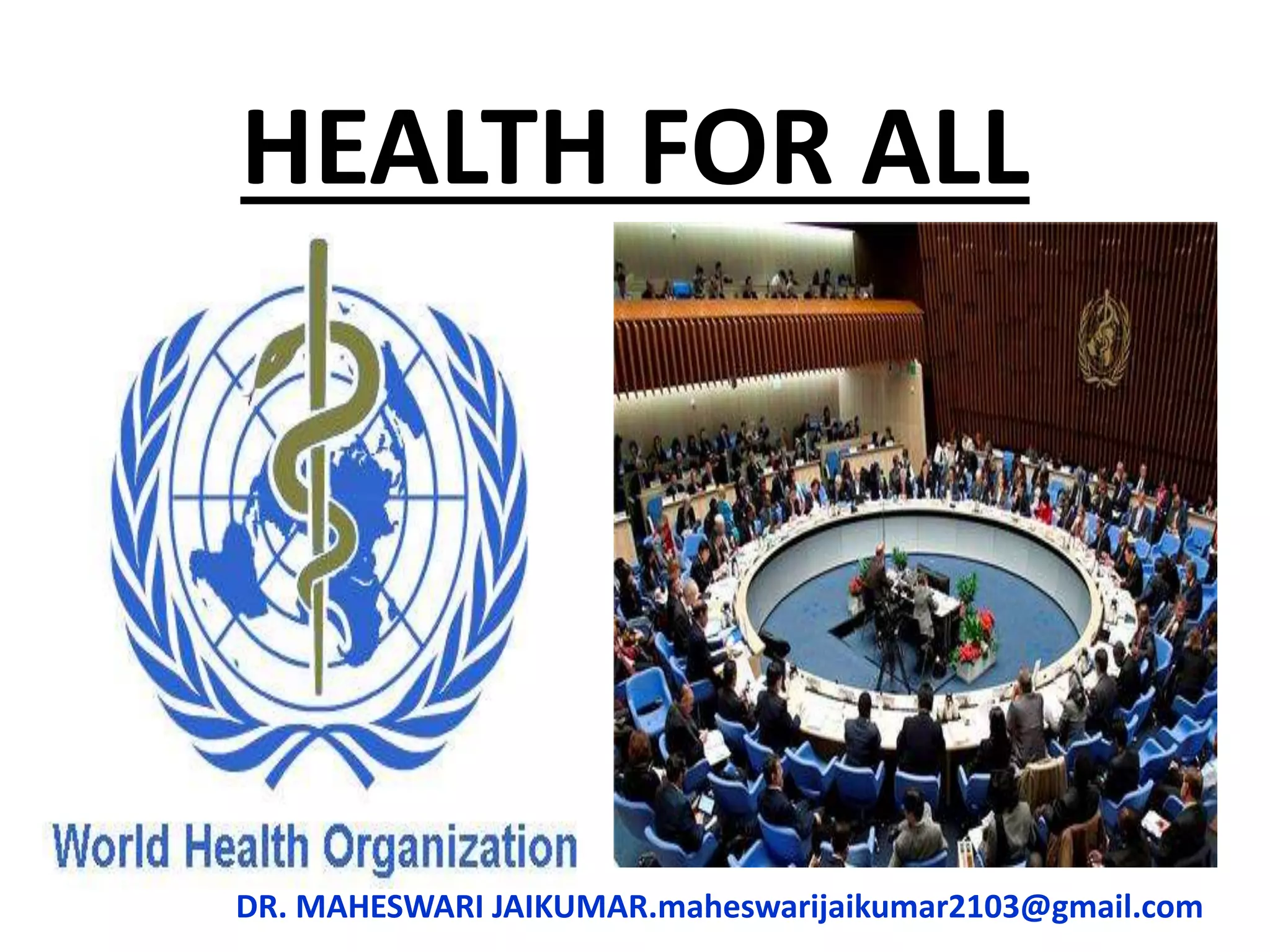
HEALTH FOR ALL
• The slogan Health For All was
given by the World Health
Oraganization in the year 1977
(May)
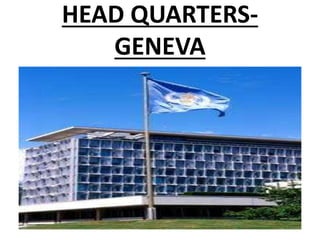
HEAD QUARTERS-
GENEVA
GOAL OF WHO
• Health For All is the main social
goal of governments and WHO.
• It is the attainment by all the
people of the world by the year
2000 AD “a level of health that
will permit them to lead a
socially and economically
productive life”.
• This goal has come to be
popularly known as “Health For
All by 2000 AD”.
BACKGROUND OF THE
PHILOSOPHY
• The background of this philosophy
was the unacceptably low levels of
health status of the world’s
population especially the rural
poor and gross disparities in health
between the rich and poor, urban
and rural population.
CONCEPT OF HFA
• The essential concept of “EQUITY
IN HEALTH” i.e., all people
should have an opportunity to
enjoy good health.
GLOBAL STRATEGY
• In 1981, a global strategy for HFA
was evolved by WHO.
• The global strategy provides a
global framework that is broad
enough to apply to all member
States and flexible enough to be
adapted to national and regional
variations of conditions and
requirements.
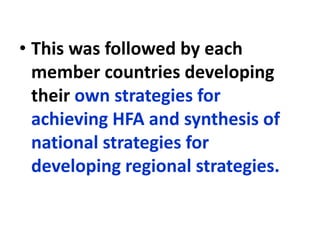
• This was followed by each
member countries developing
their own strategies for
achieving HFA and synthesis of
national strategies for
developing regional strategies.
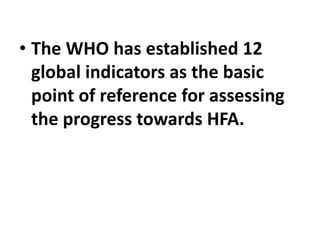
• The WHO has established 12
global indicators as the basic
point of reference for assessing
the progress towards HFA.
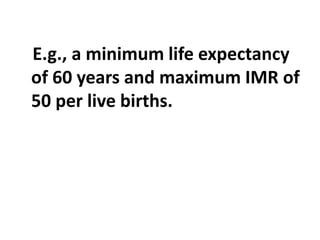
E.g., a minimum life expectancy
of 60 years and maximum IMR of
50 per live births.
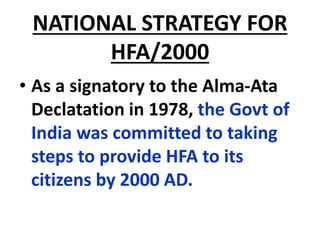
NATIONAL STRATEGY FOR
HFA/2000
• As a signatory to the Alma-Ata
Declatation in 1978, the Govt of
India was committed to taking
steps to provide HFA to its
citizens by 2000 AD.
• In pursuance of this objective
various attempts were made to
evolve suitable strategies and
approaches.
• In this connection two important
reports appeared.
• 1. Report on the Study Group on
“Health Fror All- an alternative
strategy”, sponsored by ICSSR
and ICMR.
• 2. Report of Working Group on
“Health For All by 2000 AD”
sponsored by the Ministry of
Health and family Welfare, Govt
of India.
• Both the groups considered in
great detail the various issues
involved in providing primary
health care in the Indian context.
• These reports formed the basis
of the National health Policy
formulated by the Ministry of
Health & family Welfare, Govt of
India in 1983 which committed
the Govt and people of India to
the achievement of HFA.
• The National Health Policy
echoes the WHO call for HFA and
the Alma- Ata Declaration.
• It has laid down specific goals in
respect of the various health
indicators by different dates such
as 1990, and 2000 AD.
• Foremost among the goals to be
achieved by 2000 AD were :
1. Reduction of IMR from the level
of 125 (1978) to below 60.
2. To raise the expectation of life
at birth from the level of 52
years to 64.
3. To reduce the crude death rate
from the level of 14 per 1000
pop to 9 per 1000 pop.
4. To reduce the crude birth rate
from the level of 33 per 1000
pop to 21.
5. To achieve a net reproduction
rate of one.
6. To provide portable water to
the entire rural population.
NATIONAL STRATEGY
FOR HFA
• The Govt of India recognized and
strengthened the infrastructure
to implement primary health
care.
• The infrastructure is as follows :
1. VILLAGE HEALTH POST
• In plain area, there is one Village
health Post (VHP) for 1000 pop
and in hilly & tribal areas for 500
pop.
Cont…
• Each VHP is manned by 1 Trained
Birth Attendant (TBA) and 1
Village Health Guide (VHG).
• There is also 1 Anganwadi
worker.
2. SUBCENTRE
• In plain area, there is provision
of 1 Health Subcentre (HSc) for
5000 pop and in tribal & hilly
areas 1 HSc for 2500-3000 pop.
Cont…
• Each HSc is manned by 1 Health
Worker Female (HW), {Auxillary
Nurse Midwife (ANM)} and 1
Health Worker (M) and 1 part
time attendant.
3. PRIMARY HEALTH CENTRE
• There is provision of one Primary
Health centre (PHC) for every
30,000 pop in plain areas and 1
PHC for every 25,000 pop in
tribal and hilly areas.
Cont..
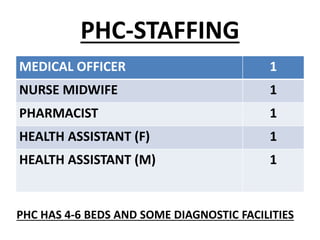
PHC-STAFFING
MEDICAL OFFICER 1
NURSE MIDWIFE 1
PHARMACIST 1
HEALTH ASSISTANT (F) 1
HEALTH ASSISTANT (M) 1
PHC HAS 4-6 BEDS AND SOME DIAGNOSTIC FACILITIES
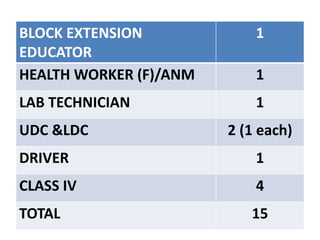
BLOCK EXTENSION
EDUCATOR
1
HEALTH WORKER (F)/ANM 1
LAB TECHNICIAN 1
UDC &LDC 2 (1 each)
DRIVER 1
CLASS IV 4
TOTAL 15
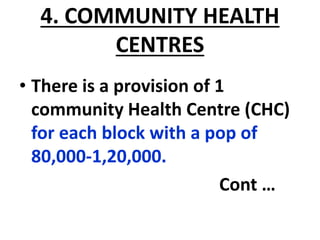
4. COMMUNITY HEALTH
CENTRES
• There is a provision of 1
community Health Centre (CHC)
for each block with a pop of
80,000-1,20,000.
Cont …
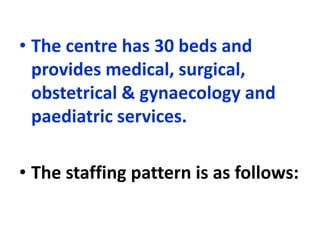
• The centre has 30 beds and
provides medical, surgical,
obstetrical & gynaecology and
paediatric services.
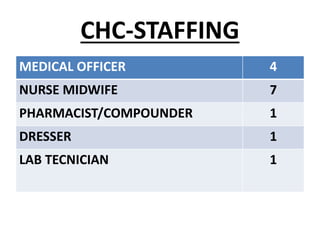
• The staffing pattern is as follows:
CHC-STAFFING
MEDICAL OFFICER 4
NURSE MIDWIFE 7
PHARMACIST/COMPOUNDER 1
DRESSER 1
LAB TECNICIAN 1
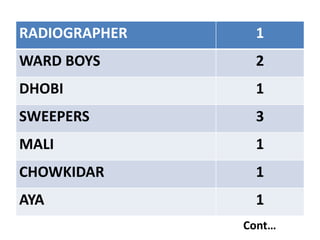
RADIOGRAPHER 1
WARD BOYS 2
DHOBI 1
SWEEPERS 3
MALI 1
CHOWKIDAR 1
AYA 1
Cont…
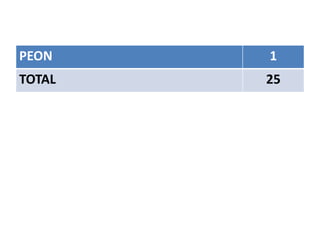
PEON 1
TOTAL 25
5. HEALTH POST IN
URBAN SLUMS
• There is a provision of 1 Health
Post for 5000 pop in urban
slums.
6. PRIMARY HEALTH CARE
PACKAGE
• Primary Health are package
which is considered suitable and
accepted for HFA by 2000 AD is
under :
Cont….
• Universal promotion of
promotive, preventive and basic
curative services.
• Health education of people.
Cont…
• Health care services to
vulnerable group of people i.e.,
children and women, eligible
couples etc.,
• Prevention and control of
endemic communicable
diseases.
Cont…
• Promotion of food supply and
improvement of nutritional
status.
• Provision of protected water
supply and sanitary disposal of
excreta.
Cont…
• Family Welfare Services.
7. REQUISITES FOR HFA
1. Political commitment.
2. Community Participation.
3. Support of Health Related
Sectors.
SPECIFIC GOALS FOR
HFA BY 2000 AD
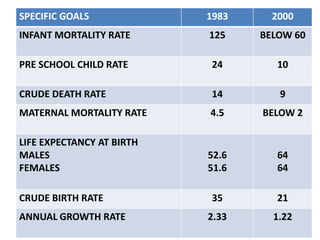
SPECIFIC GOALS 1983 2000
INFANT MORTALITY RATE 125 BELOW 60
PRE SCHOOL CHILD RATE 24 10
CRUDE DEATH RATE 14 9
MATERNAL MORTALITY RATE 4.5 BELOW 2
LIFE EXPECTANCY AT BIRTH
MALES
FEMALES
52.6
51.6
64
64
CRUDE BIRTH RATE 35 21
ANNUAL GROWTH RATE 2.33 1.22
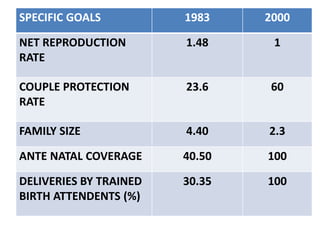
SPECIFIC GOALS 1983 2000
NET REPRODUCTION
RATE
1.48 1
COUPLE PROTECTION
RATE
23.6 60
FAMILY SIZE 4.40 2.3
ANTE NATAL COVERAGE 40.50 100
DELIVERIES BY TRAINED
BIRTH ATTENDENTS (%)
30.35 100
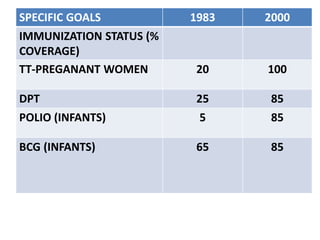
SPECIFIC GOALS 1983 2000
IMMUNIZATION STATUS (%
COVERAGE)
TT-PREGANANT WOMEN 20 100
DPT 25 85
POLIO (INFANTS) 5 85
BCG (INFANTS) 65 85
INDIA DEVELOPED ITS PRIMARY
HEALTH CARE MODEL AS A MEANS
TO ACHIEVE HFA
1978 - PRIMARY HEALTH CARE
• The concept of Primary Health
Care came in to lime light in
1978 following the Alma-Ata
declaration (USSR).
PRIMARY HEALTH CARE
• “Essential health care based on
practical, scientific and
technology made universally
accessible to individuals and
families in the
community….cont…
Cont…
• through their full participation
and at a cost that the community
and the country can afford to
maintain at every stage of their
development in the spirit of self
determination”.
CONCEPT OF PRIMARY
HEALTH
• The concept of primary health
involves a concerted effort to
provide the rural population of
developing countries with at
least the bare minimum of
health services.
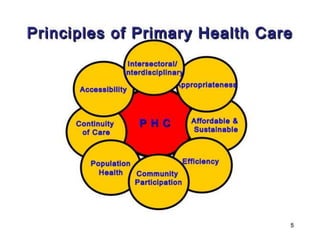
UNDERLYING PRINCIPLES
1. SOCIAL EQUITY.
2. NATION WIDE COVERAGE.
3. SELF RELIANCE.
• 4. INTERSECTORAL
COORDINATION.
• 5. COMMUNITY PARTICIPATION.
NATURE OF APPROACH
(PHC)
• Health By the People.
• Placing people’s Health in
People’s Hands”.
COMPONENTS OF PHC –
ALMA ATA
• INCLUDES…
ATLEAST THE FOLLOWING
COMPONENTS…..
ELEMENTS OF PRIMARY
HEALTH CARE
1.Education concerning prevailing
health problem & the methods
of preventing & controlling
them.
2.Promotion of food supply &
proper nutrition.
3.An adequate supply of safe
water & basic sanitation.
4.Maternal & child health care,
including family planning.
5.Immunization against major
infectious diseases.
• 6.Prevention & control of locally
endemic diseases.
• 7.Appropriate treatment of
common diseases & injuries.
• 8.Provision of essential drugs.
THANK YOU

HEALTH FOR ALL

  • 1.
    HEALTH FOR ALL DR.MAHESWARI JAIKUMAR.maheswarijaikumar2103@gmail.com
  • 2.
  • 3.
    HEALTH FOR ALL •The slogan Health For All was given by the World Health Oraganization in the year 1977 (May)
  • 4.
  • 5.
    GOAL OF WHO •Health For All is the main social goal of governments and WHO.
  • 6.
    • It isthe attainment by all the people of the world by the year 2000 AD “a level of health that will permit them to lead a socially and economically productive life”.
  • 7.
    • This goalhas come to be popularly known as “Health For All by 2000 AD”.
  • 8.
    BACKGROUND OF THE PHILOSOPHY •The background of this philosophy was the unacceptably low levels of health status of the world’s population especially the rural poor and gross disparities in health between the rich and poor, urban and rural population.
  • 9.
    CONCEPT OF HFA •The essential concept of “EQUITY IN HEALTH” i.e., all people should have an opportunity to enjoy good health.
  • 10.
    GLOBAL STRATEGY • In1981, a global strategy for HFA was evolved by WHO.
  • 11.
    • The globalstrategy provides a global framework that is broad enough to apply to all member States and flexible enough to be adapted to national and regional variations of conditions and requirements.
  • 12.
    • This wasfollowed by each member countries developing their own strategies for achieving HFA and synthesis of national strategies for developing regional strategies.
  • 13.
    • The WHOhas established 12 global indicators as the basic point of reference for assessing the progress towards HFA.
  • 14.
    E.g., a minimumlife expectancy of 60 years and maximum IMR of 50 per live births.
  • 15.
    NATIONAL STRATEGY FOR HFA/2000 •As a signatory to the Alma-Ata Declatation in 1978, the Govt of India was committed to taking steps to provide HFA to its citizens by 2000 AD.
  • 16.
    • In pursuanceof this objective various attempts were made to evolve suitable strategies and approaches. • In this connection two important reports appeared.
  • 17.
    • 1. Reporton the Study Group on “Health Fror All- an alternative strategy”, sponsored by ICSSR and ICMR.
  • 18.
    • 2. Reportof Working Group on “Health For All by 2000 AD” sponsored by the Ministry of Health and family Welfare, Govt of India.
  • 19.
    • Both thegroups considered in great detail the various issues involved in providing primary health care in the Indian context.
  • 20.
    • These reportsformed the basis of the National health Policy formulated by the Ministry of Health & family Welfare, Govt of India in 1983 which committed the Govt and people of India to the achievement of HFA.
  • 21.
    • The NationalHealth Policy echoes the WHO call for HFA and the Alma- Ata Declaration. • It has laid down specific goals in respect of the various health indicators by different dates such as 1990, and 2000 AD.
  • 22.
    • Foremost amongthe goals to be achieved by 2000 AD were : 1. Reduction of IMR from the level of 125 (1978) to below 60.
  • 23.
    2. To raisethe expectation of life at birth from the level of 52 years to 64. 3. To reduce the crude death rate from the level of 14 per 1000 pop to 9 per 1000 pop.
  • 24.
    4. To reducethe crude birth rate from the level of 33 per 1000 pop to 21. 5. To achieve a net reproduction rate of one.
  • 25.
    6. To provideportable water to the entire rural population.
  • 26.
    NATIONAL STRATEGY FOR HFA •The Govt of India recognized and strengthened the infrastructure to implement primary health care. • The infrastructure is as follows :
  • 27.
    1. VILLAGE HEALTHPOST • In plain area, there is one Village health Post (VHP) for 1000 pop and in hilly & tribal areas for 500 pop. Cont…
  • 28.
    • Each VHPis manned by 1 Trained Birth Attendant (TBA) and 1 Village Health Guide (VHG). • There is also 1 Anganwadi worker.
  • 29.
    2. SUBCENTRE • Inplain area, there is provision of 1 Health Subcentre (HSc) for 5000 pop and in tribal & hilly areas 1 HSc for 2500-3000 pop. Cont…
  • 30.
    • Each HScis manned by 1 Health Worker Female (HW), {Auxillary Nurse Midwife (ANM)} and 1 Health Worker (M) and 1 part time attendant.
  • 31.
    3. PRIMARY HEALTHCENTRE • There is provision of one Primary Health centre (PHC) for every 30,000 pop in plain areas and 1 PHC for every 25,000 pop in tribal and hilly areas. Cont..
  • 32.
    PHC-STAFFING MEDICAL OFFICER 1 NURSEMIDWIFE 1 PHARMACIST 1 HEALTH ASSISTANT (F) 1 HEALTH ASSISTANT (M) 1 PHC HAS 4-6 BEDS AND SOME DIAGNOSTIC FACILITIES
  • 33.
    BLOCK EXTENSION EDUCATOR 1 HEALTH WORKER(F)/ANM 1 LAB TECHNICIAN 1 UDC &LDC 2 (1 each) DRIVER 1 CLASS IV 4 TOTAL 15
  • 34.
    4. COMMUNITY HEALTH CENTRES •There is a provision of 1 community Health Centre (CHC) for each block with a pop of 80,000-1,20,000. Cont …
  • 35.
    • The centrehas 30 beds and provides medical, surgical, obstetrical & gynaecology and paediatric services. • The staffing pattern is as follows:
  • 36.
    CHC-STAFFING MEDICAL OFFICER 4 NURSEMIDWIFE 7 PHARMACIST/COMPOUNDER 1 DRESSER 1 LAB TECNICIAN 1
  • 37.
    RADIOGRAPHER 1 WARD BOYS2 DHOBI 1 SWEEPERS 3 MALI 1 CHOWKIDAR 1 AYA 1 Cont…
  • 38.
  • 39.
    5. HEALTH POSTIN URBAN SLUMS • There is a provision of 1 Health Post for 5000 pop in urban slums.
  • 40.
    6. PRIMARY HEALTHCARE PACKAGE • Primary Health are package which is considered suitable and accepted for HFA by 2000 AD is under : Cont….
  • 41.
    • Universal promotionof promotive, preventive and basic curative services. • Health education of people. Cont…
  • 42.
    • Health careservices to vulnerable group of people i.e., children and women, eligible couples etc., • Prevention and control of endemic communicable diseases. Cont…
  • 43.
    • Promotion offood supply and improvement of nutritional status. • Provision of protected water supply and sanitary disposal of excreta. Cont…
  • 44.
  • 45.
    7. REQUISITES FORHFA 1. Political commitment. 2. Community Participation. 3. Support of Health Related Sectors.
  • 46.
  • 47.
    SPECIFIC GOALS 19832000 INFANT MORTALITY RATE 125 BELOW 60 PRE SCHOOL CHILD RATE 24 10 CRUDE DEATH RATE 14 9 MATERNAL MORTALITY RATE 4.5 BELOW 2 LIFE EXPECTANCY AT BIRTH MALES FEMALES 52.6 51.6 64 64 CRUDE BIRTH RATE 35 21 ANNUAL GROWTH RATE 2.33 1.22
  • 48.
    SPECIFIC GOALS 19832000 NET REPRODUCTION RATE 1.48 1 COUPLE PROTECTION RATE 23.6 60 FAMILY SIZE 4.40 2.3 ANTE NATAL COVERAGE 40.50 100 DELIVERIES BY TRAINED BIRTH ATTENDENTS (%) 30.35 100
  • 49.
    SPECIFIC GOALS 19832000 IMMUNIZATION STATUS (% COVERAGE) TT-PREGANANT WOMEN 20 100 DPT 25 85 POLIO (INFANTS) 5 85 BCG (INFANTS) 65 85
  • 50.
    INDIA DEVELOPED ITSPRIMARY HEALTH CARE MODEL AS A MEANS TO ACHIEVE HFA
  • 51.
    1978 - PRIMARYHEALTH CARE • The concept of Primary Health Care came in to lime light in 1978 following the Alma-Ata declaration (USSR).
  • 52.
    PRIMARY HEALTH CARE •“Essential health care based on practical, scientific and technology made universally accessible to individuals and families in the community….cont…
  • 53.
    Cont… • through theirfull participation and at a cost that the community and the country can afford to maintain at every stage of their development in the spirit of self determination”.
  • 54.
    CONCEPT OF PRIMARY HEALTH •The concept of primary health involves a concerted effort to provide the rural population of developing countries with at least the bare minimum of health services.
  • 55.
    UNDERLYING PRINCIPLES 1. SOCIALEQUITY. 2. NATION WIDE COVERAGE. 3. SELF RELIANCE.
  • 56.
    • 4. INTERSECTORAL COORDINATION. •5. COMMUNITY PARTICIPATION.
  • 58.
    NATURE OF APPROACH (PHC) •Health By the People. • Placing people’s Health in People’s Hands”.
  • 59.
    COMPONENTS OF PHC– ALMA ATA • INCLUDES… ATLEAST THE FOLLOWING COMPONENTS…..
  • 60.
    ELEMENTS OF PRIMARY HEALTHCARE 1.Education concerning prevailing health problem & the methods of preventing & controlling them. 2.Promotion of food supply & proper nutrition.
  • 61.
    3.An adequate supplyof safe water & basic sanitation. 4.Maternal & child health care, including family planning.
  • 62.
    5.Immunization against major infectiousdiseases. • 6.Prevention & control of locally endemic diseases.
  • 63.
    • 7.Appropriate treatmentof common diseases & injuries. • 8.Provision of essential drugs.
  • 64.