SULTANTE OF
OMAN
Case 1
• A 79-year-old man is admitted to the hospital
for an elective total knee replacement. He
lives by himself and performs all of his
activities of daily living. His medical history
includes degenerative joint disease, coronary
heart disease, and hypertension. He has no
history of psychiatric problems or alcohol and
drug history.
• In the evening, several hours after an
uneventful surgical procedure, the patient
becomes diaphoretic and tachypnic. He is
alert, but also agitated and confused, and
cannot give full attention to the hospital staff
and their questions. He does remember his
name, but does not believe that he is in a
hospital.
Choose the most likely diagnosis
1. Amnesic Disorder
2. Delirium
3. Dementia
4. Multi-infarct dementia
• For the past 10 years the memory of a 74-year-
old woman has progressively declined. Lately,
she has caused several small kitchen fires by
forgetting to turn off the stove, she cannot
remember how to cook her favorite recipes,
and she becomes disoriented and confused at
night. She identifies an increasing number of
objects as “that thing” because she cannot
recall the correct name. Her muscle strength
and balance are intact
Case 2
Choose the most likely diagnosis.
a.Huntington’s disease
b. Multi-infarct dementia
c. Creutzfeldt-Jakob disease
d. Alzheimer’s disease
e. Wilson’s disease
case 3
• A 70-year-old male with a dementing disorder
dies in a car accident. During the previous five
years, his personality had dramatically changed
and he caused much embarrassment to his family
due to his intrusive and inappropriate behavior.
Pathological examination of his brain shows
fronto-temporal atrophy, gliosis of the frontal
lobes’ white matter, characteristic intracellular
inclusions, and swollen neurons. Amyloid plaques
and neurofibrillary tangles are absent
Choose the correct diagnosis:
a. Alzheimer’s disease
b. Pick’s disease
c. Creutzfeldt-Jakob disease
d. B12 deficiency dementia
e. HIV dementia
Case 4
• 65-year-old woman with a history of MI, hypertension,
and asthma presents with new onset of hallucinations.
She can no longer sleep at night because she sees small
children and cats in her apartment. She thinks she
must be going crazy and is too frightened to explain the
symptoms to her husband. She has no prior psychiatric
history. Her vital signs are blood pressure supine
115/80 mm Hg and standing 90/60 mm Hg. Physical
examination reveals an alert, oriented elderly woman
with a slight resting tremor and mild rigidity in her
upper and lower extremities, but no cog wheeling.
Mini-mental status examination reveals deficits in long-
term recall.
Choose the most likely diagnosis.
a.Huntington’s disease
b. Parkinson disease
c. Creutzfeldt-Jakob disease
d. Alzheimer’s disease
e. Lewy body dementia
Case 5
• A 78-year-old man comes to the physician for
evaluation after falling five times in 2 months.
An x-ray skeletal survey reveals no fractures,
but the patient admits to worsening urinary
incontinence over the previous 4 months. His
wife states that his memory and concentration
have deteriorated recently.
Choose the most likely diagnosis.
a.Huntington’s disease
b. Multi-infarct dementia
c. Normal pressure hydrocephalus
d. Alzheimer’s disease
e. Lewy body dementia
A 72-year-old married man is brought for evaluation to a
primary care physician by his wife. His wife is very
concerned about her husband’s decline in memory, as
well as his development of stuttering speech and a slow
gait over the past two to three years.
She reports that he now requires assistance with bathing
and grooming, and that he has been reporting seeing
children hiding in their bedroom closet. He often
refuses to go to bed at night until he removes all of the
clothing from the closet in order to “find the children.”
He has no prior history of any medical problems and
takes no medications .
Case 6
On physical examination : muscle rigidity, with a
slow, shuffling gait but no tremor. The patient
appears very confused, and his score on a
Mini-Mental State Exam is 15/30
Investigations:
a complete blood count, chemistry panel, thyroid
profile, syphilis serology, and vitamin B12 and
folate levels are all within normal limits.
MRI was ordered (reveals generalized atrophy
with no sign of acute infarction) .
The patient’s wife calls on the day of the
scheduled MRI, stating that her husband had
become aggressive while she was trying to
dress him..
The physician prescribes risperidone 1 mg twice
per day to control his aggression. The patient
then develops profound rigidity, with difficulty
swallowing and drooling.
What is the most likely diagnosis?
a.Huntington’s disease
b. Multi-infarct dementia
c. Parkinson disease
d. Alzheimer’s disease
e. Lewy body dementia
A 78 years old female is brought to the clinic by her
daughter . The daughter tells you that her mother
is having difficulty with her memory .
2 years ago & since that time she has deteriorated in
a slow steady manner . However she is not totally
incapacitated.
She is able to perform some of the activities of daily
living : dressing & bathing .When she cooks ,she
often leaves burners on & when she drives the car
she often gets lost.
What are the points that make the diagnosis of
dementia most likely in this case???
The daughter states that her mother’s memory and
confusion have been getting worse
Her personality has changed ,her kind &caring mother
now displays periods of both agitation and aggression
No history of trauma
not alcoholic
PMH : unremarkable FH: unremarkable
Examinations : unremarkable
-Progressive deterioration of intellectual
function with preservation of consciousness .
-Most important risk factor is increasing age
5% of population over the age 65 years
20% of population over the age 80 years
vs.
Variable Delirium Dementia
Level of attention Impaired (fluctuated) Usually, alert
Onset acute Gradual
Course Fluctuating from hour to
hour ( sun downing)
Progressive deterioration
consciousness Clouded Intact
Hallucinations Present In advanced case
Prognosis Reversible Largely irreversible , but up
to15% due to treatable
causes and are reversible
• Poor memory ( more for recent)
• Impaired attention
• Aphasia, apraxia
• Disoriented
Cognition
• Odd and disorganized
• Restless, wondering
• Self neglect
Behaviour
• Anxiety
• DepressionMood
•Slow
•delusions
Thinking
•illusion
•hallusination
Perception
•impairedInsight
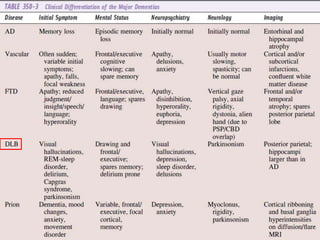
Alzheimer s disease 50-60%
Vascular disease 15-20%
Mixed dementia 10-20%
Other <10%
 like lewy-body dementia, pick s disease,
alcohol related,vitm B12...
aafp.org
Aims:
*identify rare treatable conditions that may present as dementia
*diagnose any condition that may exacerbate dementia (..eg.. Delirium, infection)
* Obtain the information needed to plan continuing care.
Assessment of functional capacity in dementia pt:
*Continence
*Dressing
*Self-care
*Cooking ability and nutrition
*Shopping/ housework
*Degree of orientation at home
*Social contact
*Safety in the home
• Patient history:
Interview the patient and their family members
about nature of onset, specific deficits, physical
symptoms, and comorbid conditions
Review medications, as well as family and social
history
• Examination:
General appearance.
Speech, mood, thinking, behavior.
aphasia, apraxia, agnosia and executive functioning.
Mini mental state examination.
Neurological examination.
Systemic examination.
Mini Mental State
Examination
Maximum score Score
5 ___
5 ___
3
___
5 ____
3
____
Orientation
1. What is the (year) (season) (date) (day) (month)?
2. Where are we: (state) (county) (town or city) (hospital) (floor)?
Registration
3. Name three common objects (e.g., "apple," "table," "penny"):
Take one second to say each. Then ask the patientto repeat all three after
you have said them. Give one point for each correct answer. Then repeat
them untilhe or she learns all three. Count trialsand record.
Trials: ___
Attention and calculation
4. Spell "world" backwards. The score is the number of lettersin correct order.
(D___L___R___O___W___)
Recall
5. Ask for the three objects repeated above. Give one point for each correct
answer.
(Note: recall cannot be testedif all three objectswere not remembered
during
registration.)
Mini Mental State
Examination- cont
Maximum score Score
2 ___
1 ___
3
___
1 ___
1 ___
1 ___
Total score:
30 ___
Language
6. Name a "pencil" and "watch."
7. Repeat the following: "No ifs, ands or buts."
8. Follow a three-stage command:
"Take a paper in your right hand, fold it in half and put it
on the floor.“
9. “CLOSE YOUR EYES”.
10. Write a sentence.
11. Copy the following design:
Scores of 24 or higher are generally
considerednormal.
Blood test
• FBC, ESR, CRP
• T4 and TSH
• urea and
creatinine
• glucose
• B12 and folate
• syphilis serology
• HIV
• caeruloplasmin
other
• cerebrospinal
fluid
examination
• electroencephal
ography (EEG)
Imaging
• MRI
• CT
• SPECT
:
Treat any treatable physical disorders
Treat the cause of superimposed delirium
Treat even minor medical problems
Involve and support relatives
Arrange help for carers
Medications for night and daytime restlessness
If home care fails, arrange hospital care
*Restlessness: sedative
..eg thioridazine, promazine
*Paranoid delusions: antipsychotic
*Depressive symptoms: antidepressent
*Alzheimer's disease: cholinesrerase inhibitors
..eg donepezil, rivastigmine
• most common type of dementia.
• The prevalence increase with age .Alzheimer’s
disease
• FH
• down syndrome
• Head injury
RF
• Accumulation B amyloidal peptide cause
progressive neural damage  increase
number of senile plaques reduced
cerebral production of acetylcholine
synthesis
Cause
Pathophysiology
• Genetic factors
• Pathogenesis:
Gross pathology :
o diffuse atrophy especially frontal and
temporal and parietal lobes Dilation of
ventricles
Con/ Pathogenesis
• Microscopic pathology:
Senile plaques, amyloid angiopathy
Neurofibrillary tangles
Biochemical pathology: 50-90% reduction in
action of choline acetyltransferase
• slowly progressive memory loss of
insidious onset in a fully conscious
patient
• slowly progressive behavioral changes
CF
• Aphasia
• Apraxia
• Agnosia
• Disturbance of executive functions
CF
• cholinesterase inhibitors,(donepezil,
rivastigmine, and galantamine are
currently approved
• Antiglutamatergic (memantine)
Treatment
• 2nd most common cause of
dementia.
VD
• Multiple infarcts of varying size
• The brain is atrophic , ventricular
dilatationPathology
• Stepwise progression
• Episodes of confusion
• Seizure
• Neurological signs
Clinical
features
• Vascular risk factors such as
hypertension, coronary
disease, and diabetes
mellitus
• Specific evidence of :
• strokes and transient -
ischemic attacks
• Neuroimaging evidence of
strokes
• Psychiatric disturbances (eg,
emotional lability,
depression, apathy)
Diagnostic
criteria for
Vascular
dementia:
• characterized by dementia and
Parkinson’s disease .
• More rapid than in Alzheimer's disease
LBD
• Lewy bodies (pale halo-like intracellular,
eosinophilic inclusions. )
Pathology
• Initially ,visual hallucination predominant .
• Fluctuating cognitive loss
• sings of parkinsonism
• Sensitive to side effects of neuroleptic
drugs
CF
• hydrocephalus that occurs in
adults, usually older adults.
• It is tried of: dementia, ataxia,
incontinence
Normal pressure
hydrocephalus
• The drainage of CSF is blocked
gradually, and the excess fluid
builds up slowly.cause
• Shunt surgery is the most common
treatment for the symptoms of normal
pressure hydrocephalus.
treatment
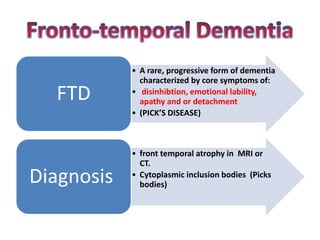
• A rare, progressive form of dementia
characterized by core symptoms of:
• disinhibtion, emotional lability,
apathy and or detachment
• (PICK’S DISEASE)
FTD
• front temporal atrophy in MRI or
CT.
• Cytoplasmic inclusion bodies (Picks
bodies)Diagnosis
• Dementia is common and its different from cognitive
decline due to normal aging process
• The most common type of dementia is AD followed by VD
• Early detection of AD plays a significant role in better
prognosis
• VD can be prevented by controlling the risk factors
• There are several treatable forms of dementia like in:
hypothyroidism, nutritional deficiencies, NPH
MCQ1
• One of the most common features of
neurological disorders are Language deficits
and are collectively known as
• a) Dysphasias
• b) Alogias
• c) Anomias
• d) Aphasias
MCQ2
• When an individual displays a deficit in the
comprehension of speech involving difficulties
in recognising spoken words and converting
thoughts into words is known as
• a) Wernicke's aphasia
• b) Broca's aphasia
• c) Beidecker's aphasia
• d) Warnick's aphasia
MCQ3
• If an individual has an inability to initiate
speech or respond to speech with anything
other than simple words is known as
• a) Nonfluent aphasia
• b) Fluent aphasia
• c) Disruptive aphasia
• d) Anomic aphasia
• Aphasia is an impairment of language.
(speak , understand ,fluency ,reading and writing)
• Most of the lesion that cause aphasia involve
dominant hemisphere. (95% of R handed people,
the L cerebral hemisphere is dominant.
PROCESS OF
SPEECH
TYPES OF SPEECH
DISORDERS
HEARING
UNDERSTANDING
THOUGHT &
WORD PROCESSING
VOICE PRODUCTION
ARTICULATION
DEAFNESS
APHASIA
APHASIA
DYSPHONIA
DYSARTHRIA
• stroke (most common cause )
• injury to the brain
• tumors in the brain
• Alzheimer's disease
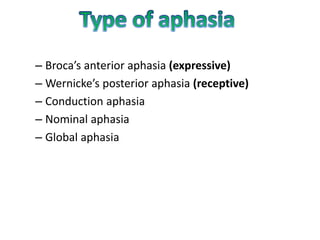
– Broca’s anterior aphasia (expressive)
– Wernicke’s posterior aphasia (receptive)
– Conduction aphasia
– Nominal aphasia
– Global aphasia
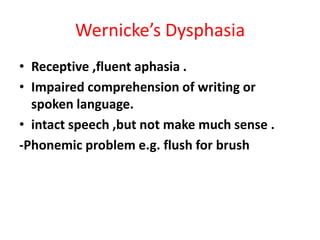
Boca's Area or Brodmann areas 44 & 45
• Its The motor speech area
• posterior inferior frontal gyrus
• formation of words
• connections with the adjacent primary motor
areas
- the muscles of the larynx, mouth, tongue,
soft palate, and the respiratory muscles
• controls the output of spoken language.
Broca’s aphasia
• Expressive, no fluent aphasia
• comprehension is intact .
• Effortful speech and slow .
• Often associated with a right side
hemiparesis.
Wernicke's area or Brodmann's area 22
• sensory speech area
• superior temporal gyrus
with extensions around
the posterior end of the
lateral sulcus into the parietal region.
• It receives fibers (visual cortex and auditory
cortex in the superior temporal gyrus).
• It permits understanding written and spoken
language
Wernicke’s Dysphasia
• Receptive ,fluent aphasia .
• Impaired comprehension of writing or
spoken language.
• intact speech ,but not make much sense .
-Phonemic problem e.g. flush for brush
Conduction Aphasia
• Communication between Broca’s and
Wernicke’s area is impaired
• Repetition is impaired
• Comprehension and fluency are less affected
Nominal aphasia
• Naming of objects is impaired, but other
aspects of speech are intact
• Lesion is usually in the posterior dominant
temporoparietal area
DYSARTHRIA
• Acquired speech disorder caused by impaired
control of muscle responsible for speech
• Caused by weakness, paralysis, or
incoordnation of the speech muscle.
• The language content is normal .
Causes
• Stroke
• Nerve – muscle diseases eg ( Myasthenia gravis )
• Muscle disease eg ( myopathy )
• Progressive neurological disease
- Parkinson's
- Huntington's
Types
• Spastic ; UMN damage, bilateral
• Flaccid ; LMN damage
• Ataxic ; cerebellar damage
• Hypokinetic; extrapyramidal
- Parkinson's disease
• Hyperkinetic; extrapyramidal
- Huntington's disease
• Mixed ; multiple motor system affected
Spastic dysarthria
• Common type of dysarthria
• Caused by bilateral damage to UMN
• Causes
- stroke
- ALS ( amyotrophic lateral sclerosis)
- MS
• Neurological symptoms
- weakness, reduced ROM, decrease fine motor
control
Flaccid dysarthria
• Caused by impairment of LMNs in cranial nerve
and spinal nerve
• Weakness in speech or respiratory musculature
• Vital CNs to speech production
- trigeminal , facial , glossopharyngeal, vagus ,
accessory and hypoglossal
• Relevant SNs
- cervical and thoracic
Ataxic dysarthria
• Damage to cerebellum
• Primarily affect articulation and prosody
• Cuases
- Degenerative disease
- Stroke
- Toxic condition
* lead , mercury, alcoholism , cyanide
- tumors, infection
Hypokinetic dysarthria
• Associated with basal ganglion pathology
• The only dysarthria that may have increased speech
rate
• Causes
- Parkinson's disease
- traumatic head injury
* punch drunk encephalopathy
- toxic metal poisoning
-stroke
• Neurological symptoms
- increased muscle tone , decreased range and frequency of
movement
Hyperkinetic dysarthria
• Dysfunction to basal ganglia
• Produce involuntary movements that interfere
with normal speech production
• Causes
- chorea
- tardive dyskinesia
- dystonia
DYSPHONIA
• Is due to defect in the production of sound
CAUSES
1) Laryngeal diseases-eg;laryngitis
2) Vocal cord lesions
3) Xth cranial nerve palsy
4) psychogenic
Evaluation
• Assess comprehension:
– Ask the patient to carry out one, two or several steps
of command
– E.g. Stand up, jump and close the door
• Assess repetition:
– Ask the patient to repeat a sentence
• Assess naming:
– Ask the patient to name common and uncommon
things
• Assess reading and writing:
– Usually affected in dysphasia
Evaluation
• Dysarthria and dysphonia
– Listen to spontaneous speech, note VOLUME,
RHYTHM and CLARITY
– Ask the patient to repeat phrases like ‘yellow
lorry’ to test lingual sounds and ‘baby
hippopotamus’ to test labial sounds and some
tongue twisters
– Ask the patient to count till 30 to assess muscle
fatigue
– Ask the patient to cough and say ‘Aaah’
Evaluation
• Dysphasias
– During spontaneous speech, listen to FLUENCY
and APPROPRIEATNESS of content, particularly for
par aphasias and neologisms
– Ask the patient to name common objects
– Give the patient a 3-stage command
– Ask the patient to repeat simple sentences
– Ask the patient to read a paragraph
– Ask the patient to write a sentence and examine
the handwriting
Management
• Most patients recover spontaneously or
improve within the first month
• Speech therapy can be helpful, but unlikely to
be of benefit after the first few months
• Pharmacological treatment for aphasia
following stroke (Review)
• Speech and language therapy for aphasia
following stroke (Review)
Resources
• Macleod’s clinical examination
• Davidson’s principles and practice of medicine
• Oxford handbook of clinical medicine
• Step up to medicine

Dementia and speech abnormalities

  • 1.
  • 2.
    Case 1 • A79-year-old man is admitted to the hospital for an elective total knee replacement. He lives by himself and performs all of his activities of daily living. His medical history includes degenerative joint disease, coronary heart disease, and hypertension. He has no history of psychiatric problems or alcohol and drug history.
  • 3.
    • In theevening, several hours after an uneventful surgical procedure, the patient becomes diaphoretic and tachypnic. He is alert, but also agitated and confused, and cannot give full attention to the hospital staff and their questions. He does remember his name, but does not believe that he is in a hospital.
  • 4.
    Choose the mostlikely diagnosis 1. Amnesic Disorder 2. Delirium 3. Dementia 4. Multi-infarct dementia
  • 5.
    • For thepast 10 years the memory of a 74-year- old woman has progressively declined. Lately, she has caused several small kitchen fires by forgetting to turn off the stove, she cannot remember how to cook her favorite recipes, and she becomes disoriented and confused at night. She identifies an increasing number of objects as “that thing” because she cannot recall the correct name. Her muscle strength and balance are intact Case 2
  • 6.
    Choose the mostlikely diagnosis. a.Huntington’s disease b. Multi-infarct dementia c. Creutzfeldt-Jakob disease d. Alzheimer’s disease e. Wilson’s disease
  • 7.
    case 3 • A70-year-old male with a dementing disorder dies in a car accident. During the previous five years, his personality had dramatically changed and he caused much embarrassment to his family due to his intrusive and inappropriate behavior. Pathological examination of his brain shows fronto-temporal atrophy, gliosis of the frontal lobes’ white matter, characteristic intracellular inclusions, and swollen neurons. Amyloid plaques and neurofibrillary tangles are absent
  • 8.
    Choose the correctdiagnosis: a. Alzheimer’s disease b. Pick’s disease c. Creutzfeldt-Jakob disease d. B12 deficiency dementia e. HIV dementia
  • 9.
    Case 4 • 65-year-oldwoman with a history of MI, hypertension, and asthma presents with new onset of hallucinations. She can no longer sleep at night because she sees small children and cats in her apartment. She thinks she must be going crazy and is too frightened to explain the symptoms to her husband. She has no prior psychiatric history. Her vital signs are blood pressure supine 115/80 mm Hg and standing 90/60 mm Hg. Physical examination reveals an alert, oriented elderly woman with a slight resting tremor and mild rigidity in her upper and lower extremities, but no cog wheeling. Mini-mental status examination reveals deficits in long- term recall.
  • 10.
    Choose the mostlikely diagnosis. a.Huntington’s disease b. Parkinson disease c. Creutzfeldt-Jakob disease d. Alzheimer’s disease e. Lewy body dementia
  • 11.
    Case 5 • A78-year-old man comes to the physician for evaluation after falling five times in 2 months. An x-ray skeletal survey reveals no fractures, but the patient admits to worsening urinary incontinence over the previous 4 months. His wife states that his memory and concentration have deteriorated recently.
  • 12.
    Choose the mostlikely diagnosis. a.Huntington’s disease b. Multi-infarct dementia c. Normal pressure hydrocephalus d. Alzheimer’s disease e. Lewy body dementia
  • 13.
    A 72-year-old marriedman is brought for evaluation to a primary care physician by his wife. His wife is very concerned about her husband’s decline in memory, as well as his development of stuttering speech and a slow gait over the past two to three years. She reports that he now requires assistance with bathing and grooming, and that he has been reporting seeing children hiding in their bedroom closet. He often refuses to go to bed at night until he removes all of the clothing from the closet in order to “find the children.” He has no prior history of any medical problems and takes no medications . Case 6
  • 14.
    On physical examination: muscle rigidity, with a slow, shuffling gait but no tremor. The patient appears very confused, and his score on a Mini-Mental State Exam is 15/30 Investigations: a complete blood count, chemistry panel, thyroid profile, syphilis serology, and vitamin B12 and folate levels are all within normal limits. MRI was ordered (reveals generalized atrophy with no sign of acute infarction) .
  • 15.
    The patient’s wifecalls on the day of the scheduled MRI, stating that her husband had become aggressive while she was trying to dress him.. The physician prescribes risperidone 1 mg twice per day to control his aggression. The patient then develops profound rigidity, with difficulty swallowing and drooling.
  • 16.
    What is themost likely diagnosis? a.Huntington’s disease b. Multi-infarct dementia c. Parkinson disease d. Alzheimer’s disease e. Lewy body dementia
  • 17.
    A 78 yearsold female is brought to the clinic by her daughter . The daughter tells you that her mother is having difficulty with her memory . 2 years ago & since that time she has deteriorated in a slow steady manner . However she is not totally incapacitated. She is able to perform some of the activities of daily living : dressing & bathing .When she cooks ,she often leaves burners on & when she drives the car she often gets lost.
  • 18.
    What are thepoints that make the diagnosis of dementia most likely in this case??? The daughter states that her mother’s memory and confusion have been getting worse Her personality has changed ,her kind &caring mother now displays periods of both agitation and aggression No history of trauma not alcoholic PMH : unremarkable FH: unremarkable Examinations : unremarkable
  • 19.
    -Progressive deterioration ofintellectual function with preservation of consciousness . -Most important risk factor is increasing age 5% of population over the age 65 years 20% of population over the age 80 years
  • 21.
    vs. Variable Delirium Dementia Levelof attention Impaired (fluctuated) Usually, alert Onset acute Gradual Course Fluctuating from hour to hour ( sun downing) Progressive deterioration consciousness Clouded Intact Hallucinations Present In advanced case Prognosis Reversible Largely irreversible , but up to15% due to treatable causes and are reversible
  • 22.
    • Poor memory( more for recent) • Impaired attention • Aphasia, apraxia • Disoriented Cognition • Odd and disorganized • Restless, wondering • Self neglect Behaviour • Anxiety • DepressionMood
  • 23.
  • 26.
    Alzheimer s disease50-60% Vascular disease 15-20% Mixed dementia 10-20% Other <10%  like lewy-body dementia, pick s disease, alcohol related,vitm B12... aafp.org
  • 27.
    Aims: *identify rare treatableconditions that may present as dementia *diagnose any condition that may exacerbate dementia (..eg.. Delirium, infection) * Obtain the information needed to plan continuing care. Assessment of functional capacity in dementia pt: *Continence *Dressing *Self-care *Cooking ability and nutrition *Shopping/ housework *Degree of orientation at home *Social contact *Safety in the home
  • 28.
    • Patient history: Interviewthe patient and their family members about nature of onset, specific deficits, physical symptoms, and comorbid conditions Review medications, as well as family and social history
  • 29.
    • Examination: General appearance. Speech,mood, thinking, behavior. aphasia, apraxia, agnosia and executive functioning. Mini mental state examination. Neurological examination. Systemic examination.
  • 30.
    Mini Mental State Examination Maximumscore Score 5 ___ 5 ___ 3 ___ 5 ____ 3 ____ Orientation 1. What is the (year) (season) (date) (day) (month)? 2. Where are we: (state) (county) (town or city) (hospital) (floor)? Registration 3. Name three common objects (e.g., "apple," "table," "penny"): Take one second to say each. Then ask the patientto repeat all three after you have said them. Give one point for each correct answer. Then repeat them untilhe or she learns all three. Count trialsand record. Trials: ___ Attention and calculation 4. Spell "world" backwards. The score is the number of lettersin correct order. (D___L___R___O___W___) Recall 5. Ask for the three objects repeated above. Give one point for each correct answer. (Note: recall cannot be testedif all three objectswere not remembered during registration.)
  • 31.
    Mini Mental State Examination-cont Maximum score Score 2 ___ 1 ___ 3 ___ 1 ___ 1 ___ 1 ___ Total score: 30 ___ Language 6. Name a "pencil" and "watch." 7. Repeat the following: "No ifs, ands or buts." 8. Follow a three-stage command: "Take a paper in your right hand, fold it in half and put it on the floor.“ 9. “CLOSE YOUR EYES”. 10. Write a sentence. 11. Copy the following design: Scores of 24 or higher are generally considerednormal.
  • 32.
    Blood test • FBC,ESR, CRP • T4 and TSH • urea and creatinine • glucose • B12 and folate • syphilis serology • HIV • caeruloplasmin other • cerebrospinal fluid examination • electroencephal ography (EEG) Imaging • MRI • CT • SPECT
  • 33.
    : Treat any treatablephysical disorders Treat the cause of superimposed delirium Treat even minor medical problems Involve and support relatives Arrange help for carers Medications for night and daytime restlessness If home care fails, arrange hospital care
  • 34.
    *Restlessness: sedative ..eg thioridazine,promazine *Paranoid delusions: antipsychotic *Depressive symptoms: antidepressent *Alzheimer's disease: cholinesrerase inhibitors ..eg donepezil, rivastigmine
  • 36.
    • most commontype of dementia. • The prevalence increase with age .Alzheimer’s disease • FH • down syndrome • Head injury RF • Accumulation B amyloidal peptide cause progressive neural damage  increase number of senile plaques reduced cerebral production of acetylcholine synthesis Cause
  • 37.
    Pathophysiology • Genetic factors •Pathogenesis: Gross pathology : o diffuse atrophy especially frontal and temporal and parietal lobes Dilation of ventricles
  • 38.
    Con/ Pathogenesis • Microscopicpathology: Senile plaques, amyloid angiopathy Neurofibrillary tangles Biochemical pathology: 50-90% reduction in action of choline acetyltransferase
  • 40.
    • slowly progressivememory loss of insidious onset in a fully conscious patient • slowly progressive behavioral changes CF • Aphasia • Apraxia • Agnosia • Disturbance of executive functions CF • cholinesterase inhibitors,(donepezil, rivastigmine, and galantamine are currently approved • Antiglutamatergic (memantine) Treatment
  • 41.
    • 2nd mostcommon cause of dementia. VD • Multiple infarcts of varying size • The brain is atrophic , ventricular dilatationPathology • Stepwise progression • Episodes of confusion • Seizure • Neurological signs Clinical features
  • 42.
    • Vascular riskfactors such as hypertension, coronary disease, and diabetes mellitus • Specific evidence of : • strokes and transient - ischemic attacks • Neuroimaging evidence of strokes • Psychiatric disturbances (eg, emotional lability, depression, apathy) Diagnostic criteria for Vascular dementia:
  • 43.
    • characterized bydementia and Parkinson’s disease . • More rapid than in Alzheimer's disease LBD • Lewy bodies (pale halo-like intracellular, eosinophilic inclusions. ) Pathology • Initially ,visual hallucination predominant . • Fluctuating cognitive loss • sings of parkinsonism • Sensitive to side effects of neuroleptic drugs CF
  • 44.
    • hydrocephalus thatoccurs in adults, usually older adults. • It is tried of: dementia, ataxia, incontinence Normal pressure hydrocephalus • The drainage of CSF is blocked gradually, and the excess fluid builds up slowly.cause • Shunt surgery is the most common treatment for the symptoms of normal pressure hydrocephalus. treatment
  • 45.
    • A rare,progressive form of dementia characterized by core symptoms of: • disinhibtion, emotional lability, apathy and or detachment • (PICK’S DISEASE) FTD • front temporal atrophy in MRI or CT. • Cytoplasmic inclusion bodies (Picks bodies)Diagnosis
  • 47.
    • Dementia iscommon and its different from cognitive decline due to normal aging process • The most common type of dementia is AD followed by VD • Early detection of AD plays a significant role in better prognosis • VD can be prevented by controlling the risk factors • There are several treatable forms of dementia like in: hypothyroidism, nutritional deficiencies, NPH
  • 49.
    MCQ1 • One ofthe most common features of neurological disorders are Language deficits and are collectively known as • a) Dysphasias • b) Alogias • c) Anomias • d) Aphasias
  • 50.
    MCQ2 • When anindividual displays a deficit in the comprehension of speech involving difficulties in recognising spoken words and converting thoughts into words is known as • a) Wernicke's aphasia • b) Broca's aphasia • c) Beidecker's aphasia • d) Warnick's aphasia
  • 51.
    MCQ3 • If anindividual has an inability to initiate speech or respond to speech with anything other than simple words is known as • a) Nonfluent aphasia • b) Fluent aphasia • c) Disruptive aphasia • d) Anomic aphasia
  • 52.
    • Aphasia isan impairment of language. (speak , understand ,fluency ,reading and writing) • Most of the lesion that cause aphasia involve dominant hemisphere. (95% of R handed people, the L cerebral hemisphere is dominant.
  • 54.
    PROCESS OF SPEECH TYPES OFSPEECH DISORDERS HEARING UNDERSTANDING THOUGHT & WORD PROCESSING VOICE PRODUCTION ARTICULATION DEAFNESS APHASIA APHASIA DYSPHONIA DYSARTHRIA
  • 55.
    • stroke (mostcommon cause ) • injury to the brain • tumors in the brain • Alzheimer's disease
  • 56.
    – Broca’s anterioraphasia (expressive) – Wernicke’s posterior aphasia (receptive) – Conduction aphasia – Nominal aphasia – Global aphasia
  • 57.
    Boca's Area orBrodmann areas 44 & 45 • Its The motor speech area • posterior inferior frontal gyrus • formation of words • connections with the adjacent primary motor areas - the muscles of the larynx, mouth, tongue, soft palate, and the respiratory muscles • controls the output of spoken language.
  • 58.
    Broca’s aphasia • Expressive,no fluent aphasia • comprehension is intact . • Effortful speech and slow . • Often associated with a right side hemiparesis.
  • 59.
    Wernicke's area orBrodmann's area 22 • sensory speech area • superior temporal gyrus with extensions around the posterior end of the lateral sulcus into the parietal region. • It receives fibers (visual cortex and auditory cortex in the superior temporal gyrus). • It permits understanding written and spoken language
  • 60.
    Wernicke’s Dysphasia • Receptive,fluent aphasia . • Impaired comprehension of writing or spoken language. • intact speech ,but not make much sense . -Phonemic problem e.g. flush for brush
  • 61.
    Conduction Aphasia • Communicationbetween Broca’s and Wernicke’s area is impaired • Repetition is impaired • Comprehension and fluency are less affected
  • 62.
    Nominal aphasia • Namingof objects is impaired, but other aspects of speech are intact • Lesion is usually in the posterior dominant temporoparietal area
  • 64.
    DYSARTHRIA • Acquired speechdisorder caused by impaired control of muscle responsible for speech • Caused by weakness, paralysis, or incoordnation of the speech muscle. • The language content is normal .
  • 65.
    Causes • Stroke • Nerve– muscle diseases eg ( Myasthenia gravis ) • Muscle disease eg ( myopathy ) • Progressive neurological disease - Parkinson's - Huntington's
  • 66.
    Types • Spastic ;UMN damage, bilateral • Flaccid ; LMN damage • Ataxic ; cerebellar damage • Hypokinetic; extrapyramidal - Parkinson's disease • Hyperkinetic; extrapyramidal - Huntington's disease • Mixed ; multiple motor system affected
  • 67.
    Spastic dysarthria • Commontype of dysarthria • Caused by bilateral damage to UMN • Causes - stroke - ALS ( amyotrophic lateral sclerosis) - MS • Neurological symptoms - weakness, reduced ROM, decrease fine motor control
  • 68.
    Flaccid dysarthria • Causedby impairment of LMNs in cranial nerve and spinal nerve • Weakness in speech or respiratory musculature • Vital CNs to speech production - trigeminal , facial , glossopharyngeal, vagus , accessory and hypoglossal • Relevant SNs - cervical and thoracic
  • 69.
    Ataxic dysarthria • Damageto cerebellum • Primarily affect articulation and prosody • Cuases - Degenerative disease - Stroke - Toxic condition * lead , mercury, alcoholism , cyanide - tumors, infection
  • 70.
    Hypokinetic dysarthria • Associatedwith basal ganglion pathology • The only dysarthria that may have increased speech rate • Causes - Parkinson's disease - traumatic head injury * punch drunk encephalopathy - toxic metal poisoning -stroke • Neurological symptoms - increased muscle tone , decreased range and frequency of movement
  • 71.
    Hyperkinetic dysarthria • Dysfunctionto basal ganglia • Produce involuntary movements that interfere with normal speech production • Causes - chorea - tardive dyskinesia - dystonia
  • 72.
    DYSPHONIA • Is dueto defect in the production of sound CAUSES 1) Laryngeal diseases-eg;laryngitis 2) Vocal cord lesions 3) Xth cranial nerve palsy 4) psychogenic
  • 73.
    Evaluation • Assess comprehension: –Ask the patient to carry out one, two or several steps of command – E.g. Stand up, jump and close the door • Assess repetition: – Ask the patient to repeat a sentence • Assess naming: – Ask the patient to name common and uncommon things • Assess reading and writing: – Usually affected in dysphasia
  • 74.
    Evaluation • Dysarthria anddysphonia – Listen to spontaneous speech, note VOLUME, RHYTHM and CLARITY – Ask the patient to repeat phrases like ‘yellow lorry’ to test lingual sounds and ‘baby hippopotamus’ to test labial sounds and some tongue twisters – Ask the patient to count till 30 to assess muscle fatigue – Ask the patient to cough and say ‘Aaah’
  • 75.
    Evaluation • Dysphasias – Duringspontaneous speech, listen to FLUENCY and APPROPRIEATNESS of content, particularly for par aphasias and neologisms – Ask the patient to name common objects – Give the patient a 3-stage command – Ask the patient to repeat simple sentences – Ask the patient to read a paragraph – Ask the patient to write a sentence and examine the handwriting
  • 76.
    Management • Most patientsrecover spontaneously or improve within the first month • Speech therapy can be helpful, but unlikely to be of benefit after the first few months
  • 77.
    • Pharmacological treatmentfor aphasia following stroke (Review) • Speech and language therapy for aphasia following stroke (Review)
  • 78.
    Resources • Macleod’s clinicalexamination • Davidson’s principles and practice of medicine • Oxford handbook of clinical medicine • Step up to medicine

Editor's Notes

  • #12 The classical clinical findings of normal pressure hydrocephalus are 1-3: urinary incontinence intellectual deterioration gait disturbances These can be remembered with the unkind mnemonic Wet, Wacky and Wobbly.  As the name suggests mean CSF opening pressure in patients with NPH is within the normal range  (<18 cm H2O or 13 mm Hg) 3. 
  • #21 The cerebrum has 2 parts: the right cerebral hemisphere and the left cerebral hemisphere. They are connected at the bottom and have a deep groove running between them. In general, the right cerebral hemisphere controls the left side of the body, and the left cerebral hemisphere controls the right. The right side is involved with creativity and artistic abilities. The left side is important for logic and rational thinking. The hemispheres of the cerebrum are divided into lobes, or broad regions of the brain. Each lobe is responsible for a variety of bodily functions: Frontal lobes are involved with personality, speech, and motor development Temporal lobes are responsible for memory, language and speech functions Parietal lobes are involved with sensation Occipital lobes are the primary vision centers Frontal lobe: Function[edit] The executive functions of the frontal lobes involve the ability to recognize future consequences resulting from current actions, to choose between good and bad actions (or better and best), override and suppress socially unacceptable responses, and determine similarities and differences between things or events. The frontal lobes also play an important part in retaining longer term memories which are not task-based. These are often memories associated with emotions derived from input from the brain's limbic system. The frontal lobe modifies those emotions to generally fit socially acceptable norms. Stuss, et al. discuss in a review of many studies how damage to the frontal lobe can occur in an assortment of ways and result in many different consequences.Transient ischemic attacks (TIAs) and/or strokes are common causes of frontal lobe damage in older adults (ages 65 and older). These strokes and TIAs (or mini-strokes) can occur due to blockage of blood flow to the brain or because of the rupturing of a blood vessel/aneurysm inside of the brain. Other ways in which injury can occur include head injuries such as concussions incurred during accidents, diagnoses such as Alzheimer’s Disease or Parkinson’s Disease (which cause dementia symptoms), and frontal lobe epilepsy (which can occur at any age) Temporal lobe:
  • #38 Less than 7% of AD is familial Autosomal dominant mainly
  • #39 Senile plaques: central core of amyloid beta (Aß) surrounded by distorted, swollen neurites Amyloid angiopathy - Aß deposition in blood vessels of leptomeninges and brain Neurofibrillary tangles – hyperphosphorylation of tau protein
  • #54 A region at the posterior end of the superior temporal gyrus called Wernicke's area is concerned with comprehension of auditory and visual information. It projects via the arcuate fasciculus to Broca's area (area 44) in the frontal lobe immediately in front of the inferior end of the motor cortex.  Broca's area processes the information received from Wernicke's area into a detailed and coordinated pattern for vocalization and then projects the pattern via a speech articulation area in the insula to the motor cortex, which initiates the appropriate movements of the lips, tongue, and larynx to produce speech.  The probable sequence of events that occurs when a subject names a visual object is shown in Figure 19-8. The angular gyrus behind Wernicke's area appears to process information from words that are read in such a way that they can be converted into the auditory forms of the words in Wernicke's area.