SUPPLY CHAIN MANAGEMENT
LEARNING
OBJECTIVES:
1. Understand the concepts, importance, and roles of
Supply Chain Management in today’s business
environment
2. Become familiar with the components, scenarios and
key features of effective supply chain management
3. Apply the concepts and practices of Supply Chain
Management in problem-based learning situations
SUPPLY CHAIN MANAGEMENT
WHAT IS A SUPPLY CHAIN
MANAGEMENT?
Supply chain management is the handling of the
entire production flow of a good or service — starting
from the raw components all the way to delivering the
final product to the consumer.
SUPPLY CHAIN MANAGEMENT
A company creates a network of suppliers
(“links” in the chain) that move the product along
from the suppliers of raw materials to those
organizations that deal directly with users.
WHAT IS A SUPPLY CHAIN
MANAGEMENT?
SUPPLY CHAIN MANAGEMENT
1 PLANNING
3 MANUFACTURING
5 RETURNING
SOURCING
DELIVERY & LOGISTICS
2
4
5 COMPONENTS OF SUPPLY CHAIN
MANAGEMENT
HOW DOES SUPPLY CHAIN
MANAGEMENT WORK?
SUPPLY CHAIN MANAGEMENT
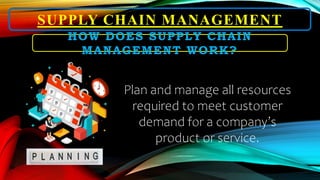
Plan and manage all resources
required to meet customer
demand for a company’s
product or service.
HOW DOES SUPPLY CHAIN
MANAGEMENT WORK?
SUPPLY CHAIN MANAGEMENT
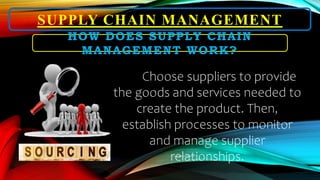
Choose suppliers to provide
the goods and services needed to
create the product. Then,
establish processes to monitor
and manage supplier
relationships.
HOW DOES SUPPLY CHAIN
MANAGEMENT WORK?
SUPPLY CHAIN MANAGEMENT
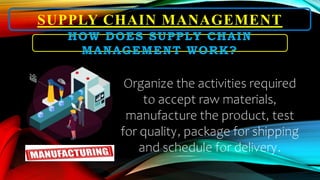
Organize the activities required
to accept raw materials,
manufacture the product, test
for quality, package for shipping
and schedule for delivery.
HOW DOES SUPPLY CHAIN
MANAGEMENT WORK?
SUPPLY CHAIN MANAGEMENT
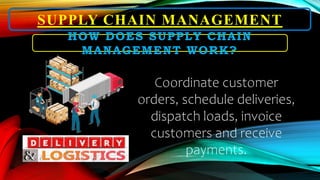
Coordinate customer
orders, schedule deliveries,
dispatch loads, invoice
customers and receive
payments.
HOW DOES SUPPLY CHAIN
MANAGEMENT WORK?
SUPPLY CHAIN MANAGEMENT
Create a network or process
to take back defective,
excess or unwanted
products.
HOW DOES SUPPLY CHAIN
MANAGEMENT WORK?
Effective supply chain management systems
minimize cost, waste and time in the production
cycle. The industry standard has become a just-in-
time supply chain where retail sales automatically
signal replenishment orders to manufacturers.
SUPPLY CHAIN MANAGEMENT
WHY IS SUPPLY CHAIN
MANAGEMENT IMPORTANT?
SUPPLY CHAIN MANAGEMENT
WHY IS SUPPLY CHAIN
MANAGEMENT IMPORTANT?
Retail shelves can then be restocked almost
as quickly as product is sold. One way to further
improve on this process is to analyze
the data from supply chain partners to see where
further improvements can be made.
SUPPLY CHAIN MANAGEMENT
WHY IS SUPPLY CHAIN
MANAGEMENT IMPORTANT?
Three scenarios where effective supply chain
managementincreasesvaluetothesupplychaincycle:
1. Identifying potential problems
2. Optimizing price dynamically
3. Improving the allocation of “available to promise”
inventory
SUPPLY CHAIN MANAGEMENT
When a customer orders more
product than the manufacturer can
deliver, the buyer can complain of
poor service. Through data analysis,
manufacturers may be able to
anticipate the shortage before the
buyer is disappointed.
WHY IS SUPPLY CHAIN
MANAGEMENT IMPORTANT?
IDENTIFYING POTENTIAL
PROBLEMS
SUPPLY CHAIN MANAGEMENT
Seasonal products have a limited shelf
life. At the end of the season, these
products are typically scrapped or sold
at deep discounts. Airlines, hotels and
others with perishable “products”
typically adjust prices dynamically to
meet demand.
WHY IS SUPPLY CHAIN
MANAGEMENT IMPORTANT?
OPTIMIZING PRICE
DYNAMICALLY
SUPPLY CHAIN MANAGEMENT
Analytical software tools help to
dynamically allocate resources
and schedule work based on the
sales forecast, actual orders and
promised delivery of raw
materials.
WHY IS SUPPLY CHAIN
MANAGEMENT IMPORTANT?
IMPROVING THE ALLOCATION
OF “AVAILABLE TO PROMISE”
INVENTORY
SUPPLY CHAIN MANAGEMENT
KEY FEATURES OF EFFECTIVE SUPPLY
CHAIN MANAGEMENT
The supply chain is the most obvious “face” of
the business for customers and consumers. The
better and more effective a company’s supply chain
management is, the better it protects its business
reputation and long-term sustainability.
SUPPLY CHAIN MANAGEMENT
KEY FEATURES OF EFFECTIVE SUPPLY
CHAIN MANAGEMENT
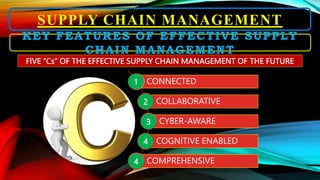
FIVE “Cs” OF THE EFFECTIVE SUPPLY CHAIN MANAGEMENT OF THE FUTURE
CONNECTED
COLLABORATIVE
CYBER-AWARE
COGNITIVE ENABLED
COMPREHENSIVE
1
2
3
4
4
SUPPLY CHAIN MANAGEMENT
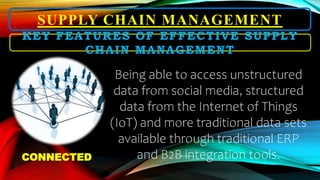
Being able to access unstructured
data from social media, structured
data from the Internet of Things
(IoT) and more traditional data sets
available through traditional ERP
and B2B integration tools.
KEY FEATURES OF EFFECTIVE SUPPLY
CHAIN MANAGEMENT
CONNECTED
SUPPLY CHAIN MANAGEMENT
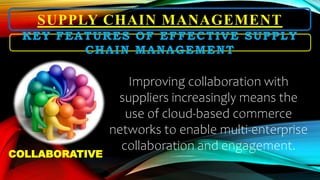
Improving collaboration with
suppliers increasingly means the
use of cloud-based commerce
networks to enable multi-enterprise
collaboration and engagement.
KEY FEATURES OF EFFECTIVE SUPPLY
CHAIN MANAGEMENT
COLLABORATIVE
SUPPLY CHAIN MANAGEMENT
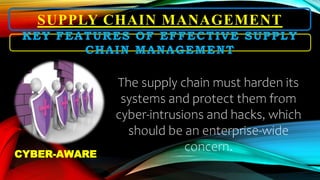
The supply chain must harden its
systems and protect them from
cyber-intrusions and hacks, which
should be an enterprise-wide
concern.
KEY FEATURES OF EFFECTIVE SUPPLY
CHAIN MANAGEMENT
CYBER-AWARE
SUPPLY CHAIN MANAGEMENT
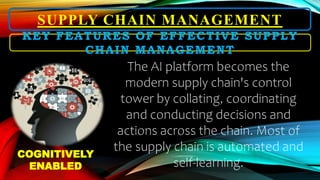
The AI platform becomes the
modern supply chain's control
tower by collating, coordinating
and conducting decisions and
actions across the chain. Most of
the supply chain is automated and
self-learning.
KEY FEATURES OF EFFECTIVE SUPPLY
CHAIN MANAGEMENT
COGNITIVELY
ENABLED
SUPPLY CHAIN MANAGEMENT
Analytics capabilities must be
scaled with data in real time.
Insights will be comprehensive and
fast. Latency is unacceptable in the
supply chain of the future.
KEY FEATURES OF EFFECTIVE SUPPLY
CHAIN MANAGEMENT
COMPREHENSIVE
SUPPLY CHAIN MANAGEMENT
EXERCISE
SUPPLY CHAIN MANAGEMENT
What is Supply Chain Management?
EXERCISE
SUPPLY CHAIN MANAGEMENT
EXERCISE
What are the 5 Components of Supply Chain
Management?
SUPPLY CHAIN MANAGEMENT
EXERCISE
What are the three scenarios where effective
supply chain management increases value to
the supply chain cycle?
SUPPLY CHAIN MANAGEMENT
EXERCISE
What are the five “Cs” of the effective Supply
Chain Management of the future?
SUPPLY CHAIN MANAGEMENT
EXERCISE
Why Supply Chain Management is important?
SUPPLY CHAIN MANAGEMENT
Referenc
e:
- https://www.ibm.com/topics/supply-chain-management
- https://www.investopedia.com/terms/s/scm.asp
- https://www.michiganstateuniversityonline.com/resources/supply
-chain/what-is-supply-chain-management/
SUPPLY CHAIN MANAGEMENT.pptx

SUPPLY CHAIN MANAGEMENT.pptx

  • 2.
    SUPPLY CHAIN MANAGEMENT LEARNING OBJECTIVES: 1.Understand the concepts, importance, and roles of Supply Chain Management in today’s business environment 2. Become familiar with the components, scenarios and key features of effective supply chain management 3. Apply the concepts and practices of Supply Chain Management in problem-based learning situations
  • 3.
    SUPPLY CHAIN MANAGEMENT WHATIS A SUPPLY CHAIN MANAGEMENT? Supply chain management is the handling of the entire production flow of a good or service — starting from the raw components all the way to delivering the final product to the consumer.
  • 4.
    SUPPLY CHAIN MANAGEMENT Acompany creates a network of suppliers (“links” in the chain) that move the product along from the suppliers of raw materials to those organizations that deal directly with users. WHAT IS A SUPPLY CHAIN MANAGEMENT?
  • 5.
    SUPPLY CHAIN MANAGEMENT 1PLANNING 3 MANUFACTURING 5 RETURNING SOURCING DELIVERY & LOGISTICS 2 4 5 COMPONENTS OF SUPPLY CHAIN MANAGEMENT HOW DOES SUPPLY CHAIN MANAGEMENT WORK?
  • 6.
    SUPPLY CHAIN MANAGEMENT Planand manage all resources required to meet customer demand for a company’s product or service. HOW DOES SUPPLY CHAIN MANAGEMENT WORK?
  • 7.
    SUPPLY CHAIN MANAGEMENT Choosesuppliers to provide the goods and services needed to create the product. Then, establish processes to monitor and manage supplier relationships. HOW DOES SUPPLY CHAIN MANAGEMENT WORK?
  • 8.
    SUPPLY CHAIN MANAGEMENT Organizethe activities required to accept raw materials, manufacture the product, test for quality, package for shipping and schedule for delivery. HOW DOES SUPPLY CHAIN MANAGEMENT WORK?
  • 9.
    SUPPLY CHAIN MANAGEMENT Coordinatecustomer orders, schedule deliveries, dispatch loads, invoice customers and receive payments. HOW DOES SUPPLY CHAIN MANAGEMENT WORK?
  • 10.
    SUPPLY CHAIN MANAGEMENT Createa network or process to take back defective, excess or unwanted products. HOW DOES SUPPLY CHAIN MANAGEMENT WORK?
  • 11.
    Effective supply chainmanagement systems minimize cost, waste and time in the production cycle. The industry standard has become a just-in- time supply chain where retail sales automatically signal replenishment orders to manufacturers. SUPPLY CHAIN MANAGEMENT WHY IS SUPPLY CHAIN MANAGEMENT IMPORTANT?
  • 12.
    SUPPLY CHAIN MANAGEMENT WHYIS SUPPLY CHAIN MANAGEMENT IMPORTANT? Retail shelves can then be restocked almost as quickly as product is sold. One way to further improve on this process is to analyze the data from supply chain partners to see where further improvements can be made.
  • 13.
    SUPPLY CHAIN MANAGEMENT WHYIS SUPPLY CHAIN MANAGEMENT IMPORTANT? Three scenarios where effective supply chain managementincreasesvaluetothesupplychaincycle: 1. Identifying potential problems 2. Optimizing price dynamically 3. Improving the allocation of “available to promise” inventory
  • 14.
    SUPPLY CHAIN MANAGEMENT Whena customer orders more product than the manufacturer can deliver, the buyer can complain of poor service. Through data analysis, manufacturers may be able to anticipate the shortage before the buyer is disappointed. WHY IS SUPPLY CHAIN MANAGEMENT IMPORTANT? IDENTIFYING POTENTIAL PROBLEMS
  • 15.
    SUPPLY CHAIN MANAGEMENT Seasonalproducts have a limited shelf life. At the end of the season, these products are typically scrapped or sold at deep discounts. Airlines, hotels and others with perishable “products” typically adjust prices dynamically to meet demand. WHY IS SUPPLY CHAIN MANAGEMENT IMPORTANT? OPTIMIZING PRICE DYNAMICALLY
  • 16.
    SUPPLY CHAIN MANAGEMENT Analyticalsoftware tools help to dynamically allocate resources and schedule work based on the sales forecast, actual orders and promised delivery of raw materials. WHY IS SUPPLY CHAIN MANAGEMENT IMPORTANT? IMPROVING THE ALLOCATION OF “AVAILABLE TO PROMISE” INVENTORY
  • 17.
    SUPPLY CHAIN MANAGEMENT KEYFEATURES OF EFFECTIVE SUPPLY CHAIN MANAGEMENT The supply chain is the most obvious “face” of the business for customers and consumers. The better and more effective a company’s supply chain management is, the better it protects its business reputation and long-term sustainability.
  • 18.
    SUPPLY CHAIN MANAGEMENT KEYFEATURES OF EFFECTIVE SUPPLY CHAIN MANAGEMENT FIVE “Cs” OF THE EFFECTIVE SUPPLY CHAIN MANAGEMENT OF THE FUTURE CONNECTED COLLABORATIVE CYBER-AWARE COGNITIVE ENABLED COMPREHENSIVE 1 2 3 4 4
  • 19.
    SUPPLY CHAIN MANAGEMENT Beingable to access unstructured data from social media, structured data from the Internet of Things (IoT) and more traditional data sets available through traditional ERP and B2B integration tools. KEY FEATURES OF EFFECTIVE SUPPLY CHAIN MANAGEMENT CONNECTED
  • 20.
    SUPPLY CHAIN MANAGEMENT Improvingcollaboration with suppliers increasingly means the use of cloud-based commerce networks to enable multi-enterprise collaboration and engagement. KEY FEATURES OF EFFECTIVE SUPPLY CHAIN MANAGEMENT COLLABORATIVE
  • 21.
    SUPPLY CHAIN MANAGEMENT Thesupply chain must harden its systems and protect them from cyber-intrusions and hacks, which should be an enterprise-wide concern. KEY FEATURES OF EFFECTIVE SUPPLY CHAIN MANAGEMENT CYBER-AWARE
  • 22.
    SUPPLY CHAIN MANAGEMENT TheAI platform becomes the modern supply chain's control tower by collating, coordinating and conducting decisions and actions across the chain. Most of the supply chain is automated and self-learning. KEY FEATURES OF EFFECTIVE SUPPLY CHAIN MANAGEMENT COGNITIVELY ENABLED
  • 23.
    SUPPLY CHAIN MANAGEMENT Analyticscapabilities must be scaled with data in real time. Insights will be comprehensive and fast. Latency is unacceptable in the supply chain of the future. KEY FEATURES OF EFFECTIVE SUPPLY CHAIN MANAGEMENT COMPREHENSIVE
  • 24.
  • 25.
    SUPPLY CHAIN MANAGEMENT Whatis Supply Chain Management? EXERCISE
  • 26.
    SUPPLY CHAIN MANAGEMENT EXERCISE Whatare the 5 Components of Supply Chain Management?
  • 27.
    SUPPLY CHAIN MANAGEMENT EXERCISE Whatare the three scenarios where effective supply chain management increases value to the supply chain cycle?
  • 28.
    SUPPLY CHAIN MANAGEMENT EXERCISE Whatare the five “Cs” of the effective Supply Chain Management of the future?
  • 29.
    SUPPLY CHAIN MANAGEMENT EXERCISE WhySupply Chain Management is important?
  • 30.
    SUPPLY CHAIN MANAGEMENT Referenc e: -https://www.ibm.com/topics/supply-chain-management - https://www.investopedia.com/terms/s/scm.asp - https://www.michiganstateuniversityonline.com/resources/supply -chain/what-is-supply-chain-management/