FINANCIAL
EDUCATION AND
INVESTMENT
AWARENESS (FEIA)
MODULE-1:
FOUNDATION FOR FINANCE
MONEY
A medium of exchange that is centralized,
generally accepted, recognized, and
facilitates transactions of goods and
services, is known as money.
Money is any item or medium of
exchange that is accepted by people for the
payment of goods and services, as well as
the repayment of loans.
Benefits/ Need of Money:
1. Money gives you freedom: When we have enough money, we can live where
we want, take care of our needs, and indulge in our hobbies.
Continue…
2. Money gives you the power to pursue your dreams: Having money makes it
possible to start a business, build a dream home, pay the costs associated with
having a family, or accomplish other goals.
Continue…
3. Money gives you security: When we have enough money in the bank, we
never need to worry about having a roof over our head or about having enough to
eat or about being able to see a doctor when we are sick.
Continue..
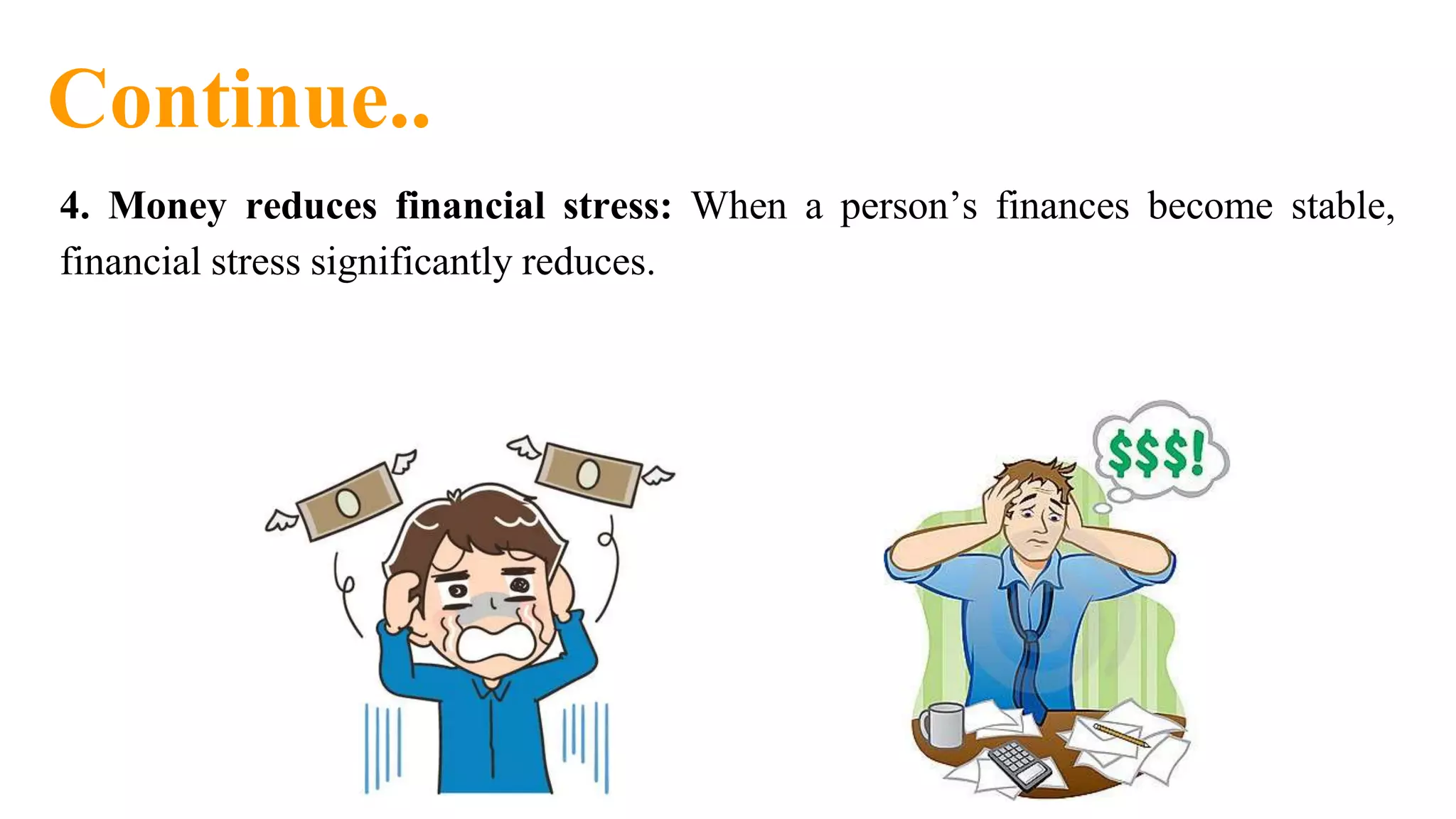
4. Money reduces financial stress: When a person’s finances become stable,
financial stress significantly reduces.
Continue..
• Money allows us to meet our basic needs—
to buy food and shelter and pay for
healthcare.
• Money allows to buy goods and services
we need.
• Money helps to improve the lifestyle and
living standard of the people.
NEED FOR FINANCIAL PLANNING:
Meaning of Financial Planning:
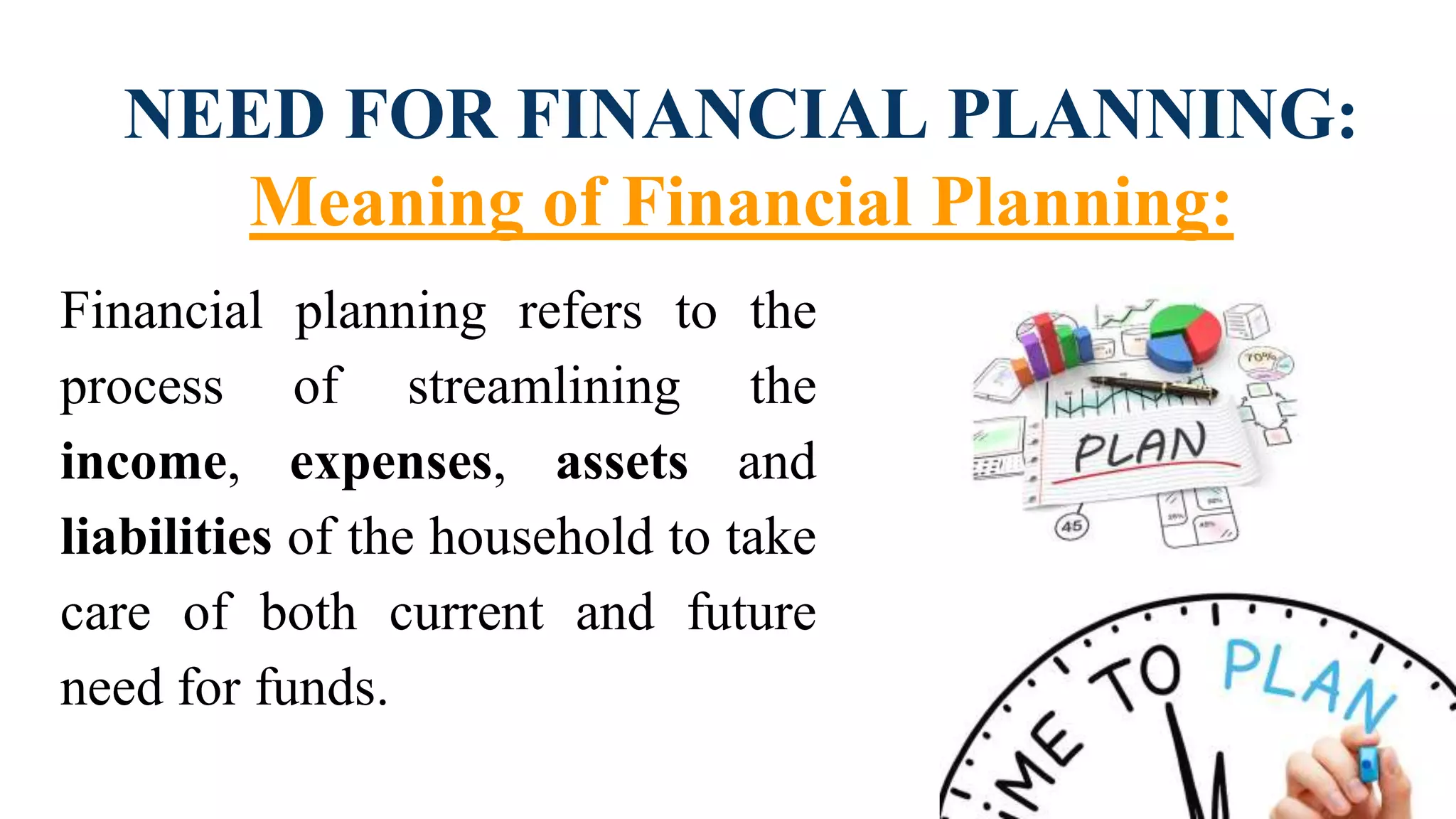
Financial planning refers to the
process of streamlining the
income, expenses, assets and
liabilities of the household to take
care of both current and future
need for funds.
Benefits of financial planning:
1. Increase your savings: When we create a financial plan, we get a good deal of
insight into our income and expenses. We can track and cut down the costs
consciously. This automatically increases the savings in the long run.
Continue…
2. Enjoy a better standard of living: With a good financial plan, there is no need
to compromise the lifestyle. It is possible to achieve the goals while living in
relative comfort.
Continue…
3. Be prepared for emergencies: Creating an emergency fund is a critical aspect
of financial planning. The Emergency fund should be equal to at least 6 months of
the monthly salary.
Continue…
4. Attain peace of mind: Financial planning helps you manage your money
efficiently and enjoy peace of mind.
LIFE GOALS AND FINANCIAL
GOALS:
Financial goal is the term used to describe the
future needs of an individual that require
funding. It specifies the sum of money
required in order to meet the needs and when
it is required. Goals described in terms of the
money required to meet it at a point of time in
future, is called a financial goal.
Types of Financial Goals:
a) Short-Term Goals (< 5 Years) : Short-term goals are something you want to
achieve in the future over the next few months. These are required for your more
immediate expenses. These expenses are generally smaller in scope and easier to
project and predict.
b) Medium-Term Goals (5 - 10 Years) : Medium Term lies between short term
and long term. Short-term goals have a typical timeline of a year whereas long-
term goals are planned for a decade or more. Clearing outstanding dues on your
credit card or personal loan can be classified under medium-term goals.
c) Long-Term Goals (> 10 Years) : Long-term goals require more deliberation,
and in most cases, money. Retirement, buying a house, and funding a child’s
higher education are typical long-term goals.
Continue..
Examples of financial goal
• Rs. 1 lakh required after 6 months to buy a car
• Rs. 30 lakhs required after five years for the college admission for child is a
financial goal.
• Retirement
• Emergency Fund
Each Financial goal contains two important components:
1. Goal Value
2. Time to goal or investment horizon
Continue..
1. Goal value: The goal value is the amount of money required for
the goal at the time when it has to be met.
2. Time to goal or Investment Horizon: Financial goals may be
short-term, medium-term or long-term. The term to goal refers to the
time remaining for the funds to be made available to meet they
goals.
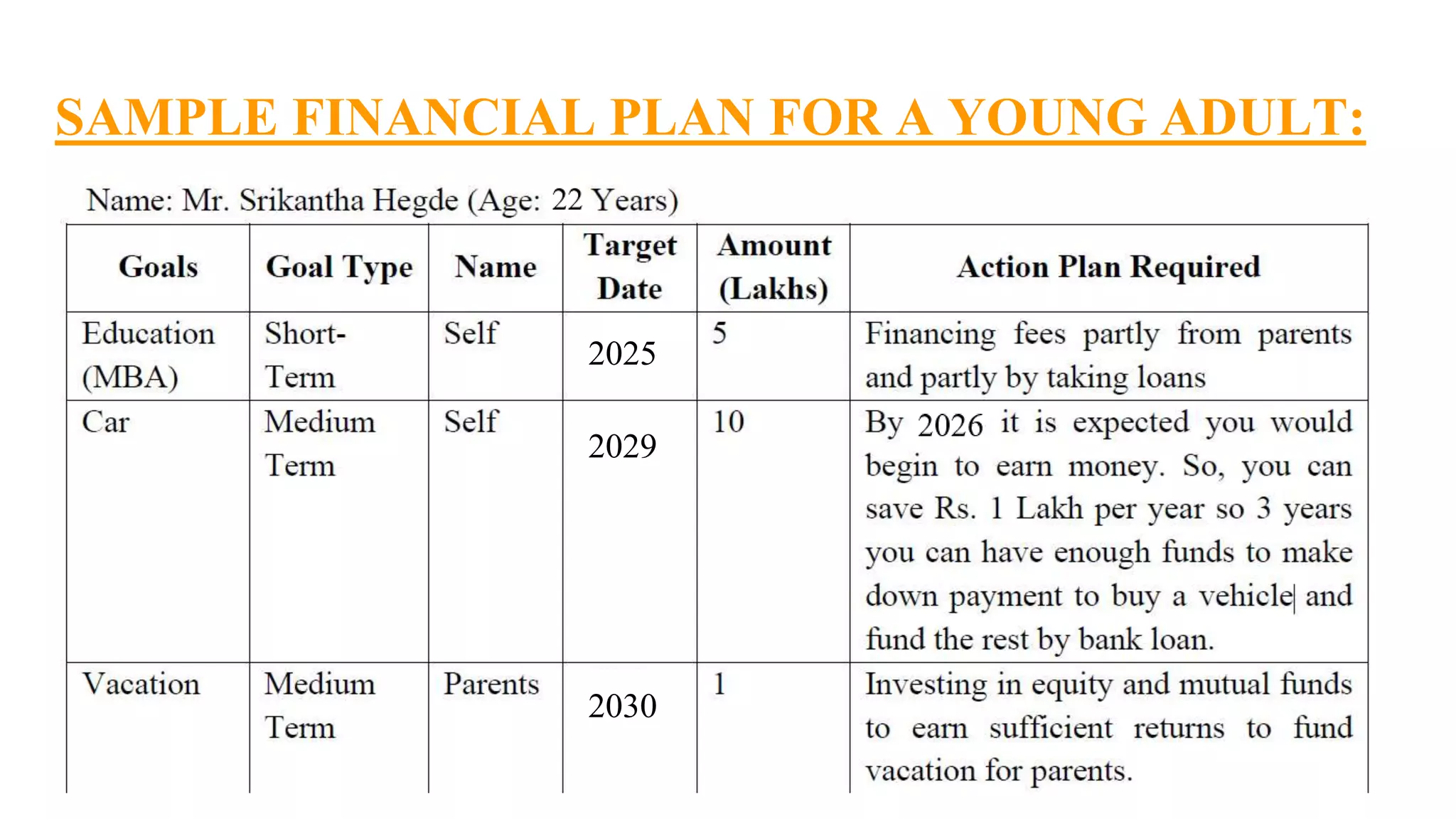
SAMPLE FINANCIAL PLAN FOR A YOUNG ADULT:
2025
2029
2030
Continue..
2032
2034

Financial Education and Investment Awareness

  • 1.
  • 2.
  • 3.
    MONEY A medium ofexchange that is centralized, generally accepted, recognized, and facilitates transactions of goods and services, is known as money. Money is any item or medium of exchange that is accepted by people for the payment of goods and services, as well as the repayment of loans.
  • 4.
    Benefits/ Need ofMoney: 1. Money gives you freedom: When we have enough money, we can live where we want, take care of our needs, and indulge in our hobbies.
  • 5.
    Continue… 2. Money givesyou the power to pursue your dreams: Having money makes it possible to start a business, build a dream home, pay the costs associated with having a family, or accomplish other goals.
  • 6.
    Continue… 3. Money givesyou security: When we have enough money in the bank, we never need to worry about having a roof over our head or about having enough to eat or about being able to see a doctor when we are sick.
  • 7.
    Continue.. 4. Money reducesfinancial stress: When a person’s finances become stable, financial stress significantly reduces.
  • 8.
    Continue.. • Money allowsus to meet our basic needs— to buy food and shelter and pay for healthcare. • Money allows to buy goods and services we need. • Money helps to improve the lifestyle and living standard of the people.
  • 9.
    NEED FOR FINANCIALPLANNING: Meaning of Financial Planning: Financial planning refers to the process of streamlining the income, expenses, assets and liabilities of the household to take care of both current and future need for funds.
  • 10.
    Benefits of financialplanning: 1. Increase your savings: When we create a financial plan, we get a good deal of insight into our income and expenses. We can track and cut down the costs consciously. This automatically increases the savings in the long run.
  • 11.
    Continue… 2. Enjoy abetter standard of living: With a good financial plan, there is no need to compromise the lifestyle. It is possible to achieve the goals while living in relative comfort.
  • 12.
    Continue… 3. Be preparedfor emergencies: Creating an emergency fund is a critical aspect of financial planning. The Emergency fund should be equal to at least 6 months of the monthly salary.
  • 13.
    Continue… 4. Attain peaceof mind: Financial planning helps you manage your money efficiently and enjoy peace of mind.
  • 14.
    LIFE GOALS ANDFINANCIAL GOALS: Financial goal is the term used to describe the future needs of an individual that require funding. It specifies the sum of money required in order to meet the needs and when it is required. Goals described in terms of the money required to meet it at a point of time in future, is called a financial goal.
  • 15.
    Types of FinancialGoals: a) Short-Term Goals (< 5 Years) : Short-term goals are something you want to achieve in the future over the next few months. These are required for your more immediate expenses. These expenses are generally smaller in scope and easier to project and predict. b) Medium-Term Goals (5 - 10 Years) : Medium Term lies between short term and long term. Short-term goals have a typical timeline of a year whereas long- term goals are planned for a decade or more. Clearing outstanding dues on your credit card or personal loan can be classified under medium-term goals. c) Long-Term Goals (> 10 Years) : Long-term goals require more deliberation, and in most cases, money. Retirement, buying a house, and funding a child’s higher education are typical long-term goals.
  • 17.
    Continue.. Examples of financialgoal • Rs. 1 lakh required after 6 months to buy a car • Rs. 30 lakhs required after five years for the college admission for child is a financial goal. • Retirement • Emergency Fund Each Financial goal contains two important components: 1. Goal Value 2. Time to goal or investment horizon
  • 18.
    Continue.. 1. Goal value:The goal value is the amount of money required for the goal at the time when it has to be met. 2. Time to goal or Investment Horizon: Financial goals may be short-term, medium-term or long-term. The term to goal refers to the time remaining for the funds to be made available to meet they goals.
  • 19.
    SAMPLE FINANCIAL PLANFOR A YOUNG ADULT: 2025 2029 2030
  • 20.