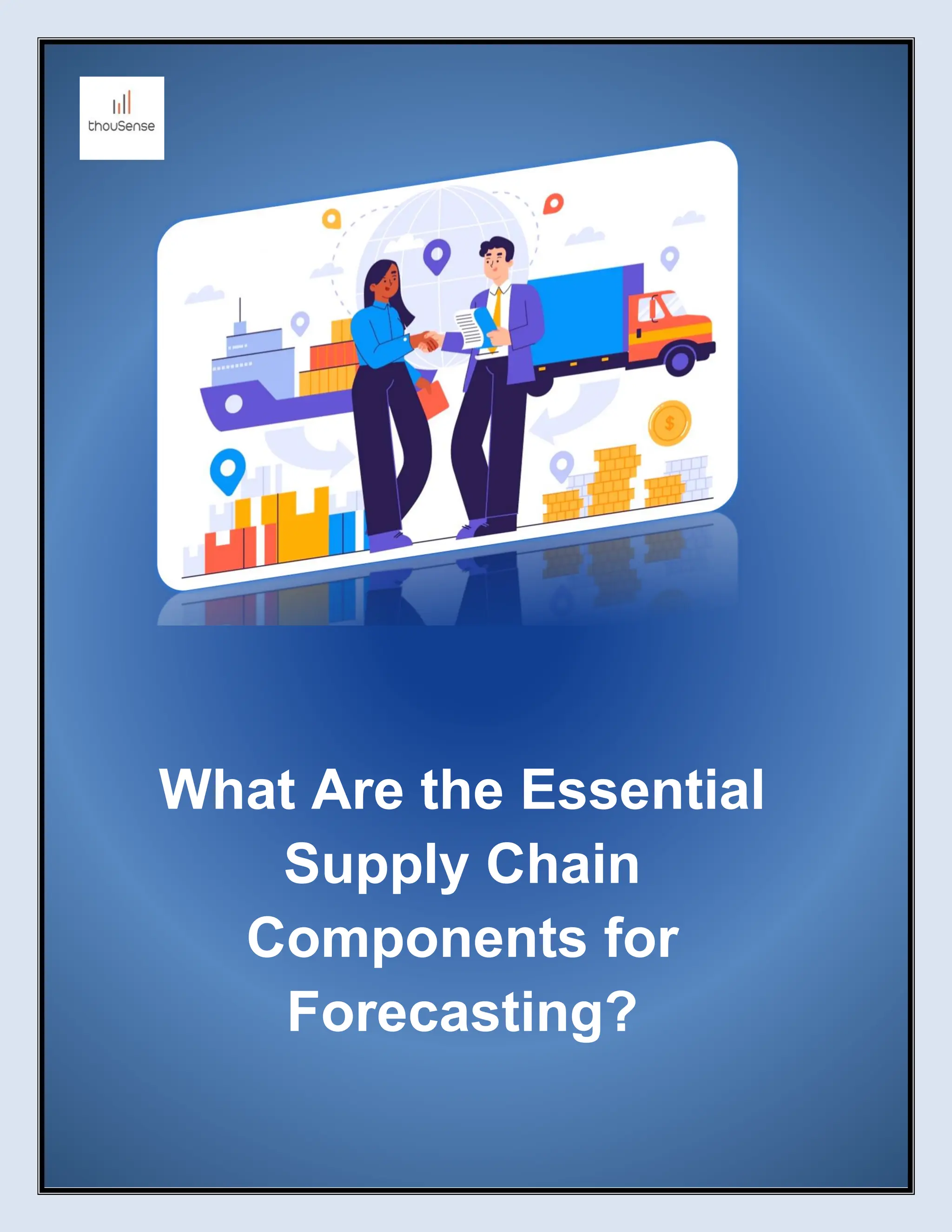
What Are the Essential
Supply Chain
Components for
Forecasting?
02 July 2024
| thouSense | 1
Supply chain management is the backbone of any business that deals with the production,
distribution, and sale of products. Within this framework, supply chain management forecasting
plays a critical role in ensuring that businesses can meet demand efficiently without
overproducing or understocking. Accurate demand forecasting and understanding the essential
supply chain components for forecasting are key to optimizing operations and enhancing
overall business performance. This blog will explore these components and explain their
significance in supply chain management forecasting.
Understanding Supply Chain Management Forecasting
Supply chain management forecasting involves predicting future demand for products or
services to ensure that all supply chain activities—from sourcing and procurement to production,
distribution, and customer service—are aligned with market needs. Effective forecasting allows
businesses to plan their resources, optimize inventory levels, and improve customer
satisfaction.
Essential Supply Chain Components for Forecasting
Several critical components make up the supply chain, each playing a vital role in forecasting.
These components work together to ensure that the supply chain operates smoothly and
efficiently. Here are the essential supply chain components for forecasting:
1. Demand Forecasting
Demand forecasting is the technique of projecting the future customer demand for a product or
service.. It is the foundation of supply chain management forecasting and helps businesses
plan their production schedules, manage inventory, and allocate resources efficiently.
• Importance: Accurate demand forecasting helps prevent overproduction or
underproduction, reduces costs, and ensures that products are available to meet
customer needs.
• Techniques: Quantitative methods (e.g., time series analysis, causal models, machine
learning) and qualitative methods (e.g., expert judgment, market surveys).
2. Inventory Management
Inventory management involves maintaining optimal inventory levels to meet customer demand
while minimizing carrying costs. Effective inventory management ensures that firms have the
proper amount of stock at the appropriate time.
Importance: Prevents stockouts and overstock situations, reduces storage costs, and
enhances cash flow.
• Techniques: Economic order quantity (EOQ), just-in-time (JIT) inventory, safety stock
analysis, and inventory optimization software.
02 July 2024
| thouSense | 2
3. Production Planning
Production planning is the process of scheduling production activities to meet forecasted
demand. It ensures that manufacturing resources are used efficiently and that production
schedules align with market needs.
• Importance: Enhances production efficiency, reduces lead times, and ensures timely
delivery of products.
• Techniques: Capacity planning, master production scheduling (MPS), and material
requirements planning (MRP).
4. Sourcing and Procurement
Sourcing and procurement entails identifying vendors and buying raw materials, components,
and services required for production.Effective sourcing ensures that businesses obtain quality
inputs at competitive prices.
• Importance: Ensures a reliable supply of materials, reduces costs, and builds strong
supplier relationships.
• Techniques: Supplier assessment, strategic sourcing, and e-procurement systems.
5. Logistics and Distribution
Logistics and distribution refer to the transportation and delivery of products to clients. Efficient
logistics ensure that things arrive on time and for the lowest feasible cost.
• Importance: Reduces transportation costs, improves delivery times, and enhances
customer satisfaction.
• Techniques: Route optimization, load planning, and distribution network design.
6. Customer Service
Customer service manages customer interactions and ensures that customer needs are met.
Excellent customer service enhances customer satisfaction and builds long-term relationships.
• Importance: Improves customer satisfaction, drives repeat business, and enhances
brand reputation.
• Techniques: Customer relationship management (CRM) systems, feedback analysis,
and service level agreements (SLAs).
7. Information Technology
Information technology (IT) supports all components of supply chain management by providing
tools and systems for collecting, processing, and sharing information. Advanced IT systems
enhance visibility, coordination, and decision-making across the supply chain.
• Importance: Improves data accuracy, enables real-time tracking, and supports
advanced analytics.
02 July 2024
| thouSense | 3
• Techniques: Enterprise resource planning (ERP) systems, supply chain management
software, and data analytics tools.
The Interaction of Supply Chain Components in Forecasting
The interaction between these essential supply chain components is crucial for effective supply
chain management forecasting. Here's how these components work together to ensure
accurate forecasting and efficient supply chain operations:
1. Demand Forecasting and Inventory Management
Demand forecasting provides the data needed to maintain optimal inventory levels. By
predicting future demand, businesses can adjust their inventory levels to prevent stockouts and
overstock situations.
• Example: A retail chain uses demand forecasting to predict sales for the holiday season.
Based on these forecasts, the company adjusts its inventory levels to ensure sufficient
stock without overstocking.
2. Production Planning and Sourcing
Accurate demand forecasting informs production planning, ensuring that manufacturing
schedules align with market demand. Sourcing and procurement activities are coordinated to
ensure that raw materials and components are available for production.
• Example: An automotive manufacturer uses demand forecasts to plan production
schedules for different car models. The procurement team coordinates with suppliers to
ensure timely delivery of necessary parts.
3. Logistics and Distribution and Customer Service
Logistics and distribution activities are planned based on demand forecasts to ensure timely
delivery of products to customers. Effective customer service relies on accurate forecasting to
meet customer expectations and resolve issues promptly.
• Example: An e-commerce company uses demand forecasting to plan its delivery routes
and schedules. This ensures that customers receive their orders on time, enhancing
overall satisfaction.
4. Information Technology and Supply Chain Coordination
Information technology supports the integration and coordination of all supply chain
components. Advanced IT systems provide real-time data and analytics, enabling businesses to
make informed decisions and respond quickly to changes in demand.
02 July 2024
| thouSense | 4
• Example: A pharmaceutical company uses an ERP system to integrate demand
forecasting with inventory management, production planning, and logistics. This ensures
seamless coordination across the supply chain.
The Role of Demand Forecasting in Supply Chain
Management Forecasting
Demand forecasting is at the heart of supply chain management forecasting. It provides the
data and insights needed to plan and coordinate all supply chain activities. Here are some ways
in which demand forecasting impacts supply chain management:
1. Optimizing Inventory Levels
Accurate demand forecasting helps businesses maintain optimal inventory levels. By predicting
future demand, companies can avoid overstocking and stockouts, reducing carrying costs and
improving cash flow.
• Example: A fashion retailer uses demand forecasting to predict seasonal trends. This
allows the company to adjust its inventory levels to meet customer demand without
excess stock.
2. Enhancing Production Efficiency
Demand forecasting ensures that production schedules align with market demand. This helps
businesses optimize their manufacturing processes, reduce lead times, and ensure timely
delivery of products.
• Example: A food and beverage company uses demand forecasts to plan its production
schedules. This ensures that products are manufactured and delivered on time to meet
customer demand.
3. Improving Supply Chain Coordination
Demand forecasting provides the data needed to coordinate supply chain activities, such as
sourcing, production, and logistics. By aligning these activities with forecasted demand,
businesses can improve efficiency and reduce costs.
• Example: A consumer electronics company uses demand forecasting to coordinate its
supply chain activities. This ensures that raw materials are sourced, products are
manufactured, and goods are delivered according to market demand.
4. Reducing Costs
Effective demand forecasting helps businesses minimize costs associated with excess
inventory, emergency production runs, and expedited shipping. By predicting demand
accurately, companies can optimize their supply chain operations and reduce waste.
02 July 2024
| thouSense | 5
• Example: A healthcare company uses demand forecasting to predict the need for
medical supplies. This allows the company to maintain optimal inventory levels, reducing
storage costs and preventing stockouts.
5. Enhancing Customer Satisfaction
Accurate demand forecasting ensures that products are available when and where customers
need them, leading to higher customer satisfaction and loyalty. By meeting customer demand
consistently, businesses can build long-term relationships and drive repeat business.
• Example: An online retailer uses demand forecasting to ensure that popular products
are always in stock. This leads to a better customer experience and increased sales.
Best Practices for Effective Supply Chain Management
Forecasting
To optimize supply chain management forecasting, businesses should consider the following
best practices:
1. Use a Combination of Forecasting Methods
Combining multiple forecasting methods can enhance accuracy. Hybrid models that integrate
qualitative and quantitative approaches provide a comprehensive view of future demand.
• Example: A retail company uses both market surveys (qualitative) and time series
analysis (quantitative) to improve its demand forecasts.
2. Continuously Monitor and Update Forecasts
Regularly updating forecasts based on new data and market developments ensures that
predictions remain accurate and relevant. Real-time data integration and dynamic forecasting
models support this practice.
• Example: A tech company continuously updates its demand forecasts based on real-
time sales data and market trends.
3. Leverage Advanced Analytics and AI
Incorporating advanced analytics and AI into demand forecasting techniques allows
businesses to analyze large datasets, identify complex patterns, and generate more accurate
forecasts.
• Example: An e-commerce platform uses machine learning algorithms to analyze
customer behavior and predict future demand for various products.
02 July 2024
| thouSense | 6
4. Engage Cross-Functional Teams
Involving cross-functional teams in the demand forecasting process ensures diverse
perspectives and insights are considered. Collaboration between marketing, sales, finance, and
operations teams improves forecast accuracy.
• Example: A manufacturing company engages its marketing, sales, and operations
teams in the demand forecasting process to ensure comprehensive and accurate
predictions.
5. Invest in Robust Forecasting Tools
Investing in robust forecasting tools that offer advanced analytics, real-time data integration,
and machine learning capabilities enhances the effectiveness of demand forecasting
techniques.
• Example: A global logistics company invests in advanced forecasting software to
improve its demand prediction capabilities and optimize its supply chain operations.
Conclusion
Understanding the essential supply chain components for forecasting is crucial for optimizing
supply chain operations and achieving business success. Demand forecasting, inventory
management, production planning, sourcing and procurement, logistics and distribution,
customer service, and information technology are critical components that work together to
ensure efficient resource utilization and smooth operations. By leveraging accurate demand
forecasting and integrating it with other supply chain components, businesses can reduce costs,
improve customer satisfaction, and make informed strategic decisions. Effective supply chain
management forecasting ensures that businesses can meet market demands, respond to
changes, and achieve long-term success.
FAQs
1. What are the essential supply chain components for forecasting?
The essential supply chain components for forecasting include demand forecasting, inventory
management, production planning, sourcing and procurement, logistics and distribution,
customer service, and information technology.
2. How does demand forecasting impact supply chain management forecasting?
Demand forecasting impacts supply chain management forecasting by providing the data
needed to plan and coordinate supply chain activities, optimize inventory levels, enhance
production efficiency, improve supply chain coordination, reduce costs, and enhance customer
satisfaction.
02 July 2024
| thouSense | 7
3. What are the best practices for effective supply chain management forecasting?
Best practices for effective supply chain management forecasting include using a combination
of forecasting methods, continuously monitoring and updating forecasts, leveraging advanced
analytics and AI, engaging cross-functional teams, and investing in robust forecasting tools.
Predict your sales volume and demand trends with our Artificial Intelligence-based SaaS
platform visit: https://thousense.ai/
02 July 2024
| thouSense | 8
Contact Us For Further
Inquiries
• Visit: https://thousense.ai/
• Mail: contact@thouc-labs.ai
• Phone Number: +91 829-108-8306

What Are the Essential Supply Chain Components for Forecasting.pdf

  • 1.
    What Are theEssential Supply Chain Components for Forecasting?
  • 2.
    02 July 2024 |thouSense | 1 Supply chain management is the backbone of any business that deals with the production, distribution, and sale of products. Within this framework, supply chain management forecasting plays a critical role in ensuring that businesses can meet demand efficiently without overproducing or understocking. Accurate demand forecasting and understanding the essential supply chain components for forecasting are key to optimizing operations and enhancing overall business performance. This blog will explore these components and explain their significance in supply chain management forecasting. Understanding Supply Chain Management Forecasting Supply chain management forecasting involves predicting future demand for products or services to ensure that all supply chain activities—from sourcing and procurement to production, distribution, and customer service—are aligned with market needs. Effective forecasting allows businesses to plan their resources, optimize inventory levels, and improve customer satisfaction. Essential Supply Chain Components for Forecasting Several critical components make up the supply chain, each playing a vital role in forecasting. These components work together to ensure that the supply chain operates smoothly and efficiently. Here are the essential supply chain components for forecasting: 1. Demand Forecasting Demand forecasting is the technique of projecting the future customer demand for a product or service.. It is the foundation of supply chain management forecasting and helps businesses plan their production schedules, manage inventory, and allocate resources efficiently. • Importance: Accurate demand forecasting helps prevent overproduction or underproduction, reduces costs, and ensures that products are available to meet customer needs. • Techniques: Quantitative methods (e.g., time series analysis, causal models, machine learning) and qualitative methods (e.g., expert judgment, market surveys). 2. Inventory Management Inventory management involves maintaining optimal inventory levels to meet customer demand while minimizing carrying costs. Effective inventory management ensures that firms have the proper amount of stock at the appropriate time. Importance: Prevents stockouts and overstock situations, reduces storage costs, and enhances cash flow. • Techniques: Economic order quantity (EOQ), just-in-time (JIT) inventory, safety stock analysis, and inventory optimization software.
  • 3.
    02 July 2024 |thouSense | 2 3. Production Planning Production planning is the process of scheduling production activities to meet forecasted demand. It ensures that manufacturing resources are used efficiently and that production schedules align with market needs. • Importance: Enhances production efficiency, reduces lead times, and ensures timely delivery of products. • Techniques: Capacity planning, master production scheduling (MPS), and material requirements planning (MRP). 4. Sourcing and Procurement Sourcing and procurement entails identifying vendors and buying raw materials, components, and services required for production.Effective sourcing ensures that businesses obtain quality inputs at competitive prices. • Importance: Ensures a reliable supply of materials, reduces costs, and builds strong supplier relationships. • Techniques: Supplier assessment, strategic sourcing, and e-procurement systems. 5. Logistics and Distribution Logistics and distribution refer to the transportation and delivery of products to clients. Efficient logistics ensure that things arrive on time and for the lowest feasible cost. • Importance: Reduces transportation costs, improves delivery times, and enhances customer satisfaction. • Techniques: Route optimization, load planning, and distribution network design. 6. Customer Service Customer service manages customer interactions and ensures that customer needs are met. Excellent customer service enhances customer satisfaction and builds long-term relationships. • Importance: Improves customer satisfaction, drives repeat business, and enhances brand reputation. • Techniques: Customer relationship management (CRM) systems, feedback analysis, and service level agreements (SLAs). 7. Information Technology Information technology (IT) supports all components of supply chain management by providing tools and systems for collecting, processing, and sharing information. Advanced IT systems enhance visibility, coordination, and decision-making across the supply chain. • Importance: Improves data accuracy, enables real-time tracking, and supports advanced analytics.
  • 4.
    02 July 2024 |thouSense | 3 • Techniques: Enterprise resource planning (ERP) systems, supply chain management software, and data analytics tools. The Interaction of Supply Chain Components in Forecasting The interaction between these essential supply chain components is crucial for effective supply chain management forecasting. Here's how these components work together to ensure accurate forecasting and efficient supply chain operations: 1. Demand Forecasting and Inventory Management Demand forecasting provides the data needed to maintain optimal inventory levels. By predicting future demand, businesses can adjust their inventory levels to prevent stockouts and overstock situations. • Example: A retail chain uses demand forecasting to predict sales for the holiday season. Based on these forecasts, the company adjusts its inventory levels to ensure sufficient stock without overstocking. 2. Production Planning and Sourcing Accurate demand forecasting informs production planning, ensuring that manufacturing schedules align with market demand. Sourcing and procurement activities are coordinated to ensure that raw materials and components are available for production. • Example: An automotive manufacturer uses demand forecasts to plan production schedules for different car models. The procurement team coordinates with suppliers to ensure timely delivery of necessary parts. 3. Logistics and Distribution and Customer Service Logistics and distribution activities are planned based on demand forecasts to ensure timely delivery of products to customers. Effective customer service relies on accurate forecasting to meet customer expectations and resolve issues promptly. • Example: An e-commerce company uses demand forecasting to plan its delivery routes and schedules. This ensures that customers receive their orders on time, enhancing overall satisfaction. 4. Information Technology and Supply Chain Coordination Information technology supports the integration and coordination of all supply chain components. Advanced IT systems provide real-time data and analytics, enabling businesses to make informed decisions and respond quickly to changes in demand.
  • 5.
    02 July 2024 |thouSense | 4 • Example: A pharmaceutical company uses an ERP system to integrate demand forecasting with inventory management, production planning, and logistics. This ensures seamless coordination across the supply chain. The Role of Demand Forecasting in Supply Chain Management Forecasting Demand forecasting is at the heart of supply chain management forecasting. It provides the data and insights needed to plan and coordinate all supply chain activities. Here are some ways in which demand forecasting impacts supply chain management: 1. Optimizing Inventory Levels Accurate demand forecasting helps businesses maintain optimal inventory levels. By predicting future demand, companies can avoid overstocking and stockouts, reducing carrying costs and improving cash flow. • Example: A fashion retailer uses demand forecasting to predict seasonal trends. This allows the company to adjust its inventory levels to meet customer demand without excess stock. 2. Enhancing Production Efficiency Demand forecasting ensures that production schedules align with market demand. This helps businesses optimize their manufacturing processes, reduce lead times, and ensure timely delivery of products. • Example: A food and beverage company uses demand forecasts to plan its production schedules. This ensures that products are manufactured and delivered on time to meet customer demand. 3. Improving Supply Chain Coordination Demand forecasting provides the data needed to coordinate supply chain activities, such as sourcing, production, and logistics. By aligning these activities with forecasted demand, businesses can improve efficiency and reduce costs. • Example: A consumer electronics company uses demand forecasting to coordinate its supply chain activities. This ensures that raw materials are sourced, products are manufactured, and goods are delivered according to market demand. 4. Reducing Costs Effective demand forecasting helps businesses minimize costs associated with excess inventory, emergency production runs, and expedited shipping. By predicting demand accurately, companies can optimize their supply chain operations and reduce waste.
  • 6.
    02 July 2024 |thouSense | 5 • Example: A healthcare company uses demand forecasting to predict the need for medical supplies. This allows the company to maintain optimal inventory levels, reducing storage costs and preventing stockouts. 5. Enhancing Customer Satisfaction Accurate demand forecasting ensures that products are available when and where customers need them, leading to higher customer satisfaction and loyalty. By meeting customer demand consistently, businesses can build long-term relationships and drive repeat business. • Example: An online retailer uses demand forecasting to ensure that popular products are always in stock. This leads to a better customer experience and increased sales. Best Practices for Effective Supply Chain Management Forecasting To optimize supply chain management forecasting, businesses should consider the following best practices: 1. Use a Combination of Forecasting Methods Combining multiple forecasting methods can enhance accuracy. Hybrid models that integrate qualitative and quantitative approaches provide a comprehensive view of future demand. • Example: A retail company uses both market surveys (qualitative) and time series analysis (quantitative) to improve its demand forecasts. 2. Continuously Monitor and Update Forecasts Regularly updating forecasts based on new data and market developments ensures that predictions remain accurate and relevant. Real-time data integration and dynamic forecasting models support this practice. • Example: A tech company continuously updates its demand forecasts based on real- time sales data and market trends. 3. Leverage Advanced Analytics and AI Incorporating advanced analytics and AI into demand forecasting techniques allows businesses to analyze large datasets, identify complex patterns, and generate more accurate forecasts. • Example: An e-commerce platform uses machine learning algorithms to analyze customer behavior and predict future demand for various products.
  • 7.
    02 July 2024 |thouSense | 6 4. Engage Cross-Functional Teams Involving cross-functional teams in the demand forecasting process ensures diverse perspectives and insights are considered. Collaboration between marketing, sales, finance, and operations teams improves forecast accuracy. • Example: A manufacturing company engages its marketing, sales, and operations teams in the demand forecasting process to ensure comprehensive and accurate predictions. 5. Invest in Robust Forecasting Tools Investing in robust forecasting tools that offer advanced analytics, real-time data integration, and machine learning capabilities enhances the effectiveness of demand forecasting techniques. • Example: A global logistics company invests in advanced forecasting software to improve its demand prediction capabilities and optimize its supply chain operations. Conclusion Understanding the essential supply chain components for forecasting is crucial for optimizing supply chain operations and achieving business success. Demand forecasting, inventory management, production planning, sourcing and procurement, logistics and distribution, customer service, and information technology are critical components that work together to ensure efficient resource utilization and smooth operations. By leveraging accurate demand forecasting and integrating it with other supply chain components, businesses can reduce costs, improve customer satisfaction, and make informed strategic decisions. Effective supply chain management forecasting ensures that businesses can meet market demands, respond to changes, and achieve long-term success. FAQs 1. What are the essential supply chain components for forecasting? The essential supply chain components for forecasting include demand forecasting, inventory management, production planning, sourcing and procurement, logistics and distribution, customer service, and information technology. 2. How does demand forecasting impact supply chain management forecasting? Demand forecasting impacts supply chain management forecasting by providing the data needed to plan and coordinate supply chain activities, optimize inventory levels, enhance production efficiency, improve supply chain coordination, reduce costs, and enhance customer satisfaction.
  • 8.
    02 July 2024 |thouSense | 7 3. What are the best practices for effective supply chain management forecasting? Best practices for effective supply chain management forecasting include using a combination of forecasting methods, continuously monitoring and updating forecasts, leveraging advanced analytics and AI, engaging cross-functional teams, and investing in robust forecasting tools. Predict your sales volume and demand trends with our Artificial Intelligence-based SaaS platform visit: https://thousense.ai/
  • 9.
    02 July 2024 |thouSense | 8 Contact Us For Further Inquiries • Visit: https://thousense.ai/ • Mail: contact@thouc-labs.ai • Phone Number: +91 829-108-8306