THE DELHI SULTANS
AND THEIR
MONUMENTS
BY
ARUSH KASHYAP
ISHANTH GOWDA
DIGANTH GOWDA
MRIDUL KUMAR JHA
SUNAY SHET
CHAUHANS
[1175-1192]
 Prithviraj III, popularly known as Prithviraj
Chauhan or Rai Pithora was a king from the
Chahamana dynasty. He ruled
Sapadalaksha, the traditional Chahamana
territory, in present-day north-western India.
 Early in his career, Prithviraj achieved military
successes against several neighbouring
Hindu kingdoms, most notably against the
Chandela king Paramardi. He also repulsed
the early invasions by Muhammad of Ghor, a
ruler of the Muslim Ghurid dynasty. However,
in 1192 CE, the Ghurids defeated Prithviraj at
the Second battle of Tarain, and executed
him shortly after. His defeat at Tarain is seen
as a landmark event in the Islamic conquest
of India, and has been described in several
semi-legendary accounts.
THE EARLY TURKISH
RULERS [1206-1290]
 Mu'izz ad-Din Muhammad Ghori,
born Shihab ad-Din, also known as
Muhammad of Ghor, was the
Sultan of the Ghurid Empire along
with his brother Ghiyath ad-Din
Muhammad from 1173 to 1202
and as the sole ruler from 1202 to
1206.
 Qutb al-Din Aibak was a general of
the Ghurid king Mu'izz ad-Din
Muhammad Ghori. He was in-
charge of the Ghurid territories in
northern India, and after Mu'izz ad-
Din's death, he became the ruler
of an independent kingdom that
evolved into the Delhi Sultanate
ruled by the Mamluk dynasty.
THE EARLY TURKISH
RULERS [1206-1290]
 Shams ud-Din Iltutmish, was the
third of the Mamluk kings who
ruled the former Ghurid
territories in northern India. He
was the first Muslim sovereign
to rule from Delhi, and is thus
considered the effective founder
of the Delhi Sultanate.
 Raziya al-Din, popularly known
as Razzia Sultan, was a ruler of
the Delhi Sultanate in the
northern part of the Indian
subcontinent. She is notable for
being the first female Muslim
ruler of the Indian Subcontinent.
THE EARLY TURKISH
RULERS [1206-1290]
 Ghiyas ud din Balban; was the ninth
sultan of the Mamluk dynasty of
Delhi. Ghiyas ud Din was the wazir of
the last Shamsi sultan, Nasiruddin
Mahmud. He reduced the power of
the treacherous nobility and
heightened the stature of the sultan.
 He was the son of a Central Asian
Turkic noble. As a child, he and
others from his tribe were captured by
the Mongols and sold as slaves in
Ghazni. He was sold to Khwaja Jamal
ud-din of Basra, a Sufi who
nicknamed him Baha ud din. The
Khwaja brought him to Delhi where
he and the other slaves were bought
by Sultan Shams-ud-din Iltutmish,
himself a captured Ilbari Turk in
origin, in 1232.
KHILJI DYNASTY
[1290-1320]
 Jalal-ud-din Khalji was the founder
and first Sultan of the Khalji dynasty
that ruled the Delhi Sultanate from
1290 to 1320. Originally named
Firuz, Jalal-ud-din started his career
as an officer of the Mamluk dynasty,
and rose to an important position
under Sultan Muizzuddin Qaiqabad.
 ʿAlāʾ ud-Dīn Khaljī, born as Ali
Gurshasp, was the most powerful
emperor of the Khalji dynasty that
ruled the Delhi Sultanate in the
Indian subcontinent. Alauddin
instituted a number of significant
administrative changes, related to
revenues, price controls, and
society.
TUGHLUQ DYNASTY
[1320-1414]
 Ghiyath al-Din Tughluq,
Ghiasuddin Tughlaq, or Ghazi
Malik, was the founder of the
Tughluq dynasty in India, who
reigned over the Sultanate of Delhi
from 1320 to 1325. He founded
the city of Tughluqabad. He died
under mysterious circumstances in
1325.
 Muhammad bin Tughluq was the
Sultan of Delhi from 1325 to 1351.
He was the eldest son of Ghiyas -
ud -Din -Tughlaq, the founder of
the Tughluq dynasty. His wife was
the daughter of the Raja of
Dipalpur.
TUGHLUQ DYNASTY
[1320-1413]
 Sultan Firoz Shah Tughlaq was a
Muslim ruler of the Tughlaq
dynasty, who reigned over the
Sultanate of Delhi from 1351 to
1388. His father's name was
Rajab who had the title
Sipahsalar.
 Tughlaq was a fervent Muslim and
adopted sharia policies. He made
a number of important
concessions to theologians. He
imposed Jizya tax on all non-
Muslims. He tried to ban practices
that the orthodox theologians
considered un-Islamic, an
example being his prohibition of
the practice of Muslim women
going out to worship at the graves
of saints.
SAYYID DYNASTY
[1414-145`]
 Sayyid Khizr Khan was the founder
of the Sayyid dynasty, the ruling
dynasty of the Delhi sultanate, in
northern India soon after the
invasion of Timur and the fall of the
Tughlaq dynasty. Khan was
Governor of Multan under the
Tughlaq ruler, Firuz Shah Tughlaq,
and was known to be an able
administrator.
 A contemporary writer Yahya
Sirhindi mentions in his Takhrikh-i-
Mubarak Shahi that Khizr Khan
was a descendant of Muhammad,
but his conclusion was based only
on a testimony of the saint Syed
Jalal-ud-Din Bukhari of Uchh
Sharif.
LODI DYNASTY
[1451-1526]
 Bahlul Khan Lodi was the chief of
the Pashtun Lodi tribe. Founder of
the Lodi dynasty from the Delhi
Sultanate upon the abdication of
the last claimant from the previous
Sayyid rule. Bahlul became sultan
of the dynasty on 19 April 1451.
 Bahlul's grandfather, Malik Bahram
Lodhi, a Pashtun tribal chief of
Lodhi tribe. He later took service
under the governor of Multan,
Malik Mardan Daulat. Malik
Bahram had a total of about five
sons.
MONUMENTS
MADE BY
DELHI SULTANS [1206-1489]
 The Monuments
Constructed In The Period
Of The Delhi Sultans Are :-
 QUTUB MINAR
 TUGHLAKABAD FORT
 ALAI DARWAZA
 JAMMAT KHANA MASJID
 GHIYASUDDIN TUGHLAQ'S
TOMB
 HAZRAT NIZAMUDDIN AULIA
DARGAH
QUTUB MINAR
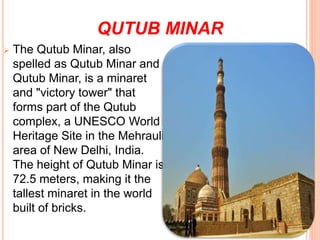
 The Qutub Minar, also
spelled as Qutub Minar and
Qutub Minar, is a minaret
and "victory tower" that
forms part of the Qutub
complex, a UNESCO World
Heritage Site in the Mehrauli
area of New Delhi, India.
The height of Qutub Minar is
72.5 meters, making it the
tallest minaret in the world
built of bricks.
TUGHLAKABAD FORT
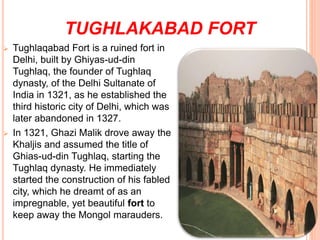
 Tughlaqabad Fort is a ruined fort in
Delhi, built by Ghiyas-ud-din
Tughlaq, the founder of Tughlaq
dynasty, of the Delhi Sultanate of
India in 1321, as he established the
third historic city of Delhi, which was
later abandoned in 1327.
 In 1321, Ghazi Malik drove away the
Khaljis and assumed the title of
Ghias-ud-din Tughlaq, starting the
Tughlaq dynasty. He immediately
started the construction of his fabled
city, which he dreamt of as an
impregnable, yet beautiful fort to
keep away the Mongol marauders.
ALAI DARWAZA
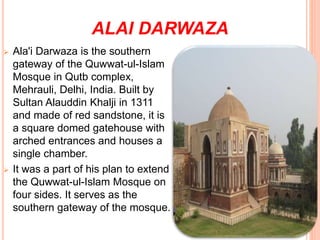
 Ala'i Darwaza is the southern
gateway of the Quwwat-ul-Islam
Mosque in Qutb complex,
Mehrauli, Delhi, India. Built by
Sultan Alauddin Khalji in 1311
and made of red sandstone, it is
a square domed gatehouse with
arched entrances and houses a
single chamber.
 It was a part of his plan to extend
the Quwwat-ul-Islam Mosque on
four sides. It serves as the
southern gateway of the mosque.
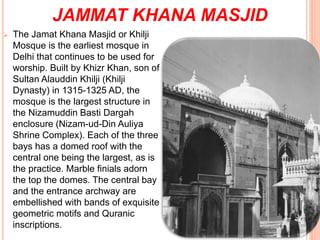
JAMMAT KHANA MASJID
 The Jamat Khana Masjid or Khilji
Mosque is the earliest mosque in
Delhi that continues to be used for
worship. Built by Khizr Khan, son of
Sultan Alauddin Khilji (Khilji
Dynasty) in 1315-1325 AD, the
mosque is the largest structure in
the Nizamuddin Basti Dargah
enclosure (Nizam-ud-Din Auliya
Shrine Complex). Each of the three
bays has a domed roof with the
central one being the largest, as is
the practice. Marble finials adorn
the top the domes. The central bay
and the entrance archway are
embellished with bands of exquisite
geometric motifs and Quranic
inscriptions.
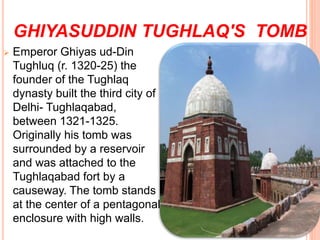
GHIYASUDDIN TUGHLAQ'S TOMB
 Emperor Ghiyas ud-Din
Tughluq (r. 1320-25) the
founder of the Tughlaq
dynasty built the third city of
Delhi- Tughlaqabad,
between 1321-1325.
Originally his tomb was
surrounded by a reservoir
and was attached to the
Tughlaqabad fort by a
causeway. The tomb stands
at the center of a pentagonal
enclosure with high walls.
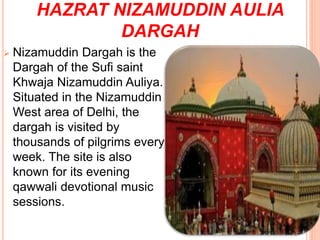
HAZRAT NIZAMUDDIN AULIA
DARGAH
 Nizamuddin Dargah is the
Dargah of the Sufi saint
Khwaja Nizamuddin Auliya.
Situated in the Nizamuddin
West area of Delhi, the
dargah is visited by
thousands of pilgrims every
week. The site is also
known for its evening
qawwali devotional music
sessions.
DELHI SULTANS AND THEIR MONUMENTS

DELHI SULTANS AND THEIR MONUMENTS

  • 1.
    THE DELHI SULTANS ANDTHEIR MONUMENTS BY ARUSH KASHYAP ISHANTH GOWDA DIGANTH GOWDA MRIDUL KUMAR JHA SUNAY SHET
  • 2.
    CHAUHANS [1175-1192]  Prithviraj III,popularly known as Prithviraj Chauhan or Rai Pithora was a king from the Chahamana dynasty. He ruled Sapadalaksha, the traditional Chahamana territory, in present-day north-western India.  Early in his career, Prithviraj achieved military successes against several neighbouring Hindu kingdoms, most notably against the Chandela king Paramardi. He also repulsed the early invasions by Muhammad of Ghor, a ruler of the Muslim Ghurid dynasty. However, in 1192 CE, the Ghurids defeated Prithviraj at the Second battle of Tarain, and executed him shortly after. His defeat at Tarain is seen as a landmark event in the Islamic conquest of India, and has been described in several semi-legendary accounts.
  • 3.
    THE EARLY TURKISH RULERS[1206-1290]  Mu'izz ad-Din Muhammad Ghori, born Shihab ad-Din, also known as Muhammad of Ghor, was the Sultan of the Ghurid Empire along with his brother Ghiyath ad-Din Muhammad from 1173 to 1202 and as the sole ruler from 1202 to 1206.  Qutb al-Din Aibak was a general of the Ghurid king Mu'izz ad-Din Muhammad Ghori. He was in- charge of the Ghurid territories in northern India, and after Mu'izz ad- Din's death, he became the ruler of an independent kingdom that evolved into the Delhi Sultanate ruled by the Mamluk dynasty.
  • 4.
    THE EARLY TURKISH RULERS[1206-1290]  Shams ud-Din Iltutmish, was the third of the Mamluk kings who ruled the former Ghurid territories in northern India. He was the first Muslim sovereign to rule from Delhi, and is thus considered the effective founder of the Delhi Sultanate.  Raziya al-Din, popularly known as Razzia Sultan, was a ruler of the Delhi Sultanate in the northern part of the Indian subcontinent. She is notable for being the first female Muslim ruler of the Indian Subcontinent.
  • 5.
    THE EARLY TURKISH RULERS[1206-1290]  Ghiyas ud din Balban; was the ninth sultan of the Mamluk dynasty of Delhi. Ghiyas ud Din was the wazir of the last Shamsi sultan, Nasiruddin Mahmud. He reduced the power of the treacherous nobility and heightened the stature of the sultan.  He was the son of a Central Asian Turkic noble. As a child, he and others from his tribe were captured by the Mongols and sold as slaves in Ghazni. He was sold to Khwaja Jamal ud-din of Basra, a Sufi who nicknamed him Baha ud din. The Khwaja brought him to Delhi where he and the other slaves were bought by Sultan Shams-ud-din Iltutmish, himself a captured Ilbari Turk in origin, in 1232.
  • 6.
    KHILJI DYNASTY [1290-1320]  Jalal-ud-dinKhalji was the founder and first Sultan of the Khalji dynasty that ruled the Delhi Sultanate from 1290 to 1320. Originally named Firuz, Jalal-ud-din started his career as an officer of the Mamluk dynasty, and rose to an important position under Sultan Muizzuddin Qaiqabad.  ʿAlāʾ ud-Dīn Khaljī, born as Ali Gurshasp, was the most powerful emperor of the Khalji dynasty that ruled the Delhi Sultanate in the Indian subcontinent. Alauddin instituted a number of significant administrative changes, related to revenues, price controls, and society.
  • 7.
    TUGHLUQ DYNASTY [1320-1414]  Ghiyathal-Din Tughluq, Ghiasuddin Tughlaq, or Ghazi Malik, was the founder of the Tughluq dynasty in India, who reigned over the Sultanate of Delhi from 1320 to 1325. He founded the city of Tughluqabad. He died under mysterious circumstances in 1325.  Muhammad bin Tughluq was the Sultan of Delhi from 1325 to 1351. He was the eldest son of Ghiyas - ud -Din -Tughlaq, the founder of the Tughluq dynasty. His wife was the daughter of the Raja of Dipalpur.
  • 8.
    TUGHLUQ DYNASTY [1320-1413]  SultanFiroz Shah Tughlaq was a Muslim ruler of the Tughlaq dynasty, who reigned over the Sultanate of Delhi from 1351 to 1388. His father's name was Rajab who had the title Sipahsalar.  Tughlaq was a fervent Muslim and adopted sharia policies. He made a number of important concessions to theologians. He imposed Jizya tax on all non- Muslims. He tried to ban practices that the orthodox theologians considered un-Islamic, an example being his prohibition of the practice of Muslim women going out to worship at the graves of saints.
  • 9.
    SAYYID DYNASTY [1414-145`]  SayyidKhizr Khan was the founder of the Sayyid dynasty, the ruling dynasty of the Delhi sultanate, in northern India soon after the invasion of Timur and the fall of the Tughlaq dynasty. Khan was Governor of Multan under the Tughlaq ruler, Firuz Shah Tughlaq, and was known to be an able administrator.  A contemporary writer Yahya Sirhindi mentions in his Takhrikh-i- Mubarak Shahi that Khizr Khan was a descendant of Muhammad, but his conclusion was based only on a testimony of the saint Syed Jalal-ud-Din Bukhari of Uchh Sharif.
  • 10.
    LODI DYNASTY [1451-1526]  BahlulKhan Lodi was the chief of the Pashtun Lodi tribe. Founder of the Lodi dynasty from the Delhi Sultanate upon the abdication of the last claimant from the previous Sayyid rule. Bahlul became sultan of the dynasty on 19 April 1451.  Bahlul's grandfather, Malik Bahram Lodhi, a Pashtun tribal chief of Lodhi tribe. He later took service under the governor of Multan, Malik Mardan Daulat. Malik Bahram had a total of about five sons.
  • 11.
    MONUMENTS MADE BY DELHI SULTANS[1206-1489]  The Monuments Constructed In The Period Of The Delhi Sultans Are :-  QUTUB MINAR  TUGHLAKABAD FORT  ALAI DARWAZA  JAMMAT KHANA MASJID  GHIYASUDDIN TUGHLAQ'S TOMB  HAZRAT NIZAMUDDIN AULIA DARGAH
  • 12.
    QUTUB MINAR  TheQutub Minar, also spelled as Qutub Minar and Qutub Minar, is a minaret and "victory tower" that forms part of the Qutub complex, a UNESCO World Heritage Site in the Mehrauli area of New Delhi, India. The height of Qutub Minar is 72.5 meters, making it the tallest minaret in the world built of bricks.
  • 13.
    TUGHLAKABAD FORT  TughlaqabadFort is a ruined fort in Delhi, built by Ghiyas-ud-din Tughlaq, the founder of Tughlaq dynasty, of the Delhi Sultanate of India in 1321, as he established the third historic city of Delhi, which was later abandoned in 1327.  In 1321, Ghazi Malik drove away the Khaljis and assumed the title of Ghias-ud-din Tughlaq, starting the Tughlaq dynasty. He immediately started the construction of his fabled city, which he dreamt of as an impregnable, yet beautiful fort to keep away the Mongol marauders.
  • 14.
    ALAI DARWAZA  Ala'iDarwaza is the southern gateway of the Quwwat-ul-Islam Mosque in Qutb complex, Mehrauli, Delhi, India. Built by Sultan Alauddin Khalji in 1311 and made of red sandstone, it is a square domed gatehouse with arched entrances and houses a single chamber.  It was a part of his plan to extend the Quwwat-ul-Islam Mosque on four sides. It serves as the southern gateway of the mosque.
  • 15.
    JAMMAT KHANA MASJID The Jamat Khana Masjid or Khilji Mosque is the earliest mosque in Delhi that continues to be used for worship. Built by Khizr Khan, son of Sultan Alauddin Khilji (Khilji Dynasty) in 1315-1325 AD, the mosque is the largest structure in the Nizamuddin Basti Dargah enclosure (Nizam-ud-Din Auliya Shrine Complex). Each of the three bays has a domed roof with the central one being the largest, as is the practice. Marble finials adorn the top the domes. The central bay and the entrance archway are embellished with bands of exquisite geometric motifs and Quranic inscriptions.
  • 16.
    GHIYASUDDIN TUGHLAQ'S TOMB Emperor Ghiyas ud-Din Tughluq (r. 1320-25) the founder of the Tughlaq dynasty built the third city of Delhi- Tughlaqabad, between 1321-1325. Originally his tomb was surrounded by a reservoir and was attached to the Tughlaqabad fort by a causeway. The tomb stands at the center of a pentagonal enclosure with high walls.
  • 17.
    HAZRAT NIZAMUDDIN AULIA DARGAH Nizamuddin Dargah is the Dargah of the Sufi saint Khwaja Nizamuddin Auliya. Situated in the Nizamuddin West area of Delhi, the dargah is visited by thousands of pilgrims every week. The site is also known for its evening qawwali devotional music sessions.