Drive For Success
First Line Manager Training
– Stage 2
JULIA MENAUL
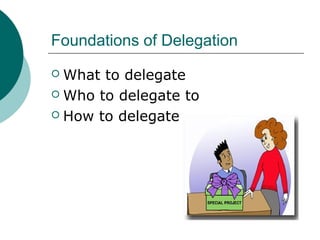
Foundations of Delegation
 What to delegate
 Who to delegate to
 How to delegate
Basics of Delegation
 What is
delegation?
 What isn’t
delegation?
 3 elements
to delegation
What are the barriers to effective
delegation?
What are the benefits? To you and
them
Delegation
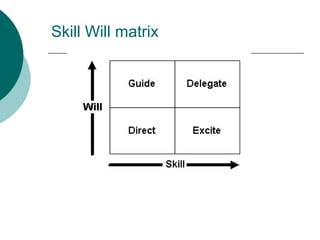
Skill Will matrix
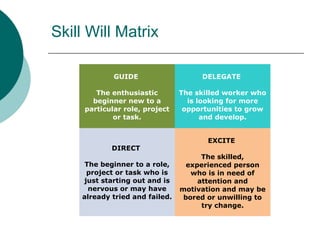
Skill Will Matrix
GUIDE
The enthusiastic
beginner new to a
particular role, project
or task.
DELEGATE
The skilled worker who
is looking for more
opportunities to grow
and develop.
DIRECT
The beginner to a role,
project or task who is
just starting out and is
nervous or may have
already tried and failed.
EXCITE
The skilled,
experienced person
who is in need of
attention and
motivation and may be
bored or unwilling to
try change.
Delegation
Using the templates in your workbook, use the skill
/will matrix to show :
 Where each of your team members are now
 Where you would like each of them to be (may not be
any change but think about how to keep them
motivated!)
10 Step Model for Delegating
1) Identify the task
2) Decide what should be delegated
3) Identify the right person for the job
4) Explain why you are delegating it to them
5) Specify the expected outcomes, and agree the deadline
6) Discuss how they are going to go about it7)
Identify the resources they will need
8) Decide how and when you are going to monitor progress
9) Identify who else needs to be informed
10) Show commitment
Training & Delegating – two sides of
same coin……….
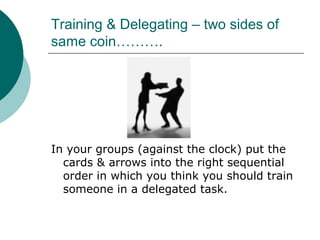
In your groups (against the clock) put the
cards & arrows into the right sequential
order in which you think you should train
someone in a delegated task.
Action Planning
 What had the biggest impact on
you today?
 What did you learn about yourself?
Others?
 What are you going to do with it?

Delegation slides

  • 1.
    Drive For Success FirstLine Manager Training – Stage 2 JULIA MENAUL
  • 2.
    Foundations of Delegation What to delegate  Who to delegate to  How to delegate
  • 3.
    Basics of Delegation What is delegation?  What isn’t delegation?  3 elements to delegation
  • 4.
    What are thebarriers to effective delegation? What are the benefits? To you and them Delegation
  • 6.
  • 7.
    Skill Will Matrix GUIDE Theenthusiastic beginner new to a particular role, project or task. DELEGATE The skilled worker who is looking for more opportunities to grow and develop. DIRECT The beginner to a role, project or task who is just starting out and is nervous or may have already tried and failed. EXCITE The skilled, experienced person who is in need of attention and motivation and may be bored or unwilling to try change.
  • 8.
    Delegation Using the templatesin your workbook, use the skill /will matrix to show :  Where each of your team members are now  Where you would like each of them to be (may not be any change but think about how to keep them motivated!)
  • 10.
    10 Step Modelfor Delegating 1) Identify the task 2) Decide what should be delegated 3) Identify the right person for the job 4) Explain why you are delegating it to them 5) Specify the expected outcomes, and agree the deadline 6) Discuss how they are going to go about it7) Identify the resources they will need 8) Decide how and when you are going to monitor progress 9) Identify who else needs to be informed 10) Show commitment
  • 11.
    Training & Delegating– two sides of same coin………. In your groups (against the clock) put the cards & arrows into the right sequential order in which you think you should train someone in a delegated task.
  • 12.
    Action Planning  Whathad the biggest impact on you today?  What did you learn about yourself? Others?  What are you going to do with it?

Editor's Notes

  • #7 I’ve been using Ken Blanchard’s model for a few years but I really don’t like it, don’t find it very easy to explain, don’t like that is uses coaching as a term so I’m reverting to this more simple model because I think for this group, who are very practical, it will be more effective and straightforward. But again, please redo as you prefer!
  • #9 Key for me here is to get them to take learning back to the workplace and think about individual team members and link back to the value of talking about how we work together, as well as the work itself, in 1-2-1 situations, which was one of the key messages from the last session