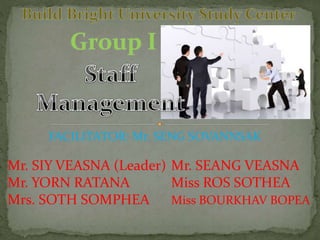
Mr. SIY VEASNA (Leader) Mr. SEANG VEASNA
Mr. YORN RATANA Miss ROS SOTHEA
Mrs. SOTH SOMPHEA Miss BOURKHAV BOPEA
FACILITATOR: Mr. SENG SOVANNSAK
We would like to thank our lecturer Mr. Seng
Sovannsak who give all guideline about the
assignment and give important hints of the
assignment. This work is made by my group
focusing on studies and research and also gives
credits to our lecturer who guided us. We would also
be very pleasure to our tutor Seng Sovannsak who
guided us in the tutorial task. We also certify that
the assignment has not previously been submitted
for the assignment in any other course or at any
other time in this course.
 INTRODUCTION TO STAFF MANAGEMENT
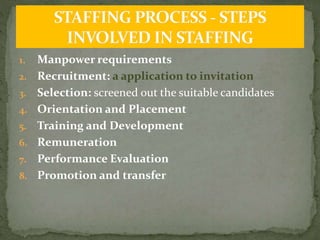
 STAFFING PROCESS - STEPS INVOLVED IN STAFFING
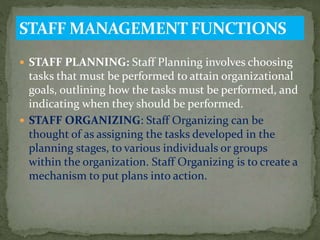
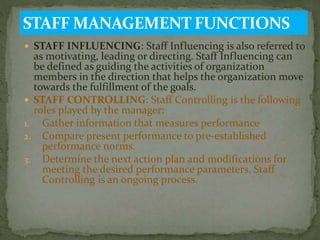
 STAFF MANAGEMENT FUNCTIONS
 5 GOLD RULES FOR STAFF MANAGEMENT
 KEY TO SUCCESS: KEEPING THE BEST STAFF
HAPPILY AROUND
 10 WAYS TO SURVIVE OFFICE POLITICS
 Overview:
Staff Management is the leading staffing provider with
deep domain expertise supporting clients in the
manufacturing, distribution and logistics segment.
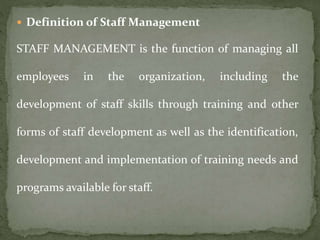
 Definition of Staff Management
STAFF MANAGEMENT is the function of managing all
employees in the organization, including the
development of staff skills through training and other
forms of staff development as well as the identification,
development and implementation of training needs and
programs available for staff.
1. Manpower requirements
2. Recruitment: a application to invitation
3. Selection: screened out the suitable candidates
4. Orientation and Placement
5. Training and Development
6. Remuneration
7. Performance Evaluation
8. Promotion and transfer
 STAFF PLANNING: Staff Planning involves choosing
tasks that must be performed to attain organizational
goals, outlining how the tasks must be performed, and
indicating when they should be performed.
 STAFF ORGANIZING: Staff Organizing can be
thought of as assigning the tasks developed in the
planning stages, to various individuals or groups
within the organization. Staff Organizing is to create a
mechanism to put plans into action.
 STAFF INFLUENCING: Staff Influencing is also referred to
as motivating, leading or directing. Staff Influencing can
be defined as guiding the activities of organization
members in the direction that helps the organization move
towards the fulfillment of the goals.
 STAFF CONTROLLING: Staff Controlling is the following
roles played by the manager:
1. Gather information that measures performance
2. Compare present performance to pre-established
performance norms.
3. Determine the next action plan and modifications for
meeting the desired performance parameters. Staff
Controlling is an ongoing process.
1. Keep staff challenged: Try to keep them busy (a
more positive term would be ‘fresh’) in learning and
doing new things once in a while. They will enjoy the
dynamic it brings to their tedious working life and
realize how the company treats them as individuals.
2. Let staff know what is expected from them: A
step further than giving feedback to staff, letting
them know their exact position in the company and
what is expected form them is a simple and direct
way for staff to realize their importance to the
company.
3. Raise equity in the company: If staff has good
performance, don’t be stingy on giving them bonuses or
other forms of reward. It is the best way to raise their
morale as well as sense of belonging to the company since
the company recognizes and treasures their contribution.
4. Cultivate organization traditions: These could be
formal or informal, as long as the staff accept and
recognize them. For instant, team lunch or Christmas
party. Once a tradition is established, it becomes a strong
bond between staff and the company.
5. Utilize staff’s talents and skills beyond the job
description: Recognizing staff’s talents and skills would
be the first step to achieve this goal. You just need to pay
attention to the staff’s resume or simply a usual chat with
them and you might have already found their ‘hidden
talent’! Try to utilize their talent and skills, you will find it
not only benefits the company but also the recognition
from staff.
Remember, staff is your most valuable asset in any business.
Managing them in a reasonable manner will ensure long
term success for your company.
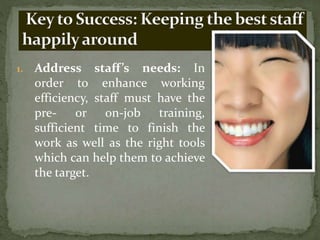
1. Address staff’s needs: In
order to enhance working
efficiency, staff must have the
pre- or on-job training,
sufficient time to finish the
work as well as the right tools
which can help them to achieve
the target.
2. Accept staff’s opinion: These can be fall into
different categories such as working condition, process
or even about benefits. The underlying principal is to
make them feel that they are valued and respected,
and that their contribution to the company is
appreciated.
3. Group activities with staff outside office hour:
These activities can be as simply and casual as picnic
or hiking in weekends. Or it could be as big and formal
as annual dinner for all staff in the organization.
The point is to create chances for staffs in all levels to
do something relax together other than working.
4. Provide opportunities for staff to grow and
develop: It is important for staff to realize that they
are valued not as working machines for the company.
Instead, the company shows care for the growth and
development of staff as a person.
5. Communicate with staff about the situation and
prospect of the company: Regular meeting of staff
and reveal the situation and prospect of the company
to them is important for staff to eliminate any anxiety
regarding the company.
 1: Live at peace with others
 2: Don't talk out of school
 3: Be helpful
 4: Stay away from gossip
 5: Stay out of those talk-down-the-boss sessions
 6: Be a straight arrow
 7: Address the "politics" issue openly when
appropriate
 8: Document things
 9: Set incentives to foster teamwork
 10: Set an example for your staff
 http://www.farorecruitment.com/index.php/when-
strong-leadership-style-meets-soft-skills/
 http://www.careerbuilder.com/jobs/company/c8c3316
b6pxvwv26wsn/staff-management
 http://en.wikipedia.org/wiki/Staff_management
 http://www.managementstudyguide.com/staffing-
process.htm
Staff Management

Staff Management

  • 1.
    Mr. SIY VEASNA(Leader) Mr. SEANG VEASNA Mr. YORN RATANA Miss ROS SOTHEA Mrs. SOTH SOMPHEA Miss BOURKHAV BOPEA FACILITATOR: Mr. SENG SOVANNSAK
  • 2.
    We would liketo thank our lecturer Mr. Seng Sovannsak who give all guideline about the assignment and give important hints of the assignment. This work is made by my group focusing on studies and research and also gives credits to our lecturer who guided us. We would also be very pleasure to our tutor Seng Sovannsak who guided us in the tutorial task. We also certify that the assignment has not previously been submitted for the assignment in any other course or at any other time in this course.
  • 3.
     INTRODUCTION TOSTAFF MANAGEMENT  STAFFING PROCESS - STEPS INVOLVED IN STAFFING  STAFF MANAGEMENT FUNCTIONS  5 GOLD RULES FOR STAFF MANAGEMENT  KEY TO SUCCESS: KEEPING THE BEST STAFF HAPPILY AROUND  10 WAYS TO SURVIVE OFFICE POLITICS
  • 4.
     Overview: Staff Managementis the leading staffing provider with deep domain expertise supporting clients in the manufacturing, distribution and logistics segment.
  • 5.
     Definition ofStaff Management STAFF MANAGEMENT is the function of managing all employees in the organization, including the development of staff skills through training and other forms of staff development as well as the identification, development and implementation of training needs and programs available for staff.
  • 6.
    1. Manpower requirements 2.Recruitment: a application to invitation 3. Selection: screened out the suitable candidates 4. Orientation and Placement 5. Training and Development 6. Remuneration 7. Performance Evaluation 8. Promotion and transfer
  • 7.
     STAFF PLANNING:Staff Planning involves choosing tasks that must be performed to attain organizational goals, outlining how the tasks must be performed, and indicating when they should be performed.  STAFF ORGANIZING: Staff Organizing can be thought of as assigning the tasks developed in the planning stages, to various individuals or groups within the organization. Staff Organizing is to create a mechanism to put plans into action.
  • 8.
     STAFF INFLUENCING:Staff Influencing is also referred to as motivating, leading or directing. Staff Influencing can be defined as guiding the activities of organization members in the direction that helps the organization move towards the fulfillment of the goals.  STAFF CONTROLLING: Staff Controlling is the following roles played by the manager: 1. Gather information that measures performance 2. Compare present performance to pre-established performance norms. 3. Determine the next action plan and modifications for meeting the desired performance parameters. Staff Controlling is an ongoing process.
  • 9.
    1. Keep staffchallenged: Try to keep them busy (a more positive term would be ‘fresh’) in learning and doing new things once in a while. They will enjoy the dynamic it brings to their tedious working life and realize how the company treats them as individuals. 2. Let staff know what is expected from them: A step further than giving feedback to staff, letting them know their exact position in the company and what is expected form them is a simple and direct way for staff to realize their importance to the company.
  • 10.
    3. Raise equityin the company: If staff has good performance, don’t be stingy on giving them bonuses or other forms of reward. It is the best way to raise their morale as well as sense of belonging to the company since the company recognizes and treasures their contribution. 4. Cultivate organization traditions: These could be formal or informal, as long as the staff accept and recognize them. For instant, team lunch or Christmas party. Once a tradition is established, it becomes a strong bond between staff and the company.
  • 11.
    5. Utilize staff’stalents and skills beyond the job description: Recognizing staff’s talents and skills would be the first step to achieve this goal. You just need to pay attention to the staff’s resume or simply a usual chat with them and you might have already found their ‘hidden talent’! Try to utilize their talent and skills, you will find it not only benefits the company but also the recognition from staff. Remember, staff is your most valuable asset in any business. Managing them in a reasonable manner will ensure long term success for your company.
  • 12.
    1. Address staff’sneeds: In order to enhance working efficiency, staff must have the pre- or on-job training, sufficient time to finish the work as well as the right tools which can help them to achieve the target.
  • 13.
    2. Accept staff’sopinion: These can be fall into different categories such as working condition, process or even about benefits. The underlying principal is to make them feel that they are valued and respected, and that their contribution to the company is appreciated. 3. Group activities with staff outside office hour: These activities can be as simply and casual as picnic or hiking in weekends. Or it could be as big and formal as annual dinner for all staff in the organization. The point is to create chances for staffs in all levels to do something relax together other than working.
  • 14.
    4. Provide opportunitiesfor staff to grow and develop: It is important for staff to realize that they are valued not as working machines for the company. Instead, the company shows care for the growth and development of staff as a person. 5. Communicate with staff about the situation and prospect of the company: Regular meeting of staff and reveal the situation and prospect of the company to them is important for staff to eliminate any anxiety regarding the company.
  • 15.
     1: Liveat peace with others  2: Don't talk out of school  3: Be helpful  4: Stay away from gossip  5: Stay out of those talk-down-the-boss sessions  6: Be a straight arrow  7: Address the "politics" issue openly when appropriate  8: Document things  9: Set incentives to foster teamwork  10: Set an example for your staff
  • 16.