Annalisa E + Luke V
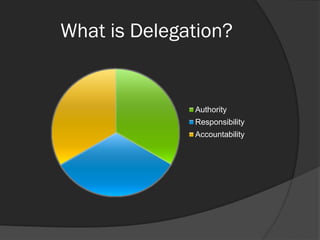
What is Delegation?
Authority
Responsibility
Accountability
What is..(cont.)
 Responsibility
 Ultimate Responsibility
 Authority
 Get the job done
 Carefully define the terms
 Accountability
 Automatic once responsibility is accepted
 Obligation
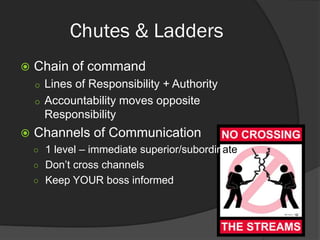
Chutes & Ladders
 Chain of command
 Lines of Responsibility + Authority
 Accountability moves opposite
Responsibility
 Channels of Communication
○ 1 level – immediate superior/subordinate
○ Don’t cross channels
○ Keep YOUR boss informed
The Good Stuff..
 Delegation as a conceptual skill
 Parts of the whole
 Benefits
 Once an employee is trained the
supervisor can fall back into a supportive
role
 People who are given responsibility
generally work better and get more done.
 Developing your people and multiplying their
contribution.
Resistance
 Afraid of the work not being done correctly
 Ego problem- this place NEEDS me
 Afraid employees will turn out better work than they would
have otherwise put out themselves
 Do not want to take responsibility for the mistakes of others.
 Habit or momentum
 Some people simply cannot delegate, ex) family run business
 Supervisors who are newly promoted from hourly jobs also have troube
shifting from doing to managing(most common reason for failure to
delegate
 Momentum takes over common sense, cannot see long term benefits
over immediate issue
 There may be no workers who are qualified and willing
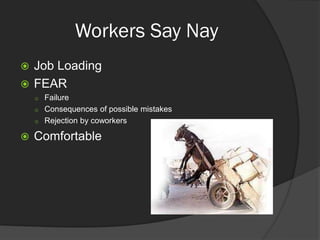
Workers Say Nay
 Job Loading
 FEAR
 Failure
 Consequences of possible mistakes
 Rejection by coworkers
 Comfortable
Conditions for Success
 Advance Planning
 Positive Attitude
 Trust
 Let go and take risks
 Good Communication
 Commitment
How DO We Delegate?
 Plan
 Data collection
 Sifting and organizing
 Pick a person
 Develop the task in detail – think performance standard
 Define area of responsibility
 Define activities to be carried out
 Define results you expect
 Define authority necessary to fulfill the responsibility
 Delegate
 Responsibility
 Authority
 accountability
 Follow up
 Reverse delegation
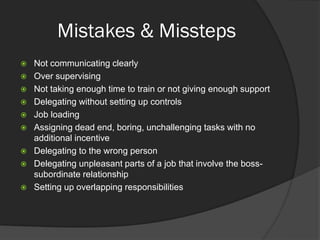
Mistakes & Missteps
 Not communicating clearly
 Over supervising
 Not taking enough time to train or not giving enough support
 Delegating without setting up controls
 Job loading
 Assigning dead end, boring, unchallenging tasks with no
additional incentive
 Delegating to the wrong person
 Delegating unpleasant parts of a job that involve the boss-
subordinate relationship
 Setting up overlapping responsibilities
Activity

HR delegation

  • 1.
  • 2.
  • 3.
    What is..(cont.)  Responsibility Ultimate Responsibility  Authority  Get the job done  Carefully define the terms  Accountability  Automatic once responsibility is accepted  Obligation
  • 4.
    Chutes & Ladders Chain of command  Lines of Responsibility + Authority  Accountability moves opposite Responsibility  Channels of Communication ○ 1 level – immediate superior/subordinate ○ Don’t cross channels ○ Keep YOUR boss informed
  • 5.
    The Good Stuff.. Delegation as a conceptual skill  Parts of the whole  Benefits  Once an employee is trained the supervisor can fall back into a supportive role  People who are given responsibility generally work better and get more done.  Developing your people and multiplying their contribution.
  • 6.
    Resistance  Afraid ofthe work not being done correctly  Ego problem- this place NEEDS me  Afraid employees will turn out better work than they would have otherwise put out themselves  Do not want to take responsibility for the mistakes of others.  Habit or momentum  Some people simply cannot delegate, ex) family run business  Supervisors who are newly promoted from hourly jobs also have troube shifting from doing to managing(most common reason for failure to delegate  Momentum takes over common sense, cannot see long term benefits over immediate issue  There may be no workers who are qualified and willing
  • 7.
    Workers Say Nay Job Loading  FEAR  Failure  Consequences of possible mistakes  Rejection by coworkers  Comfortable
  • 8.
    Conditions for Success Advance Planning  Positive Attitude  Trust  Let go and take risks  Good Communication  Commitment
  • 9.
    How DO WeDelegate?  Plan  Data collection  Sifting and organizing  Pick a person  Develop the task in detail – think performance standard  Define area of responsibility  Define activities to be carried out  Define results you expect  Define authority necessary to fulfill the responsibility  Delegate  Responsibility  Authority  accountability  Follow up  Reverse delegation
  • 10.
    Mistakes & Missteps Not communicating clearly  Over supervising  Not taking enough time to train or not giving enough support  Delegating without setting up controls  Job loading  Assigning dead end, boring, unchallenging tasks with no additional incentive  Delegating to the wrong person  Delegating unpleasant parts of a job that involve the boss- subordinate relationship  Setting up overlapping responsibilities
  • 11.