SUPERVISORY SKILLS
1
 Successful supervisors need to work effectively and
maintain good relations with their employees, boss,
and peers.
- With employees, supervisors should set a good example,
be ethical, and develop trust.
- Supervisors should give their boss loyalty, cooperation,
information, and results and be aware of and respond to
the boss’s style.
- With peers, supervisors should keep competition fair and
as friendly as possible and offer support or criticism in a
constructive way.
2
SUPERVISORY RESPONSIBILITIES
INCLUDE:
 Conducting safety meetings
 Conducting Incident/Accident investigations
 Assisting in the development/implementation of
JSAs
 Maintaining both equipment and the workplace
 Establishing work methods & providing training
 Supervising employees in the
performance of tasks
3
SAFETY MEETINGS
Purpose of Safety Meetings
 Establish Communication
 Promote safety awareness
 Motivate employees
 Sharing ideas
 Discuss safety standards
 Demonstrate management’s concern
4
WHEN TO CONDUCT AN
INVESTIGATION?
An investigation must be conducted for any
incident/accident.
Includes employees, non-employees, and property
5
WHAT IS A JSA?
 Breaks a job/task into steps
 Identifies safety hazards
 Develops safe procedures
……. So it is a Job Safety
Analysis
6
RECORDING KEEPING
 Maintain in work area
 Document their use
7
 Maintain a safe work
environment & correct
unsafe actions
 Maintain operational
efficiency
Inspections
8
WRITTEN COMPONENT
 Included in operational safety
plan/manual
 Procedures to:
 Identify & Correct Hazards
 Good housekeeping safety
rules
9
TYPES OF HAZARDS
 Building Safety
 Office Safety
 Fire Safety
 Electrical Safety
 Emergency Equipment
 Storage Methods
10
TRAINING
SAFETY AND TASK TRAINING
11
WHY CONDUCT TRAINING?
To provide a systematic method of teaching
employees to perform the required tasks in a
safe and efficient manner.
12
ARE THE SUPERVISOR’S
RESPONSIBLITIES COMPLETE
WHEN THE TRAINING IS OVER?
13
SUPERVISOR’S SUPERVISING
Supervisors should, as part of their responsibilities
observe employees performing their tasks.
 Are they performing the tasks properly
 Are they performing in accordance with
safety procedures
 Are they using the proper PPE
14
CONSEQUENCES OF NOT PLANNING?
 Wasted time
 Wasted money
 Missed deadlines
 Conflict within teams
 Overlooked opportunities
 Lost customers due to poor or slow service
15
BENEFITS OF PLANNING
 Signals about problems, which may arise before
they actually happen.
 Enables managers to have a clearer understanding
of business.
 Stimulates a co-operative, integrated &
enthusiastic approach to tackling problems &
opportunities.
 Poor performing areas can be identified &
eliminated.
 Able to set more realistic objectives.
16
EFFECTIVE SUPERVISOR
 a. Sense of responsibility.
 Supervisors must be willing to take seriously the
responsibility that goes with the job.
 b. Self confidence.
 Supervisors who believe in their ability to get the
job done will convey confidence to employees.
17
 c. High energy level.
 Many organizations expect supervisors to willingly
put in long hours in order to handle the variety of
duties that come with the job.
 d. Empathy.
 Supervisors need to be sensitive and higher
management. Supervisors who have difficulty
understanding what makes people tick are at a
disadvantage.
18
 e. Internal locus of control.
 People with an internal locus of control are
thought to be leaders because they try harder to
take charge of events.
 f. Sense of humor.
 People with a good sense of humor are more fun
to work with or for.
19
CHARACTERISTICS OF A SUCCESSFUL
SUPERVISOR
 The characteristics of a successful
supervisor include:
 positive attitude
 loyal
 fair
 good communicator
 able to delegate
 wants the job
20
ADDITIONAL CHARACTERISTICS OF A
SUCCESSFUL SUPERVISOR
 Additional criteria for a successful supervisor
include:
 technical skills
 human relations skills
 conceptual skills
 decision making skills
21
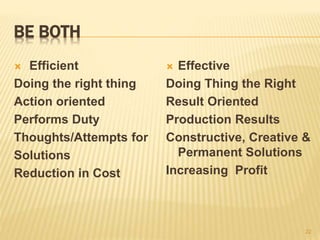
BE BOTH
 Efficient
Doing the right thing
Action oriented
Performs Duty
Thoughts/Attempts for
Solutions
Reduction in Cost
 Effective
Doing Thing the Right
Result Oriented
Production Results
Constructive, Creative &
Permanent Solutions
Increasing Profit
22
QUESTIONS?
23
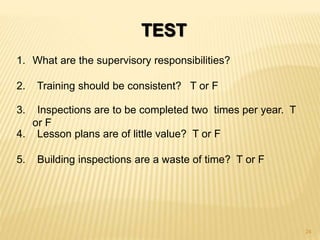
TEST
1. What are the supervisory responsibilities?
2. Training should be consistent? T or F
3. Inspections are to be completed two times per year. T
or F
4. Lesson plans are of little value? T or F
5. Building inspections are a waste of time? T or F
24
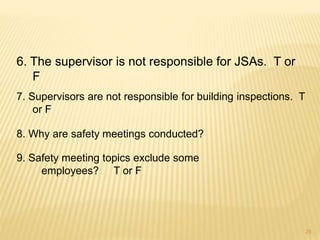
6. The supervisor is not responsible for JSAs. T or
F
7. Supervisors are not responsible for building inspections. T
or F
6. The supervisor is not responsible for JSAs. T or
F
8. Why are safety meetings conducted?
9. Safety meeting topics exclude some
employees? T or F
25
26
By Trainer Prerna Patel -
9724372141

Supervisory skills

  • 1.
  • 2.
     Successful supervisorsneed to work effectively and maintain good relations with their employees, boss, and peers. - With employees, supervisors should set a good example, be ethical, and develop trust. - Supervisors should give their boss loyalty, cooperation, information, and results and be aware of and respond to the boss’s style. - With peers, supervisors should keep competition fair and as friendly as possible and offer support or criticism in a constructive way. 2
  • 3.
    SUPERVISORY RESPONSIBILITIES INCLUDE:  Conductingsafety meetings  Conducting Incident/Accident investigations  Assisting in the development/implementation of JSAs  Maintaining both equipment and the workplace  Establishing work methods & providing training  Supervising employees in the performance of tasks 3
  • 4.
    SAFETY MEETINGS Purpose ofSafety Meetings  Establish Communication  Promote safety awareness  Motivate employees  Sharing ideas  Discuss safety standards  Demonstrate management’s concern 4
  • 5.
    WHEN TO CONDUCTAN INVESTIGATION? An investigation must be conducted for any incident/accident. Includes employees, non-employees, and property 5
  • 6.
    WHAT IS AJSA?  Breaks a job/task into steps  Identifies safety hazards  Develops safe procedures ……. So it is a Job Safety Analysis 6
  • 7.
    RECORDING KEEPING  Maintainin work area  Document their use 7
  • 8.
     Maintain asafe work environment & correct unsafe actions  Maintain operational efficiency Inspections 8
  • 9.
    WRITTEN COMPONENT  Includedin operational safety plan/manual  Procedures to:  Identify & Correct Hazards  Good housekeeping safety rules 9
  • 10.
    TYPES OF HAZARDS Building Safety  Office Safety  Fire Safety  Electrical Safety  Emergency Equipment  Storage Methods 10
  • 11.
  • 12.
    WHY CONDUCT TRAINING? Toprovide a systematic method of teaching employees to perform the required tasks in a safe and efficient manner. 12
  • 13.
    ARE THE SUPERVISOR’S RESPONSIBLITIESCOMPLETE WHEN THE TRAINING IS OVER? 13
  • 14.
    SUPERVISOR’S SUPERVISING Supervisors should,as part of their responsibilities observe employees performing their tasks.  Are they performing the tasks properly  Are they performing in accordance with safety procedures  Are they using the proper PPE 14
  • 15.
    CONSEQUENCES OF NOTPLANNING?  Wasted time  Wasted money  Missed deadlines  Conflict within teams  Overlooked opportunities  Lost customers due to poor or slow service 15
  • 16.
    BENEFITS OF PLANNING Signals about problems, which may arise before they actually happen.  Enables managers to have a clearer understanding of business.  Stimulates a co-operative, integrated & enthusiastic approach to tackling problems & opportunities.  Poor performing areas can be identified & eliminated.  Able to set more realistic objectives. 16
  • 17.
    EFFECTIVE SUPERVISOR  a.Sense of responsibility.  Supervisors must be willing to take seriously the responsibility that goes with the job.  b. Self confidence.  Supervisors who believe in their ability to get the job done will convey confidence to employees. 17
  • 18.
     c. Highenergy level.  Many organizations expect supervisors to willingly put in long hours in order to handle the variety of duties that come with the job.  d. Empathy.  Supervisors need to be sensitive and higher management. Supervisors who have difficulty understanding what makes people tick are at a disadvantage. 18
  • 19.
     e. Internallocus of control.  People with an internal locus of control are thought to be leaders because they try harder to take charge of events.  f. Sense of humor.  People with a good sense of humor are more fun to work with or for. 19
  • 20.
    CHARACTERISTICS OF ASUCCESSFUL SUPERVISOR  The characteristics of a successful supervisor include:  positive attitude  loyal  fair  good communicator  able to delegate  wants the job 20
  • 21.
    ADDITIONAL CHARACTERISTICS OFA SUCCESSFUL SUPERVISOR  Additional criteria for a successful supervisor include:  technical skills  human relations skills  conceptual skills  decision making skills 21
  • 22.
    BE BOTH  Efficient Doingthe right thing Action oriented Performs Duty Thoughts/Attempts for Solutions Reduction in Cost  Effective Doing Thing the Right Result Oriented Production Results Constructive, Creative & Permanent Solutions Increasing Profit 22
  • 23.
  • 24.
    TEST 1. What arethe supervisory responsibilities? 2. Training should be consistent? T or F 3. Inspections are to be completed two times per year. T or F 4. Lesson plans are of little value? T or F 5. Building inspections are a waste of time? T or F 24
  • 25.
    6. The supervisoris not responsible for JSAs. T or F 7. Supervisors are not responsible for building inspections. T or F 6. The supervisor is not responsible for JSAs. T or F 8. Why are safety meetings conducted? 9. Safety meeting topics exclude some employees? T or F 25
  • 26.
    26 By Trainer PrernaPatel - 9724372141