Smart Control of Traffic Light Using Artificial Intelligence
ABSTRACT
Traffic congestion is becoming one of the critical issues with increasing population and automobiles in
cities. Traffic jams not only cause extra delay and stress for the drivers, but also increase fuel consumption
and air pollution. Although it seems to pervade everywhere, megacities are the ones most affected by it. And
its ever-increasing nature makes it necessary to calculate the road traffic density in real-time for better signal
control and effective traffic management.
Our proposed system aims to utilize simulation design using pygame to show traffic junctions for traffic
density calculation using deep Learning techniqeus. It also focuses on the algorithm for switching the traffic
lights based on the vehicle density timer to reduce congestion, thereby providing faster transit to people and
reducing pollution..
INTRODUCTION
With the increasing number of vehicles in urban areas, many road networks are facing problems with the
capacity drop of roads and the corresponding Level of Service.
Many traffic-related issues occur because of traffic control systems on intersections that use fixed signal
timers. They repeat the same phase sequence and its duration with no changes. Increased demand for road
capacity also increases the need for new solutions for traffic control that can be found in the field of
Intelligent Transport Systems.
Let us take the case study of Mumbai and Bangalore. Traffic flow in Bangalore is the worst in the world
while Mumbai is close behind in fourth position, according to a report detailing the traffic situation in 416
cities across 57 countries. In Bangalore, a journey during rush-hour takes 71% longer. In Mumbai, it is 65%
longer
LITERATURE SURVEY
Reference [2] proposes a solution using video processing. The video from the live feed is processed before
being sent to the servers where a C++ based algorithm is used to generate the results. Hard code and
Dynamic coded methodologies are compared, in which the dynamic algorithm showed an improvement of
35%
Reference [3] proposes an Arduino-UNO based system that aims to reduce traffic congestion and waiting
time. This system acquires images through the camera and then processes the image in MATLAB, where the
image is converted to a threshold image by removing saturation and hues, and traffic density is calculated.
Arduino and MATLAB are connected using USB and simulation packages, which are preinstalled.
This system makes use of two fuzzy controllers with 3 inputs and one output for primary and secondary
driveways. A simulation was done using VISSIM and MATLAB and for low traffic density, it improved
traffic conditions. Reference
EXISTING SYSTEM
 proposes a solution using video processing. The video from the live feed is processed before being sent to the
servers where a C++ based algorithm is used to generate the results. Hard code and Dynamic coded
methodologies are compared, in which.
 proposes an Arduino-UNO based system that aims to reduce traffic congestion and waiting time. This system
acquires images through the camera and then processes the image in MATLAB, where the image is converted to
a threshold image by removing saturation and hues, and traffic density is calculated. Arduino and MATLAB are
connected using USB and simulation packages, which are preinstalled. Depending on traffic count and traffic
density, the Arduino sets the duration of green light for each lane. But this method has several flaws.
Disadvantages
 The cars often overlap with each other and it is difficult to get a proper count of how many vehicles are
on the road. Moreover, different objects interfered with the detection as they too were converted to black
and white and there was no way of making a distinction between regular objects like billboards, poles,
and trees with vehicles.
 Then, segmentation is performed using sliding window technique to count the cars irrespective of size
and ANN is run through the segmented image, the output of which is used in fuzzy controller to set timers
for red and green light using crisp output. Results had an average error of 2% with execution time of 1.5
seconds..
PROPOSED SYSTEM
Proposed system works on simulation using pygame to demonstrate traffic junctions as input for real-time
traffic density calculation using object detection. Live simulation data is passed on to the vehicle detection
algorithm, which uses YOLO. The number of vehicles of each class, such as car, bike, bus, and truck, is
detected, which is to calculate the density of traffic.
The signal switching algorithm uses this density, among some other factors, to set the green signal timer for
each lane. The red signal times are updated accordingly.
The green signal time is restricted to a maximum and minimum value in order to avoid starvation of a
particular lane. A simulation is also developed to demonstrate the system’s effectiveness and compare it with
the existing static system.
ADVANTAGES
 This helps to optimize the green signal times, and traffic is cleared at a much faster rate than a static
system, thus reducing the unwanted delays, congestion, and waiting time, which in turn will reduce the
fuel consumption and pollution.
 The vehicles are classified as a car, bike, bus/truck, or rickshaw to obtain an accurate estimate of the
green signal time. It uses YOLO in order to detect the number of vehicles and then set the timer of the
traffic signal according to vehicle density in the corresponding direction
Algorithm
The backbone CNN used in YOLO can be further simplified to improve processing time. Darknet is an open
source neural network framework written in C and CUDA. It is fast, easy to install, and supports CPU and
GPU computation .
With DarkNet, YOLO achieves 72.9% top 1 accuracy and 91.2% top-5 accuracy on ImageNet. Darknet uses
mostly 3 × 3 filters to extract features and 1 × 1 filters to reduce output channels. It also uses global average
pooling to make predictions .
The Signal Switching Algorithm sets the green signal timer according to traffic density returned by the
vehicle detection module, and updates the red signal timers of other signals accordingly. It also switches
between the signals cyclically according to the timers.
1) The processing time of the algorithm to calculate traffic density and then the green light duration – this decides at what time the image needs to be
acquired
2) Number of lanes
3) Total count of vehicles of each class like cars, trucks, motorcycles, etc.
4) Traffic density calculated using the above factors
5) Time added due to lag each vehicle suffers during start-up and the non-linear increase in lag suffered by the vehicles which are at the back
6) The average speed of each class of vehicle when the green light starts i.e. the average time required to cross the signal by each class of vehicle
7) The minimum and maximum time limit for the green light duration - to prevent starvation
Use case diagrams
SEQUENCE DIAGRAMS
ACTIVITY DIAGRAM
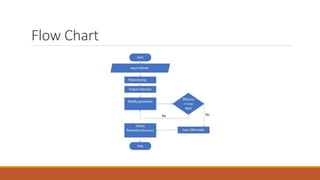
Flow Chart
HARDWARE REQUIREMENTS:
• System : Intel(R) Core(TM) i3-7020U CPU @ 2.30GHz
• Hard Disk : 1 TB.
• Input Devices : Keyboard, Mouse
• Ram : 4 GB.
SOFTWARE REQUIREMENTS:
 Operating system : Windows XP/7/10.
 Coding Language : Python
 Tool : Anaconda
 Interface : pygame
Traffic
Timer
Conclusion
In conclusion, the proposed system sets the green signal time adaptively according to the traffic density at
the signal and ensures that the direction with more traffic is allotted a green signal for a longer duration of
time as compared to the direction with lesser traffic. This will lower the unwanted delays and reduce
congestion and waiting time, which in turn will reduce fuel consumption and pollution.
References
 TomTom.com, 'Tom Tom World Traffic Index', 2019. [Online]. Available:
https://www.tomtom.com/en_gb/traffic-index/ranking/
 [2] Khushi, "Smart Control of Traffic Light System using Image Processing," 2017 International
Conference on Current Trends in Computer, Electrical, Electronics and Communication (CTCEEC),
Mysore, 2017, pp. 99-103, doi: 10.1109/CTCEEC.2017.8454966.
 [3] A. Vogel, I. Oremović, R. Šimić and E. Ivanjko, "Improving Traffic Light Control by Means of Fuzzy
Logic," 2018 International Symposium ELMAR, Zadar, 2018, pp. 51-56, doi:
10.23919/ELMAR.2018.8534692.

Traffic PPT.pptx

  • 1.
    Smart Control ofTraffic Light Using Artificial Intelligence
  • 2.
    ABSTRACT Traffic congestion isbecoming one of the critical issues with increasing population and automobiles in cities. Traffic jams not only cause extra delay and stress for the drivers, but also increase fuel consumption and air pollution. Although it seems to pervade everywhere, megacities are the ones most affected by it. And its ever-increasing nature makes it necessary to calculate the road traffic density in real-time for better signal control and effective traffic management. Our proposed system aims to utilize simulation design using pygame to show traffic junctions for traffic density calculation using deep Learning techniqeus. It also focuses on the algorithm for switching the traffic lights based on the vehicle density timer to reduce congestion, thereby providing faster transit to people and reducing pollution..
  • 3.
    INTRODUCTION With the increasingnumber of vehicles in urban areas, many road networks are facing problems with the capacity drop of roads and the corresponding Level of Service. Many traffic-related issues occur because of traffic control systems on intersections that use fixed signal timers. They repeat the same phase sequence and its duration with no changes. Increased demand for road capacity also increases the need for new solutions for traffic control that can be found in the field of Intelligent Transport Systems. Let us take the case study of Mumbai and Bangalore. Traffic flow in Bangalore is the worst in the world while Mumbai is close behind in fourth position, according to a report detailing the traffic situation in 416 cities across 57 countries. In Bangalore, a journey during rush-hour takes 71% longer. In Mumbai, it is 65% longer
  • 4.
    LITERATURE SURVEY Reference [2]proposes a solution using video processing. The video from the live feed is processed before being sent to the servers where a C++ based algorithm is used to generate the results. Hard code and Dynamic coded methodologies are compared, in which the dynamic algorithm showed an improvement of 35% Reference [3] proposes an Arduino-UNO based system that aims to reduce traffic congestion and waiting time. This system acquires images through the camera and then processes the image in MATLAB, where the image is converted to a threshold image by removing saturation and hues, and traffic density is calculated. Arduino and MATLAB are connected using USB and simulation packages, which are preinstalled. This system makes use of two fuzzy controllers with 3 inputs and one output for primary and secondary driveways. A simulation was done using VISSIM and MATLAB and for low traffic density, it improved traffic conditions. Reference
  • 5.
    EXISTING SYSTEM  proposesa solution using video processing. The video from the live feed is processed before being sent to the servers where a C++ based algorithm is used to generate the results. Hard code and Dynamic coded methodologies are compared, in which.  proposes an Arduino-UNO based system that aims to reduce traffic congestion and waiting time. This system acquires images through the camera and then processes the image in MATLAB, where the image is converted to a threshold image by removing saturation and hues, and traffic density is calculated. Arduino and MATLAB are connected using USB and simulation packages, which are preinstalled. Depending on traffic count and traffic density, the Arduino sets the duration of green light for each lane. But this method has several flaws.
  • 6.
    Disadvantages  The carsoften overlap with each other and it is difficult to get a proper count of how many vehicles are on the road. Moreover, different objects interfered with the detection as they too were converted to black and white and there was no way of making a distinction between regular objects like billboards, poles, and trees with vehicles.  Then, segmentation is performed using sliding window technique to count the cars irrespective of size and ANN is run through the segmented image, the output of which is used in fuzzy controller to set timers for red and green light using crisp output. Results had an average error of 2% with execution time of 1.5 seconds..
  • 7.
    PROPOSED SYSTEM Proposed systemworks on simulation using pygame to demonstrate traffic junctions as input for real-time traffic density calculation using object detection. Live simulation data is passed on to the vehicle detection algorithm, which uses YOLO. The number of vehicles of each class, such as car, bike, bus, and truck, is detected, which is to calculate the density of traffic. The signal switching algorithm uses this density, among some other factors, to set the green signal timer for each lane. The red signal times are updated accordingly. The green signal time is restricted to a maximum and minimum value in order to avoid starvation of a particular lane. A simulation is also developed to demonstrate the system’s effectiveness and compare it with the existing static system.
  • 8.
    ADVANTAGES  This helpsto optimize the green signal times, and traffic is cleared at a much faster rate than a static system, thus reducing the unwanted delays, congestion, and waiting time, which in turn will reduce the fuel consumption and pollution.  The vehicles are classified as a car, bike, bus/truck, or rickshaw to obtain an accurate estimate of the green signal time. It uses YOLO in order to detect the number of vehicles and then set the timer of the traffic signal according to vehicle density in the corresponding direction
  • 9.
    Algorithm The backbone CNNused in YOLO can be further simplified to improve processing time. Darknet is an open source neural network framework written in C and CUDA. It is fast, easy to install, and supports CPU and GPU computation . With DarkNet, YOLO achieves 72.9% top 1 accuracy and 91.2% top-5 accuracy on ImageNet. Darknet uses mostly 3 × 3 filters to extract features and 1 × 1 filters to reduce output channels. It also uses global average pooling to make predictions . The Signal Switching Algorithm sets the green signal timer according to traffic density returned by the vehicle detection module, and updates the red signal timers of other signals accordingly. It also switches between the signals cyclically according to the timers.
  • 10.
    1) The processingtime of the algorithm to calculate traffic density and then the green light duration – this decides at what time the image needs to be acquired 2) Number of lanes 3) Total count of vehicles of each class like cars, trucks, motorcycles, etc. 4) Traffic density calculated using the above factors 5) Time added due to lag each vehicle suffers during start-up and the non-linear increase in lag suffered by the vehicles which are at the back 6) The average speed of each class of vehicle when the green light starts i.e. the average time required to cross the signal by each class of vehicle 7) The minimum and maximum time limit for the green light duration - to prevent starvation
  • 11.
  • 12.
  • 13.
  • 14.
  • 15.
    HARDWARE REQUIREMENTS: • System: Intel(R) Core(TM) i3-7020U CPU @ 2.30GHz • Hard Disk : 1 TB. • Input Devices : Keyboard, Mouse • Ram : 4 GB.
  • 16.
    SOFTWARE REQUIREMENTS:  Operatingsystem : Windows XP/7/10.  Coding Language : Python  Tool : Anaconda  Interface : pygame
  • 17.
  • 18.
  • 19.
    Conclusion In conclusion, theproposed system sets the green signal time adaptively according to the traffic density at the signal and ensures that the direction with more traffic is allotted a green signal for a longer duration of time as compared to the direction with lesser traffic. This will lower the unwanted delays and reduce congestion and waiting time, which in turn will reduce fuel consumption and pollution.
  • 20.
    References  TomTom.com, 'TomTom World Traffic Index', 2019. [Online]. Available: https://www.tomtom.com/en_gb/traffic-index/ranking/  [2] Khushi, "Smart Control of Traffic Light System using Image Processing," 2017 International Conference on Current Trends in Computer, Electrical, Electronics and Communication (CTCEEC), Mysore, 2017, pp. 99-103, doi: 10.1109/CTCEEC.2017.8454966.  [3] A. Vogel, I. Oremović, R. Šimić and E. Ivanjko, "Improving Traffic Light Control by Means of Fuzzy Logic," 2018 International Symposium ELMAR, Zadar, 2018, pp. 51-56, doi: 10.23919/ELMAR.2018.8534692.