Introduction to Neural
Networks
In this article, we will be talking about neural networks. A
functional unit of deep learning, this means a neural
network accepts input and gives an output. Deep Learning
uses Artificial Neural Networks (ANN). ANNs imitates the
human brain’s behavior to solve complex data problems.
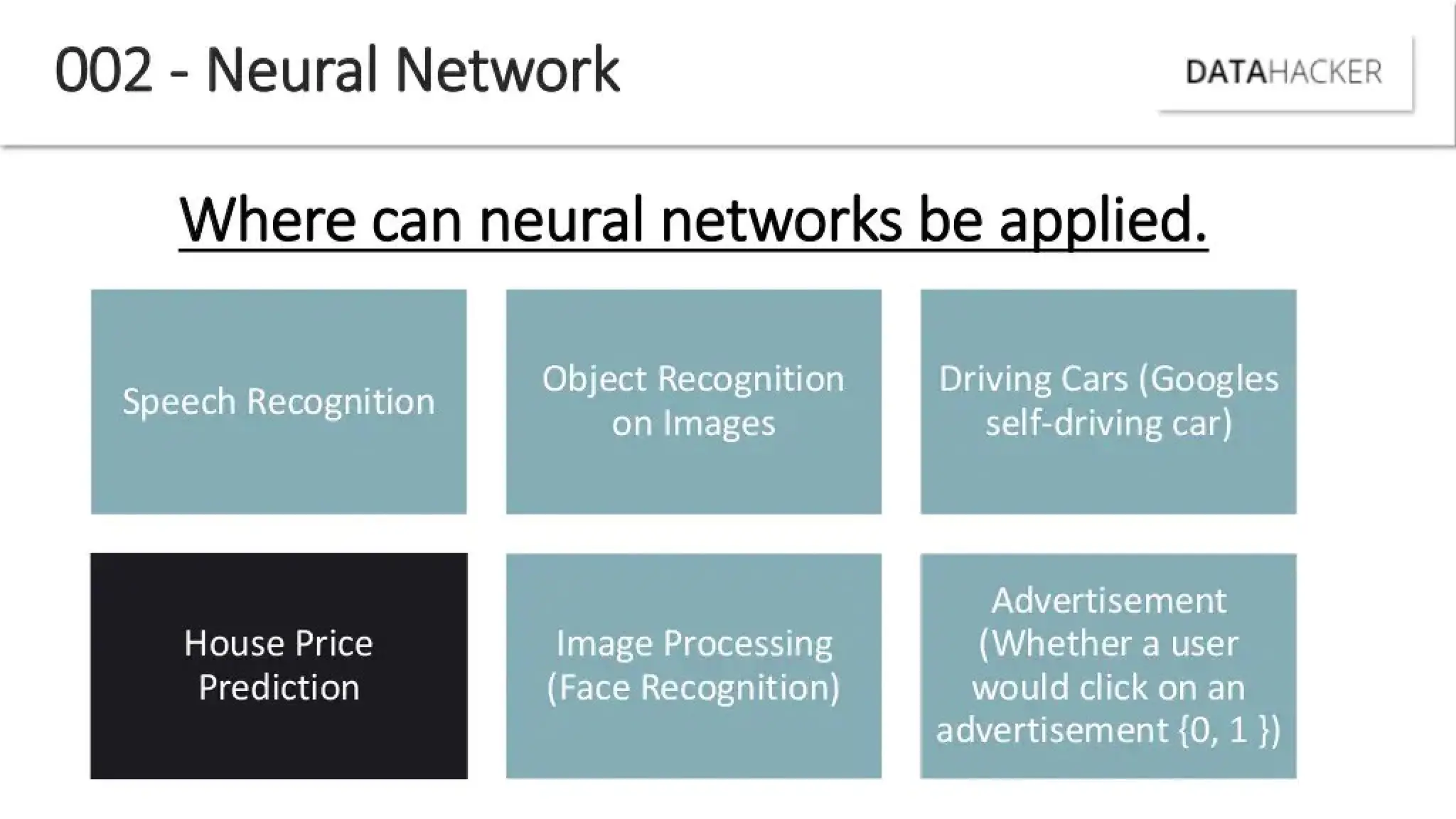
• These technologies solve problems in image recognition,
speech recognition, pattern recognition, and natural
language processing (NLP), to name a few.
• In this article, you will learn the basics of artificial
neural networks or ANN. It will also give you an in-
depth interpretation of how neural networks operate.
Key Terms
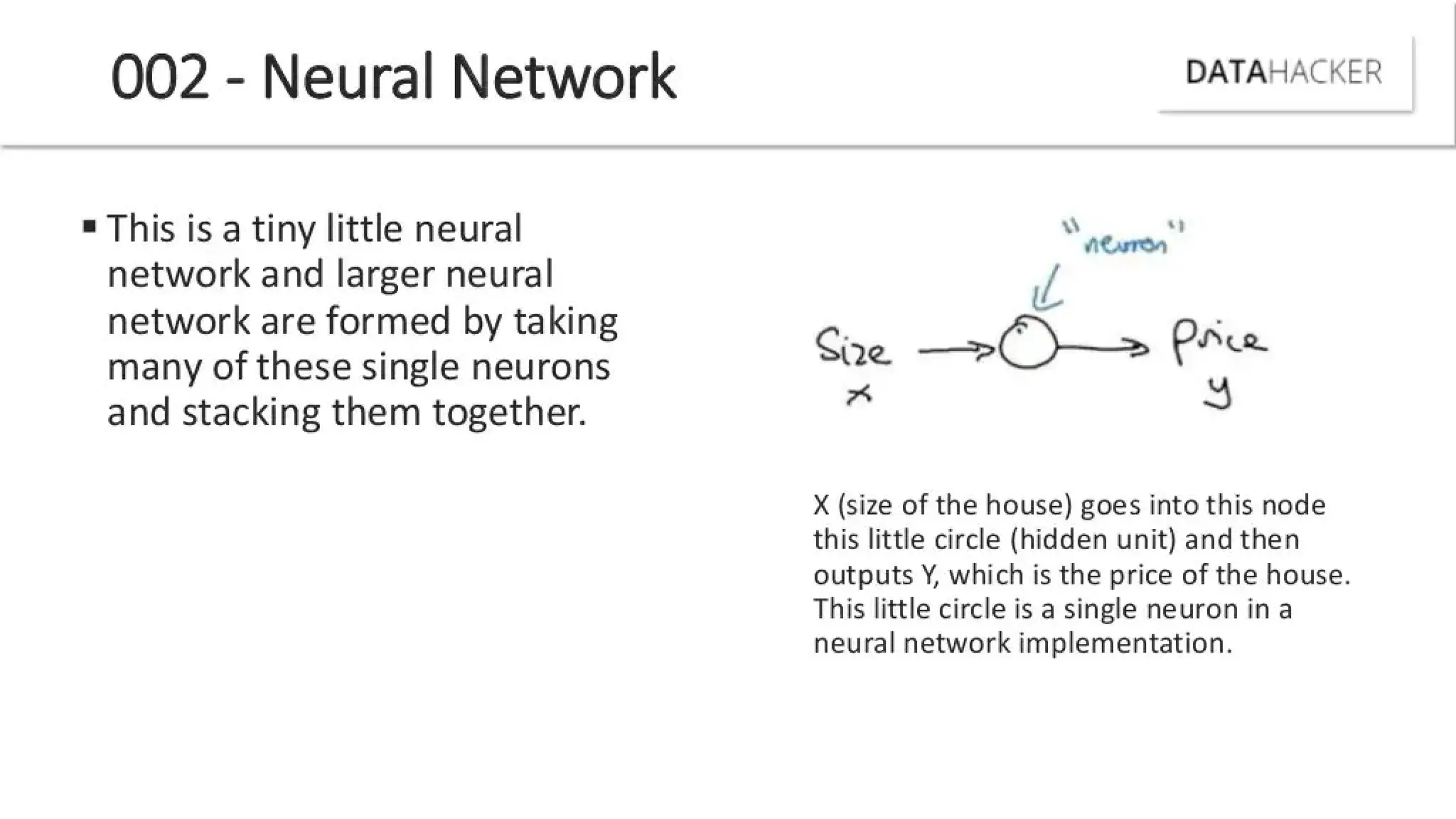
•Neuron: A building block of ANN. It is responsible for accepting
input data, performing calculations, and producing output.
•Input data: Information or data provided to the neurons.
•Artificial Neural Network(ANN): A computational system inspired
by the way biological neural networks in the human brain process
information.
•Deep Neural Network: An ANN with many layers placed between
the input layer and the output layer.
•Weights: The strength of the connection between two neurons.
Weights determine what impact the input will have on the output.
•Bias: An additional parameter used along with the sum of the
product of weights and inputs to produce an output.
•Activation Function: Determines the output of a neural network.
Neural Networks Overview
• Have you ever wondered how your brain recognizes
images? No matter what or how the image looks, the brain
can tell that this is an image of a cat and not a dog. The
brain relates to the best possible pattern and concludes the
result. The example below will help you understand neural
networks:
• Consider a scenario where you have a set of labeled images,
and you have to classify the images based on if it is a dog or
a cat.
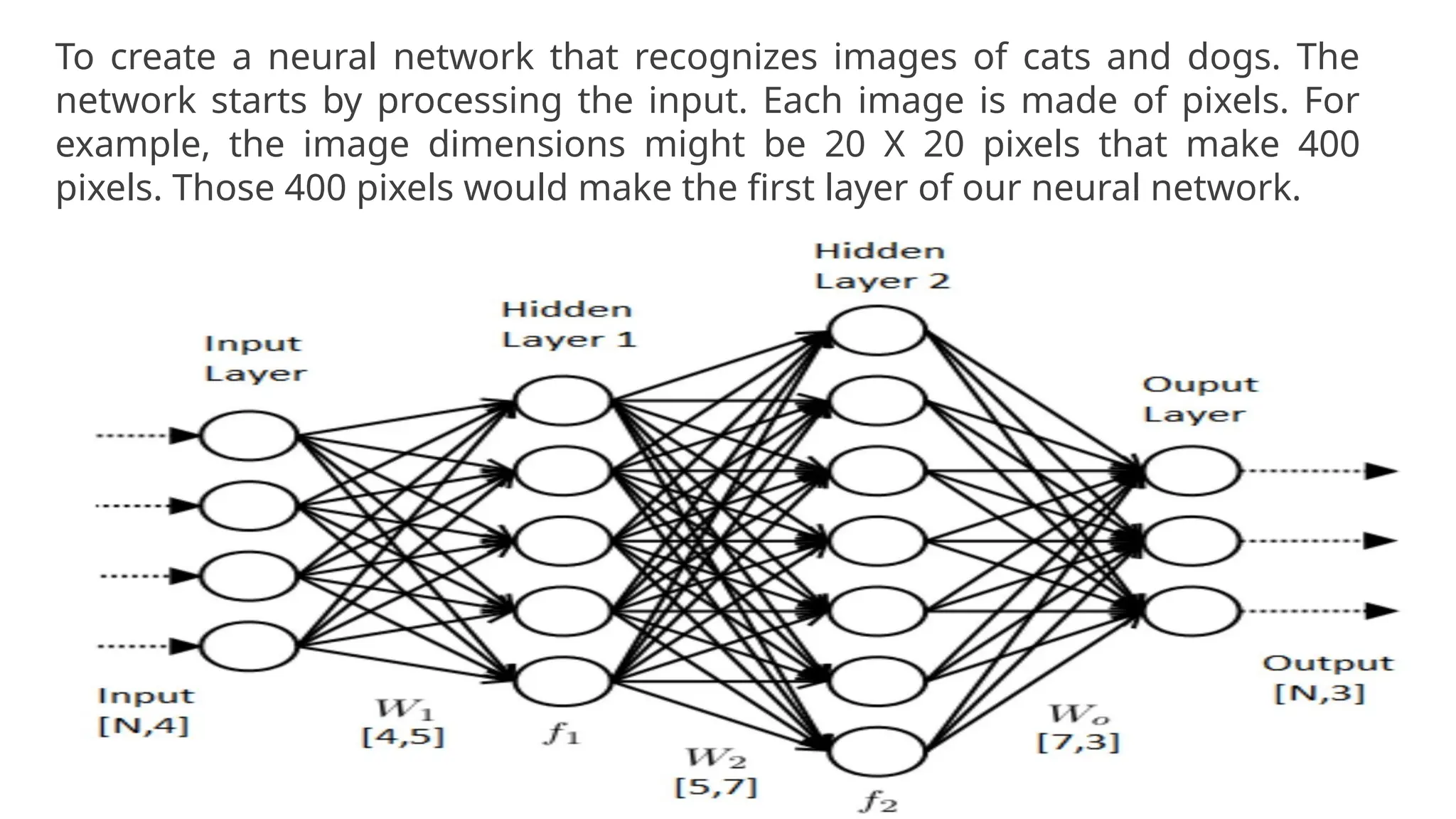
To create a neural network that recognizes images of cats and dogs. The
network starts by processing the input. Each image is made of pixels. For
example, the image dimensions might be 20 X 20 pixels that make 400
pixels. Those 400 pixels would make the first layer of our neural network.
• A neural network is made of artificial neurons that receive and
process input data. Data is passed through the input layer, the
hidden layer, and the output layer.
• A neural network process starts when input data is fed to it.
Data is then processed via its layers to provide the desired
output.
• A neural network learns from structured data and exhibits the
output. Learning taking place within neural networks can be in
three different categories:
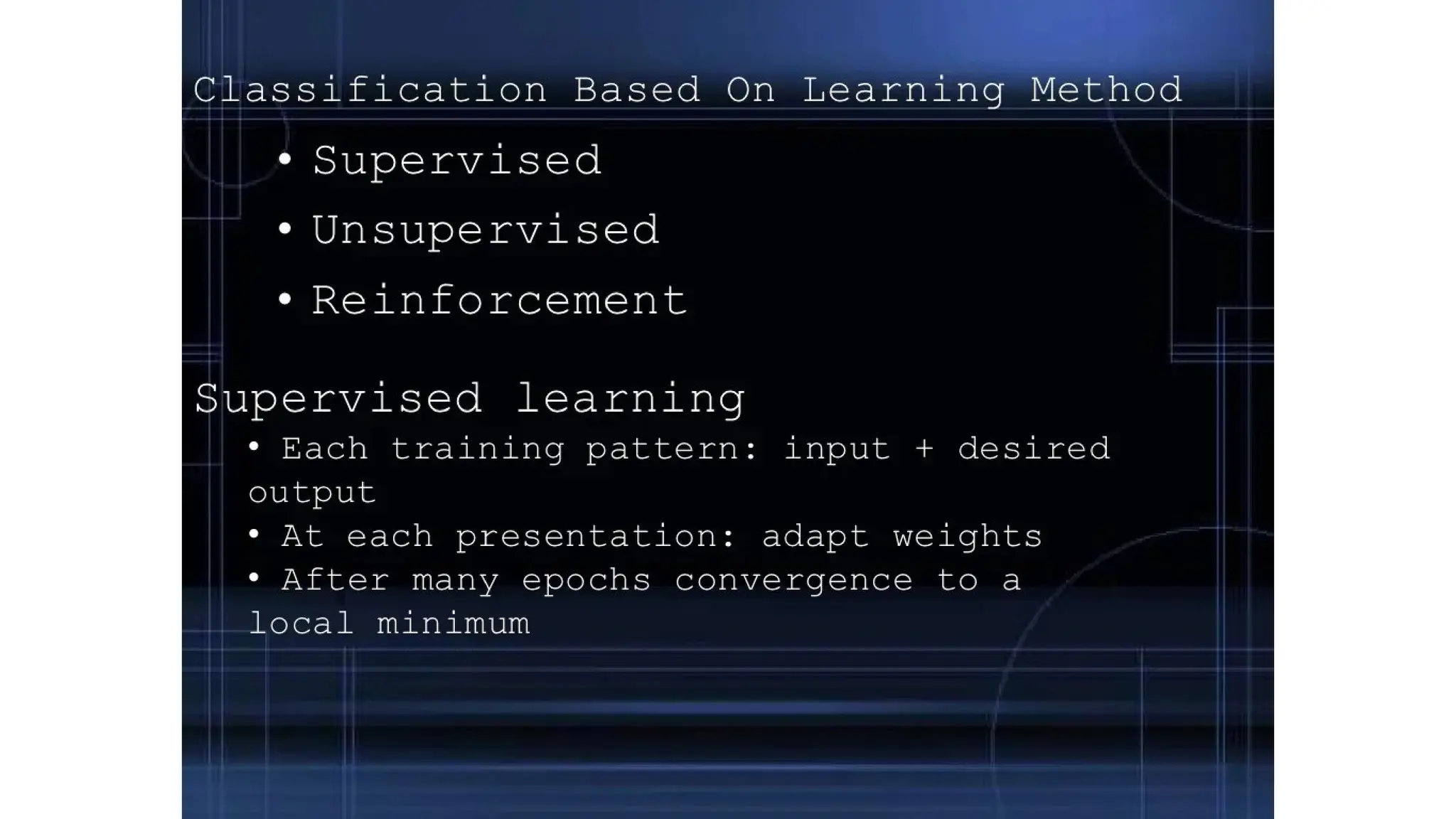
•Supervised Learning - with the help of labeled data, inputs,
and outputs are fed to the algorithms. They then predict the
desired result after being trained on how to interpret data.
•Unsupervised Learning - ANN learns with no human
intervention. There is no labeled data, and output is
determined according to patterns identified within the output
data.
•Reinforcement Learning - the network learns depending on
the feedback you give it.
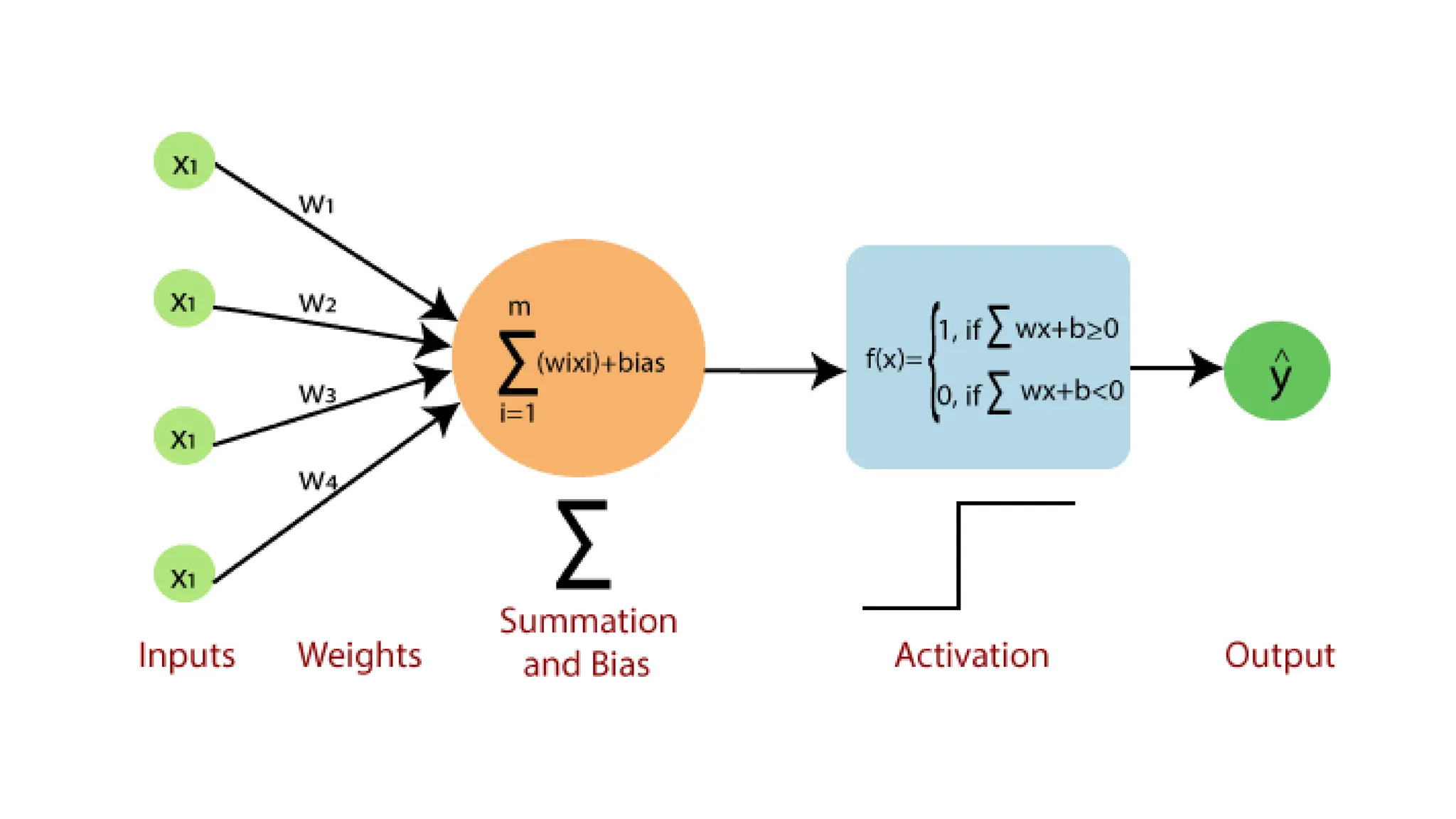
The essential building block of a neural network is a
perceptron or neuron. It uses the
supervised learning method to learn and classify data. We
will learn more about the perceptron later in this article.
How Neural Networks work
Neural Networks are complex systems with artificial neurons.
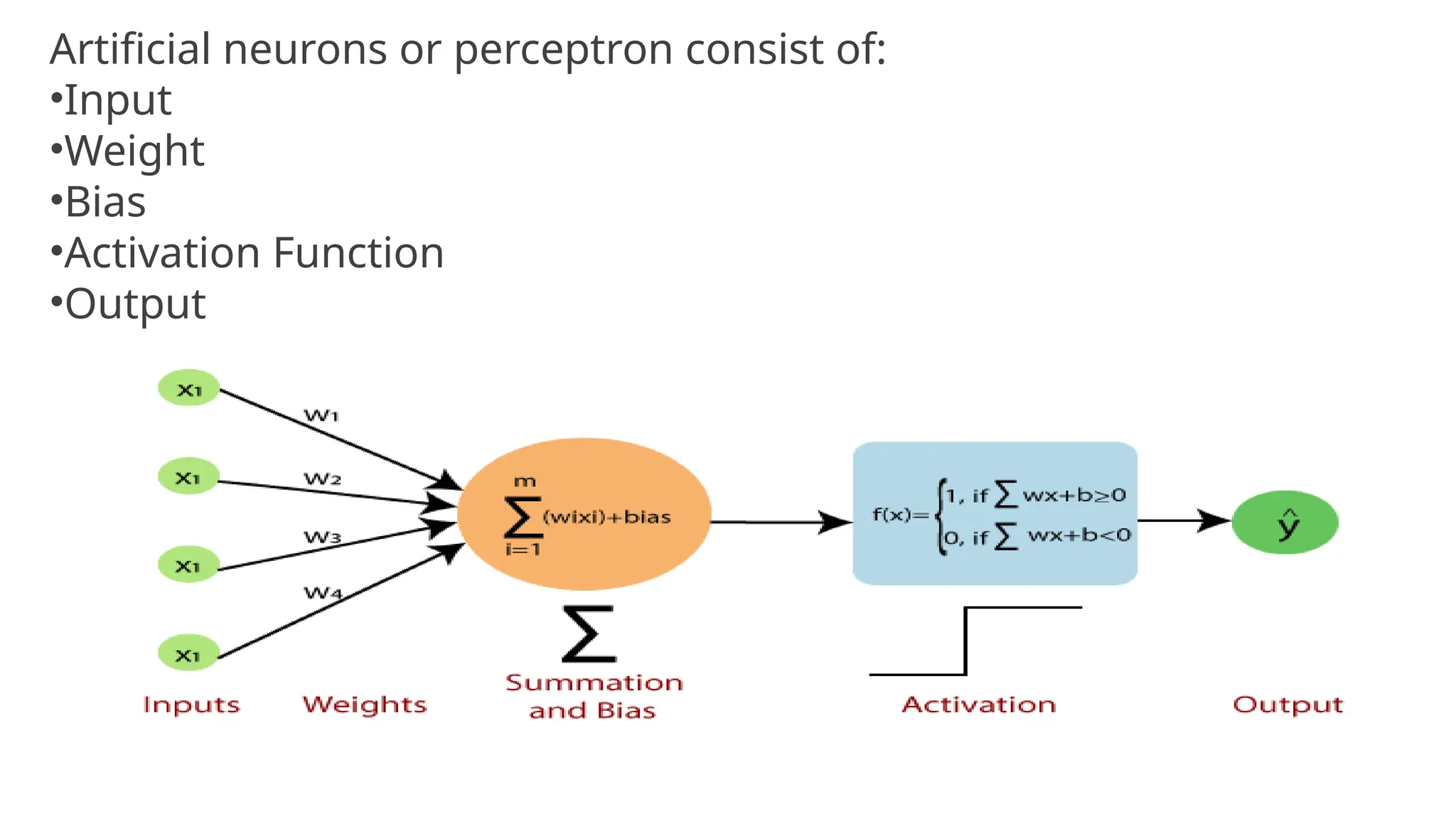
Artificial neurons or perceptron consist of:
•Input
•Weight
•Bias
•Activation Function
•Output
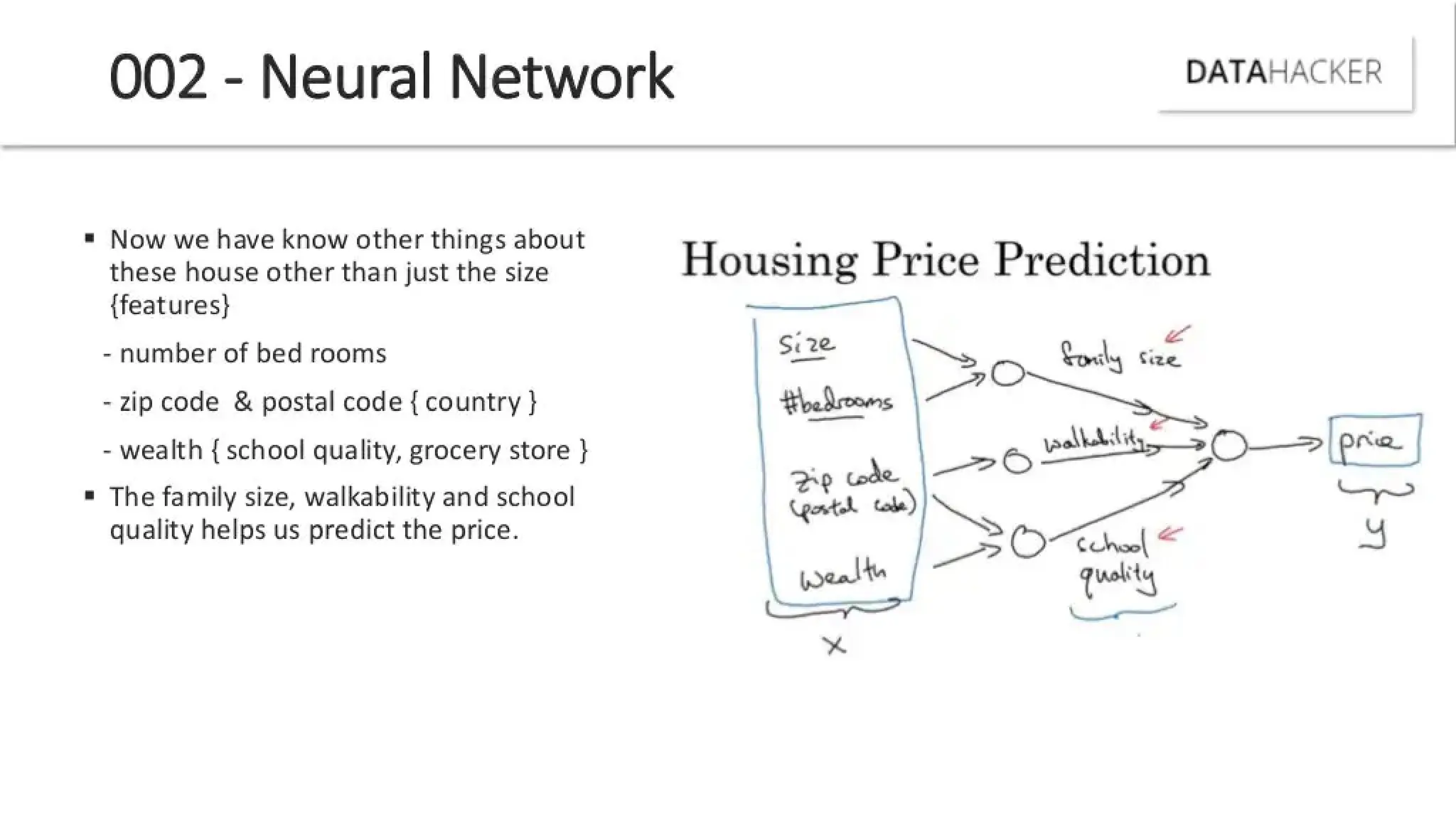
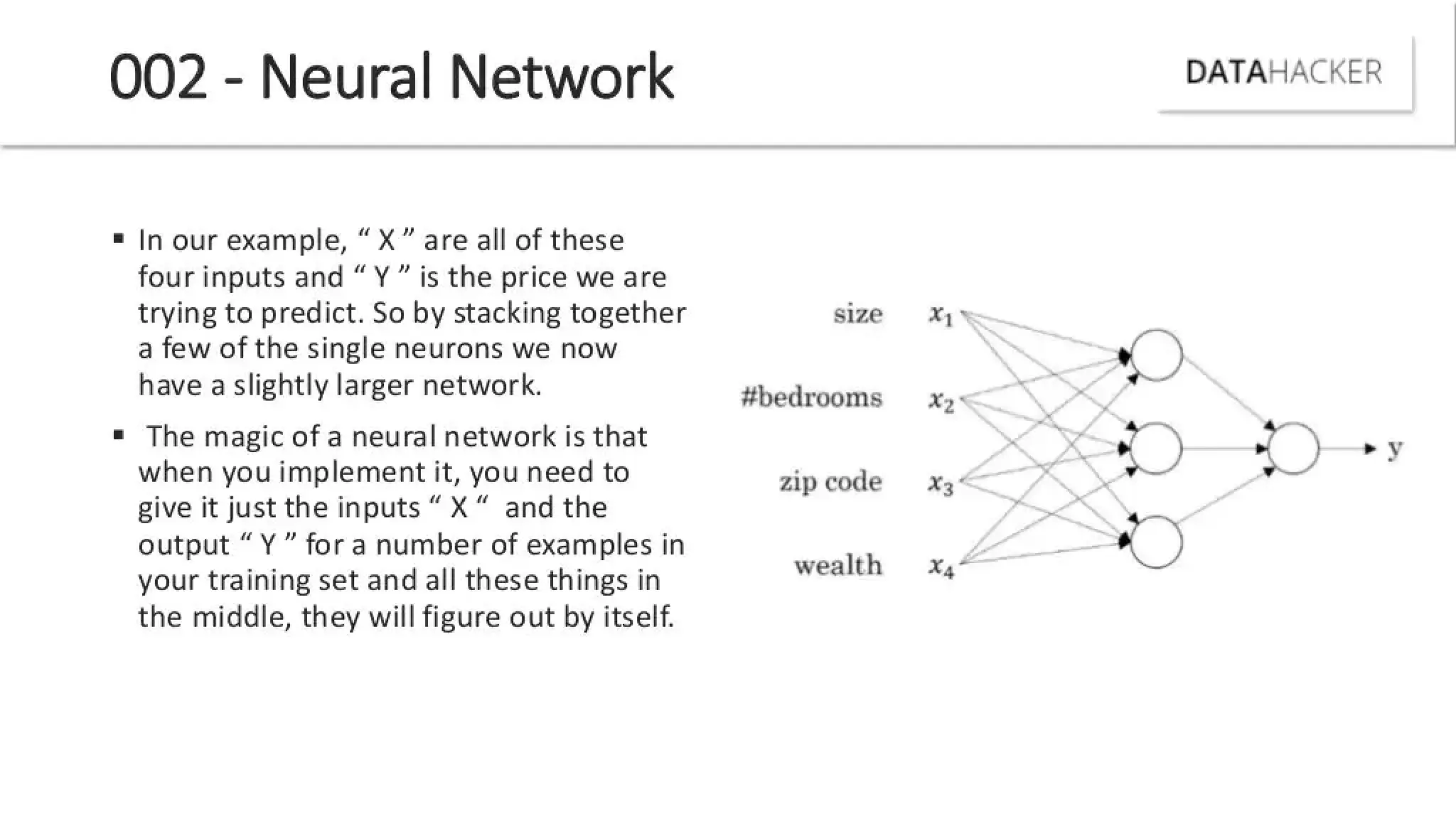
The neurons receive many inputs and process a single output.
Neural networks are comprised of layers of neurons.
These layers consist of the following:
•Input layer
•Multiple hidden layers
•Output layer
The input layer receives data represented by a numeric value. Hidden
layers perform the most computations required by the network.
Finally, the output layer predicts the output.
In a neural network, neurons dominate one another. Each layer is made of neurons. Once the input
layer receives data, it is redirected to the hidden layer. Each input is assigned with weights.
The weight is a value in a neural network that converts input data within the network’s hidden layers.
Weights work by input layer, taking input data, and multiplying it by the weight value.
It then initiates a value for the first hidden layer. The hidden layers transform the input data and pass
it to the other layer. The output layer produces the desired output.
The inputs and weights are multiplied, and their sum is sent to neurons in the hidden layer. Bias is
applied to each neuron. Each neuron adds the inputs it receives to get the sum. This value then transits
through the activation function.
The activation function outcome then decides if a neuron is activated or not. An activated neuron
transfers information into the other layers. With this approach, the data gets generated in the
network until the neuron reaches the output layer.
Another name for this is forward propagation. Feed-forward propagation is the process of inputting
data into an input node and getting the output through the output node. (We’ll discuss feed-forward
propagation a bit more in the section below).
Feed-forward propagation takes place when the hidden layer accepts the input data. Processes it as per the activation
function and passes it to the output. The neuron in the output layer with the highest probability then projects the
result.
If the output is wrong, backpropagation takes place. While designing a neural network, weights are
initialized to each input. Backpropagation means re-adjusting each input’s weights to minimize the
errors, thus resulting in a more accurate output.
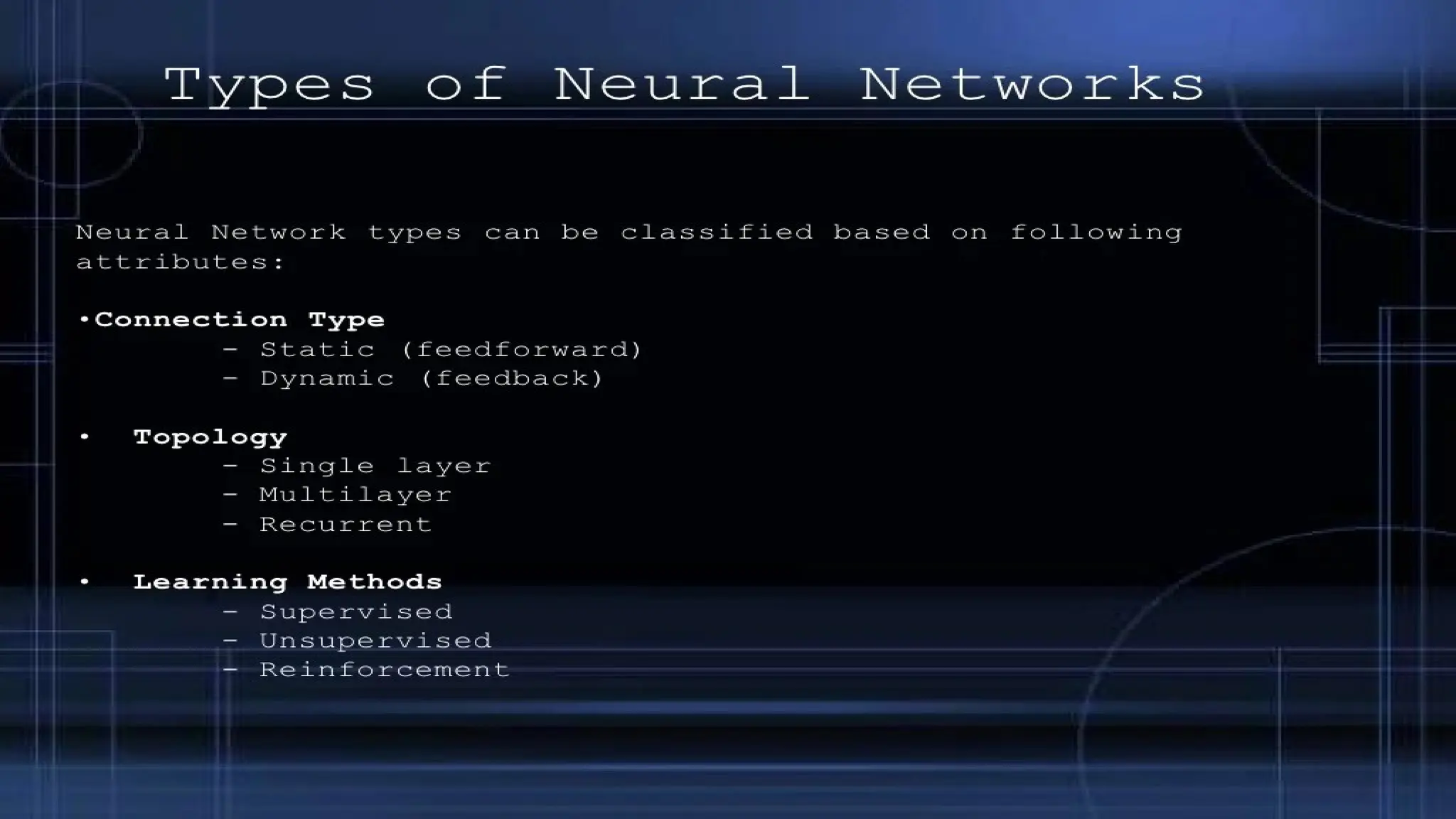
Types of Neural
Networks
Neural networks are identified based on mathematical
performance and principles to determine the output. Below
we will go over different types of neural networks.
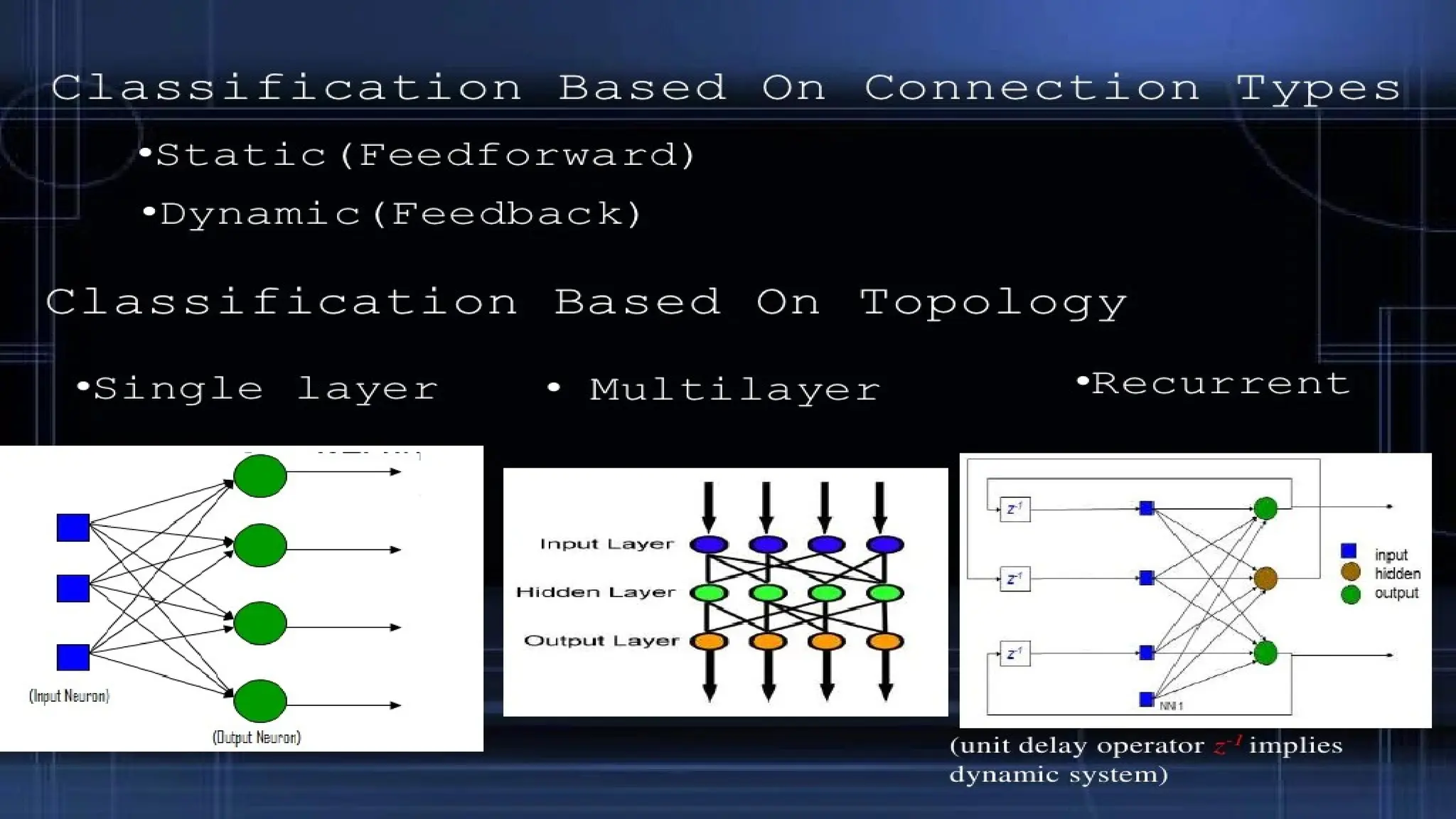
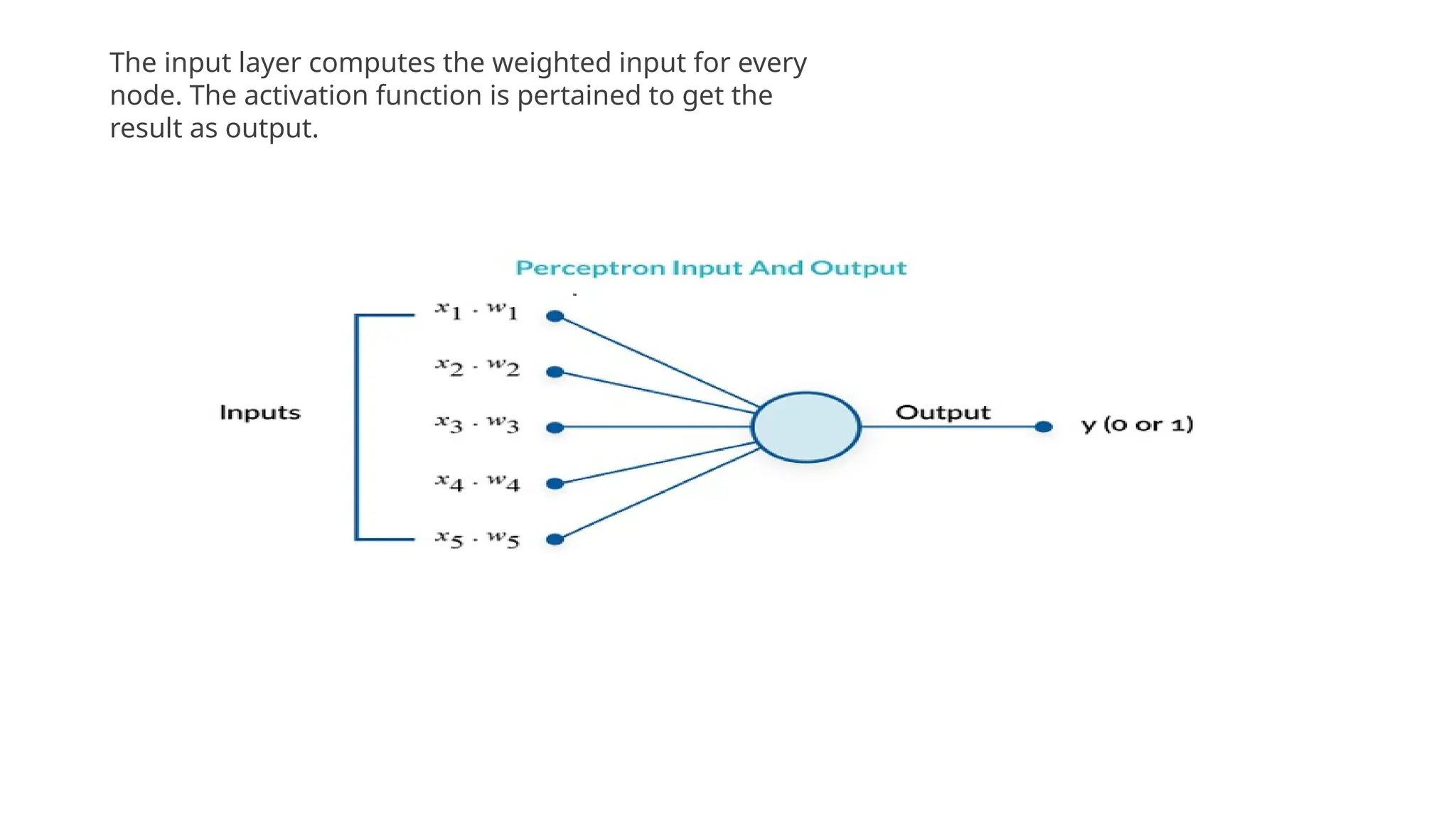
Perceptron
• Minsky and Papert proposed the Perceptron model (Single-layer neural
network). They said it was modeled after how the human brain function.
• The perceptron is the oldest neural network, created by Frank Rosenblatt
in 1958. It has a single neuron and is the simplest form of a neural
network:
• It is one of the simplest models that can learn and solve complex data
problems using neural networks. Perceptron is also called an artificial
neuron.
• A perceptron network is comprised of two layers:
• Input Layer
• Output Layer
The input layer computes the weighted input for every
node. The activation function is pertained to get the
result as output.
Feed Forward Neural Network
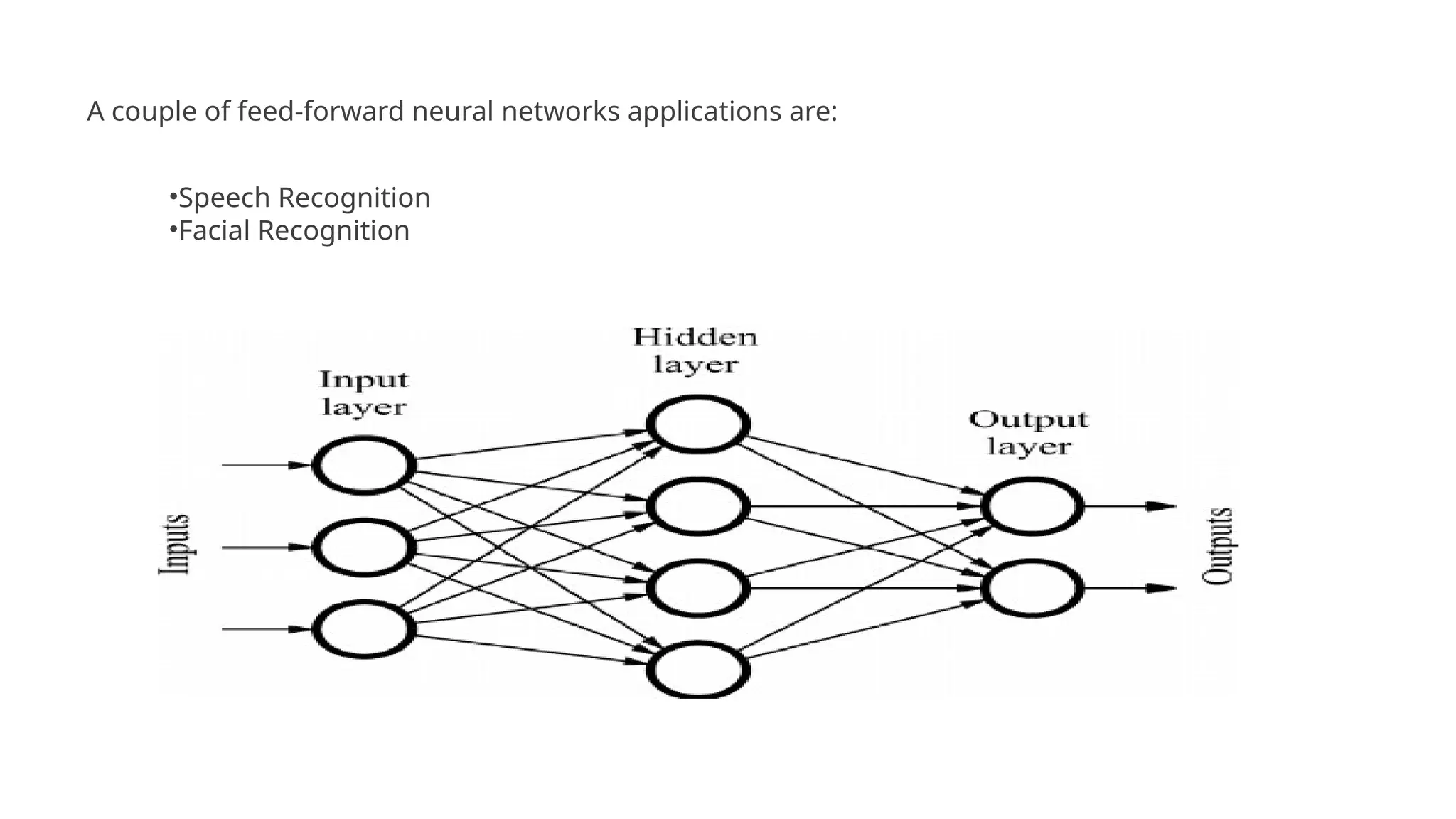
• In a feed-forward network, data moves in a single direction.
It enters via the input nodes and leaves through output
nodes.
• This is a front propagation wave.
• By moving data in one direction, there is no
backpropagation. The backpropagation algorithm calculates
the gradient of the loss function with consideration to
weights in the network.
• The input product sum and their weights are computed. The
data later is transferred to the output.
A couple of feed-forward neural networks applications are:
•Speech Recognition
•Facial Recognition
Radial Basis Function Neural Network
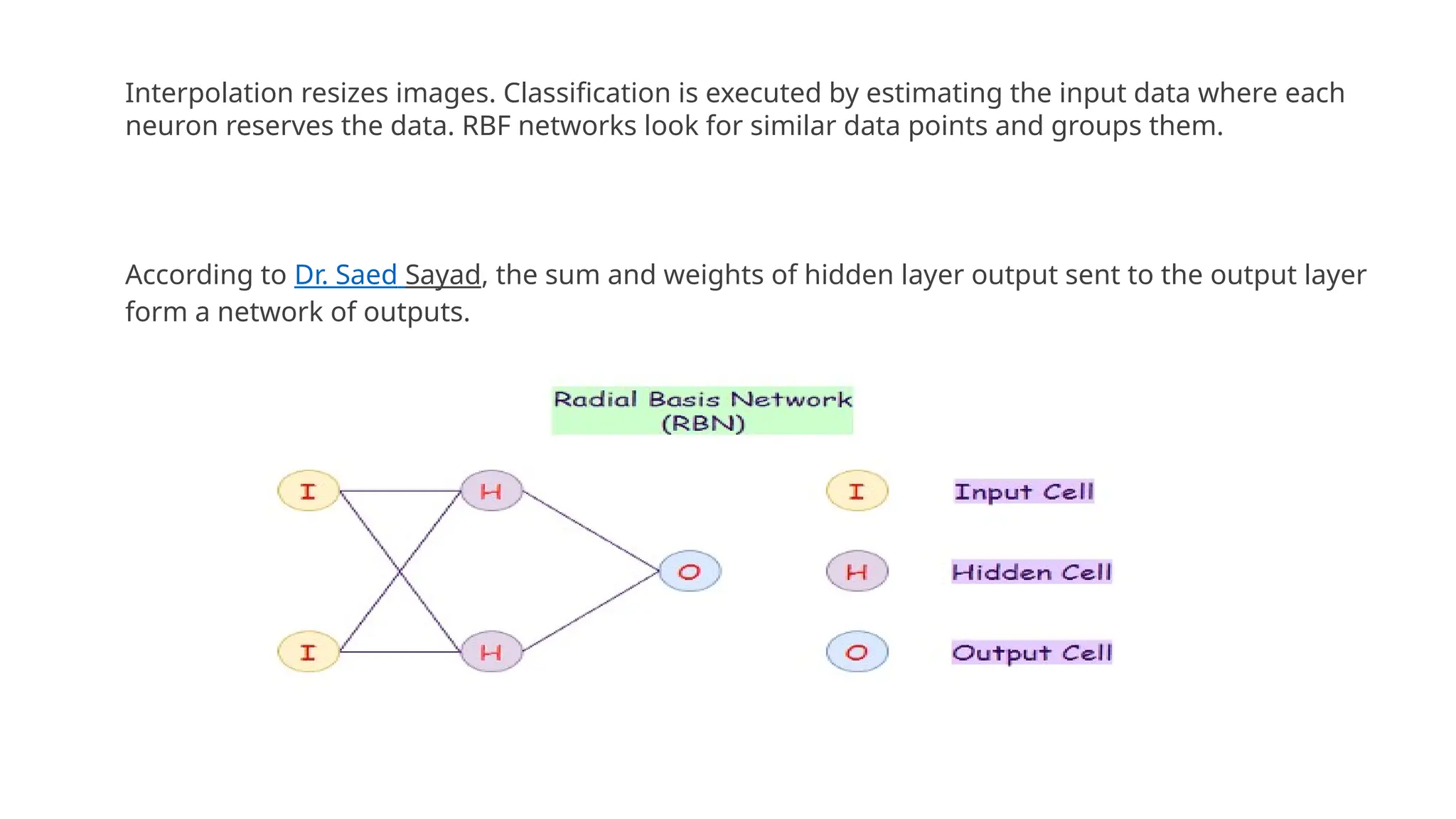
• Radial Basis Function Neural Networks (RBF are comprised
of three layers:
• Input Layer
• Hidden Layer
• Output Layer
• RBF networks classify data based on the distance of any
centered point and interpolation.
Interpolation resizes images. Classification is executed by estimating the input data where each
neuron reserves the data. RBF networks look for similar data points and groups them.
According to Dr. Saed Sayad, the sum and weights of hidden layer output sent to the output layer
form a network of outputs.
Recurrent Neural Network
• Neural networks such as a feed-forward networks move
data in one direction. This type of network has the
disadvantage of not remembering the data in past inputs.
This is where RNNs comes into play. RNNs do not work like
standard neural networks.
• A Recurrent Neural Network (RNN) is a network good at
modeling sequential data. Sequential data means data that
follow a particular order in that a thing follows another.
• In RNN, the output of the previous stage goes back in as an
input of the current step. RNN is a feedback neural network.
• Saving the output helps make other decisions.
• In RNNs, data runs through a loop, such that each node remembers data in the
previous step.
• For example: Let’s say you are taking five classes this semester, and this is your schedule:
Monday = Cryptography, Tuesday = Audit of Information Systems, Wednesday = Advanced
Database, Thursday = Java, and Friday = Business intelligence.
For the NN to tell you the class you are studying (any given day), it has to be able to “look” at the
class studied the day before.
With the example above, you can tell the output must go back in as input to decide the next
output.
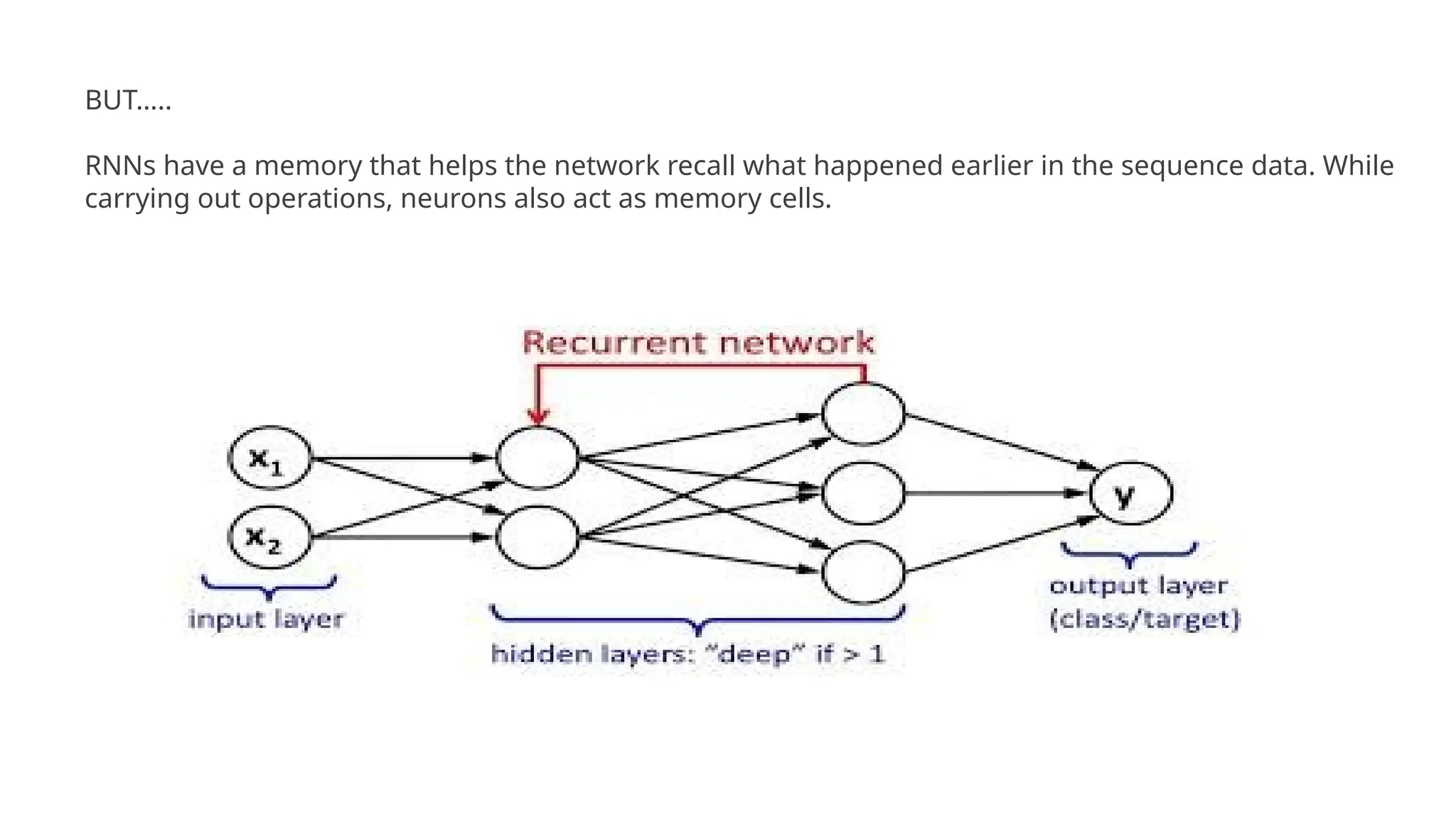
BUT…..
RNNs have a memory that helps the network recall what happened earlier in the sequence data. While
carrying out operations, neurons also act as memory cells.
RNN are used to solve problems in stock predictions, text data, and audio data.
In other words, it’s used to solve similar problems in text-to-speech conversion and language
translation. Learn more about text generation with RNN here.
Convolution Neural Network
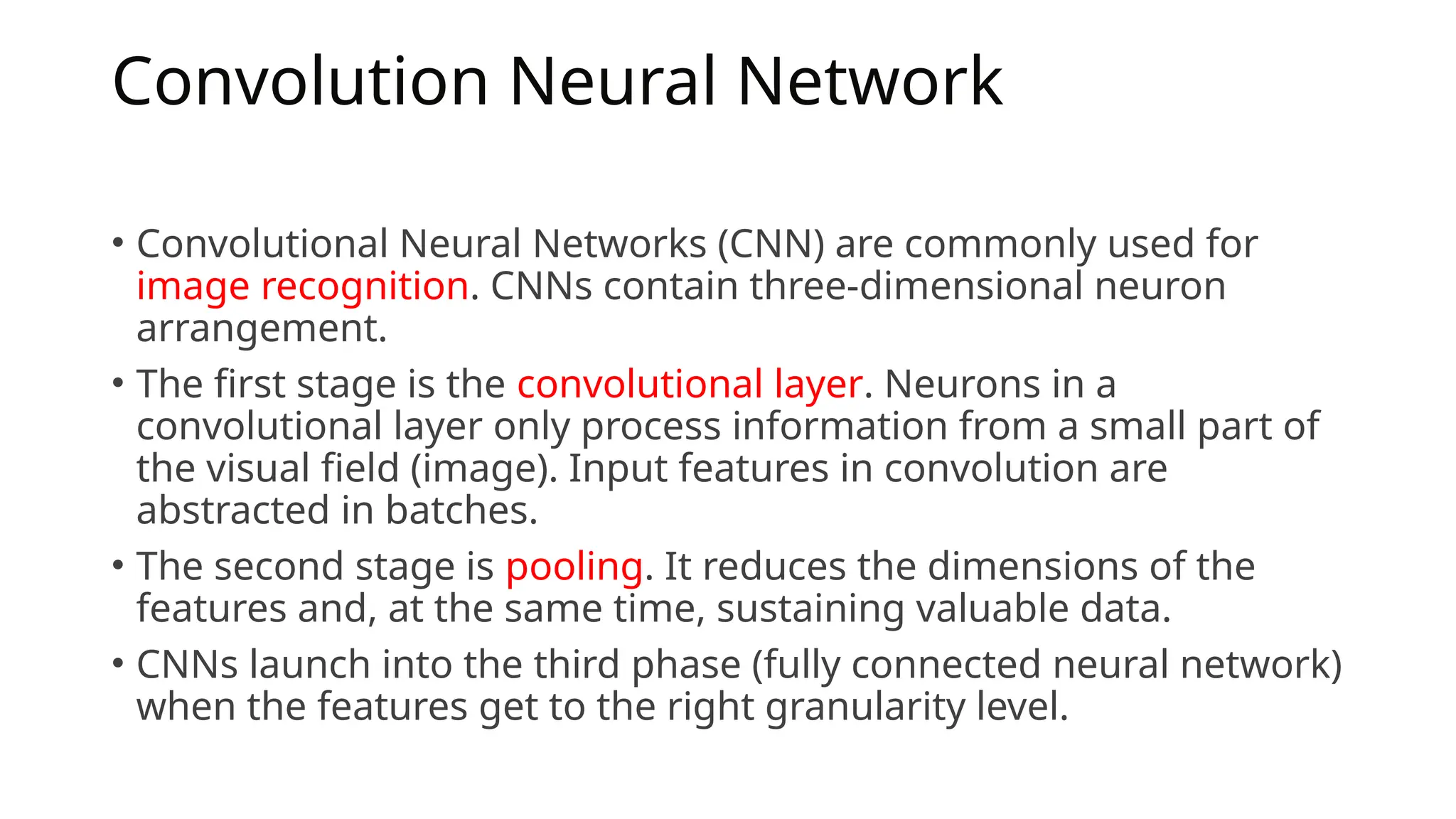
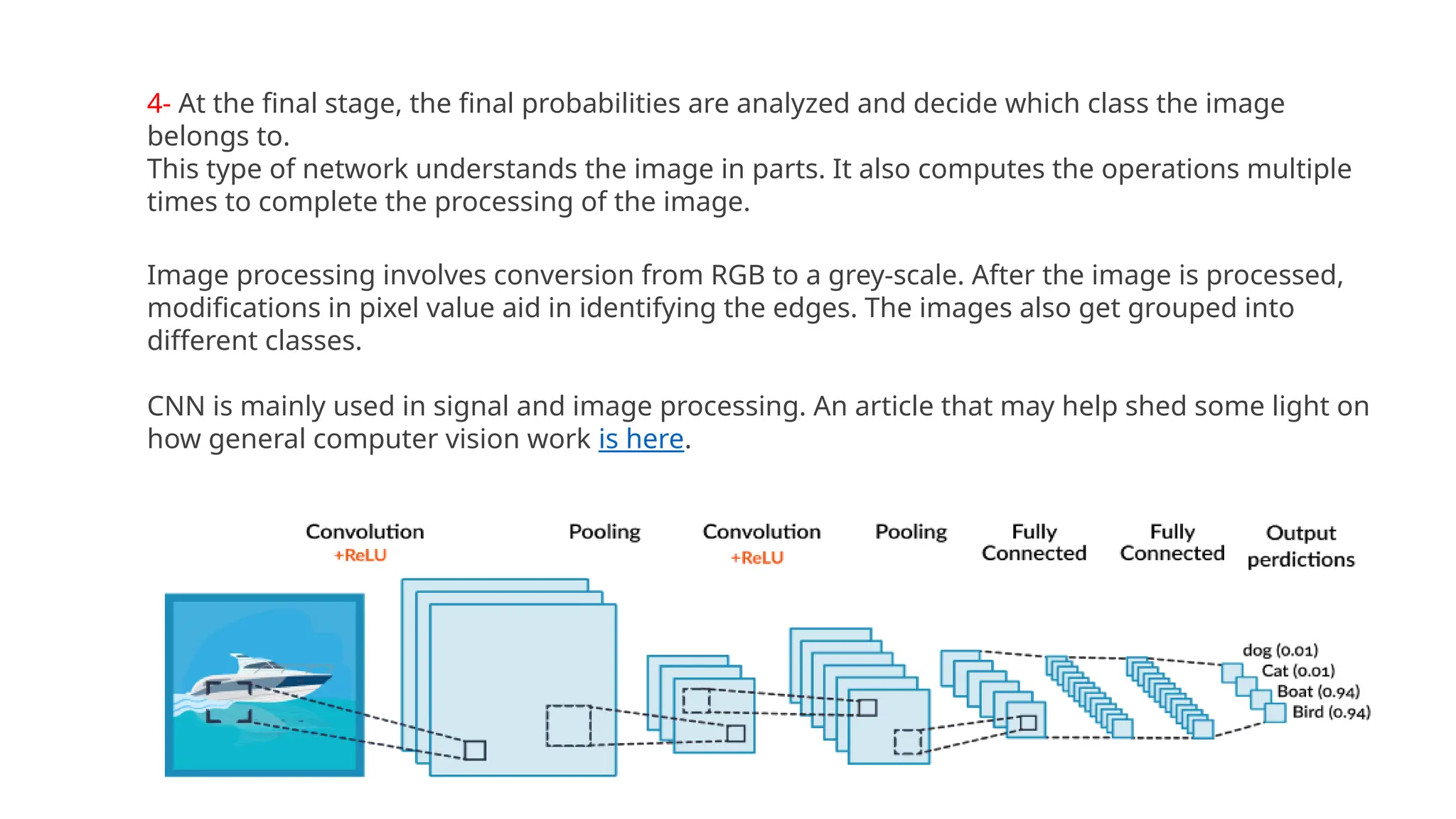
• Convolutional Neural Networks (CNN) are commonly used for
image recognition. CNNs contain three-dimensional neuron
arrangement.
• The first stage is the convolutional layer. Neurons in a
convolutional layer only process information from a small part of
the visual field (image). Input features in convolution are
abstracted in batches.
• The second stage is pooling. It reduces the dimensions of the
features and, at the same time, sustaining valuable data.
• CNNs launch into the third phase (fully connected neural network)
when the features get to the right granularity level.
4- At the final stage, the final probabilities are analyzed and decide which class the image
belongs to.
This type of network understands the image in parts. It also computes the operations multiple
times to complete the processing of the image.
Image processing involves conversion from RGB to a grey-scale. After the image is processed,
modifications in pixel value aid in identifying the edges. The images also get grouped into
different classes.
CNN is mainly used in signal and image processing. An article that may help shed some light on
how general computer vision work is here.
Modular Neural Network
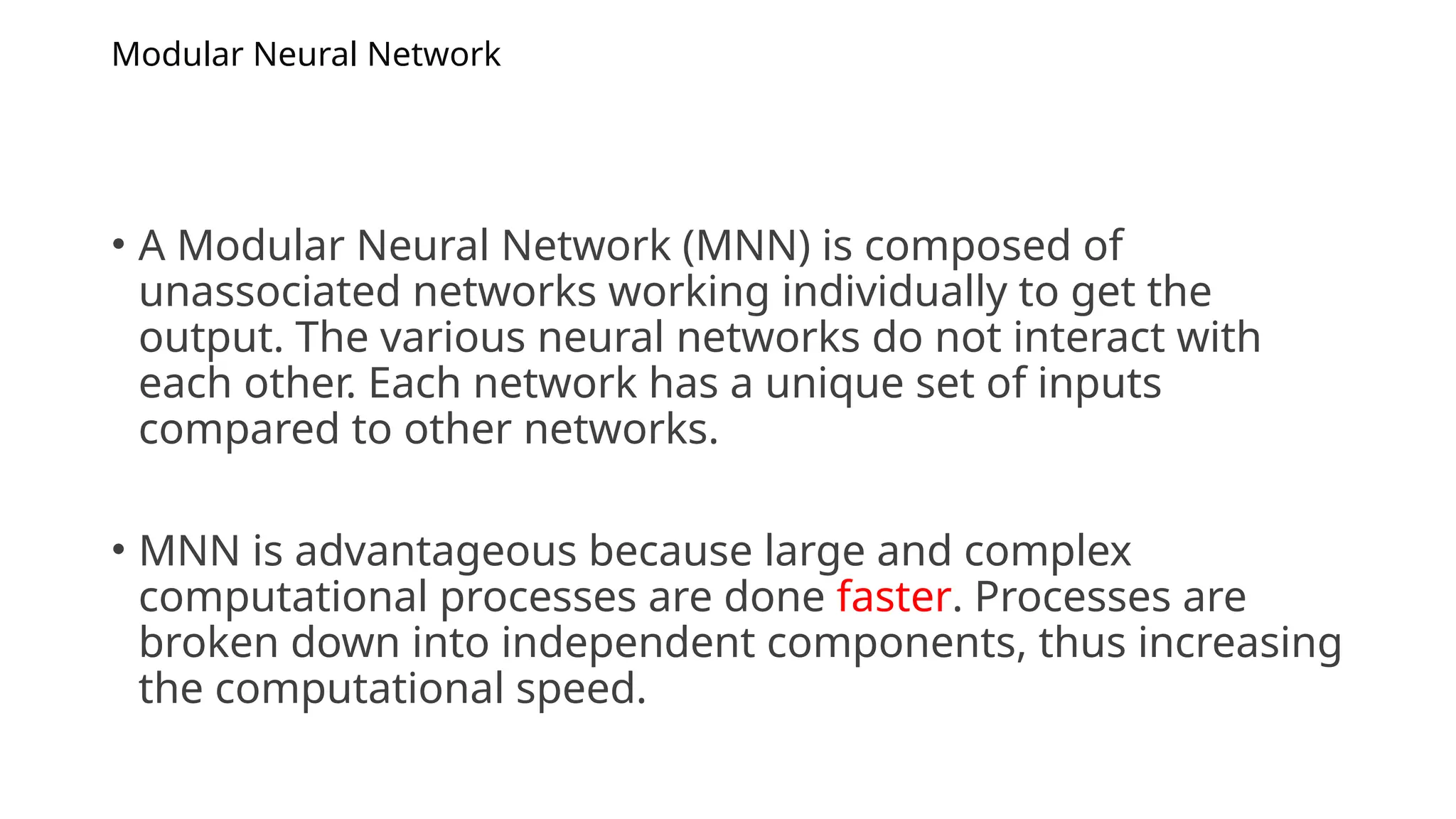
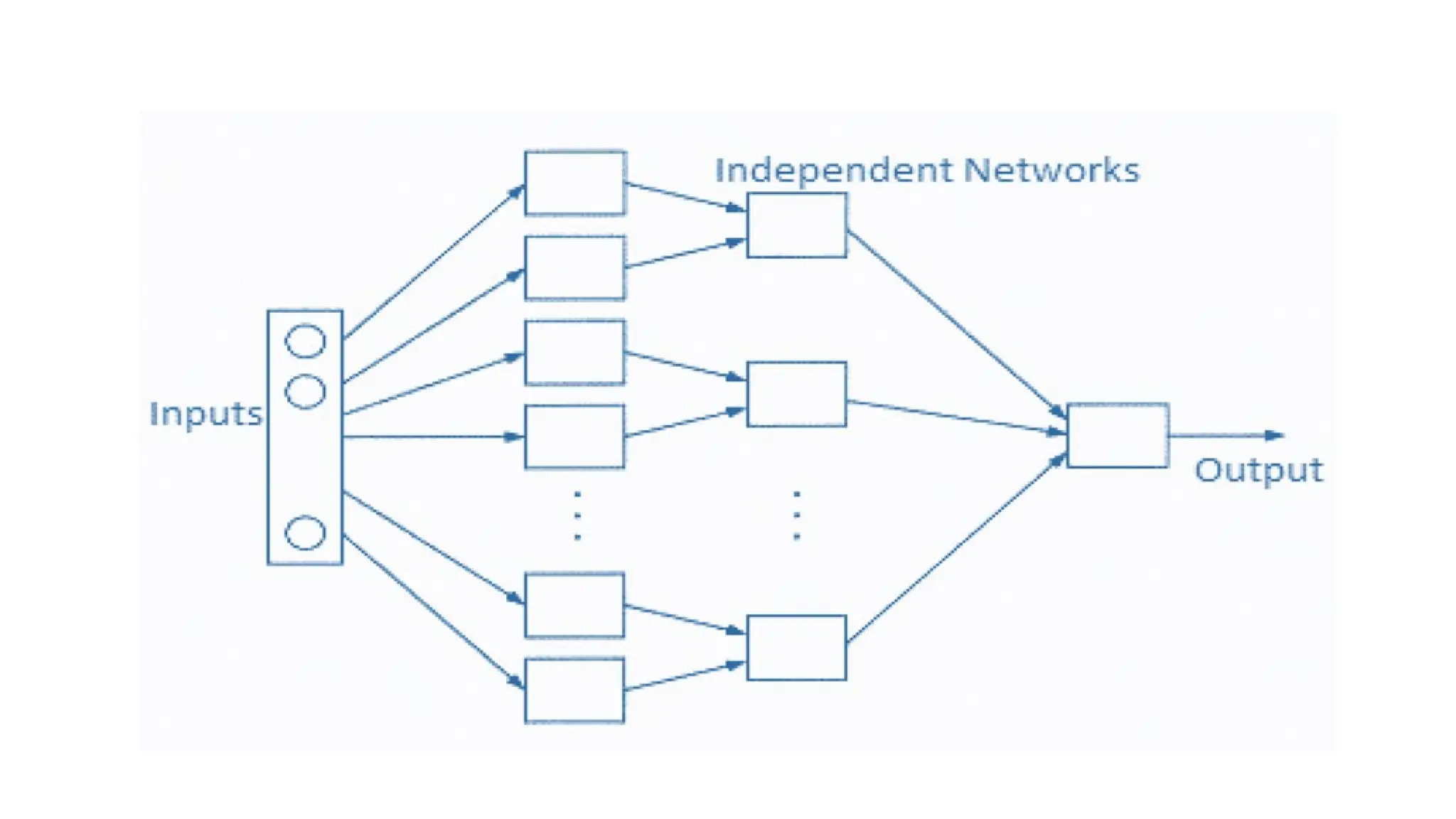
• A Modular Neural Network (MNN) is composed of
unassociated networks working individually to get the
output. The various neural networks do not interact with
each other. Each network has a unique set of inputs
compared to other networks.
• MNN is advantageous because large and complex
computational processes are done faster. Processes are
broken down into independent components, thus increasing
the computational speed.
Applications of Neural Networks
• Neural networks are effectively applied to several fields to resolve
data issues, some examples are listed below:
• Neural networks are playing a significant role in facial recognition.
Some smartphones can identify the age of a person. This is based
on facial features and visual pattern recognition.
Weather Forecasting
• Neural networks are trained to recognize the patterns and
identify distinct kinds of weather. Weather forecasting, with the
help of neural networks, not only predicts the weather.
Facial Recognition
Music composition
• Neural networks are mastering patterns in sounds and tunes. These networks train themselves
adequately to create new music. They are also being used in music composition software.
Image processing and Character recognition
• Neural networks can recognize and learn patterns in an image. Image processing is a growing
field.
• Image recognition is used in:
•Facial recognition.
•Cancer cell detection.
•Satellite imagery processing for use in defense and agriculture.
Character recognition is helping to detect fraud and national security assessments.
Advantages of Neural Networks
• Fault tolerance
In a neural network, even if a few neurons are not working properly, that would
not prevent the neural networks from generating outputs.
• Real-time Operations
Neural networks can learn synchronously and easily adapt to their changing
environments.
• Adaptive Learning
Neural networks can learn how to work on different tasks. Based on the data
given to produce the right output.
• Parallel processing capacity
Neural networks have the strength and ability to perform
multiple jobs simultaneously.
Disadvantages of Neural Networks
• Unexplained behavior of the network
• There is no specified rule (or rule of thumb) for a neural network procedure. A proper network
structure is achieved by trying the best network, in a trial and error approach. It is a process that
involves refinement.
Hardware dependence
• The pieces of equipment of a neural network are dependent on one another. By which we mean,
that neural networks require (or are highly dependent on) processors with adequate processing
capacity.
Neural networks provide a solution to a problem. Due to the complexity of the networks, it
doesn’t provide the reasoning behind “why and how” it made the decisions it made.
Therefore, trust in the network may be reduced.
Determination of appropriate network structure
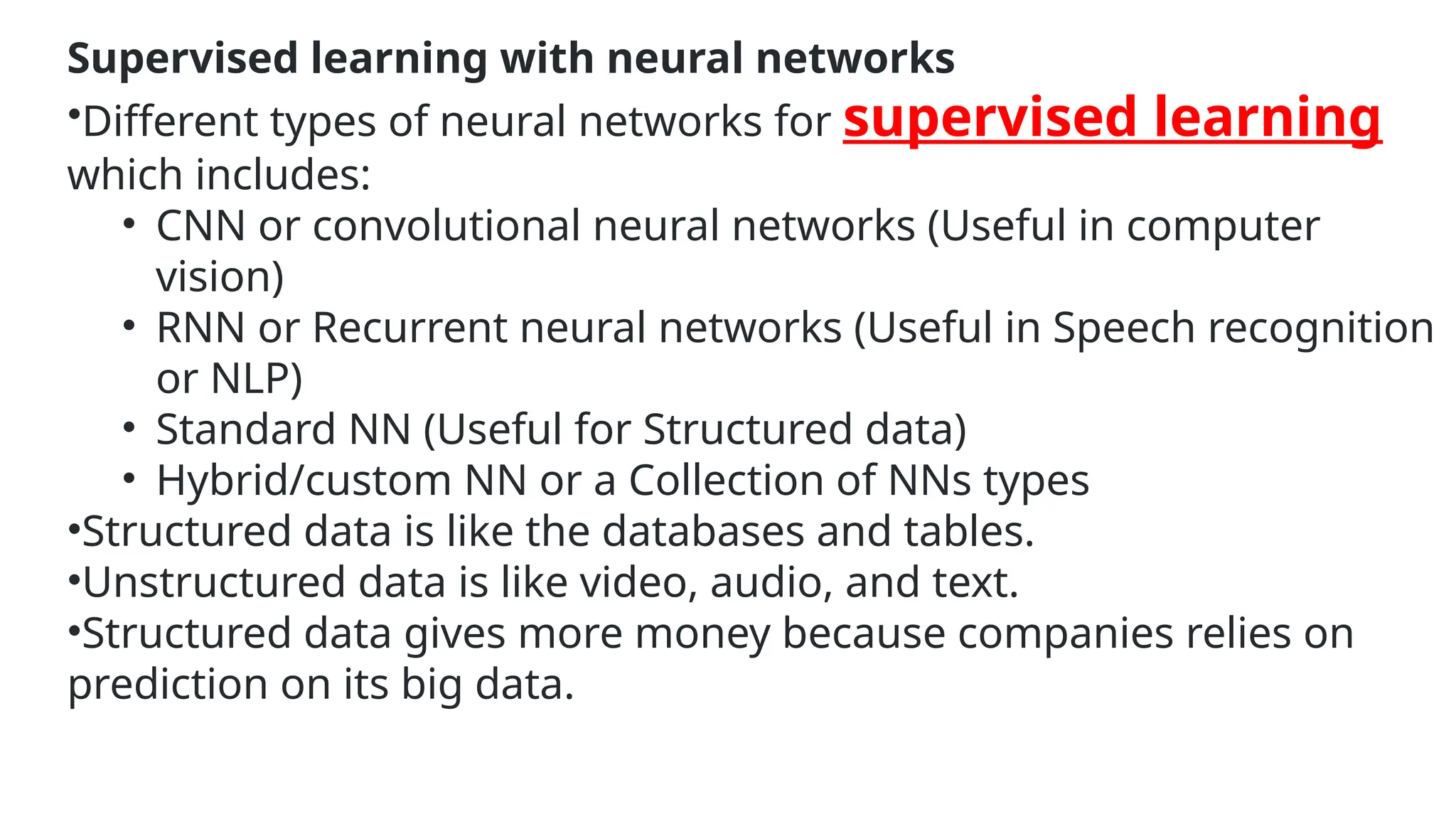
Supervised learning with neural networks
•Different types of neural networks for supervised learning
which includes:
• CNN or convolutional neural networks (Useful in computer
vision)
• RNN or Recurrent neural networks (Useful in Speech recognition
or NLP)
• Standard NN (Useful for Structured data)
• Hybrid/custom NN or a Collection of NNs types
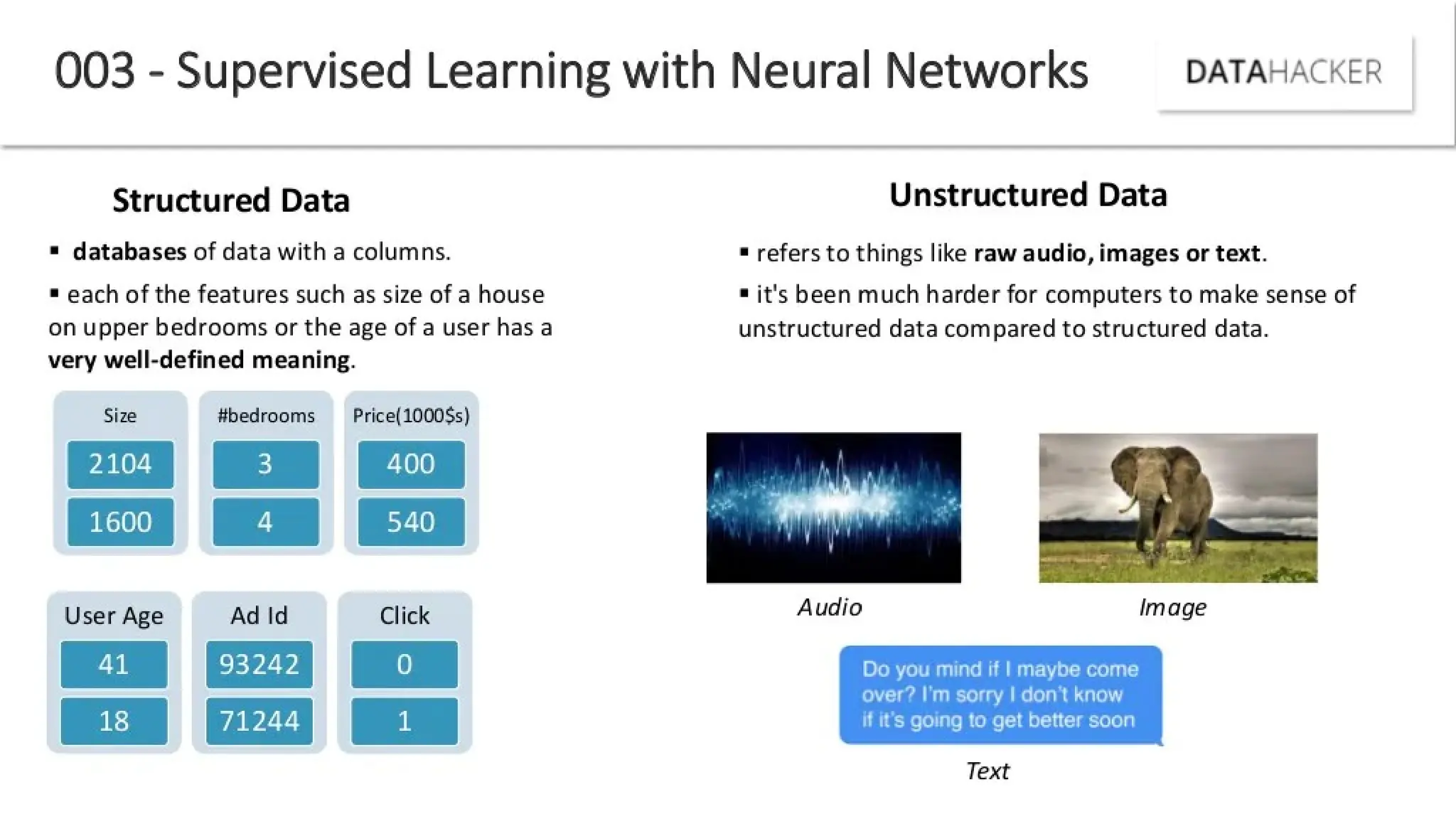
•Structured data is like the databases and tables.
•Unstructured data is like video, audio, and text.
•Structured data gives more money because companies relies on
prediction on its big data.
Summary

1.Introduction to Artificial Neural Networks.pptx

  • 1.
  • 3.
    In this article,we will be talking about neural networks. A functional unit of deep learning, this means a neural network accepts input and gives an output. Deep Learning uses Artificial Neural Networks (ANN). ANNs imitates the human brain’s behavior to solve complex data problems.
  • 4.
    • These technologiessolve problems in image recognition, speech recognition, pattern recognition, and natural language processing (NLP), to name a few. • In this article, you will learn the basics of artificial neural networks or ANN. It will also give you an in- depth interpretation of how neural networks operate.
  • 5.
    Key Terms •Neuron: Abuilding block of ANN. It is responsible for accepting input data, performing calculations, and producing output. •Input data: Information or data provided to the neurons. •Artificial Neural Network(ANN): A computational system inspired by the way biological neural networks in the human brain process information. •Deep Neural Network: An ANN with many layers placed between the input layer and the output layer. •Weights: The strength of the connection between two neurons. Weights determine what impact the input will have on the output. •Bias: An additional parameter used along with the sum of the product of weights and inputs to produce an output. •Activation Function: Determines the output of a neural network.
  • 6.
    Neural Networks Overview •Have you ever wondered how your brain recognizes images? No matter what or how the image looks, the brain can tell that this is an image of a cat and not a dog. The brain relates to the best possible pattern and concludes the result. The example below will help you understand neural networks: • Consider a scenario where you have a set of labeled images, and you have to classify the images based on if it is a dog or a cat.
  • 7.
    To create aneural network that recognizes images of cats and dogs. The network starts by processing the input. Each image is made of pixels. For example, the image dimensions might be 20 X 20 pixels that make 400 pixels. Those 400 pixels would make the first layer of our neural network.
  • 8.
    • A neuralnetwork is made of artificial neurons that receive and process input data. Data is passed through the input layer, the hidden layer, and the output layer. • A neural network process starts when input data is fed to it. Data is then processed via its layers to provide the desired output. • A neural network learns from structured data and exhibits the output. Learning taking place within neural networks can be in three different categories:
  • 9.
    •Supervised Learning -with the help of labeled data, inputs, and outputs are fed to the algorithms. They then predict the desired result after being trained on how to interpret data. •Unsupervised Learning - ANN learns with no human intervention. There is no labeled data, and output is determined according to patterns identified within the output data. •Reinforcement Learning - the network learns depending on the feedback you give it.
  • 10.
    The essential buildingblock of a neural network is a perceptron or neuron. It uses the supervised learning method to learn and classify data. We will learn more about the perceptron later in this article.
  • 11.
    How Neural Networkswork Neural Networks are complex systems with artificial neurons.
  • 12.
    Artificial neurons orperceptron consist of: •Input •Weight •Bias •Activation Function •Output
  • 13.
    The neurons receivemany inputs and process a single output. Neural networks are comprised of layers of neurons. These layers consist of the following: •Input layer •Multiple hidden layers •Output layer The input layer receives data represented by a numeric value. Hidden layers perform the most computations required by the network. Finally, the output layer predicts the output.
  • 14.
    In a neuralnetwork, neurons dominate one another. Each layer is made of neurons. Once the input layer receives data, it is redirected to the hidden layer. Each input is assigned with weights. The weight is a value in a neural network that converts input data within the network’s hidden layers. Weights work by input layer, taking input data, and multiplying it by the weight value. It then initiates a value for the first hidden layer. The hidden layers transform the input data and pass it to the other layer. The output layer produces the desired output. The inputs and weights are multiplied, and their sum is sent to neurons in the hidden layer. Bias is applied to each neuron. Each neuron adds the inputs it receives to get the sum. This value then transits through the activation function. The activation function outcome then decides if a neuron is activated or not. An activated neuron transfers information into the other layers. With this approach, the data gets generated in the network until the neuron reaches the output layer. Another name for this is forward propagation. Feed-forward propagation is the process of inputting data into an input node and getting the output through the output node. (We’ll discuss feed-forward propagation a bit more in the section below).
  • 15.
    Feed-forward propagation takesplace when the hidden layer accepts the input data. Processes it as per the activation function and passes it to the output. The neuron in the output layer with the highest probability then projects the result. If the output is wrong, backpropagation takes place. While designing a neural network, weights are initialized to each input. Backpropagation means re-adjusting each input’s weights to minimize the errors, thus resulting in a more accurate output.
  • 21.
    Types of Neural Networks Neuralnetworks are identified based on mathematical performance and principles to determine the output. Below we will go over different types of neural networks.
  • 22.
    Perceptron • Minsky andPapert proposed the Perceptron model (Single-layer neural network). They said it was modeled after how the human brain function. • The perceptron is the oldest neural network, created by Frank Rosenblatt in 1958. It has a single neuron and is the simplest form of a neural network: • It is one of the simplest models that can learn and solve complex data problems using neural networks. Perceptron is also called an artificial neuron. • A perceptron network is comprised of two layers: • Input Layer • Output Layer
  • 23.
    The input layercomputes the weighted input for every node. The activation function is pertained to get the result as output.
  • 24.
    Feed Forward NeuralNetwork • In a feed-forward network, data moves in a single direction. It enters via the input nodes and leaves through output nodes. • This is a front propagation wave. • By moving data in one direction, there is no backpropagation. The backpropagation algorithm calculates the gradient of the loss function with consideration to weights in the network. • The input product sum and their weights are computed. The data later is transferred to the output.
  • 25.
    A couple offeed-forward neural networks applications are: •Speech Recognition •Facial Recognition
  • 26.
    Radial Basis FunctionNeural Network • Radial Basis Function Neural Networks (RBF are comprised of three layers: • Input Layer • Hidden Layer • Output Layer • RBF networks classify data based on the distance of any centered point and interpolation.
  • 27.
    Interpolation resizes images.Classification is executed by estimating the input data where each neuron reserves the data. RBF networks look for similar data points and groups them. According to Dr. Saed Sayad, the sum and weights of hidden layer output sent to the output layer form a network of outputs.
  • 28.
    Recurrent Neural Network •Neural networks such as a feed-forward networks move data in one direction. This type of network has the disadvantage of not remembering the data in past inputs. This is where RNNs comes into play. RNNs do not work like standard neural networks. • A Recurrent Neural Network (RNN) is a network good at modeling sequential data. Sequential data means data that follow a particular order in that a thing follows another. • In RNN, the output of the previous stage goes back in as an input of the current step. RNN is a feedback neural network.
  • 29.
    • Saving theoutput helps make other decisions. • In RNNs, data runs through a loop, such that each node remembers data in the previous step. • For example: Let’s say you are taking five classes this semester, and this is your schedule: Monday = Cryptography, Tuesday = Audit of Information Systems, Wednesday = Advanced Database, Thursday = Java, and Friday = Business intelligence. For the NN to tell you the class you are studying (any given day), it has to be able to “look” at the class studied the day before. With the example above, you can tell the output must go back in as input to decide the next output.
  • 30.
    BUT….. RNNs have amemory that helps the network recall what happened earlier in the sequence data. While carrying out operations, neurons also act as memory cells.
  • 31.
    RNN are usedto solve problems in stock predictions, text data, and audio data. In other words, it’s used to solve similar problems in text-to-speech conversion and language translation. Learn more about text generation with RNN here.
  • 32.
    Convolution Neural Network •Convolutional Neural Networks (CNN) are commonly used for image recognition. CNNs contain three-dimensional neuron arrangement. • The first stage is the convolutional layer. Neurons in a convolutional layer only process information from a small part of the visual field (image). Input features in convolution are abstracted in batches. • The second stage is pooling. It reduces the dimensions of the features and, at the same time, sustaining valuable data. • CNNs launch into the third phase (fully connected neural network) when the features get to the right granularity level.
  • 33.
    4- At thefinal stage, the final probabilities are analyzed and decide which class the image belongs to. This type of network understands the image in parts. It also computes the operations multiple times to complete the processing of the image. Image processing involves conversion from RGB to a grey-scale. After the image is processed, modifications in pixel value aid in identifying the edges. The images also get grouped into different classes. CNN is mainly used in signal and image processing. An article that may help shed some light on how general computer vision work is here.
  • 34.
    Modular Neural Network •A Modular Neural Network (MNN) is composed of unassociated networks working individually to get the output. The various neural networks do not interact with each other. Each network has a unique set of inputs compared to other networks. • MNN is advantageous because large and complex computational processes are done faster. Processes are broken down into independent components, thus increasing the computational speed.
  • 36.
    Applications of NeuralNetworks • Neural networks are effectively applied to several fields to resolve data issues, some examples are listed below: • Neural networks are playing a significant role in facial recognition. Some smartphones can identify the age of a person. This is based on facial features and visual pattern recognition. Weather Forecasting • Neural networks are trained to recognize the patterns and identify distinct kinds of weather. Weather forecasting, with the help of neural networks, not only predicts the weather. Facial Recognition
  • 37.
    Music composition • Neuralnetworks are mastering patterns in sounds and tunes. These networks train themselves adequately to create new music. They are also being used in music composition software. Image processing and Character recognition • Neural networks can recognize and learn patterns in an image. Image processing is a growing field. • Image recognition is used in: •Facial recognition. •Cancer cell detection. •Satellite imagery processing for use in defense and agriculture. Character recognition is helping to detect fraud and national security assessments.
  • 38.
    Advantages of NeuralNetworks • Fault tolerance In a neural network, even if a few neurons are not working properly, that would not prevent the neural networks from generating outputs. • Real-time Operations Neural networks can learn synchronously and easily adapt to their changing environments. • Adaptive Learning Neural networks can learn how to work on different tasks. Based on the data given to produce the right output. • Parallel processing capacity Neural networks have the strength and ability to perform multiple jobs simultaneously.
  • 39.
    Disadvantages of NeuralNetworks • Unexplained behavior of the network • There is no specified rule (or rule of thumb) for a neural network procedure. A proper network structure is achieved by trying the best network, in a trial and error approach. It is a process that involves refinement. Hardware dependence • The pieces of equipment of a neural network are dependent on one another. By which we mean, that neural networks require (or are highly dependent on) processors with adequate processing capacity. Neural networks provide a solution to a problem. Due to the complexity of the networks, it doesn’t provide the reasoning behind “why and how” it made the decisions it made. Therefore, trust in the network may be reduced. Determination of appropriate network structure
  • 47.
    Supervised learning withneural networks •Different types of neural networks for supervised learning which includes: • CNN or convolutional neural networks (Useful in computer vision) • RNN or Recurrent neural networks (Useful in Speech recognition or NLP) • Standard NN (Useful for Structured data) • Hybrid/custom NN or a Collection of NNs types •Structured data is like the databases and tables. •Unstructured data is like video, audio, and text. •Structured data gives more money because companies relies on prediction on its big data.
  • 51.