Deep Learning for Computer Vision
Igor Trajkovski
admin@time.mk
twitter.com/mkrobot
facebook.com/mkrobot
SkopjeTechMeetup
29.9.2016
Slides from Andrej Karpathy, Yann LeCun & Geoffrey Hinton
Artificial Neural Network
Very few assumptions made about the input vector.
In many real-world applications input vectors have structure.
Spectrograms
ImagesText
Convolutional Neural Networks:
A pinch of history
Hubel & Wiesel,
1959
RECEPTIVE FIELDS OF SINGLE NEURONES IN
THE CAT'S STRIATE CORTEX
1962
RECEPTIVE FIELDS, BINOCULAR
INTERACTION
AND FUNCTIONAL ARCHITECTURE IN
THE CAT'S VISUAL CORTEX
https://www.youtube.com/watch?v=8VdFf3egwfg
A bit of history:
Neurocognitron
[Fukushima 1980]
“sandwich” architecture (SCSCSC…)
simple cells: modifiable parameters
complex cells: perform pooling
Gradient-based learning applied to
document recognition
[LeCun, Bottou, Bengio, Haffner 1998]
LeNet-5
https://www.youtube.com/watch?v=FwFduRA_L6Q
car 99%
Computer
Vision
2011
Computer
Vision
2011
+  code complexity :(
ImageNet Classification with Deep
Convolutional Neural Networks
[Krizhevsky, Sutskever, Hinton, 2012]
“AlexNet”
Deng et al.
Russakovsky et al.
NVIDIA et al.
“What I learned from competing against a ConvNet on
ImageNet” (karpathy.github.io)
“What I learned from competing against a ConvNet on
ImageNet” (karpathy.github.io)
TLDR: Human accuracy is somewhere 2-5%.
(depending on how much training or how little life you have)
(slide from Kaiming He’s recent presentation)
[224x224x3]
f 1000 numbers,
indicating class scores
Feature
Extraction
vector describing
various image statistics
[224x224x3]
f 1000 numbers,
indicating class scores
training
training
“Run the image through 20 layers of 3x3
convolutions and train the filters with SGD.”
Convolutional Neural Networks
[224x224x3]
f 1000 numbers,
indicating class scores
training
Only two basic operations are involved throughout:
1.  Dot products w.x
2.  Max operations
parameters
(~10M of them)
preview:
e.g. 200K numbers e.g. 10 numbers
Convolution 1-D
1 -1 -1
-1 1 -1
-1 -1 1
-1 -1 -1 -1 -1 -1 -1 -1 -1
-1 1 -1 -1 -1 -1 -1 1 -1
-1 -1 1 -1 -1 -1 1 -1 -1
-1 -1 -1 1 -1 1 -1 -1 -1
-1 -1 -1 -1 1 -1 -1 -1 -1
-1 -1 -1 1 -1 1 -1 -1 -1
-1 -1 1 -1 -1 -1 1 -1 -1
-1 1 -1 -1 -1 -1 -1 1 -1
-1 -1 -1 -1 -1 -1 -1 -1 -1
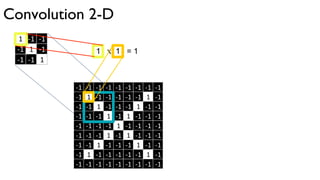
Convolution 2-D
1
1 -1 -1
-1 1 -1
-1 -1 1
-1 -1 -1 -1 -1 -1 -1 -1 -1
-1 1 -1 -1 -1 -1 -1 1 -1
-1 -1 1 -1 -1 -1 1 -1 -1
-1 -1 -1 1 -1 1 -1 -1 -1
-1 -1 -1 -1 1 -1 -1 -1 -1
-1 -1 -1 1 -1 1 -1 -1 -1
-1 -1 1 -1 -1 -1 1 -1 -1
-1 1 -1 -1 -1 -1 -1 1 -1
-1 -1 -1 -1 -1 -1 -1 -1 -1
Convolution 2-D
1 1
1 -1 -1
-1 1 -1
-1 -1 1
-1 -1 -1 -1 -1 -1 -1 -1 -1
-1 1 -1 -1 -1 -1 -1 1 -1
-1 -1 1 -1 -1 -1 1 -1 -1
-1 -1 -1 1 -1 1 -1 -1 -1
-1 -1 -1 -1 1 -1 -1 -1 -1
-1 -1 -1 1 -1 1 -1 -1 -1
-1 -1 1 -1 -1 -1 1 -1 -1
-1 1 -1 -1 -1 -1 -1 1 -1
-1 -1 -1 -1 -1 -1 -1 -1 -1
Convolution 2-D
1 1 1
1 -1 -1
-1 1 -1
-1 -1 1
-1 -1 -1 -1 -1 -1 -1 -1 -1
-1 1 -1 -1 -1 -1 -1 1 -1
-1 -1 1 -1 -1 -1 1 -1 -1
-1 -1 -1 1 -1 1 -1 -1 -1
-1 -1 -1 -1 1 -1 -1 -1 -1
-1 -1 -1 1 -1 1 -1 -1 -1
-1 -1 1 -1 -1 -1 1 -1 -1
-1 1 -1 -1 -1 -1 -1 1 -1
-1 -1 -1 -1 -1 -1 -1 -1 -1
Convolution 2-D
1 1 1
1
1 -1 -1
-1 1 -1
-1 -1 1
-1 -1 -1 -1 -1 -1 -1 -1 -1
-1 1 -1 -1 -1 -1 -1 1 -1
-1 -1 1 -1 -1 -1 1 -1 -1
-1 -1 -1 1 -1 1 -1 -1 -1
-1 -1 -1 -1 1 -1 -1 -1 -1
-1 -1 -1 1 -1 1 -1 -1 -1
-1 -1 1 -1 -1 -1 1 -1 -1
-1 1 -1 -1 -1 -1 -1 1 -1
-1 -1 -1 -1 -1 -1 -1 -1 -1
Convolution 2-D
1 1 1
1 1
1 -1 -1
-1 1 -1
-1 -1 1
-1 -1 -1 -1 -1 -1 -1 -1 -1
-1 1 -1 -1 -1 -1 -1 1 -1
-1 -1 1 -1 -1 -1 1 -1 -1
-1 -1 -1 1 -1 1 -1 -1 -1
-1 -1 -1 -1 1 -1 -1 -1 -1
-1 -1 -1 1 -1 1 -1 -1 -1
-1 -1 1 -1 -1 -1 1 -1 -1
-1 1 -1 -1 -1 -1 -1 1 -1
-1 -1 -1 -1 -1 -1 -1 -1 -1
Convolution 2-D
1 1 1
1 1 1
1 -1 -1
-1 1 -1
-1 -1 1
-1 -1 -1 -1 -1 -1 -1 -1 -1
-1 1 -1 -1 -1 -1 -1 1 -1
-1 -1 1 -1 -1 -1 1 -1 -1
-1 -1 -1 1 -1 1 -1 -1 -1
-1 -1 -1 -1 1 -1 -1 -1 -1
-1 -1 -1 1 -1 1 -1 -1 -1
-1 -1 1 -1 -1 -1 1 -1 -1
-1 1 -1 -1 -1 -1 -1 1 -1
-1 -1 -1 -1 -1 -1 -1 -1 -1
Convolution 2-D
1 1 1
1 1 1
1
1 -1 -1
-1 1 -1
-1 -1 1
-1 -1 -1 -1 -1 -1 -1 -1 -1
-1 1 -1 -1 -1 -1 -1 1 -1
-1 -1 1 -1 -1 -1 1 -1 -1
-1 -1 -1 1 -1 1 -1 -1 -1
-1 -1 -1 -1 1 -1 -1 -1 -1
-1 -1 -1 1 -1 1 -1 -1 -1
-1 -1 1 -1 -1 -1 1 -1 -1
-1 1 -1 -1 -1 -1 -1 1 -1
-1 -1 -1 -1 -1 -1 -1 -1 -1
Convolution 2-D
1 1 1
1 1 1
1 1
1 -1 -1
-1 1 -1
-1 -1 1
-1 -1 -1 -1 -1 -1 -1 -1 -1
-1 1 -1 -1 -1 -1 -1 1 -1
-1 -1 1 -1 -1 -1 1 -1 -1
-1 -1 -1 1 -1 1 -1 -1 -1
-1 -1 -1 -1 1 -1 -1 -1 -1
-1 -1 -1 1 -1 1 -1 -1 -1
-1 -1 1 -1 -1 -1 1 -1 -1
-1 1 -1 -1 -1 -1 -1 1 -1
-1 -1 -1 -1 -1 -1 -1 -1 -1
Convolution 2-D
1 1 1
1 1 1
1 1 1
1 -1 -1
-1 1 -1
-1 -1 1
-1 -1 -1 -1 -1 -1 -1 -1 -1
-1 1 -1 -1 -1 -1 -1 1 -1
-1 -1 1 -1 -1 -1 1 -1 -1
-1 -1 -1 1 -1 1 -1 -1 -1
-1 -1 -1 -1 1 -1 -1 -1 -1
-1 -1 -1 1 -1 1 -1 -1 -1
-1 -1 1 -1 -1 -1 1 -1 -1
-1 1 -1 -1 -1 -1 -1 1 -1
-1 -1 -1 -1 -1 -1 -1 -1 -1
Convolution 2-D
1
1 1 1
1 1 1
1 1 1
1 -1 -1
-1 1 -1
-1 -1 1
-1 -1 -1 -1 -1 -1 -1 -1 -1
-1 1 -1 -1 -1 -1 -1 1 -1
-1 -1 1 -1 -1 -1 1 -1 -1
-1 -1 -1 1 -1 1 -1 -1 -1
-1 -1 -1 -1 1 -1 -1 -1 -1
-1 -1 -1 1 -1 1 -1 -1 -1
-1 -1 1 -1 -1 -1 1 -1 -1
-1 1 -1 -1 -1 -1 -1 1 -1
-1 -1 -1 -1 -1 -1 -1 -1 -1
Convolution 2-D
1
1 -1 -1
-1 1 -1
-1 -1 1
-1 -1 -1 -1 -1 -1 -1 -1 -1
-1 1 -1 -1 -1 -1 -1 1 -1
-1 -1 1 -1 -1 -1 1 -1 -1
-1 -1 -1 1 -1 1 -1 -1 -1
-1 -1 -1 -1 1 -1 -1 -1 -1
-1 -1 -1 1 -1 1 -1 -1 -1
-1 -1 1 -1 -1 -1 1 -1 -1
-1 1 -1 -1 -1 -1 -1 1 -1
-1 -1 -1 -1 -1 -1 -1 -1 -1
Convolution 2-D
1 1 -1
1 -1 -1
-1 1 -1
-1 -1 1
-1 -1 -1 -1 -1 -1 -1 -1 -1
-1 1 -1 -1 -1 -1 -1 1 -1
-1 -1 1 -1 -1 -1 1 -1 -1
-1 -1 -1 1 -1 1 -1 -1 -1
-1 -1 -1 -1 1 -1 -1 -1 -1
-1 -1 -1 1 -1 1 -1 -1 -1
-1 -1 1 -1 -1 -1 1 -1 -1
-1 1 -1 -1 -1 -1 -1 1 -1
-1 -1 -1 -1 -1 -1 -1 -1 -1
Convolution 2-D
1 1 -1
1 1 1
-1 1 1
1 -1 -1
-1 1 -1
-1 -1 1
-1 -1 -1 -1 -1 -1 -1 -1 -1
-1 1 -1 -1 -1 -1 -1 1 -1
-1 -1 1 -1 -1 -1 1 -1 -1
-1 -1 -1 1 -1 1 -1 -1 -1
-1 -1 -1 -1 1 -1 -1 -1 -1
-1 -1 -1 1 -1 1 -1 -1 -1
-1 -1 1 -1 -1 -1 1 -1 -1
-1 1 -1 -1 -1 -1 -1 1 -1
-1 -1 -1 -1 -1 -1 -1 -1 -1
Convolution 2-D
1
1 -1 -1
-1 1 -1
-1 -1 1
-1 -1 -1 -1 -1 -1 -1 -1 -1
-1 1 -1 -1 -1 -1 -1 1 -1
-1 -1 1 -1 -1 -1 1 -1 -1
-1 -1 -1 1 -1 1 -1 -1 -1
-1 -1 -1 -1 1 -1 -1 -1 -1
-1 -1 -1 1 -1 1 -1 -1 -1
-1 -1 1 -1 -1 -1 1 -1 -1
-1 1 -1 -1 -1 -1 -1 1 -1
-1 -1 -1 -1 -1 -1 -1 -1 -1
1 1 -1
1 1 1
-1 1 1
55
1 1 -1
1 1 1
-1 1 1
Convolution 2-D
1 -1 -1
-1 1 -1
-1 -1 1
-1 -1 -1 -1 -1 -1 -1 -1 -1
-1 1 -1 -1 -1 -1 -1 1 -1
-1 -1 1 -1 -1 -1 1 -1 -1
-1 -1 -1 1 -1 1 -1 -1 -1
-1 -1 -1 -1 1 -1 -1 -1 -1
-1 -1 -1 1 -1 1 -1 -1 -1
-1 -1 1 -1 -1 -1 1 -1 -1
-1 1 -1 -1 -1 -1 -1 1 -1
-1 -1 -1 -1 -1 -1 -1 -1 -1
=
0.77 -0.11 0.11 0.33 0.55 -0.11 0.33
-0.11 1.00 -0.11 0.33 -0.11 0.11 -0.11
0.11 -0.11 1.00 -0.33 0.11 -0.11 0.55
0.33 0.33 -0.33 0.55 -0.33 0.33 0.33
0.55 -0.11 0.11 -0.33 1.00 -0.11 0.11
-0.11 0.11 -0.11 0.33 -0.11 1.00 -0.11
0.33 -0.11 0.55 0.33 0.11 -0.11 0.77
Convolution 2-D
32
32
3
Convolution Layer
32x32x3 image
width
height
depth
32
32
3
Convolution Layer
5x5x3 filter
32x32x3 image
Convolve the filter with the image
i.e. “slide over the image spatially,
computing dot products”
32
32
3
Convolution Layer
5x5x3 filter
32x32x3 image
Convolve the filter with the image
i.e. “slide over the image spatially,
computing dot products”
Filters always extend the full
depth of the input volume
32
32
3
Convolution Layer
32x32x3 image
5x5x3 filter
1 number:
the result of taking a dot product between the
filter and a small 5x5x3 chunk of the image
(i.e. 5*5*3 = 75-dimensional dot product + bias)
32
32
3
Convolution Layer
32x32x3 image
5x5x3 filter
convolve (slide) over all
spatial locations
activation map
1
28
28
32
32
3
Convolution Layer
32x32x3 image
5x5x3 filter
convolve (slide) over all
spatial locations
activation maps
1
28
28
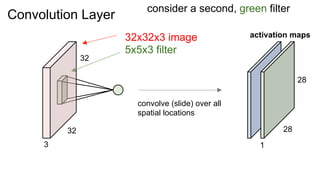
consider a second, green filter
32
32
3
Convolution Layer
activation maps
6
28
28
For example, if we had 6 5x5 filters, we’ll get 6 separate activation maps:
We stack these up to get a “new image” of size 28x28x6!
32
32
3
Convolution Layer
activation maps
6
28
28
For example, if we had 6 5x5 filters, we’ll get 6 separate activation maps:
We processed [32x32x3] volume into [28x28x6] volume.
Q: how many parameters would this be if we used a fully connected layer instead?
32
32
3
Convolution Layer
activation maps
6
28
28
For example, if we had 6 5x5 filters, we’ll get 6 separate activation maps:
We processed [32x32x3] volume into [28x28x6] volume.
Q: how many parameters would this be if we used a fully connected layer instead?
A: (32*32*3)*(28*28*6) = 14.5M parameters, ~14.5M multiplies
32
32
3
Convolution Layer
activation maps
6
28
28
For example, if we had 6 5x5 filters, we’ll get 6 separate activation maps:
We processed [32x32x3] volume into [28x28x6] volume.
Q: how many parameters are used instead?
32
32
3
Convolution Layer
activation maps
6
28
28
For example, if we had 6 5x5 filters, we’ll get 6 separate activation maps:
We processed [32x32x3] volume into [28x28x6] volume.
Q: how many parameters are used instead? --- And how many multiplies?
A: (5*5*3)*6 = 450 parameters
32
32
3
Convolution Layer
activation maps
6
28
28
For example, if we had 6 5x5 filters, we’ll get 6 separate activation maps:
We processed [32x32x3] volume into [28x28x6] volume.
Q: how many parameters are used instead?
A: (5*5*3)*6 = 450 parameters, (5*5*3)*(28*28*6) = ~350K multiplies
example 5x5 filters
(32 total)
We call the layer convolutional
because it is related to convolution
of two signals:
elementwise multiplication and sum of
a filter and the signal (image)
one filter =>
one activation map
Preview: ConvNet is a sequence of Convolution Layers, interspersed with
activation functions
32
32
3
28
28
6
CONV,
ReLU
e.g. 6
5x5x3
filters
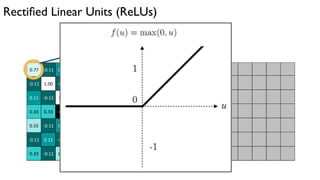
Rectified Linear Units (ReLUs)
0.77 -0.11 0.11 0.33 0.55 -0.11 0.33
-0.11 1.00 -0.11 0.33 -0.11 0.11 -0.11
0.11 -0.11 1.00 -0.33 0.11 -0.11 0.55
0.33 0.33 -0.33 0.55 -0.33 0.33 0.33
0.55 -0.11 0.11 -0.33 1.00 -0.11 0.11
-0.11 0.11 -0.11 0.33 -0.11 1.00 -0.11
0.33 -0.11 0.55 0.33 0.11 -0.11 0.77
0.77
0.77 0
Rectified Linear Units (ReLUs)
0.77 -0.11 0.11 0.33 0.55 -0.11 0.33
-0.11 1.00 -0.11 0.33 -0.11 0.11 -0.11
0.11 -0.11 1.00 -0.33 0.11 -0.11 0.55
0.33 0.33 -0.33 0.55 -0.33 0.33 0.33
0.55 -0.11 0.11 -0.33 1.00 -0.11 0.11
-0.11 0.11 -0.11 0.33 -0.11 1.00 -0.11
0.33 -0.11 0.55 0.33 0.11 -0.11 0.77
0.77 0 0.11 0.33 0.55 0 0.33
Rectified Linear Units (ReLUs)
0.77 -0.11 0.11 0.33 0.55 -0.11 0.33
-0.11 1.00 -0.11 0.33 -0.11 0.11 -0.11
0.11 -0.11 1.00 -0.33 0.11 -0.11 0.55
0.33 0.33 -0.33 0.55 -0.33 0.33 0.33
0.55 -0.11 0.11 -0.33 1.00 -0.11 0.11
-0.11 0.11 -0.11 0.33 -0.11 1.00 -0.11
0.33 -0.11 0.55 0.33 0.11 -0.11 0.77
0.77 0 0.11 0.33 0.55 0 0.33
0 1.00 0 0.33 0 0.11 0
0.11 0 1.00 0 0.11 0 0.55
0.33 0.33 0 0.55 0 0.33 0.33
0.55 0 0.11 0 1.00 0 0.11
0 0.11 0 0.33 0 1.00 0
0.33 0 0.55 0.33 0.11 0 0.77
Rectified Linear Units (ReLUs)
0.77 -0.11 0.11 0.33 0.55 -0.11 0.33
-0.11 1.00 -0.11 0.33 -0.11 0.11 -0.11
0.11 -0.11 1.00 -0.33 0.11 -0.11 0.55
0.33 0.33 -0.33 0.55 -0.33 0.33 0.33
0.55 -0.11 0.11 -0.33 1.00 -0.11 0.11
-0.11 0.11 -0.11 0.33 -0.11 1.00 -0.11
0.33 -0.11 0.55 0.33 0.11 -0.11 0.77
Preview: ConvNet is a sequence of Convolutional Layers, interspersed with
activation functions
32
32
3
CONV,
ReLU
e.g. 6
5x5x3
filters 28
28
6
CONV,
ReLU
e.g. 10
5x5x6
filters
CONV,
ReLU
….
10
24
24
two more layers to go: POOL/FC
Pooling layer
-  makes the representations smaller and more manageable
-  operates over each activation map independently:
1 1 2 4
5 6 7 8
3 2 1 0
1 2 3 4
Single depth slice
x
y
max pool with 2x2 filters
and stride 2 6 8
3 4
MAX POOLING
Fully Connected Layer (FC layer)
-  Contains neurons that connect to the entire input volume,
as in ordinary Neural Networks
Softmax
SCORES PROBABILITIES
http://cs.stanford.edu/people/karpathy/convnetjs/demo/cifar10.html
[ConvNetJS demo: training on CIFAR-10]
Case Study: AlexNet
[Krizhevsky et al. 2012]
Input: 227x227x3 images
First layer (CONV1): 96 11x11 filters applied at stride 4
=>
Q: what is the output volume size? Hint: (227-11)/4+1 = 55
Case Study: AlexNet
[Krizhevsky et al. 2012]
Input: 227x227x3 images
First layer (CONV1): 96 11x11 filters applied at stride 4
=>
Output volume [55x55x96]
Q: What is the total number of parameters in this layer?
Case Study: AlexNet
[Krizhevsky et al. 2012]
Input: 227x227x3 images
First layer (CONV1): 96 11x11 filters applied at stride 4
=>
Output volume [55x55x96]
Parameters: (11*11*3)*96 = 35K
Case Study: AlexNet
[Krizhevsky et al. 2012]
1st layer filters
Case Study: AlexNet
[Krizhevsky et al. 2012]
2nd layer filters
Face recognition
Case Study: AlexNet
[Krizhevsky et al. 2012]
Full (simplified) AlexNet architecture:
[227x227x3] INPUT
[55x55x96] CONV1: 96 11x11 filters at stride 4, pad 0
[27x27x96] MAX POOL1: 3x3 filters at stride 2
[27x27x96] NORM1: Normalization layer
[27x27x256] CONV2: 256 5x5 filters at stride 1, pad 2
[13x13x256] MAX POOL2: 3x3 filters at stride 2
[13x13x256] NORM2: Normalization layer
[13x13x384] CONV3: 384 3x3 filters at stride 1, pad 1
[13x13x384] CONV4: 384 3x3 filters at stride 1, pad 1
[13x13x256] CONV5: 256 3x3 filters at stride 1, pad 1
[6x6x256] MAX POOL3: 3x3 filters at stride 2
[4096] FC6: 4096 neurons
[4096] FC7: 4096 neurons
[1000] FC8: 1000 neurons (class scores)
Compared to LeCun 1998:
1 DATA:
- More data: 10^6 vs. 10^3
2 COMPUTE:
- GPU (~100x speedup)
3 ALGORITHM:
- Deeper: More layers (8 weight layers)
- Fancy regularization (dropout)
- Fancy non-linearity (ReLU)
Case Study: AlexNet
[Krizhevsky et al. 2012]
Full (simplified) AlexNet architecture:
[227x227x3] INPUT
[55x55x96] CONV1: 96 11x11 filters at stride 4, pad 0
[27x27x96] MAX POOL1: 3x3 filters at stride 2
[27x27x96] NORM1: Normalization layer
[27x27x256] CONV2: 256 5x5 filters at stride 1, pad 2
[13x13x256] MAX POOL2: 3x3 filters at stride 2
[13x13x256] NORM2: Normalization layer
[13x13x384] CONV3: 384 3x3 filters at stride 1, pad 1
[13x13x384] CONV4: 384 3x3 filters at stride 1, pad 1
[13x13x256] CONV5: 256 3x3 filters at stride 1, pad 1
[6x6x256] MAX POOL3: 3x3 filters at stride 2
[4096] FC6: 4096 neurons
[4096] FC7: 4096 neurons
[1000] FC8: 1000 neurons (class scores)
Details/Retrospectives:
- first use of ReLU
- used Norm layers (not common anymore)
- heavy data augmentation
- dropout 0.5
- batch size 128
- SGD Momentum 0.9
- Learning rate 1e-2, reduced by 10
manually when val accuracy plateaus
- L2 weight decay 5e-4
- 7 CNN ensemble: 18.2% -> 15.4%
Case Study: VGGNet
[Simonyan and Zisserman, 2014]
best model
Only 3x3 CONV stride 1, pad 1
and 2x2 MAX POOL stride 2
11.2% top 5 error in ILSVRC 2013
->
7.3% top 5 error
Case Study: GoogLeNet [Szegedy et al., 2014]
Inception module
ILSVRC 2014 winner (6.7% top 5 error)
Slide from Kaiming He’s recent presentation https://www.youtube.com/watch?v=1PGLj-uKT1w
Case Study: ResNet [He et al., 2015]
ILSVRC 2015 winner (3.6% top 5 error)
Case Study:
ResNet
[He et al., 2015]
224x224x3
spatial dimension
only 56x56!
VGG: ~2-3 weeks training with 4 GPUs
ResNet: ~2-3 weeks training with 4 GPUs
~$1K each
Addressing other tasks...
Transfer Learning
1. Train on
Imagenet
3. Medium dataset:
finetuning
more data = retrain more of
the network (or all of it)
2. Small dataset:
feature extractor
Freeze these
Train this
Freeze these
Train this
Transfer Learning
CNN Features off-the-shelf: an Astounding Baseline for Recognition [Razavian et al, 2014]
Addressing other tasks...
image CNN features
224x224x3
A block of compute with a few
million parameters.
7x7x512
Addressing other tasks...
image CNN features
224x224x3
A block of compute with a few
million parameters.
7x7x512
predicted thing
desired thing
Addressing other tasks...
image CNN features
224x224x3
A block of compute with a few
million parameters.
7x7x512
predicted thing
desired thing
this part changes
from task to task
Image Classification
thing = a vector of probabilities for different classes
image CNN features
224x224x3
7x7x512
e.g. vector of 1000 numbers giving
probabilities for different classes.
fully connected layer
Image Captioning
image CNN features
224x224x3
7x7x512
A sequence of 10,000-dimensional
vectors giving probabilities of
different words in the caption.
RNN
Localization
image CNN features
224x224x3
7x7x512
fully connected layer
Class
probabilities
(as before)
4 numbers:
-  X coord
-  Y coord
-  Width
-  Height
Reinforcement Learning
image CNN features
160x210x3
fully connected
e.g. vector of 8 numbers giving
probability of wanting to take any
of the 8 possible ATARI actions.
Mnih et al. 2015
ConvNets are everywhere…
e.g. Google Photos search
Face Verification, Taigman et al. 2014 (FAIR)
Self-driving cars[Goodfellow et al. 2014]
Ciresan et al. 2013
Turaga et al 2010
ConvNets are everywhere…
Whale recognition, Kaggle Challenge Satellite image analysis
Mnih and Hinton, 2010
Galaxy Challenge Dielman et al. 2015
WaveNet, van den Oord et al. 2016 Image captioning, Vinyals et al. 2015
ConvNets are everywhere…
AlphaGo, Silver et al 2016
VizDoom
StarCraft
ConvNets are everywhere…
DeepDream reddit.com/r/deepdream
NeuralStyle, Gatys et al. 2015
deepart.io, Prisma, etc.
Practical considerations
when applying ConvNets
What hardware do I use?
Buy your own machine:
-  NVIDIA DIGITS DevBox (TITAN X GPUs)
-  NVIDIA DGX-1 (P100 GPUs)
Build your own machine:
https://graphific.github.io/posts/building-a-deep-learning-dream-machine/
GPUs in the cloud:
-  Amazon AWS (GRID K520 :( )
-  Microsoft Azure (soon); 4x K80 GPUs
-  Cirrascale (“rent-a-box”)
What framework do I use?
Caffe
Torch
Theano
LasagneKeras
TensorFlow
Mxnet
chainer
Nervana’s Neon
Microsoft’s CNTK
Deeplearning4j
...
e.g. with keras.ioThe power is easily accessible.
Q: How do I know what architecture/hyperparameters
to use?
A: don’t be a hero.
1.  Take whatever works best on ILSVRC (latest ResNet)
2.  Download a pretrained model
3.  Potentially add/delete some parts of it
4.  Finetune it on your application.
5.  Play with the regularization strength (dropout rates)
MOOCS
Machine Learning
Coursera.org, Andrew Ng
Neural Networks for Machine Learning
Coursera.org, Geoffrey Hinton
Computational Neuroscience
Coursera.org, Rajesh P.N. Rao
Deep Learning
Udacity.org, Vincent Vanhoucke
Convolutional Neural Networks
Stanford.edu, Andrej Karapthy
(in Skopje) Convolutional Neural Networks & DL for NLP @ edu.time.mk
Thank you!
admin@time.mk
twitter.com/mkrobot
facebook.com/mkrobot

Deep Learning - STM 6

  • 1.
    Deep Learning forComputer Vision Igor Trajkovski admin@time.mk twitter.com/mkrobot facebook.com/mkrobot SkopjeTechMeetup 29.9.2016 Slides from Andrej Karpathy, Yann LeCun & Geoffrey Hinton
  • 2.
  • 3.
    Artificial Neural Network Veryfew assumptions made about the input vector.
  • 4.
    In many real-worldapplications input vectors have structure. Spectrograms ImagesText
  • 5.
  • 6.
    Hubel & Wiesel, 1959 RECEPTIVEFIELDS OF SINGLE NEURONES IN THE CAT'S STRIATE CORTEX 1962 RECEPTIVE FIELDS, BINOCULAR INTERACTION AND FUNCTIONAL ARCHITECTURE IN THE CAT'S VISUAL CORTEX https://www.youtube.com/watch?v=8VdFf3egwfg
  • 7.
    A bit ofhistory: Neurocognitron [Fukushima 1980] “sandwich” architecture (SCSCSC…) simple cells: modifiable parameters complex cells: perform pooling
  • 8.
    Gradient-based learning appliedto document recognition [LeCun, Bottou, Bengio, Haffner 1998] LeNet-5 https://www.youtube.com/watch?v=FwFduRA_L6Q
  • 9.
  • 10.
  • 11.
    ImageNet Classification withDeep Convolutional Neural Networks [Krizhevsky, Sutskever, Hinton, 2012] “AlexNet” Deng et al. Russakovsky et al. NVIDIA et al.
  • 12.
    “What I learnedfrom competing against a ConvNet on ImageNet” (karpathy.github.io)
  • 13.
    “What I learnedfrom competing against a ConvNet on ImageNet” (karpathy.github.io) TLDR: Human accuracy is somewhere 2-5%. (depending on how much training or how little life you have)
  • 14.
    (slide from KaimingHe’s recent presentation)
  • 15.
    [224x224x3] f 1000 numbers, indicatingclass scores Feature Extraction vector describing various image statistics [224x224x3] f 1000 numbers, indicating class scores training training
  • 16.
    “Run the imagethrough 20 layers of 3x3 convolutions and train the filters with SGD.”
  • 17.
  • 18.
    [224x224x3] f 1000 numbers, indicatingclass scores training Only two basic operations are involved throughout: 1.  Dot products w.x 2.  Max operations parameters (~10M of them)
  • 19.
  • 20.
  • 21.
    1 -1 -1 -11 -1 -1 -1 1 -1 -1 -1 -1 -1 -1 -1 -1 -1 -1 1 -1 -1 -1 -1 -1 1 -1 -1 -1 1 -1 -1 -1 1 -1 -1 -1 -1 -1 1 -1 1 -1 -1 -1 -1 -1 -1 -1 1 -1 -1 -1 -1 -1 -1 -1 1 -1 1 -1 -1 -1 -1 -1 1 -1 -1 -1 1 -1 -1 -1 1 -1 -1 -1 -1 -1 1 -1 -1 -1 -1 -1 -1 -1 -1 -1 -1 Convolution 2-D
  • 22.
    1 1 -1 -1 -11 -1 -1 -1 1 -1 -1 -1 -1 -1 -1 -1 -1 -1 -1 1 -1 -1 -1 -1 -1 1 -1 -1 -1 1 -1 -1 -1 1 -1 -1 -1 -1 -1 1 -1 1 -1 -1 -1 -1 -1 -1 -1 1 -1 -1 -1 -1 -1 -1 -1 1 -1 1 -1 -1 -1 -1 -1 1 -1 -1 -1 1 -1 -1 -1 1 -1 -1 -1 -1 -1 1 -1 -1 -1 -1 -1 -1 -1 -1 -1 -1 Convolution 2-D
  • 23.
    1 1 1 -1-1 -1 1 -1 -1 -1 1 -1 -1 -1 -1 -1 -1 -1 -1 -1 -1 1 -1 -1 -1 -1 -1 1 -1 -1 -1 1 -1 -1 -1 1 -1 -1 -1 -1 -1 1 -1 1 -1 -1 -1 -1 -1 -1 -1 1 -1 -1 -1 -1 -1 -1 -1 1 -1 1 -1 -1 -1 -1 -1 1 -1 -1 -1 1 -1 -1 -1 1 -1 -1 -1 -1 -1 1 -1 -1 -1 -1 -1 -1 -1 -1 -1 -1 Convolution 2-D
  • 24.
    1 1 1 1-1 -1 -1 1 -1 -1 -1 1 -1 -1 -1 -1 -1 -1 -1 -1 -1 -1 1 -1 -1 -1 -1 -1 1 -1 -1 -1 1 -1 -1 -1 1 -1 -1 -1 -1 -1 1 -1 1 -1 -1 -1 -1 -1 -1 -1 1 -1 -1 -1 -1 -1 -1 -1 1 -1 1 -1 -1 -1 -1 -1 1 -1 -1 -1 1 -1 -1 -1 1 -1 -1 -1 -1 -1 1 -1 -1 -1 -1 -1 -1 -1 -1 -1 -1 Convolution 2-D
  • 25.
    1 1 1 1 1-1 -1 -1 1 -1 -1 -1 1 -1 -1 -1 -1 -1 -1 -1 -1 -1 -1 1 -1 -1 -1 -1 -1 1 -1 -1 -1 1 -1 -1 -1 1 -1 -1 -1 -1 -1 1 -1 1 -1 -1 -1 -1 -1 -1 -1 1 -1 -1 -1 -1 -1 -1 -1 1 -1 1 -1 -1 -1 -1 -1 1 -1 -1 -1 1 -1 -1 -1 1 -1 -1 -1 -1 -1 1 -1 -1 -1 -1 -1 -1 -1 -1 -1 -1 Convolution 2-D
  • 26.
    1 1 1 11 1 -1 -1 -1 1 -1 -1 -1 1 -1 -1 -1 -1 -1 -1 -1 -1 -1 -1 1 -1 -1 -1 -1 -1 1 -1 -1 -1 1 -1 -1 -1 1 -1 -1 -1 -1 -1 1 -1 1 -1 -1 -1 -1 -1 -1 -1 1 -1 -1 -1 -1 -1 -1 -1 1 -1 1 -1 -1 -1 -1 -1 1 -1 -1 -1 1 -1 -1 -1 1 -1 -1 -1 -1 -1 1 -1 -1 -1 -1 -1 -1 -1 -1 -1 -1 Convolution 2-D
  • 27.
    1 1 1 11 1 1 -1 -1 -1 1 -1 -1 -1 1 -1 -1 -1 -1 -1 -1 -1 -1 -1 -1 1 -1 -1 -1 -1 -1 1 -1 -1 -1 1 -1 -1 -1 1 -1 -1 -1 -1 -1 1 -1 1 -1 -1 -1 -1 -1 -1 -1 1 -1 -1 -1 -1 -1 -1 -1 1 -1 1 -1 -1 -1 -1 -1 1 -1 -1 -1 1 -1 -1 -1 1 -1 -1 -1 -1 -1 1 -1 -1 -1 -1 -1 -1 -1 -1 -1 -1 Convolution 2-D
  • 28.
    1 1 1 11 1 1 1 -1 -1 -1 1 -1 -1 -1 1 -1 -1 -1 -1 -1 -1 -1 -1 -1 -1 1 -1 -1 -1 -1 -1 1 -1 -1 -1 1 -1 -1 -1 1 -1 -1 -1 -1 -1 1 -1 1 -1 -1 -1 -1 -1 -1 -1 1 -1 -1 -1 -1 -1 -1 -1 1 -1 1 -1 -1 -1 -1 -1 1 -1 -1 -1 1 -1 -1 -1 1 -1 -1 -1 -1 -1 1 -1 -1 -1 -1 -1 -1 -1 -1 -1 -1 Convolution 2-D
  • 29.
    1 1 1 11 1 1 1 1 -1 -1 -1 1 -1 -1 -1 1 -1 -1 -1 -1 -1 -1 -1 -1 -1 -1 1 -1 -1 -1 -1 -1 1 -1 -1 -1 1 -1 -1 -1 1 -1 -1 -1 -1 -1 1 -1 1 -1 -1 -1 -1 -1 -1 -1 1 -1 -1 -1 -1 -1 -1 -1 1 -1 1 -1 -1 -1 -1 -1 1 -1 -1 -1 1 -1 -1 -1 1 -1 -1 -1 -1 -1 1 -1 -1 -1 -1 -1 -1 -1 -1 -1 -1 Convolution 2-D
  • 30.
    1 1 1 11 1 1 1 1 1 -1 -1 -1 1 -1 -1 -1 1 -1 -1 -1 -1 -1 -1 -1 -1 -1 -1 1 -1 -1 -1 -1 -1 1 -1 -1 -1 1 -1 -1 -1 1 -1 -1 -1 -1 -1 1 -1 1 -1 -1 -1 -1 -1 -1 -1 1 -1 -1 -1 -1 -1 -1 -1 1 -1 1 -1 -1 -1 -1 -1 1 -1 -1 -1 1 -1 -1 -1 1 -1 -1 -1 -1 -1 1 -1 -1 -1 -1 -1 -1 -1 -1 -1 -1 Convolution 2-D
  • 31.
    1 1 1 1 11 1 1 1 1 1 -1 -1 -1 1 -1 -1 -1 1 -1 -1 -1 -1 -1 -1 -1 -1 -1 -1 1 -1 -1 -1 -1 -1 1 -1 -1 -1 1 -1 -1 -1 1 -1 -1 -1 -1 -1 1 -1 1 -1 -1 -1 -1 -1 -1 -1 1 -1 -1 -1 -1 -1 -1 -1 1 -1 1 -1 -1 -1 -1 -1 1 -1 -1 -1 1 -1 -1 -1 1 -1 -1 -1 -1 -1 1 -1 -1 -1 -1 -1 -1 -1 -1 -1 -1 Convolution 2-D
  • 32.
    1 1 -1 -1 -11 -1 -1 -1 1 -1 -1 -1 -1 -1 -1 -1 -1 -1 -1 1 -1 -1 -1 -1 -1 1 -1 -1 -1 1 -1 -1 -1 1 -1 -1 -1 -1 -1 1 -1 1 -1 -1 -1 -1 -1 -1 -1 1 -1 -1 -1 -1 -1 -1 -1 1 -1 1 -1 -1 -1 -1 -1 1 -1 -1 -1 1 -1 -1 -1 1 -1 -1 -1 -1 -1 1 -1 -1 -1 -1 -1 -1 -1 -1 -1 -1 Convolution 2-D
  • 33.
    1 1 -1 1-1 -1 -1 1 -1 -1 -1 1 -1 -1 -1 -1 -1 -1 -1 -1 -1 -1 1 -1 -1 -1 -1 -1 1 -1 -1 -1 1 -1 -1 -1 1 -1 -1 -1 -1 -1 1 -1 1 -1 -1 -1 -1 -1 -1 -1 1 -1 -1 -1 -1 -1 -1 -1 1 -1 1 -1 -1 -1 -1 -1 1 -1 -1 -1 1 -1 -1 -1 1 -1 -1 -1 -1 -1 1 -1 -1 -1 -1 -1 -1 -1 -1 -1 -1 Convolution 2-D
  • 34.
    1 1 -1 11 1 -1 1 1 1 -1 -1 -1 1 -1 -1 -1 1 -1 -1 -1 -1 -1 -1 -1 -1 -1 -1 1 -1 -1 -1 -1 -1 1 -1 -1 -1 1 -1 -1 -1 1 -1 -1 -1 -1 -1 1 -1 1 -1 -1 -1 -1 -1 -1 -1 1 -1 -1 -1 -1 -1 -1 -1 1 -1 1 -1 -1 -1 -1 -1 1 -1 -1 -1 1 -1 -1 -1 1 -1 -1 -1 -1 -1 1 -1 -1 -1 -1 -1 -1 -1 -1 -1 -1 Convolution 2-D
  • 35.
    1 1 -1 -1 -11 -1 -1 -1 1 -1 -1 -1 -1 -1 -1 -1 -1 -1 -1 1 -1 -1 -1 -1 -1 1 -1 -1 -1 1 -1 -1 -1 1 -1 -1 -1 -1 -1 1 -1 1 -1 -1 -1 -1 -1 -1 -1 1 -1 -1 -1 -1 -1 -1 -1 1 -1 1 -1 -1 -1 -1 -1 1 -1 -1 -1 1 -1 -1 -1 1 -1 -1 -1 -1 -1 1 -1 -1 -1 -1 -1 -1 -1 -1 -1 -1 1 1 -1 1 1 1 -1 1 1 55 1 1 -1 1 1 1 -1 1 1 Convolution 2-D
  • 36.
    1 -1 -1 -11 -1 -1 -1 1 -1 -1 -1 -1 -1 -1 -1 -1 -1 -1 1 -1 -1 -1 -1 -1 1 -1 -1 -1 1 -1 -1 -1 1 -1 -1 -1 -1 -1 1 -1 1 -1 -1 -1 -1 -1 -1 -1 1 -1 -1 -1 -1 -1 -1 -1 1 -1 1 -1 -1 -1 -1 -1 1 -1 -1 -1 1 -1 -1 -1 1 -1 -1 -1 -1 -1 1 -1 -1 -1 -1 -1 -1 -1 -1 -1 -1 = 0.77 -0.11 0.11 0.33 0.55 -0.11 0.33 -0.11 1.00 -0.11 0.33 -0.11 0.11 -0.11 0.11 -0.11 1.00 -0.33 0.11 -0.11 0.55 0.33 0.33 -0.33 0.55 -0.33 0.33 0.33 0.55 -0.11 0.11 -0.33 1.00 -0.11 0.11 -0.11 0.11 -0.11 0.33 -0.11 1.00 -0.11 0.33 -0.11 0.55 0.33 0.11 -0.11 0.77 Convolution 2-D
  • 37.
  • 38.
    32 32 3 Convolution Layer 5x5x3 filter 32x32x3image Convolve the filter with the image i.e. “slide over the image spatially, computing dot products”
  • 39.
    32 32 3 Convolution Layer 5x5x3 filter 32x32x3image Convolve the filter with the image i.e. “slide over the image spatially, computing dot products” Filters always extend the full depth of the input volume
  • 40.
    32 32 3 Convolution Layer 32x32x3 image 5x5x3filter 1 number: the result of taking a dot product between the filter and a small 5x5x3 chunk of the image (i.e. 5*5*3 = 75-dimensional dot product + bias)
  • 41.
    32 32 3 Convolution Layer 32x32x3 image 5x5x3filter convolve (slide) over all spatial locations activation map 1 28 28
  • 42.
    32 32 3 Convolution Layer 32x32x3 image 5x5x3filter convolve (slide) over all spatial locations activation maps 1 28 28 consider a second, green filter
  • 43.
    32 32 3 Convolution Layer activation maps 6 28 28 Forexample, if we had 6 5x5 filters, we’ll get 6 separate activation maps: We stack these up to get a “new image” of size 28x28x6!
  • 44.
    32 32 3 Convolution Layer activation maps 6 28 28 Forexample, if we had 6 5x5 filters, we’ll get 6 separate activation maps: We processed [32x32x3] volume into [28x28x6] volume. Q: how many parameters would this be if we used a fully connected layer instead?
  • 45.
    32 32 3 Convolution Layer activation maps 6 28 28 Forexample, if we had 6 5x5 filters, we’ll get 6 separate activation maps: We processed [32x32x3] volume into [28x28x6] volume. Q: how many parameters would this be if we used a fully connected layer instead? A: (32*32*3)*(28*28*6) = 14.5M parameters, ~14.5M multiplies
  • 46.
    32 32 3 Convolution Layer activation maps 6 28 28 Forexample, if we had 6 5x5 filters, we’ll get 6 separate activation maps: We processed [32x32x3] volume into [28x28x6] volume. Q: how many parameters are used instead?
  • 47.
    32 32 3 Convolution Layer activation maps 6 28 28 Forexample, if we had 6 5x5 filters, we’ll get 6 separate activation maps: We processed [32x32x3] volume into [28x28x6] volume. Q: how many parameters are used instead? --- And how many multiplies? A: (5*5*3)*6 = 450 parameters
  • 48.
    32 32 3 Convolution Layer activation maps 6 28 28 Forexample, if we had 6 5x5 filters, we’ll get 6 separate activation maps: We processed [32x32x3] volume into [28x28x6] volume. Q: how many parameters are used instead? A: (5*5*3)*6 = 450 parameters, (5*5*3)*(28*28*6) = ~350K multiplies
  • 49.
    example 5x5 filters (32total) We call the layer convolutional because it is related to convolution of two signals: elementwise multiplication and sum of a filter and the signal (image) one filter => one activation map
  • 50.
    Preview: ConvNet isa sequence of Convolution Layers, interspersed with activation functions 32 32 3 28 28 6 CONV, ReLU e.g. 6 5x5x3 filters
  • 51.
    Rectified Linear Units(ReLUs) 0.77 -0.11 0.11 0.33 0.55 -0.11 0.33 -0.11 1.00 -0.11 0.33 -0.11 0.11 -0.11 0.11 -0.11 1.00 -0.33 0.11 -0.11 0.55 0.33 0.33 -0.33 0.55 -0.33 0.33 0.33 0.55 -0.11 0.11 -0.33 1.00 -0.11 0.11 -0.11 0.11 -0.11 0.33 -0.11 1.00 -0.11 0.33 -0.11 0.55 0.33 0.11 -0.11 0.77 0.77
  • 52.
    0.77 0 Rectified LinearUnits (ReLUs) 0.77 -0.11 0.11 0.33 0.55 -0.11 0.33 -0.11 1.00 -0.11 0.33 -0.11 0.11 -0.11 0.11 -0.11 1.00 -0.33 0.11 -0.11 0.55 0.33 0.33 -0.33 0.55 -0.33 0.33 0.33 0.55 -0.11 0.11 -0.33 1.00 -0.11 0.11 -0.11 0.11 -0.11 0.33 -0.11 1.00 -0.11 0.33 -0.11 0.55 0.33 0.11 -0.11 0.77
  • 53.
    0.77 0 0.110.33 0.55 0 0.33 Rectified Linear Units (ReLUs) 0.77 -0.11 0.11 0.33 0.55 -0.11 0.33 -0.11 1.00 -0.11 0.33 -0.11 0.11 -0.11 0.11 -0.11 1.00 -0.33 0.11 -0.11 0.55 0.33 0.33 -0.33 0.55 -0.33 0.33 0.33 0.55 -0.11 0.11 -0.33 1.00 -0.11 0.11 -0.11 0.11 -0.11 0.33 -0.11 1.00 -0.11 0.33 -0.11 0.55 0.33 0.11 -0.11 0.77
  • 54.
    0.77 0 0.110.33 0.55 0 0.33 0 1.00 0 0.33 0 0.11 0 0.11 0 1.00 0 0.11 0 0.55 0.33 0.33 0 0.55 0 0.33 0.33 0.55 0 0.11 0 1.00 0 0.11 0 0.11 0 0.33 0 1.00 0 0.33 0 0.55 0.33 0.11 0 0.77 Rectified Linear Units (ReLUs) 0.77 -0.11 0.11 0.33 0.55 -0.11 0.33 -0.11 1.00 -0.11 0.33 -0.11 0.11 -0.11 0.11 -0.11 1.00 -0.33 0.11 -0.11 0.55 0.33 0.33 -0.33 0.55 -0.33 0.33 0.33 0.55 -0.11 0.11 -0.33 1.00 -0.11 0.11 -0.11 0.11 -0.11 0.33 -0.11 1.00 -0.11 0.33 -0.11 0.55 0.33 0.11 -0.11 0.77
  • 55.
    Preview: ConvNet isa sequence of Convolutional Layers, interspersed with activation functions 32 32 3 CONV, ReLU e.g. 6 5x5x3 filters 28 28 6 CONV, ReLU e.g. 10 5x5x6 filters CONV, ReLU …. 10 24 24
  • 56.
    two more layersto go: POOL/FC
  • 57.
    Pooling layer -  makesthe representations smaller and more manageable -  operates over each activation map independently:
  • 58.
    1 1 24 5 6 7 8 3 2 1 0 1 2 3 4 Single depth slice x y max pool with 2x2 filters and stride 2 6 8 3 4 MAX POOLING
  • 59.
    Fully Connected Layer(FC layer) -  Contains neurons that connect to the entire input volume, as in ordinary Neural Networks
  • 60.
  • 61.
  • 62.
    Case Study: AlexNet [Krizhevskyet al. 2012] Input: 227x227x3 images First layer (CONV1): 96 11x11 filters applied at stride 4 => Q: what is the output volume size? Hint: (227-11)/4+1 = 55
  • 63.
    Case Study: AlexNet [Krizhevskyet al. 2012] Input: 227x227x3 images First layer (CONV1): 96 11x11 filters applied at stride 4 => Output volume [55x55x96] Q: What is the total number of parameters in this layer?
  • 64.
    Case Study: AlexNet [Krizhevskyet al. 2012] Input: 227x227x3 images First layer (CONV1): 96 11x11 filters applied at stride 4 => Output volume [55x55x96] Parameters: (11*11*3)*96 = 35K
  • 65.
    Case Study: AlexNet [Krizhevskyet al. 2012] 1st layer filters
  • 66.
    Case Study: AlexNet [Krizhevskyet al. 2012] 2nd layer filters
  • 67.
  • 68.
    Case Study: AlexNet [Krizhevskyet al. 2012] Full (simplified) AlexNet architecture: [227x227x3] INPUT [55x55x96] CONV1: 96 11x11 filters at stride 4, pad 0 [27x27x96] MAX POOL1: 3x3 filters at stride 2 [27x27x96] NORM1: Normalization layer [27x27x256] CONV2: 256 5x5 filters at stride 1, pad 2 [13x13x256] MAX POOL2: 3x3 filters at stride 2 [13x13x256] NORM2: Normalization layer [13x13x384] CONV3: 384 3x3 filters at stride 1, pad 1 [13x13x384] CONV4: 384 3x3 filters at stride 1, pad 1 [13x13x256] CONV5: 256 3x3 filters at stride 1, pad 1 [6x6x256] MAX POOL3: 3x3 filters at stride 2 [4096] FC6: 4096 neurons [4096] FC7: 4096 neurons [1000] FC8: 1000 neurons (class scores) Compared to LeCun 1998: 1 DATA: - More data: 10^6 vs. 10^3 2 COMPUTE: - GPU (~100x speedup) 3 ALGORITHM: - Deeper: More layers (8 weight layers) - Fancy regularization (dropout) - Fancy non-linearity (ReLU)
  • 69.
    Case Study: AlexNet [Krizhevskyet al. 2012] Full (simplified) AlexNet architecture: [227x227x3] INPUT [55x55x96] CONV1: 96 11x11 filters at stride 4, pad 0 [27x27x96] MAX POOL1: 3x3 filters at stride 2 [27x27x96] NORM1: Normalization layer [27x27x256] CONV2: 256 5x5 filters at stride 1, pad 2 [13x13x256] MAX POOL2: 3x3 filters at stride 2 [13x13x256] NORM2: Normalization layer [13x13x384] CONV3: 384 3x3 filters at stride 1, pad 1 [13x13x384] CONV4: 384 3x3 filters at stride 1, pad 1 [13x13x256] CONV5: 256 3x3 filters at stride 1, pad 1 [6x6x256] MAX POOL3: 3x3 filters at stride 2 [4096] FC6: 4096 neurons [4096] FC7: 4096 neurons [1000] FC8: 1000 neurons (class scores) Details/Retrospectives: - first use of ReLU - used Norm layers (not common anymore) - heavy data augmentation - dropout 0.5 - batch size 128 - SGD Momentum 0.9 - Learning rate 1e-2, reduced by 10 manually when val accuracy plateaus - L2 weight decay 5e-4 - 7 CNN ensemble: 18.2% -> 15.4%
  • 70.
    Case Study: VGGNet [Simonyanand Zisserman, 2014] best model Only 3x3 CONV stride 1, pad 1 and 2x2 MAX POOL stride 2 11.2% top 5 error in ILSVRC 2013 -> 7.3% top 5 error
  • 71.
    Case Study: GoogLeNet[Szegedy et al., 2014] Inception module ILSVRC 2014 winner (6.7% top 5 error)
  • 72.
    Slide from KaimingHe’s recent presentation https://www.youtube.com/watch?v=1PGLj-uKT1w Case Study: ResNet [He et al., 2015] ILSVRC 2015 winner (3.6% top 5 error)
  • 73.
    Case Study: ResNet [He etal., 2015] 224x224x3 spatial dimension only 56x56!
  • 74.
    VGG: ~2-3 weekstraining with 4 GPUs ResNet: ~2-3 weeks training with 4 GPUs ~$1K each
  • 75.
  • 76.
    Transfer Learning 1. Trainon Imagenet 3. Medium dataset: finetuning more data = retrain more of the network (or all of it) 2. Small dataset: feature extractor Freeze these Train this Freeze these Train this
  • 77.
    Transfer Learning CNN Featuresoff-the-shelf: an Astounding Baseline for Recognition [Razavian et al, 2014]
  • 78.
    Addressing other tasks... imageCNN features 224x224x3 A block of compute with a few million parameters. 7x7x512
  • 79.
    Addressing other tasks... imageCNN features 224x224x3 A block of compute with a few million parameters. 7x7x512 predicted thing desired thing
  • 80.
    Addressing other tasks... imageCNN features 224x224x3 A block of compute with a few million parameters. 7x7x512 predicted thing desired thing this part changes from task to task
  • 81.
    Image Classification thing =a vector of probabilities for different classes image CNN features 224x224x3 7x7x512 e.g. vector of 1000 numbers giving probabilities for different classes. fully connected layer
  • 82.
    Image Captioning image CNNfeatures 224x224x3 7x7x512 A sequence of 10,000-dimensional vectors giving probabilities of different words in the caption. RNN
  • 83.
    Localization image CNN features 224x224x3 7x7x512 fullyconnected layer Class probabilities (as before) 4 numbers: -  X coord -  Y coord -  Width -  Height
  • 84.
    Reinforcement Learning image CNNfeatures 160x210x3 fully connected e.g. vector of 8 numbers giving probability of wanting to take any of the 8 possible ATARI actions. Mnih et al. 2015
  • 85.
    ConvNets are everywhere… e.g.Google Photos search Face Verification, Taigman et al. 2014 (FAIR) Self-driving cars[Goodfellow et al. 2014] Ciresan et al. 2013 Turaga et al 2010
  • 86.
    ConvNets are everywhere… Whalerecognition, Kaggle Challenge Satellite image analysis Mnih and Hinton, 2010 Galaxy Challenge Dielman et al. 2015 WaveNet, van den Oord et al. 2016 Image captioning, Vinyals et al. 2015
  • 87.
    ConvNets are everywhere… AlphaGo,Silver et al 2016 VizDoom StarCraft
  • 88.
    ConvNets are everywhere… DeepDreamreddit.com/r/deepdream NeuralStyle, Gatys et al. 2015 deepart.io, Prisma, etc.
  • 89.
  • 90.
    What hardware doI use? Buy your own machine: -  NVIDIA DIGITS DevBox (TITAN X GPUs) -  NVIDIA DGX-1 (P100 GPUs) Build your own machine: https://graphific.github.io/posts/building-a-deep-learning-dream-machine/ GPUs in the cloud: -  Amazon AWS (GRID K520 :( ) -  Microsoft Azure (soon); 4x K80 GPUs -  Cirrascale (“rent-a-box”)
  • 91.
    What framework doI use? Caffe Torch Theano LasagneKeras TensorFlow Mxnet chainer Nervana’s Neon Microsoft’s CNTK Deeplearning4j ...
  • 92.
    e.g. with keras.ioThepower is easily accessible.
  • 93.
    Q: How doI know what architecture/hyperparameters to use? A: don’t be a hero. 1.  Take whatever works best on ILSVRC (latest ResNet) 2.  Download a pretrained model 3.  Potentially add/delete some parts of it 4.  Finetune it on your application. 5.  Play with the regularization strength (dropout rates)
  • 94.
    MOOCS Machine Learning Coursera.org, AndrewNg Neural Networks for Machine Learning Coursera.org, Geoffrey Hinton Computational Neuroscience Coursera.org, Rajesh P.N. Rao Deep Learning Udacity.org, Vincent Vanhoucke Convolutional Neural Networks Stanford.edu, Andrej Karapthy (in Skopje) Convolutional Neural Networks & DL for NLP @ edu.time.mk
  • 95.