An introduction to
Deep Learning
Julien Simon, AI Evangelist, EMEA
@julsimon
What to expect
• Artificial Intelligence, Machine Learning, Deep Learning
• The 5 myths of AI
• Deep Learning in action
• Basics of Deep Learning
• NVIDIA Volta V100 and AWS P3
• Q&A
• Artificial	Intelligence:	design	software	applications	which	exhibit	
human-like	behavior,	e.g.	speech,	natural	language	processing,	
reasoning	or	intuition
• Machine	Learning:	teach	machines	to	learn	without	being	
explicitly	programmed
• Deep	Learning:	using	neural	networks,	teach	machines	to	learn	
from	data	where	features	cannot	be	explicitly	expressed
The 5 Myths of AI
Myth #1 - AI is the flavour of the month
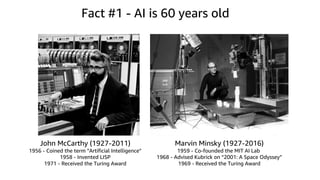
John McCarthy (1927-2011)
1956 - Coined the term “Artificial Intelligence”
1958 - Invented LISP
1971 - Received the Turing Award
Fact #1 - AI is 60 years old
Marvin Minsky (1927-2016)
1959 - Co-founded the MIT AI Lab
1968 - Advised Kubrick on “2001: A Space Odyssey”
1969 - Received the Turing Award
Myth #2 - AI is dark magic
aka « You’re not smart enough »
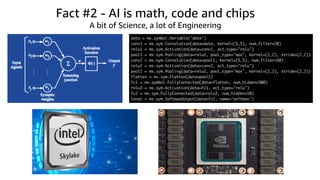
Fact #2 - AI is math, code and chips
A bit of Science, a lot of Engineering
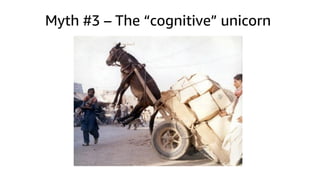
Myth #3 – The “cognitive” unicorn
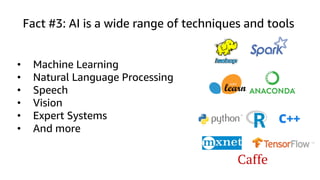
Fact #3: AI is a wide range of techniques and tools
• Machine Learning
• Natural Language Processing
• Speech
• Vision
• Expert Systems
• And more
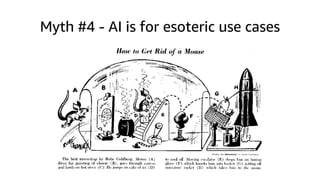
Myth #4 - AI is for esoteric use cases
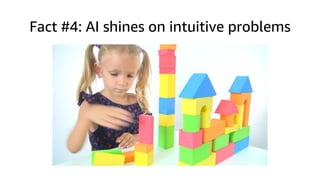
Fact #4: AI shines on intuitive problems
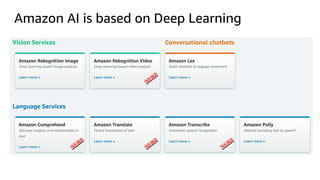
Amazon AI is based on Deep Learning
Myth #5 - AI is not production-ready
Fact #5: AI means business
Deep Learning in action
Selected customers running AI on AWS
Basics of Deep Learning
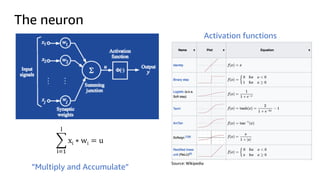
Activation functions
The neuron
! xi ∗ wi
&
'()
= u
”Multiply and Accumulate”
Source: Wikipedia
© 2017, Amazon Web Services, Inc. or its Affiliates. All rights reserved.
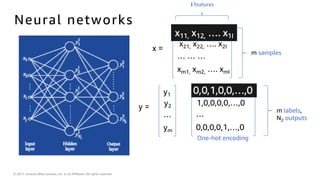
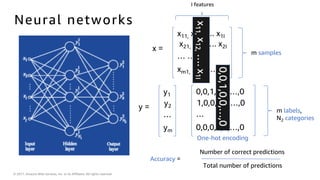
x =
x11, x12, …. x1I
x21, x22, …. x2I
… … …
xm1, xm2, …. xmI
I features
m samples
y =
y1
y2
…
ym
m labels,
N2 outputs
0,0,1,0,0,…,0
1,0,0,0,0,…,0
…
0,0,0,0,1,…,0
One-hot encoding
Neural networks
© 2017, Amazon Web Services, Inc. or its Affiliates. All rights reserved.
x =
x11, x12, …. x1I
x21, x22, …. x2I
… … …
xm1, xm2, …. xmI
I features
m samples
y =
y1
y2
…
ym
m labels,
N2 categories
Total number of predictions
Accuracy =
Number of correct predictions
0,0,1,0,0,…,0
1,0,0,0,0,…,0
…
0,0,0,0,1,…,0
One-hot encoding
Neural networks
© 2017, Amazon Web Services, Inc. or its Affiliates. All rights reserved.
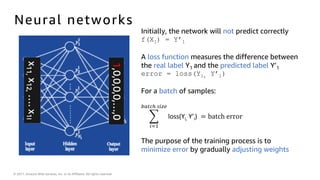
Neural networks
Initially, the network will not predict correctly
f(X1) = Y’1
A loss function measures the difference between
the real label Y1 and the predicted label Y’1
error = loss(Y1, Y’1)
For a batch of samples:
! loss(Yi,	Y’i)	
,-./0	2345
3()
= batch	error
The purpose of the training process is to
minimize error by gradually adjusting weights
© 2017, Amazon Web Services, Inc. or its Affiliates. All rights reserved.
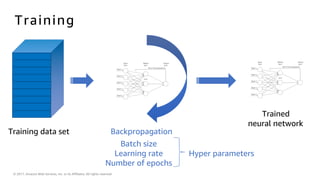
Training
Training data set Training
Trained
neural network
Batch size
Learning rate
Number of epochs
Hyper parameters
Backpropagation
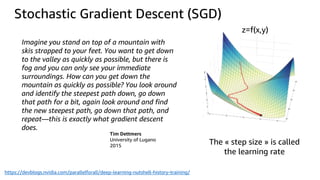
Stochastic Gradient Descent (SGD)
Imagine you stand on top of a mountain with
skis strapped to your feet. You want to get down
to the valley as quickly as possible, but there is
fog and you can only see your immediate
surroundings. How can you get down the
mountain as quickly as possible? You look around
and identify the steepest path down, go down
that path for a bit, again look around and find
the new steepest path, go down that path, and
repeat—this is exactly what gradient descent
does.
Tim Dettmers
University of Lugano
2015
https://devblogs.nvidia.com/parallelforall/deep-learning-nutshell-history-training/
The « step size » is called
the learning rate
z=f(x,y)
© 2017, Amazon Web Services, Inc. or its Affiliates. All rights reserved.
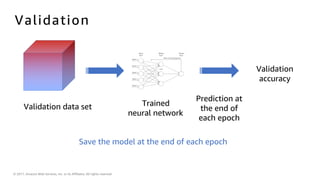
Validation
Validation data set Trained
neural network
Validation
accuracy
Prediction at
the end of
each epoch
Save the model at the end of each epoch
© 2017, Amazon Web Services, Inc. or its Affiliates. All rights reserved.
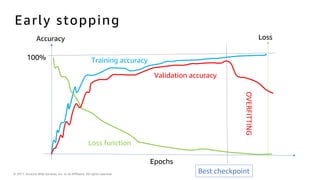
Early stopping
Training accuracy
Loss function
Accuracy
100%
Epochs
Validation accuracy
Loss
Best	checkpoint
OVERFITTING
© 2017, Amazon Web Services, Inc. or its Affiliates. All rights reserved.
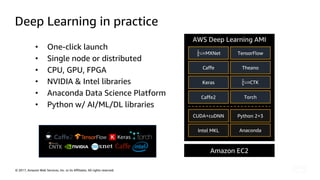
Deep Learning in practice
AWS Deep Learning AMI
MXNet
Torch
CTKKeras
TheanoCaffe
TensorFlow
Amazon EC2
AnacondaIntel MKL
CUDA+cuDNN Python 2+3
Caffe2
• One-click launch
• Single node or distributed
• CPU, GPU, FPGA
• NVIDIA & Intel libraries
• Anaconda Data Science Platform
• Python w/ AI/ML/DL libraries
NVIDIA Volta and AWS P3
© 2017, Amazon Web Services, Inc. or its Affiliates. All rights reserved.
Resources
https://aws.amazon.com/machine-learning
https://aws.amazon.com/blogs/ai
https://www.nvidia.com/en-us/deep-learning-ai/
https://www.nvidia.fr/dli
https://www.nvidia.fr/data-center/volta-gpu-architecture/
https://aws.amazon.com/ec2/instance-types/p3/
https://medium.com/@julsimon
Thank you!
Julien Simon, AI Evangelist, EMEA
@julsimon

An introduction to Deep Learning

  • 1.
    An introduction to DeepLearning Julien Simon, AI Evangelist, EMEA @julsimon
  • 2.
    What to expect •Artificial Intelligence, Machine Learning, Deep Learning • The 5 myths of AI • Deep Learning in action • Basics of Deep Learning • NVIDIA Volta V100 and AWS P3 • Q&A
  • 3.
  • 4.
  • 5.
    Myth #1 -AI is the flavour of the month
  • 6.
    John McCarthy (1927-2011) 1956- Coined the term “Artificial Intelligence” 1958 - Invented LISP 1971 - Received the Turing Award Fact #1 - AI is 60 years old Marvin Minsky (1927-2016) 1959 - Co-founded the MIT AI Lab 1968 - Advised Kubrick on “2001: A Space Odyssey” 1969 - Received the Turing Award
  • 7.
    Myth #2 -AI is dark magic aka « You’re not smart enough »
  • 8.
    Fact #2 -AI is math, code and chips A bit of Science, a lot of Engineering
  • 9.
    Myth #3 –The “cognitive” unicorn
  • 10.
    Myth #3 –The “cognitive” unicorn
  • 11.
    Fact #3: AIis a wide range of techniques and tools • Machine Learning • Natural Language Processing • Speech • Vision • Expert Systems • And more
  • 12.
    Myth #4 -AI is for esoteric use cases
  • 13.
    Fact #4: AIshines on intuitive problems
  • 14.
    Amazon AI isbased on Deep Learning
  • 15.
    Myth #5 -AI is not production-ready
  • 16.
    Fact #5: AImeans business
  • 17.
  • 18.
  • 19.
  • 20.
    Activation functions The neuron !xi ∗ wi & '() = u ”Multiply and Accumulate” Source: Wikipedia
  • 21.
    © 2017, AmazonWeb Services, Inc. or its Affiliates. All rights reserved. x = x11, x12, …. x1I x21, x22, …. x2I … … … xm1, xm2, …. xmI I features m samples y = y1 y2 … ym m labels, N2 outputs 0,0,1,0,0,…,0 1,0,0,0,0,…,0 … 0,0,0,0,1,…,0 One-hot encoding Neural networks
  • 22.
    © 2017, AmazonWeb Services, Inc. or its Affiliates. All rights reserved. x = x11, x12, …. x1I x21, x22, …. x2I … … … xm1, xm2, …. xmI I features m samples y = y1 y2 … ym m labels, N2 categories Total number of predictions Accuracy = Number of correct predictions 0,0,1,0,0,…,0 1,0,0,0,0,…,0 … 0,0,0,0,1,…,0 One-hot encoding Neural networks
  • 23.
    © 2017, AmazonWeb Services, Inc. or its Affiliates. All rights reserved. Neural networks Initially, the network will not predict correctly f(X1) = Y’1 A loss function measures the difference between the real label Y1 and the predicted label Y’1 error = loss(Y1, Y’1) For a batch of samples: ! loss(Yi, Y’i) ,-./0 2345 3() = batch error The purpose of the training process is to minimize error by gradually adjusting weights
  • 24.
    © 2017, AmazonWeb Services, Inc. or its Affiliates. All rights reserved. Training Training data set Training Trained neural network Batch size Learning rate Number of epochs Hyper parameters Backpropagation
  • 25.
    Stochastic Gradient Descent(SGD) Imagine you stand on top of a mountain with skis strapped to your feet. You want to get down to the valley as quickly as possible, but there is fog and you can only see your immediate surroundings. How can you get down the mountain as quickly as possible? You look around and identify the steepest path down, go down that path for a bit, again look around and find the new steepest path, go down that path, and repeat—this is exactly what gradient descent does. Tim Dettmers University of Lugano 2015 https://devblogs.nvidia.com/parallelforall/deep-learning-nutshell-history-training/ The « step size » is called the learning rate z=f(x,y)
  • 26.
    © 2017, AmazonWeb Services, Inc. or its Affiliates. All rights reserved. Validation Validation data set Trained neural network Validation accuracy Prediction at the end of each epoch Save the model at the end of each epoch
  • 27.
    © 2017, AmazonWeb Services, Inc. or its Affiliates. All rights reserved. Early stopping Training accuracy Loss function Accuracy 100% Epochs Validation accuracy Loss Best checkpoint OVERFITTING
  • 28.
    © 2017, AmazonWeb Services, Inc. or its Affiliates. All rights reserved. Deep Learning in practice AWS Deep Learning AMI MXNet Torch CTKKeras TheanoCaffe TensorFlow Amazon EC2 AnacondaIntel MKL CUDA+cuDNN Python 2+3 Caffe2 • One-click launch • Single node or distributed • CPU, GPU, FPGA • NVIDIA & Intel libraries • Anaconda Data Science Platform • Python w/ AI/ML/DL libraries
  • 29.
  • 30.
    © 2017, AmazonWeb Services, Inc. or its Affiliates. All rights reserved. Resources https://aws.amazon.com/machine-learning https://aws.amazon.com/blogs/ai https://www.nvidia.com/en-us/deep-learning-ai/ https://www.nvidia.fr/dli https://www.nvidia.fr/data-center/volta-gpu-architecture/ https://aws.amazon.com/ec2/instance-types/p3/ https://medium.com/@julsimon
  • 31.
    Thank you! Julien Simon,AI Evangelist, EMEA @julsimon