Deep Learning
Dr. Baljit Singh Khehra
Professor
CSE Department
Baba Banda Singh Bahadur Engineering College
Fatehgarh Sahib-140407, Punjab, India
Convolution


 

M1 N1
N1
f * g (x, y)
f * g (x) 
 
0

   f (,)g(x , y  )
 0 0
 f (,)g(x , y  )dd
f ()g(x )
 f ()g(x )d
2D(continuous, discrete) :
1D(continuous, discrete) : Input
Kernel
Output is
sometimes called
Feature map
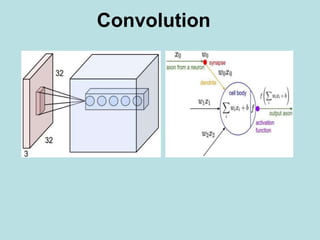
Convolution
32
3
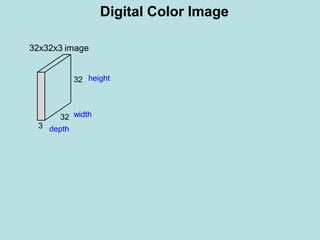
32x32x3 image
width
height
32
depth
Digital Color Image
32x32x3 image
5x5x3 filter
32
Convolve the filter with the image
i.e. “slide over the image spatially,
computing dot products”
32
3
Convolutions: More detail
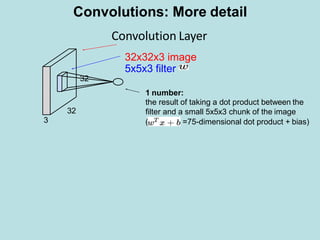
32
3
Convolution Layer
32x32x3 image
5x5x3 filter
32
1 number:
the result of taking a dot product between the
filter and a small 5x5x3 chunk of the image
(i.e. 5*5*3 =75-dimensional dot product + bias)
Convolutions: More detail
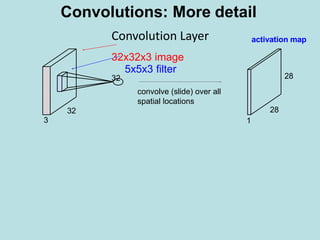
32
3
activation mapConvolution Layer
32x32x3 image
5x5x3 filter
32
1
28
28
convolve (slide) over all
spatial locations
Convolutions: More detail
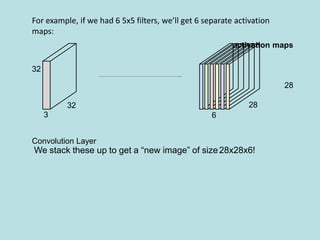
32
3 6
28
For example, if we had 6 5x5 filters, we’ll get 6 separate activation
maps:
activation maps
32
28
Convolution Layer
We stack these up to get a “new image” of size28x28x6!
Size of Image after Convolution
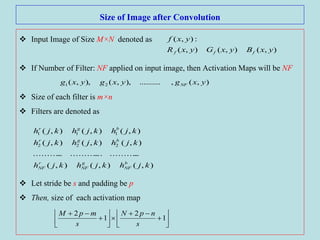
 Input Image of Size M×N denoted as
 If Number of Filter: NF applied on input image, then Activation Maps will be NF
 Size of each filter is m×n
 Filters are denoted as
 Let stride be s and padding be p
 Then, size of each activation map
),(),(),(
:),(
yxByxGyxR
yxf
fff
),(,..........),,(),,( 21 yxgyxgyxg NF
),(),(),(
.....................................
),(),(),(
),(),(),(
222
111
kjhkjhkjh
kjhkjhkjh
kjhkjhkjh
b
NF
g
NF
r
NF
bgr
bgr
















1
2
1
2
s
npN
s
mpM
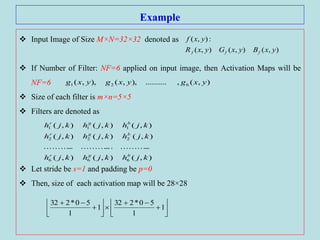
Example
 Input Image of Size M×N=32×32 denoted as
 If Number of Filter: NF=6 applied on input image, then Activation Maps will be
NF=6
 Size of each filter is m×n=5×5
 Filters are denoted as
 Let stride be s=1 and padding be p=0
 Then, size of each activation map will be 28×28
),(),(),(
:),(
yxByxGyxR
yxf
fff
),(,..........),,(),,( 621 yxgyxgyxg
),(),(),(
.....................................
),(),(),(
),(),(),(
666
222
111
kjhkjhkjh
kjhkjhkjh
kjhkjhkjh
bgr
bgr
bgr












1
1
50*232
1
1
50*232
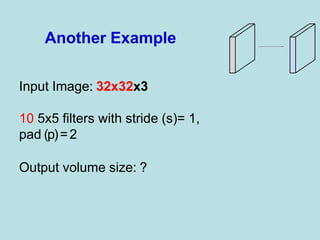
Input Image: 32x32x3
10 5x5 filters with stride (s)= 1,
pad (p)=2
Output volume size: ?
Another Example
Input volume: 32x32x3
10 5x5 filters with stride 1, pad 2
Output volume size:
[(32+2*2-5)/1+1]×[(32+2*2-5)/1+1] = 32×32
spatially, so
32x32x10
Output
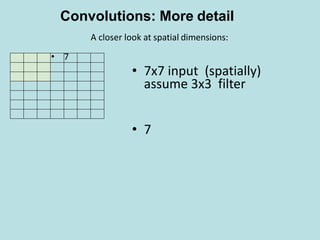
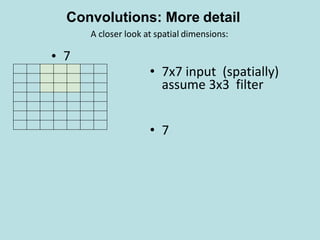
• 7
• 7x7 input (spatially)
assume 3x3 filter
• 7
A closer look at spatial dimensions:
Convolutions: More detail
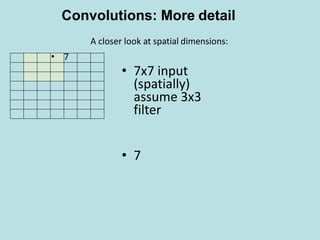
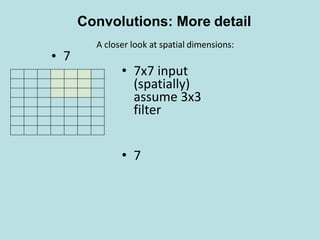
• 7
• 7x7 input
(spatially)
assume 3x3
filter
• 7
A closer look at spatial dimensions:
Convolutions: More detail
• 7
• 7x7 input (spatially)
assume 3x3 filter
• 7
A closer look at spatial dimensions:
Convolutions: More detail
• 7
• 7x7 input
(spatially)
assume 3x3
filter
• 7
A closer look at spatial dimensions:
Convolutions: More detail
7
• • 7x7 input (spatially)
assume 3x3 filter
7
A closer look at spatial dimensions:
Convolutions: More detail
[(7+2*0-3)/1+1]×[(7+2*0-3)/1+1] = 5×5 Output
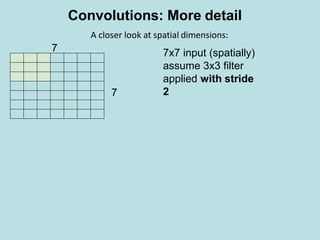
7x7 input (spatially)
assume 3x3 filter
applied with stride
2
7
7
A closer look at spatial dimensions:
Convolutions: More detail
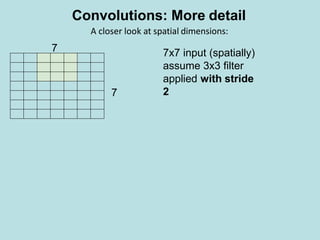
7x7 input (spatially)
assume 3x3 filter
applied with stride
2
7
7
A closer look at spatial dimensions:
Convolutions: More detail
7x7 input (spatially)
assume 3x3 filter
applied with stride
2
=> 3x3 output!
7
7
A closer look at spatial dimensions:
Convolutions: More detail
[(7+2*0-3)/2+1]×[(7+2*0-3)/2+1] = 3×3 Output
7x7 input (spatially)
assume 3x3 filter
applied with stride
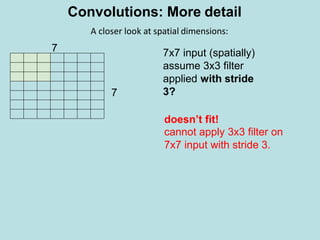
3?
7
7
A closer look at spatial dimensions:
Convolutions: More detail
[(7+2*0-3)/3+1]×[(7+2*0-3)/3+1] = [4/3+1]×[4/3+1] =2.33×2.33
7x7 input (spatially)
assume 3x3 filter
applied with stride
3?
7
7
A closer look at spatial dimensions:
doesn’t fit!
cannot apply 3x3 filter on
7x7 input with stride 3.
Convolutions: More detail
In practice: Common to zero pad the border
0 0 0 0 0 0
0
0
0
0
e.g. input 7x7
3x3 filter, applied with stride 1
pad with 1 pixel border => what is theoutput?
Convolutions: More detail
[(7+2*1-3)/1+1]×[(7+2*1-3)/1+1] = 7×7 Output
In practice: Common to zero pad the border
e.g. input 7x7
3x3 filter, applied with stride 2
pad with 1 pixel border => what is theoutput?
0 0 0 0 0 0
0
0
0
0
Convolutions: More detail
[(7+2*1-3)/2+1]×[(7+2*1-3)/2+1] = 4×4 Output
In practice: Common to zero pad the border
0 0 0 0 0 0
0
0
0
0
Convolutions: More detail
e.g. input 7x7
3x3 filter, applied with stride 3
pad with 1 pixel border => what is theoutput?
[(7+2*1-3)/3+1]×[(7+2*1-3)/3+1] = 3×3 Output
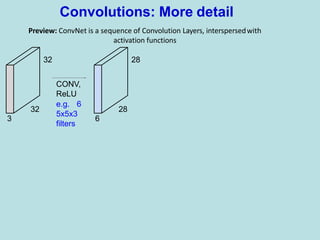
Preview: ConvNet is a sequence of Convolution Layers, interspersedwith
activation functions
32
32
3
28
28
6
CONV,
ReLU
e.g. 6
5x5x3
filters
Convolutions: More detail
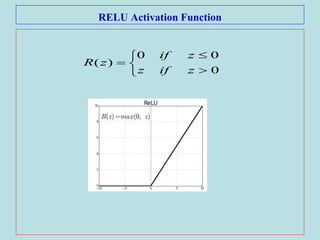
RELU Activation Function






0
00
)(
zifz
zif
zR
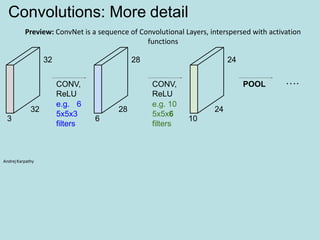
Preview: ConvNet is a sequence of Convolutional Layers, interspersed with activation
functions
32
32
3
CONV,
ReLU
e.g. 6
5x5x3
filters
28
28
6
CONV,
ReLU
e.g. 10
5x5x6
filters
POOL
Andrej Karpathy
….
10
24
24
Convolutions: More detail
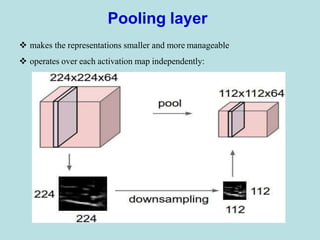
Pooling layer
 makes the representations smaller and more manageable
 operates over each activation map independently:
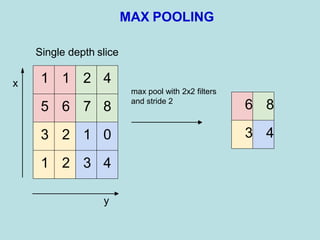
1 1 2 4
5 6 7 8
3 2 1 0
1 2 3 4
Single depth slice
x
y
max pool with 2x2 filters
and stride 2
6 8
3 4
MAX POOLING
[(CONVRELU)*NPOOL]*MFC
N: up to 5
M is Large
FC: Contains neurons that connect to the
entire input volume, as in ordinary Neural
Networks
General Architecture of CNNs
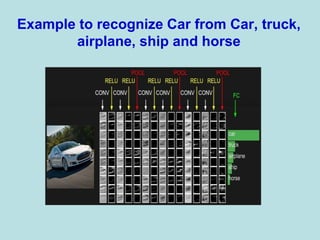
Example to recognize Car from Car, truck,
airplane, ship and horse
Deep learning

Deep learning

  • 1.
    Deep Learning Dr. BaljitSingh Khehra Professor CSE Department Baba Banda Singh Bahadur Engineering College Fatehgarh Sahib-140407, Punjab, India
  • 2.
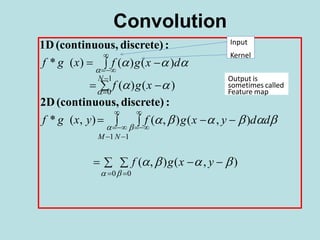
    Convolution      M1 N1 N1 f* g (x, y) f * g (x)    0     f (,)g(x , y  )  0 0  f (,)g(x , y  )dd f ()g(x )  f ()g(x )d 2D(continuous, discrete) : 1D(continuous, discrete) : Input Kernel Output is sometimes called Feature map
  • 3.
  • 4.
  • 5.
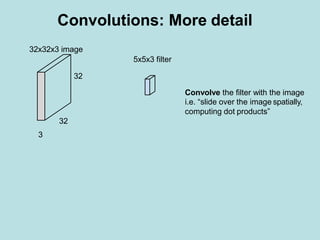
    32x32x3 image 5x5x3 filter 32 Convolvethe filter with the image i.e. “slide over the image spatially, computing dot products” 32 3 Convolutions: More detail
  • 6.
    32 3 Convolution Layer 32x32x3 image 5x5x3filter 32 1 number: the result of taking a dot product between the filter and a small 5x5x3 chunk of the image (i.e. 5*5*3 =75-dimensional dot product + bias) Convolutions: More detail
  • 7.
    32 3 activation mapConvolution Layer 32x32x3image 5x5x3 filter 32 1 28 28 convolve (slide) over all spatial locations Convolutions: More detail
  • 8.
    32 3 6 28 For example,if we had 6 5x5 filters, we’ll get 6 separate activation maps: activation maps 32 28 Convolution Layer We stack these up to get a “new image” of size28x28x6!
  • 9.
    Size of Imageafter Convolution  Input Image of Size M×N denoted as  If Number of Filter: NF applied on input image, then Activation Maps will be NF  Size of each filter is m×n  Filters are denoted as  Let stride be s and padding be p  Then, size of each activation map ),(),(),( :),( yxByxGyxR yxf fff ),(,..........),,(),,( 21 yxgyxgyxg NF ),(),(),( ..................................... ),(),(),( ),(),(),( 222 111 kjhkjhkjh kjhkjhkjh kjhkjhkjh b NF g NF r NF bgr bgr                 1 2 1 2 s npN s mpM
  • 10.
    Example  Input Imageof Size M×N=32×32 denoted as  If Number of Filter: NF=6 applied on input image, then Activation Maps will be NF=6  Size of each filter is m×n=5×5  Filters are denoted as  Let stride be s=1 and padding be p=0  Then, size of each activation map will be 28×28 ),(),(),( :),( yxByxGyxR yxf fff ),(,..........),,(),,( 621 yxgyxgyxg ),(),(),( ..................................... ),(),(),( ),(),(),( 666 222 111 kjhkjhkjh kjhkjhkjh kjhkjhkjh bgr bgr bgr             1 1 50*232 1 1 50*232
  • 11.
    Input Image: 32x32x3 105x5 filters with stride (s)= 1, pad (p)=2 Output volume size: ? Another Example
  • 12.
    Input volume: 32x32x3 105x5 filters with stride 1, pad 2 Output volume size: [(32+2*2-5)/1+1]×[(32+2*2-5)/1+1] = 32×32 spatially, so 32x32x10 Output
  • 13.
    • 7 • 7x7input (spatially) assume 3x3 filter • 7 A closer look at spatial dimensions: Convolutions: More detail
  • 14.
    • 7 • 7x7input (spatially) assume 3x3 filter • 7 A closer look at spatial dimensions: Convolutions: More detail
  • 15.
    • 7 • 7x7input (spatially) assume 3x3 filter • 7 A closer look at spatial dimensions: Convolutions: More detail
  • 16.
    • 7 • 7x7input (spatially) assume 3x3 filter • 7 A closer look at spatial dimensions: Convolutions: More detail
  • 17.
    7 • • 7x7input (spatially) assume 3x3 filter 7 A closer look at spatial dimensions: Convolutions: More detail [(7+2*0-3)/1+1]×[(7+2*0-3)/1+1] = 5×5 Output
  • 18.
    7x7 input (spatially) assume3x3 filter applied with stride 2 7 7 A closer look at spatial dimensions: Convolutions: More detail
  • 19.
    7x7 input (spatially) assume3x3 filter applied with stride 2 7 7 A closer look at spatial dimensions: Convolutions: More detail
  • 20.
    7x7 input (spatially) assume3x3 filter applied with stride 2 => 3x3 output! 7 7 A closer look at spatial dimensions: Convolutions: More detail [(7+2*0-3)/2+1]×[(7+2*0-3)/2+1] = 3×3 Output
  • 21.
    7x7 input (spatially) assume3x3 filter applied with stride 3? 7 7 A closer look at spatial dimensions: Convolutions: More detail [(7+2*0-3)/3+1]×[(7+2*0-3)/3+1] = [4/3+1]×[4/3+1] =2.33×2.33
  • 22.
    7x7 input (spatially) assume3x3 filter applied with stride 3? 7 7 A closer look at spatial dimensions: doesn’t fit! cannot apply 3x3 filter on 7x7 input with stride 3. Convolutions: More detail
  • 23.
    In practice: Commonto zero pad the border 0 0 0 0 0 0 0 0 0 0 e.g. input 7x7 3x3 filter, applied with stride 1 pad with 1 pixel border => what is theoutput? Convolutions: More detail [(7+2*1-3)/1+1]×[(7+2*1-3)/1+1] = 7×7 Output
  • 24.
    In practice: Commonto zero pad the border e.g. input 7x7 3x3 filter, applied with stride 2 pad with 1 pixel border => what is theoutput? 0 0 0 0 0 0 0 0 0 0 Convolutions: More detail [(7+2*1-3)/2+1]×[(7+2*1-3)/2+1] = 4×4 Output
  • 25.
    In practice: Commonto zero pad the border 0 0 0 0 0 0 0 0 0 0 Convolutions: More detail e.g. input 7x7 3x3 filter, applied with stride 3 pad with 1 pixel border => what is theoutput? [(7+2*1-3)/3+1]×[(7+2*1-3)/3+1] = 3×3 Output
  • 26.
    Preview: ConvNet isa sequence of Convolution Layers, interspersedwith activation functions 32 32 3 28 28 6 CONV, ReLU e.g. 6 5x5x3 filters Convolutions: More detail
  • 27.
  • 28.
    Preview: ConvNet isa sequence of Convolutional Layers, interspersed with activation functions 32 32 3 CONV, ReLU e.g. 6 5x5x3 filters 28 28 6 CONV, ReLU e.g. 10 5x5x6 filters POOL Andrej Karpathy …. 10 24 24 Convolutions: More detail
  • 29.
    Pooling layer  makesthe representations smaller and more manageable  operates over each activation map independently:
  • 30.
    1 1 24 5 6 7 8 3 2 1 0 1 2 3 4 Single depth slice x y max pool with 2x2 filters and stride 2 6 8 3 4 MAX POOLING
  • 31.
    [(CONVRELU)*NPOOL]*MFC N: up to5 M is Large FC: Contains neurons that connect to the entire input volume, as in ordinary Neural Networks General Architecture of CNNs
  • 32.
    Example to recognizeCar from Car, truck, airplane, ship and horse