DECISION MAKING
MODELS
-Shiv Raj (USCBC20094)
-Rudra Prasanna Panda(USCBC20130)
-Bibek Kujur(USCBC20140)
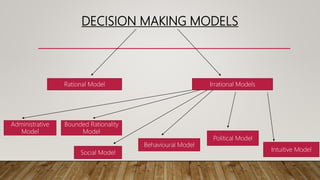
DECISION MAKING MODELS
Rational Model Irrational Models
Administrative
Model
Bounded Rationality
Model
Social Model
Behavioural Model
Political Model
Intuitive Model
RATIONAL/CLASSSICAL MODEL OF DECISION
MAKING
• Rationality refers to a logical, step by step approach to decision making, with a thorough analysis of
alternatives and their consequences. The organizational decision making falls into the rational
category.
• The rational model of decision making is also called programmed decision making is the product of
classical economic theory and assumes that the decision maker is completely rational in his/her
approach.
• Classical Model of decision making: a perspective model that tells how the decision should be made.
1) Assumes managers have access to all the information needed to reach a decision.
2) Managers can then make the optimum decision by easily ranking their own preferences among
alternatives.
• Unfortunately, managers often do not have all (or even most) required information.
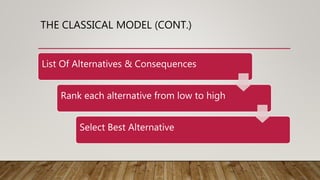
THE CLASSICAL MODEL (CONT.)
List Of Alternatives & Consequences
Rank each alternative from low to high
Select Best Alternative
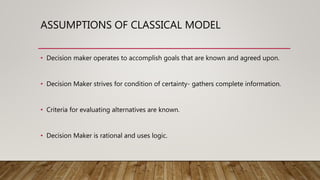
ASSUMPTIONS OF CLASSICAL MODEL
• Decision maker operates to accomplish goals that are known and agreed upon.
• Decision Maker strives for condition of certainty- gathers complete information.
• Criteria for evaluating alternatives are known.
• Decision Maker is rational and uses logic.
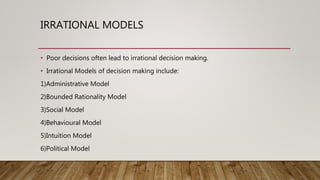
IRRATIONAL MODELS
• Poor decisions often lead to irrational decision making.
• Irrational Models of decision making include:
1)Administrative Model
2)Bounded Rationality Model
3)Social Model
4)Behavioural Model
5)Intuition Model
6)Political Model
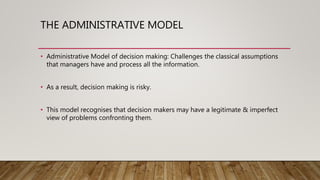
THE ADMINISTRATIVE MODEL
• Administrative Model of decision making: Challenges the classical assumptions
that managers have and process all the information.
• As a result, decision making is risky.
• This model recognises that decision makers may have a legitimate & imperfect
view of problems confronting them.
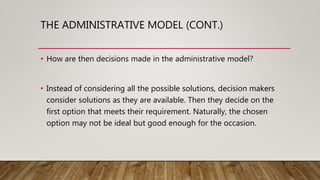
THE ADMINISTRATIVE MODEL (CONT.)
• How are then decisions made in the administrative model?
• Instead of considering all the possible solutions, decision makers
consider solutions as they are available. Then they decide on the
first option that meets their requirement. Naturally, the chosen
option may not be ideal but good enough for the occasion.
THE ADMINISTRATIVE MODEL (CONT.)
• Assumptions of Administrative Model:
1) Decision goals often are vague, conflicting and lack consensus among
managers.
2) Rational procedures are not always used.
3) Mangers’ searches for alternatives are limited.
4) Managers settle for a satisficing rather than a maximizing solution.
5) Intuition, looks to past experience.
BOUNDED RATIONALITY MODEL
• There is a large number of alternatives and information is vast so
that managers cannot consider it all.
• Decisions are limited by people’s cognitive abilities.
• Most managers do not see all alternatives and decide based on
incomplete information.
• Example, when ordering at a restaurant, customers will make
suboptimal decisions because they feel rushed by the waiter.
SOCIAL MODEL
• Social Model is based on human frailties. (weakness in character or morals)
• Humans are bundle of feelings, emotions and instincts. These variables influence behaviours of
people which look irrational.
• Irrational behaviours result in irrational decisions.
• Example- Deciding for whom to vote, What to eat or buy, Which college too attend,etc.
BEHAVIOURAL MODEL
• This model is based on the assumption that people act in terms of what they
really perceive about a given situation.
• The decision maker acts under uncertainty and lack of information.
• Managers make decisions on problems that are often ambiguous, he or she has
only partial knowledge about the available alternatives and their consequences.
• Example- Suppose there is a fire breaking out at The Vivanta, the manager would
have various ways to cope up but because he has no idea how many people are
there in which area of the building, he would take a vogus decision which maynot
be beneficial to all but the majority.
INTUITION MODEL
• This model represents a quick appreciation of a decision situation based on past
experience but without conscious thought.
• Intuitive Decision Making is based on years of hands—on experience which helps
managers gain quick understanding of the problem and easy identification of a
solution without pains taking computations.
• Example- A senior HR Manager uses intuitive model of decision making to look
for the perfect candidate for the job role.
POLITICAL MODEL
• The political model represents the decision making process in terms of self
interests and goals of powerful internal & external stakeholders.
• The political model reflects reality in the organisations.
• Conditions of uncertainty and ambiguity can often be seen.
• Example- Any group with the best decision can do coalitions.
FACTORS INFLUENCING DECISIONS
The following factors influence the managerial decision making:
1) Objectives of a Firm
2) Public Awareness
3) Economic Factors
4) Technological Factors
5) Human & Behavioural Factors
6) Social Costs
7) Environmental Factors
THANK YOU

DECISION MAKING MODELS_GDTB PPT.pptx

  • 1.
    DECISION MAKING MODELS -Shiv Raj(USCBC20094) -Rudra Prasanna Panda(USCBC20130) -Bibek Kujur(USCBC20140)
  • 2.
    DECISION MAKING MODELS RationalModel Irrational Models Administrative Model Bounded Rationality Model Social Model Behavioural Model Political Model Intuitive Model
  • 3.
    RATIONAL/CLASSSICAL MODEL OFDECISION MAKING • Rationality refers to a logical, step by step approach to decision making, with a thorough analysis of alternatives and their consequences. The organizational decision making falls into the rational category. • The rational model of decision making is also called programmed decision making is the product of classical economic theory and assumes that the decision maker is completely rational in his/her approach. • Classical Model of decision making: a perspective model that tells how the decision should be made. 1) Assumes managers have access to all the information needed to reach a decision. 2) Managers can then make the optimum decision by easily ranking their own preferences among alternatives. • Unfortunately, managers often do not have all (or even most) required information.
  • 4.
    THE CLASSICAL MODEL(CONT.) List Of Alternatives & Consequences Rank each alternative from low to high Select Best Alternative
  • 5.
    ASSUMPTIONS OF CLASSICALMODEL • Decision maker operates to accomplish goals that are known and agreed upon. • Decision Maker strives for condition of certainty- gathers complete information. • Criteria for evaluating alternatives are known. • Decision Maker is rational and uses logic.
  • 6.
    IRRATIONAL MODELS • Poordecisions often lead to irrational decision making. • Irrational Models of decision making include: 1)Administrative Model 2)Bounded Rationality Model 3)Social Model 4)Behavioural Model 5)Intuition Model 6)Political Model
  • 7.
    THE ADMINISTRATIVE MODEL •Administrative Model of decision making: Challenges the classical assumptions that managers have and process all the information. • As a result, decision making is risky. • This model recognises that decision makers may have a legitimate & imperfect view of problems confronting them.
  • 8.
    THE ADMINISTRATIVE MODEL(CONT.) • How are then decisions made in the administrative model? • Instead of considering all the possible solutions, decision makers consider solutions as they are available. Then they decide on the first option that meets their requirement. Naturally, the chosen option may not be ideal but good enough for the occasion.
  • 9.
    THE ADMINISTRATIVE MODEL(CONT.) • Assumptions of Administrative Model: 1) Decision goals often are vague, conflicting and lack consensus among managers. 2) Rational procedures are not always used. 3) Mangers’ searches for alternatives are limited. 4) Managers settle for a satisficing rather than a maximizing solution. 5) Intuition, looks to past experience.
  • 10.
    BOUNDED RATIONALITY MODEL •There is a large number of alternatives and information is vast so that managers cannot consider it all. • Decisions are limited by people’s cognitive abilities. • Most managers do not see all alternatives and decide based on incomplete information. • Example, when ordering at a restaurant, customers will make suboptimal decisions because they feel rushed by the waiter.
  • 11.
    SOCIAL MODEL • SocialModel is based on human frailties. (weakness in character or morals) • Humans are bundle of feelings, emotions and instincts. These variables influence behaviours of people which look irrational. • Irrational behaviours result in irrational decisions. • Example- Deciding for whom to vote, What to eat or buy, Which college too attend,etc.
  • 12.
    BEHAVIOURAL MODEL • Thismodel is based on the assumption that people act in terms of what they really perceive about a given situation. • The decision maker acts under uncertainty and lack of information. • Managers make decisions on problems that are often ambiguous, he or she has only partial knowledge about the available alternatives and their consequences. • Example- Suppose there is a fire breaking out at The Vivanta, the manager would have various ways to cope up but because he has no idea how many people are there in which area of the building, he would take a vogus decision which maynot be beneficial to all but the majority.
  • 13.
    INTUITION MODEL • Thismodel represents a quick appreciation of a decision situation based on past experience but without conscious thought. • Intuitive Decision Making is based on years of hands—on experience which helps managers gain quick understanding of the problem and easy identification of a solution without pains taking computations. • Example- A senior HR Manager uses intuitive model of decision making to look for the perfect candidate for the job role.
  • 14.
    POLITICAL MODEL • Thepolitical model represents the decision making process in terms of self interests and goals of powerful internal & external stakeholders. • The political model reflects reality in the organisations. • Conditions of uncertainty and ambiguity can often be seen. • Example- Any group with the best decision can do coalitions.
  • 15.
    FACTORS INFLUENCING DECISIONS Thefollowing factors influence the managerial decision making: 1) Objectives of a Firm 2) Public Awareness 3) Economic Factors 4) Technological Factors 5) Human & Behavioural Factors 6) Social Costs 7) Environmental Factors
  • 16.