Government College University Faisalabad. Page 1
Plan Implementation and Educational Management
Assignment Name: -
Decision-Making & Process
Submitted To: -
Sir Fahad Maqbool
Submitted By: -
Zunera Latif
Roll No: -
27901
Registration No: -
2017-GCUF-012583
Session: -
2017-2018
Class: -
B.Ed. (1.5 year)
DEPARTMENT OF EDUCATION
GOVERNMENT COLLEGE UNIVERSITY, FAISALABAD.
Government College University Faisalabad. Page 2
Decision Making Process
Introduction
Decision making is a daily activity for any human being. There is no exception about that. When it
comes to business organizations, decision making is a habit and a process as well. Effective and successful
decisions make profit to the company and unsuccessful ones make losses. Therefore, corporate decision
making process is the most critical process in any organization.
In the decision making process, we choose one course of action from a few possible alternatives. In
the process of decision making, we may use many tools, techniques and perceptions. In addition, we may
make our own private decisions or may prefer a collective decision. Usually, decision making is hard.
Majority of corporate decisions involve some level of dissatisfaction or conflict with another party.
Definition
Decision:-
 Making a choice from two or more alternative.
 Made up of a composite of information, data, facts and belief.
 Data by itself does not constitute useful information unless it is analyzed and processed.
Decision Making:-
 The process of examining your possibilities and options, comparing them, and choosing a course of
action.
 As defined by Baker et al in their 2001 study, “efficient decision-making involves a series of steps
that require the input of information at different stages of the process, as well as a process for
feedback”.
The Decision-Making Process
 Use in day-to-day decisions you make
 Can help you make good choices
 Businesses and individuals use the process as they chose the best uses for their limited resources
 Helps you identify and consider your various alternatives and their consequences before you
make a final decision
Government College University Faisalabad. Page 3
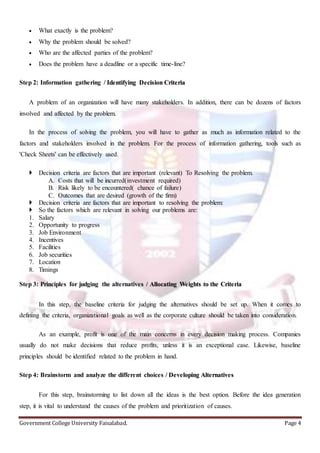
Let's have a look at the decision making process in detail.
There are 8 steps of Decision Making:
 Identification of problem•
 Identification of decision Criteria•
 Allocating weight to criteria•
 Develop alternatives•
 Analysis of Alternatives•
 Selection of alternatives•
 Implementation of the best alternatives•
 Evaluation of decision effectiveness
Steps of Decision Making Process
Following are the important steps of the decision making process. Each step may be supported by
different tools and techniques.
Step 1: Identification of the purpose of the decision / Identifying the Problem
In this step, the problem is thoroughly analyzed. There are a couple of questions one should ask when it
comes to identifying the purpose of the decision.
Government College University Faisalabad. Page 4
 What exactly is the problem?
 Why the problem should be solved?
 Who are the affected parties of the problem?
 Does the problem have a deadline or a specific time-line?
Step 2: Information gathering / Identifying Decision Criteria
A problem of an organization will have many stakeholders. In addition, there can be dozens of factors
involved and affected by the problem.
In the process of solving the problem, you will have to gather as much as information related to the
factors and stakeholders involved in the problem. For the process of information gathering, tools such as
'Check Sheets' can be effectively used.
 Decision criteria are factors that are important (relevant) To Resolving the problem.
A. Costs that will be incurred(investment required)
B. Risk likely to be encountered( chance of failure)
C. Outcomes that are desired (growth of the firm)
 Decision criteria are factors that are important to resolving the problem:
 So the factors which are relevant in solving our problems are:
1. Salary
2. Opportunity to progress
3. Job Environment
4. Incentives
5. Facilities
6. Job securities
7. Location
8. Timings
Step 3: Principles for judging the alternatives / Allocating Weights to the Criteria
In this step, the baseline criteria for judging the alternatives should be set up. When it comes to
defining the criteria, organizational goals as well as the corporate culture should be taken into consideration.
As an example, profit is one of the main concerns in every decision making process. Companies
usually do not make decisions that reduce profits, unless it is an exceptional case. Likewise, baseline
principles should be identified related to the problem in hand.
Step 4: Brainstorm and analyze the different choices / Developing Alternatives
For this step, brainstorming to list down all the ideas is the best option. Before the idea generation
step, it is vital to understand the causes of the problem and prioritization of causes.
Government College University Faisalabad. Page 5
For this, you can make use of Cause-and-Effect diagrams and Pareto Chart tool. Cause-and-Effect
diagram helps you to identify all possible causes of the problem and Pareto chart helps you to prioritize and
identify the causes with highest effect.
Then, you can move on generating all possible solutions (alternatives) for the problem in hand.
Step 5: Evaluation of alternatives / Analyzing Alternatives
Use your judgment principles and decision-making criteria to evaluate each alternative. In this step,
experience and effectiveness of the judgment principles come into play. You need to compare each
alternative for their positives and negatives.
Step 6: Select the best alternative
Once you go through from Step 1 to Step 5, this step is easy. In addition, the selection of the best
alternative is an informed decision since you have already followed a methodology to derive and select the
best alternative.
Step 7: Execute the decision
Convert your decision into a plan or a sequence of activities. Execute your plan by yourself or with
the help of subordinates.
Step 8: Evaluate the results
Evaluate the outcome of your decision. See whether there is anything you should learn and then
correct in future decision making. This is one of the best practices that will improve your decision-making
skills.
Conclusion
When it comes to making decisions, one should always weigh the positive and negative business
consequences and should favor the positive outcomes. This avoids the possible losses to the organization
and keeps the company running with a sustained growth. Sometimes, avoiding decision making seems
easier; especially, when you get into a lot of confrontation after making the tough decision. But, making the
decisions and accepting its consequences is the only way to stay in control of your corporate life and time.

Decision Making And Process

  • 1.
    Government College UniversityFaisalabad. Page 1 Plan Implementation and Educational Management Assignment Name: - Decision-Making & Process Submitted To: - Sir Fahad Maqbool Submitted By: - Zunera Latif Roll No: - 27901 Registration No: - 2017-GCUF-012583 Session: - 2017-2018 Class: - B.Ed. (1.5 year) DEPARTMENT OF EDUCATION GOVERNMENT COLLEGE UNIVERSITY, FAISALABAD.
  • 2.
    Government College UniversityFaisalabad. Page 2 Decision Making Process Introduction Decision making is a daily activity for any human being. There is no exception about that. When it comes to business organizations, decision making is a habit and a process as well. Effective and successful decisions make profit to the company and unsuccessful ones make losses. Therefore, corporate decision making process is the most critical process in any organization. In the decision making process, we choose one course of action from a few possible alternatives. In the process of decision making, we may use many tools, techniques and perceptions. In addition, we may make our own private decisions or may prefer a collective decision. Usually, decision making is hard. Majority of corporate decisions involve some level of dissatisfaction or conflict with another party. Definition Decision:-  Making a choice from two or more alternative.  Made up of a composite of information, data, facts and belief.  Data by itself does not constitute useful information unless it is analyzed and processed. Decision Making:-  The process of examining your possibilities and options, comparing them, and choosing a course of action.  As defined by Baker et al in their 2001 study, “efficient decision-making involves a series of steps that require the input of information at different stages of the process, as well as a process for feedback”. The Decision-Making Process  Use in day-to-day decisions you make  Can help you make good choices  Businesses and individuals use the process as they chose the best uses for their limited resources  Helps you identify and consider your various alternatives and their consequences before you make a final decision
  • 3.
    Government College UniversityFaisalabad. Page 3 Let's have a look at the decision making process in detail. There are 8 steps of Decision Making:  Identification of problem•  Identification of decision Criteria•  Allocating weight to criteria•  Develop alternatives•  Analysis of Alternatives•  Selection of alternatives•  Implementation of the best alternatives•  Evaluation of decision effectiveness Steps of Decision Making Process Following are the important steps of the decision making process. Each step may be supported by different tools and techniques. Step 1: Identification of the purpose of the decision / Identifying the Problem In this step, the problem is thoroughly analyzed. There are a couple of questions one should ask when it comes to identifying the purpose of the decision.
  • 4.
    Government College UniversityFaisalabad. Page 4  What exactly is the problem?  Why the problem should be solved?  Who are the affected parties of the problem?  Does the problem have a deadline or a specific time-line? Step 2: Information gathering / Identifying Decision Criteria A problem of an organization will have many stakeholders. In addition, there can be dozens of factors involved and affected by the problem. In the process of solving the problem, you will have to gather as much as information related to the factors and stakeholders involved in the problem. For the process of information gathering, tools such as 'Check Sheets' can be effectively used.  Decision criteria are factors that are important (relevant) To Resolving the problem. A. Costs that will be incurred(investment required) B. Risk likely to be encountered( chance of failure) C. Outcomes that are desired (growth of the firm)  Decision criteria are factors that are important to resolving the problem:  So the factors which are relevant in solving our problems are: 1. Salary 2. Opportunity to progress 3. Job Environment 4. Incentives 5. Facilities 6. Job securities 7. Location 8. Timings Step 3: Principles for judging the alternatives / Allocating Weights to the Criteria In this step, the baseline criteria for judging the alternatives should be set up. When it comes to defining the criteria, organizational goals as well as the corporate culture should be taken into consideration. As an example, profit is one of the main concerns in every decision making process. Companies usually do not make decisions that reduce profits, unless it is an exceptional case. Likewise, baseline principles should be identified related to the problem in hand. Step 4: Brainstorm and analyze the different choices / Developing Alternatives For this step, brainstorming to list down all the ideas is the best option. Before the idea generation step, it is vital to understand the causes of the problem and prioritization of causes.
  • 5.
    Government College UniversityFaisalabad. Page 5 For this, you can make use of Cause-and-Effect diagrams and Pareto Chart tool. Cause-and-Effect diagram helps you to identify all possible causes of the problem and Pareto chart helps you to prioritize and identify the causes with highest effect. Then, you can move on generating all possible solutions (alternatives) for the problem in hand. Step 5: Evaluation of alternatives / Analyzing Alternatives Use your judgment principles and decision-making criteria to evaluate each alternative. In this step, experience and effectiveness of the judgment principles come into play. You need to compare each alternative for their positives and negatives. Step 6: Select the best alternative Once you go through from Step 1 to Step 5, this step is easy. In addition, the selection of the best alternative is an informed decision since you have already followed a methodology to derive and select the best alternative. Step 7: Execute the decision Convert your decision into a plan or a sequence of activities. Execute your plan by yourself or with the help of subordinates. Step 8: Evaluate the results Evaluate the outcome of your decision. See whether there is anything you should learn and then correct in future decision making. This is one of the best practices that will improve your decision-making skills. Conclusion When it comes to making decisions, one should always weigh the positive and negative business consequences and should favor the positive outcomes. This avoids the possible losses to the organization and keeps the company running with a sustained growth. Sometimes, avoiding decision making seems easier; especially, when you get into a lot of confrontation after making the tough decision. But, making the decisions and accepting its consequences is the only way to stay in control of your corporate life and time.