San José State University
Math 253: Mathematical Methods for Data Visualization
Linear Discriminant Analysis (LDA)
Dr. Guangliang Chen
Outline
• Motivation:
– PCA is unsupervised (blind to training labels)
– PCA focuses on variance (not always useful or relevant)
• LDA: a supervised dimensionality reduction approach
– 2-class LDA
– Multiclass extension
• Comparison between PCA and LDA
Linear Discriminant Analysis (LDA)
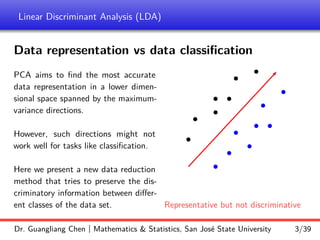
Data representation vs data classification
PCA aims to find the most accurate
data representation in a lower dimen-
sional space spanned by the maximum-
variance directions.
However, such directions might not
work well for tasks like classification.
Here we present a new data reduction
method that tries to preserve the dis-
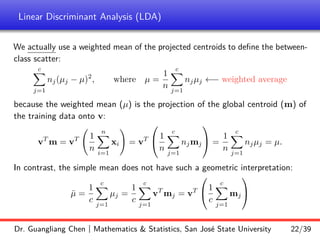
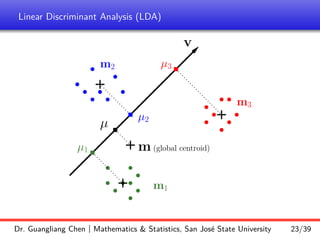
criminatory information between differ-
ent classes of the data set.
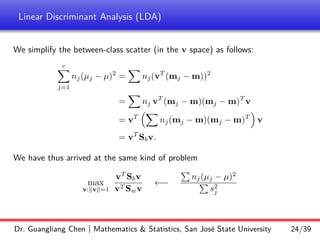
b
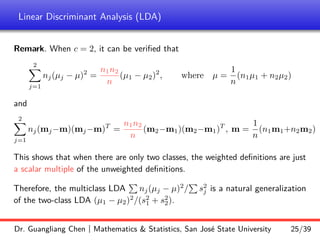
b
b
b
b
b
b
b b
b
b
b
b
b
b
Representative but not discriminative
Dr. Guangliang Chen | Mathematics & Statistics, San José State University 3/39
Linear Discriminant Analysis (LDA)
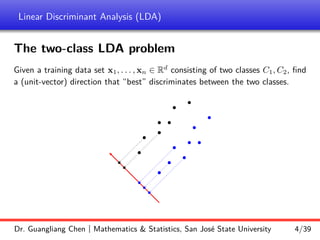
The two-class LDA problem
Given a training data set x1, . . . , xn ∈ Rd
consisting of two classes C1, C2, find
a (unit-vector) direction that “best” discriminates between the two classes.
b
b
b
b
b
b
b
b b
b
b
b
b
b
r
r
r
r
r
b
Dr. Guangliang Chen | Mathematics & Statistics, San José State University 4/39
Linear Discriminant Analysis (LDA)
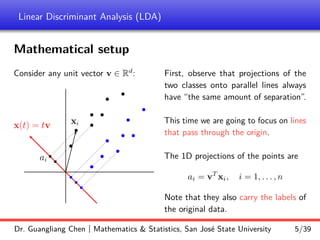
Mathematical setup
Consider any unit vector v ∈ Rd
:
b
b
b
b
b
b
b
b b
b
b
b
b
b
r
r
r
r
r
b
x(t) = tv xi
ai
First, observe that projections of the
two classes onto parallel lines always
have “the same amount of separation”.
This time we are going to focus on lines
that pass through the origin.
The 1D projections of the points are
ai = vT
xi, i = 1, . . . , n
Note that they also carry the labels of
the original data.
Dr. Guangliang Chen | Mathematics & Statistics, San José State University 5/39
Linear Discriminant Analysis (LDA)
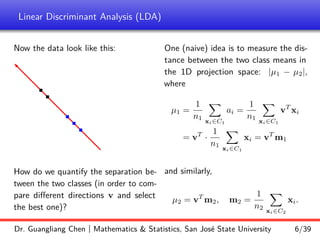
Now the data look like this:
r
r
r
r
r
How do we quantify the separation be-
tween the two classes (in order to com-
pare different directions v and select
the best one)?
One (naive) idea is to measure the dis-
tance between the two class means in
the 1D projection space: |µ1 − µ2|,
where
µ1 =
1
n1
X
xi∈C1
ai =
1
n1
X
xi∈C1
vT
xi
= vT
·
1
n1
X
xi∈C1
xi = vT
m1
and similarly,
µ2 = vT
m2, m2 =
1
n2
X
xi∈C2
xi.
Dr. Guangliang Chen | Mathematics & Statistics, San José State University 6/39
Linear Discriminant Analysis (LDA)
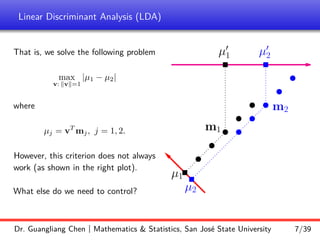
That is, we solve the following problem
max
v: kvk=1
|µ1 − µ2|
where
µj = vT
mj, j = 1, 2.
However, this criterion does not always
work (as shown in the right plot).
What else do we need to control?
b
b
b
b
b
b
b
b
b
b
r
r
b
r
r
µ1
µ2
µ′
1 µ′
2
m2
m1
Dr. Guangliang Chen | Mathematics & Statistics, San José State University 7/39
Linear Discriminant Analysis (LDA)
It turns out that we should also pay attention to the variances of the projected
classes:
s2
1 =
X
xi∈C1
(ai − µ1)2
, s2
2 =
X
xi∈C2
(ai − µ2)2
Ideally, the projected classes have both faraway means and small variances.
This can be achieved through the following modified formulation:
max
v:kvk=1
(µ1 − µ2)2
s2
1 + s2
2
.
The optimal v should be such that
• (µ1 − µ2)2
: large
• s2
1, s2
2: both small
Dr. Guangliang Chen | Mathematics & Statistics, San José State University 8/39
Linear Discriminant Analysis (LDA)
Mathematical derivation
First, we derive a formula for the distance between the two projected centroids:
(µ1 − µ2)2
= (vT
m1 − vT
m2)2
= (vT
(m1 − m2))2
= vT
(m1 − m2) · (m1 − m2)T
v
= vT
Sbv,
where
Sb = (m1 − m2)(m1 − m2)T
∈ Rd×d
is called the between-class scatter matrix.
Remark. Clearly, Sb is square, symmetric and positive semidefinite. Moreover,
rank(Sb) = 1, which implies that it only has 1 positive eigenvalue!
Dr. Guangliang Chen | Mathematics & Statistics, San José State University 9/39
Linear Discriminant Analysis (LDA)
Next, for each class j = 1, 2, the variance of the projection (onto v) is
s2
j =
X
xi∈Cj
(ai − µj)2
=
X
xi∈Cj
(vT
xi − vT
mj)2
=
X
xi∈Cj
vT
(xi − mj)(xi − mj)T
v
= vT


X
xi∈Cj
(xi − mj)(xi − mj)T

 v
= vT
Sjv,
where
Sj =
X
xi∈Cj
(xi − mj)(xi − mj)T
∈ Rd×d
is called the within-class scatter matrix for class j.
Dr. Guangliang Chen | Mathematics & Statistics, San José State University 10/39
Linear Discriminant Analysis (LDA)
The total within-class scatter of the two classes in the projection space is
s2
1 + s2
2 = vT
S1v + vT
S2v = vT
(S1 + S2)v = vT
Swv
where
Sw = S1 + S2 =
X
xi∈C1
(xi − m1)(xi − m1)T
+
X
xi∈C2
(xi − m2)(xi − m2)T
is called the total within-class scatter matrix of the original data.
Remark. Sw ∈ Rd×d
is also square, symmetric, and positive semidefinite.
Dr. Guangliang Chen | Mathematics & Statistics, San José State University 11/39
Linear Discriminant Analysis (LDA)
Putting everything together, we have derived the following optimization problem:
max
v:kvk=1
vT
Sbv
vT Swv
←− Where did we see this?
Theorem 0.1. Suppose Sw is nonsingular. The maximizer of the problem is given
by the largest eigenvector v1 of S−1
w Sb, i.e.,
S−1
w Sbv1 = λ1v1.
Remark. rank(S−1
w Sb) = rank(Sb) = 1, so λ1 is the only nonzero (positive)
eigenvalue that can be found. It represents the the largest amount of separation
between the two classes along any single direction.
Dr. Guangliang Chen | Mathematics & Statistics, San José State University 12/39
Linear Discriminant Analysis (LDA)
Computing
The following are different ways of finding the optimal direction v1:
• Slowest way (via three expensive steps):
1. work really hard to invert the d × d matrix Sw,
2. do the matrix multiplication S−1
w Sb,
3. solve the eigenvalue problem S−1
w Sbv1 = λ1v1.
• A slight better way: Rewrite as a generalized eigenvalue problem
Sbv1 = λ1Swv1,
and then solve it through functions like eigs(A,B) in MATLAB.
Dr. Guangliang Chen | Mathematics & Statistics, San José State University 13/39
Linear Discriminant Analysis (LDA)
• The smartest way is to rewrite as
λ1v1 = S−1
w (m1 − m2)(m1 − m2)T
| {z }
Sb
v1
= S−1
w (m1 − m2) · (m1 − m2)T
v1
| {z }
scalar
This implies that
v1 ∝ S−1
w (m1 − m2)
and it can be computed from S−1
w (m1 − m2) through rescaling!
Remark. Here, inverting Sw should still be avoided; instead, one should
implement this by solving a linear system Swx = m1 − m2. This can be
done through Sw  (m1 − m2) in MATLAB.
Dr. Guangliang Chen | Mathematics & Statistics, San José State University 14/39
Linear Discriminant Analysis (LDA)
Two-class LDA: summary
The optimal discriminatory direction is
v∗
= S−1
w (m1 − m2) (plus normalization)
It is the solution of
max
v:kvk=1
vT
Sbv
vT Swv
←−
(µ1 − µ2)2
s2
1 + s2
2
where
Sb = (m1 − m2)(m1 − m2)T
Sw = S1 + S2, Sj =
X
x∈Cj
(x − mj)(x − mj)T
Dr. Guangliang Chen | Mathematics & Statistics, San José State University 15/39
Linear Discriminant Analysis (LDA)
A small example
Data
• Class 1 has three points (1,2), (2,3), (3, 4.9), with mean m1 = (2, 3.3)T
• Class 2 has three points (2,1), (3,2), (4, 3.9), with mean m2 = (3, 2.3)T
Within-class scatter matrix
Sw =
4 5.8
5.8 8.68
!
Thus, the optimal direction is
v = S−1
w (m1 − m2) = (−13.4074, 9.0741)T normalizing
−→ (−0.8282, 0.5605)T
Dr. Guangliang Chen | Mathematics & Statistics, San José State University 16/39
Linear Discriminant Analysis (LDA)
and the projection coordinates are
Y = [0.2928, 0.0252, 0.2619, −1.0958, −1.3635, −1.1267]
-2 -1 0 1 2 3 4
-1
0
1
2
3
4
Dr. Guangliang Chen | Mathematics & Statistics, San José State University 17/39
Linear Discriminant Analysis (LDA)
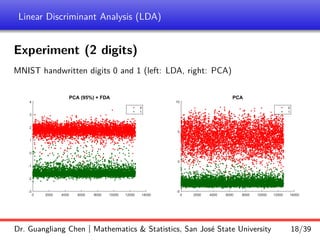
Experiment (2 digits)
MNIST handwritten digits 0 and 1 (left: LDA, right: PCA)
0 2000 4000 6000 8000 10000 12000 14000
-3
-2
-1
0
1
2
3
4
PCA (95%) + FDA
0
1
0 2000 4000 6000 8000 10000 12000 14000
-5
0
5
10
PCA
0
1
Dr. Guangliang Chen | Mathematics & Statistics, San José State University 18/39
Linear Discriminant Analysis (LDA)
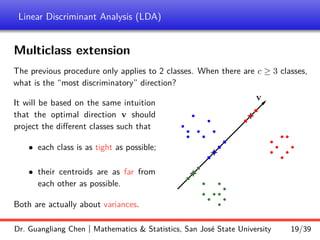
Multiclass extension
The previous procedure only applies to 2 classes. When there are c ≥ 3 classes,
what is the “most discriminatory” direction?
It will be based on the same intuition
that the optimal direction v should
project the different classes such that
• each class is as tight as possible;
• their centroids are as far from
each other as possible.
Both are actually about variances.
b
b
b
b b
b
b
b
b
b
b
b
b
b
b
b
b
b
b
b
b
b
b
b
b
+
+
r
r
r
v
r
+
r
r
r
r
r
r
Dr. Guangliang Chen | Mathematics & Statistics, San José State University 19/39
Linear Discriminant Analysis (LDA)
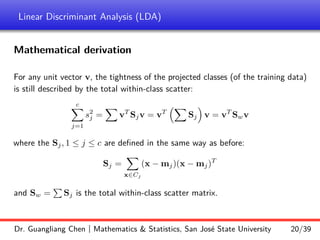
Mathematical derivation
For any unit vector v, the tightness of the projected classes (of the training data)
is still described by the total within-class scatter:
c
X
j=1
s2
j =
X
vT
Sjv = vT
X
Sj

v = vT
Swv
where the Sj, 1 ≤ j ≤ c are defined in the same way as before:
Sj =
X
x∈Cj
(x − mj)(x − mj)T
and Sw =
P
Sj is the total within-class scatter matrix.
Dr. Guangliang Chen | Mathematics  Statistics, San José State University 20/39
Linear Discriminant Analysis (LDA)
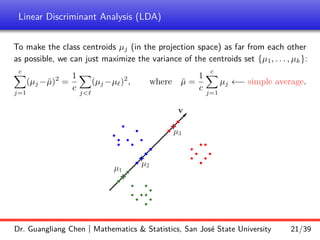
To make the class centroids µj (in the projection space) as far from each other
as possible, we can just maximize the variance of the centroids set {µ1, . . . , µk}:
c
X
j=1
(µj −µ̄)2
=
1
c
X
j`
(µj −µ`)2
, where µ̄ =
1
c
c
X
j=1
µj ←− simple average.
b
b
b
b b
b
b
b
b
b
b
b
b
b
b
b
b
b
b
b
b
b
b
b
b
+
+
r
r
r
v
r
+
r
r
r
r
r
r
µ1
µ2
µ3
Dr. Guangliang Chen | Mathematics  Statistics, San José State University 21/39
Linear Discriminant Analysis (LDA)
We actually use a weighted mean of the projected centroids to define the between-
class scatter:
c
X
j=1
nj(µj − µ)2
, where µ =
1
n
c
X
j=1
njµj ←− weighted average
because the weighted mean (µ) is the projection of the global centroid (m) of
the training data onto v:
vT
m = vT 1
n
n
X
i=1
xi
!
= vT

 1
n
c
X
j=1
njmj

 =
1
n
c
X
j=1
njµj = µ.
In contrast, the simple mean does not have such a geometric interpretation:
µ̄ =
1
c
c
X
j=1
µj =
1
c
c
X
j=1
vT
mj = vT

1
c
c
X
j=1
mj


Dr. Guangliang Chen | Mathematics  Statistics, San José State University 22/39
Linear Discriminant Analysis (LDA)
b
b
b
b b
b
b
b
b
b
b
b
b
b
b
b
b
b
b
b
b
b
b
b
b
+
+
+
r
r
r
+
m2
m1
m3
µ2
µ1
µ3
m (global centroid)
µ r
v
Dr. Guangliang Chen | Mathematics  Statistics, San José State University 23/39
Linear Discriminant Analysis (LDA)
We simplify the between-class scatter (in the v space) as follows:
c
X
j=1
nj(µj − µ)2
=
X
nj(vT
(mj − m))2
=
X
nj vT
(mj − m)(mj − m)T
v
= vT
X
nj(mj − m)(mj − m)T

v
= vT
Sbv.
We have thus arrived at the same kind of problem
max
v:kvk=1
vT
Sbv
vT Swv
←−
P
nj(µj − µ)2
P
s2
j
Dr. Guangliang Chen | Mathematics  Statistics, San José State University 24/39
Linear Discriminant Analysis (LDA)
Remark. When c = 2, it can be verified that
2
X
j=1
nj(µj − µ)2
=
n1n2
n
(µ1 − µ2)2
, where µ =
1
n
(n1µ1 + n2µ2)
and
2
X
j=1
nj(mj−m)(mj−m)T
=
n1n2
n
(m2−m1)(m2−m1)T
, m =
1
n
(n1m1+n2m2)
This shows that when there are only two classes, the weighted definitions are just
a scalar multiple of the unweighted definitions.
Therefore, the multiclass LDA
P
nj(µj − µ)2
/
P
s2
j is a natural generalization
of the two-class LDA (µ1 − µ2)2
/(s2
1 + s2
2).
Dr. Guangliang Chen | Mathematics  Statistics, San José State University 25/39
Linear Discriminant Analysis (LDA)
Computing
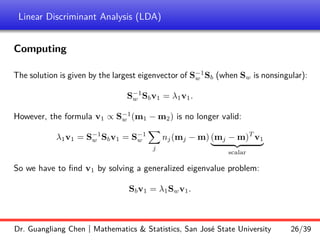
The solution is given by the largest eigenvector of S−1
w Sb (when Sw is nonsingular):
S−1
w Sbv1 = λ1v1.
However, the formula v1 ∝ S−1
w (m1 − m2) is no longer valid:
λ1v1 = S−1
w Sbv1 = S−1
w
X
j
nj(mj − m) (mj − m)T
v1
| {z }
scalar
So we have to find v1 by solving a generalized eigenvalue problem:
Sbv1 = λ1Swv1.
Dr. Guangliang Chen | Mathematics  Statistics, San José State University 26/39
Linear Discriminant Analysis (LDA)
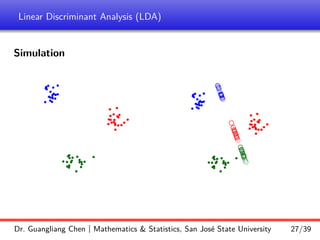
Simulation
Dr. Guangliang Chen | Mathematics  Statistics, San José State University 27/39
Linear Discriminant Analysis (LDA)
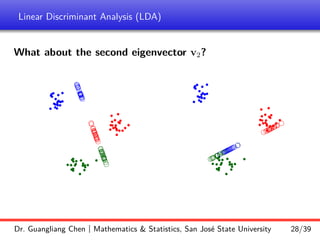
What about the second eigenvector v2?
Dr. Guangliang Chen | Mathematics  Statistics, San José State University 28/39
Linear Discriminant Analysis (LDA)
How many discriminatory directions can we find?
To answer this question, we just need to count the number of nonzero eigenvalues
S−1
w Sbv = λv
since only the nonzero eigenvectors will be used as the discriminatory directions.
In the above equation, the within-class scatter matrix Sw is assumed to be
nonsingular. However, the between-class scatter matrix Sb is of low rank:
Sb =
X
ni(mi − m)(mi − m)T
= [
√
n1(m1 − m) · · ·
√
nc(mc − m)] ·



√
n1(m1 − m)T
.
.
.
√
nc(mc − m)T



Dr. Guangliang Chen | Mathematics  Statistics, San José State University 29/39
Linear Discriminant Analysis (LDA)
b
b
b
b b
b
b
b
b
b
b
b
b
b
b
b
b
b
b
b
b
b
b
b
b
+
+
+
+
m2
m1
m3
m (global centroid)
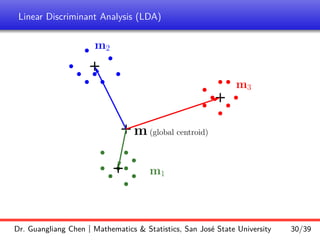
Dr. Guangliang Chen | Mathematics  Statistics, San José State University 30/39
Linear Discriminant Analysis (LDA)
Observe that the columns of the matrix
[
√
n1(m1 − m) · · ·
√
nc(mc − m)]
are linearly dependent:
√
n1 ·
√
n1(m1 − m) + · · · +
√
nc ·
√
nc(mc − m)
= (n1m1 + · · · ncmc) − (n1 + · · · + nc)m
= nm − nm
= 0.
The shows that rank(Sb) ≤ c − 1 (where c is the number of training classes).
Therefore, one can only find at most c − 1 discriminatory directions.
Dr. Guangliang Chen | Mathematics  Statistics, San José State University 31/39
Linear Discriminant Analysis (LDA)
Multiclass LDA algorithm
Input: Training data X ∈ Rn×d
(with c classes)
Output: At most c − 1 discriminatory directions and projections of X onto them
1. Compute
Sw =
c
X
j=1
X
x∈Cj
(x − mj)(x − mj)T
, Sb =
c
X
j=1
nj(mj − m)(mj − m)T
.
2. Solve the generalized eigenvalue problem Sbv = λSwv to find all nonzero
eigenvectors Vk = [v1, . . . , vk] (for some k ≤ c − 1)
3. Project the data X onto them Y = X · Vk ∈ Rn×k
.
Dr. Guangliang Chen | Mathematics  Statistics, San José State University 32/39
Linear Discriminant Analysis (LDA)
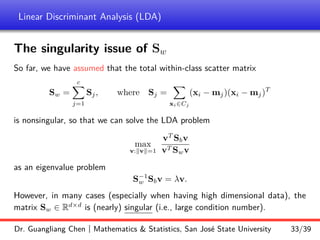
The singularity issue of Sw
So far, we have assumed that the total within-class scatter matrix
Sw =
c
X
j=1
Sj, where Sj =
X
xi∈Cj
(xi − mj)(xi − mj)T
is nonsingular, so that we can solve the LDA problem
max
v:kvk=1
vT
Sbv
vT Swv
as an eigenvalue problem
S−1
w Sbv = λv.
However, in many cases (especially when having high dimensional data), the
matrix Sw ∈ Rd×d
is (nearly) singular (i.e., large condition number).
Dr. Guangliang Chen | Mathematics  Statistics, San José State University 33/39
Linear Discriminant Analysis (LDA)
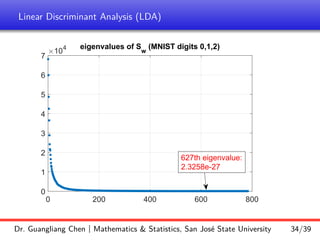
0 200 400 600 800
0
1
2
3
4
5
6
7
10
4 eigenvalues of S
w
(MNIST digits 0,1,2)
627th eigenvalue:
2.3258e-27
Dr. Guangliang Chen | Mathematics  Statistics, San José State University 34/39
Linear Discriminant Analysis (LDA)
How does this happen?
Let e
xi = xi−mj for each i = 1, 2 . . . , n
be the centered data points using its
own class centroid.
Define
e
X = [e
x1 . . . e
xn]T
∈ Rn×d
.
Then
Sw = e
XT e
X ∈ Rd×d
.
b
b
b
b b
b
b
b
b
b
b
b
b
b
b
b
b
b
b
b
b
b
b
b
b
+
+
+
Important issue: For high dimensional data (i.e., d is large), the centered data
often do not fully span all d dimensions, thus making rank(Sw) = rank( e
X)  d
(which implies that Sw is singular).
Dr. Guangliang Chen | Mathematics  Statistics, San José State University 35/39
Linear Discriminant Analysis (LDA)
Common fixes:
• Apply global PCA to reduce the dimensionality of the labeled data (all
classes)
Ypca = X − [m . . . m]T

· Vpca
and then perform LDA on the reduced data:
Zlda = Ypca · Vlda ←− learned from Ypca
• Use pseudoinverse instead: S†
wSbv = λv
• Regularize Sw:
S0
w = Sw + βId = QΛQT
+ βId = Q(Λ + βId)QT
where Λ + βId = diag(λ1 + β, . . . , λd + β).
Dr. Guangliang Chen | Mathematics  Statistics, San José State University 36/39
Linear Discriminant Analysis (LDA)
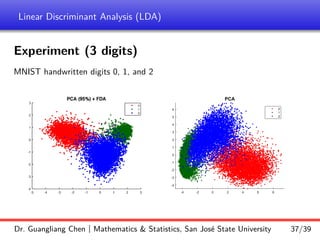
Experiment (3 digits)
MNIST handwritten digits 0, 1, and 2
-4 -2 0 2 4 6 8
-4
-3
-2
-1
0
1
2
3
4
5
6
PCA
0
1
2
Dr. Guangliang Chen | Mathematics  Statistics, San José State University 37/39
Linear Discriminant Analysis (LDA)
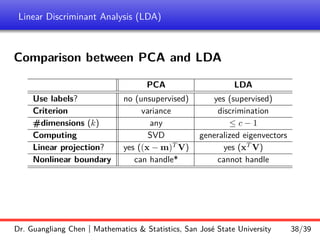
Comparison between PCA and LDA
PCA LDA
Use labels? no (unsupervised) yes (supervised)
Criterion variance discrimination
#dimensions (k) any ≤ c − 1
Computing SVD generalized eigenvectors
Linear projection? yes ((x − m)T
V) yes (xT
V)
Nonlinear boundary can handle* cannot handle
Dr. Guangliang Chen | Mathematics  Statistics, San José State University 38/39
Linear Discriminant Analysis (LDA)
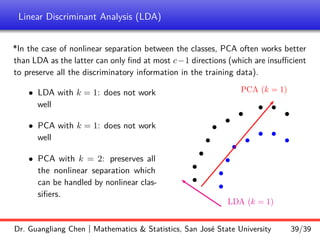
*In the case of nonlinear separation between the classes, PCA often works better
than LDA as the latter can only find at most c−1 directions (which are insufficient
to preserve all the discriminatory information in the training data).
• LDA with k = 1: does not work
well
• PCA with k = 1: does not work
well
• PCA with k = 2: preserves all
the nonlinear separation which
can be handled by nonlinear clas-
sifiers.
b
b
b
b
b
b
b
b
b
b
b
b
b
b
b
b
b
b
LDA (k = 1)
PCA (k = 1)
Dr. Guangliang Chen | Mathematics  Statistics, San José State University 39/39

Lecture on linerar discriminatory analysis

  • 1.
    San José StateUniversity Math 253: Mathematical Methods for Data Visualization Linear Discriminant Analysis (LDA) Dr. Guangliang Chen
  • 2.
    Outline • Motivation: – PCAis unsupervised (blind to training labels) – PCA focuses on variance (not always useful or relevant) • LDA: a supervised dimensionality reduction approach – 2-class LDA – Multiclass extension • Comparison between PCA and LDA
  • 3.
    Linear Discriminant Analysis(LDA) Data representation vs data classification PCA aims to find the most accurate data representation in a lower dimen- sional space spanned by the maximum- variance directions. However, such directions might not work well for tasks like classification. Here we present a new data reduction method that tries to preserve the dis- criminatory information between differ- ent classes of the data set. b b b b b b b b b b b b b b b Representative but not discriminative Dr. Guangliang Chen | Mathematics & Statistics, San José State University 3/39
  • 4.
    Linear Discriminant Analysis(LDA) The two-class LDA problem Given a training data set x1, . . . , xn ∈ Rd consisting of two classes C1, C2, find a (unit-vector) direction that “best” discriminates between the two classes. b b b b b b b b b b b b b b r r r r r b Dr. Guangliang Chen | Mathematics & Statistics, San José State University 4/39
  • 5.
    Linear Discriminant Analysis(LDA) Mathematical setup Consider any unit vector v ∈ Rd : b b b b b b b b b b b b b b r r r r r b x(t) = tv xi ai First, observe that projections of the two classes onto parallel lines always have “the same amount of separation”. This time we are going to focus on lines that pass through the origin. The 1D projections of the points are ai = vT xi, i = 1, . . . , n Note that they also carry the labels of the original data. Dr. Guangliang Chen | Mathematics & Statistics, San José State University 5/39
  • 6.
    Linear Discriminant Analysis(LDA) Now the data look like this: r r r r r How do we quantify the separation be- tween the two classes (in order to com- pare different directions v and select the best one)? One (naive) idea is to measure the dis- tance between the two class means in the 1D projection space: |µ1 − µ2|, where µ1 = 1 n1 X xi∈C1 ai = 1 n1 X xi∈C1 vT xi = vT · 1 n1 X xi∈C1 xi = vT m1 and similarly, µ2 = vT m2, m2 = 1 n2 X xi∈C2 xi. Dr. Guangliang Chen | Mathematics & Statistics, San José State University 6/39
  • 7.
    Linear Discriminant Analysis(LDA) That is, we solve the following problem max v: kvk=1 |µ1 − µ2| where µj = vT mj, j = 1, 2. However, this criterion does not always work (as shown in the right plot). What else do we need to control? b b b b b b b b b b r r b r r µ1 µ2 µ′ 1 µ′ 2 m2 m1 Dr. Guangliang Chen | Mathematics & Statistics, San José State University 7/39
  • 8.
    Linear Discriminant Analysis(LDA) It turns out that we should also pay attention to the variances of the projected classes: s2 1 = X xi∈C1 (ai − µ1)2 , s2 2 = X xi∈C2 (ai − µ2)2 Ideally, the projected classes have both faraway means and small variances. This can be achieved through the following modified formulation: max v:kvk=1 (µ1 − µ2)2 s2 1 + s2 2 . The optimal v should be such that • (µ1 − µ2)2 : large • s2 1, s2 2: both small Dr. Guangliang Chen | Mathematics & Statistics, San José State University 8/39
  • 9.
    Linear Discriminant Analysis(LDA) Mathematical derivation First, we derive a formula for the distance between the two projected centroids: (µ1 − µ2)2 = (vT m1 − vT m2)2 = (vT (m1 − m2))2 = vT (m1 − m2) · (m1 − m2)T v = vT Sbv, where Sb = (m1 − m2)(m1 − m2)T ∈ Rd×d is called the between-class scatter matrix. Remark. Clearly, Sb is square, symmetric and positive semidefinite. Moreover, rank(Sb) = 1, which implies that it only has 1 positive eigenvalue! Dr. Guangliang Chen | Mathematics & Statistics, San José State University 9/39
  • 10.
    Linear Discriminant Analysis(LDA) Next, for each class j = 1, 2, the variance of the projection (onto v) is s2 j = X xi∈Cj (ai − µj)2 = X xi∈Cj (vT xi − vT mj)2 = X xi∈Cj vT (xi − mj)(xi − mj)T v = vT   X xi∈Cj (xi − mj)(xi − mj)T   v = vT Sjv, where Sj = X xi∈Cj (xi − mj)(xi − mj)T ∈ Rd×d is called the within-class scatter matrix for class j. Dr. Guangliang Chen | Mathematics & Statistics, San José State University 10/39
  • 11.
    Linear Discriminant Analysis(LDA) The total within-class scatter of the two classes in the projection space is s2 1 + s2 2 = vT S1v + vT S2v = vT (S1 + S2)v = vT Swv where Sw = S1 + S2 = X xi∈C1 (xi − m1)(xi − m1)T + X xi∈C2 (xi − m2)(xi − m2)T is called the total within-class scatter matrix of the original data. Remark. Sw ∈ Rd×d is also square, symmetric, and positive semidefinite. Dr. Guangliang Chen | Mathematics & Statistics, San José State University 11/39
  • 12.
    Linear Discriminant Analysis(LDA) Putting everything together, we have derived the following optimization problem: max v:kvk=1 vT Sbv vT Swv ←− Where did we see this? Theorem 0.1. Suppose Sw is nonsingular. The maximizer of the problem is given by the largest eigenvector v1 of S−1 w Sb, i.e., S−1 w Sbv1 = λ1v1. Remark. rank(S−1 w Sb) = rank(Sb) = 1, so λ1 is the only nonzero (positive) eigenvalue that can be found. It represents the the largest amount of separation between the two classes along any single direction. Dr. Guangliang Chen | Mathematics & Statistics, San José State University 12/39
  • 13.
    Linear Discriminant Analysis(LDA) Computing The following are different ways of finding the optimal direction v1: • Slowest way (via three expensive steps): 1. work really hard to invert the d × d matrix Sw, 2. do the matrix multiplication S−1 w Sb, 3. solve the eigenvalue problem S−1 w Sbv1 = λ1v1. • A slight better way: Rewrite as a generalized eigenvalue problem Sbv1 = λ1Swv1, and then solve it through functions like eigs(A,B) in MATLAB. Dr. Guangliang Chen | Mathematics & Statistics, San José State University 13/39
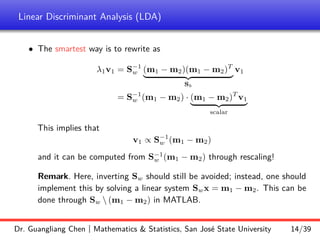
  • 14.
    Linear Discriminant Analysis(LDA) • The smartest way is to rewrite as λ1v1 = S−1 w (m1 − m2)(m1 − m2)T | {z } Sb v1 = S−1 w (m1 − m2) · (m1 − m2)T v1 | {z } scalar This implies that v1 ∝ S−1 w (m1 − m2) and it can be computed from S−1 w (m1 − m2) through rescaling! Remark. Here, inverting Sw should still be avoided; instead, one should implement this by solving a linear system Swx = m1 − m2. This can be done through Sw (m1 − m2) in MATLAB. Dr. Guangliang Chen | Mathematics & Statistics, San José State University 14/39
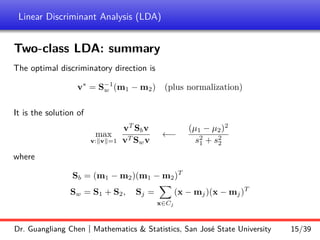
  • 15.
    Linear Discriminant Analysis(LDA) Two-class LDA: summary The optimal discriminatory direction is v∗ = S−1 w (m1 − m2) (plus normalization) It is the solution of max v:kvk=1 vT Sbv vT Swv ←− (µ1 − µ2)2 s2 1 + s2 2 where Sb = (m1 − m2)(m1 − m2)T Sw = S1 + S2, Sj = X x∈Cj (x − mj)(x − mj)T Dr. Guangliang Chen | Mathematics & Statistics, San José State University 15/39
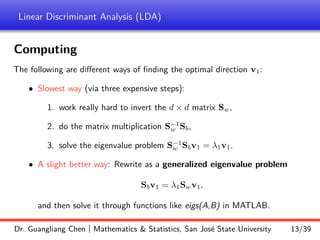
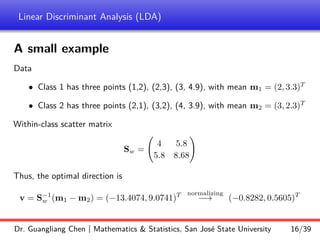
  • 16.
    Linear Discriminant Analysis(LDA) A small example Data • Class 1 has three points (1,2), (2,3), (3, 4.9), with mean m1 = (2, 3.3)T • Class 2 has three points (2,1), (3,2), (4, 3.9), with mean m2 = (3, 2.3)T Within-class scatter matrix Sw = 4 5.8 5.8 8.68 ! Thus, the optimal direction is v = S−1 w (m1 − m2) = (−13.4074, 9.0741)T normalizing −→ (−0.8282, 0.5605)T Dr. Guangliang Chen | Mathematics & Statistics, San José State University 16/39
  • 17.
    Linear Discriminant Analysis(LDA) and the projection coordinates are Y = [0.2928, 0.0252, 0.2619, −1.0958, −1.3635, −1.1267] -2 -1 0 1 2 3 4 -1 0 1 2 3 4 Dr. Guangliang Chen | Mathematics & Statistics, San José State University 17/39
  • 18.
    Linear Discriminant Analysis(LDA) Experiment (2 digits) MNIST handwritten digits 0 and 1 (left: LDA, right: PCA) 0 2000 4000 6000 8000 10000 12000 14000 -3 -2 -1 0 1 2 3 4 PCA (95%) + FDA 0 1 0 2000 4000 6000 8000 10000 12000 14000 -5 0 5 10 PCA 0 1 Dr. Guangliang Chen | Mathematics & Statistics, San José State University 18/39
  • 19.
    Linear Discriminant Analysis(LDA) Multiclass extension The previous procedure only applies to 2 classes. When there are c ≥ 3 classes, what is the “most discriminatory” direction? It will be based on the same intuition that the optimal direction v should project the different classes such that • each class is as tight as possible; • their centroids are as far from each other as possible. Both are actually about variances. b b b b b b b b b b b b b b b b b b b b b b b b b + + r r r v r + r r r r r r Dr. Guangliang Chen | Mathematics & Statistics, San José State University 19/39
  • 20.
    Linear Discriminant Analysis(LDA) Mathematical derivation For any unit vector v, the tightness of the projected classes (of the training data) is still described by the total within-class scatter: c X j=1 s2 j = X vT Sjv = vT X Sj v = vT Swv where the Sj, 1 ≤ j ≤ c are defined in the same way as before: Sj = X x∈Cj (x − mj)(x − mj)T and Sw = P Sj is the total within-class scatter matrix. Dr. Guangliang Chen | Mathematics Statistics, San José State University 20/39
  • 21.
    Linear Discriminant Analysis(LDA) To make the class centroids µj (in the projection space) as far from each other as possible, we can just maximize the variance of the centroids set {µ1, . . . , µk}: c X j=1 (µj −µ̄)2 = 1 c X j` (µj −µ`)2 , where µ̄ = 1 c c X j=1 µj ←− simple average. b b b b b b b b b b b b b b b b b b b b b b b b b + + r r r v r + r r r r r r µ1 µ2 µ3 Dr. Guangliang Chen | Mathematics Statistics, San José State University 21/39
  • 22.
    Linear Discriminant Analysis(LDA) We actually use a weighted mean of the projected centroids to define the between- class scatter: c X j=1 nj(µj − µ)2 , where µ = 1 n c X j=1 njµj ←− weighted average because the weighted mean (µ) is the projection of the global centroid (m) of the training data onto v: vT m = vT 1 n n X i=1 xi ! = vT   1 n c X j=1 njmj   = 1 n c X j=1 njµj = µ. In contrast, the simple mean does not have such a geometric interpretation: µ̄ = 1 c c X j=1 µj = 1 c c X j=1 vT mj = vT  1 c c X j=1 mj   Dr. Guangliang Chen | Mathematics Statistics, San José State University 22/39
  • 23.
    Linear Discriminant Analysis(LDA) b b b b b b b b b b b b b b b b b b b b b b b b b + + + r r r + m2 m1 m3 µ2 µ1 µ3 m (global centroid) µ r v Dr. Guangliang Chen | Mathematics Statistics, San José State University 23/39
  • 24.
    Linear Discriminant Analysis(LDA) We simplify the between-class scatter (in the v space) as follows: c X j=1 nj(µj − µ)2 = X nj(vT (mj − m))2 = X nj vT (mj − m)(mj − m)T v = vT X nj(mj − m)(mj − m)T v = vT Sbv. We have thus arrived at the same kind of problem max v:kvk=1 vT Sbv vT Swv ←− P nj(µj − µ)2 P s2 j Dr. Guangliang Chen | Mathematics Statistics, San José State University 24/39
  • 25.
    Linear Discriminant Analysis(LDA) Remark. When c = 2, it can be verified that 2 X j=1 nj(µj − µ)2 = n1n2 n (µ1 − µ2)2 , where µ = 1 n (n1µ1 + n2µ2) and 2 X j=1 nj(mj−m)(mj−m)T = n1n2 n (m2−m1)(m2−m1)T , m = 1 n (n1m1+n2m2) This shows that when there are only two classes, the weighted definitions are just a scalar multiple of the unweighted definitions. Therefore, the multiclass LDA P nj(µj − µ)2 / P s2 j is a natural generalization of the two-class LDA (µ1 − µ2)2 /(s2 1 + s2 2). Dr. Guangliang Chen | Mathematics Statistics, San José State University 25/39
  • 26.
    Linear Discriminant Analysis(LDA) Computing The solution is given by the largest eigenvector of S−1 w Sb (when Sw is nonsingular): S−1 w Sbv1 = λ1v1. However, the formula v1 ∝ S−1 w (m1 − m2) is no longer valid: λ1v1 = S−1 w Sbv1 = S−1 w X j nj(mj − m) (mj − m)T v1 | {z } scalar So we have to find v1 by solving a generalized eigenvalue problem: Sbv1 = λ1Swv1. Dr. Guangliang Chen | Mathematics Statistics, San José State University 26/39
  • 27.
    Linear Discriminant Analysis(LDA) Simulation Dr. Guangliang Chen | Mathematics Statistics, San José State University 27/39
  • 28.
    Linear Discriminant Analysis(LDA) What about the second eigenvector v2? Dr. Guangliang Chen | Mathematics Statistics, San José State University 28/39
  • 29.
    Linear Discriminant Analysis(LDA) How many discriminatory directions can we find? To answer this question, we just need to count the number of nonzero eigenvalues S−1 w Sbv = λv since only the nonzero eigenvectors will be used as the discriminatory directions. In the above equation, the within-class scatter matrix Sw is assumed to be nonsingular. However, the between-class scatter matrix Sb is of low rank: Sb = X ni(mi − m)(mi − m)T = [ √ n1(m1 − m) · · · √ nc(mc − m)] ·    √ n1(m1 − m)T . . . √ nc(mc − m)T    Dr. Guangliang Chen | Mathematics Statistics, San José State University 29/39
  • 30.
    Linear Discriminant Analysis(LDA) b b b b b b b b b b b b b b b b b b b b b b b b b + + + + m2 m1 m3 m (global centroid) Dr. Guangliang Chen | Mathematics Statistics, San José State University 30/39
  • 31.
    Linear Discriminant Analysis(LDA) Observe that the columns of the matrix [ √ n1(m1 − m) · · · √ nc(mc − m)] are linearly dependent: √ n1 · √ n1(m1 − m) + · · · + √ nc · √ nc(mc − m) = (n1m1 + · · · ncmc) − (n1 + · · · + nc)m = nm − nm = 0. The shows that rank(Sb) ≤ c − 1 (where c is the number of training classes). Therefore, one can only find at most c − 1 discriminatory directions. Dr. Guangliang Chen | Mathematics Statistics, San José State University 31/39
  • 32.
    Linear Discriminant Analysis(LDA) Multiclass LDA algorithm Input: Training data X ∈ Rn×d (with c classes) Output: At most c − 1 discriminatory directions and projections of X onto them 1. Compute Sw = c X j=1 X x∈Cj (x − mj)(x − mj)T , Sb = c X j=1 nj(mj − m)(mj − m)T . 2. Solve the generalized eigenvalue problem Sbv = λSwv to find all nonzero eigenvectors Vk = [v1, . . . , vk] (for some k ≤ c − 1) 3. Project the data X onto them Y = X · Vk ∈ Rn×k . Dr. Guangliang Chen | Mathematics Statistics, San José State University 32/39
  • 33.
    Linear Discriminant Analysis(LDA) The singularity issue of Sw So far, we have assumed that the total within-class scatter matrix Sw = c X j=1 Sj, where Sj = X xi∈Cj (xi − mj)(xi − mj)T is nonsingular, so that we can solve the LDA problem max v:kvk=1 vT Sbv vT Swv as an eigenvalue problem S−1 w Sbv = λv. However, in many cases (especially when having high dimensional data), the matrix Sw ∈ Rd×d is (nearly) singular (i.e., large condition number). Dr. Guangliang Chen | Mathematics Statistics, San José State University 33/39
  • 34.
    Linear Discriminant Analysis(LDA) 0 200 400 600 800 0 1 2 3 4 5 6 7 10 4 eigenvalues of S w (MNIST digits 0,1,2) 627th eigenvalue: 2.3258e-27 Dr. Guangliang Chen | Mathematics Statistics, San José State University 34/39
  • 35.
    Linear Discriminant Analysis(LDA) How does this happen? Let e xi = xi−mj for each i = 1, 2 . . . , n be the centered data points using its own class centroid. Define e X = [e x1 . . . e xn]T ∈ Rn×d . Then Sw = e XT e X ∈ Rd×d . b b b b b b b b b b b b b b b b b b b b b b b b b + + + Important issue: For high dimensional data (i.e., d is large), the centered data often do not fully span all d dimensions, thus making rank(Sw) = rank( e X) d (which implies that Sw is singular). Dr. Guangliang Chen | Mathematics Statistics, San José State University 35/39
  • 36.
    Linear Discriminant Analysis(LDA) Common fixes: • Apply global PCA to reduce the dimensionality of the labeled data (all classes) Ypca = X − [m . . . m]T · Vpca and then perform LDA on the reduced data: Zlda = Ypca · Vlda ←− learned from Ypca • Use pseudoinverse instead: S† wSbv = λv • Regularize Sw: S0 w = Sw + βId = QΛQT + βId = Q(Λ + βId)QT where Λ + βId = diag(λ1 + β, . . . , λd + β). Dr. Guangliang Chen | Mathematics Statistics, San José State University 36/39
  • 37.
    Linear Discriminant Analysis(LDA) Experiment (3 digits) MNIST handwritten digits 0, 1, and 2 -4 -2 0 2 4 6 8 -4 -3 -2 -1 0 1 2 3 4 5 6 PCA 0 1 2 Dr. Guangliang Chen | Mathematics Statistics, San José State University 37/39
  • 38.
    Linear Discriminant Analysis(LDA) Comparison between PCA and LDA PCA LDA Use labels? no (unsupervised) yes (supervised) Criterion variance discrimination #dimensions (k) any ≤ c − 1 Computing SVD generalized eigenvectors Linear projection? yes ((x − m)T V) yes (xT V) Nonlinear boundary can handle* cannot handle Dr. Guangliang Chen | Mathematics Statistics, San José State University 38/39
  • 39.
    Linear Discriminant Analysis(LDA) *In the case of nonlinear separation between the classes, PCA often works better than LDA as the latter can only find at most c−1 directions (which are insufficient to preserve all the discriminatory information in the training data). • LDA with k = 1: does not work well • PCA with k = 1: does not work well • PCA with k = 2: preserves all the nonlinear separation which can be handled by nonlinear clas- sifiers. b b b b b b b b b b b b b b b b b b LDA (k = 1) PCA (k = 1) Dr. Guangliang Chen | Mathematics Statistics, San José State University 39/39