Edmund Tayao, LOGODEF
Understanding Autonomy,
Decentralization and
Governance
Making Sense of
Politics as Means and
Not An Enterprise
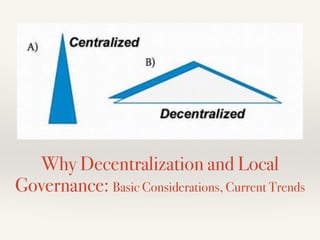
Why Decentralization and Local
Governance: Basic Considerations, Current Trends
Politics as Business and Governance as Service
❖ From purely political and security issues to economic
and welfare issues!
❖ Education, Health, Labor, Natural Resources especially Water, Religious and
Ethnic Diversity, Disaster Management and Mitigation, Traffic Management and
other day to day issues!
❖ Representation, Transparency, Accountability and
Responsiveness!
❖ Government to Governance
Development Requires A Bigger Role for LGUs
❖ Reinventing as Restructuring (Osborne and Gaebler 1992)!
❖ LGUs are at the frontlines of governance!
❖ Governance as Division of Labor and Participation!
❖ Key Points are to “Maximize,” “Organize” and “Optimize”!
❖ Maximize Resources!
❖ Organize Constituency!
❖ Optimize Delivery of Services!
❖ The Farther the LGU from the national government the more
significant role it plays
Increasing Role of LGUs
❖ As Social and Economic
Development becomes the
focus of Government Local
Governments have also come
to play more important roles!
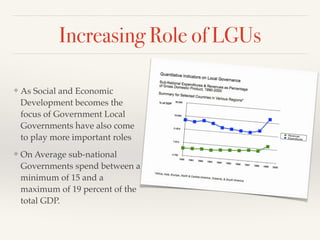
❖ On Average sub-national
Governments spend between a
minimum of 15 and a
maximum of 19 percent of the
total GDP.
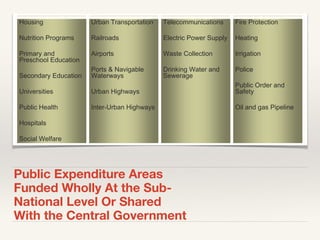
Fire Protection
Heating
Irrigation
Police
Public Order and
Safety
Oil and gas Pipeline
OTHER SERVICES
Urban Transportation
Railroads
Airports
Ports & Navigable
Waterways
Urban Highways
Inter-Urban Highways
TRANSPORTATION
Telecommunications
Electric Power Supply
Waste Collection
Drinking Water and
Sewerage
UTILITIES
Housing
Nutrition Programs
Primary and
Preschool Education
Secondary Education
Universities
Public Health
Hospitals
Social Welfare
SOCIAL SERVICES
Public Expenditure Areas
Funded Wholly At the Sub-
National Level Or Shared
With the Central Government
Substantial Sharing of Functions and Expenses
❖ 80 to 85 percent of GDP still
with Central Government
considering key functions of
national bureaucracy, foreign
relations, national defense,
monetary and fiscal policy!
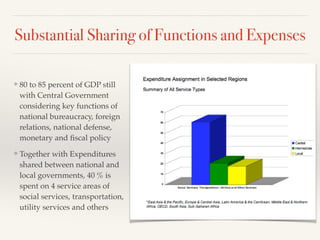
❖ Together with Expenditures
shared between national and
local governments, 40 % is
spent on 4 service areas of
social services, transportation,
utility services and others
Growing Developmental Function of LGUs
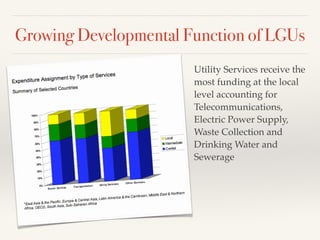
Utility Services receive the
most funding at the local
level accounting for
Telecommunications,
Electric Power Supply,
Waste Collection and
Drinking Water and
Sewerage!
!
!
Development is the Real Revolution
Democratization and
Decentralization
Transition from Government to Governance-
Innovations in the 1987 Constitution
❖ PR System- Party-list Representation!
❖ Legislature’s role on Martial Law!
❖ Concretization of ‘People Power’- Initiative,
Referendum, and Recall!
❖ Decentralization
Objectives
❖ Improve Delivery of Services!
❖ Afford significant autonomy to LGUs, and!
❖ Develop local economy, possibly result to local
economic elites.
Autonomy is Self-Governance
but Should Not Be Confused
with Independence
Decentralization is the Process
of Redistributing or Dispersing
Functions
The Advantage of Local Governance
Why reforms directed at the local has better chances to work?
❖ LGUs are smaller, easier to manage and reforms may be
easier to introduce!
❖ Facilitating interaction between leaders and
constituency is less complicated
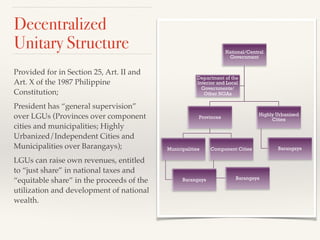
National/Central
Government
Provinces
Municipalities
Barangays
Component Cities
Barangays
Highly Urbanized
Cities
Barangays
Department of the
Interior and Local
Governments/
Other NGAs
Decentralized
Unitary Structure
Provided for in Section 25, Art. II and
Art. X of the 1987 Philippine
Constitution;!
President has “general supervision”
over LGUs (Provinces over component
cities and municipalities; Highly
Urbanized/Independent Cities and
Municipalities over Barangays);!
LGUs can raise own revenues, entitled
to “just share” in national taxes and
“equitable share” in the proceeds of the
utilization and development of national
wealth.
Decentralization is a Framework
❖ Designed to allow seamless functioning of separate
institutions at different levels, at the same time allowing
each level to retain integrity;!
❖ As framework, it is like a hardware that can be
maximized only depending on the software (programs
and or policies)
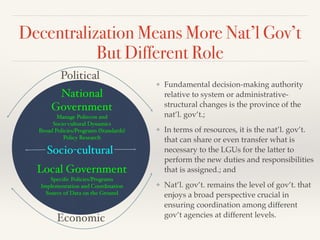
Decentralization Means More Nat’l Gov’t
But Different Role
❖ Fundamental decision-making authority
relative to system or administrative-
structural changes is the province of the
nat’l. gov’t.;!
❖ In terms of resources, it is the nat’l. gov’t.
that can share or even transfer what is
necessary to the LGUs for the latter to
perform the new duties and responsibilities
that is assigned.; and!
❖ Nat’l. gov’t. remains the level of gov’t. that
enjoys a broad perspective crucial in
ensuring coordination among different
gov’t agencies at different levels.
Political
Economic
Socio-cultural
National "
Government"
Manage Poliecon and"
Socio-cultural Dynamics"
Broad Policies/Programs (Standards)"
Policy Research
Local Government"
Specific Policies/Programs"
Implementation and Coordination"
Source of Data on the Ground
Points to Consider for Bangsamoro
Local Governance
❖ National/Central Government’s work is with Bangsamoro and the
latter works with LGUs;!
❖ Ensure to take note of LGU capacity before assigning specific functions
or programs (avoid unfunded mandates);!
❖ Technical support from DILG National and Bangsamoro DILG should
always be there;!
❖ Institutionalize mechanism of review (monitoring and evaluation) of
Bangsamoro decentralization; and,!
❖ Work closely with Civil Society and Academe to further enrich local
governance and development.
The Question of “How” is Always Fundamental but Most Difficult
Policy Making
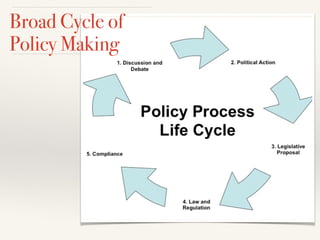
Broad Cycle of
Policy Making
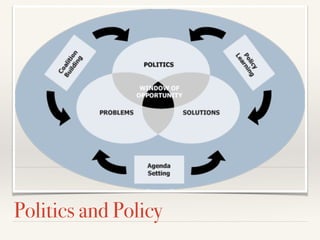
Politics and Policy
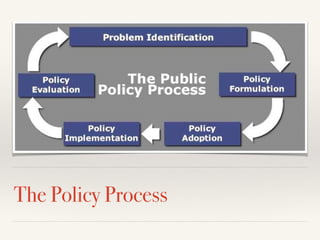
The Policy Process
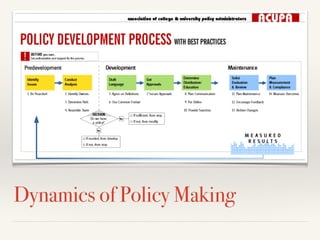
Dynamics of Policy Making
Underpinnings of Local Legislative Process
❖ Policy as Regulation and Program!
❖ Awareness of National-Local and Interlocal Relations and
Dynamics!
❖ The Difference of Executive-Legislative Roles and Relations at the
National and Local Government!
❖ The Local Executive and Legislator and their Political and Policy
Role- Desired Values and Skills!
❖ The Sanguniang Bayan as an Institution!
❖ The fundamental role of research
Governance is
Comprehensive and
Forward Looking
Requiring
Diligence,
Persistence
and Resilience!
see us at www.logodef.org!
email edtayao@logodef.org,
tweet @edtayao

Autonomy decentralization and governance

  • 1.
    Edmund Tayao, LOGODEF UnderstandingAutonomy, Decentralization and Governance Making Sense of Politics as Means and Not An Enterprise
  • 2.
    Why Decentralization andLocal Governance: Basic Considerations, Current Trends
  • 3.
    Politics as Businessand Governance as Service ❖ From purely political and security issues to economic and welfare issues! ❖ Education, Health, Labor, Natural Resources especially Water, Religious and Ethnic Diversity, Disaster Management and Mitigation, Traffic Management and other day to day issues! ❖ Representation, Transparency, Accountability and Responsiveness! ❖ Government to Governance
  • 4.
    Development Requires ABigger Role for LGUs ❖ Reinventing as Restructuring (Osborne and Gaebler 1992)! ❖ LGUs are at the frontlines of governance! ❖ Governance as Division of Labor and Participation! ❖ Key Points are to “Maximize,” “Organize” and “Optimize”! ❖ Maximize Resources! ❖ Organize Constituency! ❖ Optimize Delivery of Services! ❖ The Farther the LGU from the national government the more significant role it plays
  • 5.
    Increasing Role ofLGUs ❖ As Social and Economic Development becomes the focus of Government Local Governments have also come to play more important roles! ❖ On Average sub-national Governments spend between a minimum of 15 and a maximum of 19 percent of the total GDP.
  • 6.
    Fire Protection Heating Irrigation Police Public Orderand Safety Oil and gas Pipeline OTHER SERVICES Urban Transportation Railroads Airports Ports & Navigable Waterways Urban Highways Inter-Urban Highways TRANSPORTATION Telecommunications Electric Power Supply Waste Collection Drinking Water and Sewerage UTILITIES Housing Nutrition Programs Primary and Preschool Education Secondary Education Universities Public Health Hospitals Social Welfare SOCIAL SERVICES Public Expenditure Areas Funded Wholly At the Sub- National Level Or Shared With the Central Government
  • 7.
    Substantial Sharing ofFunctions and Expenses ❖ 80 to 85 percent of GDP still with Central Government considering key functions of national bureaucracy, foreign relations, national defense, monetary and fiscal policy! ❖ Together with Expenditures shared between national and local governments, 40 % is spent on 4 service areas of social services, transportation, utility services and others
  • 8.
    Growing Developmental Functionof LGUs Utility Services receive the most funding at the local level accounting for Telecommunications, Electric Power Supply, Waste Collection and Drinking Water and Sewerage! ! !
  • 9.
    Development is theReal Revolution Democratization and Decentralization
  • 10.
    Transition from Governmentto Governance- Innovations in the 1987 Constitution ❖ PR System- Party-list Representation! ❖ Legislature’s role on Martial Law! ❖ Concretization of ‘People Power’- Initiative, Referendum, and Recall! ❖ Decentralization
  • 11.
    Objectives ❖ Improve Deliveryof Services! ❖ Afford significant autonomy to LGUs, and! ❖ Develop local economy, possibly result to local economic elites. Autonomy is Self-Governance but Should Not Be Confused with Independence Decentralization is the Process of Redistributing or Dispersing Functions
  • 12.
    The Advantage ofLocal Governance Why reforms directed at the local has better chances to work? ❖ LGUs are smaller, easier to manage and reforms may be easier to introduce! ❖ Facilitating interaction between leaders and constituency is less complicated
  • 13.
    National/Central Government Provinces Municipalities Barangays Component Cities Barangays Highly Urbanized Cities Barangays Departmentof the Interior and Local Governments/ Other NGAs Decentralized Unitary Structure Provided for in Section 25, Art. II and Art. X of the 1987 Philippine Constitution;! President has “general supervision” over LGUs (Provinces over component cities and municipalities; Highly Urbanized/Independent Cities and Municipalities over Barangays);! LGUs can raise own revenues, entitled to “just share” in national taxes and “equitable share” in the proceeds of the utilization and development of national wealth.
  • 14.
    Decentralization is aFramework ❖ Designed to allow seamless functioning of separate institutions at different levels, at the same time allowing each level to retain integrity;! ❖ As framework, it is like a hardware that can be maximized only depending on the software (programs and or policies)
  • 15.
    Decentralization Means MoreNat’l Gov’t But Different Role ❖ Fundamental decision-making authority relative to system or administrative- structural changes is the province of the nat’l. gov’t.;! ❖ In terms of resources, it is the nat’l. gov’t. that can share or even transfer what is necessary to the LGUs for the latter to perform the new duties and responsibilities that is assigned.; and! ❖ Nat’l. gov’t. remains the level of gov’t. that enjoys a broad perspective crucial in ensuring coordination among different gov’t agencies at different levels. Political Economic Socio-cultural National " Government" Manage Poliecon and" Socio-cultural Dynamics" Broad Policies/Programs (Standards)" Policy Research Local Government" Specific Policies/Programs" Implementation and Coordination" Source of Data on the Ground
  • 16.
    Points to Considerfor Bangsamoro Local Governance ❖ National/Central Government’s work is with Bangsamoro and the latter works with LGUs;! ❖ Ensure to take note of LGU capacity before assigning specific functions or programs (avoid unfunded mandates);! ❖ Technical support from DILG National and Bangsamoro DILG should always be there;! ❖ Institutionalize mechanism of review (monitoring and evaluation) of Bangsamoro decentralization; and,! ❖ Work closely with Civil Society and Academe to further enrich local governance and development.
  • 17.
    The Question of“How” is Always Fundamental but Most Difficult Policy Making
  • 18.
  • 19.
  • 20.
  • 21.
  • 22.
    Underpinnings of LocalLegislative Process ❖ Policy as Regulation and Program! ❖ Awareness of National-Local and Interlocal Relations and Dynamics! ❖ The Difference of Executive-Legislative Roles and Relations at the National and Local Government! ❖ The Local Executive and Legislator and their Political and Policy Role- Desired Values and Skills! ❖ The Sanguniang Bayan as an Institution! ❖ The fundamental role of research
  • 23.
    Governance is Comprehensive and ForwardLooking Requiring Diligence, Persistence and Resilience! see us at www.logodef.org! email edtayao@logodef.org, tweet @edtayao