Decentralization
By:
Mohammad Asif Nasseri
Content
 What is Decentralization
 Decentralization Vs Centralization
 Types of Decentralization
 Advantages and Disadvantages
 Classic example of Decentralizations
 Should Your Organization Be Decentralized?
 Decentralization Organizations Examples
What is Decentralization?
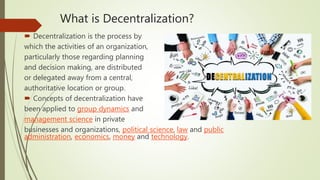
 Decentralization is the process by
which the activities of an organization,
particularly those regarding planning
and decision making, are distributed
or delegated away from a central,
authoritative location or group.
 Concepts of decentralization have
been applied to group dynamics and
management science in private
businesses and organizations, political science, law and public
administration, economics, money and technology.
Centralization Decentralization
The unification of powers and authorities, in
hands of high-level management
Dispersal of powers and authorities by the top
level to the functional management.
The systematic and consistent concentration of
authority at central points.
Unlike, decentralization is the systematic
delegation of authority in an organization.
Centralization is best for a small sized
organization,
The large sized organization should practice
decentralization.
There are full leadership and coordination in
Centralization.
Decentralization shares the burden of the top
level managers.
Formal communication exists
Communication stretches in all directions.
In centralization due to the concentration of
powers in the hands of a single person, the
decision takes time.
Decentralization proves better regarding
decision making as the decisions are taken
much closer to the actions.
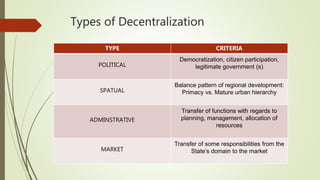
Types of Decentralization
TYPE CRITERIA
POLITICAL
Democratization, citizen participation,
legitimate government (s)
SPATUAL
Balance pattern of regional development:
Primacy vs. Mature urban hierarchy
ADMINSTRATIVE
Transfer of functions with regards to
planning, management, allocation of
resources
MARKET
Transfer of some responsibilities from the
State’s domain to the market
Advantages of Decentralization
 Reduces the burden on top
executives
 Facilitates diversification
 provide product and market
emphasis
 Executive Development
 It promotes motivation
 Better control and supervision
 Quick Decision-Making
Dis Advantages of Decentralization
 Uniform policies not Followed
 Problem of Co-Ordination
 More Financial Burden
 Require Qualified Personnel
 Conflict
Should Organizations be Decentralized
So, How can we tell an Organization would
benefit from Decentralization?
Real World Examples of Decentralization
 Fortune 500 company , it employs
approximately 50,000 people
 100 of businesses across 55 countries
 ITW has $6 billion in sales
 it is broken into 400 units
 an average revenue of just $15 million
 Each unit has its own general manager
 There aren’t any companywide, preset
benchmark profit goals
 top management imposes standards
based on a particular unit’s competition
 Philip Morris bought General Foods in
1985, then bought Kraft in 1988
 Oscar Mayer, Nabisco, and Jacobs Suchard
in Europe
 Instead of letting all of them have their
own functions and operate as business
units within a holding company, there was
a centralized model with very strong
functional control.
 Kraft Foods created a new, more
decentralized, business model
 Outcome: The centralized structure did
not work
Examples of Organizations That Are a Combination
of Centralized and Decentralized
 Subway
 Subway gives local stores control over hiring, but a
centralized headquarters makes decisions about things such
as menu and marketing.
Johnson & Johnson
 Johnson & Johnson, well known for its decentralized
structure, has over 200 units that function autonomously.
Some focus on particular components of a product, requiring
cooperation between such units.
Valve
 The gaming company Valve has embraced a flat structure,
eliminating job titles and allowing employees to work on or
initiate any project they choose. Such a structure might
germinate a great deal of creativity within a young company,
but it may need to be adapted as the company grows.
Thank you

Decentralization

  • 1.
  • 2.
    Content  What isDecentralization  Decentralization Vs Centralization  Types of Decentralization  Advantages and Disadvantages  Classic example of Decentralizations  Should Your Organization Be Decentralized?  Decentralization Organizations Examples
  • 3.
    What is Decentralization? Decentralization is the process by which the activities of an organization, particularly those regarding planning and decision making, are distributed or delegated away from a central, authoritative location or group.  Concepts of decentralization have been applied to group dynamics and management science in private businesses and organizations, political science, law and public administration, economics, money and technology.
  • 8.
    Centralization Decentralization The unificationof powers and authorities, in hands of high-level management Dispersal of powers and authorities by the top level to the functional management. The systematic and consistent concentration of authority at central points. Unlike, decentralization is the systematic delegation of authority in an organization. Centralization is best for a small sized organization, The large sized organization should practice decentralization. There are full leadership and coordination in Centralization. Decentralization shares the burden of the top level managers. Formal communication exists Communication stretches in all directions. In centralization due to the concentration of powers in the hands of a single person, the decision takes time. Decentralization proves better regarding decision making as the decisions are taken much closer to the actions.
  • 9.
    Types of Decentralization TYPECRITERIA POLITICAL Democratization, citizen participation, legitimate government (s) SPATUAL Balance pattern of regional development: Primacy vs. Mature urban hierarchy ADMINSTRATIVE Transfer of functions with regards to planning, management, allocation of resources MARKET Transfer of some responsibilities from the State’s domain to the market
  • 10.
    Advantages of Decentralization Reduces the burden on top executives  Facilitates diversification  provide product and market emphasis  Executive Development  It promotes motivation  Better control and supervision  Quick Decision-Making
  • 11.
    Dis Advantages ofDecentralization  Uniform policies not Followed  Problem of Co-Ordination  More Financial Burden  Require Qualified Personnel  Conflict
  • 12.
  • 13.
    So, How canwe tell an Organization would benefit from Decentralization?
  • 14.
    Real World Examplesof Decentralization  Fortune 500 company , it employs approximately 50,000 people  100 of businesses across 55 countries  ITW has $6 billion in sales  it is broken into 400 units  an average revenue of just $15 million  Each unit has its own general manager  There aren’t any companywide, preset benchmark profit goals  top management imposes standards based on a particular unit’s competition  Philip Morris bought General Foods in 1985, then bought Kraft in 1988  Oscar Mayer, Nabisco, and Jacobs Suchard in Europe  Instead of letting all of them have their own functions and operate as business units within a holding company, there was a centralized model with very strong functional control.  Kraft Foods created a new, more decentralized, business model  Outcome: The centralized structure did not work
  • 15.
    Examples of OrganizationsThat Are a Combination of Centralized and Decentralized  Subway  Subway gives local stores control over hiring, but a centralized headquarters makes decisions about things such as menu and marketing. Johnson & Johnson  Johnson & Johnson, well known for its decentralized structure, has over 200 units that function autonomously. Some focus on particular components of a product, requiring cooperation between such units. Valve  The gaming company Valve has embraced a flat structure, eliminating job titles and allowing employees to work on or initiate any project they choose. Such a structure might germinate a great deal of creativity within a young company, but it may need to be adapted as the company grows.
  • 16.