Centralization &
De-centralization
Content
 Introduction
 Definition
 Centralization
 Favor of Centralization
 Disfavor of Centralization
 Decentralization
 Favor of Decentralization
 Disfavor of Decentralization
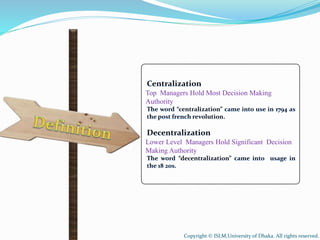
Centralization
Top Managers Hold Most Decision Making
Authority
The word “centralization” came into use in 1794 as
the post french revolution.
Decentralization
Lower Level Managers Hold Significant Decision
Making Authority
The word “decentralization” came into usage in
the 18 20s.
Copyright © ISLM,University of Dhaka. All rights reserved.
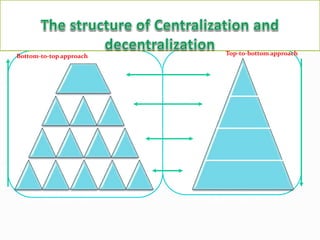
Decentralized approach
Bottom-to-top approach
Centralized approach
Top-to-bottom approach
Level 1
Level 2
Level 3
Level 4
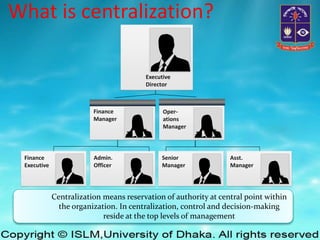
What is centralization?
Admin.
Officer
Senior
Manager
Finance
Executive
Asst.
Manager
Executive
Director
Oper-
ations
Manager
Finance
Manager
Centralization means reservation of authority at central point within
the organization. In centralization, control and decision-making
reside at the top levels of management
1. Delay in information management: Centralization creates loss of
man-hours and delay in information management. Quick decision is
not possible which also results delay in information management
process.
2.Remot control: Staff of the information institute are always kept
under the control of the authority.
3.No loyalty: In centralization management process there is no
subordinate’s initiative in work.
4.No special attention: In centralization no special attention is
given to special work as all works are done at one place.
5.Frustration:Centralization leads to frustration because of too rigid
central control.
6. Expectation: Many poor users can not be able to read their
expected books.
7.Interest: Many users lose their interest in reading
books because of they have to
come the specific place first then
they can collect their information.
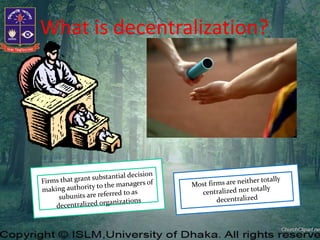
What is decentralization?
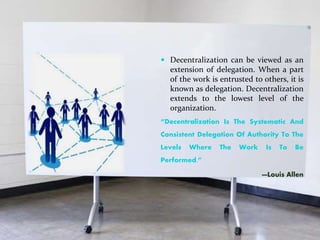
 Decentralization can be viewed as an
extension of delegation. When a part
of the work is entrusted to others, it is
known as delegation. Decentralization
extends to the lowest level of the
organization.
“Decentralization Is The Systematic And
Consistent Delegation Of Authority To The
Levels Where The Work Is To Be
Performed.”
—Louis Allen
1. Reduces the burden on the top executives: Decentralization relieves
the top executives of the burden of performing various information
management functions.
2.Facilitates diversification: Under decentralization, the
diversification of information management activities is facilitated.
3.Pressure of work: Decentralization of information institution
helps to reduce the working pressure because it has many centers.
4.Proper management: Decentralizing of information institution
helps to make the proper management of information.
5.Root level: Rural users also able to read their expected
books.
6. Executive development: When an information institution is
decentralized, executives in the institution will get the opportunity to
develop their talents by taking initiative.
7.It promotes motivation: Decentralization stimulates the formation
of small cohesive groups.
8. Better control and supervision: Decentralization ensures better
control and supervision as the subordinates at the lowest point.
9. Quick decision- making: Decentralization brings decision making
process closer to the scene of action.
Copyright © ISLM,University of Dhaka. All rights reserved.
Uniform policies not followed: Under decentralization , it is not possible to
follow uniform policies and standardized procedures.
Problem of co-ordination: Decentralization of information
institution creates problems of co-ordination of information
management.
More financial burden: It involves more financial burden and a
small information institution can not afford to do this.
Required Qualified personnel: Decentralization of
information management becomes useless when there is
no qualified and competent personnel.
Disadvantages of Decentralization
Difficulties: It can be faced
difficulties , because it is trying to
get everyone on the same page
when making decision.
More staff: It needs more staff for
maintaining the overall system.
Expensive:
Lack of Specialization:
Copyright © ISLM,University of Dhaka. All rights reserved.
Business owners should carefully consider which type of organizational
structure to use in their company
Small organizations typically benefit from centralized organizational
structures because owners often remain at the forefront of business
operations
Larger organizations usually require a more decentralized structure since
such companies can have several divisions or departments
Business owners may need to consider changing the organizational structure
depending on the growth and expansion of business operations
Copyright © ISLM,University of Dhaka. All rights reserved.
A balance must be maintained in management of
information Institution. So that an effective
structure evolves that permits the
accomplishment of goals and objectives. In
complex situations ,not all principles will have
the same priority, nor will they pull in the same
direction. Often varying situation will require
one principle to be emphasized more than
another until the environment changes.
Thank You Everybody

Centralization and decentralization

  • 2.
  • 3.
    Content  Introduction  Definition Centralization  Favor of Centralization  Disfavor of Centralization  Decentralization  Favor of Decentralization  Disfavor of Decentralization
  • 5.
    Centralization Top Managers HoldMost Decision Making Authority The word “centralization” came into use in 1794 as the post french revolution. Decentralization Lower Level Managers Hold Significant Decision Making Authority The word “decentralization” came into usage in the 18 20s. Copyright © ISLM,University of Dhaka. All rights reserved.
  • 6.
    Decentralized approach Bottom-to-top approach Centralizedapproach Top-to-bottom approach Level 1 Level 2 Level 3 Level 4
  • 8.
    What is centralization? Admin. Officer Senior Manager Finance Executive Asst. Manager Executive Director Oper- ations Manager Finance Manager Centralizationmeans reservation of authority at central point within the organization. In centralization, control and decision-making reside at the top levels of management
  • 11.
    1. Delay ininformation management: Centralization creates loss of man-hours and delay in information management. Quick decision is not possible which also results delay in information management process. 2.Remot control: Staff of the information institute are always kept under the control of the authority. 3.No loyalty: In centralization management process there is no subordinate’s initiative in work.
  • 12.
    4.No special attention:In centralization no special attention is given to special work as all works are done at one place. 5.Frustration:Centralization leads to frustration because of too rigid central control. 6. Expectation: Many poor users can not be able to read their expected books. 7.Interest: Many users lose their interest in reading books because of they have to come the specific place first then they can collect their information.
  • 14.
  • 15.
     Decentralization canbe viewed as an extension of delegation. When a part of the work is entrusted to others, it is known as delegation. Decentralization extends to the lowest level of the organization. “Decentralization Is The Systematic And Consistent Delegation Of Authority To The Levels Where The Work Is To Be Performed.” —Louis Allen
  • 16.
    1. Reduces theburden on the top executives: Decentralization relieves the top executives of the burden of performing various information management functions. 2.Facilitates diversification: Under decentralization, the diversification of information management activities is facilitated. 3.Pressure of work: Decentralization of information institution helps to reduce the working pressure because it has many centers. 4.Proper management: Decentralizing of information institution helps to make the proper management of information. 5.Root level: Rural users also able to read their expected books.
  • 17.
    6. Executive development:When an information institution is decentralized, executives in the institution will get the opportunity to develop their talents by taking initiative. 7.It promotes motivation: Decentralization stimulates the formation of small cohesive groups. 8. Better control and supervision: Decentralization ensures better control and supervision as the subordinates at the lowest point. 9. Quick decision- making: Decentralization brings decision making process closer to the scene of action.
  • 18.
    Copyright © ISLM,Universityof Dhaka. All rights reserved. Uniform policies not followed: Under decentralization , it is not possible to follow uniform policies and standardized procedures. Problem of co-ordination: Decentralization of information institution creates problems of co-ordination of information management. More financial burden: It involves more financial burden and a small information institution can not afford to do this. Required Qualified personnel: Decentralization of information management becomes useless when there is no qualified and competent personnel. Disadvantages of Decentralization
  • 19.
    Difficulties: It canbe faced difficulties , because it is trying to get everyone on the same page when making decision. More staff: It needs more staff for maintaining the overall system. Expensive: Lack of Specialization: Copyright © ISLM,University of Dhaka. All rights reserved.
  • 20.
    Business owners shouldcarefully consider which type of organizational structure to use in their company Small organizations typically benefit from centralized organizational structures because owners often remain at the forefront of business operations Larger organizations usually require a more decentralized structure since such companies can have several divisions or departments Business owners may need to consider changing the organizational structure depending on the growth and expansion of business operations Copyright © ISLM,University of Dhaka. All rights reserved.
  • 21.
    A balance mustbe maintained in management of information Institution. So that an effective structure evolves that permits the accomplishment of goals and objectives. In complex situations ,not all principles will have the same priority, nor will they pull in the same direction. Often varying situation will require one principle to be emphasized more than another until the environment changes.
  • 22.