Financial Administration, MPA
Dr. Abdullahi HASHİ, Lincoln University College, Department Of Political Science and Public
Administration.
INTRODUCTION
 Finance is the life blood of every organization; Personnel and materials
which are needed for the functioning of any office, industry, enterprise can
be made available only if money is provided.
 The efficiency of operating systems and maintenance systems depends upon the
effectiveness of financial system as every administrative act may have financial
implications.
 The significance of finance to public administration is quite obvious as is evident
from the remark of Lloyd George: "Government is finance".
Public Financial Administration Scholars
 Prominent and most quoted scholars relevant to the specialized study of public
financial administration include:
 J. J. N. Cloete
 B. J. Roux
 P. S. Botes
 D. F. S. Fourie
 W. L. J. Adlem
 S. B. M. Marume
 M. Marx
FINANCIAL ADMINISTRATION : MEANING
 The term Financial Administration consists of two words viz. 'Finance' and
'Administration’.
 The word 'administration' refers to organization and management of collective
human efforts in the pursuit of a conscious objective.
 The word 'Finance’ refers to monetary (money) resource.
 Financial Administration refers to that set of activities which are related to making
available money to the various branches of an office, or an organisation to enable it
to carrying out its objectives. Whether it is the Department of Agriculture, Railways,
Road Transport Corporation, Primary Health Centre, or Municipality.
 According to Jaze Gaston "Financial Administration is that part of government
organisation which deals with the collection, preservation and distribution of public
funds, with the coordination of public revenue and expenditure, with the
management of credit operations on behalf of the State and with the general
control of the financial affairs of public household:’’
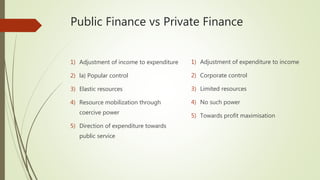
Public Finance vs Private Finance
1) Adjustment of income to expenditure
2) la) Popular control
3) Elastic resources
4) Resource mobilization through
coercive power
5) Direction of expenditure towards
public service
1) Adjustment of expenditure to income
2) Corporate control
3) Limited resources
4) No such power
5) Towards profit maximisation
NATURE OF FINANCIAL ADMINISTRATION
 There are two different views regarding the nature of financial administration.
These are:
i) Traditional view;
ii) Modern view.
Traditional View
 Advocates of this view conceive financial administration as a sum total of activities
undertaken in pursuit of generation, regulation and distribution of monetary resources
needed for the sustenance and growth of public organizations.
 A financial administrator shoulders responsibility for ensuring adequate financial backing
for running public organization in the most efficient manner. His/her job is to plan,
programme, organize and direct all financial activities in public organisations so as to
achieve efficient implementation of public policy.
Modem view
 The modem view considers financial administration as an integral part of the overall
management process of public organizations rather than one of raising and
disbursing public funds.
 According to this view financial administration has the following roles.
a) Equalizing Role : Under this role financial administration seeks to demolish the
inequalities of wealth. It seeks, through fiscal policies, to transfer income from the
affluent to the poor.
b) Functional Role : Under normal circumstances the economy cannot function on its
own. Under this role, financial administration seeks to ensure, through taxation, public
expenditure and public debt, and proper functioning of the economy. It evolves policy
instruments to maintain high economic growth and full employment.
c) Stabilizing Role : Under this role, the objective of financial administration is the
stabilization of price level and inflationary trends through fiscal as well as monetary
policies.
d) Activating Role : Under this role financial administration involves the study of such
steps that will facilitate a smooth and rapid flow of investment and its optimal
allocation to iricrease the volume of national income.
e) Participatory Role : According to this view, financial administration involves
formulation and execution of policies for making the state a producer of both public
and private goods with the objective of maximising social welfare of the community.
SCOPE OF FINANCIAL ADMINISTRATION
 The government organization which deals with the following four aspects
constitutes financial administration.
1) The collection, preservation and distribution of public funds.
2) The coordination of public revenues and expenditure.
3) The management of credit operations on behalf of the State.
4) The general control of the financial affairs of the government.
 In modern governments all the above aspects are dealt with by the Finance
Department and its subordinate agencies.
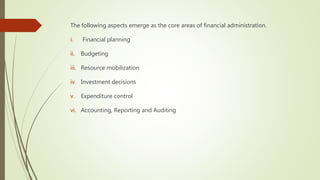
The following aspects emerge as the core areas of financial administration.
i. Financial planning
ii. Budgeting
iii. Resource mobilization
iv. Investment decisions
v. Expenditure control
vi. Accounting, Reporting and Auditing
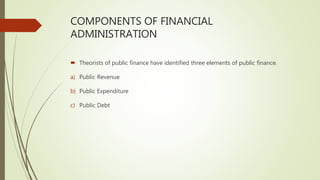
COMPONENTS OF FINANCIAL
ADMINISTRATION
 Theorists of public finance have identified three elements of public finance.
a) Public Revenue
b) Public Expenditure
c) Public Debt
 Some other thinkers, taking clue from Luther Gulick, have tried to project
POSDCORCs view wherein :
P - Stands for Financial Planning
0 - Stands for Financial Organisation such as Finance Ministry
S - Stands for financial Personnel
D - Stands for Direction such as Financial advise
CO - Stands for Coordination of Income and Expenditure
R - Stands for Financial Reporting such as accounting
C - Stands for control which includes executive control, audit control and
legislative control.
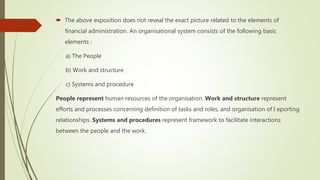
 The above exposition does not reveal the exact picture related to the elements of
financial administration. An organisational system consists of the following basic
elements :
a) The People
b) Work and structure
c) Systems and procedure
People represent human resources of the organisation. Work and structure represent
efforts and processes concerning definition of tasks and roles, and organisation of I eporting
relationships. Systems and procedures represent framework to facilitate interactions
between the people and the work.
a) Human Eleme
 Taxpayers
 Suppliers (Funds and materials)
 Employees (Public Officials)
 Entrepreneurs (Politicians)
 Customers & Common person
b) Work and Structures
 The Legislature and its financial committees
 The Cabinet
 The Finance Department
 The Administrative Departments
 The Executive Departments
 The Audit Department
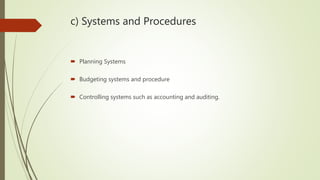
c) Systems and Procedures
 Planning Systems
 Budgeting systems and procedure
 Controlling systems such as accounting and auditing.

Financial admin

  • 1.
    Financial Administration, MPA Dr.Abdullahi HASHİ, Lincoln University College, Department Of Political Science and Public Administration.
  • 2.
    INTRODUCTION  Finance isthe life blood of every organization; Personnel and materials which are needed for the functioning of any office, industry, enterprise can be made available only if money is provided.  The efficiency of operating systems and maintenance systems depends upon the effectiveness of financial system as every administrative act may have financial implications.  The significance of finance to public administration is quite obvious as is evident from the remark of Lloyd George: "Government is finance".
  • 3.
    Public Financial AdministrationScholars  Prominent and most quoted scholars relevant to the specialized study of public financial administration include:  J. J. N. Cloete  B. J. Roux  P. S. Botes  D. F. S. Fourie  W. L. J. Adlem  S. B. M. Marume  M. Marx
  • 4.
    FINANCIAL ADMINISTRATION :MEANING  The term Financial Administration consists of two words viz. 'Finance' and 'Administration’.  The word 'administration' refers to organization and management of collective human efforts in the pursuit of a conscious objective.  The word 'Finance’ refers to monetary (money) resource.  Financial Administration refers to that set of activities which are related to making available money to the various branches of an office, or an organisation to enable it to carrying out its objectives. Whether it is the Department of Agriculture, Railways, Road Transport Corporation, Primary Health Centre, or Municipality.
  • 5.
     According toJaze Gaston "Financial Administration is that part of government organisation which deals with the collection, preservation and distribution of public funds, with the coordination of public revenue and expenditure, with the management of credit operations on behalf of the State and with the general control of the financial affairs of public household:’’
  • 6.
    Public Finance vsPrivate Finance 1) Adjustment of income to expenditure 2) la) Popular control 3) Elastic resources 4) Resource mobilization through coercive power 5) Direction of expenditure towards public service 1) Adjustment of expenditure to income 2) Corporate control 3) Limited resources 4) No such power 5) Towards profit maximisation
  • 7.
    NATURE OF FINANCIALADMINISTRATION  There are two different views regarding the nature of financial administration. These are: i) Traditional view; ii) Modern view.
  • 8.
    Traditional View  Advocatesof this view conceive financial administration as a sum total of activities undertaken in pursuit of generation, regulation and distribution of monetary resources needed for the sustenance and growth of public organizations.  A financial administrator shoulders responsibility for ensuring adequate financial backing for running public organization in the most efficient manner. His/her job is to plan, programme, organize and direct all financial activities in public organisations so as to achieve efficient implementation of public policy.
  • 9.
    Modem view  Themodem view considers financial administration as an integral part of the overall management process of public organizations rather than one of raising and disbursing public funds.  According to this view financial administration has the following roles. a) Equalizing Role : Under this role financial administration seeks to demolish the inequalities of wealth. It seeks, through fiscal policies, to transfer income from the affluent to the poor.
  • 10.
    b) Functional Role: Under normal circumstances the economy cannot function on its own. Under this role, financial administration seeks to ensure, through taxation, public expenditure and public debt, and proper functioning of the economy. It evolves policy instruments to maintain high economic growth and full employment. c) Stabilizing Role : Under this role, the objective of financial administration is the stabilization of price level and inflationary trends through fiscal as well as monetary policies.
  • 11.
    d) Activating Role: Under this role financial administration involves the study of such steps that will facilitate a smooth and rapid flow of investment and its optimal allocation to iricrease the volume of national income. e) Participatory Role : According to this view, financial administration involves formulation and execution of policies for making the state a producer of both public and private goods with the objective of maximising social welfare of the community.
  • 12.
    SCOPE OF FINANCIALADMINISTRATION  The government organization which deals with the following four aspects constitutes financial administration. 1) The collection, preservation and distribution of public funds. 2) The coordination of public revenues and expenditure. 3) The management of credit operations on behalf of the State. 4) The general control of the financial affairs of the government.  In modern governments all the above aspects are dealt with by the Finance Department and its subordinate agencies.
  • 13.
    The following aspectsemerge as the core areas of financial administration. i. Financial planning ii. Budgeting iii. Resource mobilization iv. Investment decisions v. Expenditure control vi. Accounting, Reporting and Auditing
  • 14.
    COMPONENTS OF FINANCIAL ADMINISTRATION Theorists of public finance have identified three elements of public finance. a) Public Revenue b) Public Expenditure c) Public Debt
  • 15.
     Some otherthinkers, taking clue from Luther Gulick, have tried to project POSDCORCs view wherein : P - Stands for Financial Planning 0 - Stands for Financial Organisation such as Finance Ministry S - Stands for financial Personnel D - Stands for Direction such as Financial advise CO - Stands for Coordination of Income and Expenditure R - Stands for Financial Reporting such as accounting C - Stands for control which includes executive control, audit control and legislative control.
  • 16.
     The aboveexposition does not reveal the exact picture related to the elements of financial administration. An organisational system consists of the following basic elements : a) The People b) Work and structure c) Systems and procedure People represent human resources of the organisation. Work and structure represent efforts and processes concerning definition of tasks and roles, and organisation of I eporting relationships. Systems and procedures represent framework to facilitate interactions between the people and the work.
  • 17.
    a) Human Eleme Taxpayers  Suppliers (Funds and materials)  Employees (Public Officials)  Entrepreneurs (Politicians)  Customers & Common person
  • 18.
    b) Work andStructures  The Legislature and its financial committees  The Cabinet  The Finance Department  The Administrative Departments  The Executive Departments  The Audit Department
  • 19.
    c) Systems andProcedures  Planning Systems  Budgeting systems and procedure  Controlling systems such as accounting and auditing.