Strategies for Making
Buildings Green and Energy
Efficient
*Jit Kumar Gupta
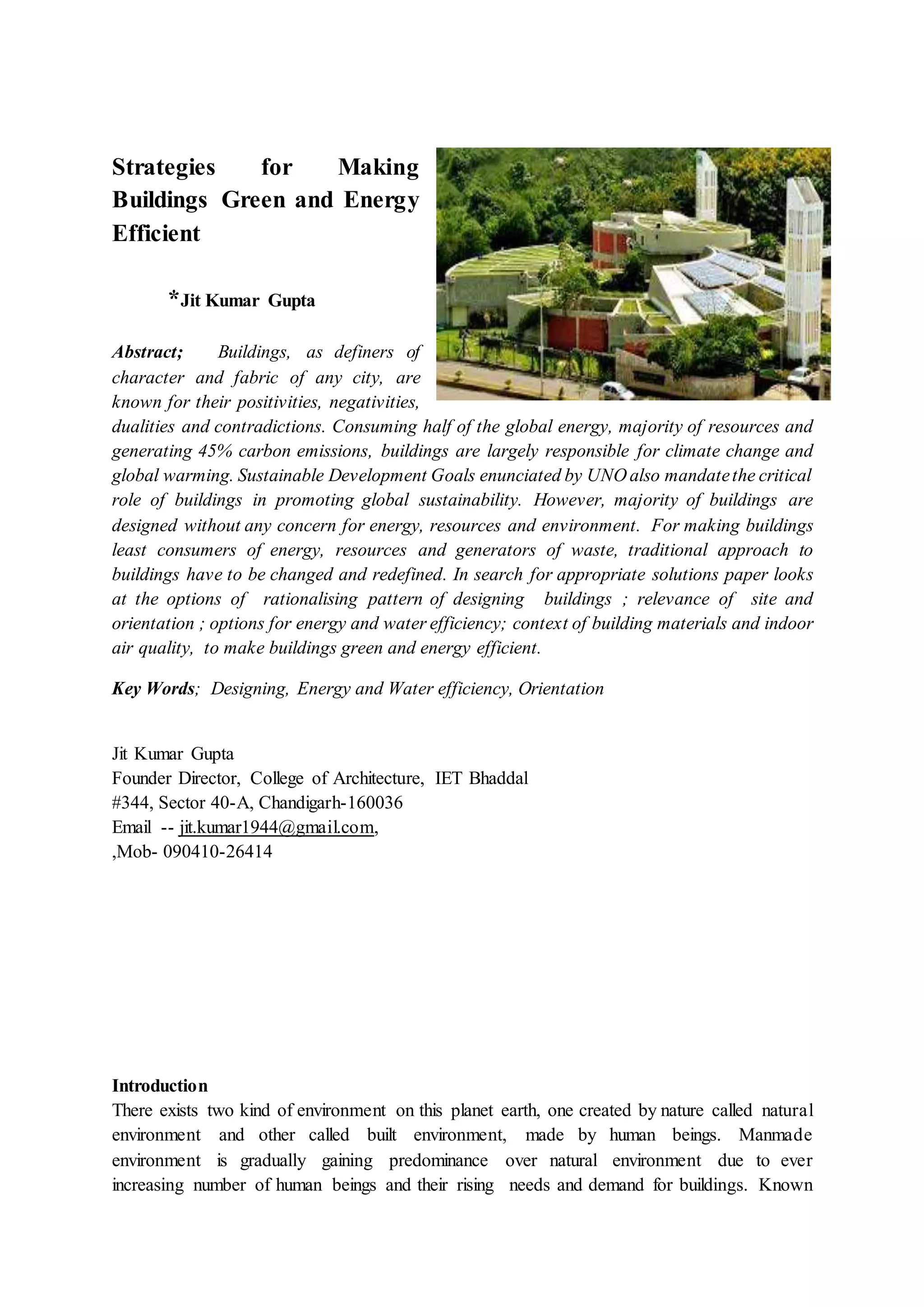
Abstract; Buildings, as definers of
character and fabric of any city, are
known for their positivities, negativities,
dualities and contradictions. Consuming half of the global energy, majority of resources and
generating 45% carbon emissions, buildings are largely responsible for climate change and
global warming. Sustainable Development Goals enunciated by UNO also mandatethe critical
role of buildings in promoting global sustainability. However, majority of buildings are
designed without any concern for energy, resources and environment. For making buildings
least consumers of energy, resources and generators of waste, traditional approach to
buildings have to be changed and redefined. In search for appropriate solutions paper looks
at the options of rationalising pattern of designing buildings ; relevance of site and
orientation ; options for energy and water efficiency; context of building materials and indoor
air quality, to make buildings green and energy efficient.
Key Words; Designing, Energy and Water efficiency, Orientation
Jit Kumar Gupta
Founder Director, College of Architecture, IET Bhaddal
#344, Sector 40-A, Chandigarh-160036
Email -- jit.kumar1944@gmail.com,
,Mob- 090410-26414
Introduction
There exists two kind of environment on this planet earth, one created by nature called natural
environment and other called built environment, made by human beings. Manmade
environment is gradually gaining predominance over natural environment due to ever
increasing number of human beings and their rising needs and demand for buildings. Known
for concentration, cities house large number of people, buildings, activities and amenities in
small space. Occupying only two percent of the earth’s landmass, containing 50 percent of
world population, cities consume 75 percent of world’s resources and produce 75 percent of
waste. Consumption of resources and generation of waste by urban settlements are the outcome
of quality, quantity and typologies of buildings designed and built.
Buildings define both human history, growth and development besides future journey of
mankind. Buildings remain vital for human growth because they are central to all human
activities and are known to deeply impact the quality of life, because 80% of human life is
spent within buildings. Modulating quality of life, buildings make human beings healthy/sick.
As largest polluter of environment /ecology and generators of large carbon footprints, buildings
remain responsible for climate change, global warming and modulators of sustainability.
Large consumption of resources and generation of waste can be attributed to the way buildings
are designed, constructed, operated and maintained. Making buildings sustainable is essential
for preserving, protecting and making value addition to resources, environment and ecology.
Considering the contours of Indian urbanisation, McKinsey Global Institute, ‘India Urban
Awakening: Building Inclusive Cities -Report’, states that 700-900 million sqmts of built
space would be required annually, to meet the needs of urban India. Considering the enormity
of space and their implications as consumer of energy and resources, buildings need to be
planned, constructed and operated with utmost care and caution, with focus on energy
conservation, sustainability and resource efficiency
GREEN BUILDINGS
Buildings known for their positivities, negativities, dualities and contradictions, not only
provide space for productive living for human beings, but are also anti-thesis to the
environment and ecology. Buildings constitute a complex system of designing, construction,
materials, resources and environment. Revolving around seven layers during its life-cycle
( Siting , designing, construction, operation, maintenance, renovation and deconstruction);
promoting consumption (energy, water, materials and natural resources); impacting
environment ( generating waste, air / water pollution, indoor pollution, heat islands, storm
water runoff); buildings adversely impact human health, environment and precious
resources.( Table-1)
Table-1—Impact of Built Environment
According to World Energy Council Report, 2016, buildings consume over 45% global energy,
30% raw materials, 25% timber harvested, 16% fresh water withdrawal, 35% of world’s CO2
emission, 40% municipal solid waste and 50% ozone depleting CFC besides promoting ‘sick
building syndrome’. Considering lifecycle cost and energy, only !0% cost& 17% energy goes
into making of a building whereas remaining 90% cost/ 83% energy is used in their operation
and maintenance, involving heating, cooling, lighting and ventilating. Thus buildings offer
greatest opportunity to minimize energy consumption by merely changing the manner in which
buildings are planned, constructed and operated.
Looking at the entire gamut of built environment,
Green Buildings emerge as the best
option to make buildings sustainable
and least consumers of energy and
resources. Green Buildings minimize
use of water, optimize energy
efficiency, conserve natural resources,
generate less waste and provide
healthier space for occupants as
compared to conventional buildings.
Green Buildings also save energy upto
50%; water consumption by 40%;
reduce carbon emission by 35% ; Co2
by 8000-12000 tons and 3 MW of connected electric load / million Sqft building; besides
reducing 70% waste. Green buildings not only reduce consumption of non-renewable resources
but also fetch better returns from buildings. Such buildings provide financial, environmental
and social benefits besides creating a win-win situation for both owners, occupants and users
through improved productivity. Studies reveal that, ‘ Green Schools make learning easy and
more meaningful’; ‘Green Houses makes people happy and healthy’; Green Hospitals cures
patients quickly and Green Shopping Malls can increase sale / profits’. Green building may
cost more up-front, but save through lower operating costs over useful life of building. Cost
savings is optimised when buildings is designed as green buildings at the conceptual design
phase. Potential financial benefits of improving indoor environments exceed costs by
a factor of 8 and 14. Green Building practices expands/ complements building design concerns
of: economy, utility, durability and comfort
DESIGNING GREEN BUILDINGS
World Green Building Council has defined Green Building as a, “Building that, in its design,
construction or operation, reduces or eliminates negative impacts, can create positive impacts,
on our climate and natural environment. Green buildings preserve precious natural resources,
improve quality of life. It includes following features;
 Using efficiently energy, water and other resources
 Using renewable energy including solar energy
 Reducing pollution and waste, involving re-use and recycling
 Promoting good indoor environmental air quality
 Using non-toxic waste based sustainable materials
 Valuing environment as integral part of design, construction and operation
 Ensuring quality of life for occupants
 Evolving design, that responds positively to changing environment
While principles for building green remain universal but designing green buildings will vary
from region to region and within regions, depending upon prevailing climate, site conditions,
cultures, traditions, available materials, construction practices and building typology besides
environmental, economic and social priorities. Buildings shall continue to be consumers of
energy but a green building not only minimise the use of such resources but also replaces the
conventional resources with resources, which are available in abundance and remain
regenerative universally. Basic approach to green buildings shall revolve around designing
with nature, making best use of natural resources and adopting integrated approach to
design. While Planning with nature would essentially involve, making optimum use of
Panchbhutas- Prithvi (site), Agni( energy), Jal (water), Vayu (air) and Aakash (Space), for
meeting the basic needs of energy and resources for buildings, Integrated approach to
building design would essentially revolve around, respecting site , rationalising site planning,
rationalising built form, lowering surface to volume ratio; promoting building efficiency,
evolving efficient structural design; adopting solar passive techniques, using energy efficient
equipment, controlling lighting, heating, ventilation; using solar energy/air movement,
reducing transportation, minimising waste, using local materials in natural form, optimising
landscaping etc. Orientation will remain determinant for optimising nature and natural
resources and accordingly, will be effectively leveraged in design solutions to modulate heat
gain/loss and evolve energy efficient building envelop. Since requirements of building design
would vary, accordingly, buildings with regard to climate, sun and wind will have to be
oriented differently in different regions. For ensuring buildings to make best use of solar and
wind energy, essential would be that majority of sites should have advantage of best
orientation. Accordingly, town planner’s role would be important role to ensure that maximum
number of plots have best orientation, to enable Architects to evolve a sustainable and energy
efficient design of building. Rationalising site planning would involve that entire built up area
shall have benefit of natural light during the day. This would be particularly critical in case of
row housing, where plots have the option to draw light only from front and rear. For making
buildings energy efficient, they must be designed to conform to the norms and standards
defined by the Indian Green Building Council for green buildings.
Since designing green buildings remains a professional/team work, accordingly such projects
shall invariably involve creating a dedicated teams of architects, engineers, landscape expert ,
consultants etc, having knowledge, expertise , understanding, experience of designing green
buildings .
PLANNING FOR SITE AND BUILDING
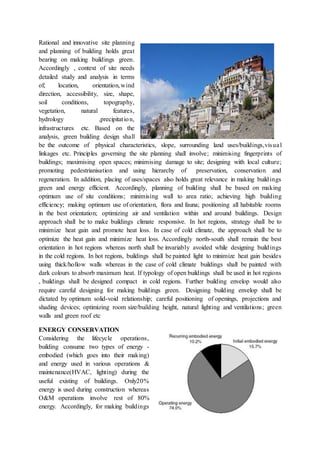
Rational and innovative site planning
and planning of building holds great
bearing on making buildings green.
Accordingly , context of site needs
detailed study and analysis in terms
of; location, orientation,wind
direction, accessibility, size, shape,
soil conditions, topography,
vegetation, natural features,
hydrology ,precipitation,
infrastructures etc. Based on the
analysis, green building design shall
be the outcome of physical characteristics, slope, surrounding land uses/buildings,visual
linkages etc. Principles governing the site planning shall involve; minimising fingerprints of
buildings; maximising open spaces; minimising damage to site; designing with local culture;
promoting pedestrianisation and using hierarchy of preservation, conservation and
regeneration. In addition, placing of uses/spaces also holds great relevance in making buildings
green and energy efficient. Accordingly, planning of building shall be based on making
optimum use of site conditions; minimising wall to area ratio; achieving high building
efficiency; making optimum use of orientation, flora and fauna; positioning all habitable rooms
in the best orientation; optimizing air and ventilation within and around buildings. Design
approach shall be to make buildings climate responsive. In hot regions, strategy shall be to
minimize heat gain and promote heat loss. In case of cold climate, the approach shall be to
optimize the heat gain and minimize heat loss. Accordingly north-south shall remain the best
orientation in hot regions whereas north shall be invariably avoided while designing buildings
in the cold regions. In hot regions, buildings shall be painted light to minimize heat gain besides
using thick/hollow walls whereas in the case of cold climate buildings shall be painted with
dark colours to absorb maximum heat. If typology of open buildings shall be used in hot regions
, buildings shall be designed compact in cold regions. Further building envelop would also
require careful designing for making buildings green. Designing building envelop shall be
dictated by optimum solid-void relationship; careful positioning of openings, projections and
shading devices; optimizing room size/building height, natural lighting and ventilations; green
walls and green roof etc
ENERGY CONSERVATION
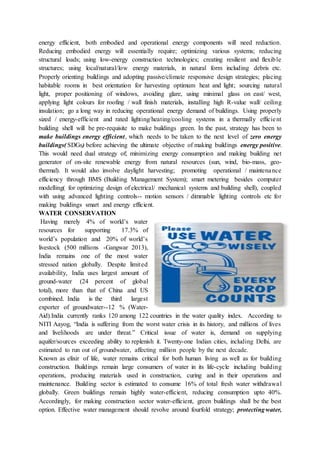
Considering the lifecycle operations,
building consume two types of energy -
embodied (which goes into their making)
and energy used in various operations &
maintenance(HVAC, lighting) during the
useful existing of buildings. Only20%
energy is used during construction whereas
O&M operations involve rest of 80%
energy. Accordingly, for making buildings
energy efficient, both embodied and operational energy components will need reduction.
Reducing embodied energy will essentially require; optimizing various systems; reducing
structural loads; using low-energy construction technologies; creating resilient and flexible
structures; using local/natural/low energy materials, in natural form including debris etc.
Properly orienting buildings and adopting passive/climate responsive design strategies; placing
habitable rooms in best orientation for harvesting optimum heat and light; sourcing natural
light, proper positioning of windows, avoiding glare, using minimal glass on east/ west,
applying light colours for roofing / wall finish materials, installing high R-value wall/ ceiling
insulation; go a long way in reducing operational energy demand of buildings. Using properly
sized / energy-efficient and rated lighting/heating/cooling systems in a thermally efficient
building shell will be pre-requisite to make buildings green. In the past, strategy has been to
make buildings energy efficient, which needs to be taken to the next level of zero energy
buildings( SDGs) before achieving the ultimate objective of making buildings energy positive.
This would need dual strategy of; minimizing energy consumption and making building net
generator of on-site renewable energy from natural resources (sun, wind, bio-mass, geo-
thermal). It would also involve daylight harvesting; promoting operational / maintenance
efficiency through BMS (Building Management System); smart metering besides computer
modelling( for optimizing design of electrical/ mechanical systems and building shell), coupled
with using advanced lighting controls-- motion sensors / dimmable lighting controls etc for
making buildings smart and energy efficient.
WATER CONSERVATION
Having merely 4% of world’s water
resources for supporting 17.3% of
world’s population and 20% of world’s
livestock (500 millions -Gangwar 2013),
India remains one of the most water
stressed nation globally. Despite limited
availability, India uses largest amount of
ground-water (24 percent of global
total), more than that of China and US
combined. India is the third largest
exporter of groundwater--12 % (Water-
Aid).India currently ranks 120 among 122 countries in the water quality index. According to
NITI Aayog, “India is suffering from the worst water crisis in its history, and millions of lives
and livelihoods are under threat.” Critical issue of water is, demand on supplying
aquifer/sources exceeding ability to replenish it. Twenty-one Indian cities, including Delhi, are
estimated to run out of groundwater, affecting million people by the next decade.
Known as elixir of life, water remains critical for both human living as well as for building
construction. Buildings remain large consumers of water in its life-cycle including building
operations, producing materials used in construction, curing and in their operations and
maintenance. Building sector is estimated to consume 16% of total fresh water withdrawal
globally. Green buildings remain highly water-efficient, reducing consumption upto 40%.
Accordingly, for making construction sector water-efficient, green buildings shall be the best
option. Effective water management should revolve around fourfold strategy; protectingwater,
conserving water, protecting water quality and reducing consumption. Options for
minimizing water consumption shall involve; adopting water-efficient construction practices.
Pre-fabrication technology is known for its water efficiency which needs leveraging
effectively. Strategy for multiple uses of water through dual plumbing; in-house sewage
treatment; using phytometric solutionfor sewage treatment; using grey water for flushing and
landscaping; using water rated/efficient fixtures -ultra-low flush toilets/urinals; rationalizing
landscaping; using native flora& fauna; minimizing building footprints ; providing large
porous space can lower water consumption and increase ground water recharge. The intent is
to reduce the generation of waste water and potable water demand. Slow the flow, breaking
water flow, creating mist by mixing air with water, are other options to reduce water
consumption. From water efficiency , there is need to graduate to zero-water buildings and
ultimately water-positive buildings by promoting rainwater harvesting, ground water re-
charging, air based cooling and reinventing sanitation system which is not simply water
based.
GREEN MATERIALS AND TECHNOLOGIES
Buildings consume three billion tons of raw
materials annually, constituting 40 percent of
total materials used globally (Roodman and
Lenssen, 1995). Materials remain major
determinant of embodied energy, cost, quality
and maintenance of buildings besides posing
serious environmental issues associated with;
extraction, transportation, processing,
fabrication, installation, reuse, recycling and
their disposal. Considering their major
implications, materials used in buildings should, promote conservation of non-renewable
resources ; ensure energy conservation; minimise maintenance/replacement costs,; create
healthy indoor environment; lowering costs associated with making additions/alterations
besides offering .greater design flexibility. Accordingly, materials used in buildings should
essentially be resource efficient; natural, plentiful, renewable; energy/water efficient;
environment responsive; affordable; involving minimum maintenance; recyclable; locally
available; easily salvaged, furbished and remanufactured; made from industrial/agro waste and
durable. Further materials should be lightweight to reduce self- load of building, involving
using fewer/more durable materials and generating less waste at the end. In addition, green
buildings shall involve using state of art and innovative construction technology which are
cost- effective, material efficient, speedier, energy/water efficient, safe, generators of minimum
waste, using local resources, ensuring optimum use of materials, integrating renewable and
low-carbon technologies.
INDOOR AIR QUALITY (IAQ)
With cost, quality and time becoming important, indoor air quality, despite its critical role and
importance, remains the most neglected aspect of building design. Since human beings spent
80% of their life span within building, accordingly IAQ becomes critical for making people
healthy/sick. Good IAQ remains essential element of Green Buildings because it ensures
quality in workplaces; reduces fatigue / tiredness of occupants; fosters better health and
improves their work performance. IAQ becomes critical when people themselves become
major source of emission. Good IAQ is known to create optimum living conditions by avoiding
CO2 concentration. Poor IAQ is the product of materials/ finishes used both in interior and
exterior of buildings; poor ventilation; chemical emissions; lack of natural light; smoke/dust;
moistures etc. As major determinant of IAQ, materials selected should be non-toxic; having
minimal chemical emissions; involve low-VOC assembly: moisture resistant and easy to
maintain besides using indoor plants. Promoting good IAQ would require temperature range
of 21 - 24oC, relative humidity (RH) below70%; CO2 levels < 1000ppm; exclude VOC with
vapour pressures limited to restrict the fungal/ microbial/ pathogens growth. Natural daylight/
outside views/ good landscaping / efficient ventilation are known to improve the IAQ.
CONCLUSION
Using less water, energy or natural resources,
Green buildings not only reduce/eliminate
negative impacts of buildings, but also positively
impact environment by generating their own
energy and increased bio-diversity. Globally,
green buildings have capacity to reduce
greenhouse gas emissions by 84 GtCO2; energy
savings of 50% and limiting global temperature
rises to 2°C by 2050 (UNEP). Green buildings
offer numerous economic/ financial benefits--
lower construction costs, higher property value; increased occupancy rates/ lower operating
costs for building owner. Green buildings are known to command 7% increase in value over
traditional buildings; workers in green offices recording 101% increase in cognitive scores
(brain function), sleeping 46 minutes more per night with increased productivity of 8%. Green
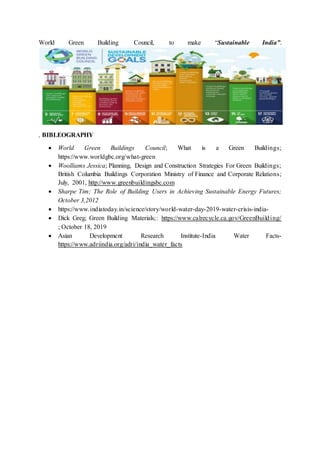
Buildings remain best option for achieving global SDGs; addressing climate change; creating
sustainable/thriving communities; driving economic growth ensuring environmental,
economic and social benefits; minimising waste and maximising reuse ; promoting health and
wellbeing and creating win-win situation for owners, occupants, communities and nations.
Considering massive urbanisation and growing needs of built environment, India must
immediately put in place an effective/efficient policy framework to retrofit the existing
buildings and make all new buildings net- zero carbon by 2050, on the pattern suggested by
World Green Building Council, to make “Sustainable India”.
, BIBLEOGRAPHY
 World Green Buildings Council; What is a Green Buildings;
https://www.worldgbc.org/what-green
 Woolliams Jessica; Planning, Design and Construction Strategies For Green Buildings;
British Columbia Buildings Corporation Ministry of Finance and Corporate Relations;
July, 2001, http://www.greenbuildingsbc.com
 Sharpe Tim; The Role of Building Users in Achieving Sustainable Energy Futures;
October 3,2012
 https://www.indiatoday.in/science/story/world-water-day-2019-water-crisis-india-
 Dick Greg; Green Building Materials;: https://www.calrecycle.ca.gov/GreenBuilding/
; October 18, 2019
 Asian Development Research Institute-India Water Facts-
https://www.adriindia.org/adri/india_water_facts

Green and Energy Efficient Buildings

  • 1.
    Strategies for Making BuildingsGreen and Energy Efficient *Jit Kumar Gupta Abstract; Buildings, as definers of character and fabric of any city, are known for their positivities, negativities, dualities and contradictions. Consuming half of the global energy, majority of resources and generating 45% carbon emissions, buildings are largely responsible for climate change and global warming. Sustainable Development Goals enunciated by UNO also mandatethe critical role of buildings in promoting global sustainability. However, majority of buildings are designed without any concern for energy, resources and environment. For making buildings least consumers of energy, resources and generators of waste, traditional approach to buildings have to be changed and redefined. In search for appropriate solutions paper looks at the options of rationalising pattern of designing buildings ; relevance of site and orientation ; options for energy and water efficiency; context of building materials and indoor air quality, to make buildings green and energy efficient. Key Words; Designing, Energy and Water efficiency, Orientation Jit Kumar Gupta Founder Director, College of Architecture, IET Bhaddal #344, Sector 40-A, Chandigarh-160036 Email -- jit.kumar1944@gmail.com, ,Mob- 090410-26414 Introduction There exists two kind of environment on this planet earth, one created by nature called natural environment and other called built environment, made by human beings. Manmade environment is gradually gaining predominance over natural environment due to ever increasing number of human beings and their rising needs and demand for buildings. Known
  • 2.
    for concentration, citieshouse large number of people, buildings, activities and amenities in small space. Occupying only two percent of the earth’s landmass, containing 50 percent of world population, cities consume 75 percent of world’s resources and produce 75 percent of waste. Consumption of resources and generation of waste by urban settlements are the outcome of quality, quantity and typologies of buildings designed and built. Buildings define both human history, growth and development besides future journey of mankind. Buildings remain vital for human growth because they are central to all human activities and are known to deeply impact the quality of life, because 80% of human life is spent within buildings. Modulating quality of life, buildings make human beings healthy/sick. As largest polluter of environment /ecology and generators of large carbon footprints, buildings remain responsible for climate change, global warming and modulators of sustainability. Large consumption of resources and generation of waste can be attributed to the way buildings are designed, constructed, operated and maintained. Making buildings sustainable is essential for preserving, protecting and making value addition to resources, environment and ecology. Considering the contours of Indian urbanisation, McKinsey Global Institute, ‘India Urban Awakening: Building Inclusive Cities -Report’, states that 700-900 million sqmts of built space would be required annually, to meet the needs of urban India. Considering the enormity of space and their implications as consumer of energy and resources, buildings need to be planned, constructed and operated with utmost care and caution, with focus on energy conservation, sustainability and resource efficiency GREEN BUILDINGS Buildings known for their positivities, negativities, dualities and contradictions, not only provide space for productive living for human beings, but are also anti-thesis to the environment and ecology. Buildings constitute a complex system of designing, construction, materials, resources and environment. Revolving around seven layers during its life-cycle ( Siting , designing, construction, operation, maintenance, renovation and deconstruction); promoting consumption (energy, water, materials and natural resources); impacting environment ( generating waste, air / water pollution, indoor pollution, heat islands, storm water runoff); buildings adversely impact human health, environment and precious resources.( Table-1) Table-1—Impact of Built Environment According to World Energy Council Report, 2016, buildings consume over 45% global energy, 30% raw materials, 25% timber harvested, 16% fresh water withdrawal, 35% of world’s CO2
  • 3.
    emission, 40% municipalsolid waste and 50% ozone depleting CFC besides promoting ‘sick building syndrome’. Considering lifecycle cost and energy, only !0% cost& 17% energy goes into making of a building whereas remaining 90% cost/ 83% energy is used in their operation and maintenance, involving heating, cooling, lighting and ventilating. Thus buildings offer greatest opportunity to minimize energy consumption by merely changing the manner in which buildings are planned, constructed and operated. Looking at the entire gamut of built environment, Green Buildings emerge as the best option to make buildings sustainable and least consumers of energy and resources. Green Buildings minimize use of water, optimize energy efficiency, conserve natural resources, generate less waste and provide healthier space for occupants as compared to conventional buildings. Green Buildings also save energy upto 50%; water consumption by 40%; reduce carbon emission by 35% ; Co2 by 8000-12000 tons and 3 MW of connected electric load / million Sqft building; besides reducing 70% waste. Green buildings not only reduce consumption of non-renewable resources but also fetch better returns from buildings. Such buildings provide financial, environmental and social benefits besides creating a win-win situation for both owners, occupants and users through improved productivity. Studies reveal that, ‘ Green Schools make learning easy and more meaningful’; ‘Green Houses makes people happy and healthy’; Green Hospitals cures patients quickly and Green Shopping Malls can increase sale / profits’. Green building may cost more up-front, but save through lower operating costs over useful life of building. Cost savings is optimised when buildings is designed as green buildings at the conceptual design phase. Potential financial benefits of improving indoor environments exceed costs by a factor of 8 and 14. Green Building practices expands/ complements building design concerns of: economy, utility, durability and comfort DESIGNING GREEN BUILDINGS World Green Building Council has defined Green Building as a, “Building that, in its design, construction or operation, reduces or eliminates negative impacts, can create positive impacts, on our climate and natural environment. Green buildings preserve precious natural resources, improve quality of life. It includes following features;  Using efficiently energy, water and other resources  Using renewable energy including solar energy  Reducing pollution and waste, involving re-use and recycling  Promoting good indoor environmental air quality  Using non-toxic waste based sustainable materials  Valuing environment as integral part of design, construction and operation
  • 4.
     Ensuring qualityof life for occupants  Evolving design, that responds positively to changing environment While principles for building green remain universal but designing green buildings will vary from region to region and within regions, depending upon prevailing climate, site conditions, cultures, traditions, available materials, construction practices and building typology besides environmental, economic and social priorities. Buildings shall continue to be consumers of energy but a green building not only minimise the use of such resources but also replaces the conventional resources with resources, which are available in abundance and remain regenerative universally. Basic approach to green buildings shall revolve around designing with nature, making best use of natural resources and adopting integrated approach to design. While Planning with nature would essentially involve, making optimum use of Panchbhutas- Prithvi (site), Agni( energy), Jal (water), Vayu (air) and Aakash (Space), for meeting the basic needs of energy and resources for buildings, Integrated approach to building design would essentially revolve around, respecting site , rationalising site planning, rationalising built form, lowering surface to volume ratio; promoting building efficiency, evolving efficient structural design; adopting solar passive techniques, using energy efficient equipment, controlling lighting, heating, ventilation; using solar energy/air movement, reducing transportation, minimising waste, using local materials in natural form, optimising landscaping etc. Orientation will remain determinant for optimising nature and natural resources and accordingly, will be effectively leveraged in design solutions to modulate heat gain/loss and evolve energy efficient building envelop. Since requirements of building design would vary, accordingly, buildings with regard to climate, sun and wind will have to be oriented differently in different regions. For ensuring buildings to make best use of solar and wind energy, essential would be that majority of sites should have advantage of best orientation. Accordingly, town planner’s role would be important role to ensure that maximum number of plots have best orientation, to enable Architects to evolve a sustainable and energy efficient design of building. Rationalising site planning would involve that entire built up area shall have benefit of natural light during the day. This would be particularly critical in case of row housing, where plots have the option to draw light only from front and rear. For making buildings energy efficient, they must be designed to conform to the norms and standards defined by the Indian Green Building Council for green buildings. Since designing green buildings remains a professional/team work, accordingly such projects shall invariably involve creating a dedicated teams of architects, engineers, landscape expert , consultants etc, having knowledge, expertise , understanding, experience of designing green buildings . PLANNING FOR SITE AND BUILDING
  • 5.
    Rational and innovativesite planning and planning of building holds great bearing on making buildings green. Accordingly , context of site needs detailed study and analysis in terms of; location, orientation,wind direction, accessibility, size, shape, soil conditions, topography, vegetation, natural features, hydrology ,precipitation, infrastructures etc. Based on the analysis, green building design shall be the outcome of physical characteristics, slope, surrounding land uses/buildings,visual linkages etc. Principles governing the site planning shall involve; minimising fingerprints of buildings; maximising open spaces; minimising damage to site; designing with local culture; promoting pedestrianisation and using hierarchy of preservation, conservation and regeneration. In addition, placing of uses/spaces also holds great relevance in making buildings green and energy efficient. Accordingly, planning of building shall be based on making optimum use of site conditions; minimising wall to area ratio; achieving high building efficiency; making optimum use of orientation, flora and fauna; positioning all habitable rooms in the best orientation; optimizing air and ventilation within and around buildings. Design approach shall be to make buildings climate responsive. In hot regions, strategy shall be to minimize heat gain and promote heat loss. In case of cold climate, the approach shall be to optimize the heat gain and minimize heat loss. Accordingly north-south shall remain the best orientation in hot regions whereas north shall be invariably avoided while designing buildings in the cold regions. In hot regions, buildings shall be painted light to minimize heat gain besides using thick/hollow walls whereas in the case of cold climate buildings shall be painted with dark colours to absorb maximum heat. If typology of open buildings shall be used in hot regions , buildings shall be designed compact in cold regions. Further building envelop would also require careful designing for making buildings green. Designing building envelop shall be dictated by optimum solid-void relationship; careful positioning of openings, projections and shading devices; optimizing room size/building height, natural lighting and ventilations; green walls and green roof etc ENERGY CONSERVATION Considering the lifecycle operations, building consume two types of energy - embodied (which goes into their making) and energy used in various operations & maintenance(HVAC, lighting) during the useful existing of buildings. Only20% energy is used during construction whereas O&M operations involve rest of 80% energy. Accordingly, for making buildings
  • 6.
    energy efficient, bothembodied and operational energy components will need reduction. Reducing embodied energy will essentially require; optimizing various systems; reducing structural loads; using low-energy construction technologies; creating resilient and flexible structures; using local/natural/low energy materials, in natural form including debris etc. Properly orienting buildings and adopting passive/climate responsive design strategies; placing habitable rooms in best orientation for harvesting optimum heat and light; sourcing natural light, proper positioning of windows, avoiding glare, using minimal glass on east/ west, applying light colours for roofing / wall finish materials, installing high R-value wall/ ceiling insulation; go a long way in reducing operational energy demand of buildings. Using properly sized / energy-efficient and rated lighting/heating/cooling systems in a thermally efficient building shell will be pre-requisite to make buildings green. In the past, strategy has been to make buildings energy efficient, which needs to be taken to the next level of zero energy buildings( SDGs) before achieving the ultimate objective of making buildings energy positive. This would need dual strategy of; minimizing energy consumption and making building net generator of on-site renewable energy from natural resources (sun, wind, bio-mass, geo- thermal). It would also involve daylight harvesting; promoting operational / maintenance efficiency through BMS (Building Management System); smart metering besides computer modelling( for optimizing design of electrical/ mechanical systems and building shell), coupled with using advanced lighting controls-- motion sensors / dimmable lighting controls etc for making buildings smart and energy efficient. WATER CONSERVATION Having merely 4% of world’s water resources for supporting 17.3% of world’s population and 20% of world’s livestock (500 millions -Gangwar 2013), India remains one of the most water stressed nation globally. Despite limited availability, India uses largest amount of ground-water (24 percent of global total), more than that of China and US combined. India is the third largest exporter of groundwater--12 % (Water- Aid).India currently ranks 120 among 122 countries in the water quality index. According to NITI Aayog, “India is suffering from the worst water crisis in its history, and millions of lives and livelihoods are under threat.” Critical issue of water is, demand on supplying aquifer/sources exceeding ability to replenish it. Twenty-one Indian cities, including Delhi, are estimated to run out of groundwater, affecting million people by the next decade. Known as elixir of life, water remains critical for both human living as well as for building construction. Buildings remain large consumers of water in its life-cycle including building operations, producing materials used in construction, curing and in their operations and maintenance. Building sector is estimated to consume 16% of total fresh water withdrawal globally. Green buildings remain highly water-efficient, reducing consumption upto 40%. Accordingly, for making construction sector water-efficient, green buildings shall be the best option. Effective water management should revolve around fourfold strategy; protectingwater,
  • 7.
    conserving water, protectingwater quality and reducing consumption. Options for minimizing water consumption shall involve; adopting water-efficient construction practices. Pre-fabrication technology is known for its water efficiency which needs leveraging effectively. Strategy for multiple uses of water through dual plumbing; in-house sewage treatment; using phytometric solutionfor sewage treatment; using grey water for flushing and landscaping; using water rated/efficient fixtures -ultra-low flush toilets/urinals; rationalizing landscaping; using native flora& fauna; minimizing building footprints ; providing large porous space can lower water consumption and increase ground water recharge. The intent is to reduce the generation of waste water and potable water demand. Slow the flow, breaking water flow, creating mist by mixing air with water, are other options to reduce water consumption. From water efficiency , there is need to graduate to zero-water buildings and ultimately water-positive buildings by promoting rainwater harvesting, ground water re- charging, air based cooling and reinventing sanitation system which is not simply water based. GREEN MATERIALS AND TECHNOLOGIES Buildings consume three billion tons of raw materials annually, constituting 40 percent of total materials used globally (Roodman and Lenssen, 1995). Materials remain major determinant of embodied energy, cost, quality and maintenance of buildings besides posing serious environmental issues associated with; extraction, transportation, processing, fabrication, installation, reuse, recycling and their disposal. Considering their major implications, materials used in buildings should, promote conservation of non-renewable resources ; ensure energy conservation; minimise maintenance/replacement costs,; create healthy indoor environment; lowering costs associated with making additions/alterations besides offering .greater design flexibility. Accordingly, materials used in buildings should essentially be resource efficient; natural, plentiful, renewable; energy/water efficient; environment responsive; affordable; involving minimum maintenance; recyclable; locally available; easily salvaged, furbished and remanufactured; made from industrial/agro waste and durable. Further materials should be lightweight to reduce self- load of building, involving using fewer/more durable materials and generating less waste at the end. In addition, green buildings shall involve using state of art and innovative construction technology which are cost- effective, material efficient, speedier, energy/water efficient, safe, generators of minimum waste, using local resources, ensuring optimum use of materials, integrating renewable and low-carbon technologies. INDOOR AIR QUALITY (IAQ) With cost, quality and time becoming important, indoor air quality, despite its critical role and importance, remains the most neglected aspect of building design. Since human beings spent 80% of their life span within building, accordingly IAQ becomes critical for making people
  • 8.
    healthy/sick. Good IAQremains essential element of Green Buildings because it ensures quality in workplaces; reduces fatigue / tiredness of occupants; fosters better health and improves their work performance. IAQ becomes critical when people themselves become major source of emission. Good IAQ is known to create optimum living conditions by avoiding CO2 concentration. Poor IAQ is the product of materials/ finishes used both in interior and exterior of buildings; poor ventilation; chemical emissions; lack of natural light; smoke/dust; moistures etc. As major determinant of IAQ, materials selected should be non-toxic; having minimal chemical emissions; involve low-VOC assembly: moisture resistant and easy to maintain besides using indoor plants. Promoting good IAQ would require temperature range of 21 - 24oC, relative humidity (RH) below70%; CO2 levels < 1000ppm; exclude VOC with vapour pressures limited to restrict the fungal/ microbial/ pathogens growth. Natural daylight/ outside views/ good landscaping / efficient ventilation are known to improve the IAQ. CONCLUSION Using less water, energy or natural resources, Green buildings not only reduce/eliminate negative impacts of buildings, but also positively impact environment by generating their own energy and increased bio-diversity. Globally, green buildings have capacity to reduce greenhouse gas emissions by 84 GtCO2; energy savings of 50% and limiting global temperature rises to 2°C by 2050 (UNEP). Green buildings offer numerous economic/ financial benefits-- lower construction costs, higher property value; increased occupancy rates/ lower operating costs for building owner. Green buildings are known to command 7% increase in value over traditional buildings; workers in green offices recording 101% increase in cognitive scores (brain function), sleeping 46 minutes more per night with increased productivity of 8%. Green Buildings remain best option for achieving global SDGs; addressing climate change; creating sustainable/thriving communities; driving economic growth ensuring environmental, economic and social benefits; minimising waste and maximising reuse ; promoting health and wellbeing and creating win-win situation for owners, occupants, communities and nations. Considering massive urbanisation and growing needs of built environment, India must immediately put in place an effective/efficient policy framework to retrofit the existing buildings and make all new buildings net- zero carbon by 2050, on the pattern suggested by
  • 9.
    World Green BuildingCouncil, to make “Sustainable India”. , BIBLEOGRAPHY  World Green Buildings Council; What is a Green Buildings; https://www.worldgbc.org/what-green  Woolliams Jessica; Planning, Design and Construction Strategies For Green Buildings; British Columbia Buildings Corporation Ministry of Finance and Corporate Relations; July, 2001, http://www.greenbuildingsbc.com  Sharpe Tim; The Role of Building Users in Achieving Sustainable Energy Futures; October 3,2012  https://www.indiatoday.in/science/story/world-water-day-2019-water-crisis-india-  Dick Greg; Green Building Materials;: https://www.calrecycle.ca.gov/GreenBuilding/ ; October 18, 2019  Asian Development Research Institute-India Water Facts- https://www.adriindia.org/adri/india_water_facts