

How to debug a kernel crash
Debugging - for rigtige programmører
- en dag fyldt med fejl
(Danish Debugging conf 2013)

Jesper Dangaard Brouer
Senior Kernel Engineer, Red Hat

2013-10-26
1/27

How to debug a kernel crash – and other tricks
Who am I
●

Name: Jesper Dangaard Brouer
–

Linux Kernel Developer at Red Hat

–

Edu: Computer Science for Uni. Copenhagen
●

–

Linux user since 1996, professional since 1998
●

–

Focus on Network, Dist. sys and OS
Sysadm, Kernel Developer, Embedded

OpenSource projects, author of
–
●

Patches accepted into
–

–

2/27

ADSL-optimizer, CPAN IPTables::libiptc, IPTV-Analyzer
Linux kernel, iproute2, iptables, libpcap and Wireshark

Organizer of Netfilter Workshop 2013
How to debug a kernel crash – and other tricks
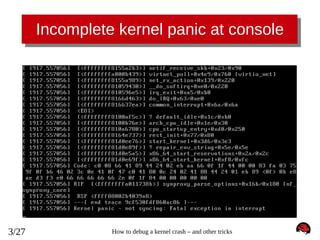
Incomplete kernel panic at console

3/27

How to debug a kernel crash – and other tricks
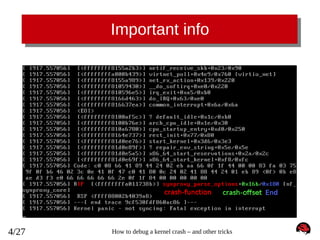
Important info

4/27

How to debug a kernel crash – and other tricks
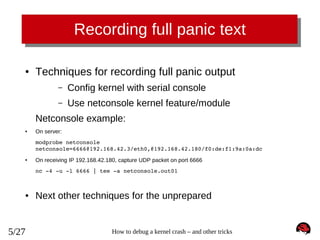
Recording full panic text
●

Techniques for recording full panic output
–

Config kernel with serial console

–

Use netconsole kernel feature/module

Netconsole example:
●

On server:
modprobe netconsole 
netconsole=6666@192.168.42.3/eth0,@192.168.42.180/f0:de:f1:9a:0a:dc

●

On receiving IP 192.168.42.180, capture UDP packet on port 6666
nc ­4 ­u ­l 6666 | tee ­a netconsole.out01

●

5/27

Next other techniques for the unprepared

How to debug a kernel crash – and other tricks
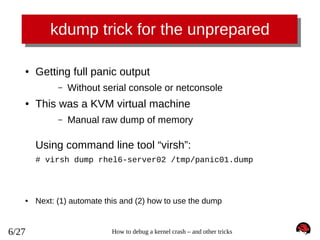
kdump trick for the unprepared
●

Getting full panic output
–

●

Without serial console or netconsole

This was a KVM virtual machine
–

Manual raw dump of memory

Using command line tool “virsh”:
# virsh dump rhel6-server02 /tmp/panic01.dump

●

6/27

Next: (1) automate this and (2) how to use the dump

How to debug a kernel crash – and other tricks
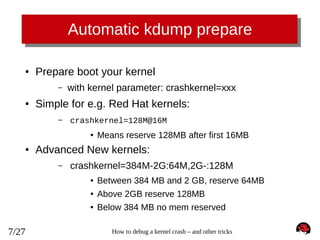
Automatic kdump prepare
●

Prepare boot your kernel
–

●

with kernel parameter: crashkernel=xxx

Simple for e.g. Red Hat kernels:
–

crashkernel=128M@16M
●

●

Means reserve 128MB after first 16MB

Advanced New kernels:
–

crashkernel=384M-2G:64M,2G-:128M
●
●

Above 2GB reserve 128MB

●

7/27

Between 384 MB and 2 GB, reserve 64MB
Below 384 MB no mem reserved
How to debug a kernel crash – and other tricks
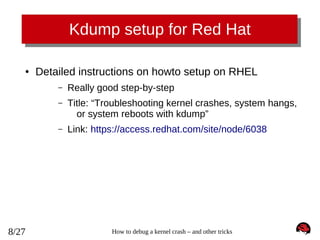
Kdump setup for Red Hat
●

Detailed instructions on howto setup on RHEL
–
–

Title: “Troubleshooting kernel crashes, system hangs,
or system reboots with kdump”

–

8/27

Really good step-by-step

Link: https://access.redhat.com/site/node/6038

How to debug a kernel crash – and other tricks
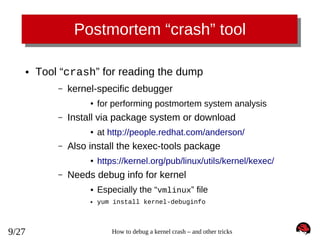
Postmortem “crash” tool
●

Tool “crash” for reading the dump
–

kernel-specific debugger
●

–

Install via package system or download
●

–

at http://people.redhat.com/anderson/

Also install the kexec-tools package
●

–

for performing postmortem system analysis

https://kernel.org/pub/linux/utils/kernel/kexec/

Needs debug info for kernel
●
●

9/27

Especially the “vmlinux” file
yum install kernel-debuginfo

How to debug a kernel crash – and other tricks
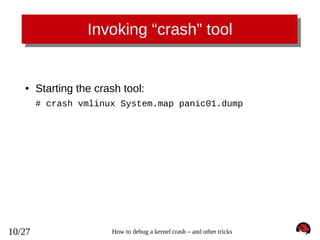
Invoking “crash” tool

●

Starting the crash tool:
# crash vmlinux System.map panic01.dump

10/27

How to debug a kernel crash – and other tricks
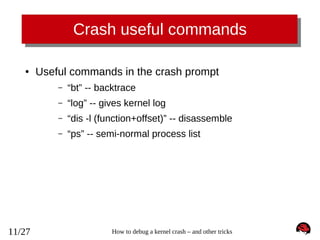
Crash useful commands
●

Useful commands in the crash prompt
–
–

“log” -- gives kernel log

–

“dis -l (function+offset)” -- disassemble

–

11/27

“bt” -- backtrace

“ps” -- semi-normal process list

How to debug a kernel crash – and other tricks
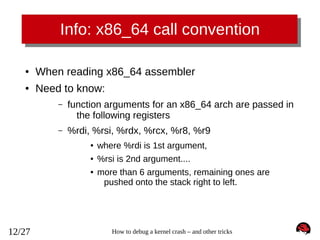
Info: x86_64 call convention
●

When reading x86_64 assembler

●

Need to know:
–

function arguments for an x86_64 arch are passed in
the following registers

–

%rdi, %rsi, %rdx, %rcx, %r8, %r9
●

where %rdi is 1st argument,

●

%rsi is 2nd argument....

●

12/27

more than 6 arguments, remaining ones are
pushed onto the stack right to left.

How to debug a kernel crash – and other tricks
Crash bt - backtrace
crash> bt
PID: 0
TASK: ffffffff81c10480 CPU: 0
COMMAND: "swapper/0"
#0 [ffff88002b4037c0] die at ffffffff81005c08
#1 [ffff88002b4037f0] do_trap at ffffffff81663deb
#2 [ffff88002b403800] __atomic_notifier_call_chain at ffffffff81667162
#3 [ffff88002b403850] do_invalid_op at ffffffff81002ea5
#4 [ffff88002b403890] dev_queue_xmit at ffffffff8155c59a
#5 [ffff88002b4038f0] invalid_op at ffffffff8166cc48
[exception RIP: synproxy_parse_options+363] (<-- notice decimal 363 == 0x16b)
RIP: ffffffffa010b38b RSP: ffff88002b4039a8 RFLAGS: 00010282
RAX: 00000000fffffff2 RBX: 000000000000000c RCX: 000000000000000c
RDX: ffff88002b4039a8 RSI: 0000000000000028 RDI: ffff880029768700
RBP: ffff88002b4039e8
R8: 0000000000000000
R9: 0000000000000000
R10: ffff880029768700 R11: 0000000000000000 R12: ffff88002b403a28
R13: ffff880029be5658 R14: ffff8800260a8630 R15: ffff880029aa6c62
ORIG_RAX: ffffffffffffffff CS: 0010 SS: 0018
#6 [ffff88002b4039a0] synproxy_parse_options at ffffffffa010b32b [nf_synproxy_core]
#7 [ffff88002b4039f0] synproxy_tg4 at ffffffffa0110a9e [ipt_SYNPROXY]
#8 [ffff88002b403a20] __kmalloc at ffffffff8117c4ae
#9 [ffff88002b403a80] ipt_do_table at ffffffffa00a90ee [ip_tables]
#10 [ffff88002b403bb0] iptable_filter_hook at ffffffffa00b20d3 [iptable_filter]
#11 [ffff88002b403bc0] nf_iterate at ffffffff815894b6
#12 [ffff88002b403c20] nf_hook_slow at ffffffff81589574
#13 [ffff88002b403ca0] ip_local_deliver at ffffffff81592a73
#14 [ffff88002b403cd0] ip_rcv_finish at ffffffff815923c1
#15 [ffff88002b403d00] ip_rcv at ffffffff81592d24
#16 [ffff88002b403d40] __netif_receive_skb_core at ffffffff81559f42
#17 [ffff88002b403db0] __netif_receive_skb at ffffffff8155a0d1
#18 [ffff88002b403dd0] netif_receive_skb at ffffffff8155a2b3
#19 [ffff88002b403e00] virtnet_poll at ffffffffa0027439 [virtio_net]
#20 [ffff88002b403ea0] net_rx_action at ffffffff8155a989
#21 [ffff88002b403f00] __do_softirq at ffffffff81059430
#22 [ffff88002b403f70] irq_exit at ffffffff810596e5
#23 [ffff88002b403f80] do_IRQ at ffffffff8166d463

13/27

How to debug a kernel crash – and other tricks
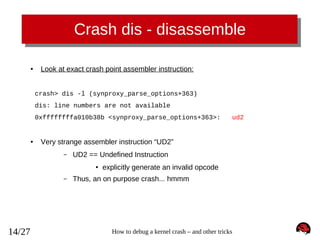
Crash dis - disassemble
●

Look at exact crash point assembler instruction:
crash> dis -l (synproxy_parse_options+363)
dis: line numbers are not available
0xffffffffa010b38b <synproxy_parse_options+363>:

●

Very strange assembler instruction “UD2”
–

UD2 == Undefined Instruction
●

–

14/27

ud2

explicitly generate an invalid opcode

Thus, an on purpose crash... hmmm

How to debug a kernel crash – and other tricks
Crash log – getting full log
crash> log
[... cut ...]
[
53.644810] ------------[ cut here ]-----------[
53.645587] kernel BUG at net/netfilter/nf_synproxy_core.c:35!
[
53.645587] invalid opcode: 0000 [#1] SMP
[
53.645587] Modules linked in: xt_conntrack xt_LOG ipt_SYNPROXY nf_synproxy_core xt_CT iptable_raw sunrpc ipt_REJECT nf_conntrack_ipv4
nf_defrag_ipv4 iptable_filter ip_tables ip6t_REJECT nf_conntrack_ipv6 nf_defrag_ipv6 xt_state nf_conntrack ip6table_filter ip6_tables
binfmt_misc floppy joydev microcode pcspkr virtio_balloon virtio_net i2c_piix4 i2c_core virtio_blk
[
53.645587] CPU: 0 PID: 0 Comm: swapper/0 Not tainted 3.12.0-rc3-synproxy04-bug+ #11
[
53.645587] Hardware name: Bochs Bochs, BIOS Bochs 01/01/2011
[
53.645587] task: ffffffff81c10480 ti: ffffffff81c00000 task.ti: ffffffff81c00000
[
53.645587] RIP: 0010:[<ffffffffa010b38b>] [<ffffffffa010b38b>] synproxy_parse_options+0x16b/0x180 [nf_synproxy_core]
[
53.645587] RSP: 0018:ffff88002b4039a8 EFLAGS: 00010282
[
53.645587] RAX: 00000000fffffff2 RBX: 000000000000000c RCX: 000000000000000c
[
53.645587] RDX: ffff88002b4039a8 RSI: 0000000000000028 RDI: ffff880029768700
[
53.645587] RBP: ffff88002b4039e8 R08: 0000000000000000 R09: 0000000000000000
[
53.645587] R10: ffff880029768700 R11: 0000000000000000 R12: ffff88002b403a28
[
53.645587] R13: ffff880029be5658 R14: ffff8800260a8630 R15: ffff880029aa6c62
[
53.645587] FS: 0000000000000000(0000) GS:ffff88002b400000(0000) knlGS:0000000000000000
[
53.645587] CS: 0010 DS: 0000 ES: 0000 CR0: 000000008005003b
[
53.645587] CR2: ffffffffff600400 CR3: 0000000028780000 CR4: 00000000000006f0
[
53.645587] Stack:
[
53.645587] ffff88002b4039d8 ffff8800289d16c0 ffff880029abf4f0 ffff88002b403b48
[
53.645587] ffff88002b4039d8 5daa3322d0120d19 ffff88002b403b48 ffff880029768700
[
53.645587] ffff88002b403a78 ffffffffa0110a9e ffff88002b403a18 ffff880029abf4f0
[
53.645587] Call Trace:
[
53.645587] <IRQ>
[
53.645587]
[
53.645587] [<ffffffffa0110a9e>] synproxy_tg4+0xde/0x2f8 [ipt_SYNPROXY]
[
53.645587] [<ffffffff8117c4ae>] ? __kmalloc+0x2e/0x190
[
53.645587] [<ffffffffa00a90ee>] ipt_do_table+0x2fe/0x745 [ip_tables]
[
53.645587] [<ffffffff813ace70>] ? virtqueue_kick+0x20/0x30
[
53.645587] [<ffffffffa00b20d3>] iptable_filter_hook+0x33/0x64 [iptable_filter]
[
53.645587] [<ffffffff815894b6>] nf_iterate+0x86/0xd0
[
53.645587] [<ffffffff81592680>] ? ip_rcv_finish+0x340/0x340
[
53.645587] [<ffffffff81589574>] nf_hook_slow+0x74/0x130
[
53.645587] [<ffffffff81592680>] ? ip_rcv_finish+0x340/0x340
[
53.645587] [<ffffffff81592a73>] ip_local_deliver+0x73/0x80
[
53.645587] [<ffffffff815923c1>] ip_rcv_finish+0x81/0x340
[
53.645587] [<ffffffff81592d24>] ip_rcv+0x2a4/0x3e0
[
53.645587] [<ffffffff81559f42>] __netif_receive_skb_core+0x672/0x7e0
[
53.645587] [<ffffffff8155a0d1>] __netif_receive_skb+0x21/0x70
[
53.645587] [<ffffffff8155a2b3>] netif_receive_skb+0x23/0x90
[
53.645587] [<ffffffffa0027439>] virtnet_poll+0x4e9/0x760 [virtio_net]
[
53.645587] [<ffffffff8155a989>] net_rx_action+0x139/0x220
[... cut ...]
[
53.645587] Code: c0 08 66 41 89 44 24 02 eb aa 66 0f 1f 44 00 00 83 fa 03 75 9f 0f b6 46 02 3c 0e 41 0f 47 c0 41 80 0c 24 02 41 88 44
24 01 eb 89 <0f> 0b e8 ae 93 f4 e0 66 66 66 66 66 2e 0f 1f 84 00 00 00 00 00
[
53.645587] RIP [<ffffffffa010b38b>] synproxy_parse_options+0x16b/0x180 [nf_synproxy_core]
[
53.645587] RSP <ffff88002b4039a8>
[
53.645587] ---[ end trace f6ddc710ff8b9002 ]--[
53.645587] Kernel panic - not syncing: Fatal exception in interrupt

15/27

How to debug a kernel crash – and other tricks
Extra "ps" and "files" crash tricks
crash> ps
PID
PPID
[...cut...]
1512
1295
1515
1512
1563
1515

CPU

TASK

ST

%MEM

VSZ

RSS

COMM

0
0
0

ffff88002992c5f0
ffff88002992aea0
ffff880027a1c5f0

IN
IN
IN

0.5
0.3
0.1

100044
108344
105492

3892
1796
848

sshd
bash
less

crash> files 1563
PID: 1563
TASK: ffff880027a1c5f0 CPU: 0
COMMAND: "less"
ROOT: /
CWD: /root
FD
FILE
DENTRY
INODE
TYPE PATH
0 ffff8800297cef00 ffff880028d64240 ffff8800290e2fc0 CHR /dev/pts/0
1 ffff8800297cef00 ffff880028d64240 ffff8800290e2fc0 CHR /dev/pts/0
2 ffff8800297cef00 ffff880028d64240 ffff8800290e2fc0 CHR /dev/pts/0
3 ffff880029471100 ffff880029f813c0 ffff88002b28fce0 CHR /tty
4 ffff880029768800 ffff880028d44000 ffff880028d76480 REG /root/iptables_synproxy.sh
crash> set 1563
PID: 1563
COMMAND: "less"
TASK: ffff880027a1c5f0 [THREAD_INFO: ffff880028286000]
CPU: 0
STATE: TASK_INTERRUPTIBLE

16/27

How to debug a kernel crash – and other tricks
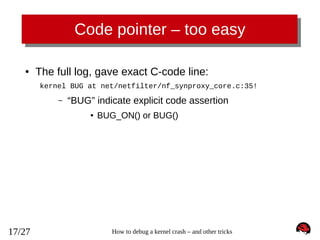
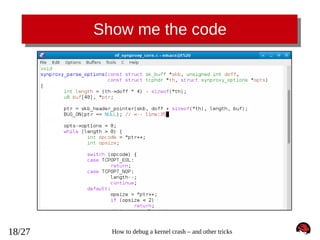
Code pointer – too easy
●

The full log, gave exact C-code line:
kernel BUG at net/netfilter/nf_synproxy_core.c:35!
–

“BUG” indicate explicit code assertion
●

17/27

BUG_ON() or BUG()

How to debug a kernel crash – and other tricks
Show me the code

18/27

How to debug a kernel crash – and other tricks
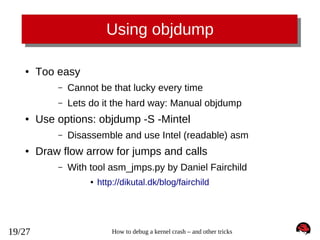
Using objdump
●

Too easy
–
–

●

Cannot be that lucky every time
Lets do it the hard way: Manual objdump

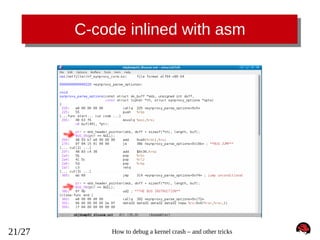
Use options: objdump -S -Mintel
–

●

Disassemble and use Intel (readable) asm

Draw flow arrow for jumps and calls
–

With tool asm_jmps.py by Daniel Fairchild
●

19/27

http://dikutal.dk/blog/fairchild

How to debug a kernel crash – and other tricks
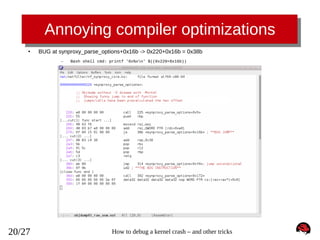
Annoying compiler optimizations
●

BUG at synproxy_parse_options+0x16b -> 0x220+0x16b = 0x38b
–

20/27

Bash shell cmd: printf '0x%xn' $((0x220+0x16b))

How to debug a kernel crash – and other tricks
C-code inlined with asm

21/27

How to debug a kernel crash – and other tricks
Panic finished
●

Next: Some instrumentation hints
–
–

Probing a running kernel

–

SystemTap

–

22/27

Dynamic printk

Benchmarking tool: “perf”

How to debug a kernel crash – and other tricks
Panic finished
●

Next: Some instrumentation hints
–
–

Probing a running kernel

–

SystemTap

–

23/27

Dynamic printk

Benchmarking tool: “perf”

How to debug a kernel crash – and other tricks
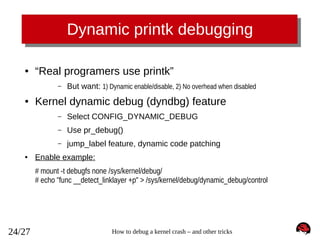
Dynamic printk debugging
●

“Real programers use printk”
–

●

But want: 1) Dynamic enable/disable, 2) No overhead when disabled

Kernel dynamic debug (dyndbg) feature
–
–

Use pr_debug()

–
●

Select CONFIG_DYNAMIC_DEBUG
jump_label feature, dynamic code patching

Enable example:
# mount -t debugfs none /sys/kernel/debug/
# echo "func __detect_linklayer +p" > /sys/kernel/debug/dynamic_debug/control

24/27

How to debug a kernel crash – and other tricks
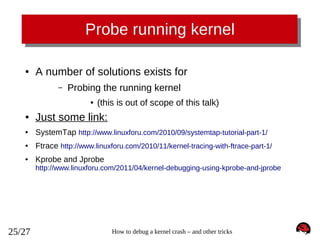
Probe running kernel
●

A number of solutions exists for
–

Probing the running kernel
●

(this is out of scope of this talk)

●

Just some link:

●

SystemTap http://www.linuxforu.com/2010/09/systemtap-tutorial-part-1/

●

Ftrace http://www.linuxforu.com/2010/11/kernel-tracing-with-ftrace-part-1/

●

Kprobe and Jprobe

http://www.linuxforu.com/2011/04/kernel-debugging-using-kprobe-and-jprobe

25/27

How to debug a kernel crash – and other tricks
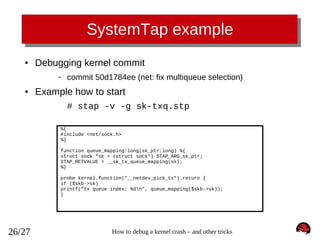
SystemTap example
●

Debugging kernel commit
–

●

commit 50d1784ee (net: fix multiqueue selection)

Example how to start
# stap -v -g sk-txq.stp
%{
#include <net/sock.h>
%}
function queue_mapping:long(sk_ptr:long) %{
struct sock *sk = (struct sock*) STAP_ARG_sk_ptr;
STAP_RETVALUE = __sk_tx_queue_mapping(sk);
%}
probe kernel.function("__netdev_pick_tx").return {
if ($skb->sk)
printf("tx queue index: %dn", queue_mapping($skb->sk));
}

26/27

How to debug a kernel crash – and other tricks
Performance benchmarking
●

Performance analyzing tool: “perf”
–
–

Tracepoints

–
●

Supports hardware perf counters
Dynamic probes (e.g. kprobes or uprobes)

Both kernel and userspace profiling
–

Try it! -- run: “perf top”
●
●

27/27

perf record -g -a
perf report

How to debug a kernel crash – and other tricks
The End
●

If unlikely(time for questions)
–

28/27

Questions?

How to debug a kernel crash – and other tricks

Debugging 2013- Jesper Brouer

  • 1.
    How to debuga kernel crash Debugging - for rigtige programmører - en dag fyldt med fejl (Danish Debugging conf 2013) Jesper Dangaard Brouer Senior Kernel Engineer, Red Hat 2013-10-26 1/27 How to debug a kernel crash – and other tricks
  • 2.
    Who am I ● Name:Jesper Dangaard Brouer – Linux Kernel Developer at Red Hat – Edu: Computer Science for Uni. Copenhagen ● – Linux user since 1996, professional since 1998 ● – Focus on Network, Dist. sys and OS Sysadm, Kernel Developer, Embedded OpenSource projects, author of – ● Patches accepted into – – 2/27 ADSL-optimizer, CPAN IPTables::libiptc, IPTV-Analyzer Linux kernel, iproute2, iptables, libpcap and Wireshark Organizer of Netfilter Workshop 2013 How to debug a kernel crash – and other tricks
  • 3.
    Incomplete kernel panicat console 3/27 How to debug a kernel crash – and other tricks
  • 4.
    Important info 4/27 How todebug a kernel crash – and other tricks
  • 5.
    Recording full panictext ● Techniques for recording full panic output – Config kernel with serial console – Use netconsole kernel feature/module Netconsole example: ● On server: modprobe netconsole  netconsole=6666@192.168.42.3/eth0,@192.168.42.180/f0:de:f1:9a:0a:dc ● On receiving IP 192.168.42.180, capture UDP packet on port 6666 nc ­4 ­u ­l 6666 | tee ­a netconsole.out01 ● 5/27 Next other techniques for the unprepared How to debug a kernel crash – and other tricks
  • 6.
    kdump trick forthe unprepared ● Getting full panic output – ● Without serial console or netconsole This was a KVM virtual machine – Manual raw dump of memory Using command line tool “virsh”: # virsh dump rhel6-server02 /tmp/panic01.dump ● 6/27 Next: (1) automate this and (2) how to use the dump How to debug a kernel crash – and other tricks
  • 7.
    Automatic kdump prepare ● Prepareboot your kernel – ● with kernel parameter: crashkernel=xxx Simple for e.g. Red Hat kernels: – crashkernel=128M@16M ● ● Means reserve 128MB after first 16MB Advanced New kernels: – crashkernel=384M-2G:64M,2G-:128M ● ● Above 2GB reserve 128MB ● 7/27 Between 384 MB and 2 GB, reserve 64MB Below 384 MB no mem reserved How to debug a kernel crash – and other tricks
  • 8.
    Kdump setup forRed Hat ● Detailed instructions on howto setup on RHEL – – Title: “Troubleshooting kernel crashes, system hangs, or system reboots with kdump” – 8/27 Really good step-by-step Link: https://access.redhat.com/site/node/6038 How to debug a kernel crash – and other tricks
  • 9.
    Postmortem “crash” tool ● Tool“crash” for reading the dump – kernel-specific debugger ● – Install via package system or download ● – at http://people.redhat.com/anderson/ Also install the kexec-tools package ● – for performing postmortem system analysis https://kernel.org/pub/linux/utils/kernel/kexec/ Needs debug info for kernel ● ● 9/27 Especially the “vmlinux” file yum install kernel-debuginfo How to debug a kernel crash – and other tricks
  • 10.
    Invoking “crash” tool ● Startingthe crash tool: # crash vmlinux System.map panic01.dump 10/27 How to debug a kernel crash – and other tricks
  • 11.
    Crash useful commands ● Usefulcommands in the crash prompt – – “log” -- gives kernel log – “dis -l (function+offset)” -- disassemble – 11/27 “bt” -- backtrace “ps” -- semi-normal process list How to debug a kernel crash – and other tricks
  • 12.
    Info: x86_64 callconvention ● When reading x86_64 assembler ● Need to know: – function arguments for an x86_64 arch are passed in the following registers – %rdi, %rsi, %rdx, %rcx, %r8, %r9 ● where %rdi is 1st argument, ● %rsi is 2nd argument.... ● 12/27 more than 6 arguments, remaining ones are pushed onto the stack right to left. How to debug a kernel crash – and other tricks
  • 13.
    Crash bt -backtrace crash> bt PID: 0 TASK: ffffffff81c10480 CPU: 0 COMMAND: "swapper/0" #0 [ffff88002b4037c0] die at ffffffff81005c08 #1 [ffff88002b4037f0] do_trap at ffffffff81663deb #2 [ffff88002b403800] __atomic_notifier_call_chain at ffffffff81667162 #3 [ffff88002b403850] do_invalid_op at ffffffff81002ea5 #4 [ffff88002b403890] dev_queue_xmit at ffffffff8155c59a #5 [ffff88002b4038f0] invalid_op at ffffffff8166cc48 [exception RIP: synproxy_parse_options+363] (<-- notice decimal 363 == 0x16b) RIP: ffffffffa010b38b RSP: ffff88002b4039a8 RFLAGS: 00010282 RAX: 00000000fffffff2 RBX: 000000000000000c RCX: 000000000000000c RDX: ffff88002b4039a8 RSI: 0000000000000028 RDI: ffff880029768700 RBP: ffff88002b4039e8 R8: 0000000000000000 R9: 0000000000000000 R10: ffff880029768700 R11: 0000000000000000 R12: ffff88002b403a28 R13: ffff880029be5658 R14: ffff8800260a8630 R15: ffff880029aa6c62 ORIG_RAX: ffffffffffffffff CS: 0010 SS: 0018 #6 [ffff88002b4039a0] synproxy_parse_options at ffffffffa010b32b [nf_synproxy_core] #7 [ffff88002b4039f0] synproxy_tg4 at ffffffffa0110a9e [ipt_SYNPROXY] #8 [ffff88002b403a20] __kmalloc at ffffffff8117c4ae #9 [ffff88002b403a80] ipt_do_table at ffffffffa00a90ee [ip_tables] #10 [ffff88002b403bb0] iptable_filter_hook at ffffffffa00b20d3 [iptable_filter] #11 [ffff88002b403bc0] nf_iterate at ffffffff815894b6 #12 [ffff88002b403c20] nf_hook_slow at ffffffff81589574 #13 [ffff88002b403ca0] ip_local_deliver at ffffffff81592a73 #14 [ffff88002b403cd0] ip_rcv_finish at ffffffff815923c1 #15 [ffff88002b403d00] ip_rcv at ffffffff81592d24 #16 [ffff88002b403d40] __netif_receive_skb_core at ffffffff81559f42 #17 [ffff88002b403db0] __netif_receive_skb at ffffffff8155a0d1 #18 [ffff88002b403dd0] netif_receive_skb at ffffffff8155a2b3 #19 [ffff88002b403e00] virtnet_poll at ffffffffa0027439 [virtio_net] #20 [ffff88002b403ea0] net_rx_action at ffffffff8155a989 #21 [ffff88002b403f00] __do_softirq at ffffffff81059430 #22 [ffff88002b403f70] irq_exit at ffffffff810596e5 #23 [ffff88002b403f80] do_IRQ at ffffffff8166d463 13/27 How to debug a kernel crash – and other tricks
  • 14.
    Crash dis -disassemble ● Look at exact crash point assembler instruction: crash> dis -l (synproxy_parse_options+363) dis: line numbers are not available 0xffffffffa010b38b <synproxy_parse_options+363>: ● Very strange assembler instruction “UD2” – UD2 == Undefined Instruction ● – 14/27 ud2 explicitly generate an invalid opcode Thus, an on purpose crash... hmmm How to debug a kernel crash – and other tricks
  • 15.
    Crash log –getting full log crash> log [... cut ...] [ 53.644810] ------------[ cut here ]-----------[ 53.645587] kernel BUG at net/netfilter/nf_synproxy_core.c:35! [ 53.645587] invalid opcode: 0000 [#1] SMP [ 53.645587] Modules linked in: xt_conntrack xt_LOG ipt_SYNPROXY nf_synproxy_core xt_CT iptable_raw sunrpc ipt_REJECT nf_conntrack_ipv4 nf_defrag_ipv4 iptable_filter ip_tables ip6t_REJECT nf_conntrack_ipv6 nf_defrag_ipv6 xt_state nf_conntrack ip6table_filter ip6_tables binfmt_misc floppy joydev microcode pcspkr virtio_balloon virtio_net i2c_piix4 i2c_core virtio_blk [ 53.645587] CPU: 0 PID: 0 Comm: swapper/0 Not tainted 3.12.0-rc3-synproxy04-bug+ #11 [ 53.645587] Hardware name: Bochs Bochs, BIOS Bochs 01/01/2011 [ 53.645587] task: ffffffff81c10480 ti: ffffffff81c00000 task.ti: ffffffff81c00000 [ 53.645587] RIP: 0010:[<ffffffffa010b38b>] [<ffffffffa010b38b>] synproxy_parse_options+0x16b/0x180 [nf_synproxy_core] [ 53.645587] RSP: 0018:ffff88002b4039a8 EFLAGS: 00010282 [ 53.645587] RAX: 00000000fffffff2 RBX: 000000000000000c RCX: 000000000000000c [ 53.645587] RDX: ffff88002b4039a8 RSI: 0000000000000028 RDI: ffff880029768700 [ 53.645587] RBP: ffff88002b4039e8 R08: 0000000000000000 R09: 0000000000000000 [ 53.645587] R10: ffff880029768700 R11: 0000000000000000 R12: ffff88002b403a28 [ 53.645587] R13: ffff880029be5658 R14: ffff8800260a8630 R15: ffff880029aa6c62 [ 53.645587] FS: 0000000000000000(0000) GS:ffff88002b400000(0000) knlGS:0000000000000000 [ 53.645587] CS: 0010 DS: 0000 ES: 0000 CR0: 000000008005003b [ 53.645587] CR2: ffffffffff600400 CR3: 0000000028780000 CR4: 00000000000006f0 [ 53.645587] Stack: [ 53.645587] ffff88002b4039d8 ffff8800289d16c0 ffff880029abf4f0 ffff88002b403b48 [ 53.645587] ffff88002b4039d8 5daa3322d0120d19 ffff88002b403b48 ffff880029768700 [ 53.645587] ffff88002b403a78 ffffffffa0110a9e ffff88002b403a18 ffff880029abf4f0 [ 53.645587] Call Trace: [ 53.645587] <IRQ> [ 53.645587] [ 53.645587] [<ffffffffa0110a9e>] synproxy_tg4+0xde/0x2f8 [ipt_SYNPROXY] [ 53.645587] [<ffffffff8117c4ae>] ? __kmalloc+0x2e/0x190 [ 53.645587] [<ffffffffa00a90ee>] ipt_do_table+0x2fe/0x745 [ip_tables] [ 53.645587] [<ffffffff813ace70>] ? virtqueue_kick+0x20/0x30 [ 53.645587] [<ffffffffa00b20d3>] iptable_filter_hook+0x33/0x64 [iptable_filter] [ 53.645587] [<ffffffff815894b6>] nf_iterate+0x86/0xd0 [ 53.645587] [<ffffffff81592680>] ? ip_rcv_finish+0x340/0x340 [ 53.645587] [<ffffffff81589574>] nf_hook_slow+0x74/0x130 [ 53.645587] [<ffffffff81592680>] ? ip_rcv_finish+0x340/0x340 [ 53.645587] [<ffffffff81592a73>] ip_local_deliver+0x73/0x80 [ 53.645587] [<ffffffff815923c1>] ip_rcv_finish+0x81/0x340 [ 53.645587] [<ffffffff81592d24>] ip_rcv+0x2a4/0x3e0 [ 53.645587] [<ffffffff81559f42>] __netif_receive_skb_core+0x672/0x7e0 [ 53.645587] [<ffffffff8155a0d1>] __netif_receive_skb+0x21/0x70 [ 53.645587] [<ffffffff8155a2b3>] netif_receive_skb+0x23/0x90 [ 53.645587] [<ffffffffa0027439>] virtnet_poll+0x4e9/0x760 [virtio_net] [ 53.645587] [<ffffffff8155a989>] net_rx_action+0x139/0x220 [... cut ...] [ 53.645587] Code: c0 08 66 41 89 44 24 02 eb aa 66 0f 1f 44 00 00 83 fa 03 75 9f 0f b6 46 02 3c 0e 41 0f 47 c0 41 80 0c 24 02 41 88 44 24 01 eb 89 <0f> 0b e8 ae 93 f4 e0 66 66 66 66 66 2e 0f 1f 84 00 00 00 00 00 [ 53.645587] RIP [<ffffffffa010b38b>] synproxy_parse_options+0x16b/0x180 [nf_synproxy_core] [ 53.645587] RSP <ffff88002b4039a8> [ 53.645587] ---[ end trace f6ddc710ff8b9002 ]--[ 53.645587] Kernel panic - not syncing: Fatal exception in interrupt 15/27 How to debug a kernel crash – and other tricks
  • 16.
    Extra "ps" and"files" crash tricks crash> ps PID PPID [...cut...] 1512 1295 1515 1512 1563 1515 CPU TASK ST %MEM VSZ RSS COMM 0 0 0 ffff88002992c5f0 ffff88002992aea0 ffff880027a1c5f0 IN IN IN 0.5 0.3 0.1 100044 108344 105492 3892 1796 848 sshd bash less crash> files 1563 PID: 1563 TASK: ffff880027a1c5f0 CPU: 0 COMMAND: "less" ROOT: / CWD: /root FD FILE DENTRY INODE TYPE PATH 0 ffff8800297cef00 ffff880028d64240 ffff8800290e2fc0 CHR /dev/pts/0 1 ffff8800297cef00 ffff880028d64240 ffff8800290e2fc0 CHR /dev/pts/0 2 ffff8800297cef00 ffff880028d64240 ffff8800290e2fc0 CHR /dev/pts/0 3 ffff880029471100 ffff880029f813c0 ffff88002b28fce0 CHR /tty 4 ffff880029768800 ffff880028d44000 ffff880028d76480 REG /root/iptables_synproxy.sh crash> set 1563 PID: 1563 COMMAND: "less" TASK: ffff880027a1c5f0 [THREAD_INFO: ffff880028286000] CPU: 0 STATE: TASK_INTERRUPTIBLE 16/27 How to debug a kernel crash – and other tricks
  • 17.
    Code pointer –too easy ● The full log, gave exact C-code line: kernel BUG at net/netfilter/nf_synproxy_core.c:35! – “BUG” indicate explicit code assertion ● 17/27 BUG_ON() or BUG() How to debug a kernel crash – and other tricks
  • 18.
    Show me thecode 18/27 How to debug a kernel crash – and other tricks
  • 19.
    Using objdump ● Too easy – – ● Cannotbe that lucky every time Lets do it the hard way: Manual objdump Use options: objdump -S -Mintel – ● Disassemble and use Intel (readable) asm Draw flow arrow for jumps and calls – With tool asm_jmps.py by Daniel Fairchild ● 19/27 http://dikutal.dk/blog/fairchild How to debug a kernel crash – and other tricks
  • 20.
    Annoying compiler optimizations ● BUGat synproxy_parse_options+0x16b -> 0x220+0x16b = 0x38b – 20/27 Bash shell cmd: printf '0x%xn' $((0x220+0x16b)) How to debug a kernel crash – and other tricks
  • 21.
    C-code inlined withasm 21/27 How to debug a kernel crash – and other tricks
  • 22.
    Panic finished ● Next: Someinstrumentation hints – – Probing a running kernel – SystemTap – 22/27 Dynamic printk Benchmarking tool: “perf” How to debug a kernel crash – and other tricks
  • 23.
    Panic finished ● Next: Someinstrumentation hints – – Probing a running kernel – SystemTap – 23/27 Dynamic printk Benchmarking tool: “perf” How to debug a kernel crash – and other tricks
  • 24.
    Dynamic printk debugging ● “Realprogramers use printk” – ● But want: 1) Dynamic enable/disable, 2) No overhead when disabled Kernel dynamic debug (dyndbg) feature – – Use pr_debug() – ● Select CONFIG_DYNAMIC_DEBUG jump_label feature, dynamic code patching Enable example: # mount -t debugfs none /sys/kernel/debug/ # echo "func __detect_linklayer +p" > /sys/kernel/debug/dynamic_debug/control 24/27 How to debug a kernel crash – and other tricks
  • 25.
    Probe running kernel ● Anumber of solutions exists for – Probing the running kernel ● (this is out of scope of this talk) ● Just some link: ● SystemTap http://www.linuxforu.com/2010/09/systemtap-tutorial-part-1/ ● Ftrace http://www.linuxforu.com/2010/11/kernel-tracing-with-ftrace-part-1/ ● Kprobe and Jprobe http://www.linuxforu.com/2011/04/kernel-debugging-using-kprobe-and-jprobe 25/27 How to debug a kernel crash – and other tricks
  • 26.
    SystemTap example ● Debugging kernelcommit – ● commit 50d1784ee (net: fix multiqueue selection) Example how to start # stap -v -g sk-txq.stp %{ #include <net/sock.h> %} function queue_mapping:long(sk_ptr:long) %{ struct sock *sk = (struct sock*) STAP_ARG_sk_ptr; STAP_RETVALUE = __sk_tx_queue_mapping(sk); %} probe kernel.function("__netdev_pick_tx").return { if ($skb->sk) printf("tx queue index: %dn", queue_mapping($skb->sk)); } 26/27 How to debug a kernel crash – and other tricks
  • 27.
    Performance benchmarking ● Performance analyzingtool: “perf” – – Tracepoints – ● Supports hardware perf counters Dynamic probes (e.g. kprobes or uprobes) Both kernel and userspace profiling – Try it! -- run: “perf top” ● ● 27/27 perf record -g -a perf report How to debug a kernel crash – and other tricks
  • 28.
    The End ● If unlikely(timefor questions) – 28/27 Questions? How to debug a kernel crash – and other tricks