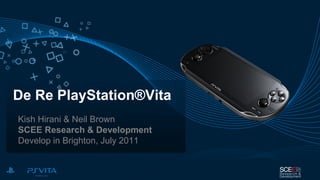
De Re PlayStation®Vita
Kish Hirani & Neil Brown
SCEE Research & Development
Develop in Brighton, July 2011
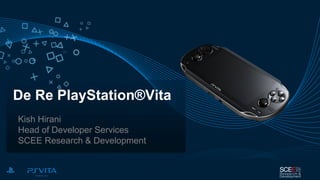
De Re PlayStation®Vita
Kish Hirani
Head of Developer Services
SCEE Research & Development
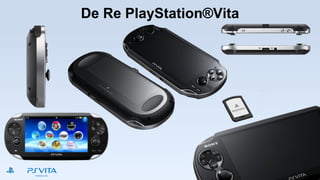
De Re PlayStation®Vita
• Brief Hardware Overview
• Key Points of Differentiation
• Hardware as well as Software
• Development Hardware
• Highlight Simplified Software Libraries & T&Ms
• Implementation Tech Demo videos
• Example of use in game
• Graphics on PS®Vita (Neil Brown)
Hardware Overview
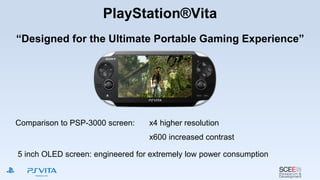
“Designed for the Ultimate Portable Gaming Experience”
Comparison to PSP-3000 screen: x4 higher resolution
x600 increased contrast
5 inch OLED screen: engineered for extremely low power consumption
PlayStation®Vita
Hardware Overview
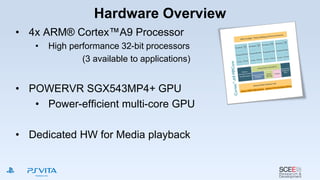
• 4x ARM® Cortex™A9 Processor
• High performance 32-bit processors
(3 available to applications)
• POWERVR SGX543MP4+ GPU
• Power-efficient multi-core GPU
• Dedicated HW for Media playback
Key Points of
Differentiation
Hardware
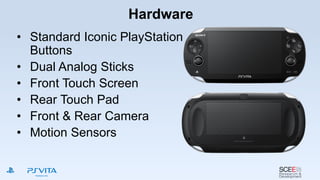
• Standard Iconic PlayStation
Buttons
• Dual Analog Sticks
• Front Touch Screen
• Rear Touch Pad
• Front & Rear Camera
• Motion Sensors
Software
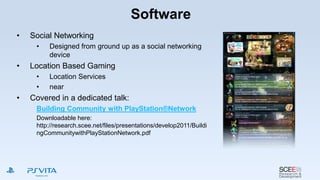
• Social Networking
• Designed from ground up as a social networking
device
• Location Based Gaming
• Location Services
• near
• Covered in a dedicated talk:
Building Community with PlayStation®Network
Downloadable here:
http://research.scee.net/files/presentations/develop2011/Buildi
ngCommunitywithPlayStationNetwork.pdf
Software
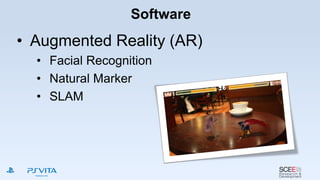
• Augmented Reality (AR)
• Facial Recognition
• Natural Marker
• SLAM
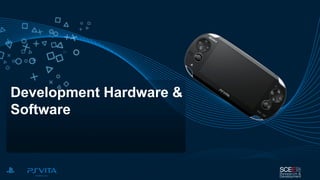
Development Hardware &
Software
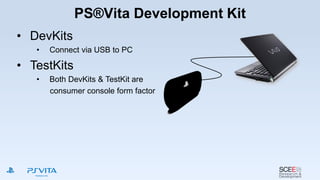
PS®Vita Development Kit
• DevKits
• Connect via USB to PC
• TestKits
• Both DevKits & TestKit are
consumer console form factor
Simplified Libraries
• We’ve created some really simplified libraries to help you if you’re a small
team, or you don’t need fine grained control
• Simplified video player
• Start, stop, rewind
• Simplified audio & MIDI music playback libraries
• Simplified network interface
• The low level libraries are still available if you want to manage everything
yourself
• The simplified libraries are optimised so are not slower than the low level API
Other Libraries to Simplify Development
• Vector Maths and Geometry
• Rigid Body Physics Simulation
• Animation
• Facial Recognition
• Even optimised game engine:
PhyreEngine™
PhyreEngine™
• PlayStation optimised game engine
• PSP, PS3, PS Vita, PC
• Provided as source
• Portable, reusable
• Free to use, either full or in part
• Partner Programme
• Integrating with middleware to ensure developers can choose the best solutions
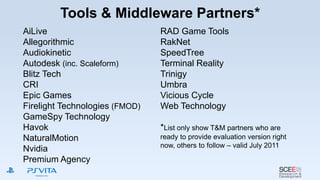
Tools & Middleware Partners*
AiLive
Allegorithmic
Audiokinetic
Autodesk (inc. Scaleform)
Blitz Tech
CRI
Epic Games
Firelight Technologies (FMOD)
GameSpy Technology
Havok
NaturalMotion
Nvidia
Premium Agency
RAD Game Tools
RakNet
SpeedTree
Terminal Reality
Trinigy
Umbra
Vicious Cycle
Web Technology
*List only show T&M partners who are
ready to provide evaluation version right
now, others to follow – valid July 2011
Facial Recognition
& Augmented Reality
Facial Recognition Tech Demo
• Video Chat tech demo By SCE Japan Studio
• Uses facial recognition libs:
• Face Detection
• Feature Detection
• Eyes, Nose, Mouth, etc
• Head tracking
• Face attributes
• Smile, Male/Female, Age (Adult/Child), Glasses
• Eyes open/close (early alpha code)
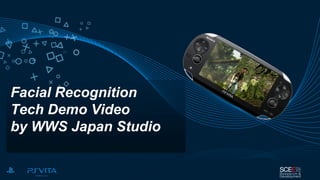
Facial Recognition
Tech Demo Video
by WWS Japan Studio
Augmented Reality (AR)
• Most games until now use a special tracking
marker
• On PS Vita R&D in Natural Marker technology
allows us to use almost any image as a tracking
marker
• Real time Simultaneous Localisation And
Mapping (SLAM)
• Use any patterned surface as a marker
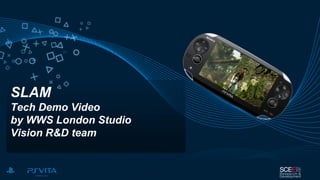
SLAM
Tech Demo Video
by WWS London Studio
Vision R&D team
AR for gaming
• Order of priority when implementing AR:
• Robustness (reliable)
• Speed & Frame Rate
• Accuracy (dependable)
• Just in case you are interested in medical AR research they come up with the
following order of priority:
• Accuracy (it needs to be dependable otherwise could have fatal consequences)
• Speed & Frame Rate (easy to achieve as cost of hardware is not a major factor)
• Robustness (lower as location, lighting, etc are usually predictable)
…In Conclusion
PlayStation®Vita Inception
• Unlike our previous hardware, PS Vita was not created in isolation by our
hardware engineers in Japan
• Huge amounts of input from our 1st party as well as 3rd party studios (inc T&M
partners) from a very early stage
• Not just the inputs mechanisms and gameplay features you’d expect, but also
• Hardware – SOC: CPU and GPU
• Software – Libraries and API design and implementation
• Tools – design and implementation
• All aspects of PS Vita has been developed from the ground up with
developers in mind
• In a very real sense it has been created by developers for developers
Useful Links
• tpr_registration@scee.net - 1st port of call in becoming a registered
developer
• https://www.tpr.scee.net/ - Registered developers on existing PS platforms
• http://www.worldwidestudios.net/xdev - For registered developers who
wish to propose titles to SCEE XDEV
• SCEA PubFund - Please contact your SCEE account manager who will
reach out to SCEA Developer Relations who oversee PubFund (open to all
developers globally)
• http://research.scee.net/ - SCEE R&D public site where we place all public
presentations.
Graphics on
PlayStation®Vita
Neil Brown – Senior Engineer
SCEE R&D
Graphics on PlayStation®Vita
• Introduction
• Hardware
• Tile Based Deferred Rendering
• Software
• Programming Model
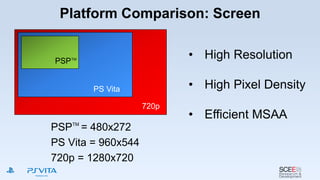
Platform Comparison: Screen
• High Resolution
• High Pixel Density
• Efficient MSAA
PSP = 480x272
PS Vita = 960x544
720p = 1280x720
720p
PSP
PS Vita
TM
TM
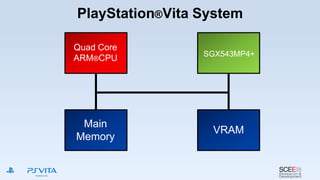
PlayStation®Vita System
Quad Core
ARM®CPU SGX543MP4+
Main
Memory
VRAM
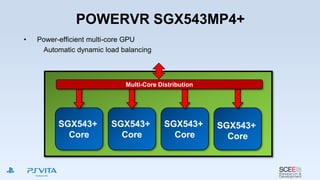
POWERVR SGX543MP4+
• Power-efficient multi-core GPU
Automatic dynamic load balancing
SGX543+
Core
SGX543+
Core
SGX543+
Core
SGX543+
Core
Multi-Core Distribution
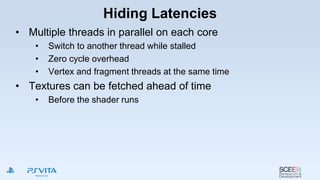
Hiding Latencies
• Multiple threads in parallel on each core
• Switch to another thread while stalled
• Zero cycle overhead
• Vertex and fragment threads at the same time
• Textures can be fetched ahead of time
• Before the shader runs
Tile-Based Deferred
Rendering
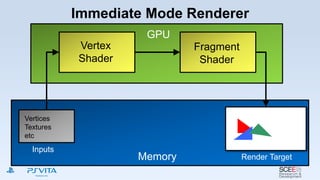
Immediate Mode Renderer
Vertex
Shader
Fragment
Shader
Memory
Vertices
Textures
etc
Inputs
Render Target
GPU
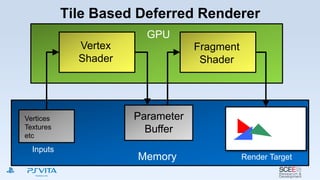
Tile Based Deferred Renderer
Vertex
Shader
Fragment
Shader
Parameter
Buffer
Memory
Vertices
Textures
etc
Inputs
Render Target
Parameter
Buffer
GPU
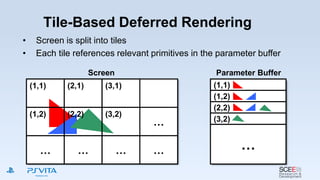
Tile-Based Deferred Rendering
• Screen is split into tiles
• Each tile references relevant primitives in the parameter buffer
Parameter BufferScreen
…
(3,1)
(3,2)
(1,1) (2,1)
…… …
…
(1,1)
(2,2)
(1,2)
(3,2)
…
(1,2) (2,2)
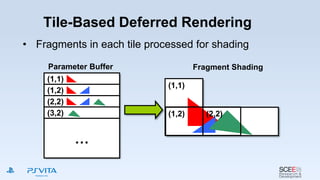
Tile-Based Deferred Rendering
(1,1)
(2,2)
(1,2)
(3,2)
…
(1,1)
(2,2)(1,2)
Fragment ShadingParameter Buffer
• Fragments in each tile processed for shading
Parameter Buffer
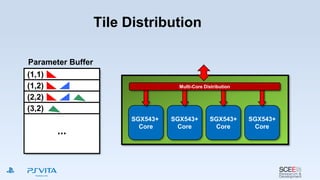
SGX543+
Core
SGX543+
Core
SGX543+
Core
SGX543+
Core
Multi-Core Distribution
Tile Distribution
...
(1,1)
(1,2)
(2,2)
(3,2)
Advantages of TBDR:
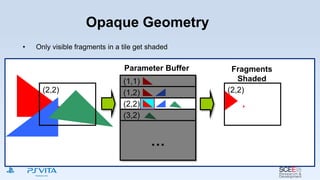
1) Hidden Surface Removal
Opaque Geometry
• Only visible fragments in a tile get shaded
Fragments
Shaded
Parameter Buffer
(1,1)
(2,2)
(1,2)
(3,2)
…
(2,2) (2,2)
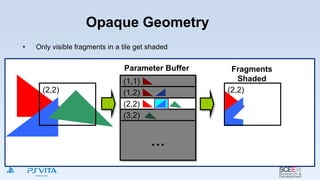
Opaque Geometry
• Only visible fragments in a tile get shaded
Parameter Buffer
(1,1)
(2,2)
(1,2)
(3,2)
…
(2,2)
Fragments
Shaded
(2,2)
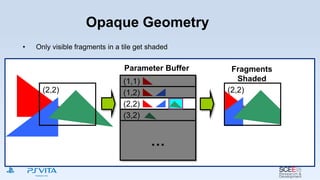
Opaque Geometry
• Only visible fragments in a tile get shaded
Parameter Buffer
(1,1)
(2,2)
(1,2)
(3,2)
…
(2,2)
Fragments
Shaded
(2,2)
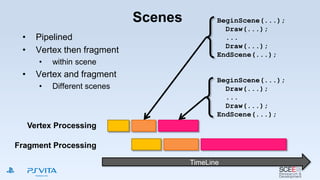
Scenes BeginScene(...);
Draw(...);
...
Draw(...);
EndScene(...);
BeginScene(...);
Draw(...);
...
Draw(...);
EndScene(...);
• Pipelined
• Vertex then fragment
• within scene
• Vertex and fragment
• Different scenes
Vertex Processing
Fragment Processing
TimeLine
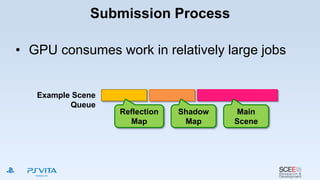
Submission Process
• GPU consumes work in relatively large jobs
Example Scene
Queue
Reflection
Map
Shadow
Map
Main
Scene
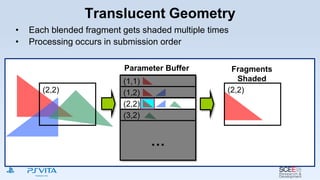
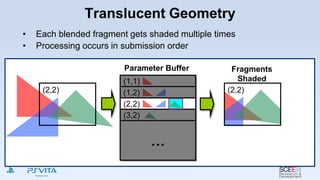
Translucent Geometry
• Each blended fragment gets shaded multiple times
• Processing occurs in submission order
Parameter Buffer
(1,1)
(2,2)
(1,2)
(3,2)
…
(2,2)
Fragments
Shaded
(2,2)
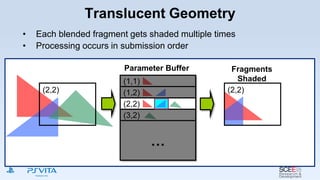
Translucent Geometry
Parameter Buffer
(1,1)
(2,2)
(1,2)
(3,2)
…
(2,2)
• Each blended fragment gets shaded multiple times
• Processing occurs in submission order
Fragments
Shaded
(2,2)
Translucent Geometry
Parameter Buffer
(1,1)
(2,2)
(1,2)
(3,2)
…
(2,2)
• Each blended fragment gets shaded multiple times
• Processing occurs in submission order
Fragments
Shaded
(2,2)
Advantages of TBDR:
2: Data is kept ‘on-chip’
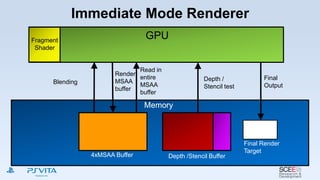
Final Render
Target
Read in
entire
MSAA
buffer
Immediate Mode Renderer
GPU
Final
Output
Fragment
Shader
MemoryMemory
Depth /Stencil Buffer4xMSAA Buffer
Blending
Render
MSAA
buffer
Depth /
Stencil test
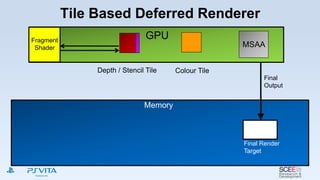
Tile Based Deferred Renderer
Final Render
Target
GPU
Depth / Stencil Tile Colour Tile
Fragment
Shader
Memory
Final
Output
MSAA
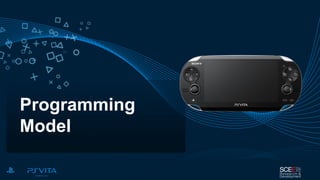
Programming
Model
Programming Model
• No unnecessary complications
• Tile-based processing handled behind the scenes
• Leaving you a familiar API interface
Shader Model 3.x+
• Familiar format of
• Vertex / Fragment Shaders
• Geometry
• Textures
• Render Targets
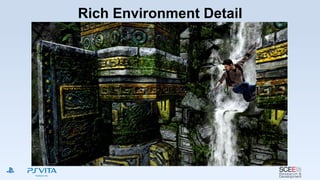
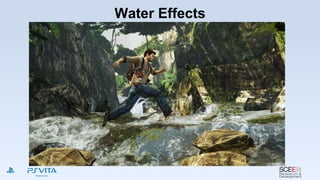
• Reduce asset size, but keep same visual fidelity
• Can be up and running in a few weeks
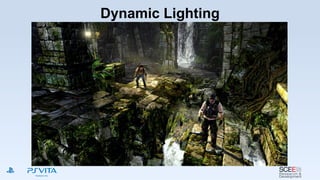
Dynamic Lighting
Rich Environment Detail
Water Effects
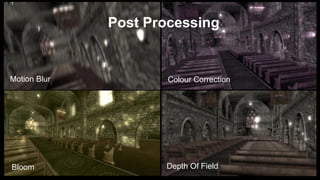
Post Processing
Motion Blur Colour Correction
Bloom Depth Of Field
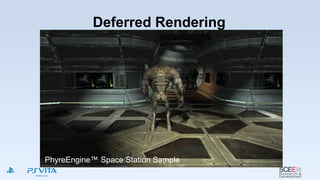
Deferred Rendering
PhyreEngine™ Space Station Sample
Razor
• Next Gen version of SN Tuner and GPAD rolled into one
• Analyse CPU and GPU at the same time
• Host PC
• Target on screen HUD
• Fully integrated into Visual Studio
• Easy to track down you bottlenecks
• Comprehensive CPU and GPU counters
• Covers all cores
• Intuitive Interface
• Lots of really cool features I’m not allowed to talk about
Summary
Summary
• Created from the ground up for developers
• Rich set of interfaces
• Hardware does the hard work
• Shader Model 3.x+
• Powerful and intuitive tools
• Developer Friendly
Thanks To
• SCEI
• SCEE R&D
• SCE ATG
• SN Systems
• WWS 1st and 2nd party developers
Any Questions?
De Re PlayStation Vita

De Re PlayStation Vita