CLOUD GAMING : UNDERSTANDING
SUPPORT FROM THE VIRTUALIZATION
AND HARDWARE
Gautam Krishna R
Roll No: 28 | CSE S7
OVERVIEW
• Introduction
• Cloud gaming
• Types of Cloud Gaming
• Architecture
• Advantages
• Challenges
• Virtualization
• Introduction
• Design and Implementation
• Conclusion and outlook
2
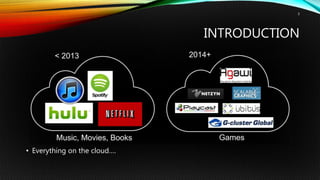
INTRODUCTION
3
• Everything on the cloud….
CLOUD GAMING
• Cloud gaming, sometimes called gaming on demand
• Cloud gaming, in its simplest form, renders an interactive gaming application
remotely in the cloud and streams the scenes as a video sequence back to the
player over the Internet.
• Two types:
• Video (or pixel) streaming
• File streaming
4
TYPE :1 VIDEO STREAMING
• The actual game is stored, executed, and rendered on the remote operator's or
game company's server.
• The video results are streamed directly to a consumer's computers over the internet
using thin client.
• Keystrokes and button presses are sent directly to the server
• Server sends back the game response
• Allows access to games without the need of a Consoles or High end PC
5
TYPE 2: FILE STREAMING
• Also known as progressive downloading.
• A small part of a game, usually less than 5% of the total game size is downloaded to
the user’s device.
• The remaining game content is downloaded to the end user's device while playing.
• Rendering and processing takes place in user’s PC or console.
• This allows instant access to games with low bandwidth Internet connections.
6
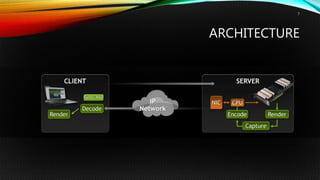
ARCHITECTURE
7
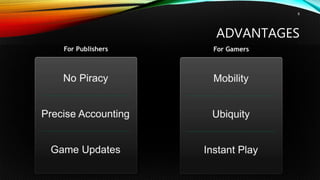
ADVANTAGES
8
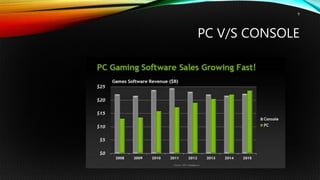
PC V/S CONSOLE
9
CHALLENGES
• Currently most of the cloud gaming platforms private/public non-virtualized
environment.
• Each users have his on clusters in the cloud.
• Costs to maintain private environment is high
• Deployment costs will be high
10
THE SOLUTION: VIRTUALIZATION
• A virtualized cloud environment refers to a cloud cluster that can be easily scaled.
• Each user have his own virtualized cloud environment
• Maintenance cost is low
• Deployment cost is low
11
DESIGN AND IMPLEMENTATION
• Recent advancement in technology created new classes of GPUs specifically for
virtualized environments.
• E.g.: NVIDIA GRID
• Implementation of a high performance cloud gaming system: Rhizome
• With NVIDIA GRID GPU and its hardware H.264 encoder.
• The gaming protocol can be customized.
12
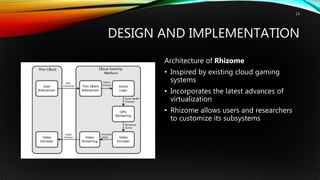
DESIGN AND IMPLEMENTATION
Architecture of Rhizome
• Inspired by existing cloud gaming
systems
• Incorporates the latest advances of
virtualization
• Rhizome allows users and researchers
to customize its subsystems
13
DESIGN AND IMPLEMENTATION
Remote server setup
• Needs to setup remote desktop hooks
• The commands are sent to the server
over TCP
• The rendering is performed by the GPU
that is assigned to the VM
• The media stream that is transmitted to
the client undergoes several
optimizations
• Platform independent implementation
• Tested on amazon EC2
• Easily saleable
• Rhizome platform capture video from
the GPU and encode it using hardware
H.264 encoder
14
DESIGN AND IMPLEMENTATION
Thin Client Configuration
• Tests where done on EVGA Tegra NOTE
7 tablet
• It was powered by NVIDIA Tegra 4
chipset and quad-core ARM Cortex-
A15 CPU
• With a NVIDIA GeForce GPU
• Various benchmarking tests are done
on the device
• It was found that Hardware decoding is
both performance and power efficient
• The Rhizome client uses hardware
encoding
15
CONCLUSION
• Cloud gaming a the game changing technology
• Efficient cloud can be achieved with the latest hardware and virtualization
technology advances
• Virtualization for GPU has greatly improved and is ready for gaming over a public
cloud
• Only hardware encoders can achieve acceptable gaming performance
• Cloud gaming is rapidly evolving, particularly toward 4K UHD
16
REFERENCE
• M. Armbrust et al., “A view of cloud computing,” Commun. ACM, vol. 53, no. 4, pp. 50–58,
2010.
• W. Cai, M. Chen, and V. C. M. Leung, “Toward gaming as a service,” IEEE Internet Comput.,
vol. 18, no. 3, pp. 12–18, May/Jun. 2014.
• R. Shea, J. Liu, E. C.-H. Ngai, and Y. Cui, “Cloud gaming: Architecture and performance,” IEEE
Netw., vol. 27, no. 4, pp. 16–21, Jul./Aug. 2013.
• M. Claypool, D. Finkel, A. Grant, and M. Solano, “On the perfor-mance of OnLive thin client
games,”
• C.-Y. Huang, C.-H. Hsu, Y.-C. Chang, and K.-T. Chen, “GamingAnywhere: An open cloud
gaming system,”
• ACM Multimedia Syst. Conf. (MMSys), 2013, pp. 36–47. [Online].
• Available: http://doi.acm.org/10.1145/2483977.2483981
• OnLive. [Online]. Available: http://www.onlive.com/, accessed Sep. 2014.
• Gaikai. [Online]. Available: http://www.gaikai.com/, accessed Sep. 2014.
17
THANK YOU!Questions ???
18

Cloud Gaming

  • 1.
    CLOUD GAMING :UNDERSTANDING SUPPORT FROM THE VIRTUALIZATION AND HARDWARE Gautam Krishna R Roll No: 28 | CSE S7
  • 2.
    OVERVIEW • Introduction • Cloudgaming • Types of Cloud Gaming • Architecture • Advantages • Challenges • Virtualization • Introduction • Design and Implementation • Conclusion and outlook 2
  • 3.
  • 4.
    CLOUD GAMING • Cloudgaming, sometimes called gaming on demand • Cloud gaming, in its simplest form, renders an interactive gaming application remotely in the cloud and streams the scenes as a video sequence back to the player over the Internet. • Two types: • Video (or pixel) streaming • File streaming 4
  • 5.
    TYPE :1 VIDEOSTREAMING • The actual game is stored, executed, and rendered on the remote operator's or game company's server. • The video results are streamed directly to a consumer's computers over the internet using thin client. • Keystrokes and button presses are sent directly to the server • Server sends back the game response • Allows access to games without the need of a Consoles or High end PC 5
  • 6.
    TYPE 2: FILESTREAMING • Also known as progressive downloading. • A small part of a game, usually less than 5% of the total game size is downloaded to the user’s device. • The remaining game content is downloaded to the end user's device while playing. • Rendering and processing takes place in user’s PC or console. • This allows instant access to games with low bandwidth Internet connections. 6
  • 7.
  • 8.
  • 9.
  • 10.
    CHALLENGES • Currently mostof the cloud gaming platforms private/public non-virtualized environment. • Each users have his on clusters in the cloud. • Costs to maintain private environment is high • Deployment costs will be high 10
  • 11.
    THE SOLUTION: VIRTUALIZATION •A virtualized cloud environment refers to a cloud cluster that can be easily scaled. • Each user have his own virtualized cloud environment • Maintenance cost is low • Deployment cost is low 11
  • 12.
    DESIGN AND IMPLEMENTATION •Recent advancement in technology created new classes of GPUs specifically for virtualized environments. • E.g.: NVIDIA GRID • Implementation of a high performance cloud gaming system: Rhizome • With NVIDIA GRID GPU and its hardware H.264 encoder. • The gaming protocol can be customized. 12
  • 13.
    DESIGN AND IMPLEMENTATION Architectureof Rhizome • Inspired by existing cloud gaming systems • Incorporates the latest advances of virtualization • Rhizome allows users and researchers to customize its subsystems 13
  • 14.
    DESIGN AND IMPLEMENTATION Remoteserver setup • Needs to setup remote desktop hooks • The commands are sent to the server over TCP • The rendering is performed by the GPU that is assigned to the VM • The media stream that is transmitted to the client undergoes several optimizations • Platform independent implementation • Tested on amazon EC2 • Easily saleable • Rhizome platform capture video from the GPU and encode it using hardware H.264 encoder 14
  • 15.
    DESIGN AND IMPLEMENTATION ThinClient Configuration • Tests where done on EVGA Tegra NOTE 7 tablet • It was powered by NVIDIA Tegra 4 chipset and quad-core ARM Cortex- A15 CPU • With a NVIDIA GeForce GPU • Various benchmarking tests are done on the device • It was found that Hardware decoding is both performance and power efficient • The Rhizome client uses hardware encoding 15
  • 16.
    CONCLUSION • Cloud gaminga the game changing technology • Efficient cloud can be achieved with the latest hardware and virtualization technology advances • Virtualization for GPU has greatly improved and is ready for gaming over a public cloud • Only hardware encoders can achieve acceptable gaming performance • Cloud gaming is rapidly evolving, particularly toward 4K UHD 16
  • 17.
    REFERENCE • M. Armbrustet al., “A view of cloud computing,” Commun. ACM, vol. 53, no. 4, pp. 50–58, 2010. • W. Cai, M. Chen, and V. C. M. Leung, “Toward gaming as a service,” IEEE Internet Comput., vol. 18, no. 3, pp. 12–18, May/Jun. 2014. • R. Shea, J. Liu, E. C.-H. Ngai, and Y. Cui, “Cloud gaming: Architecture and performance,” IEEE Netw., vol. 27, no. 4, pp. 16–21, Jul./Aug. 2013. • M. Claypool, D. Finkel, A. Grant, and M. Solano, “On the perfor-mance of OnLive thin client games,” • C.-Y. Huang, C.-H. Hsu, Y.-C. Chang, and K.-T. Chen, “GamingAnywhere: An open cloud gaming system,” • ACM Multimedia Syst. Conf. (MMSys), 2013, pp. 36–47. [Online]. • Available: http://doi.acm.org/10.1145/2483977.2483981 • OnLive. [Online]. Available: http://www.onlive.com/, accessed Sep. 2014. • Gaikai. [Online]. Available: http://www.gaikai.com/, accessed Sep. 2014. 17
  • 18.