Core Audio Cranks It Up
                                  Chris Adamson • @invalidname
                           Voices That Matter: iOS Developer Conference
                                    Nov. 13, 2011 • Boston, MA


Tuesday, November 15, 11
What We'll Cover
               • Core Audio: what it is and why it's there

               • Audio Units and graphs

               • Fun with I/O

               • Special effects

               • Music with MIDI


Tuesday, November 15, 11
Core Audio
               • Low-level, low-latency, professional audio
                 processing API, ported from OS X to iPhone
                 OS.

               • Legendarily difficult: see Mike Ash's "Why
                 Core Audio Is Hard" (Oct. 2006)

               • Consists of three audio engines and various
                 helpers


Tuesday, November 15, 11
What's in the box
               • #import AudioToolbox, possibly also AudioUnit,
                 CoreMIDI

               • Helper APIs — File I/O, format conversion,
                 stream parsing, MIDI events, sessions

               • Audio Engine APIs — Audio Units, Audio
                 Queues, OpenAL

                    • Queues and OpenAL implemented atop units


Tuesday, November 15, 11
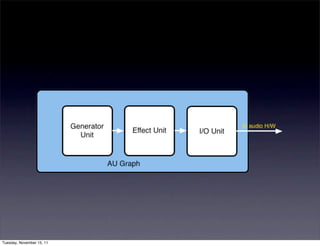
Audio Units
               • Process audio in some way: generate, apply
                 affects, mix, hardware I/O, etc.

               • Arbitrary number of inputs and outputs (usually
                 one each)

               • Rare case: process a buffer of samples in
                 place

               • Common case: connect units in a "graph"


Tuesday, November 15, 11
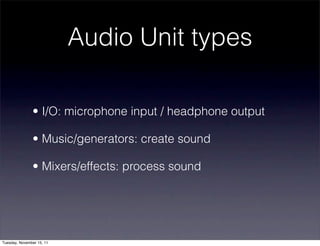
Audio Unit types

               • I/O: microphone input / headphone output

               • Music/generators: create sound

               • Mixers/effects: process sound


Tuesday, November 15, 11
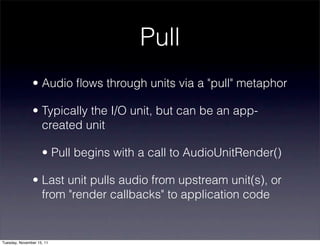
Pull
               • Audio flows through units via a "pull" metaphor

               • Typically the I/O unit, but can be an app-
                 created unit

                    • Pull begins with a call to AudioUnitRender()

               • Last unit pulls audio from upstream unit(s), or
                 from "render callbacks" to application code


Tuesday, November 15, 11
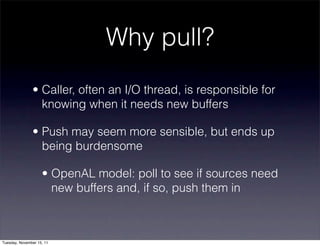
Why pull?
               • Caller, often an I/O thread, is responsible for
                 knowing when it needs new buffers

               • Push may seem more sensible, but ends up
                 being burdensome

                    • OpenAL model: poll to see if sources need
                      new buffers and, if so, push them in


Tuesday, November 15, 11
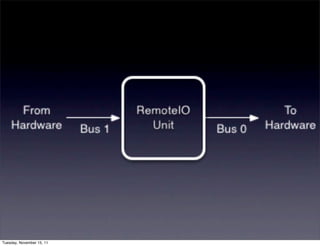
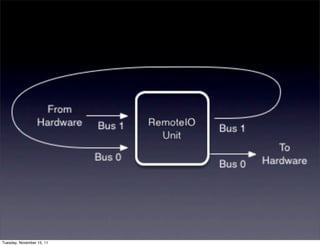
I/O units
               • Abstraction over audio hardware

               • AURemoteIO for local use, echo-cancelling
                 AUVoiceProcessingIO for VOIP

               • Can only have one per graph

               • Special meaning for buses: 0 is output to
                 headphones/speakers, 1 is input from
                 microphone


Tuesday, November 15, 11
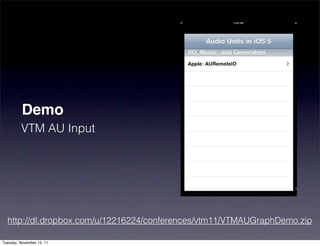
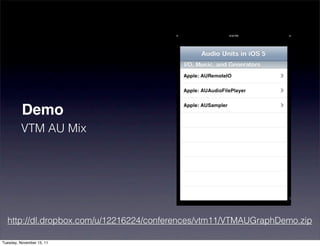
Demo
         VTM AU Input


  http://dl.dropbox.com/u/12216224/conferences/vtm11/VTMAUGraphDemo.zip

Tuesday, November 15, 11
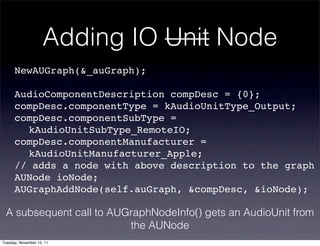
Adding IO Unit Node
      NewAUGraph(&_auGraph);

      AudioComponentDescription compDesc = {0};
      compDesc.componentType = kAudioUnitType_Output;
      compDesc.componentSubType =
      ! kAudioUnitSubType_RemoteIO;
      compDesc.componentManufacturer =
      ! kAudioUnitManufacturer_Apple;
      // adds a node with above description to the graph
      AUNode ioNode;
      AUGraphAddNode(self.auGraph, &compDesc, &ioNode);

 A subsequent call to AUGraphNodeInfo() gets an AudioUnit from
                         the AUNode
Tuesday, November 15, 11
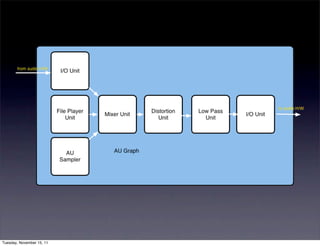
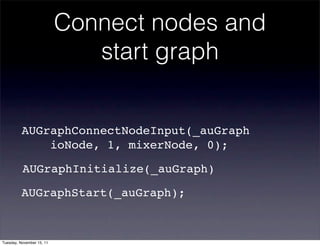
Connect nodes and
                              start graph


          AUGraphConnectNodeInput(_auGraph
              ioNode, 1, mixerNode, 0);

          AUGraphInitialize(_auGraph)

          AUGraphStart(_auGraph);!


Tuesday, November 15, 11
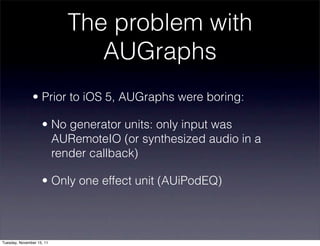
The problem with
                              AUGraphs
               • Prior to iOS 5, AUGraphs were boring:

                    • No generator units: only input was
                      AURemoteIO (or synthesized audio in a
                      render callback)

                    • Only one effect unit (AUiPodEQ)


Tuesday, November 15, 11
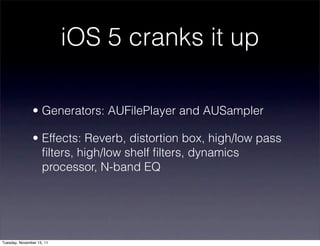
iOS 5 cranks it up

               • Generators: AUFilePlayer and AUSampler

               • Effects: Reverb, distortion box, high/low pass
                 filters, high/low shelf filters, dynamics
                 processor, N-band EQ


Tuesday, November 15, 11
AUFilePlayer
               • Generator unit that produces sound from a file

               • Prior to this, playing a file in an AUGraph was
                 unduly burdensome

                    • Render callbacks cannot perform blocking calls
                      like file I/O, so you'd read from file in one thread,
                      put samples in a ring buffer, and have callback
                      pull from buffer

                    • We have an OSX example of this in book. Ouch.


Tuesday, November 15, 11
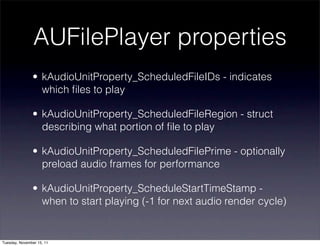
AUFilePlayer properties
               • kAudioUnitProperty_ScheduledFileIDs - indicates
                 which files to play

               • kAudioUnitProperty_ScheduledFileRegion - struct
                 describing what portion of file to play

               • kAudioUnitProperty_ScheduledFilePrime - optionally
                 preload audio frames for performance

               • kAudioUnitProperty_ScheduleStartTimeStamp -
                 when to start playing (-1 for next audio render cycle)


Tuesday, November 15, 11
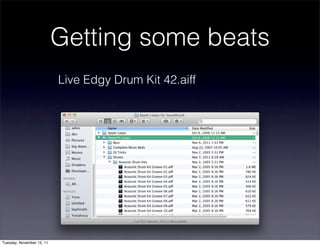
Getting some beats
                           Live Edgy Drum Kit 42.aiff


Tuesday, November 15, 11
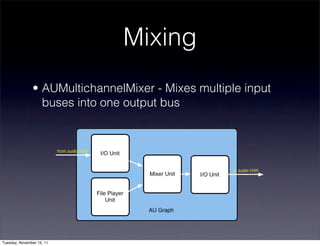
Mixing
               • AUMultichannelMixer - Mixes multiple input
                 buses into one output bus


Tuesday, November 15, 11
Demo
         VTM AU Mix


  http://dl.dropbox.com/u/12216224/conferences/vtm11/VTMAUGraphDemo.zip

Tuesday, November 15, 11
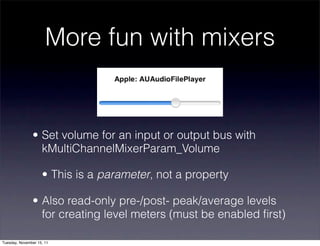
More fun with mixers


               • Set volume for an input or output bus with
                 kMultiChannelMixerParam_Volume

                    • This is a parameter, not a property

               • Also read-only pre-/post- peak/average levels
                 for creating level meters (must be enabled first)

Tuesday, November 15, 11
Also new: MIDI

               • Core MIDI added in iOS 4.2

               • Provides I/O with MIDI hardware, or MIDI-
                 over-WiFi

               • Hardware access is via Camera Connection
                 Kit and MIDI-to-USB adapter


Tuesday, November 15, 11
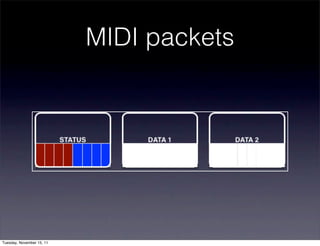
MIDI packets


Tuesday, November 15, 11
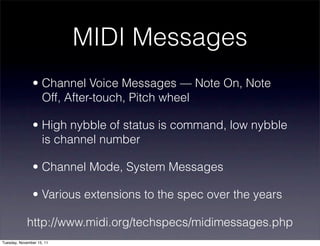
MIDI Messages
               • Channel Voice Messages — Note On, Note
                 Off, After-touch, Pitch wheel

               • High nybble of status is command, low nybble
                 is channel number

               • Channel Mode, System Messages

               • Various extensions to the spec over the years

             http://www.midi.org/techspecs/midimessages.php
Tuesday, November 15, 11
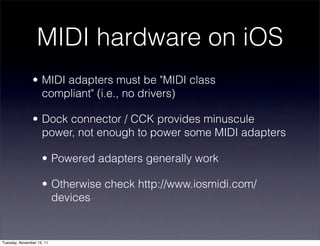
MIDI hardware on iOS
               • MIDI adapters must be "MIDI class
                 compliant" (i.e., no drivers)

               • Dock connector / CCK provides minuscule
                 power, not enough to power some MIDI adapters

                    • Powered adapters generally work

                    • Otherwise check http://www.iosmidi.com/
                      devices


Tuesday, November 15, 11
MIDI set-up
    MIDIClientCreate(CFSTR("VTM iOS Demo"), MyMIDINotifyProc,
    ! ! callbackContext, &client);
    MIDIInputPortCreate(client, CFSTR("Input port"),
    ! ! MyMIDIReadProc, callbackContext, &inPort);
    unsigned long sourceCount = MIDIGetNumberOfSources();
    for (int i = 0; i < sourceCount; ++i) {
    ! MIDIEndpointRef src = MIDIGetSource(i);
    ! CFStringRef endpointName = NULL;
    ! MIDIObjectGetStringProperty(src, kMIDIPropertyName,
    ! ! &endpointName);
    ! char endpointNameC[255];
    ! CFStringGetCString(endpointName, endpointNameC,
    ! ! 255, kCFStringEncodingUTF8);
    ! printf(" source %d: %sn", i, endpointNameC);
    ! MIDIPortConnectSource(inPort, src, NULL);
    }
Tuesday, November 15, 11
So what do we do in
                            MyMIDIReadProc?
               • Prior to iOS 5, there was no API that actually
                 did anything with MIDI events

               • On OSX, Core Audio defines music units,
                 which play sounds in response to MIDI events

               • iOS 5 and Lion add the AUSampler


Tuesday, November 15, 11
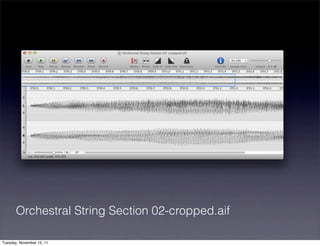
AUSampler

               • Music unit that starts with a source clip and
                 pitch-shifts to create different tones

               • Can use DLS or SoundFont 2 files as source

               • Can also create your own sample files with
                 AULab


Tuesday, November 15, 11
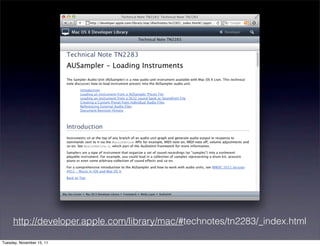
http://developer.apple.com/library/mac/#technotes/tn2283/_index.html

Tuesday, November 15, 11
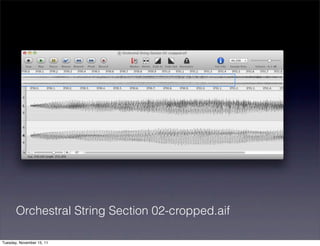
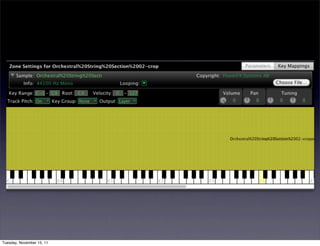
Orchestral String Section 02-cropped.aif

Tuesday, November 15, 11
Orchestral String Section 02-cropped.aif

Tuesday, November 15, 11
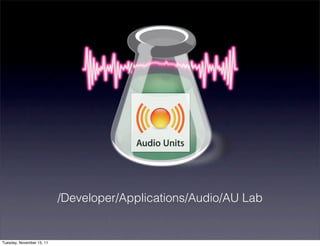
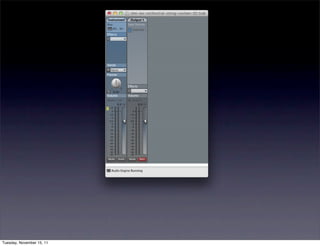
/Developer/Applications/Audio/AU Lab


Tuesday, November 15, 11
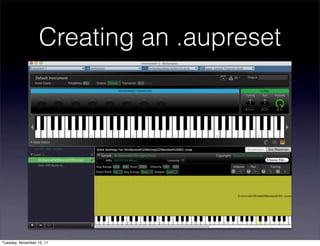
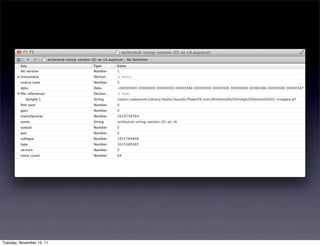
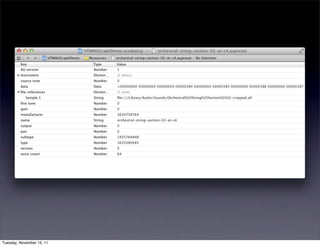
Creating an .aupreset


Tuesday, November 15, 11
Loading .aupreset (1/3)
   NSString *filePath = [[NSBundle mainBundle]
   ! pathForResource: AU_SAMPLER_PRESET_FILE
   ! ofType:@"aupreset"];
   CFURLRef presetURL =
   ! (__bridge CFURLRef) [NSURL fileURLWithPath:filePath];

   // load preset file into a CFDataRef
   CFDataRef presetData = NULL;
   SInt32 errorCode = noErr;
   Boolean gotPresetData =
   ! CFURLCreateDataAndPropertiesFromResource(
   ! ! kCFAllocatorSystemDefault, presetURL,
   ! ! &presetData, NULL, NULL, &errorCode);


Tuesday, November 15, 11
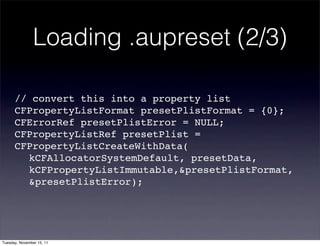
Loading .aupreset (2/3)

      // convert this into a property list
      CFPropertyListFormat presetPlistFormat = {0};
      CFErrorRef presetPlistError = NULL;
      CFPropertyListRef presetPlist =
      CFPropertyListCreateWithData(
      ! kCFAllocatorSystemDefault, presetData,
      ! kCFPropertyListImmutable,&presetPlistFormat,
      ! &presetPlistError);


Tuesday, November 15, 11
Loading .aupreset (3/3)
          // set this plist as the
          // kAudioUnitProperty_ClassInfo on _auSampler
          if (presetPlist) {
          ! ! AudioUnitSetProperty(
          ! ! ! ! self.auSampler,
          ! ! ! ! kAudioUnitProperty_ClassInfo,
          ! ! ! ! kAudioUnitScope_Global,
          ! ! ! ! 0,
          ! ! ! ! &presetPlist,
          ! ! ! ! sizeof(presetPlist);
          }


Tuesday, November 15, 11
Now what?
               • We have configured Core MIDI to call
                 MyMIDIReadProc on incoming MIDI events

               • We have configured the AUSampler audio
                 unit with a sampled sound

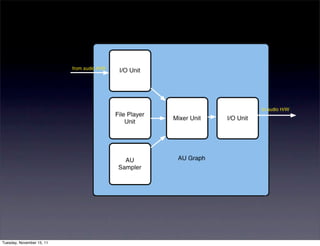
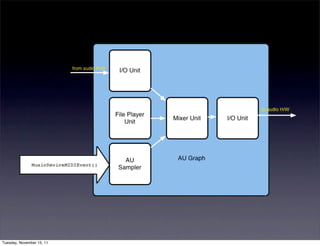
               • We need to deliver the MIDI events to the
                 AUSampler unit


Tuesday, November 15, 11
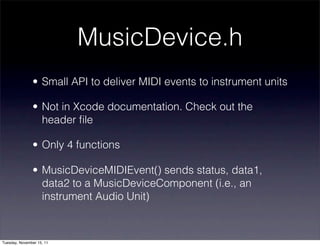
MusicDevice.h
               • Small API to deliver MIDI events to instrument units

               • Not in Xcode documentation. Check out the
                 header file

               • Only 4 functions

               • MusicDeviceMIDIEvent() sends status, data1,
                 data2 to a MusicDeviceComponent (i.e., an
                 instrument Audio Unit)


Tuesday, November 15, 11
Delivering MIDI event
    MIDIPacket *packet = (MIDIPacket *)pktlist->packet;!
    for (int i=0; i < pktlist->numPackets; i++) {
    ! Byte midiStatus = packet->data[0];
    ! Byte midiCommand = midiStatus >> 4;
    ! // is it a note-on or note-off
    ! if ((midiCommand == 0x09) || (midiCommand == 0x08)) {
    ! ! Byte note = packet->data[1] & 0x7F;
    ! ! Byte velocity = packet->data[2] & 0x7F;
    ! ! // send to augraph
    ! ! MusicDeviceMIDIEvent (myVC.auSampler, midiStatus,
    note, velocity, 0);
    ! }
    ! packet = MIDIPacketNext(packet);
    }


Tuesday, November 15, 11
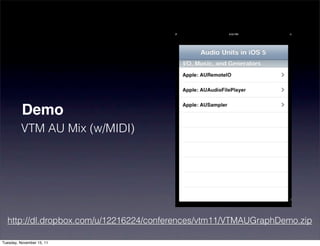
Demo
         VTM AU Mix (w/MIDI)


  http://dl.dropbox.com/u/12216224/conferences/vtm11/VTMAUGraphDemo.zip

Tuesday, November 15, 11
Effects
               • iOS 5 first version to offer multiple audio effects

               • Many effects use floating-point samples, rather
                 than ints or fixed-point; requires adjusting the
                 stream formats of units connected to them (or
                 in-line AUConverters)

               • Adjust with parameters (see
                 AudioUnitParameters.h)


Tuesday, November 15, 11
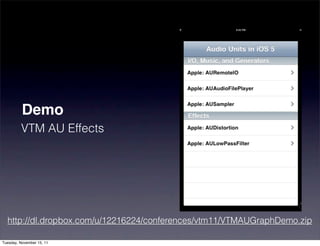
Two sample effects

               • Distortion effect - audio "fuzzing" effect, takes
                 no parameters

               • Low pass filter - Cuts off frequencies above a
                 given frequency


Tuesday, November 15, 11
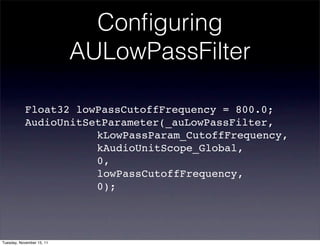
Configuring
                           AULowPassFilter

           Float32 lowPassCutoffFrequency = 800.0;
           AudioUnitSetParameter(_auLowPassFilter,
           ! ! ! ! ! kLowPassParam_CutoffFrequency,
           ! ! ! ! ! kAudioUnitScope_Global,
           ! ! ! ! ! 0,
           ! ! ! ! ! lowPassCutoffFrequency,
           ! ! ! ! ! 0);


Tuesday, November 15, 11
Demo
         VTM AU Effects


  http://dl.dropbox.com/u/12216224/conferences/vtm11/VTMAUGraphDemo.zip

Tuesday, November 15, 11
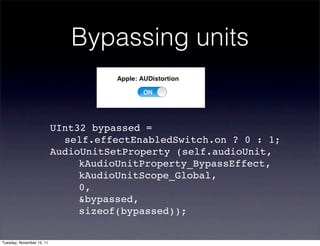
Bypassing units


                           UInt32 bypassed =
                           ! self.effectEnabledSwitch.on ? 0 : 1;
                           AudioUnitSetProperty (self.audioUnit,
                           ! ! kAudioUnitProperty_BypassEffect,
                           ! ! kAudioUnitScope_Global,
                           ! ! 0,
                           ! ! &bypassed,
                           ! ! sizeof(bypassed));

Tuesday, November 15, 11
Recap

               • Audio Units are greatly enhanced in iOS 5

               • Real-time mixing and effects on mic input,
                 pitch-shifted samples, and file playback

               • Best choice for serious audio production


Tuesday, November 15, 11
Resources
               • http://lists.apple.com/mailman/listinfo2/coreaudio-
                 api

               • https://devforums.apple.com/community/ios/
                 graphics/audio

               • Blogs:

                    • Mine: http://www.subfurther.com/blog

                    • Michael Tyson: http://atastypixel.com/blog/


Tuesday, November 15, 11
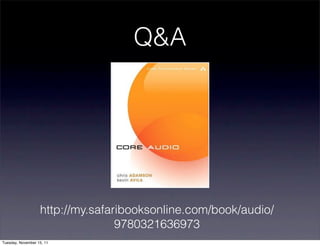
Q&A


                   http://my.safaribooksonline.com/book/audio/
                                  9780321636973
Tuesday, November 15, 11

Core Audio Cranks It Up

  • 1.
    Core Audio CranksIt Up Chris Adamson • @invalidname Voices That Matter: iOS Developer Conference Nov. 13, 2011 • Boston, MA Tuesday, November 15, 11
  • 2.
    What We'll Cover • Core Audio: what it is and why it's there • Audio Units and graphs • Fun with I/O • Special effects • Music with MIDI Tuesday, November 15, 11
  • 3.
    Core Audio • Low-level, low-latency, professional audio processing API, ported from OS X to iPhone OS. • Legendarily difficult: see Mike Ash's "Why Core Audio Is Hard" (Oct. 2006) • Consists of three audio engines and various helpers Tuesday, November 15, 11
  • 4.
    What's in thebox • #import AudioToolbox, possibly also AudioUnit, CoreMIDI • Helper APIs — File I/O, format conversion, stream parsing, MIDI events, sessions • Audio Engine APIs — Audio Units, Audio Queues, OpenAL • Queues and OpenAL implemented atop units Tuesday, November 15, 11
  • 5.
    Audio Units • Process audio in some way: generate, apply affects, mix, hardware I/O, etc. • Arbitrary number of inputs and outputs (usually one each) • Rare case: process a buffer of samples in place • Common case: connect units in a "graph" Tuesday, November 15, 11
  • 6.
    Audio Unit types • I/O: microphone input / headphone output • Music/generators: create sound • Mixers/effects: process sound Tuesday, November 15, 11
  • 7.
  • 8.
    Pull • Audio flows through units via a "pull" metaphor • Typically the I/O unit, but can be an app- created unit • Pull begins with a call to AudioUnitRender() • Last unit pulls audio from upstream unit(s), or from "render callbacks" to application code Tuesday, November 15, 11
  • 9.
    Why pull? • Caller, often an I/O thread, is responsible for knowing when it needs new buffers • Push may seem more sensible, but ends up being burdensome • OpenAL model: poll to see if sources need new buffers and, if so, push them in Tuesday, November 15, 11
  • 10.
    I/O units • Abstraction over audio hardware • AURemoteIO for local use, echo-cancelling AUVoiceProcessingIO for VOIP • Can only have one per graph • Special meaning for buses: 0 is output to headphones/speakers, 1 is input from microphone Tuesday, November 15, 11
  • 11.
  • 12.
  • 13.
    Demo VTM AU Input http://dl.dropbox.com/u/12216224/conferences/vtm11/VTMAUGraphDemo.zip Tuesday, November 15, 11
  • 14.
    Adding IO UnitNode NewAUGraph(&_auGraph); AudioComponentDescription compDesc = {0}; compDesc.componentType = kAudioUnitType_Output; compDesc.componentSubType = ! kAudioUnitSubType_RemoteIO; compDesc.componentManufacturer = ! kAudioUnitManufacturer_Apple; // adds a node with above description to the graph AUNode ioNode; AUGraphAddNode(self.auGraph, &compDesc, &ioNode); A subsequent call to AUGraphNodeInfo() gets an AudioUnit from the AUNode Tuesday, November 15, 11
  • 15.
    Connect nodes and start graph AUGraphConnectNodeInput(_auGraph ioNode, 1, mixerNode, 0); AUGraphInitialize(_auGraph) AUGraphStart(_auGraph);! Tuesday, November 15, 11
  • 16.
    The problem with AUGraphs • Prior to iOS 5, AUGraphs were boring: • No generator units: only input was AURemoteIO (or synthesized audio in a render callback) • Only one effect unit (AUiPodEQ) Tuesday, November 15, 11
  • 17.
    iOS 5 cranksit up • Generators: AUFilePlayer and AUSampler • Effects: Reverb, distortion box, high/low pass filters, high/low shelf filters, dynamics processor, N-band EQ Tuesday, November 15, 11
  • 18.
    AUFilePlayer • Generator unit that produces sound from a file • Prior to this, playing a file in an AUGraph was unduly burdensome • Render callbacks cannot perform blocking calls like file I/O, so you'd read from file in one thread, put samples in a ring buffer, and have callback pull from buffer • We have an OSX example of this in book. Ouch. Tuesday, November 15, 11
  • 19.
    AUFilePlayer properties • kAudioUnitProperty_ScheduledFileIDs - indicates which files to play • kAudioUnitProperty_ScheduledFileRegion - struct describing what portion of file to play • kAudioUnitProperty_ScheduledFilePrime - optionally preload audio frames for performance • kAudioUnitProperty_ScheduleStartTimeStamp - when to start playing (-1 for next audio render cycle) Tuesday, November 15, 11
  • 20.
    Getting some beats Live Edgy Drum Kit 42.aiff Tuesday, November 15, 11
  • 21.
    Mixing • AUMultichannelMixer - Mixes multiple input buses into one output bus Tuesday, November 15, 11
  • 22.
    Demo VTM AU Mix http://dl.dropbox.com/u/12216224/conferences/vtm11/VTMAUGraphDemo.zip Tuesday, November 15, 11
  • 23.
    More fun withmixers • Set volume for an input or output bus with kMultiChannelMixerParam_Volume • This is a parameter, not a property • Also read-only pre-/post- peak/average levels for creating level meters (must be enabled first) Tuesday, November 15, 11
  • 24.
    Also new: MIDI • Core MIDI added in iOS 4.2 • Provides I/O with MIDI hardware, or MIDI- over-WiFi • Hardware access is via Camera Connection Kit and MIDI-to-USB adapter Tuesday, November 15, 11
  • 25.
  • 26.
    MIDI Messages • Channel Voice Messages — Note On, Note Off, After-touch, Pitch wheel • High nybble of status is command, low nybble is channel number • Channel Mode, System Messages • Various extensions to the spec over the years http://www.midi.org/techspecs/midimessages.php Tuesday, November 15, 11
  • 27.
    MIDI hardware oniOS • MIDI adapters must be "MIDI class compliant" (i.e., no drivers) • Dock connector / CCK provides minuscule power, not enough to power some MIDI adapters • Powered adapters generally work • Otherwise check http://www.iosmidi.com/ devices Tuesday, November 15, 11
  • 28.
    MIDI set-up MIDIClientCreate(CFSTR("VTM iOS Demo"), MyMIDINotifyProc, ! ! callbackContext, &client); MIDIInputPortCreate(client, CFSTR("Input port"), ! ! MyMIDIReadProc, callbackContext, &inPort); unsigned long sourceCount = MIDIGetNumberOfSources(); for (int i = 0; i < sourceCount; ++i) { ! MIDIEndpointRef src = MIDIGetSource(i); ! CFStringRef endpointName = NULL; ! MIDIObjectGetStringProperty(src, kMIDIPropertyName, ! ! &endpointName); ! char endpointNameC[255]; ! CFStringGetCString(endpointName, endpointNameC, ! ! 255, kCFStringEncodingUTF8); ! printf(" source %d: %sn", i, endpointNameC); ! MIDIPortConnectSource(inPort, src, NULL); } Tuesday, November 15, 11
  • 29.
    So what dowe do in MyMIDIReadProc? • Prior to iOS 5, there was no API that actually did anything with MIDI events • On OSX, Core Audio defines music units, which play sounds in response to MIDI events • iOS 5 and Lion add the AUSampler Tuesday, November 15, 11
  • 30.
    AUSampler • Music unit that starts with a source clip and pitch-shifts to create different tones • Can use DLS or SoundFont 2 files as source • Can also create your own sample files with AULab Tuesday, November 15, 11
  • 31.
  • 32.
    Orchestral String Section02-cropped.aif Tuesday, November 15, 11
  • 33.
    Orchestral String Section02-cropped.aif Tuesday, November 15, 11
  • 34.
  • 35.
  • 36.
  • 37.
  • 38.
  • 39.
  • 40.
  • 41.
    Loading .aupreset (1/3) NSString *filePath = [[NSBundle mainBundle] ! pathForResource: AU_SAMPLER_PRESET_FILE ! ofType:@"aupreset"]; CFURLRef presetURL = ! (__bridge CFURLRef) [NSURL fileURLWithPath:filePath]; // load preset file into a CFDataRef CFDataRef presetData = NULL; SInt32 errorCode = noErr; Boolean gotPresetData = ! CFURLCreateDataAndPropertiesFromResource( ! ! kCFAllocatorSystemDefault, presetURL, ! ! &presetData, NULL, NULL, &errorCode); Tuesday, November 15, 11
  • 42.
    Loading .aupreset (2/3) // convert this into a property list CFPropertyListFormat presetPlistFormat = {0}; CFErrorRef presetPlistError = NULL; CFPropertyListRef presetPlist = CFPropertyListCreateWithData( ! kCFAllocatorSystemDefault, presetData, ! kCFPropertyListImmutable,&presetPlistFormat, ! &presetPlistError); Tuesday, November 15, 11
  • 43.
    Loading .aupreset (3/3) // set this plist as the // kAudioUnitProperty_ClassInfo on _auSampler if (presetPlist) { ! ! AudioUnitSetProperty( ! ! ! ! self.auSampler, ! ! ! ! kAudioUnitProperty_ClassInfo, ! ! ! ! kAudioUnitScope_Global, ! ! ! ! 0, ! ! ! ! &presetPlist, ! ! ! ! sizeof(presetPlist); } Tuesday, November 15, 11
  • 44.
    Now what? • We have configured Core MIDI to call MyMIDIReadProc on incoming MIDI events • We have configured the AUSampler audio unit with a sampled sound • We need to deliver the MIDI events to the AUSampler unit Tuesday, November 15, 11
  • 45.
  • 46.
  • 47.
    MusicDevice.h • Small API to deliver MIDI events to instrument units • Not in Xcode documentation. Check out the header file • Only 4 functions • MusicDeviceMIDIEvent() sends status, data1, data2 to a MusicDeviceComponent (i.e., an instrument Audio Unit) Tuesday, November 15, 11
  • 48.
    Delivering MIDI event MIDIPacket *packet = (MIDIPacket *)pktlist->packet;! for (int i=0; i < pktlist->numPackets; i++) { ! Byte midiStatus = packet->data[0]; ! Byte midiCommand = midiStatus >> 4; ! // is it a note-on or note-off ! if ((midiCommand == 0x09) || (midiCommand == 0x08)) { ! ! Byte note = packet->data[1] & 0x7F; ! ! Byte velocity = packet->data[2] & 0x7F; ! ! // send to augraph ! ! MusicDeviceMIDIEvent (myVC.auSampler, midiStatus, note, velocity, 0); ! } ! packet = MIDIPacketNext(packet); } Tuesday, November 15, 11
  • 49.
    Demo VTM AU Mix (w/MIDI) http://dl.dropbox.com/u/12216224/conferences/vtm11/VTMAUGraphDemo.zip Tuesday, November 15, 11
  • 50.
    Effects • iOS 5 first version to offer multiple audio effects • Many effects use floating-point samples, rather than ints or fixed-point; requires adjusting the stream formats of units connected to them (or in-line AUConverters) • Adjust with parameters (see AudioUnitParameters.h) Tuesday, November 15, 11
  • 51.
    Two sample effects • Distortion effect - audio "fuzzing" effect, takes no parameters • Low pass filter - Cuts off frequencies above a given frequency Tuesday, November 15, 11
  • 52.
  • 53.
    Configuring AULowPassFilter Float32 lowPassCutoffFrequency = 800.0; AudioUnitSetParameter(_auLowPassFilter, ! ! ! ! ! kLowPassParam_CutoffFrequency, ! ! ! ! ! kAudioUnitScope_Global, ! ! ! ! ! 0, ! ! ! ! ! lowPassCutoffFrequency, ! ! ! ! ! 0); Tuesday, November 15, 11
  • 54.
    Demo VTM AU Effects http://dl.dropbox.com/u/12216224/conferences/vtm11/VTMAUGraphDemo.zip Tuesday, November 15, 11
  • 55.
    Bypassing units UInt32 bypassed = ! self.effectEnabledSwitch.on ? 0 : 1; AudioUnitSetProperty (self.audioUnit, ! ! kAudioUnitProperty_BypassEffect, ! ! kAudioUnitScope_Global, ! ! 0, ! ! &bypassed, ! ! sizeof(bypassed)); Tuesday, November 15, 11
  • 56.
    Recap • Audio Units are greatly enhanced in iOS 5 • Real-time mixing and effects on mic input, pitch-shifted samples, and file playback • Best choice for serious audio production Tuesday, November 15, 11
  • 57.
    Resources • http://lists.apple.com/mailman/listinfo2/coreaudio- api • https://devforums.apple.com/community/ios/ graphics/audio • Blogs: • Mine: http://www.subfurther.com/blog • Michael Tyson: http://atastypixel.com/blog/ Tuesday, November 15, 11
  • 58.
    Q&A http://my.safaribooksonline.com/book/audio/ 9780321636973 Tuesday, November 15, 11