


RESISTORS
CAPACITORS
INDUCTORS
TAIMOOR TAHIR
ABBAS AHMED SIDDIQUE
HASSAN SAEED
IBRAHIM ZAFAR
SYED QASIM RAZA ZAIDI
SAQIB JAVED
CAPACITORS
Introduction
 Building block of electrical/electronic circuits which stores energy is the
linear passive element called capacitor.
 The unit of capacitance is Farad(F)
 Some general prefixes related to capacitors are milli,micro and pico Farad.
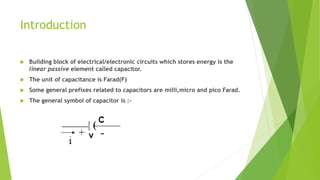
 The general symbol of capacitor is :-
Properties
 The charge accumulated on capacitor is given by :-
Q=CV
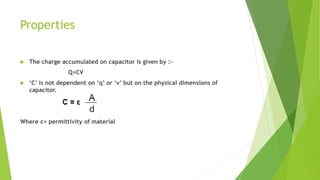
 ‘C’ is not dependent on ‘q’ or ‘v’ but on the physical dimensions of
capacitor.
Where ε= permittivity of material
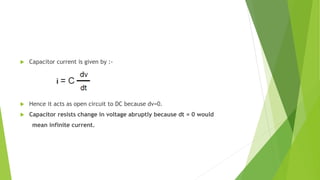
 Capacitor current is given by :-
 Hence it acts as open circuit to DC because dv=0.
 Capacitor resists change in voltage abruptly because dt = 0 would
mean infinite current.
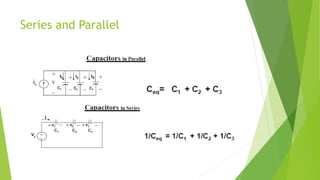
Series and Parallel
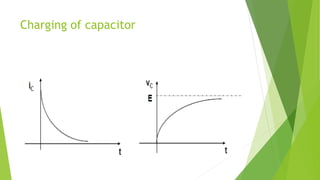
Charging of capacitor
Inductors
Introduction
 An inductor is a coil of wire having magnetic properties.
 Is a passive two terminal electric component which resists
changes in electric current passing through it.
 It consists of a conductor such as a wire, usually wound into a
coil. When a current flows through it, energy is stored
temporarily in a magnetic field in the coil.
 Whenever current passes through a conductor, lines of
magnetic flux are generated around it. This magnetic flux
opposes any change in current due to the induced e.m.f.
 This opposition to the current is known as inductance and the
component producing inductance is known as inductor.
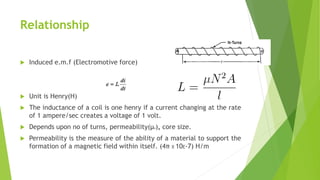
Relationship
 Induced e.m.f (Electromotive force)
 Unit is Henry(H)
 The inductance of a coil is one henry if a current changing at the rate
of 1 ampere/sec creates a voltage of 1 volt.
 Depends upon no of turns, permeability(µo), core size.
 Permeability is the measure of the ability of a material to support the
formation of a magnetic field within itself. (4π X 10E-7) H/m
Ideal and non ideal behaviour
 An "ideal inductor" has inductance, but no resistance or capacitance, and
does not dissipate or radiate energy.
 However real inductors have resistance and parasitic capacitance (due to
the electric field between the turns of wire which are at slightly different
potentials).
 At high frequencies the capacitance begins to affect the inductor's behaviour.
 Inductors with ferromagnetic cores have additional energy losses due
to hysteresis and eddy currents in the core
 At high currents, iron core inductors also show gradual departure from ideal
behaviour due to nonlinearity caused by magnetic saturation of the core.
 An inductor may radiate electromagnetic energy into surrounding space and
circuits, and may absorb electromagnetic emissions from other circuits.
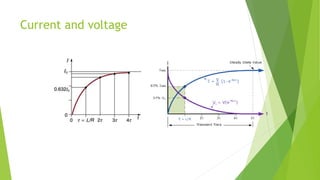
Current and voltage
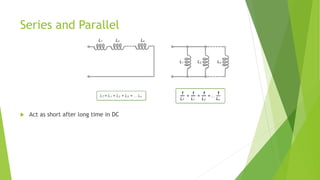
Series and Parallel
 Act as short after long time in DC
Applications
 Transformers
 switched-mode power supplies to produce DC current
 particularly in radio equipment.
 They are used to block the flow of AC current while allowing DC to pass;
inductors designed for this purpose are called chokes.
 They are also used in electronic filters to separate signals of different
frequencies, and in combination with capacitors to make tuned circuits, used
to tune radio and TV receivers.
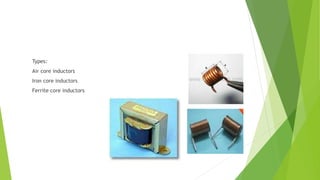
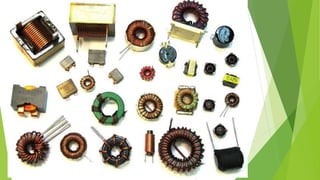
Types:
Air core inductors
Iron core inductors
Ferrite core inductors
PRESENTATION
PRESENTATION

PRESENTATION

  • 1.
    RESISTORS CAPACITORS INDUCTORS TAIMOOR TAHIR ABBAS AHMEDSIDDIQUE HASSAN SAEED IBRAHIM ZAFAR SYED QASIM RAZA ZAIDI SAQIB JAVED
  • 2.
  • 3.
    Introduction  Building blockof electrical/electronic circuits which stores energy is the linear passive element called capacitor.  The unit of capacitance is Farad(F)  Some general prefixes related to capacitors are milli,micro and pico Farad.  The general symbol of capacitor is :-
  • 4.
    Properties  The chargeaccumulated on capacitor is given by :- Q=CV  ‘C’ is not dependent on ‘q’ or ‘v’ but on the physical dimensions of capacitor. Where ε= permittivity of material
  • 5.
     Capacitor currentis given by :-  Hence it acts as open circuit to DC because dv=0.  Capacitor resists change in voltage abruptly because dt = 0 would mean infinite current.
  • 6.
  • 7.
  • 9.
  • 10.
    Introduction  An inductoris a coil of wire having magnetic properties.  Is a passive two terminal electric component which resists changes in electric current passing through it.  It consists of a conductor such as a wire, usually wound into a coil. When a current flows through it, energy is stored temporarily in a magnetic field in the coil.  Whenever current passes through a conductor, lines of magnetic flux are generated around it. This magnetic flux opposes any change in current due to the induced e.m.f.  This opposition to the current is known as inductance and the component producing inductance is known as inductor.
  • 11.
    Relationship  Induced e.m.f(Electromotive force)  Unit is Henry(H)  The inductance of a coil is one henry if a current changing at the rate of 1 ampere/sec creates a voltage of 1 volt.  Depends upon no of turns, permeability(µo), core size.  Permeability is the measure of the ability of a material to support the formation of a magnetic field within itself. (4π X 10E-7) H/m
  • 12.
    Ideal and nonideal behaviour  An "ideal inductor" has inductance, but no resistance or capacitance, and does not dissipate or radiate energy.  However real inductors have resistance and parasitic capacitance (due to the electric field between the turns of wire which are at slightly different potentials).  At high frequencies the capacitance begins to affect the inductor's behaviour.  Inductors with ferromagnetic cores have additional energy losses due to hysteresis and eddy currents in the core  At high currents, iron core inductors also show gradual departure from ideal behaviour due to nonlinearity caused by magnetic saturation of the core.  An inductor may radiate electromagnetic energy into surrounding space and circuits, and may absorb electromagnetic emissions from other circuits.
  • 13.
  • 14.
    Series and Parallel Act as short after long time in DC
  • 15.
    Applications  Transformers  switched-modepower supplies to produce DC current  particularly in radio equipment.  They are used to block the flow of AC current while allowing DC to pass; inductors designed for this purpose are called chokes.  They are also used in electronic filters to separate signals of different frequencies, and in combination with capacitors to make tuned circuits, used to tune radio and TV receivers.
  • 16.
    Types: Air core inductors Ironcore inductors Ferrite core inductors